The Ledger of Whispering Glen: A Gritty Tale of Sovereignty and the Weight of Truth
CHAPTER 1: THE RADIUS OF THE RULER
“Sir, your presence here is becoming a problem for this community.”
Garrett Wolfe didn’t move. He kept his grip on the ceramic mug, the heat of the black coffee seeping into his calloused palms. He stood on his own porch, flannel shirt open to the humid 7:42 a.m. air, watching two men in crisp, khaki polo shirts. They stood on his gravel driveway—gravel he’d laid himself, stone by heavy stone—looking like they’d been precision-molded in a factory that produced middle-management and bad news.
“Problem,” Garrett repeated. His voice was a low rumble, the sound of a cold engine finally catching. “My lawn is mowed to three inches. The trash bins are behind the fence. The dog hasn’t barked since the sun came up.”
The man with the clipboard didn’t look at the lawn. He looked at the closed garage door. Behind that door, the 1987 Sportster sat in pieces, a skeleton of chrome and potential. “Violation 7.4 C,” the man said. His name tag read Prescott, and his eyes stayed fixed on the clipboard as if it were a shield. “Storage of recreational vehicles visible from the street.”
“The door is closed, Prescott.”
“We have reports of a pattern of intent,” the second man said, lifting a digital camera. He didn’t take a photo of the house; he took a photo of the driveway border. “Last Saturday, the door was open for two hours. You were working on the machine. This constitutes a permanent display of non-conforming character.”
Garrett looked past them. Across the street, the lawns of Cedar Brook Crossing were a haunting, uniform green—stiff as plastic, smelling of chemical fertilizer and forced quiet. He saw the white Lexus creep around the corner of Autumn Ridge, its vanity plate CDRBRK1 glinting like a predator’s tooth in the morning sun. Constance Drayhill wasn’t driving; she was patrolling.
“Intent,” Garrett whispered. He felt the familiar weight of a long-haul shift settling into his shoulders—the patience of a man who had spent thirty years watching the white lines of the I-10 blur into infinity. He didn’t argue. He didn’t raise his voice. He simply watched Prescott’s hand tremble slightly as he tore the yellow carbon copy from the pad.
“You have fourteen days to comply,” Prescott said, his voice thinning. “Though Constance—President Drayhill—suggested that for someone of your… background, a more permanent storage solution might be better for everyone’s property value.”
They turned back toward their white golf cart, the tires grinding over Garrett’s gravel with a sound like teeth on bone.
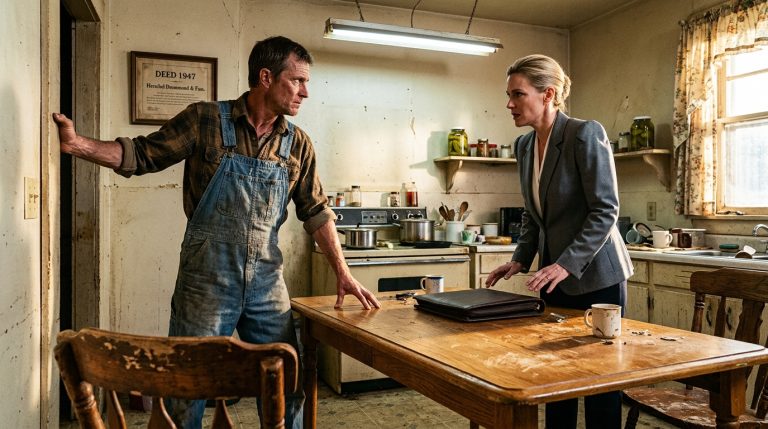
Garrett waited until the electric whine of the cart faded. He walked back inside, past the pegboard wall of organized wrenches, and sat at the kitchen table. He pushed the coffee aside and pulled a fresh notebook from the drawer. He uncapped a black marker.
He didn’t write a letter of protest. He didn’t call a lawyer. Instead, he wrote the date, the time, and the exact coordinates of where the men had stood on his property.
As he reached for the CC&R packet—the “Bible” of Cedar Brook—he noticed a small, white envelope tucked under the edge of his front door mat. He hadn’t seen them drop it. He opened it.
It wasn’t another fine. It was a photograph, taken from a high angle, looking down into his backyard. It showed him sitting by his fire pit the previous night, alone, holding a single wrench. On the back, in a tight, elegant script, were four words:
We see the rust.
CHAPTER 2: THE ANATOMY OF A GHOST
The hum of the desktop computer was a low, mechanical throat-clear in the silence of the spare bedroom. Garrett Wolfe sat rigid, his spine refusing to conform to the ergonomic curves of the office chair. In his world—the world of gear ratios, weigh stations, and thousand-mile horizons—things were either functional or they were broken. There was no middle ground.
On the screen before him sat the PDF file Prescott had emailed over an hour ago. The “official” meeting minutes from July 2019.
Garrett rubbed his eyes, the skin feeling like parched leather. He had requested the adoption history of the approved plant list, expecting a fight, perhaps a flat refusal. Instead, Constance had leaned into the bureaucracy. She had provided the “proof” with a speed that felt like a trap.
He stared at the document. It looked perfect. Crisp headers, clean margins, the names of board members—some long gone, some still haunting the committee—listed in a neat column. It was a record of a vote that supposedly occurred years before he’d ever heard of Cedar Brook Crossing. It was the legal foundation for the $150 fine sitting on his kitchen counter, the one demanding he rip the lantana from the earth.
But Garrett was a man of logs. He had spent thirty-one years recording every gallon of diesel, every minute of idle time, and every stamp on a manifest. He knew that even the most convincing lie left a thermal signature.
He clicked on the file properties.
“Metadata,” he muttered, the word feeling strange and metallic in his mouth. He’d learned the trick from a union rep in Chicago who’d used it to bury a crooked fleet manager.
He navigated to the ‘Properties’ tab, then to ‘Details.’ His eyes tracked the small, gray text.
Date Created: Tuesday, 2:14 PM.
Author: C. Drayhill.
Garrett leaned back, the chair groaning under his weight. Tuesday. Two days ago. The document that was supposed to be a dusty relic of 2019 had been birthed forty-eight hours ago on a Tuesday afternoon.
He looked closer at the font. He wasn’t an artist, but he knew the labels on parts. He knew when a font didn’t match the era. The minutes were typed in a sleek, modern sans-serif that hadn’t even been a system standard five years ago. It was a digital ghost, a manufactured history created to justify a present-day theft.
The friction of it irritated him—the sheer, lazy arrogance of the deception. It was the same feeling as a scale-house operator trying to tell him his load was over when he’d balanced the axles himself. It was a lie that relied on him being too tired or too stupid to check the stamps.
A sharp rap at the front door broke his focus.
Garrett stood, his knees popping like dry kindling. He moved through the house, his boots thudding softly on the hardwood. He didn’t check the peephole. He knew the rhythm of the neighborhood.
When he opened the door, the humidity of the Texas evening rolled in, smelling of scorched grass and the metallic tang of an approaching storm. Standing on his porch was Dara Ossey. She looked smaller than she had the day before, her shoulders hunched under a thin cardigan despite the heat. In her hand, she clutched a crumpled piece of yellow paper.
“They’re taking them, Garrett,” she said. Her voice was thin, brittle as old parchment.
Garrett stepped back, gesturing for her to enter. “Who’s taking what, Dara?”
“The chimes.” She held out the paper. It was a violation notice, near-identical to his own, but the rule cited was different. Violation 8.2: Acoustic Disruption. “I’ve had those wind chimes since I moved in. They were a gift from my grandmother. They aren’t loud. They’re just… they’re just silver.”
Garrett took the paper. He felt the familiar heat rising in his chest—not a flash of anger, but a slow, steady burn. The kind of heat that kept a man awake through a blizzard in the Rockies.
“She has a way,” Dara whispered, looking at the floor. “Constance. She makes it feel like it’s your fault for noticing. Like you’re the one breaking the peace just by having a memory of how things were. I already took them down. I didn’t want the fine. I can’t afford the fine, Garrett.”
Garrett led her to the kitchen. The light from the overhead fixture was harsh, catching the rusted edges of the filing cabinet he’d moved in from the garage.
“You want some coffee?” he asked, though he didn’t wait for an answer. He poured a mug, the liquid dark and unforgiving.
“Dara, look at me.”
She looked up. Her eyes were tired, the eyes of someone who had spent too many hours waving from a driveway, trying to be the “right kind of neighbor” while the world narrowed around her.
“I pulled the files tonight,” Garrett said, his voice flat. He pointed toward the spare room where the computer hummed. “The rules they’re using against us? They didn’t exist until Tuesday. They’re making the map as they go, trying to drive us into a ditch.”
Dara blinked, confusion warring with fear. “But… the paperwork looks real. Everyone else just complies. The man on Whispering Glen, he took down his flagpole last month. He didn’t even fight.”
“That’s what they’re counting on,” Garrett said. He reached for the notebook on the table—the ledger that was quickly becoming a record of a slow-motion war. “They think we’re just retirees and working stiffs who’ll fold because the letterhead is gray. But a log is a log. If the stamps don’t match the route, the whole manifest is a felony.”
He flipped to a clean page and slid it toward her. “Write it down, Dara. Every notice. Every time that golf cart slowed down in front of your house. Every word Prescott said to you. Don’t leave out the details. The weight of the paper matters.”
Dara picked up the pen. Her hand shook for a second, then steadied as she touched the nib to the paper.
Outside, the first heavy drops of rain began to fall, drumming against the roof with a rhythmic, insistent thud. Garrett walked to the window. In the distance, through the blur of the rain, he saw the white Lexus idling at the end of the cul-de-sac. The headlights were off, but the glow of a dashboard screen illuminated a face inside—pale, motionless, watching.
He didn’t close the blinds. He stood there, a silhouette against the kitchen light, letting Constance see exactly where he was.
He stayed there until the Lexus finally pulled away, its tires splashing through the rising water. When he turned back to the table, Dara had filled half a page. But she had stopped writing. She was staring at something near the back of the ledger—a small, Polaroid photo Garrett had clipped to the inside cover.
It was a shot of the Sportster’s chrome tank, reflecting the sunset. But in the corner of the frame, caught in the reflection of the polished metal, was a figure standing at the edge of Garrett’s property. A figure holding a long, wooden stake, marking a spot in the dirt near his driveway.
“That’s from three weeks ago,” Garrett said, his voice dropping an octave.
“That’s not Prescott,” Dara whispered, her finger hovering over the blurred reflection. “That’s Malcolm. Constance’s husband.”
Garrett leaned in. He’d seen the man around, a quiet, shadows-and-dust type who mostly stayed in the background while Constance ran the front. But in the reflection, Malcolm wasn’t just standing. He was measuring. And he wasn’t measuring grass height. He was measuring the distance from the gravel to the neighbor’s property line—right where Garrett’s lantana met the edge of the street.
The realization hit Garrett with the cold precision of a brake failure. The harassment wasn’t just about aesthetics or “patterns of intent.”
They weren’t trying to make him comply. They were trying to see how much of his land they could prove he didn’t own.
Garrett reached for the phone. “Write faster, Dara. We’re going to need more folders.”
CHAPTER 3: THE FRICTION OF THE LINE
The rain hammered the roof of the two-bedroom on Whispering Glen with the relentless cadence of a judge’s gavel. Inside, the air was thick with the scent of wet wool and the bitter, over-extracted tang of the third pot of coffee. Garrett Wolfe sat at the head of the kitchen table, his large, scarred hands framing the ledger like a holy relic.
Dara Ossey’s handwriting was different from his. Where his was the blocky, transactional scrawl of a man who had filled a thousand logbooks, hers was neat, loop-heavy, and increasingly shaky. She sat across from him, her eyes darting toward the window every time a branch scraped against the glass.
“He was right there,” Dara whispered, pointing again at the Polaroid clipped to the inside cover. “Malcolm Drayhill. Why would he be measuring your driveway apron, Garrett? He’s not on the enforcement committee. He doesn’t even wear the polo.”
Garrett didn’t answer immediately. He picked up a steel ruler—a tool from his trucking days used to check tread depth—and felt the cold, rusted surface against his thumb. “Because the polo is for the show,” Garrett said, his voice a low vibration that seemed to compete with the thunder. “Constance handles the noise. Malcolm handles the dirt.”
He leaned over the table, tapping the photo where the blurry reflection of Malcolm Drayhill held the wooden stake. “Look at the angle. He’s not checking for grass height or gravel borders. He’s looking at the easement. In this state, an HOA can’t take your land, but they can make it functionally unusable if they claim it’s part of a ‘common area’ improvement. He was marking the radius of a new fence line.”
Dara’s breath hitched. “A fence? But the CC&Rs say…”
“The CC&Rs say whatever Constance typed up on Tuesday afternoon,” Garrett interrupted, his eyes hardening. “If she can fabricate minutes from 2019, she can fabricate a boundary adjustment from 2017. She’s not just trying to fine us out of the neighborhood, Dara. She’s trying to build a case that the land my garage sits on belongs to the association.”
He stood up, the chair legs scraping against the tile like a sharp intake of breath. He walked to the filing cabinet—the one he’d dragged in from the oil-stained concrete of the garage. It was a heavy, four-drawer beast of industrial steel, its surface pocked with rust and age. He pulled the bottom drawer open.
Inside weren’t just the violation notices. There were blueprints. Original plats for Cedar Brook Crossing he’d pulled from the county records office in a rain-slicked rush before they closed.
“They think I’m just a guy with a loud bike and a bad attitude,” Garrett said, spreading the blueprints over the kitchen table, pinning the corners down with heavy mugs. “They don’t realize I’ve spent thirty years reading maps that would make a surveyor weep. I’ve navigated mountain passes with forty tons of corn syrup behind me when the GPS said the road didn’t exist. I know how to find a line.”
He ran a finger along the lot line of his property. The blue-inked lines were crisp, untouched by the petty revisions of the Drayhill administration.
“Look here,” Garrett said, his voice dropping into a tactical register. “The easement for the Greenway corridor ends exactly three feet from my gravel border. If Malcolm was staking where that photo shows, he was eight inches onto my deeded property. That’s not a violation notice, Dara. That’s trespass with intent to seize.”
Dara leaned in, her face illuminated by the harsh light of the kitchen fixture. “What do we do? If we tell them we know, she’ll just bury it deeper. She’ll find another way to make it look legal.”
“We don’t tell them,” Garrett said. He picked up the marker. “We let them keep building the trap. A bridge that’s built on a rotten foundation looks fine until you put the weight on it. We’re going to be the weight.”
He turned to a fresh page in his notebook. He wrote PRONG ONE: THE DOCUMENTARY FRAUD and underlined it twice.
“I’m going to need more than just your notes, Dara. I need the others. The man with the flagpole. The retired firefighter on the left. Anyone who’s had a letter from the ‘ghost’ signature.”
“Dale?” Dara asked, a small spark of hope flickering in her eyes. “Dale Busby? He’s been quiet lately. I think he’s tired of the fight.”
“Dale isn’t tired,” Garrett corrected. “He’s a firefighter. He knows how to wait for the backdraft. He’s just waiting for someone to open the door.”
As if punctuated by the universe, a sudden, violent crack of lightning split the sky, turning the world outside the window a brilliant, stark white for a fraction of a second. In that strobe-light moment, Garrett saw it again.
The white Lexus wasn’t at the cul-de-sac anymore. It was parked directly in front of his house. The engine was off, but the wipers were at full speed, clearing the glass just enough for the person inside to stare at the flickering light of Garrett’s kitchen.
Garrett didn’t flinch. He picked up his coffee mug, walked to the window, and raised it in a silent, mocking toast.
The Lexus didn’t move for a long minute. Then, the brake lights flared—red as a fresh wound in the darkness—and the car roared to life, its tires spinning in the mud as it accelerated away.
“She’s panicking,” Dara whispered, joining him at the glass.
“No,” Garrett said, his reflection in the dark pane looking older, harder. “She’s not panicking yet. She’s calculating. And that makes her dangerous. She’s realized that the man in 7 Whispering Glen isn’t just a trucker. He’s an auditor.”
He turned back to the blueprints. He noticed something he’d missed in his first scan—a small, handwritten notation in the corner of the original 2019 landscaping contract, tucked into the margin of the county file. It wasn’t a signature. It was a set of initials: M.D.
Garrett felt the cold iron of the situation settle in his gut. The “Drayhill” name wasn’t just on the board. It was on the payroll.
“Dara,” Garrett said, his voice sounding like gravel under a heavy tire. “How much does this neighborhood pay for lawn maintenance every year?”
“I don’t know… the dues are four hundred a month. Why?”
Garrett looked at the initials. “Because I think the reason Constance is so worried about my lantana isn’t because it’s ugly. It’s because if I plant my own garden, I don’t need her husband’s company to mow my lot. And if I don’t need them, I start asking where the rest of that four hundred dollars is going.”
He picked up a phone and dialed a number he’d memorized from a San Antonio union hall years ago.
“Hector? It’s Garrett. I need an electrician. No, not for the house. I need someone who knows how to read a financial ledger like a circuit board. Yeah. Bring the heavy tools. We’ve got a short in the system.”
He hung up and looked at Dara. The fear in her eyes had been replaced by a sharp, rusted resolve.
“Tomorrow morning, we knock on Dale’s door,” Garrett said. “And we tell him the clubhouse is under new management. We just haven’t told the current owners yet.”
He reached out and touched the rusted surface of his filing cabinet. It felt solid. Real. A fortress built of documented truth.
“Go home, Dara. Get some sleep. The storm’s just getting started.”
As she slipped out into the rain, Garrett returned to the computer. He didn’t look at the minutes again. He looked at the bank of security camera feeds he’d quietly installed under the eaves of his garage. The infrared light caught the glint of the wooden stake Malcolm had left behind.
It was still there. Driven deep into the Texas clay.
Garrett watched the screen until the sun began to bleed a gray, bruised light over the horizon. He hadn’t slept. He wouldn’t. Not until the line was restored.
CHAPTER 4: THE WRONG RULE
The sun hadn’t yet broken the horizon, leaving Cedar Brook Crossing trapped in a bruised, violet twilight. Garrett Wolfe stood at the edge of his driveway, his boots crunching rhythmically on the gravel border that had caused so much administrative grief. The morning air was thick with the scent of wet cedar and the cold, metallic tang of dew on iron.
He wasn’t alone. Seven motorcycles sat in a neat, diagonal line along the public asphalt of the street. They didn’t idle; they waited in a heavy, chrome silence. The men of the Iron Meridian didn’t wear the bright khakis of the neighborhood enforcement officers. They wore leather that had been cured by road salt and high-altitude sun, their presence a rusted anchor in a neighborhood of manicured illusions.
“They’re coming,” Hector whispered, leaning against his custom cruiser. He didn’t point. He didn’t need to. The white golf cart was creeping around the bend of Whispering Glen, its electric motor humming like a disturbed hornet.
Garrett watched the cart approach. He felt the weight of the ledger in his mind—sixty-one pages of entries, dates, and metadata anomalies. He wasn’t looking for a fight; he was looking for a signature.
Prescott stopped the cart ten feet away. He didn’t get out this time. He sat behind the wheel, his knuckles white against the plastic, looking at the seven bikers who sat like statues in the dim light. Beside him, a second man—new, younger, with a ruler tucked into his belt—looked ready to bolt.
“Violation 9.2,” Prescott said, his voice cracking. He didn’t look Garrett in the eye. He looked at the clipboard. “Excessive guest vehicles. And 6.1 B… noise disturbance.”
Garrett stepped forward, his shadow stretching long and jagged across the driveway stone. He reached into his flannel pocket and pulled out a folded slip of paper. He didn’t hand it over. He held it so the morning light caught the text.
“You’re falling behind, Prescott,” Garrett said, his voice the dry rattle of a freight train on a desert grade. “You forgot the most important one. The one Constance slipped under my door at midnight.”
He unfolded a third notice. “Violation 14.3. Display of club-related insignia inconsistent with community aesthetic standards.”
The younger officer reached for his own pad, but Garrett didn’t stop.
“I spent my night reading the CC&Rs, Prescott. The real ones. Not the ones typed up on a Tuesday afternoon. Do you know what Section 14, Subsection 3 covers?”
Prescott hesitated, his eyes darting to the motorcycles. “It’s about the… the visual harmony of the facades.”
“No,” Garrett said, his tone dropping into a dangerous, transactional flatline. “Subsection 14.3 covers fence height and material specifications for rear-facing lots. It hasn’t been amended since the day the dirt was broken in 2018. Your president cited me for a rule about a fence because I’m wearing a vest she doesn’t like. In this state, a defective citation isn’t just a mistake. It’s a voided contract.”
Garrett took another step, his presence forcing Prescott to lean back into the cart’s seat.
“You’re measuring the grass with a ruler, but you aren’t measuring the law. And that’s going to be a problem for you when the audit starts.”
“Audit?” the younger man asked, his voice high and thin.
“The money, son,” Hector chimed in from the street, his voice a rusted rasp. “We’re wondering why the community pays forty-seven thousand a year for landscaping when Garrett’s lantana is considered a crime. We’re wondering who ‘M.D.’ is, and why his initials are on the checks.”
Prescott’s face went the color of unbaked dough. He looked at the motorcycles, then at the house next door where Dale Busby was standing on his porch, arms crossed, watching the exchange with the grim patience of a man who had seen buildings fall.
“We’re just doing our jobs,” Prescott stammered. He threw the cart into reverse, the electric whine spiking as he backed away from the line of iron and leather.
Garrett didn’t watch them flee. He turned back to the Iron Meridian. “Hector, you got the gear?”
Hector nodded, reaching into his saddlebag and pulling out a heavy, industrial-grade thermal imager and a roll of blueprints. “Troy’s waiting at the county office for the deed search. If Malcolm was staking that line, he was looking for more than an easement. There’s a pipe under your gravel, Garrett. A main line that isn’t on the public grid.”
Garrett felt the friction of the mystery tighten. He looked down at the gravel, at the spot where the wooden stake had been driven. “Constance isn’t just protecting the ‘aesthetic.’ She’s protecting the infrastructure. If that pipe is where I think it is, she’s been charging the neighborhood for repairs that never happened.”
“Or repairs she’s doing for her own property using HOA funds,” Dale called out, stepping off his porch and walking toward them. He held a manila folder of his own. “I went through my old incident reports from the fire department. Three years ago, we had a pressure leak at the Drayhill house. The HOA board voted the next week to ‘upgrade’ the community irrigation system. The bill was identical to the estimate Malcolm got for his private pool.”
Garrett took the folder from Dale. The grit of the paper felt like the grit of the road—honest, heavy, and revealing. He looked at his neighbors, a vet tech, a firefighter, a bookkeeper, and a pack of road-worn truckers. They weren’t a “club” in the way Constance feared. They were a community that had been forced to learn the anatomy of a lie.
“We have nine weeks until the annual meeting,” Garrett said, his eyes scanning the horizon where the sun was finally bleeding a cold, orange light over the rooftops. “We don’t need to shout. We just need to keep the logs. Every trespass, every defective notice, every penny that doesn’t add up.”
He looked at the Sportster sitting in the garage, its chrome reflecting the birth of the day. It wasn’t just a machine anymore; it was a symbol of the sovereignty he was defending.
“Dale, call Rhonda. Tell her we need the financial disclosures. Not the summaries. The books.”
“She won’t give them up easily,” Dale warned.
Garrett ran a hand over the rusted surface of his workbench as he stepped back into the garage. “She doesn’t have a choice. Texas Property Code Section 209.005. I’m a member of this association, and I’m coming to check the oil.”
As the Iron Meridian began to fire up their engines, the low-frequency thrum shook the very air of Whispering Glen. It wasn’t a “disturbance.” It was a heartbeat.
Garrett sat at his table and opened the notebook to page sixty-two. He wrote the time, the names of the officers, and the exact rule they’d failed to cite correctly.
Then he added a new line at the bottom, one that wasn’t in any manual:
The foundation is cracked. Now we look for the leak.
CHAPTER 5: THE FINANCIAL CRYPT
“Board discretion is not a legal shield, Constance. It’s an admission of debt.”
Garrett Wolfe’s voice was as cold and flat as a steel plate in January. He stood in the narrow hallway of the Cedar Brook Crossing administrative office—a space that smelled of lemon wax and stale panic. Behind him, Rhonda Pickett stood with her arms crossed, her eyes fixed on the heavy oak door that led to the inner sanctum.
Constance Drayhill stood in the doorway, her knuckles white as she gripped the handle. She was dressed for a garden party she would never attend, her pearls shimmering under the flickering fluorescent lights. “Mr. Wolfe, you are being deliberately confrontational. The association’s financial records are sensitive. Releasing them without a formal review by our legal counsel would be a breach of fiduciary duty.”
“Section 209.005,” Rhonda said, her voice cutting through Constance’s polished veneer like a serrated blade. “Every member has the right to inspect and copy books and records. We submitted the request via certified mail ten days ago. The window for ‘discretion’ closed at midnight.”
Garrett stepped forward, invading the six-inch radius of Constance’s curated authority. He could smell the ozone of a failing air conditioner and the sharp, floral scent of her perfume, a fragrance designed to mask the smell of rot. “I spent thirty years sitting in weigh stations, Constance. I know what a doctored manifest looks like. You can open the door now, or we can wait for the Sheriff to help you find the keys.”
The silence in the hallway was brittle. For five years, Constance had ruled this quarter-acre kingdom through the silent implication of power. But Garrett Wolfe didn’t care about implications. He cared about the weight of the load.
Slowly, Constance stepped aside.
The office was small, crowded with filing cabinets that looked like gray sentinels of silence. Garrett didn’t go for the rules or the meeting minutes. He went for the bank statements and the vendor contracts. He pulled a chair to the center of the room and began to lay out the ledger of the neighborhood’s life.
Rhonda sat beside him, her laptop already open, her fingers moving across the keys with the precision of a surgeon. “Start with the landscaping line items, Garrett. Look for the LLC registrations.”
Garrett flipped through the thick, rusted rings of a three-ring binder. The paper felt thin and fragile, the ink slightly faded where it hadn’t been touched in years. He found it on page forty-two: Drayhill Grounds Services LLC. “Forty-seven thousand a year,” Garrett muttered, the numbers tasting like iron in his mouth. “Awarded in June 2020. No competitive bidding. No alternate quotes.”
“Check the registered agent,” Rhonda whispered.
Garrett pulled up the Secretary of State search on his phone. The screen flickered, reflecting the hard lines of his face. “Malcolm Drayhill. Registered at their home address three months before the contract was signed.”
He looked up at Constance, who was standing by the window, staring out at the neat, uniform lawns of the community she had bought and paid for with other people’s money. She didn’t look like a tyrant anymore. She looked like a driver who had just realized their brakes were gone on a six-percent grade.
“You voted on this, Constance,” Garrett said, his voice dropping into a dangerous, rhythmic cadence. “You voted to give your husband forty-seven thousand dollars a year of our money. You didn’t recuse yourself. You didn’t disclose the interest. In Texas, that’s not just a breach of the CC&Rs. That’s self-dealing.”
“The service was exemplary,” Constance snapped, though her voice lacked its usual steel. “The community has never looked better. Property values have increased twelve percent since we took over.”
“Because you measured the grass with a ruler and threatened anyone who didn’t conform,” Garrett countered. “But you weren’t just cutting grass, were you? Rhonda, look at the ‘Infrastructure Reserve’ payments from 2021.”
Rhonda scrolled through the digital files. “Here. Thirty-two thousand dollars for ‘Greenway Irrigation Upgrades.’ Paid to a subcontractor called Apex Pool and Spa.”
Garrett felt the friction of the mystery tighten. “Apex Pool and Spa. Why is an irrigation upgrade being handled by a pool company?”
“Because Malcolm wanted a heated grotto,” Rhonda said, her eyes widening as she cross-referenced a set of private permit filings. “He filed for a pool permit in July 2021. The invoice for the HOA ‘irrigation work’ is dated the same week the concrete was poured at the Drayhill house.”
Garrett stood up, the chair legs scraping against the floor with a sound like a scream. He walked to the window and looked out at the distant rooftops of Whispering Glen. He thought about the unlisted main line under his gravel—the pipe Malcolm had been so desperate to stake.
“It’s not just the pool,” Garrett said, his mind calculating the flow of the fraud. “The main line. The one that runs under my driveway. It’s not on the community map because it shouldn’t be there. They tapped into the shared utility line to fill that pool, didn’t they? They aren’t just stealing the money for the construction; they’re stealing the water to keep it full.”
“You have no proof of that,” Constance said, her face pale as bone.
“I have a thermal imager and a friend with a shovel,” Garrett said. “And I have a recording of you trying to buy my silence on my doorstep. You offered to drop the fines if I dropped the audit. That’s called consciousness of guilt, Constance. And I’m going to make sure every homeowner in this neighborhood hears the playback.”
He began to gather the folders, his hands moving with the deliberate speed of a man securing a load for a long haul. He didn’t take copies; he took the originals. He knew the protocol. He knew that once a ghost is seen, it tries to burn the house down to hide the evidence.
“Where are you going?” Constance asked, her voice reaching a pitch of genuine panic.
“To see a man about a brisket,” Garrett said, not looking back. “And then I’m going to see the Texas HOA Ombudsman. You thought you were dealing with a retiree who just wanted to grow tomatoes. But you forgot one thing about truckers, Constance.”
He paused at the door, the heavy folders tucked under his arm like a weapon.
“We’re used to the long haul. And we never leave a manifest unfinished.”
As they walked out into the bright, blinding Texas sun, Garrett felt the weight of the files—the physical proof of a rusted truth. But as he looked toward his house, he saw something that made his blood run cold.
Prescott’s white golf cart was parked in his driveway. The younger officer wasn’t holding a clipboard. He was holding a sledgehammer, and he was standing directly over the gravel border where the hidden pipe lay buried.
“Hey!” Garrett roared, dropping the folders as he broke into a run.
But he was too late. The hammer swung down with the force of a desperate man, and the sound of shattering PVC echoed through the quiet streets of Cedar Brook Crossing. A geyser of water erupted from the earth, a towering, muddy column that soaked the gravel, the driveway, and the man who had tried so hard to protect the line.
Garrett stopped at the edge of the flood. The water was cold, smelling of minerals and old iron. As he looked at the shattered pipe, he saw something caught in the jagged plastic—a small, waterproof container, wedged into the tap that shouldn’t have existed.
He reached into the mud, his fingers brushing against the rusted edges of the geyser’s throat, and pulled the container free. Inside wasn’t water. Inside was a stack of ledger sheets, wrapped in plastic—handwritten records of every “off-book” payment made to the board for the last four years.
Constance hadn’t just been stealing for a pool. She had been the treasurer for a syndicate of silence.
CHAPTER 6: THE SILENT ADMISSIONS
“Drop it, Prescott. Before you drown in your own desperation.”
The roar of the geyser was a jagged, wet sound that tore through the morning silence of Whispering Glen. Muddy water erupted in a violent plume, drenching Garrett Wolfe’s flannel shirt until it weighed like lead against his skin. Prescott stood frozen, the sledgehammer still gripped in his shaking hands, water cascading off the brim of his khaki HOA cap. The younger officer looked less like an enforcer and more like a man watching his life drain into a ditch.
Garrett didn’t look at the geyser. He didn’t look at his ruined gravel. He looked at the small, waterproof cylinder clutched in his left hand—the black box of Cedar Brook Crossing.
“I… I was told to clear the obstruction,” Prescott stammered, his voice barely audible over the rush of the water. “Emergency maintenance. Violation 3.1. Immediate access for utility integrity.”
“You weren’t clearing an obstruction,” Garrett said, taking a slow, deliberate step through the rising pool of mud. The grit of the Texas earth ground between his boots and the driveway stone. “You were trying to bury the lead. But you hit the main line instead. Malcolm’s tap. The one that’s been filling his pool on our dime for three years.”
From the porch next door, Dale Busby appeared, already dragging a heavy-duty industrial wrench and a length of bypass hose. He didn’t ask questions. He’d spent twenty-eight years running into burning buildings; a ruptured water main was just another Tuesday. On the street, the white Lexus decelerated to a crawl. The window didn’t roll down, but Garrett could feel Constance’s eyes behind the tinted glass, calculating the cost of the disaster.
Garrett ignored the car. He looked at the younger man with the hammer. “Who told you to hit this spot, Prescott? Was it Constance? Or did Malcolm give you the coordinates?”
Prescott didn’t answer. He dropped the sledgehammer into the mud with a dull thud and turned, stumbling back toward the white golf cart. He didn’t drive away; he simply sat there, staring at the geyser, his shoulders heaving.
“Garrett! Help me with the shut-off!” Dale yelled, gesturing toward the street-side meter box.
Garrett moved. He didn’t run; he navigated. Every movement was calculated to keep the waterproof cylinder safe. He knelt in the mud, the cold water soaking into his jeans, and helped Dale heave the rusted iron cover off the meter box. The smell of wet earth and old metal was overpowering. Together, they wrenched the valve closed.
The roar died instantly, replaced by the heavy, rhythmic dripping of water from the eaves of the garage and the squelch of mud settling into the gravel. The silence that followed was heavier than the noise.
“You okay?” Dale asked, wiping a streak of red clay from his forehead.
“I’m fine,” Garrett said. He stood up, his gaze fixing on the white Lexus. The car sat motionless for five seconds, then it accelerated, the tires chirping as it fled toward the Drayhill estate.
“What’s in the tube?” Dale asked, nodding toward Garrett’s hand.
“The truth,” Garrett replied. He walked toward his porch, his boots leaving heavy, red imprints on the concrete. He sat on the top step and unscrewed the cap of the cylinder. Inside were six sheets of legal-grade vellum, wrapped in plastic. They weren’t official HOA documents. They were handwritten ledger sheets—Malcolm Drayhill’s personal “ledger of favors.”
Garrett spread them out on his lap, ignoring the water dripping from his sleeves. It wasn’t just about the pool. It wasn’t even just about the forty-seven thousand dollars. It was a list of “Special Assessments” dating back to 2019—payments made by homeowners who had been threatened with fines, only to have them “resolved” through cash payments that never hit the association’s books.
“He’s been running a protection racket,” Garrett whispered. “Under the guise of aesthetic standards.”
“Look at the names, Garrett,” Dale said, leaning over his shoulder.
Garrett’s finger traced the lines. He saw names he recognized—the man with the flagpole, the young couple three streets over who had quietly sold their house after a “landscaping dispute.” But then he hit a name that made his stomach turn.
Vance Okafor.
The board treasurer. The man who was supposed to be the gatekeeper of the community’s soul. Beside his name was a series of dates and amounts, all marked Settled: Private.
“They didn’t just take the money,” Garrett said, his voice dropping into a dangerous, transactional flatline. “They compromised the board. They didn’t buy loyalty with friendship; they bought it with silence. Vance wasn’t just a witness. He was a client.”
He looked up at his house. The Sportster sat inside the garage, its chrome untouched by the mud, a silent observer to the rot outside. Garrett felt the familiar weight of the long haul. He had the records. He had the physical evidence of the illegal tap. He had the “black box.”
But he knew the anatomy of a cornered predator. Constance wouldn’t go quietly. She had spent five years curating this fortress, and she would burn the village before she surrendered the keys.
“Dale, call Rhonda. Tell her we need the camera footage from the last hour. Every angle of Prescott hitting that pipe.”
“What are you going to do?”
Garrett stood up, the wet flannel clinging to his chest like armor. He looked at the geyser-scarred earth of his driveway. “I’m not going to wait for the annual meeting. If the board is compromised, the meeting is a theater of lies. We need to go directly to the homeowners. Tonight.”
“Constance will call the police for ‘inciting a disturbance,'” Dale warned.
“Let her,” Garrett said. He looked at the waterproof cylinder. “I’ve spent thirty years carrying freight across lines people told me were closed. I’m not stopping now because the road is muddy.”
He walked into his garage and pulled the cover off the Sportster. The burgundy paint caught the dim light of the workbench lamp. He reached for his helmet, his fingers brushing against the cold, polished metal.
“Where are you going?”
“To pick up Hector,” Garrett said. “And the rest of the Meridian. If Constance wants to talk about ‘community aesthetic,’ let’s show her what a real community looks like when it’s been pushed too far.”
He kicked the bike to life. The roar of the engine was deeper, more honest than the roar of the geyser. It shook the walls of the garage, a low-frequency promise of accountability.
As he backed the bike out into the muddy remains of his driveway, he saw a single, white envelope stuck to the windshield of the golf cart Prescott had abandoned. He stopped the bike, leaned over, and snatched it.
Inside was a single slip of paper, no letterhead. Just one sentence in Constance’s tight, elegant script:
You should have taken the bribe, Garrett. Now you’re just a man with a ruined yard and a story no one will believe.
Garrett didn’t crumple it. He tucked it into his pocket. He looked at the geyser hole, then at the street ahead.
“We’ll see about that, Constance,” he whispered into the wind. “The log doesn’t lie.”
He cracked the throttle, the tires throwing up a spray of red mud as he headed for the gates of Cedar Brook Crossing.
CHAPTER 7: THE ANNUAL RECKONING
The low-frequency vibration of thirty-one idling engines wasn’t just a sound; it was a physical weight that pushed against the suburban silence of Cedar Brook Crossing. Garrett Wolfe sat astride the burgundy Sportster, his gloved hands steady on the grips. The mud from the morning’s geyser had dried into a pale, cracked crust on his boots, a rusted patina that marked him as a man who had already stood his ground.
Behind him, the Iron Meridian formed a phalanx of chrome and leather. They didn’t rev their engines. They didn’t shout. They simply occupied the space, a disciplined row of iron-and-oil outcasts parked diagonally along the public asphalt leading to the Millbrook Community Center. The air smelled of cooling rain, cedar, and the sharp, hot scent of exhaust.
“Garrett,” Hector’s voice crackled over the comms. “The Lexus is three cars back. She’s watching the gate.”
Garrett checked his mirror. The white Lexus sat like a ghost in the twilight, its headlights off. Constance was there, a silhouette behind the tinted glass, watching her carefully curated kingdom be invaded by the very people she had tried to label as “non-conforming.”
“Let her watch,” Garrett said, his voice a low gravel rasp. “The road only goes one way now.”
He kicked the bike into gear and led the procession forward. They moved at a walking pace, a slow, deliberate march that turned the heads of neighbors peering through their blinds. Garrett saw Dale Busby standing on his porch, a heavy manila folder tucked under his arm, nodding as the Meridian passed. He saw Dara Ossey waving from her driveway, her face a mask of anxious hope.
The Community Center parking lot was already half-full, but as the bikes rolled in, a sea of neighbors parted. People who had spent years paying “special assessments” and taking down flagpoles stood in small clusters, their faces illuminated by the orange glow of the streetlights. There was a tension in the air, the kind of stillness that precedes a tornado—the weight of thousands of small grievances finally finding a center of gravity.
Garrett parked the Sportster directly in front of the entrance. He dismounted, the leather of his jacket creaking, and pulled the waterproof cylinder from his pocket. It felt heavy, a condensed core of truth that was about to shatter the glass house at the front of the room.
Inside, the fluorescent lights hummed with a clinical, indifferent buzz. Ninety-four chairs had been set up, and every single one was occupied. Neighbors Garrett had never spoken to were lining the walls, their arms crossed, their eyes fixed on the long table at the front where the board sat.
Constance Drayhill was already in her seat. She looked immaculate—not a hair out of place, her HOA polo crisp and white. But as Garrett walked down the center aisle, the sound of his boots on the linoleum echoing like a countdown, he saw her hands. They were flat on the table, pressing down so hard the knuckles were white.
Beside her, Vance Okafor, the treasurer, looked like a man waiting for a blindfold. He wouldn’t meet Garrett’s eye. He kept staring at a spot on the wall just above the exit sign.
“This meeting of the Cedar Brook Crossing Homeowners Association is called to order,” Constance said. Her voice was thin, a wire pulled too tight. “We have a limited agenda tonight. We will begin with the President’s report on community aesthetic investments—”
“Point of order,” a voice boomed from the third row.
It was Troy Fenwick, the retired zoning officer. He stood up with the slow, inexorable grace of a man who had spent his life reading the fine print of the world. “Under Texas Property Code Section 209.0051, a homeowner has the right to be heard on any matter under the board’s consideration. And we’d like to consider the matter of the Drayhill Grounds Services contract.”
A murmur rippled through the room—a low, rising heat.
Constance’s gavel hit the block with a sharp crack. “That contract was reviewed and approved by the board in 2020. It is not on the agenda for tonight.”
“Then let’s talk about the geyser in my yard this morning,” Garrett said. He didn’t stand up; he walked to the front of the room until he was three feet from the board table. He placed the waterproof cylinder on the wood with a dull, hollow thud.
The room went silent. Even the hum of the lights seemed to dim.
“Prescott hit a pipe today, Constance,” Garrett said, his voice a calm, transactional rumble. “He was trying to bury the line. But he hit the tap instead. The one Malcolm installed to fill your grotto with community water. And he hit this.”
Garrett unscrewed the cap. He didn’t pull out the papers yet. He just looked at Vance Okafor.
“Vance,” Garrett said quietly. “Does the name ‘Malcolm’s Ledger’ mean anything to you? Or should I start reading the ‘Settled: Private’ entries for the years 2021 and 2022?”
Vance’s face went the color of ash. He looked at Constance, then at the exits, then at the floor. The silence in the room was absolute. A hundred people were holding their breath, watching the collapse of a five-year illusion.
“Those documents are private property,” Constance hissed, her composure finally fracturing. The ” Cedar Brook Number One” facade was peeling away, revealing a raw, jagged desperation. “They were obtained through trespass and theft. They are inadmissible in any formal proceeding.”
“This isn’t a courtroom, Constance,” Garrett said, leaning over the table. “This is a neighborhood. And these people aren’t ‘inadmissible.’ They’re your neighbors. The ones you’ve been extorting to pay for your husband’s pool and your garden parties.”
He turned to the room, raising his voice so it carried to the back where the Iron Meridian stood like a wall of leather.
“In this tube is a record of every ‘off-book’ payment this board has taken,” Garrett announced. “It’s a map of a racket. And it ends tonight.”
“We call for an immediate vote of no confidence,” Rhonda Pickett shouted from the side of the room, standing up with a stack of papers. “And a demand for a full forensic audit of the last five years of financials.”
“Seconded!” Dale Busby roared.
“Thirded!” a dozen voices joined in, then twenty, then the whole room was a cacophony of dissent.
Constance hammered the gavel repeatedly, a frantic, rhythmic sound that was drowned out by the roar of the community. She looked at Vance, but the treasurer was already standing up, his chair falling backward as he headed for the side door without a word.
Garrett didn’t join the shouting. He stayed fixed on Constance. He watched as the calculation left her eyes, replaced by the cold realization that the long haul was over. The road had run out.
“You think you’ve won, Garrett?” she whispered over the noise, her voice trembling with a venomous heat. “You’ve ruined the values of this community. You’ve brought in… these people. You’ve turned a neighborhood into a war zone.”
“No,” Garrett said, picking up the cylinder. “I just cleared the obstruction. The water’s finally running clear.”
He turned and walked toward the exit. He didn’t need to stay for the vote. He knew the numbers. He’d counted the bikes; he’d counted the signatures; he’d counted the truth.
As he stepped out into the cool October night, he saw the white Lexus still parked by the gate. But the driver’s side door was open. Malcolm Drayhill was standing there, looking at the Community Center, his shoulders slumped, his shadow long and thin under the flickering streetlight.
Garrett didn’t say a word to him. He walked to the Sportster, the heavy leather of his jacket a familiar weight. He kicked the bike to life, the roar of the engine a final, honest period at the end of a long sentence.
He rode out of the parking lot, the Iron Meridian following him in a disciplined, silent line. As he passed his own house, he saw the geyser hole. It was quiet now, a dark scar in the gravel. But the lantana was still there, its orange and yellow petals catching the moonlight, persistent and unbothered by the storm.
He didn’t go home. He rode toward the highway, the white lines beginning to blur into the dark Texas horizon. He had one more stop to make—a certified mail office that stayed open late.
Because a log is only as good as the person who files it.
CHAPTER 8: THE LONG HAUL HOME
“You’re going to need a bigger mailbox, Garrett.”
Dale Busby’s voice was barely a whisper over the low, rhythmic thrum of the Sportster’s idle. The sun was a bruised smear of orange on the November horizon, casting long, jagged shadows across the gravel of Whispering Glen. The geyser hole had been filled—not by the HOA, but by a collective of neighbors with shovels and a sense of pride that Constance Drayhill hadn’t been able to measure with a ruler.
Garrett sat on the bike, his gloved hands resting lightly on the bars. He looked at the house. The garage door was open, but the pegs on the wall were no longer just holding wrenches; they were holding the history of a neighborhood that had decided to wake up.
“They resigned this morning, Dale,” Garrett said. His voice was a low, steady vibration, the sound of a man who had finally reached the end of a very long route. “Vance, Garrison, and the rest. The audit isn’t just a threat anymore. It’s a process.”
Dale leaned against the porch railing, his arms crossed over a chest that had breathed enough smoke to know when the fire was finally out. “And Constance?”
“She’s listing the house,” Garrett replied. He didn’t feel a surge of triumph. He felt a quiet, heavy sense of order—the kind of feeling you get when the manifests are signed, the load is delivered, and the scales in your rearview mirror read zero. “The settlement for the defamation claim is sealed, but I suspect the ‘Cedar Brook Number One’ plate is going to be replaced by something a bit more anonymous.”
He looked down at the bike’s tank. The new paint was a deep, bruised burgundy—the color of a Texas sunset after a storm. It caught the low winter light, throwing back a perfect reflection of the street. There was no more mud. No more red clay. Just the grit of the road and the shine of the iron.
“What now, Garrett? You’ve got the whole street planted with lantana. The Iron Meridian is basically the unofficial security detail. You planning on running for the board?”
Garrett let out a short, dry laugh—the sound of gravel under a heavy tire. “No. I’ve spent my life following routes other people drew on a map. I think I’ll just stick to the garage. Maybe grow some tomatoes that actually taste like something.”
He kicked the bike into gear, the leather of his boots creaking as he found the peg. He didn’t head for the gates. He headed for the highway.
The air was cold enough to see his breath, a sharp, clean sting that reminded him he was alive. He rode through the backroads of Central Texas, passing the frayed edges of the hill country where the cedar grew thick and the fences were made of rusted wire and cedar posts. The engine did exactly what it had been built to do—it carried him forward without needing a reason.
When he returned three hours later, the moon was a sharp sliver of silver in a wide, dark sky. The neighborhood was quiet, but it was a different kind of quiet. It wasn’t the stifled, fearful silence of a curated aesthetic. It was the quiet of people sleeping in homes they finally owned.
He parked the Sportster and sat on the seat for a moment, listening to the metal cool. The ticks and pings of the engine were a familiar language. He looked at the front yard.
The lantana was still there. It was dormant now, the flowers gone, the stems looking like thin, rusted wires against the winter mulch. But he knew the roots were deep. He knew that come spring, the orange and yellow clusters would return, unbothered by lists or “patterns of intent.” They were native to this dirt. They belonged here.
He walked into the garage and reached for the manila folder sitting on the shelf above the filing cabinet. It was labeled DONE in plain black marker. He slid it into the back of the drawer, right behind the folder labeled PROCEDURE.
He didn’t need the “black box” anymore. The ledger of favors had been handed over to the Ombudsman and the county prosecutor. The manifest was complete.
Garrett walked to the kitchen and made a single pot of coffee. The house was still. He sat at the table—the same table where Dara had cried and Rhonda had mapped out the fraud—and looked at the empty notebook.
He picked up the pen and wrote one final entry.
Date: November 12. Time: 21:00. Mileage: 0. Status: Home.
He closed the book and set it aside. Outside, a dog barked at nothing in the distance. Garrett Wolfe didn’t get up to check. He just sat there in the dark, drinking his coffee, listening to the sound of a community breathing on its own.
The road was long, and the price was heavy, but the weight was finally off his shoulders. He was fifty-eight years old, Tulsa-born and highway-raised. And for the first time in his life, he wasn’t just passing through.