The Calculus of Iron and Glass: A Pragmatic Blueprint for Dismantling a Suburban Autocrat
CHAPTER 1: THE WEIGHT OF THE CLIPBOARD
“Section 4.7, Mr. Wills. Commercial vehicles are a visual nuisance.”
The sound came first—the sharp, metallic clack of a spring-loaded clip snapping shut against a board. It was a dry sound, like a bone breaking in a desert. I didn’t look up from the condenser unit I was cleaning. The oily scent of refrigerant and the grit of Indiana dust were familiar; the woman standing at the edge of my driveway was not.
“It’s been there twenty-two minutes, Beverly,” I said, finally wiping my hands on a rag that was more grease than fabric. “I’m unloading the manifold gauges. I’ve got a call-out in Cicero at noon.”
Beverly Croft didn’t move. She stood on the precise line where my sun-bleached asphalt met the cracked sidewalk, her sensible wool coat buttoned to the chin despite the April thaw. She held that clipboard like a shield, or a whetstone.
“The clock doesn’t care about your manifold gauges,” she replied. Her voice had the pinched, nasal quality of a vice-principal who had never quite left the hallway. “The Covenants, Conditions, and Restrictions are quite clear. Four hours is the limit for a commercial vehicle, but the board has discretion when a vehicle is ‘detrimental to the aesthetic uniformity’ of the street. It’s a blight, Garrett. Slate blue and white trim doesn’t go with a rusted diesel van.”
I looked at the van. It was a 2014 Ford, well-maintained but scarred by a decade of Indiana winters. Then I looked at my house. Doreen and I had spent three summers stripping the old cedar and applying that slate blue. It was the color of the sky just before a storm.
“You’ve been timing me,” I stated. It wasn’t a question.
“I’ve been monitoring the health of the neighborhood. Since the election, the board has prioritized consistency.” She stepped forward, the heels of her shoes clicking with a rhythmic, predatory intent. She held out a slip of paper. It was printed on heavy bond, her signature a sharp, aggressive slash of blue ink. “Consider this a formal warning. Next time, the fine is fifty dollars. Per day.”
I took the paper. The texture was expensive, a stark contrast to the way my own skin felt—rough, calloused, and suddenly cold. I looked past her to the top of the hill, where her six-bedroom colonial sat like a fortress overlooking the valley of split-levels and ranch homes.
“Doreen always said you had a good eye for detail, Beverly,” I said quietly.
Beverly’s expression didn’t soften. If anything, the mention of my wife, barely three months gone, made her eyes sharpen. She sensed the opening. The vulnerability of a man alone on a corner lot with a lawn that had missed its last two mows.
“Structure provides comfort in times of chaos, Garrett,” she said, her tone curdling into something that mimicked sympathy but tasted like iron. “A tidy property is a tidy mind. I’d hate to see the standards of Heron Cove slip just because one resident is… distracted.”
She turned on her heel, the clipboard tucked under her arm like a weapon in a holster. I watched her go, my thumb tracing the embossed logo of the HOA. She wasn’t looking for a clean street. She was looking for a crack in the foundation.
I walked toward the porch, the wicker chair creaking as the wind caught it. The wind chimes Doreen had hung—the ones from New Mexico—gave a soft, four-note tinkle. I saw Beverly pause at the end of the block. She didn’t look back, but she tilted her head, her phone coming up in a smooth, practiced motion.
The flash was small, almost invisible in the noon sun, but I felt it like a physical sting. She wasn’t just watching the van anymore. She was photographing the chimes.
CHAPTER 2: THE SOUND OF SURRENDER
The wind chime didn’t go quietly.
I stood on the porch, the slate-blue wood beneath my work boots feeling more like a stage than a sanctuary. The air was thick with the scent of damp earth and the metallic tang of the rusted galvanized roof on my workshop. It was a sensory baseline I usually found grounding, but today, the rhythm was off. Every creak of the wicker chair felt like a witness statement.
I reached up. The chime was heavy—thick, hand-fired clay pipes suspended by weathered leather cords. Doreen’s mother had brought it back from a village outside Santa Fe, swearing the clay was mixed with local river silt. When the wind caught it just right, it didn’t just tinkle; it hummed a low, resonant chord that felt like it was vibrating in your chest.
Now, it felt like a liability.
Beverly’s warning sat in my back pocket, the stiff bond paper poking against my hip. Section 6.4: Audible Nuisance. I hadn’t even known that section existed. Ten years of this chime singing through the Indiana summer, and suddenly it was a “disruption to the collective peace.”
I untied the leather knot. The clay pipes clattered together with a hollow, dry sound—the sound of something breaking that hasn’t quite shattered yet. I didn’t wrap them. I carried them into the house like a wounded animal, laying them across the dining room table where the dust was starting to settle in the places Doreen used to keep clean.
The silence that followed was physical. It had weight. It pressed against the walls, highlighting the empty space on the porch where the hum used to live.
“One french fry, Garrett,” I muttered to the empty room.
I knew the logic. I’d seen it in the HVAC business a thousand times. You don’t fix a pressure leak by closing one valve if the whole line is corroded. You just move the pressure somewhere else. By taking down the chime, I hadn’t bought peace; I’d signaled that I was a man who could be moved. I’d shown Beverly Croft that her clipboard had teeth.
I walked back out to the van. The diesel engine groaned as it turned over, a familiar, gritty vibration that usually signaled the start of a productive day. But as I pulled out of the driveway, I didn’t look at the road. I looked at the corner of the property line.
She was there.
Not Beverly, but the ghost of her presence. A fresh tire track in the soft spring mud near my mailbox. A footprint near the drainage ditch that didn’t match mine. She was measuring. She was documenting the “scruffy” state of a lawn that had been the pride of the block before the hospital visits started taking up all the daylight.
I worked a double shift that day, crawling through a crawlspace in Lebanon that smelled of stagnant water and dead rodents. It was honest work. It was dirty, predictable, and governed by the laws of thermodynamics. If a compressor failed, there was a reason. If a coil froze, you could trace the airflow. There was no malice in a broken furnace.
I got home after dark. The streetlights on Heron Cove Drive were those high-pressure sodium lamps that turned everything a sickly, jaundiced orange. As I pulled the van into the drive—careful to stop exactly where the “commercial vehicle” line ended—I noticed a white flutter pinned to my front door.
I didn’t even turn off the engine. I let the diesel idle, the vibrations rattling the manifold gauges in the back, as I walked up the steps.
It wasn’t a warning. It was a citation.
Violation: Section 8.2. Property Maintenance—Grass Height. Measured at 4.75 inches. Maximum permitted: 4.0 inches. Fine: $50.00.
I looked down at the grass. In the orange light, it looked like a dark, undulating sea. It had rained for three days straight while I was buried in that crawlspace. The earth had done what Indiana earth does in May—it had surged.
I looked at the house across the street. Walt’s place. His porch light was on, casting a long, steady beam across the asphalt. I saw the curtain move. Just a flicker.
Then I looked up the hill.
Beverly’s colonial was dark, except for one window on the second floor. The light was blue-white, the unmistakable glow of a computer monitor. I imagined her there, hovering over a spreadsheet, ticking off the inches, her metal clipboard resting on a mahogany desk like a scepter.
She wasn’t trying to maintain a neighborhood. She was trying to build a case.
I didn’t tear the notice up. I didn’t storm up the hill. I walked into my workshop, the air smelling of oil and old iron. I pulled out a fresh yellow legal pad and a pressurized pen that worked in the cold.
May 14th, I wrote. 7:42 PM. Received citation for grass height. Weather: Recent heavy rainfall. Note: Neighboring property (Lot 14) appears to have similar height but no notice posted.
I sat there for a long time, the fluorescent light humming above me. My hands were stained with grease, the lines of my palms mapped out in black soot. I looked at the rusted edge of my workbench, the metal worn smooth by decades of labor.
This was a different kind of leak. It wouldn’t be fixed with a wrench or a patch of primer. It required archaeology. It required finding the original weld and seeing where the rust had started.
I reached into the back of a drawer and pulled out the thick, plastic-bound folder of the CC&Rs—the “Bible” of Heron Cove that I hadn’t looked at since the closing in 2010. It felt heavy. It felt like a trap.
But as I flipped to Section 7, my eyes caught a phrase I hadn’t noticed before. A small, technical loophole buried in the “Aesthetic Uniformity” clause.
…excepting those modifications of a decorative or artistic nature that do not alter the structural integrity of the dwelling…
I looked at the reflection of the shop light in the grimy window. Decorative. Artistic.
The pressure was building, and I was finally starting to see the pipes.
CHAPTER 3: THE PROSECUTION OF HERON COVE
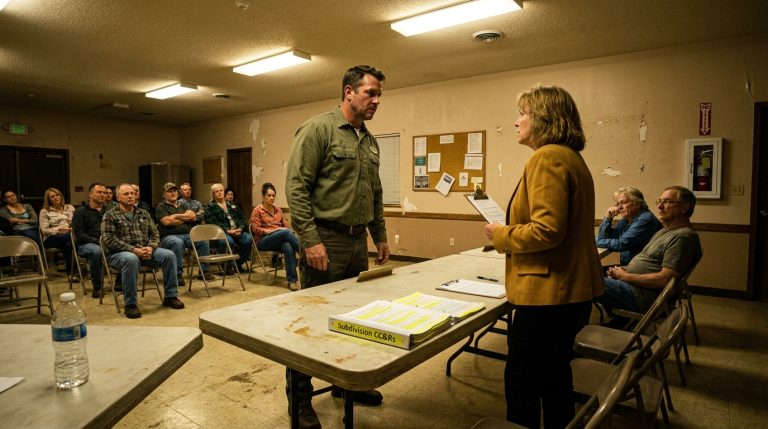
The Heron Cove community room smelled like a tomb for dreams—a cloying mixture of high-traffic carpet cleaner and the scorched, acidic tang of coffee that had been sitting on a burner since the late nineties. The fluorescent lights overhead flickered with a rhythmic hum that vibrated right behind my eyes, a low-voltage headache in the making. I sat in a beige folding chair that groaned under the weight of my work boots, feeling like a giant in a dollhouse designed for small, petty people.
Beverly Croft stood at the front of the room, her silhouette sharp against the projection screen. The blue light from the PowerPoint bathed her in a ghostly, clinical hue. She didn’t look like a neighbor; she looked like a surgeon about to excise a tumor.
“Slide fourteen,” Beverly said. Her voice didn’t need a microphone. It carried the natural resonance of a woman who had spent decades silencing crowded gymnasiums.
The image on the screen jumped. It was a close-up of my house. Not the whole house—just a four-inch patch of window trim on the second floor where the white paint had decided to flake away. In the high-resolution glow, the exposed wood looked like a raw wound. Red arrows, added with the clumsy precision of a digital amateur, pointed at the peeling edges.
“Structural deterioration begins with neglect,” Beverly continued, her laser pointer dancing across my window frame. “Small apertures lead to rot. Rot leads to infestation. Infestation leads to a decline in collective property values. We are only as strong as our weakest link.”
I leaned back, the metal edge of the chair biting into my spine. I looked around the room. There were fourteen people here. Fourteen out of forty. Most of them were staring at their laps, the reflected light from the screen making their faces look pale and complicit. Walt was there, sitting three rows ahead of me, his thick shoulders hunched, his hands clenched into fists on his knees.
“Slide fifteen,” Beverly commanded.
Now it was the driveway. The crack I’d been meaning to seal—a jagged line through the asphalt no wider than a pencil—was magnified until it looked like a canyon. Another red arrow. Another clinical diagnosis.
“This is not merely an aesthetic concern,” she said, the click of her heels echoing as she paced the small linoleum stage. “This is a liability. A trip hazard. If a delivery driver were to twist an ankle on Mr. Wills’ property, the association’s insurance premiums could be impacted. We are, essentially, subsidizing his lack of maintenance.”
It was a masterclass in bureaucratic assassination. She wasn’t calling me a bad man; she was calling me a financial drain. She was framing my grief as a tax on my neighbors. I could feel the heat rising in my neck, a slow-burn anger that tasted like copper. I thought of the wind chimes sitting silent on my dining room table. I thought of the way the porch felt without the hum of the clay.
“I move,” Beverly said, clicking to a slide that displayed a formal resolution in a font so large it felt like a shout, “that the board formally request Mr. Wills address these cited deficiencies within thirty days. Failure to comply will result in a daily fine of one hundred dollars, compounding weekly.”
Deirdre, the secretary—a woman whose entire personality seemed to be an extension of Beverly’s clipboard—seconded the motion before the words were fully out of Beverly’s mouth.
The gavel came down. It wasn’t a wooden mallet; it was a heavy metal paperweight Beverly used for the task. The sound was a flat, final thud that seemed to suck the air out of the room.
I raised my hand. It felt heavy, like I was lifting a piece of cast iron.
“Mr. Wills?” Beverly asked, her tone dripping with a performative patience.
“I’m looking at the slides, Beverly,” I said, my voice sounding gravelly and foreign in the sterile room. “And I’m wondering about Section 6.2 of the CC&Rs. The one you’re using to justify the paint trim.”
Beverly didn’t blink. She adjusted her reading glasses on their chain. “Exterior maintenance standards. It’s quite clear.”
“Does it specify a minimum area threshold?” I asked. I could feel the eyes in the room shifting toward me. “Like, does it say how many square inches of peeling constitute a violation? Because you’re looking at a four-inch patch on a two-story house. From the sidewalk, you’d need a pair of binoculars to see it.”
A beat of silence stretched. Beverly glanced down at her clipboard, her finger tracing a line of text that wasn’t there. For the first time, I saw a flicker of something in her eyes—not fear, but the momentary irritation of a predator whose prey had stepped behind a tree.
“The board will review the specific language and respond in writing,” she said, her voice tightening. “The motion has already passed. We are moving on to the treasury report.”
“I’d like to see that report,” a voice rumbled from the front.
It was Walt. He didn’t stand up, but his presence seemed to fill the room. He turned in his chair, looking not at Beverly, but at the rest of us.
“I’ve lived here since eighty-seven,” Walt said. “Before the pond was dug. Before most of you were born. We’ve had cracks in driveways for thirty years. We’ve had peeling paint. What we haven’t had is a slide show. What we haven’t had is a neighbor being put on trial in the community room.”
“Mr. Gruber, you are out of order,” Beverly snapped.
“I’m a homeowner,” Walt countered, his voice rising like a tide. “And I’m looking at these slides and I’m wondering why I don’t see any photos of the colonial at the top of the hill. The one with the rusted gutters on the east side. The ones that have been overflowing since last October.”
The room went cold. Beverly’s face didn’t change color, but her jaw set into a line so hard it looked like it was made of stone.
“The meeting is adjourned,” she said, her voice a sharp, clinical blade.
As the lights came up, the room remained silent for a long moment. People stood and moved toward the exit with their heads down, avoiding eye contact as they shuffled past me. I felt like I had a contagious disease.
Walt met me at the door. He didn’t say anything at first. He just clapped a hand on my shoulder—a heavy, calloused weight that felt more honest than anything Beverly had said all night.
“She’s digging, Garrett,” Walt whispered, his breath smelling of the venison jerky he’d been chewing. “But she’s not the only one who knows how to use a shovel.”
He handed me a small, crumpled piece of paper. “Patricia Holt. Lot 22. She’s been keeping a folder. Says you should stop by when the sun goes down.”
I walked out into the parking lot. The Indiana spring night was sharp and clear, the stars looking like cold pinpricks in a charcoal sky. I looked up the hill at Beverly’s house. The gutters were indeed rusted—a dark, jagged stain against her pristine white trim. It was a small thing. A technicality.
But as I climbed into the van, the smell of diesel and old tools filling the cabin, I realized the truth. Beverly Croft wasn’t just enforcing rules. She was creating a reality. And if I wanted to survive in it, I couldn’t just follow the map.
I had to change the landscape.
I drove home, the headlights cutting through the dark. When I pulled into my drive, I didn’t go inside. I walked out to the porch and stood where the wind chimes used to be. The silence was still there, but it felt different now. It didn’t feel like an absence.
It felt like a fuse.
CHAPTER 4: THE ARCHAEOLOGY OF SPITE
The diner on Route 9 smelled of scorched butter and the kind of industrial-strength floor cleaner that never quite wins the war against Indiana mud. It was a place of low stakes and high grease, which made it the perfect site for an excavation.
Terrence Okafor sat across from me, his charcoal suit jacket draped over the back of the vinyl booth like a discarded skin. He was methodically dismantling a patty melt with a knife and fork, a precision that matched the way he looked at a contract. Between us sat the “Bible”—the Heron Cove CC&Rs—and a growing stack of meeting minutes I’d spent forty-eight hours haunting the HOA’s neglected digital archives to find.
“It’s not in the prose, Garrett,” Terrence said, pointing a fry at a dense paragraph of legalese. “The prose is just the camouflage. You have to look at the math.”
I took a sip of coffee. It was lukewarm and tasted like it had been filtered through a copper pipe. “I’m an HVAC guy, Terrence. I live for the math. If the pressure doesn’t match the volume, you’ve got a leak. Right now, Beverly’s whole operation feels like a pressurized system with no relief valve.”
Terrence slid a yellow legal pad toward me. He had drawn a timeline in sharp, black ink. “She was elected in April 2021. The emergency assessment for the retention pond happened in late 2019. Twelve hundred dollars per household. Every resident on Heron Cove Drive paid up because the city threatened a lien on the whole development if the drainage wasn’t fixed.”
“I remember writing the check,” I said. “Doreen was the one who mailed it. She hated that check. Said it was money for a hole in the ground we never looked at.”
“Exactly. Everyone wrote the check. Except, apparently, the woman currently running the board.” Terrence tapped a photocopy of a 2020 ledger. “The year before she took the presidency, Beverly Croft had an outstanding balance. Twelve hundred dollars. Marked ‘Delinquent’ in the February minutes.”
I stared at the name. Beverly Croft. The woman who had measured my grass to the quarter-inch was a common debtor to the very organization she now led. The irony was a physical weight in my chest.
“Section 2.3,” I recited, the words burned into my memory from my late-night workshop sessions. “No member with an outstanding assessment balance shall be eligible for election to the Board of Directors.”
“That’s the hook,” Terrence whispered, leaning in. “If she was delinquent when she took the gavel, her presidency is a legal fiction. Every fine she’s levied, every citation she’s signed, every ’emergency’ meeting she’s chaired… it’s all built on sand. It’s selective enforcement by a person who isn’t even legally entitled to enforce.”
I leaned back, the vinyl of the booth sticking to my work shirt. “Why hasn’t anyone seen this?”
“Because people don’t look at ledgers when they’re grieving or busy or tired. They see the letterhead and the dollar sign and they pay the fine to make the headache go away.” Terrence sighed, checking his watch. “But Garrett, this is Layer One. It’s a violation of the bylaws, sure. But it doesn’t explain the why. Why is she so aggressive now? Why go after your wind chimes and your driveway?”
“Because she’s a predator,” I said, but the words felt hollow even as I spoke them. “She smelled a weak link.”
“Maybe. Or maybe she’s protecting something bigger.”
The diner’s bell chimed as the door swung open. Walt Gruber walked in, his linebacker frame filling the doorway. He looked around, spotted us, and marched over with a manila folder tucked under one arm. He didn’t sit. He just dropped the folder onto the table next to Terrence’s patty melt.
“Patricia Holt says hello,” Walt grunted. “She also says the library has a better memory than the HOA website.”
I opened the folder. Inside were printed copies of the 2019 financial reserves. I saw the numbers highlighted in yellow. The infrastructure fund was supposed to hold a minimum of forty thousand dollars—a mandatory “rust fund” for the community’s shared pipes, lights, and pavement.
My finger traced the bottom line. Current Balance: $11,200.
I looked at Terrence. His professional mask slipped for a second, his eyes widening as he crunched the numbers in his head.
“Thirty thousand dollars,” I muttered. “Gone.”
“Not gone,” Walt corrected, his voice like gravel in a tumbler. “Diverted. Beverly was the treasurer before she was the president. She’s been moving the pressure around for three years, Garrett. Those citations she’s giving you? Those aren’t about property values. They’re about revenue. She’s trying to fill a hole in the books before the annual audit hits in July.”
The realization hit me like a cold front. This wasn’t just a power trip. This was a survival strategy. Beverly Croft was a captain screaming about a smudge on the deck while she was secretly stripping the copper from the engine room to keep the ship from sinking.
“I’m the distraction,” I said, the grit of the diner coffee finally settling in my stomach. “She picks a fight with the most boring guy on the street, turns it into a slide show, and everyone is too busy arguing about my grass height to ask why the reserve fund is empty.”
“It’s a false bottom,” Terrence said, his lawyer’s brain already spinning. “She’s using the bylaws as a weapon to cover a fiscal crime. But if we pull the delinquent assessment card now, she’ll just pay the twelve hundred and call it an oversight. We need to wait.”
“Wait for what?” Walt asked.
“For the quarterly meeting,” Terrence said. “We don’t just show her the rust. We show her the whole collapsed pipe. But in the meantime, Garrett, you need to keep her eyes on the deck. Give her something so loud and so visible that she can’t help but stare at it.”
I thought about the workshop. I thought about the industrial surplus auction I’d seen the night before—eight convex carnival mirrors, liquidated from a bankrupt funhouse in Ohio.
“I can do loud,” I said. “And I can do visible.”
“Just keep it within Section 7.1,” Terrence warned. “Decorative and artistic.”
I stood up, the chair scraping against the floor. I looked at the folder, at the thirty-thousand-dollar gap in the community’s soul. Beverly thought she was the only one who knew how to manage a system under pressure. She thought I was just a component to be replaced.
But a system is only as strong as its connections. And out here, on the edge of Clearfield, the connections were starting to hum.
“I need to go to Ohio,” I said to Walt.
“What’s in Ohio?”
“The mirrors,” I replied. “I’m going to make sure that the next time Beverly Croft looks at my house, she sees exactly what she’s been looking for.”
I walked out into the sharp Indiana wind. The sun was setting, casting long, rusted shadows across the fields. For the first time in months, the silence of the porch didn’t feel like a void. It felt like a blueprint.
I was the Sovereign Protector of Lot 14. And the defense was about to get very, very bright.
CHAPTER 5: THE REFLECTION TRAP
The industrial surplus yard in Ohio had smelled of wet rust and the metallic tang of ozone. It was a graveyard for the gargantuan and the whimsical—bankrupt carnival rides and skeletal rollercoasters that had once promised joy, now only promising tetanus. But the mirrors were solid. Eight convex panels, silvered glass encased in pitted steel frames, heavy enough to require a two-man lift and a pallet jack.
Now, those panels were leaning against the siding of my slate-blue porch, catching the dying Indiana light.
“You’re sure about the angle?” Doug Phelps asked, wiping a smudge of grease onto his denim overalls. He was holding a heavy-duty impact driver, the tool’s shadow stretching long across the floorboards. “If we pitch them too far down, you’re just going to be looking at your own boots.”
“I don’t want to see my boots, Doug,” I said, my voice tight with the focus of a man calibrated to thousandths of an inch. “I want her to see herself. Every time she stops on that sidewalk to take a picture, I want forty versions of Beverly Croft staring back at her, squat and distorted. I want to make it physically impossible for her to get a clean shot of this house.”
I picked up an adjustable mounting bracket I’d fabricated in the shop. It was over-engineered, a hybrid of HVAC duct hangers and heavy-duty gate hinges. I’d spent six hours at the bench grinding the edges, the scent of hot iron filling my lungs until my spit tasted like copper.
“Section 7.1,” I muttered, more to myself than to Doug. “Decorative modifications. Nothing structural. Just art.”
“It’s the ugliest art I’ve ever seen,” Doug grinned, the drill screaming as he drove a three-inch lag screw into the header of the porch ceiling. The vibration traveled through the wood, through the soles of my boots, a low-frequency hum of defiance. “But it’s beautiful in its own way. Like a middle finger made of silver.”
We worked until the sun was a bruised purple smear over the cornfields. The process was mechanical, rhythmic. Lift the glass. Align the bracket. Tighten the bolts. The mirrors were heavy, their surfaces cold and unyielding against my palms. Every time I caught my own reflection, it was warped—my face stretched into a wide, grotesque mask, my shoulders looking three feet broad. It was disorienting. It was a funhouse.
I thought of the thirty-thousand-dollar gap Walt had shown me. I thought of the way Beverly had stood in that community room, projecting stability while the foundation was literally being sold for parts. She wasn’t just a vice-principal with a clipboard anymore; she was a pressure vessel with a hairline fracture.
“Last one,” Doug grunted, hoisting the final vertical mirror—the one that made you look seven feet tall and thin as a wire. We bolted it right next to the front door, flanking the space where Doreen’s New Mexico chimes used to hang.
The silence without those chimes was still there, but the mirrors filled it with a frantic, shifting energy.
“Step back,” I told him. “Let’s see the vantage point.”
We walked down the steps, past the scruffy lawn—now mowed to a precise 3.9 inches—and stood on the public sidewalk. I looked at my house, and for a second, I felt a jolt of genuine vertigo.
The porch was gone. In its place was a kaleidoscope of the street, the trees, and the sky, all bent and multiplied. When I moved, my reflection danced across eight different planes at once. If you tried to point a camera at the peeling paint Beverly loved so much, the sensor would be flooded with glare and refracted images. It was a visual scrambler made of industrial scrap.
“Garrett,” Doug said, his voice dropping an octave. “Look up the hill.”
I didn’t need to look to know who it was. The sound of the shoes was enough—the sharp, transactional clack of heels on asphalt.
Beverly was walking her usual route, the metal clipboard tucked under her arm like a ceremonial mace. She was fifty yards away, her phone already in her hand. She was a creature of habit, a predator that followed the same game trail every morning and every evening.
She stopped at the edge of my property line. The blue light from her phone screen illuminated her face, which was set in its customary mask of authoritative concern.
She raised the phone.
I stood perfectly still on the sidewalk, my hands shoved deep into the pockets of my work jacket. I felt the cold Indiana wind bite at my neck.
In the mirrors, I saw her stop. Her reflection hit the convex corner panel first. She looked like a round, silver marble. Then she hit the center flats. Her image shattered across the frames. She lowered the phone, her brow furrowed. She took a step to the left, trying to find an angle, a gap in the glass.
Each time she moved, the mirrors threw a different version of her back. She looked at her phone, then at the porch, then at her phone again.
“Evening, Beverly,” I called out. My voice was calm, the voice I used when explaining a complex repair to a panicked homeowner. “Just doing some spring decorating. Section 7.1, you know. Aesthetic modifications.”
She didn’t answer. She couldn’t. To speak would be to admit she was looking, and she never admitted to looking. She just documented.
She took one more photograph—a desperate, angled shot—and then she turned. Her walk was faster this time. The rhythmic click of her heels was erratic, a mechanical failure in her gait.
“She looks rattled,” Doug whispered.
“No,” I said, watching her retreat up the hill toward her Colonial fortress. “She looks like she’s recalculating. And a recalculated predator is twice as dangerous.”
I looked at the mirrors one last time before heading inside. In the tall, skinny one by the door, I saw a version of myself that looked like a ghost—thin, stretched, and barely there.
I thought about the manila folder on my kitchen table. Layer One was exposed. We knew she was a debtor. We knew she was a legal fraud. But the thirty thousand dollars… that was the real leak. And as I turned the key in the lock, the sound echoing in the empty house, I knew that the mirrors weren’t the end of the game.
They were just the flash-bang. The real work was still happening in the shadows of the ledger.
As I walked through the dark living room, I noticed something on the floor. A small, white envelope had been slid under the door while Doug and I were at the sidewalk.
No stamps. No return address. Just my name written in a cramped, shaky hand.
I opened it. Inside was a single photograph, blurred and grainy. It wasn’t of my house.
It was a picture of Doreen, taken through the hospital window two weeks before she died.
My heart didn’t race. It slowed. It went cold and heavy, like a block of ice in a stagnant pond. Beverly hadn’t just been documenting my property. She had been documenting my life.
I walked back to the workshop, the photograph clutched in my grease-stained hand. I sat at the bench and picked up the drill.
The defense of Lot 14 was no longer about property values. It was about the cost of a memory. And I was prepared to pay in full.
CHAPTER 6: THE WEAPONIZATION OF GHOSTS
The photograph felt colder than the steel frames of the funhouse mirrors. It was a standard four-by-six print, the kind you’d get from a drugstore kiosk, but the image it held was a jagged piece of glass in my gut. It was Doreen. She was in the hospice wing, the afternoon sun cutting a brutal, clinical line across her pillow. Her eyes were closed, her face thinned to the bone by the cancer, but her hand was resting on the windowsill—right where a small, clay New Mexico chime had been tied to the handle.
I didn’t shake. I didn’t yell. I sat on the stool in my workshop, the fluorescent light above me flickering with a dying, rhythmic hum. I smelled the ozone of the drill I’d just put down and the stale, earthy scent of the garden dirt still under my fingernails.
Beverly Croft hadn’t just been measuring my grass. She’d been standing outside a medical facility, long before she ever had the title of President, documenting the slow expiration of my life. This wasn’t about property values. This was a ledger of leverage she’d been keeping in reserve, waiting for the moment I stopped being “the boring neighbor” and started being an obstacle.
The “support” she’d been offering the neighbors—the phone calls expressing concern about my “mental state”—weren’t acts of community. They were the opening salvos of a campaign to have me declared a nuisance, not just legally, but psychologically. If she could paint me as a grieving man lost in a breakdown, the mirrors wouldn’t be seen as a clever legal loophole. They’d be seen as the symptoms of a man who needed to be removed for his own good.
I turned the photo over. No writing. Just a faint smudge of blue ink on the corner—the same blue ink she used to sign the citations.
“Calculated,” I whispered to the empty shop. “Everything is a chess move.”
I stood up and walked to the wall where I kept my service logs. I pulled the file for the Heron Cove HVAC systems—the shared units for the community room and the pool house. I’d maintained them for a decade, mostly for free, because that’s what neighbors do. I knew every valve, every rusted screw, and every failing capacitor in this development.
If Beverly wanted to play with the weight of ghosts, I would show her the weight of infrastructure.
The door to the workshop creaked open. Walt stood there, his large frame silhouetted against the jaundice-yellow streetlights. He saw the photo in my hand. He didn’t ask to see it. He saw the look on my face and stepped inside, closing the door with a soft, final click.
“She’s calling the police, Garrett,” Walt said, his voice a low rumble. “Not for the mirrors. She’s reporting a ‘wellness concern.’ She told Deirdre that you’ve been seen talking to the mirrors and that you’ve started ‘hallucinating’ about your wife.”
“She’s got a photo, Walt,” I said, sliding the picture across the workbench.
Walt looked at it. His jaw tightened so hard I heard the bone pop. “That woman is a vulture. She’s trying to build a narrative where you’re a danger to yourself so she can get a court order to clear the porch. If she clears the porch, she clears the mirrors. If she clears the mirrors, she can keep hiding the fact that she’s been stripping the reserve fund to pay for her own lifestyle.”
“Terrence said we need to wait for the meeting,” I said, my voice flat, professional. “But I’m not waiting for her to pathologize my grief.”
“What are you doing?”
“I’m checking the pressure,” I said. I picked up my manifold gauges and a heavy-duty bolt cutter. “Beverly thinks power comes from a clipboard. But in Indiana, power comes from the pipes. If the community room AC fails tomorrow, they’ll have to call an emergency repair. And since I’m the only contractor within twenty miles who touches those old units on a weekend…”
“You’re going to force a meeting,” Walt realized.
“I’m going to force an inspection,” I corrected. “Patricia has the petition. Terrence has the legal standing. But the Attorney General’s office won’t move fast enough to stop a wellness check. I need everyone in that community room when it’s ninety degrees and the air is stagnant. I want them to feel the heat. I want them to feel exactly how much she’s been neglecting the things that actually matter.”
I walked out to the van. The diesel engine hummed, a steady, vibrating heart in the dark. As I pulled out, I saw the mirrors on the porch catch the reflection of the streetlamps. They didn’t look like funhouse toys anymore. They looked like armor.
I drove to the community room. It was nearly midnight. The parking lot was empty, the shadows of the oaks long and skeletal. I didn’t break in. I had the keys—the same ones I’d used for ten years to keep the pipes from freezing in the winter.
Inside, the smell of carpet cleaner was overwhelming. I went straight to the mechanical closet. The unit was an old Carrier, a rusted beast that breathed like an exhausted runner. I didn’t sabotage it. I didn’t have to. I just adjusted the tension on the blower belt and bypassed the secondary stage of the cooling coil. It would run, but it wouldn’t cool. It would just stir the hot, stale air until the room felt like a greenhouse.
Then, I did the one thing Terrence hadn’t thought of.
I opened the service log tucked into the side of the unit. Inside were receipts for “Emergency Repairs” signed by Beverly Croft over the last three years. Totaling nearly nine thousand dollars. Repairs I knew for a fact had never happened, because I was the one who had been doing the work for free.
She wasn’t just hiding a deficit. She was creating fake invoices to siphon the last of the reserve fund into her own pockets.
I took photos of every page. The blue ink of her signature looked like a series of small, jagged scars on the paper.
As I walked back to the van, I felt the first drops of a summer rain—warm, heavy, and smelling of ozone. I looked up the hill. Beverly’s house was a fortress of white siding and dark windows. She thought she had the photograph that would break me. She thought my grief was a handle she could turn.
But she’d forgotten that a Sovereign Protector doesn’t just guard the walls. He knows how to flood the basement.
I drove home and sat on my porch, surrounded by the warped reflections of the rain. In the convex mirror, I saw the distorted image of my own face—calm, focused, and utterly devoid of the “instability” she was trying to sell.
The heat was coming. And when the community room finally reached its boiling point, I’d be the only one with the tools to fix it.
I looked at the blurred photo of Doreen one last time before tucking it into my logbook.
“Twenty-two minutes, Beverly,” I whispered into the dark. “That’s how long it takes for a room this size to become unbearable.”
CHAPTER 7: THE BOILING POINT
The Heron Cove community room was an oven. I had tuned the blower belt to a desperate whine, ensuring that while the motor screamed with effort, the actual cooling was nonexistent. By 7:05 PM, the sixty residents crammed into a space designed for thirty were radiating a collective, humid heat that turned the air into a thick soup of lavender perfume and cheap laundry detergent.
I sat in the back row, my back against the brick wall. The bricks were cool, but the air in front of me shimmered. I watched the beads of sweat track down the back of Demetri Sable’s neck. I watched Patricia Holt fanning herself with a manila folder, her face a mask of iron-willed librarian composure.
At the front of the room, Beverly Croft was disintegrating.
She was wearing a dark blazer, a garment meant to project authority, but now it was a sponge for her own panic. Her glasses were sliding down the bridge of her nose, and her hair, usually a frozen wave of silver, was beginning to wilt. She clutched her metal clipboard like a life raft, but the paper was curling in the humidity.
Beside her sat a man in a crisp charcoal suit who seemed utterly unaffected by the temperature. He was the observer from the Indiana Attorney General’s office—a quiet, predatory presence Terrence had summoned with a single, well-timed phone call. He hadn’t said a word. He just watched Beverly with the steady, unblinking gaze of an actuary looking at a rounding error.
“The… the minutes,” Beverly stammered, her voice thin and reedy. “We need to approve the minutes from the… the March session.”
“Sit down, Beverly,” Walt’s voice rumbled from the front row. It wasn’t a shout. It was the sound of a rockslide. He didn’t stand up, but his bulk seemed to displace the very air in the room. “It’s ninety-two degrees in here. We aren’t talking about minutes. We’re talking about why the reserve fund is empty and why my neighbor’s dead wife is being used as a citation tool.”
The room went from a simmer to a flash-boil. A woman I didn’t recognize—Roslyn, from the south end—stood up, her voice trembling. “You told me my father’s ramp was an eyesore. You fined me until I had to move him. He died in a facility that smelled like bleach, Beverly. All because of a ramp that matched the siding.”
Beverly’s eyes darted toward the AG observer. “That was… a board decision. For the sake of uniformity—”
“I was on the board then,” Deirdre squeaked, her face pale. She looked at the AG man, then at the crowd. The fear of prison was finally outweighing the fear of Beverly. “I never saw a vote on the ramp. Beverly just… she handed me the notice and told me to file it. She said it was an executive order.”
I stood up. The movement was slow, deliberate. I felt every eye in the room pivot toward me. I wasn’t the “boring neighbor” anymore. I was the man with the mirrors. I was the man who knew the pipes.
“I spent last night in the mechanical closet of this building,” I said. My voice was low, carrying through the stagnant air with the weight of a heavy wrench. “I was checking the service log. The one that says you paid nine thousand dollars in ‘Emergency Repairs’ to the HVAC system over the last three years. Repairs to a unit I’ve been maintaining for free.”
I held up my phone, the screen glowing with the high-resolution photos of the fake invoices. “Your signature is on every one of them, Beverly. Blue ink. Sharp edges. Just like the citations.”
The AG observer finally moved. He reached out and took a pen from his breast pocket, clicking it with a sound like a gunshot. He leaned over and whispered something to Beverly.
She didn’t answer. She just stared at the table, her hands trembling so hard the clipboard rattled against the wood.
“Section 2.3,” Patricia Holt said, standing up beside Walt. She opened her folder and pulled out the 2019 assessment record. “A member with an outstanding balance is disqualified from the board. You owed twelve hundred dollars when you took the gavel, Beverly. You still owe it. Your entire presidency has been a breach of fiduciary duty.”
The room erupted. It wasn’t a riot; it was a reckoning. People were standing, shouting, pointing. The years of petty harassments, the measured grass, the commercial vehicle warnings—it all coalesced into a single, white-hot point of resentment.
Beverly looked up then. She didn’t look at the crowd. She looked at me. Through the humid haze, across the rows of angry neighbors, her eyes found mine. There was no apology in them. There was only a jagged, rusted hate. She reached into her blazer and pulled out the photograph—the one of Doreen in the hospital.
She didn’t show it to the room. She just held it up for me to see, her fingers crushing the edges of the print. It was her last piece of leverage, her final attempt to remind me that she still held the ghosts.
“The meeting…” Beverly gasped, her voice cracking, “…is continued. Emotions are… too high.”
“No,” the AG observer said, his first words of the night cutting through the chaos like a cold front. “The meeting will proceed. And I suggest, Mrs. Croft, that you remain seated. I have several questions regarding the diversion of the infrastructure reserves that won’t wait for a later date.”
Walt stood up then, his huge shadow falling over Beverly’s table. “Sit down,” he repeated.
She sat. The dignity she had worn like a suit of armor was gone, leaving only a tired, frightened woman in a sweat-stained blazer.
I sat back down, the metal chair feeling like a throne. I looked at the photograph in her hand. From this distance, it was just a blur of color. It didn’t have power over me anymore. The mirrors had done their job—they hadn’t just distorted her view of my house; they had forced her to look at herself until the image finally shattered.
But as I watched the AG observer begin to lay out the ledger of her crimes, I felt a sudden, sharp chill that had nothing to do with the temperature.
Layer One was wide open. The delinquency, the fake invoices, the ramp—it was all there. But as the AG man turned to a page in his own binder, he frowned.
“Mrs. Croft,” the observer asked, “where is the missing thirty thousand dollars from the 2021 asphalt fund? The records show a transfer to an offshore holding company called ‘Heron Legacy LLC.’ That isn’t an HOA account.”
Beverly’s head snapped up. For a second, the panic vanished, replaced by a look of genuine, confusing shock. “I… I don’t know what that is. I only handled the internal repairs. The asphalt fund was… it was managed by the developer’s legacy trust.”
The room went silent. Even the AG man looked surprised.
I looked at Terrence, who was sitting near the front. He caught my eye and gave a subtle, worried shake of his head.
The hole in the books was deeper than Beverly. She had been stealing the scraps, the nine-thousand-dollar “emergency” fees. But the thirty thousand—the core truth of why the neighborhood was rotting from the inside out—belonged to someone else. Someone who was still in the shadows.
I leaned back against the brick wall. The victory I had planned felt suddenly like a false floor. We had dismantled the vice-principal. But we hadn’t even found the principal yet.
“The heat,” I whispered, the word lost in the renewed shouting of the neighbors. “It’s not just in this room.”
I looked at the blue blue-white glow of Beverly’s computer monitor in my mind. The blue ink. The sharp edges.
The defense of Lot 14 wasn’t over. It was just changing shape.
CHAPTER 8: THE RESONANCE OF RESTORATION
The funhouse mirrors didn’t come down with a crash. They came down with a series of rhythmic, mechanical clicks—the sound of bolts backing out of over-engineered brackets. Doug and I worked in the cool lilac light of a September dusk, the kind of Indiana evening where the humidity finally breaks and the air smells like the first turning leaf.
One by one, the convex planes were lowered. The distorted, squat versions of the street vanished, replaced by the honest, weather-worn cedar of the porch. When the last steel frame was stacked in the back of my van, I stood on the sidewalk and looked at Lot 14. For the first time in eighteen months, the house didn’t look like a fortress or a trap. It just looked like home.
“You keeping them?” Doug asked, nodding toward the stack of glass in the van.
“Two of them,” I said, my thumb tracing a dent in a steel frame. “I’m putting them in the shop. Useful for seeing around corners. And a good reminder that a perspective is just a tool you choose to use.”
Doug clapped me on the shoulder, his hand heavy and calloused, and drove off. I didn’t go inside. I walked to the edge of the driveway, near the spot where Beverly Croft used to stand with her metal clipboard. The asphalt crack I’d fought so hard over was gone, filled with a smooth, black seal that felt solid under my work boots.
The investigation into “Heron Legacy LLC” had been short and surgical. It turned out the “Principal” wasn’t a shadowy figure in a boardroom; it was a legacy shell company set up by the original developer’s estate—a ghost in the machine that Beverly had discovered and tried to mimic. The thirty thousand dollars hadn’t been stolen by a mastermind; it had been drained by years of sloppy, automated “management fees” that no one had bothered to audit until I turned the room into a pressure cooker.
Beverly was gone. Her colonial at the top of the hill was on the market, the rusted gutters finally replaced by the estate’s executors. She’d avoided jail by signing over her equity to cover the restitution for the fake invoices and the missing reserves. It wasn’t a cinematic victory. It was a settlement. A pragmatic, rusted truth.
I walked up the porch steps. The wood groaned under my weight—a familiar, welcoming sound. I reached into my jacket pocket and pulled out the bundle of clay pipes, still tied with the original weathered leather.
I stood on a wicker chair and looped the cord over the hook.
The wind caught them immediately. Four soft, resonant notes drifted into the evening air, mixing with the distant sound of Walt’s lawnmower two houses down. It wasn’t just noise. It was a vibration that felt like it was realigning the foundation of the porch.
“She’d have loved the mirrors, Doreen,” I whispered. “But she’d have hated the dust I let settle on your workbench.”
A shadow fell across the lawn. I didn’t reach for a logbook. I didn’t check the time. I just watched Patricia Holt walk up the driveway. She wasn’t carrying a clipboard. She was carrying a pie—rhubarb, from the smell of it—and a small, framed document.
“The board vote was unanimous, Garrett,” she said, leaning against the railing. She looked at the spot where the mirrors used to be, then at the clay chimes. “Section 7.1 has been officially amended. Decorative and artistic modifications are now protected as a matter of community heritage.”
She handed me the frame. It wasn’t a citation. It was a charter for the Doreen Wills Community Good Neighbor Fund.
“The money from Beverly’s restitution,” Patricia said quietly. “We decided it shouldn’t just sit in a reserve fund for pipes and pavement. It’s for the kids at the high school. Community service scholarships. We thought it should start with the people who know how to protect a sanctuary.”
I looked at the document, the white paper crisp against the slate-blue trim of the porch. The ink was black, the lines were clean. It wasn’t a weapon. It was a bridge.
“Walt’s organizing a cookout for October,” Patricia added, moving toward the steps. “He says if you don’t bring your ribs, he’s going to fine you for ‘aesthetic disappointment.'”
I laughed, the sound feeling strange and expansive in my chest. “Tell him I’ll be there. And tell him I’m bringing the venison jerky he left in my kitchen four months ago. It’s probably a structural hazard by now.”
As Patricia walked away, I sat in the wicker chair. The Indiana sky was turning a deep, bruised indigo, the first stars beginning to needle through the dark. The streetlights flickered on—the same sickly orange glow—but they didn’t look like surveillance lamps anymore. They were just lights.
I closed my eyes and let the sound of the New Mexico clay wash over me. The pressure was gone. The leak was fixed. The Sovereign Protector was off duty.
I was just a neighbor on a corner lot. And for the first time in a long time, the silence was exactly where it was supposed to be.