The Barometric Margin: A Tracker’s Account of Selective Destruction and the Assets of Inevitable Ruin
CHAPTER 1: THE LIQUID WEIGHT OF RISK
The copper core was cut clean, the sheer weight of the tool marks suggesting a commercial twenty-four-inch bypass cutter rather than standard residential shears. Marcus Blackwood crouched in the wet fescue, his thumb tracing the cold, jagged edge of the primary power feed. The scent of ozone and saturated soil hung heavy in the pre-dawn gray. Forty feet above him, the galvanized steel tower of the NOAA-certified siren loomed like a silent spire against the low-hanging Oklahoma clouds. The sky wasn’t blue; it was the color of a wet slate shingle, bruised at the edges where the pressure was already beginning to slip.
He calculated the timing in the back of his throat. The severe weather outlook had shifted three hours ago, local convective energy climbing toward four thousand joules per kilogram. Whoever had stepped across his property line between the hours of two and four in the morning had known exactly which line to sever—the insulated high-voltage lead, leaving the low-voltage diagnostic circuit intact so the control panel inside the house wouldn’t trigger a remote alert. It was a clean, transactional piece of sabotage.
“Marcus.”
Sarah stood on the back porch, her silhouette narrowed by the oversized wool cardigan she wore to counter the chill of her post-treatment circulation. The morning air carried the faint, synthetic tang of her lavender rinse, a fragile barrier against the vast, metallic smell of the approaching front. Her voice was too small for the wind, but the flatness of it reached him clearly.
“The mailbox,” she said.
He stood, his knees cracking with the familiar friction of thirty years spent on concrete observation platforms. He didn’t rush. Rushing altered the perception of peripheral risk. He walked past the cedar perimeter fence, his boots crunching systematically on the limestone gravel until he reached the black aluminum box at the curb.
Inside lay a single sheet of thick cream cardstock, unbent despite the humidity. The texture under his fingers was identical to the three previous structural notices, but the typography had changed. It wasn’t an automated system printout from the property management software. It was hand-typed on an old mechanical carriage, the letter e striking slightly above the baseline.
Your wife beat cancer once, the ink read, stamped deep into the expensive rag fibers. Stress can bring it back. Remove the siren or find out what stress can do.
Marcus looked up from the card. Across the asphalt cul-de-sac, the white Escalade with the customized plates sat behind the tinted glass of the Whitman driveway. The engine was cold, but the driver-side mirror was angled precisely toward his front walkway. He didn’t drop the cardstock. He slipped it into his internal vest pocket, his mind indexing the specific alignment of the text against the legal stationery he had pulled from Hammond’s office the previous Tuesday.
The wind shifted, a sudden three-knot drop that pulled the humidity tight against his skin. His instruments in the basement would already be registering the change—a twelve-millibar drop since midnight, the atmosphere clearing its throat before the high-velocity updrafts took over. They weren’t just trying to lower his property valuation anymore. They were measuring the structural tolerance of his family.
He turned back toward the house, his stride remaining steady, tracking the small, gray movement of a neighbor’s curtain shifting three doors down. The hunt had moved out of the committee room.
CHAPTER 2: THE LIQUIDITY OF LAND COVENANTS
“You’re checking the wrong tier of the registry, Blackwood,” the clerk muttered, his voice raspy from twenty years of breathing in the calcified dust of the county archives. He didn’t look up from his ledger. The counter between them was a thick slab of cold, polished granite, its edges sharp enough to snag the wool of Marcus’s sleeve. “HOA filings don’t sit in the public easement folders. You want the municipal variances.”
“The variance isn’t there,” Marcus said. His voice was flat, matching the dead weight of the three-ring binder he set down on the stone. The metal rings clanked against the granite with a sharp, clear ring. “I checked the 1987 baseline covenants before the courthouse opened. Subsection 4.7.3 grandfathered the meteorological tower under county emergency guidelines. What I’m looking for isn’t an amendment to the neighborhood charter. It’s an unrecorded capital transaction.”
The clerk finally raised his head. His eyes were small, rimmed with the red irritation of chronic eye strain, reflecting the fluorescent tubes overhead. “We don’t log private banking here.”
“You log enforcement contracts,” Marcus replied. He slid a single sheet of paper across the cold granite. The page was a high-resolution photocopy of an unfiled municipal enforcement draft he’d pulled from the bottom of an unrelated zoning folder five minutes earlier. The edges of the paper were crisp, the ink fresh from his home printer. “Look at the footer. The municipal code number doesn’t match the city’s standard zoning template. It uses a private litigation escrow reference code.”
The clerk’s fingers hovered over the paper, not quite touching the text. The silence between them grew heavy, filled only by the low, industrial thrum of the building’s central air unit pushing cold air through the iron grates. Outside, the rain was a steady, rhythmic tap against the reinforced glass of the basement windows—a preliminary drizzle before the true pressure trough arrived.
Marcus watched the clerk’s left hand. It was a habit from tracking storm vectors: watch the secondary indicators, the small shifts in kinetic direction before the system turns. The man’s index finger twitched twice against the stone, a calculated hesitation.
“This is a draft,” the clerk said softly, his voice dropping below the register of the overhead fans. “It doesn’t carry a recorder’s stamp. Without a stamp, it’s just expensive legal fiction.”
“It carries Dolores Whitman’s notary seal on page three,” Marcus said. He turned the page over, his thumb pressing down on the copy of the embossed circle. The sharp edges of the copied seal were clear under the artificial light. “And the counter-party isn’t the city council. It’s Sooner Storm Solutions. Why is an HOA president executing a noise-abatement enforcement agreement directly with a private disaster recovery firm before the city code enforcement officer even issues a citation?”
“That’s not an archive question, Mr. Blackwood.”
“It’s a leverage question,” Marcus said. He leaned in, his forearms flat against the granite, feeling the cold stone through his shirt. “The document references an escrow account at First Oklahoma Trust. Every time a noise fine is levied against my property under the guise of ‘neighborhood anxiety,’ the funds aren’t routed to the HOA maintenance account. They’re earmarked for a specialized legal defense reserve managed by Hammond and Associates. But look at the cross-reference code at the bottom. It ties back to a commercial ledger for equipment staging.”
He didn’t wait for the clerk to answer. The calculation was already moving in his head, a cold, geometric progression of cause and consequence. The $500 monthly fines weren’t punitive measures designed to force compliance; they were structured payments intended to fund the administrative overhead of a parallel enforcement mechanism. The Whitmans weren’t trying to win a legal battle over neighborhood aesthetics; they were clearing the board of early-warning frequencies before the major insurance adjusters finalized their seasonal underwriting contracts.
“If I pull the corporate index for Sooner Storm Solutions,” Marcus continued, his voice steady, “am I going to find an unrecorded lien against the Willow Brook community center?”
The clerk looked down at the document again, his expression hardening into something dry and defensive. “The index for private corporations is on terminal four. It’s public access. But if you’re looking for a direct wire transfer between a real estate brokerage and an insurance adjustment firm, you’re in the wrong building. The county doesn’t track blood money until someone files a foreclosure.”
“They’ve already threatened the foreclosure,” Marcus said. He reached into his vest, his fingers brushing the stiff, cream cardstock of the threat he’d found in his mailbox three hours ago. He didn’t pull it out. The physical reality of the threat was useless here; he needed the digital ledger behind it. “They filed the intent to lien under a expedited commercial emergency clause usually reserved for structural collapse. They’re trying to force the execution before the Thursday night meeting.”
He turned away from the counter before the clerk could issue another bureaucratic denial, his boots catching the gray linoleum with a sharp, precise click. The air inside the archives felt thin, stripped of oxygen by the thousands of linear feet of decaying paper surrounding him.
As he reached terminal four, his phone vibrated against his hip—a three-pulse sequence from his home security interface. He cracked the screen open. The remote feed from camera six showed the intersection of his street. A white Sooner Storm Solutions flatbed utility truck was idling near the north cul-de-sac, its warning lights off, two men in high-visibility vests standing by the rear tires. They weren’t unloading equipment. One of them was holding a digital transit level, his lens focused directly on the peak of Marcus’s siren tower.
They were measuring the fall distance. They were estimating the structural trajectory of the steel if the guy-wires were cut during high winds.
Marcus sat down at the terminal, his fingers hitting the plastic keys with a rapid, mechanical rhythm. He didn’t open the public land records this time. He bypassed the index and logged into the regional meteorological network’s private data portal, pulling up the real-time Doppler velocity data from the Vance Air Force Base radar array.
The supercell was three counties away, but its hook echo was already beginning to tighten like a fist. The thermodynamic profile showed a severe capping inversion breaking down faster than the national models had predicted. The atmosphere wasn’t just unstable; it was loaded. The Whitmans knew it, too. They weren’t waiting for the legal process because the storm season wouldn’t let them. They needed the warning system disabled before the first cloud base began to rotate, ensuring that every roof in Willow Brook Estates would be classified as an unmitigated total loss under standard policy guidelines.
He tracked the numbers on the screen: a forty-three percent inflation margin on the material costs listed in the unfiled draft contract. It wasn’t just standard overcharging; it was a pre-negotiated settlement rate between Brad Whitman and a specialized tier of regional adjusters.
The decoy secret was the noise ordinance—the petty tyranny of the neighborhood board. The real asset was the silence itself.
Marcus clicked the screen shut, the sharp plastic snap echoing through the quiet archive room. He stood up, his mind clear, the tactical parameters locked in place. He had forty-eight hours until the emergency meeting, and the air pressure in his chest was already beginning to match the dropping barometric gauge in his truck. He needed to document the exact link between the insurance payouts and the Whitman escrow account before the first siren wire was touched again.
CHAPTER 3: THE BAROMETRIC BREAKDOWN
The atmospheric seal inside the Willow Brook community clubhouse failed precisely at seven-fourteen. It wasn’t a sudden explosion, but rather a slow, toxic tightening in the inner ear—the physical signature of a low-pressure trough vacuuming the oxygen out of a poorly ventilated room. Forty people sat in rows of beige plastic chairs, their jackets damp from the early precipitation, their eyes locked on the elevated podium where Dolores Whitman stood. The fluorescent tubes overhead hummed at a jagged sixty-cycle frequency, casting sharp, clinical lines across her tailored navy blazer.
“We have reviewed the engineering briefs submitted by the structural committee,” Dolores said, her hand resting flat on a thick stack of unbound legal documents. Her voice didn’t shake; it carried the practiced, transaction-ready cadence of a commercial agent closing an eviction. “The data is unambiguous. The presence of non-standard industrial machinery within the residential perimeter introduces an unhedged liability. It degrades our collective appraisal baseline by seven to nine percent.”
Marcus sat in the fourth row, his back aligned perfectly with the rigid plastic spine of his chair. Beneath his flannel shirt, the cold edge of the FBI-monitored transmitter pressed against his lower ribs, a tiny, metallic reminder of the parameters locked in place outside this room. He didn’t look at Dolores. He looked at the window behind her, where the western sky had transitioned from a bruised slate gray to a deep, unnatural sulfur-green.
“The grandfather clause in the 1987 baseline covenants,” Marcus said, his voice cutting through the low murmur of the air conditioning with a flat, calibrated weight, “exempts all life-safety equipment from local architectural review. The county code enforcement division confirmed the variance compliance forty-eight hours ago.”
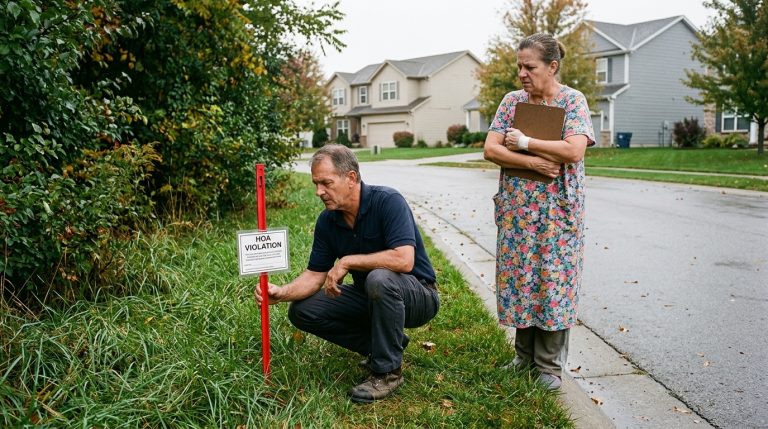
Dolores’s glass-cutting smile didn’t falter. She turned a page on her legal pad, the crisp sound of the paper tearing through the room like a dry branch snapping. “The county handles zoning, Mr. Blackwood. The association handles equity. Under corporate statute eleven, we have the unilateral authority to mitigate any installation that induces measurable resident anxiety. This board has received twelve independent affidavits stating that the monthly operational testing of your tower constitutes a psychological nuisance.”
“Affidavits from whom?” Pete Martinez stood up two rows ahead, his military-surplus field jacket rustling heavily in the confined space. His hand was clenched on the back of the seat in front of him, the skin across his knuckles white and tight. “My grandkids sleep through that test. The Hendersons use it to verify their shelter seals. The only people feeling anxious in this subdivision are the ones who need a disaster to clear their inventory.”
“Mr. Martinez, you’re out of order,” Dolores said. She reached for her gavel—a polished piece of dark walnut that sat on the formica table like a cold weight. “We are moving to a formal ballot. The motion is for immediate administrative removal of the tower structure, backed by an expedited property lien to cover the municipal enforcement escrow.”
Marcus felt the transmitter against his skin prickle with static—a sharp, high-frequency distortion caused by the massive electrical potential building in the low-level clouds outside. He leaned forward, his hands resting on his knees, his mind calculating the velocity of the storm front against the deliberate stagnation of the room. The regional radar array had shown a five-hundred-millibar velocity couplet developing seven miles southwest. The hook echo was no longer a theoretical model; it was a physical mass moving at thirty-five knots directly along the local access corridor.
Then, the National Weather Service alert radio in the corner corner crackled, its digital tone a three-stage mechanical shriek that made half the room jump.
“The National Weather Service in Tulsa has issued a tornado warning for central Tulsa County,” the synthesized voice broadcasted, its flat, algorithmic delivery contrasting sharply with the sudden panic rising in the clubhouse. “Doppler radar indicates a rotating supercell capable of producing a destructive tornado tracking directly over the Willow Brook development. Take shelter immediately in an interior room on the lowest floor.”
The room remained suspended for three seconds, the hum of the fluorescent lights suddenly loud against the silence. Through the large double windows, the first wave of true atmospheric wind struck the building, a heavy, blunt impact that made the commercial-grade glass panes groan within their aluminum tracks. Debris—shredded cedar mulch and plastic trash bin lids—rattled horizontally across the asphalt parking lot outside.
“The meeting will proceed,” Dolores announced, her voice rising an octave, stripping away the smooth corporate veneer to reveal something thin and desperate underneath. Her hand clamped down on the walnut gavel. “We are in the middle of a binding administrative action. The ballot must be recorded before this session is adjourned.”
“Are you insane, Dolores?” Mrs. Patterson called out from the back, her fingers fumbling with the strap of her emergency bag. “Look at the sky. The green light—that’s a rotating wall cloud.”
“The clubhouse is rated for ninety-mile-per-hour straight-line winds,” Dolores snapped, her eyes tracking toward Marcus, her fingers tightening on the edges of her documents until the cream paper creaked. “This is an authorized assembly. Mr. Blackwood’s device is currently generating unauthorized noise pollution outside. It’s a violation of city code.”
Right on cue, the secondary power line behind the podium gave way with a sharp blue flash, and the main lighting grid died. The room plummeted into the dull, sulfurous twilight bleeding through the western glass, the emergency exit signs casting long, skeletal red shadows across the plastic chairs.
Marcus stood up. He reached into his pocket and pulled out his phone, the screen illuminating his face with a cold, blue glow. The system interface was dead. The remote monitoring feed for his primary tower showed zero voltage—the lines hadn’t just been tripped; the primary copper trunk had been physically extracted from the junction box by Brad’s crew outside. The backup circuit had failed to engage.
He looked at Dolores, whose face was now a pale, sharp wedge in the red emergency light. She was holding her phone against her ear, her lips moving rapidly, but her eyes were fixed on the door.
“The vote is passed,” she whispered into the dark room, though no one was listening anymore. “Twelve to three. The lien is logged.”
The sound that followed wasn’t thunder. It was a deep, low-frequency vibration that traveled through the concrete foundation of the clubhouse and into the soles of Marcus’s boots—the distinct, freight-train roar of a multi-vortex system making ground contact less than twelve hundred yards away. The air inside the room grew instantly cold as the pressure dropped below the critical threshold, the structural seals on the double doors beginning to whistle as the building tried to equalize with the vacuum outside.
Marcus didn’t run for the basement stairs. He walked directly toward the podium, his boots heavy and rhythmic against the linoleum, his eyes locked on the unfiled contract that Dolores was trying to shove into her leather briefcase.
“The backup systems don’t have a corporate exemption, Dolores,” Marcus said, his voice flat against the roaring wind. “And your husband’s trucks are parked in the debris path.”
CHAPTER 4: THE LIQUIDATION METRIC
“The contract isn’t an enforcement mechanism, Dolores. It’s an asset ledger,” Marcus said. His voice was entirely flat, cutting through the high-velocity vibration of the clubhouse walls. He pulled the manila folio from the podium, his fingers anchoring the heavy paper sheets against the sudden, violent vacuum pulling at the window seals. The red illumination of the emergency exits washed over the document, highlighting the multi-million dollar underwriting codes stamped along the margins. “Your husband didn’t pre-position those flatbeds for cleanup. He pre-positioned them because Consolidated Insurance paid the staging retention fees three weeks before the weather cell even organized.”
Dolores reached for the briefcase, her manicured nails digging into the leather stitched border, but Agent Torres’s hand was already clamping down on her wrist. The cold, mechanical snap of steel constraints clicked into place beneath the low-frequency hum of the building’s emergency generator.
“Federal racketeering warrants don’t require local notification, Ms. Whitman,” Torres said, her badge catching the strobe of the perimeter strobe lights bleeding through the fractured glass. “The asset forfeiture units entered the Sooner Storm Solutions facility forty-two minutes ago. Every corporate account under your signature has been frozen under a temporary protective order.”
Outside, the physical reality of the vortex crossed the northern perimeter fence. Through the reinforced western windows, the destruction moved in slow-motion, a kinetic ballet of displaced property values. The white Escalade parked in the executive slot didn’t slide; it was lifted vertically, its tires spinning uselessly against the falling air pressure before the sheer weight of the column dropped it across the hood of a commercial utility truck three slots down. The sound was a metallic crunch, brief and clean, swallowed instantly by the roaring cavitation of the wind.
Marcus didn’t move toward the inner corridor. He watched the rain-streaked glass, his eyes tracing the exact line where his secondary backup mast was still broadcasting its auxiliary warning frequency. Across the street, the Hendersons’ basement hatch remained sealed, its deadbolts holding under the pressure of the debris field. Pete Martinez’s fortified garage was dark, its structural reinforcement braces handling the flying gravel with nothing more than rhythmic pings.
“You targeted my wife’s clinical timeline because the seasonal adjustments were tied to the quarterly underwriting report,” Marcus stated, turning his gaze back to Dolores. She was sitting back down in the plastic chair, her shoulders narrow, the expensive navy fabric of her blazer looking hollow under the cold emergency lights. “You needed the neighborhood unmonitored for forty-eight hours so the baseline damage calculations would hit the maximum payout threshold. Every structure destroyed without warning was an extra twelve percent on the contract retention pool.”
“The market handles the risk, Marcus,” Dolores whispered, her voice stripped of its calculated authority, sounding dry and thin like old paper under glass. “The houses are insured. Everyone gets rebuilt anyway.”
“They don’t get their lives back, Dolores,” Marcus replied, his fingers tracing the cold iron rim of his digital recording unit. “And the victims in Riverside didn’t get a choice when you pulled their weather alert grids two weeks before the April front.”
The double doors of the clubhouse flexed inward, the deadbolts groaning as the tail-end of the wall cloud dragged its low-pressure core directly over the concrete roof. A cascade of acoustic ceiling tiles dropped onto the back rows of empty plastic chairs, scattering pulverized fiberglass across the linoleum. No one screamed. The fifty neighbors huddled along the interior hallway remained entirely silent, their faces illuminated by the small blue screens of their mobile alerts, tracking the systematic shift of the storm center moving northeast at thirty-five knots.
Brad Whitman was brought through the rear loading doors three minutes later, his high-visibility vest torn at the shoulder, his hands secured behind his back by two local deputies. His boots left wet, limestone-dusted tracks across the floor, his breathing ragged from the run across the gravel lot. He didn’t look at his wife. He looked at the manila folder still resting under Marcus’s hand.
“The digital ledger on terminal four contains the bank routing codes for the escrow account,” Marcus said to Torres, sliding the paperwork into her tactical folder. “The kickbacks weren’t masked as real estate commissions. They were logged as ‘preventative noise mitigation consulting fees’ directly from Consolidated’s regional adjustment office. Every fine they issued to my property was a line-item entry in their corporate legal defense fund.”
“The financial crimes unit has been tracking the wire sequences since Tuesday,” Torres answered, adjusting her grip on the folder. “The entire network is coming down. Seventeen independent subdivision boards signed similar mitigation agreements with Sooner Storm Solutions over the last thirty-six months. Every one of them is being executed under the same RICO filing tonight.”
The wind began to lose its physical weight, the heavy, rhythmic thrumming against the clubhouse foundation shifting down into a steady, hollow whistle as the barometric gauge outside began its rapid climb back to normalcy. The green sulfur light in the sky was gone, replaced by the dark, clean gray of a standard Oklahoma rainfall.
Marcus walked past the frozen couple, his boots catching the fragments of glass and drywall cluttering the exit corridor. He pushed the heavy exterior door open, stepping out onto the wet asphalt of the parking lot. The air was cold now, completely stripped of its humidity, smelling intensely of ozone, split cedar, and wet earth.
Three miles to the northeast, the dark silhouette of the funnel was still visible against the continuous flicker of lightning, but its base was roping out, losing its connection to the parent supercell as the cold air inflow choked off its circulation.
He reached into his pocket and pulled out his radio, switching the frequency to the local emergency network.
“This is Marcus Blackwood,” he said into the microphone, his voice steady against the background static of the clearing front. “The primary cell has cleared the Willow Brook perimeter. All backup warning arrays are functioning normally. Report your structural status. The neighborhood is safe.”
Across the cul-de-sac, his wife Sarah stepped out onto their front porch, the wool of her cardigan dark with mist, but her hand was raised in a quiet, solid confirmation. The 40-foot galvanized steel tower behind her stood perfectly straight against the clearing sky, its mechanical head silent now, but completely intact.