The Quiet Calibration: A Master Gunner’s Final Lesson in the Echoes of Cold, Forgiving Steel
CHAPTER 1: The Weight of Silence
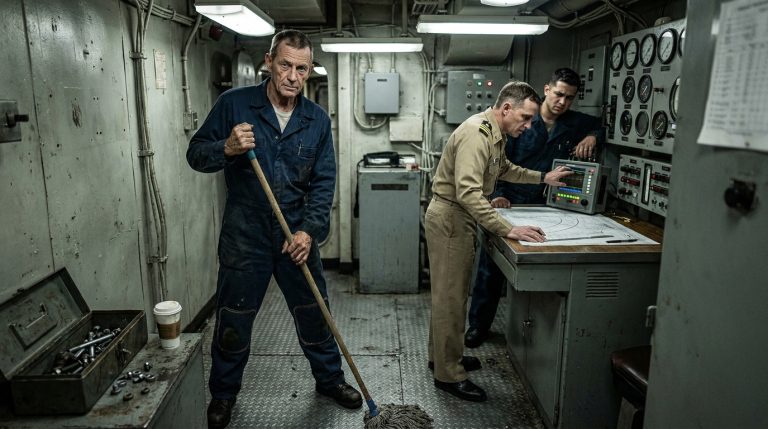
The assembly bay was a cavern of concrete and cold air, saturated with the pungent, cloying scent of CLP gun oil and the stale, sharp tang of collective anxiety. Thomas leaned against his push broom, his fingers curled around the worn wooden handle. His knuckles were swollen, maps of decades-old stiffness, but he kept his breathing shallow and rhythmic.
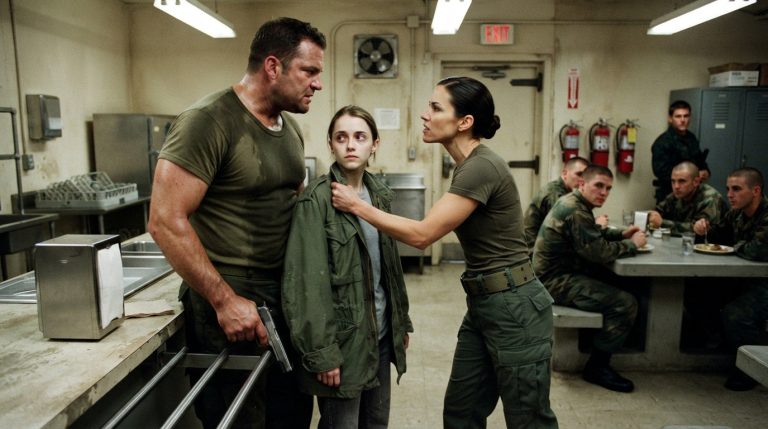
Fifty tables stretched out in the dim, industrial light. At each one, a recruit stood frozen, staring down at the scattered carcasses of the M2 Browning machine guns. They looked like porcelain dolls broken in a tantrum. Barrels lay separated from the receivers, back plates discarded like yesterday’s news, and bolt groups sat in tangled, greasy piles.
“Time remaining: fifteen seconds,” Sergeant Halloway’s voice cut through the air, a razor edge that drew blood from the silence.
Thomas watched Recruit Davis at Table Four. The boy was the image of the new century: sharp eyes, frantic movements, and a reliance on speed that ignored the friction of the steel. Davis’s hands were slick, vibrating with a high-frequency tremor that made the metallic parts clack against each other in a frantic, disjointed rhythm. He wasn’t building a weapon; he was wrestling a ghost.
Thomas tilted his head. He didn’t see the gun as the recruits did—a complex, frustrating piece of hardware. He saw it as a sequence of echoes. He could feel the weight of the M2 in his mind, the cold, heavy stability of the steel that had defined his youth in the frozen mud of the Shosen Reservoir. Back then, you didn’t have the luxury of panic. If you panicked, the metal stayed cold, and you stayed silent forever.
“Jamming it won’t make it fit, Davis!” Halloway’s roar rattled the fluorescent fixtures overhead.
Thomas felt a familiar, dull ache in his shoulder—a phantom sensation from a carry strap that hadn’t touched his skin in fifty years. Davis slammed a bolt stud down, his face flushed with the bitter, sharp heat of humiliation. It was a wasted motion. The steel didn’t care about his frustration.
“It’s the spring, Drill Sergeant!” Davis yelled back, his voice cracking, desperate to anchor his failure in the object rather than his own hands. “This kit is garbage.”
Thomas shifted his weight, his boots scuffing softly against the concrete. The sound was swallowed by the surrounding chaos, but he could feel the shift in the room’s energy. The air was thickening with resentment. Davis reached out, his gaze locking onto Thomas in the corner—a target for his fraying composure. The boy’s eyes were narrowed, reflecting the harsh glare of the lights.
“What are you looking at, Pops?” Davis snapped, pointing a greasy, trembling finger.
The room hit a sudden, suffocating dead zone of silence. Thomas felt the broom handle press into his palm, the wood smooth from his grip. He looked at the discarded parts on Davis’s table, the way the light caught the oil on the steel. It wasn’t just a machine; it was a memory. And the memory was screaming that they were doing it all wrong.
CHAPTER 2: The Anatomy of Resilience
Thomas felt the weight of fifty pairs of eyes pressing into the back of his neck, but he didn’t turn. He held his position, his fingers still wrapped around the wooden handle of his broom, the grain rough and familiar against his calloused skin. The silence in the armory wasn’t just an absence of sound; it was an absence of competence. These recruits had the tools, the digital schematics, and the physical conditioning of elite athletes, yet they lacked the one thing that kept the steel from biting back: the patience of a craftsman.
Davis stood three paces away, his face still slick with the heat of his outburst. The boy was breathing heavily, his chest rising and falling in sharp, jagged intervals. He wasn’t looking at the weapon anymore; he was looking at Thomas, his expression a volatile cocktail of anger and dawning, uncomfortable curiosity.
“Stick to the broom,” Davis repeated, though the venom had drained from his voice, replaced by a thin, brittle edge of doubt.
Thomas didn’t look at him. Instead, he allowed his gaze to drift across the room, noting the state of the other tables. It was a graveyard of ambition. Springs protruded from bolt groups like broken clockwork, and barrels lay misaligned, mocking their owners. The smell of the CLP oil—that thick, synthetic scent of modern maintenance—seemed to clash with the metallic, iron-rich memory lingering in the back of Thomas’s throat.
The memory hit him suddenly, unbidden and cold. The Shosen Reservoir. The wind had been a physical entity, carving through layers of wool and leather, turning the air into needles. He remembered the feeling of skin tearing when it brushed against the housing of the M2. He remembered the sound—not the clatter of a modern drill, but the heavy, singular thunk of a bolt locking into place, a sound that meant the difference between a night spent breathing and a night spent as a memory.
“The weapon is a conversation,” Thomas said, his voice barely rising above the hum of the ventilation system. He didn’t turn his head. He just kept his eyes fixed on the scattered bolt group on Table Four. “You’re trying to lecture it, son. You’re trying to force your cadence onto something that’s been speaking the same language for a century.”
Halloway, standing near the front of the bay, didn’t interrupt. The drill sergeant’s eyes were fixed on Thomas, his clipboard held loosely at his side. There was a look on Halloway’s face—a momentary flicker of something other than discipline. It was the look of a man recognizing a ghost, or perhaps, recognizing that the foundation of his own authority was currently being called into question by a man who shouldn’t have been anything more than a shadow in the corner.
Thomas finally released the broom. It clattered against the concrete, a dull, hollow sound that seemed to echo for an eternity. He took a step toward the table. His gait was slow, the arthritic drag of his left leg pronounced, a physical manifestation of the years that stood between him and these recruits. He didn’t need to look at Davis; he could feel the boy’s surprise.
“You think this is complex,” Thomas murmured, reaching out. His hands were gnarled, the knuckles swollen and stiff, yet as he approached the mess of metal, his movements didn’t stutter. He didn’t reach for the bolt with the frantic energy of a man looking for a solution; he reached for it with the familiarity of a man touching a face he had memorized in the dark.
He didn’t need the manual. He didn’t need the heads-up display or the digital feedback loops these kids lived by. He simply felt for the edge of the receiver, his thumb tracing the worn finish of the steel. The cold of the metal was a grounding wire, pulling him back from the reservoir, from the heat of the valleys, and anchoring him firmly in the fluorescent-lit reality of the armory.
He moved a single part—a small, seemingly insignificant spacer—just an eighth of an inch to the left. The shift was almost imperceptible to the untrained eye, but the internal geometry of the weapon suddenly sang. The tension in the bolt group vanished, the metal settling into its intended home with a soft, resonant click.
“The mistake isn’t in your strength, Davis,” Thomas said, his voice dropping to a gravelly whisper. “It’s in your detachment. You’re looking at the gun. You need to be feeling the soul of it.”
Davis stepped back, his eyes wide. The arrogance that had fueled his earlier outburst was dissolving, replaced by a profound, jarring silence. He looked at the assembly, then at Thomas’s hands—hands that were currently trembling with the effort of the hold.
Thomas ignored the boy’s confusion. He turned his attention toward the heavy steel barrel, his breath hitching slightly as the weight pressed into his palms. The arthritis screamed, a sharp spike of fire traveling up his wrist, but he didn’t waver. He knew exactly what he was doing. He was holding the line, not just for the squad, but for the truth of the steel itself.
CHAPTER 3: The Darkened Threshold
Thomas held the heavy steel barrel for a heartbeat, feeling the way the light from the overhead lamps seemed to dim around the edges of his vision. He didn’t look at the sergeant or the recruits. He looked at the cloth. The black bandana, frayed at the edges from its own years of service in simulation drills, felt thin and honest in his hands.
“Get me a blindfold,” he had said, and the air in the room had shifted. It was no longer a training bay; it was a theater of the absolute.
Halloway reached into his tactical pocket, the sound of the Velcro ripping like a gunshot in the heavy silence. He didn’t offer a challenge; he offered the cloth. “Thomas, you don’t have to do this. They’re just punks.”
The sergeant’s voice was uncharacteristically thin, stripped of its usual bark. Thomas took the bandana, his thumb brushing the cool, dark fabric. The texture was smooth, familiar. It was the same texture as the darkness that had descended on the Shosen Reservoir, the same darkness that had followed him through every jungle, every valley, and every lonely night in a janitor’s closet.
“They aren’t punks, Sergeant,” Thomas replied, his voice barely audible, yet vibrating with a resonance that silenced the distant hum of the building’s climate control. “They’re soldiers who think the world started when they were born. They need to learn.”
He didn’t wait for a rebuttal. He raised his hands, the arthritic knuckles clicking softly as he brought the cloth over his eyes. He tied the knot at the back of his head with a practiced, singular motion—a movement that bypassed his conscious mind entirely. As the world vanished, the sensory input of the room sharpened. He smelled the lingering, acrid ozone of the lights, the deep, earthy tang of sweat and damp concrete, and above all, the metallic, oil-laden scent of the M2.
In the darkness, the trembling in his hands stopped. It was as if the absence of light had silenced the part of his body that remembered age and pain.
“Time me,” Thomas whispered into the void.
“Ready,” Halloway’s voice came from the right, heavy with the gravity of the moment. “Go.”
Thomas didn’t rush. He didn’t scramble for the parts like the recruits had, driven by the panic of a digital clock. He stood perfectly still for a fraction of a second, mapping the table in his mind. He reached out, his fingers hovering until they made contact with the cold, unforgiving surface of the receiver. It felt like an old friend.
His hands began to move, not as parts of an eighty-year-old man, but as extensions of the weapon itself. He didn’t look for the bolt extension; he felt for the vibration of it against the table. He found the bolt stud, the surface worn smooth by thousands of cycles, and slid it into the receiver with a delicate, fluid motion that lacked any resistance. The metal kissed the metal—a precise, harmonious connection.
He could hear the breathing of fifty people in the room. Some were leaning forward; he could feel the shift in the air pressure as they crowded the table, their own anxieties silenced by the rhythmic, purposeful sound of his assembly. Click. The bolt group locked. Clack. The buffer body seated. Each sound was a word in a language he had spent half a century writing.
He moved to the barrel. The weight of it was significant, pulling at his shoulders, yet he leveraged it against his hip—a maneuver that wasn’t in the manual, a relic of a time when the manuals didn’t exist, only the necessity of survival. He felt the threads of the barrel extension, the fine, spiraled grooves that demanded respect. He began to rotate it, his ears pricked for the subtle, metallic harmonics of the headspace adjustment.
Every turn of the barrel was an exercise in listening. He felt the resistance of the metal, the way the steel pushed back when the tolerances tightened. He stopped, tapped the side of the housing with a calloused fingernail, and listened to the resonance. It was slightly off. Too tight.
He reversed the motion, a single, infinitesimal click, and felt the metal settle into its sweet spot. The resonance changed, becoming deeper, more authoritative. The headspace was set.
He didn’t need a gauge. He had the weight of the rifle and the memory of the steel. He reached for the charging handle, his heart hammering against his ribs with a sudden, sharp clarity. He pulled back, felt the spring groan under the pressure, and then—Kachunk.
The sound was absolute. It was the sound of a heartbeat, a life-cycle, and a duty discharged. Thomas remained still for a second, his hands resting on the weapon, the dark cloth still tight across his eyes. He felt the cold iron radiating upward, a slow, steady pulse that reminded him of everything he had lost and everything he had managed to keep.
“Time,” he breathed, the word a soft release of tension.
He reached up, untied the knot, and let the cloth fall to the floor. The light was harsh, blindingly bright, cutting into his eyes and forcing him to blink. He looked at the table. The weapon was a masterpiece of assembly, perfect in every dimension. Halloway was staring at his stopwatch, his expression frozen in a mixture of awe and something that looked suspiciously like reverence.
Thomas felt the age creeping back into his limbs, the stiffness returning to his knees as the adrenaline of the moment began to bleed out. He had done it, but he had left a piece of himself on the table, a reminder that the world they were building was hollower than they dared to admit. He turned toward the recruits, his eyes searching their faces, waiting to see if any of them had learned to listen.
CHAPTER 4: The Resonance of Steel
The armory lights seemed to hum louder in the wake of the silence, a low-frequency vibration that rattled the loose parts on the neighboring tables. Thomas stood by the table, his hands resting on the cold, black finish of the M2. He could feel the residual heat of the barrel—a subtle warmth that ghosted against his fingertips. It was the only thing in the entire bay that felt real.
He didn’t move toward his broom. He didn’t retreat into the janitor’s persona. He simply stood there, his shoulders slightly hunched, letting the gravity of the room settle around him. He watched the recruits. Fifty of them, and for the first time since he had started mopping these floors, not one was fidgeting. The digital screens of their tablets were dark, cast aside on the concrete like discarded toys. They were looking at him—really looking at him—and in their eyes, he saw the slow, painful dissolution of their carefully curated arrogance.
Davis was the most exposed. The young man’s face was pale, his eyes fixed on the assembled machine gun. He looked as if he were trying to deconstruct the last forty-five seconds, searching for the trick, the hidden catch, or the bit of code that had made the impossible look so utterly mundane.
“Check it,” Thomas repeated, his voice raspy, a sound like dry leaves skittering over pavement.
Halloway moved forward, his heavy boots clunking against the floorboards. The drill sergeant reached the table, his movements guarded, almost hesitant. He picked up the head-space and timing gauge from the tabletop, his thumb brushing the edge of the metal. He moved with a care that Thomas hadn’t seen from him in months of observation.
Halloway inserted the gauge. The click was sharp, precise, and final. He moved it, checking the tolerances, his brow furrowing as he confirmed what he already knew. He looked up at Thomas, and for a fleeting second, the wall of authority between them crumbled.
“It’s… perfect,” Halloway whispered. It wasn’t a report to the platoon; it was a quiet, private confession. He looked back at the assembled weapon, then up at the ceiling, as if trying to reconcile the image of the stooped, eighty-year-old janitor with the ghost of the man who had written the book on heavy infantry. “How? The arthritis, the age—the manual says this requires a certain level of tactile feedback, and you did it blind.”
“The manual is a guide for those who are afraid of the machine,” Thomas said, his fingers tracing the contour of the back plate. “It teaches you to follow steps. It doesn’t teach you to listen to the steel. You spend so much time looking at your devices, at your readouts, that you’ve forgotten that the metal has a voice. It tells you when it’s happy, and it tells you when it’s going to fail you. If you don’t listen, you aren’t a gunner. You’re just a spectator.”
The room remained deathly still. Davis took a hesitant step forward, his hands deep in his pockets, the greasy sheen on his fingers catching the light. He looked at the gun, then back to Thomas, his jaw tight.
“I didn’t think it was possible,” Davis admitted, the words coming out slow and forced. “They told us the M2 was obsolete for the field, that we needed the new systems to compensate for the fatigue and the complexity.”
Thomas shifted his weight, the dull ache in his hip reminding him of the long years, but he didn’t lean on the table. He stood his ground, a pillar of gray in a room full of neon lights and synthetic fibers.
“Everything is obsolete if you stop caring about how it works,” Thomas replied. He looked directly at Davis, piercing through the young man’s polished facade. “You want to be a general in twenty years? Fine. But you’ll be a general who knows nothing of the weight he’s asking his men to carry. You’ll be a general who knows how to read a map, but not how to read the silence of a foxhole. Respect the equipment, Davis. Not because it’s new, but because it’s the only thing that’s going to be standing between you and the dark when the systems fail.”
Thomas turned away then, the momentum of the moment finally beginning to wane. The shuffle returned to his step, a rhythmic, dragging sound that brought the normalcy of his station back to the bay. He walked to the corner, his hand finding the familiar, splintered wood of his push broom. It felt different now. Less like a badge of invisibility and more like a crutch he no longer needed to hide behind.
He didn’t look back as Halloway cleared his throat, the sound sharp and commanding, snapping the platoon out of its collective trance.
“You heard the master gunner,” Halloway shouted, though his voice lacked the usual, hollow bite. “Tear them down. And if I see one of you trying to force a spring that doesn’t want to go, you’re doing it again. And again. Move!”
The bay erupted into a flurry of motion, but it was different. There was no chaotic clanging of metal. No panicked scrambling. There was a deliberate, steady rhythm to it. The recruits were slower now, their hands moving with more caution, their ears strained toward the sounds of their own assembly. They were trying to hear the metal.
Thomas pushed the broom across the concrete, collecting the fine dust and grit that had settled into the seams of the floor. He kept his head down, but he could feel the shift in the room. He had broken the seal on their certainty, and he knew that for some of them, that was a dangerous gift. He would have to be careful. He wasn’t just a janitor anymore, and the ghosts he had carried for half a century were beginning to rattle the walls of his quiet life. He had started the process, but the resonance of what he had done was only just beginning to vibrate through the foundation.
CHAPTER 5: The Tactical Check
The bay was full of the sound of metal clicking into place, a symphony of progress that should have brought Thomas peace. Instead, the noise seemed to amplify the buzzing in his ears. He kept his head down, focusing on the way the bristles of his broom moved the fine grit across the floor, but the concrete was no longer solid. It had taken on the consistency of the churned-up earth of the Iron Triangle.
He felt the sudden, sickening pitch of the world—the ceiling lights stretching into long, flickering needles of white light. His hand, gripped tight around the broom handle, went numb. The smell of the CLP oil, usually so comforting, sharpened into something metallic and foul, reminiscent of the wet, rusted scent of a combat zone in the rain.
He forced himself to stay upright, his breathing becoming shallow. He was not in the armory. He was on the ridge. He could feel the cold—not the artificial climate-controlled chill of the bay, but the biting, bone-deep freeze of the Shosen Reservoir. He could hear the distant, rhythmic thump of mortar rounds hitting the perimeter.
Steady, he told himself. It is only the floor.
He caught himself swaying, his knuckles turning white as he braced against the broom. Nearby, Recruit Davis stopped his assembly, looking over at the old janitor with a frown. The boy’s eyes were narrowed, his brow creased with concern.
“Thomas? You alright, Pops?”
The voice was distant, coming to him through a thick layer of static. Thomas didn’t answer immediately. He waited for the wave of vertigo to pass, for the concrete to stabilize. He closed his eyes, forcing his focus onto the physical texture of the broom handle—the rough wood, the splinters that pressed into his palm. It was the anchor. He clung to it until the sensation of mud vanished, replaced once more by the hum of the fluorescent lights.
He opened his eyes and found himself staring at the wall of the armory, his pulse still hammering against his ribs like a trapped bird. Davis was still watching him, his hands paused in the middle of seating the bolt group. The boy’s concern was genuine, and that made it worse. It meant he was visible. He was no longer the invisible fixture of the room; he was a man showing cracks, and in a place like this, cracks were a liability.
“I’m fine,” Thomas said, his voice sounding thin and hollow. He pushed the broom forward, the movement jerky. “Just a bit of stiffness. Age is a stubborn partner.”
Davis looked unconvinced, his gaze darting to Halloway at the front of the room. The drill sergeant was currently deep in conversation with a lieutenant, his back turned to the platoon. Thomas caught the look of hesitation on Davis’s face. The boy wanted to say something—a question about the tremor, perhaps, or a comment on the fact that the old man seemed to have frozen in place for a long, uncomfortable moment.
“You really did it, didn’t you?” Davis whispered, leaning in as if to share a confidence that would be ruined by the sound of the room. “The assembly. You didn’t just know the weapon; you knew where the flaws were before you even touched it. How can someone who’s spent decades cleaning up after us know more about the M2 than the manual that came with it?”
Thomas felt the familiar, protective instinct rise within him—the desire to push the boy away, to retreat back into the comfortable safety of being the janitor who knew his place. But he looked at Davis, really looked at him, and saw the same fear he had seen in his own reflection in the puddles of Korea. The boy wasn’t looking for a secret; he was looking for a reason to keep going.
“I didn’t memorize the manual, son,” Thomas replied, his voice barely a murmur. “I memorized the consequences. When you’ve seen the weapon fail because someone thought they knew better than the steel, you learn to pay attention. You learn to listen to the things that don’t have voices.”
He didn’t wait for a reply. He kept the broom moving, his pace slightly faster than before, trying to regain the rhythm of his work. He could feel the weight of Davis’s stare, the way the boy’s curiosity was beginning to gnaw at the boundaries of the professional dynamic.
Thomas reached the edge of the bay and began to turn. As he did, he glanced toward the gear locker. The padlock was slightly askew. He knew he hadn’t touched it, and he knew Halloway was meticulous about security. A cold, prickling sensation traced its way down his spine. It was a subtle detail—a discrepancy that stood out like a jagged edge in a polished room.
He moved his broom closer, his eyes scanning the area. The floor beneath the locker was clean, yet there were faint, scuff-like marks near the baseboard that shouldn’t have been there. They weren’t the markings of boots; they looked like the drag marks of a heavy, metal crate.
He stood there for a moment.
CHAPTER 5: The Discovery of Shadows
The closet was a narrow, cramped space that smelled of ammonia and long-forgotten dampness. It was Thomas’s sanctuary, a place where he could collapse his posture and let the arthritis in his hands throb in the dark without anyone to witness the weakness. But as the door swung open, the harsh, unforgiving light of the armory bled into his refuge, illuminating the thin layer of dust that coated the metal shelves.
Davis stood in the doorway, his silhouette stark against the bright fluorescent backdrop of the main bay. He wasn’t looking at the mops. His eyes were fixed on the bottom shelf, where a heavy, leather-bound folder sat tucked away behind a rusted box of machine oil.
“I came to apologize,” Davis started, his voice hollow, but then his eyes landed on the folder. He reached out before Thomas could stop him, his fingers brushing the cracked leather. “What is this?”
Thomas felt a cold prickle of alarm run down his spine. He stepped forward, the shuffle forgotten, his presence suddenly filling the small space. “That’s private property, Recruit. Put it back.”
But Davis had already flipped the cover open. The pages inside weren’t digital—they were paper, yellowed and brittle with age, covered in hand-drawn schematics and dense, archaic annotations that looked more like poetry than military technical data. They were the original, field-modified blueprints for the M2 Browning, marked with the dates of the Shosen Reservoir and the bloody, humid chaos of the Iron Triangle.
Davis’s breath hitched. “These aren’t standard issue,” he whispered, tracing a line of ink that described a modification to the headspace adjustment that the modern manuals explicitly forbade. “These are… these are from the fifties. Why do you have these?”
Thomas reached out, his hand closing firmly over the folder, sliding it out of the boy’s grip. He felt the tremor in his own fingers—not from age, but from the sudden, sharp proximity of his past. “You’re looking for a shortcut, Davis. You’re looking for a way to cheat the physics of the machine, but you don’t even understand the foundation yet.”
“I’m looking for the truth,” Davis countered, his voice rising, gaining the sharp, transactional edge of a man who realized he had been lied to. “You aren’t just a janitor. You’ve been hiding here. You’ve been watching us fail, letting us look like idiots, while you hold the keys to the real way to run this weapon. Is this why Halloway keeps you around? Is this a punishment, or are you in deep cover?”
Thomas felt the weight of the moment pressing in. The illusion of the “old janitor” was shattering, and with it, the careful buffer he had built between himself and the military’s relentless, unfeeling progress. He looked at Davis and saw not a recruit, but a young man terrified of becoming irrelevant.
“I am not hiding,” Thomas said, his voice hard, lacking the gravelly fragility of the last few weeks. “I am holding the floor. Someone has to remember that the machine isn’t the problem—the attitude is. You think these blueprints are a secret weapon? They’re a record of cost. Every note in those margins was paid for by someone who didn’t come home.”
Davis wasn’t listening. He had caught a glimpse of a name at the bottom of a page—a name that had been officially struck from the record during the reorganization of the battalion in ’75. He looked up at Thomas, his eyes wide with a mix of shock and betrayal. “You’re Miller. The Ghost of the Triangle. Everyone thought you died in the eighties.”
Thomas stepped closer, his shadow engulfing the young recruit. The space between them was electric with the friction of the past clashing into the present. “I am Thomas. And right now, you are standing in a storage closet and holding a broom that needs to be pushed. You want to know the truth, Davis? The truth is that this weapon is a mirror. If you see a monster, it’s because you’re looking at your own fear.”
“I’m not afraid,” Davis insisted, though his voice wavered.
“You’re terrified,” Thomas corrected. “You’re terrified that you’re obsolete. You’re terrified that the world doesn’t need your instincts anymore because the machines can calculate the trajectory faster than your heart can beat. You think these papers are going to save you? They’re just paper. The skill isn’t in the blueprint, son. It’s in the calluses.”
Thomas reached out and firmly closed the door, the heavy metal thudding home and sealing them in the dim, stale air of the closet. He didn’t offer an explanation. He didn’t offer a mentor’s hand. He simply stared at Davis, waiting for the boy to decide if he was going to turn him in or if he was going to walk out of that closet and leave the past buried in the dust.
The silence that followed was heavy, textured with the smell of damp paper and the looming threat of Halloway coming to check on the progress in the bay. The stakes had shifted. The decoy was dead, and the reality of who Thomas was—and what he held—was now a secret shared, a burden that threatened to upend everything Thomas had built to keep his remaining days quiet and purposeful. Davis didn’t move; he stayed in the darkness of the closet, his hand still trembling from the touch of the old, yellowed pages.
CHAPTER 6: The Weight of the Secret
Thomas didn’t move. He stood in the narrow gap between the mop bucket and the wall, his chest rising and falling in measured, controlled rhythms. The darkness of the closet was absolute, save for the sliver of fluorescent light cutting through the crack in the door. He could feel Davis vibrating with a frantic, unspent energy, a kinetic restlessness that threatened to spill over into something catastrophic.
“You aren’t going to turn me in,” Thomas said. It wasn’t a question. It was a statement of tactical necessity.
Davis shifted, his boot scraping against the concrete. “Why? Why stay here, pushing a broom, when you could be… I don’t know, teaching? Why keep the blueprints? Why keep all of this?”
Thomas reached out, his hand finding the edge of the shelf. He didn’t look at the recruit; he stared into the darkness, his mind drifting back to the heat of the valleys, the taste of dry, metallic air, and the faces of the men who had lived and died by the grace of the M2. “You think teaching is about standing at a podium and reciting manuals? You think it’s about credentials and rank? It’s not. Teaching is about survival. If I’m not here, if I’m not the shadow in the corner, who is going to tell you when you’re drifting? Who is going to remind you that the metal has a heartbeat?”
Davis’s breathing slowed, though the tension in his frame remained. “They said you were gone. They said the ‘Ghost’ was a myth created to keep the recruits focused. But you’re real. You’re right here.”
“I am a man who remembers,” Thomas said, his voice dropping into that low, resonant frequency that always seemed to demand obedience. “And because I remember, I am a liability. Do you know what happens to relics that can still function, Davis? They get scrapped. They get replaced by something ‘better,’ something with more efficiency and less empathy. That is the way of your world. If they knew who I was, they wouldn’t ask for my advice. They would ask for my resignation.”
He felt the boy’s gaze on him, a physical weight in the small space. The air felt thick, charged with the sudden realization that this janitor wasn’t just a man—he was a living, breathing indictment of everything the military was striving to become.
“I won’t say anything,” Davis whispered. The anger had leaked out of him, replaced by a strange, quiet reverence. “But you have to show me. Not the theory. Not the history. The way you felt the metal. The way you knew the headspace was set without a gauge.”
Thomas felt a sharp, stabbing ache in his hip, a reminder of the toll the last few minutes had taken. He was tired. The facade of the old man was becoming harder to maintain, and he was exhausted by the act of being invisible. He looked at Davis, seeing the flicker of genuine hunger for knowledge—not for power, but for a connection to something solid.
“It’s not a show,” Thomas warned, his voice stern. “And it’s not a gift. It’s an obligation. You learn the machine, you learn the cost. You learn the history, you learn the weight. If you’re going to walk this path, you don’t do it because you want to be a general. You do it because you want to be a shield.”
He reached out and pushed the door open. The sudden rush of light was blinding, washing out the closet and forcing them both to shield their eyes. The armory was still active, the recruits busy with their disassembled weapons, but the atmosphere had shifted. It was no longer a place of aimless, panicked labor. There was a focus now, a quiet, methodical intensity that Thomas hadn’t seen before.
He didn’t wait for Davis to respond. He pushed his broom out of the closet and into the bay, the wood biting into his palm with a reassuring roughness. He could feel Halloway’s gaze on him from across the room—a long, searching look that made the hair on his neck stand up. The drill sergeant was smart. He was beginning to put the pieces together, the anomaly of the perfect assembly and the sudden, uncharacteristic shift in the platoon’s demeanor.
“Back to your station, Recruit,” Thomas said, his voice flat, professional.
Davis hesitated, his face flushed with the secret he now carried. He looked at the folder in Thomas’s hand—the folder that had nearly destroyed everything—and then at the janitor’s back. He turned and walked away, his steps heavy with the sudden, crushing weight of the knowledge he had stumbled into.
Thomas kept the broom moving, his eyes cast toward the floor. He knew he had just made a mistake—a tactical error born of fatigue and a moment of weakness. He had allowed the ghost to step into the light. He could feel the eyes of the room, the shifting patterns of the platoon, and the undeniable sense that his time in the shadows was drawing to a close. The secrets were no longer hidden; they were starting to resonate, and he was the only one who knew exactly how much damage that vibration could cause.
He reached the end of the bay and saw Halloway heading his way, the drill sergeant’s walk rhythmic, deliberate, and purposeful. The time for games was over. The truth was beginning to bleed into the open, and Thomas knew that the next conversation would be the one that would determine whether he was allowed to finish his service in silence or if the legend would finally be forced to answer for its own survival.
CHAPTER 7: The Confrontation of Shadows
Thomas didn’t turn around immediately. He kept his gaze fixed on the baseboard, waiting for the shadow to stretch out alongside his own. He knew Halloway’s cadence—the heavy, squared-off pace of a man who believed in the absolute order of the hierarchy. The sergeant stopped just behind his left shoulder, his presence a wall of cold authority.
“You’re a long way from the shadows, Thomas,” Halloway said. His voice wasn’t a roar. It was low, calibrated, and dangerously curious.
Thomas slowly straightened, the motion eliciting a protest from his lower back. He didn’t drop the broom. He kept his grip, the wood serving as his final line of defense against the exposure he had fought so long to avoid. He turned, facing the sergeant. Halloway was holding his tablet, his thumb hovering near the screen, the blue light reflecting in his eyes.
“I’m just doing the work, Sergeant,” Thomas replied, his voice maintaining the weathered, gravelly tone of the janitor, though he knew by now that the mask was transparent.
Halloway looked at the armory.
CHAPTER 7: The Flickering Truth
The darkness wasn’t absolute. A thin, sickly glow from the emergency exit signs cast long, distorted shadows across the concrete, turning the rows of disassembled machine guns into jagged silhouettes. Thomas didn’t move. He stood with the folder pressed against his ribs, his heart a slow, steady thudding against his chest. He could feel the electricity still crackling in the air, a phantom sensation of the short-circuit that had just claimed the lights.
“Thomas?” Halloway’s voice was close. Too close. It came from the direction of the supply racks, low and cautious.
Thomas pivoted, his movements silent, a ghost in the gray haze of the bay. He didn’t answer. He knew Halloway was listening for his breathing, for the tell-tale shuffle of his boots, for any sign that the “janitor” was something other than he claimed. Thomas pressed himself back against a workbench, his fingers tightening around the edge of the folder.
“I know you’re in here, Miller,” Halloway said. The name wasn’t a question. It was an acknowledgment. The sergeant’s tone wasn’t threatening; it was tired, weighed down by the same history that Thomas carried in his pocket. “The power didn’t blow just because of a surge. The grid is stable. Someone tripped the breaker near the locker.”
Thomas didn’t speak. He focused on the texture of the workbench—the cool, slightly pitted steel—and used it to steady his breathing. He could hear Halloway moving, the sergeant’s boots clicking softly on the floor. He was closing the distance, following the internal map of the bay that every instructor knew by heart.
“You’ve been a ghost for a long time,” Halloway continued, his voice softer now. “I did some checking. After that demonstration, it wasn’t hard to find the redacted files. Why come back here? Why play the role of the shadow when you could be a legend in the classrooms, teaching these kids what they actually need to know?”
“Because legends aren’t useful, Sergeant,” Thomas said, his voice emerging from the dark, stripped of all artifice. He didn’t try to hide the strength of his tone anymore. “Legends are statues. They get dusted off when it’s convenient and ignored when the work starts. I didn’t come back to be remembered. I came back because I’m the only one left who remembers how to make the steel talk.”
“They’re going to come for you,” Halloway whispered, his silhouette appearing a few feet away, a darker patch of void in the dim light. “The command is asking questions about the audit of the armory assets. They noticed the discrepancy in the records from the nineties. They think there’s a breach in the inventory.”
Thomas felt a cold wave of clarity wash over him. It wasn’t about the janitor. It was about the ghosts in the machine. He had been so focused on the recruits that he hadn’t seen the bureaucratic trap closing in around him.
“Let them come,” Thomas said. He stepped away from the bench, his posture straightening. The arthritis was still there, but in the dark, with the weight of the folders in his hands, it felt irrelevant. “I’ve been fighting ghosts for half a century. A few paper-pushers with badges won’t make a difference.”
“It’s not just paper-pushers,” Halloway said, his voice tight. “It’s the new directives. They want to automate the support lines. They want to remove the human element entirely. You’re not just a historical anomaly, Thomas. You’re an obstacle to the new order.”
A faint, distant hum began to build—the sound of the backup generators groaning into life. The emergency lights pulsed, bathing the room in a strobe-like effect that made the machinery jump and quiver in the shadows. Thomas saw Halloway clearly for a split second: the sergeant looked exhausted, his face lined with the same weariness that Thomas saw in his own reflection every morning.
“You’re going to help me,” Thomas said, not as a request, but as an observation. He could see the struggle in the sergeant’s eyes, the conflict between the man who valued the discipline of the craft and the soldier who had to obey the chain of command.
Halloway looked at the weapon on the table near them, then at Thomas. The power surged. The fluorescent lights flickered, hummed, and then roared to life, casting a harsh, clinical glare over the entire armory. The sudden light was violent, stripping away the anonymity of the darkness.
Thomas stood in the center of the bay, the folder clutched to his chest, his eyes locked with Halloway’s. The sergeant looked around at the platoon of recruits, who were standing frozen at their stations, their hands still resting on the M2s they had been assembling. The shift had happened. The secrets were no longer his alone. The reality of the legacy he was guarding was now out in the open, and the collision between the old way and the new was no longer a possibility—it was an inevitability that would be decided in the minutes to come.
Thomas took a single step toward Halloway, his expression unyielding. He had lived his life in the gaps and the margins, but the time for silence was over. He was a master gunner, and he still had one lesson left to teach.
CHAPTER 8: The Final Calibration
The armory door hissed open, not with the controlled, rhythmic authority of a drill sergeant, but with the sharp, clinical urgency of an outside inspection team. Three men in slate-gray uniforms entered, their eyes scanning the room with the detachment of surgeons preparing to excise a tumor. They were the architects of the new order—bureaucrats who viewed the M2 Browning not as a weapon, but as a liability to be liquidated.
Halloway stood his ground, but his posture was that of a man holding back a tide with his bare hands. “This is an active training cycle,” he barked, his voice straining to maintain its usual command.
The lead inspector, a man with thin, colorless lips and eyes like polished glass, ignored him. He walked directly toward Table Four, where Davis was still standing, his hand resting on the weapon Thomas had helped him assemble. The inspector stopped, his gaze falling on the gun with a look of genuine disgust.
“This is the discrepancy,” the inspector said, his voice flat. He turned his attention to Thomas, who stood quietly in the corner, his hand still gripping the broom. “Master Gunner Miller. You’ve been a difficult man to locate, and even harder to justify on the payroll. We have no record of a janitorial position being authorized for a person of your… clearance level.”
Thomas let the broom handle fall. It hit the floor with a finality that silenced the room. He stepped forward, the shuffle gone, his stride steady and purposeful. He walked until he stood between the inspector and the weapon.
“I don’t need a payroll,” Thomas said. His voice was steady, the gravel replaced by a sharp, clear steel. “I’m here to make sure these kids know how to maintain the iron. If that’s a breach of protocol, then the protocol is broken.”
“The protocol is being updated,” the inspector replied. He signaled his team, and they moved toward the weapons, their hands reaching for the parts with the clumsy, invasive touch of people who had never felt the heartbeat of the steel.
Thomas didn’t let them. He moved with a speed that defied the arthritis in his joints, stepping into the space between the inspector and the workbench. He didn’t use force—he used presence. He stood before the disassembled machine gun, his arms folded across his chest.
“You want to scrap them?” Thomas asked, looking the inspector directly in the eyes. “Go ahead. But realize what you’re doing. You’re taking away the only thing that teaches these kids that survival isn’t a calculation. You’re turning them into operators who don’t know the cost of the trigger pull. When the sensors go dark—and they always do—who is going to be left to hold the line?”
The inspector scoffed. “We have systems that don’t sleep, Miller. We don’t need ghosts from the Iron Triangle holding the line.”
Davis, who had been watching from his station, suddenly moved. He stepped up beside Thomas. “He’s right,” Davis said, his voice ringing out, steady and clear. “I spent two hours trying to force this weapon to fire, and I failed. He taught me in forty-five seconds how to listen to it. If you remove the human element, you don’t make us more efficient—you make us disposable.”
The room went silent. The other recruits began to move, stepping away from their own tables and closing the distance between them and the workbench, a wall of youth standing in solidarity with the old man. The inspectors looked at the wall of faces—at the genuine, fierce conviction in their eyes—and hesitated.
The lead inspector looked at the tablet in his hand, then at the master gunner. The confrontation wasn’t going to be won with force. It was going to be lost in the light of the truth. He closed his folder, the sound of the leather snapping shut like the closing of a tomb.
“Very well,” the inspector muttered. “But your time is up, Miller. Enjoy your final hour in the armory.”
As they turned to leave, Thomas didn’t move. He stood there, a quiet, immovable object in the center of the storm. Halloway let out a long, shuddering breath, his shoulders finally dropping from their rigid, defensive height. He looked at Thomas, a slow, solemn nod of respect passing between them.
Thomas turned to the table. He reached out and picked up the heavy steel barrel, the weight of it familiar and grounding. He began to wipe it down with a clean rag, his movements slow, deliberate, and reverent. The “denouement” was a quiet one; the bustle of the bay returned, but it was different now. There was a new, shared understanding in the air.
He moved to the workbench and picked up his repair kit. He found the small, worn-out spring that had caused the jam on Table Three earlier that morning and carefully replaced it. It was a simple, manual act of restoration. He checked the tension, listened to the click, and then looked at Davis.
“Keep it clean,” Thomas whispered, handing the rag to the young recruit. “And always check your headspace. It’s the difference between a tool and a catastrophe.”
He turned and walked toward the exit, the broom left behind on the floor. He didn’t look back as he passed through the doors and into the long, sterile hallway. He was tired—a deep, ancient kind of fatigue that promised sleep, but he felt a strange, quiet peace. The secret was out, the ghost had spoken, and the next generation knew that the steel was not a machine to be mastered, but a partner to be respected. He had finished his watch. The armory was in good hands.