The Infrastructure of Consequence: A Quiet Siege on the Rusting Valves of Ridgeline Estates
CHAPTER 1: THE WEIGHT OF IRON
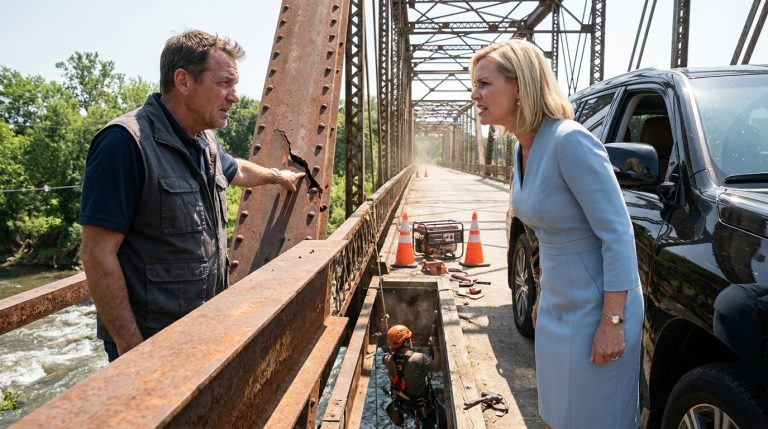
The rain wasn’t a downpour; it was a steady, rhythmic assault that turned the Tuscany Creek watershed into a hungry, rising presence. I stood on Elm Bend Drive, the water already licking at the Okafor family’s bottom step, carrying that specific, metallic scent of wet concrete and disturbed earth. My flashlight beam cut a shivering arc through the dark, settling on the pump shed’s heavy iron lock.
It was still engaged.
“Darlene,” I murmured, the name feeling like a curse in the damp air. She wasn’t picking up. Her house, perched safely on the high ground, was likely dark, or perhaps she was watching the neighborhood drown from behind drawn blinds, satisfied in her isolation.
I shifted the bolt cutters in my grip. They were heavy, cold, and possessed a violent simplicity that appealed to the part of me—the engineer, the father—that was currently vibrating with adrenaline. If I snapped that shackle, the water would recede. The Okafor’s living room wouldn’t warp. The electronics in the garage wouldn’t fry. It was a mechanical problem with a mechanical solution, and I had the tool to force the lock’s hand.
But the gravel behind me crunched.
A pair of headlights cut through the gloom, low and aggressive. Darlene’s SUV pulled to a stop, the tires throwing a wake of muddy water across the curb. She stepped out, not in a raincoat, but in a pressed linen jacket that seemed an affront to the disaster unfolding around us. She looked at the rising water, then at me, then at the bolt cutters with a disdain so sharp it felt like a blade.
“That pump is HOA property, Mr. Broussard,” she said, her voice cutting through the sound of the rain with terrifying composure. “My responsibility, not yours. Not ever yours.”
She pocketed the key, her fingers lingering on the silver teeth of it, and turned back to her door. She thought she was establishing authority. She had no idea that behind her, in the quiet, empty streets of Ridgeline, the paperwork I’d been filing for months was already moving through the federal courts, turning the ground beneath her feet into something far less stable than this flooded cul-de-sac.
I put the bolt cutters back in the truck. Not because I lost, but because I’d realized something far more disturbing as she drove away: she wasn’t just hoarding the key to be petty. As the water pooled around my boots, I looked at the weir gate’s angle, then at the peculiar way the drainage path had been blocked by recent “landscaping.” She wasn’t protecting the neighborhood. She was hiding the fact that the entire basin was designed to fail.
CHAPTER 2: THE ARCHIVE OF NEGLECT
The silence that followed the departure of Darlene’s SUV was heavy, pressed down by the relentless Tennessee rain. I stayed in the dark for a long moment, my hands gripping the steering wheel until my knuckles ached. The bolt cutters sat in the truck bed like a discarded promise. I had come here to force the gate, to do the work with iron and muscle, but Darlene had shifted the board. She hadn’t just denied me access; she had effectively declared that the neighborhood’s physical integrity was secondary to her proprietary claim over the pump.
I didn’t drive home. I drove to the municipal archives branch in the county seat, a place that smelled of ozone and decaying paper. It was 4:15 a.m. By the time the clerk arrived at eight, I was sitting on the lobby bench, my clothes stiff with dried mud, my eyes gritty with exhaustion.
“You look like you’ve been through a flood, Mr. Broussard,” the clerk said, recognizing me from my previous visits.
“Something like that,” I replied, standing up. My back protested, a sharp reminder of the hours spent hunched over the drainage berm earlier that night. “I need the original 1988 development grading permits for Ridgeline Estates. The full packet, including the Army Corps submittals.”
He sighed, already walking toward the back stacks. “That’s a deep dive. You know the file number?”
“87-TN-0044.”
He paused, glancing over his shoulder. “That’s a restricted waterway file. You’ll need to sign the log.”
I signed. My hand was steady, though my mind was racing through the implications of what I had seen at the pump shed. If the weir gate was misaligned, it wasn’t just incompetence. It was an engineering impossibility—a deliberate restriction of flow that served no purpose other than to keep the retention basin artificially dry for the high-ground lots, at the direct expense of Elm Bend.
I sat at the wooden microfilm table, the fluorescent lights humming in a dissonant C-sharp. I spent the next four hours scrolling through hundreds of pages of schematics, site surveys, and inter-office memos. I found the standard stuff first: site grading, utility easements, the usual boilerplate. But then, tucked behind a series of environmental impact assessments, I found the internal correspondence between the original developer and the county engineer.
It wasn’t a standard drainage design. It was a patch-work system. The developer had clearly been under pressure to maximize the number of buildable lots, and in doing so, they had severely undersized the main culvert beneath the primary access road. To compensate, they had installed the pump system as a “temporary” mitigation measure—a stopgap that had somehow been codified into the permanent HOA bylaws.
My finger traced the blue line of the drainage channel on the 1988 map. The calculations were clear. In a standard 50-year storm, the culvert would be overwhelmed. In anything more—like the one hitting us now—the entire Elm Bend cul-de-sac became a temporary detention basin. It was a structural death trap, and it was entirely uninsurable under current federal floodplain maps.
Darlene wasn’t just protecting her authority. She was guarding a house of cards. If the Army Corps or the insurance providers ever saw the original design intent, the neighborhood would lose its flood certification overnight. The property values wouldn’t just drop; they would vanish.
I pulled out my phone and took photos of the schematics, the timestamp blinking on the screen. As I zoomed in on the developer’s signature, I noticed a separate, more recent document attached to the back of the file. It was an invoice for “Drainage Maintenance” from a company called Whitaker Enterprises.
It was stamped Paid in full, yet the date was from two months ago, and the line item was for the exact amount I’d seen transferred out of the HOA reserve fund. I looked at the seal. It wasn’t just a maintenance company; it was a shell holding the funds.
I leaned back, the chill of the archive room finally seeping into my marrow. I wasn’t just fighting an ego. I was sitting on a bomb, and Darlene had spent nine years holding the fuse.
I closed the folder, the weight of the iron and the rust in my blood feeling suddenly heavier. I didn’t need to cut the lock on the pump anymore. I needed to burn the whole structure down.
CHAPTER 3: THE ALLY IN THE BAKE SHOP
The bakery on Route 12 was a sanctuary of cinnamon-dusted warmth, a jarring contrast to the damp, grey reality of my current life. I sat in a corner booth, the table sticky with remnants of someone else’s morning. Betty Aldridge, the HOA secretary, arrived ten minutes late, her movements tight, her eyes scanning the parking lot before she finally committed to the door. She looked like a woman who had been holding her breath for three years.
I didn’t lead with the federal permit or the shell company invoices. I led with the only thing that mattered to her: the trees.
“Darlene is going to approve the removal of the old-growth oaks on the northern border for that ‘drainage expansion’ project,” I said, keeping my voice low. “You know it’s just a way to clear the land for the developer who pays her consulting fees.”
Betty froze, her hand hovering over a massive, softball-sized cinnamon roll. The color drained from her face, leaving her features looking brittle. “She said it was for the retention capacity,” she whispered.
“It’s not,” I replied, sliding a folder across the table. I didn’t give her the heavy legal stuff yet. I gave her the correspondence I’d found in the county archives—the emails regarding the developer’s kickbacks. “She’s not managing the neighborhood, Betty. She’s liquidating it.”
Betty didn’t open the folder immediately. She just stared at it, her knuckles white against the dark wood of the table. “I’ve been the secretary for six years,” she murmured. “I’ve signed the minutes. I’ve stamped the approvals. If this comes out… if the neighbors find out what I’ve been a part of…”
“The neighbors are looking for a scapegoat, yes,” I admitted, choosing my words with the precision of a surgeon. “But if you help me fix the infrastructure, if you help me restore the oversight, you aren’t the person who let this happen. You’re the one who saved the neighborhood when the truth finally broke.”
It was a gamble—the classic ‘equal intellect’ play. I needed her, not just for her signature, but for her position as the bridge between the board’s internal history and the residents’ trust. Betty was the only one on that board who had a conscience left, and conscience, in the right context, is a weaponized asset.
“Why me?” she asked, her voice cracking.
“Because you were the only one who didn’t vote for the retaliatory fine clause,” I said. “And because you were the only one who actually responded to my email before the August flood.”
Betty took a long, shaky breath, her gaze drifting to the window, where the rain continued its assault on the asphalt. She opened the folder. As she read, her eyes widened. She recognized the signatures. She knew the vendor codes. When she reached the page detailing the Whitaker Enterprises payments, she let out a sharp, jagged sound—half-laugh, half-sob.
“She told the board this was a professional service fee,” Betty said, her tone hardening. “She told us the contractor was based in Knoxville. I never checked. I just… I trusted her. She’s been the president since before I even moved in.”
“That’s how she keeps it,” I said. “She relies on the fact that no one looks at the receipts. But I’ve looked. And I have enough to bring the board down, but I need you to document the internal voting records—the ones that didn’t make it into the official minutes.”
Betty looked at me, a flicker of something ancient and dangerous igniting in her eyes. “She has a digital ledger on her home laptop,” Betty said, her voice dropping to a near-whisper. “She keeps the ‘real’ minutes there. The ones she uses to blackmail Wendell. If you want the proof, you don’t need a subpoena. You need the encrypted file she keeps labeled ‘Landscape_Schedule’.”
I felt a chill that had nothing to do with the draft from the bakery door. The ‘Landscape_Schedule.’ The folder she’d been circulating all week. It wasn’t just a gardening guide; it was the ledger of her crimes.
“If I get that file,” I said, “the entire board collapses.”
“Then do it,” Betty replied, sliding the folder back to me. “But be careful. Darlene doesn’t just manage the HOA. She manages the perception of reality in Ridgeline. If you try to take her down, she’ll frame you for the very catastrophe she’s creating.”
I nodded, standing up to leave. As I walked out, the bell above the door chimed, a cheerful, hollow sound. I had the confirmation I needed. The decoy secret—the embezzlement—was now fully exposed in my mind. But as I looked back at the rainy streets, I knew the real secret, the design flaw that made the neighborhood uninsurable, was still buried in the technical archives, a ticking clock I hadn’t yet learned how to silence.
CHAPTER 4: THE DIGITAL LEDGER
The house was silent, save for the rhythmic clicking of a wall clock that seemed to measure the distance between my pulse and the inevitable. Darlene’s residence on the high ground was built with the same cheap, post-recession framing as the rest of Ridgeline, but it felt different tonight—insulated by a layer of unearned confidence.
I didn’t need to break in. Darlene, in her role as the neighborhood’s self-appointed sovereign, held monthly “open houses” for new residents to discuss compliance. I had memorized the layout during one of those charades months ago. The study, where she kept the central hub of her petty empire, was situated at the rear, shielded by a sliding glass door that rarely felt the weight of a secure lock.
I moved through the shadows of the backyard, the wet grass slicking my boots. The smell of damp mulch and expensive, chemical-heavy lawn fertilizer clung to the air. My heart wasn’t racing—it was calibrated. Every step was a calculation of weight distribution on the wooden deck to avoid the tell-tale groan of a loose board.
I reached the sliding door. The latch, as predicted, was a joke—a simple metal hook that yielded to a thin strip of tempered steel. I slid inside, the room smelling of pressed linen and the sharp, antiseptic scent of someone who obsessed over the absence of dust.
Her laptop sat on the mahogany desk, a monolith of black plastic. I didn’t touch it with my bare hands. I donned a pair of thin latex gloves, the synthetic texture against my skin a constant reminder of the legal line I was dancing over.
The screen flickered to life, bathing the room in a cold, blue glow. Darlene wasn’t a master of cybersecurity; she was a master of intimidation. She expected people to be too afraid to look. She hadn’t even password-protected the primary user account, only the folders themselves.
I opened the folder labeled Landscape_Schedule.
Inside, it wasn’t a gardening guide. It was a chaotic, beautiful mess of truth. Spreadsheets listed payments to Whitaker Enterprises, alongside corresponding entries for “Maintenance Reserve” that moved from the HOA account to her personal shell, then dispersed to various contractors who clearly didn’t exist. It was the physical evidence of the embezzlement I had suspected, a systematic draining of the community’s lifeblood to fund her influence.
But as I scrolled, my eyes caught a sub-folder: Tuscany_Creek_Originals.
I hesitated. My gut told me to grab the financial data and leave, to hit her with the embezzlement charge and call it a day. But the engineer in me, the part that had spent years inspecting the bones of dams and drainage basins, knew that if this was all there was, the case would be settled in a year. Darlene would pay a fine, resign, and disappear, leaving the neighborhood to rot in the next storm.
I opened the sub-folder.
The files were dated 1988. They were the original hydrological impact studies for the Tuscany Creek watershed. As I scanned the PDF versions of the site surveys, the floor seemed to drop out from under me. The culvert beneath the access road—the one I had flagged as undersized—wasn’t a miscalculation by a rushed developer. It was a documented, intentional design compromise.
The developer had known. They had submitted a proposal to the county for a larger culvert, but the cost estimates had been rejected because it would have required re-grading the entire northern slope, which would have meant tearing up the land for the high-ground lots—Darlene’s lots.
They had opted for the ‘temporary’ pump solution, knowing full well it would only last as long as the mechanical seals held. And then, there was a handwritten note from the developer to the HOA’s first president: This system is a liability. Keep the documentation localized. If the county engineers ever flag the flow-rate, characterize it as a ‘misalignment’ of the weir gate.
The room suddenly felt smaller, the air thick with the realization of the trap. Darlene hadn’t just been stealing money. She had been maintaining a lie that protected the very foundation of the neighborhood’s property values. If the truth about the 1988 design flaw hit the light of day, the neighborhood wouldn’t just be poorly managed. It would be condemned.
A light flickered in the hallway.
The sound of soft, measured footsteps—the distinct click of low heels on hardwood—echoed from the kitchen. I froze, my hand hovering over the ‘Copy’ function on the screen. Darlene was home. She was pacing the hallway, humming a tune that sounded disturbingly like the one she had hummed at the board meeting.
I had the ledger. I had the smoking gun for the embezzlement. But I also held the map to a neighborhood-wide ruin that was far greater than any petty theft. I pressed the key, the progress bar creeping across the screen with agonizing slowness. I was no longer just an observer; I was the bearer of a truth that would destroy the very community I was trying to save.
The footsteps stopped right outside the study door.
CHAPTER 5: THE COLLAPSE OF THE DECOY
The screen was at 98 percent. It was an agonizing, binary crawl toward my leverage, my ticket out of this flooded cul-de-sac.
Darlene didn’t knock. She didn’t announce herself with a polite greeting. She simply turned the handle, her presence filling the threshold of the study with an aura of cold, polished authority. The door didn’t swing wide; it nudged my shoulder, catching me in the act of shielding the laptop with my body.
“Mr. Broussard,” she said. Her voice was not raised. It was a flat, dead thing, devoid of the passive-aggressive flair she usually wore like a costume. She held a glass of water in her hand—distilled, clear, motionless. “I find that people who spend their nights in other people’s homes are usually looking for something they don’t have the stomach to face.”
I stepped away from the desk, my heart thumping against my ribs like a trapped bird. The progress bar hit 100 percent. The file was copied to my drive. I had the ledger. I had the embezzlement proof.
“I was looking for the truth about the retention basin, Darlene,” I said, my voice surprisingly steady. “And I found it. You’ve been funneling neighborhood funds into Whitaker Enterprises. You’ve been paying for ‘maintenance’ that never happened.”
I expected her to bluster. I expected the classic villainous denial, the sharp pivot to accusation. Instead, she took a slow sip of her water, her eyes never leaving mine. It was the gaze of a predator who realized the prey had stumbled into a trap, but had no idea the trap was actually a sinkhole.
“You think this is about money?” she asked, a small, sad smile touching the corners of her mouth. She walked toward the desk, her fingers trailing over the mahogany. “You think you’ve uncovered a crime, Garrett. You’ve uncovered a necessity.”
“Embezzlement is a necessity now?”
“Survival is,” she corrected. “You spent all night in the archives, didn’t you? You saw the 1988 reports. You saw the culvert specs.”
My stomach turned over. She knew. She had known all along that I was digging, and she had let me find exactly what she wanted me to find. She had built the decoy secret—the embezzlement—to ensure that if I ever got nosy, I’d focus on her personal greed rather than the neighborhood’s structural ruin.
“If you go to the board with those financial records,” she continued, “you’ll trigger an audit. That’s what you want, isn’t it? But an audit of the HOA finances won’t stop there. The moment a forensic accountant touches the infrastructure logs, they’ll have to verify the integrity of the system against the original build specs. And that, Mr. Broussard, will force an official declaration of the flood zone.”
She stood close enough that I could smell the faint, citrus-scented soap on her skin.
“You bring me down, and you bring down every house on Elm Bend. You bring down the Okafors. You bring down your own equity. You’ll be the man who turned a neighborhood of families into a graveyard of uninsurable land. Is that the engineer’s legacy you’re looking for?”
I stared at the laptop. The ‘Copy’ window was still open. I had the proof of her theft, but it was useless. It was a hand grenade I couldn’t pull the pin on without blowing myself up alongside her.
“You’re bluffing,” I said, though my voice lacked conviction.
“Am I?” she whispered. “Check the latest county assessment maps. The moment you file a formal notice of systemic failure with the state, the county is legally mandated to re-zone. There is no ‘fix’ for a culvert that was built to fail forty years ago, Garrett. There is only the silence of the people who live here. I have maintained that silence for nine years. I have kept the property values high, the lawns green, and the panic at bay.”
She walked to the sliding door and opened it, letting in the cool, wet air of the storm.
“Take the files. Go to the media. Be the hero who destroys his own home. But know this—the moment you step off this property with that drive, you aren’t fighting me anymore. You’re fighting the reality of this dirt.”
I walked past her, the weight of the flash drive in my pocket feeling like a hot coal. I had failed to execute the plan. The embezzlement was a distraction, a decoy secret that had shielded the real terror. As I stepped out into the rain, I realized with a sickening clarity that I wasn’t the one in control. The infrastructure was, and it was screaming for a collapse that no amount of paperwork could stop.
CHAPTER 6: THE PERMITS GHOST
I stood in the rec center parking lot, the rain soaking through my jacket, the flash drive in my pocket feeling like a dead weight. Darlene’s words had been a precision strike, aimed not at my body, but at the structural integrity of my own morality. She had painted me into a corner where the only way to expose her was to burn the roofs off the houses of the people I had sworn to protect.
I pulled out my phone and dialed Franklin Ossei.
“The case is compromised,” I said, my voice barely audible over the thrum of the storm. “Darlene isn’t just embezzling. She’s using the embezzlement as a distraction. The entire neighborhood’s flood certification is a fabrication based on a 1988 design flaw. If we trigger an official audit, we don’t just take her down. We destroy the equity of every homeowner in Ridgeline.”
There was a long silence on the other end, just the crackle of a bad connection and the heavy, rhythmic breathing of a man who understood exactly what I was saying.
“Garrett,” Franklin said, his voice unusually sharp. “The Army Corps inspection is scheduled for the twenty-second. We don’t have the luxury of maneuvering around the ethics of equity anymore. The law is the law. If that system is a violation of federal code, it doesn’t matter what the homeowners ‘deserve.’ It has to be addressed.”
“And if it means the Okafor family loses their home’s value?”
“Then they deserve to know it,” Franklin replied. “But listen to me. I checked the submittal logs again. The 1988 permit you found—the one you think is the original—it’s missing a seal. A federal certifying seal. That means it might not even be the valid permit. It might be a working draft that was never officially filed with the Corps.”
My hand tightened around the phone. “What are you saying?”
“I’m saying Darlene might be bluffing about the certification status. If that permit was never actually ratified, the neighborhood doesn’t have any federal flood oversight, which means the whole legal framework of ‘community flood control’ is a lie she’s been using to maintain control, not just the physical infrastructure, but the psychological narrative of the neighborhood.”
I didn’t answer. I hung up and stared at the rec center’s silhouette. If Franklin was right, the ‘Layer 2’ reality I feared—the catastrophic devaluation—might not be a looming shadow, but a ghost. Darlene had successfully convinced the entire neighborhood, and by extension, me, that they were bound by a federal reality that didn’t actually exist.
She had used the threat of an uninsurable floodplain to keep people terrified of change.
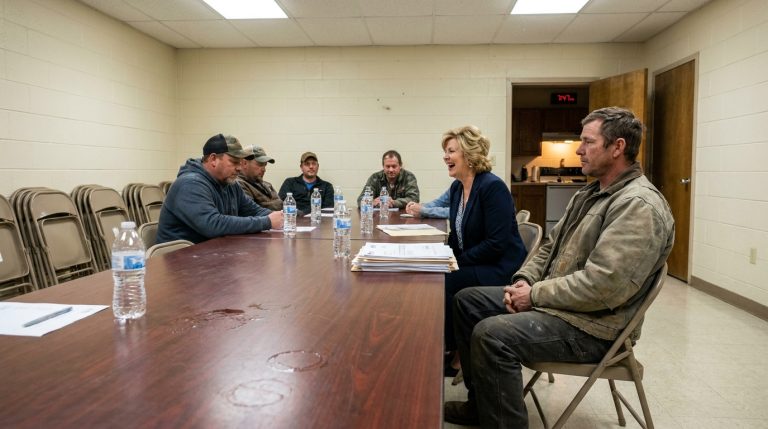
I needed to know. I walked toward the rec center, the gravel crunching under my boots with a sound like grinding teeth. Tonight was the information meeting. Darlene was inside, preparing to weaponize the community’s fear. She expected me to come in with the embezzlement ledger and trigger the collapse she had planned.
Instead, I had to pivot. I couldn’t use the ledger, and I couldn’t use the permit theory yet. I had to expose the lie itself.
I entered the rec center. The air was thick with the scent of floor wax and the low, agitated murmur of a hundred residents. Darlene was at the front, standing behind a podium draped in a tasteful, professional banner. She looked at me as I entered, her gaze lingering for a fraction of a second too long—a microscopic slip in her armor.
I sat in the back, the flash drive still in my pocket. I watched her scan the room, her confidence absolute, her control total. She believed she had won the chess game. She believed I was paralyzed by the weight of her leverage.
She began to speak, her voice melodic and rehearsed, about the ‘financial stability’ of the community. She was already setting the stage to paint anyone who questioned her as an enemy of the neighborhood’s prosperity. I felt the sharp, cold edge of resolve sharpen in my gut. I didn’t need the ledger. I needed the one document she had never dared to show: the original, un-redacted county correspondence from 1988.
If I could find that—if I could prove the lack of a federal seal—I wouldn’t just expose her. I would set the neighborhood free. But as she gestured toward the screen, a slide appeared with a photo of the pump system, the text labeled ‘Community Infrastructure Integrity.’
She was ready for me. She had anticipated my next move, and she was already weaving it into the lie. I realized then that I wasn’t just fighting Darlene; I was fighting an entire architecture of deception that had been allowed to rust into the foundation of Ridgeline for nearly forty years.
I stood up, the chair scraping loudly against the concrete floor. The room went silent. Darlene stopped, her eyes tracking me like a laser.
“Ms. Whitaker,” I said, my voice echoing off the vaulted ceiling. “I have a question about the maintenance invoices. But before we get to the money, let’s talk about the permit.”
The room inhaled, a single, collective movement of breath. Darlene’s expression didn’t change, but her hand, hidden below the podium, gripped the side of the desk with a white-knuckled intensity that revealed the truth: she was, for the first time in nine years, terrified that someone would finally ask the right question.
CHAPTER 7: THE EROSION OF AUTHORITY
Darlene stared at me, her expression a masterclass in controlled indifference. The room was deathly quiet. I could hear the faint, erratic ticking of the wall clock and the distant, muffled thud of rain against the rec center’s metal roof.
“The permit,” I repeated, my voice even, though my blood felt like liquid ice. “The 1988 Army Corps submittal you’ve been citing for nine years to justify your control over the drainage system. I checked the national registry today. That document has no federal seal. It was never filed. It’s a draft.”
A ripple of confusion moved through the crowd. I saw Chukwuemeka in the front row, his brow furrowed as he looked from me to the podium. Wendell Pruitt, sitting to Darlene’s right, looked like he was contemplating a sudden, permanent departure from the room.
Darlene finally moved. She didn’t look at me; she looked at the audience, her face shifting instantly into a mask of wounded, grandmotherly concern.
“Mr. Broussard is an engineer, not a lawyer,” she said, her voice smooth, hypnotic. “He confuses bureaucratic technicalities with the reality of our neighborhood’s safety. Whether a stamp exists on a document from 1988 is irrelevant to the fact that our pump has kept us dry for decades. He is trying to create a panic where none exists, to justify his own obsession with controlling the board.”
She was good. She had immediately framed my discovery as an elitist, technical abstraction, distancing the community’s emotional response from the objective fact of the fraud. But I wasn’t there to debate legal theory. I was there to break her control.
“It isn’t a technicality,” I said, stepping closer to the podium, my shadow stretching across the floorboards. “If the permit wasn’t filed, then this neighborhood is not a federally permitted flood-mitigation zone. Which means the HOA has no legal authority to impose fines for ‘unauthorized’ access to infrastructure. It means you’ve been holding the keys to a system you don’t legally own, for a neighborhood you’ve been lying to about its own existence.”
Darlene’s hand, still hidden below the podium, finally betrayed her. I heard the sharp, frantic clatter of keys against the table surface.
“And it means,” I continued, pressing the advantage, “that the reserve fund you’ve been raiding? The one you used to hire your ‘consultants’? That was community money being funneled into a project that had no legal standing to begin with. You weren’t protecting the neighborhood, Darlene. You were protecting your private access to a system that shouldn’t even be here.”
The room erupted. It wasn’t a roar—it was a sudden, chaotic release of sound. People were standing up, voices overlapping, the veneer of civil discourse shattering.
“Is this true?” Ruth Ann Calloway called out from the second row, her voice piercing the confusion. “Does the HOA own the pump, or not?”
Darlene’s facade finally cracked. The mask slipped, and for a fleeting second, I saw a woman who was just as exhausted, just as tired, and just as trapped by the lie as the rest of us. She looked at the crowd—her crowd—and saw not subjects, but a mob.
“I did what I had to!” she shouted, her voice losing its melodic control. “You have no idea what it takes to keep this place running! You think the creek cares about your permits? You think the water knows the difference between a stamped document and a piece of paper?”
“The water doesn’t care,” I said, my voice cutting through her panic. “But the law does. And the insurance companies do. And tomorrow, when they find out this neighborhood isn’t certified because the president spent nine years hiding the fact that the drainage system was a developer’s ‘temporary’ fix, they aren’t going to care about your intentions, Darlene. They’re going to care about the liability.”
She stared at me, the reality finally taking root in her eyes. I had given her the choice: hold the lie and watch it explode, or let go of the keys and accept the ruin of her legacy.
She turned away from the microphone, her shoulders slumped, the weight of the last decade visibly pressing her down. She walked toward the side exit, leaving the keys—the silver teeth of her petty, fragile kingdom—scattered on the podium.
The room remained in a state of stunned, paralyzed silence. I had won the skirmish, but as I looked out at the faces of my neighbors—the Okafors, Ruth Ann, the people who had trusted this lie to keep their homes safe—I realized the true cost of my victory. I had stripped away the protection of the lie, and now, we were all going to have to face the truth of the rusted, failing pipes beneath our feet.
The battle for control was over, but the fight for the neighborhood’s survival hadn’t even begun.
CHAPTER 8: THE PRICE OF THE SURFACE
The silence after Darlene left wasn’t peaceful; it was the hollow, resonant quiet of a tomb. I stood by the podium, my hands resting on the cold, laminated surface, while the neighborhood I had worked so hard to save dissolved into a frantic, panicked whisper.
Chukwuemeka was the first to approach. He didn’t ask about the pump keys. He didn’t ask about the embezzlement. He looked at the documents I had left on the table—the ones I had finally dared to reveal—and then he looked at me. His eyes were wide, the frantic energy of the meeting replaced by a terrifying, calm realization.
“It’s not just the pump, is it, Garrett?” he asked, his voice barely a tremor. “You aren’t just talking about the HOA bylaws. You’re talking about the land.”
I looked at the original 1988 schematics, the blue lines of the drainage channel looking less like infrastructure and more like a map of our own impending erasure. I nodded. There was no point in the lie anymore. Darlene had been a parasite, yes, but she had been a parasite living on a dying host.
“The culvert is fundamentally undersized,” I said, my voice feeling distant, as if someone else were speaking for me. “It was designed to fail in a fifty-year event. And because it was never officially certified—because there is no federal record of this neighborhood’s flood control—we aren’t just an unmanaged community. We are an uninsurable development.”
The news traveled through the room like a physical shockwave. I watched as people who had been shouting seconds ago suddenly went quiet, their faces draining of color. The reality of what this meant—the sudden, absolute evaporation of their home equity, the impossibility of future mortgage renewals—landed with a weight that defied description.
I walked out of the rec center, the night air biting and wet. The storm had passed, leaving behind a stillness that felt synthetic. My phone buzzed in my pocket—a text from Franklin Ossei. The Corps responded. They have no record of Ridgeline Estates. We are officially on the county’s list for site re-assessment.
I walked to the edge of the drainage basin, where the water was finally, slowly, receding. The moonlight glinted off the stagnant pools of standing water, highlighting the silt lines on the fence posts—the physical, inescapable record of our vulnerability.
I reached into my pocket and pulled out the flash drive. It contained the proof of Darlene’s embezzlement, the key to the decoy secret that had defined my obsession for eighteen months. I looked at it for a moment, then tossed it into the deep, dark mud of the retention basin. It was useless now. The embezzlement was a petty, small-time crime in the face of the monumental deception that had actually built this place.
I thought about the college freshman, the scholarship recipient who wanted to spend her life fixing the very thing that was currently destroying us. I had saved her a seat at the table of the future, but I had burned the foundation of our present to get there.
Petra was waiting in the car, her silhouette framed by the dashboard lights. She didn’t ask what happened. She simply looked at me, her eyes reflecting the exhaustion of a year spent living in the shadow of my investigation. I climbed in, the interior of the car smelling of rain and the stale, lingering scent of coffee.
“Is it done?” she asked.
“No,” I said, watching the streetlights pass by, each one illuminating a house that was now effectively worth nothing. “It’s only just starting. We saved the pump. But we lost the land.”
As we drove out of Ridgeline Estates, I looked in the rearview mirror. The neighborhood looked the same—the same manicured lawns, the same quiet, suburban cul-de-sacs, the same artificial perfection. But underneath the surface, in the rusted, failing geometry of the drainage pipes and the hollow, fraudulent bones of our legal existence, the rot was absolute.
I had spent my life believing that engineering was about fixing things—that if you identified the failure, you could build a solution. But as the darkness swallowed the neighborhood behind us, I realized that some things aren’t broken. They were built on a lie, and the only way to fix them is to let the water finally, inevitably, take its due.
I closed my eyes, the sound of the tires on the wet asphalt a rhythmic, steady reminder that I was finally, truly, going home—to a house that didn’t exist, in a place that had never truly been ours to save.