The Quiet Weight of Clay and Iron: A Middle Tennessee Surveyor’s Battle for a Dead Wife’s Soil
CHAPTER 1: THE FIRST INCURSION
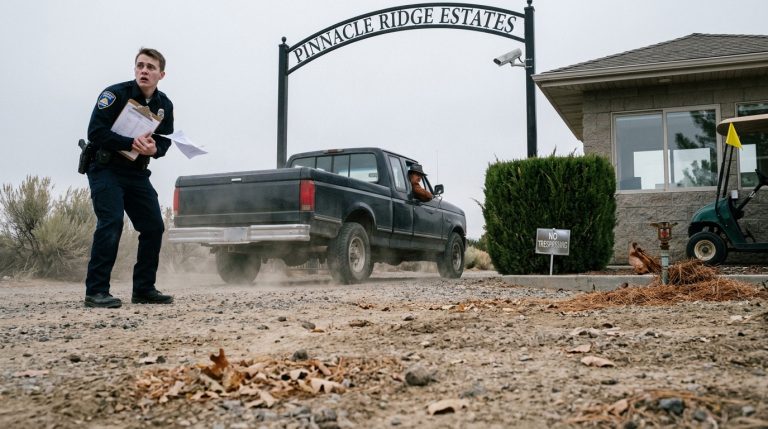
The smell of wild garlic and wet earth always hung heaviest in the low gap where the road turned to gravel. Calvin Whitlock kept his palm flat against the steering wheel of his F-150, letting the truck’s suspension roll with the ruts it had memorized over twenty-three years. To his left, the modern asphalt of Magnolia Bluff Estates curved away into clean, black ribbons, bordered by manicured fescue that looked like it had been trimmed with embroidery scissors. To his right sat the bottom land. Two acres of deep, unhurried Tennessee clay that didn’t care about subdivision bylaws.
He pulled the truck onto the shoulder, leaving the diesel engine to idle with a low, rhythmic knock.
In the middle of the first acre, sitting square over the survey line his father-in-law had staked with iron pipe in 1953, was a twin-axle utility trailer. The stenciled letters along its yellow steel flank—Bluff Hauling LLC—were flaking away in dry, sunny scales, leaving gray metal scars beneath. The tires had bitten deep into the rye grass, sinking four inches into the soft spring ground until the frame rested heavy against the earth.
Calvin climbed down from the cab. The latch on his door clicked with a dry, mechanical snap that seemed to vanish into the wide silence of the morning. He didn’t walk fast. A land surveyor spends half his life counting paces, measuring the world in fractions of an inch, and the first thing you learn is that haste ruins the line. He stopped at the edge of the trailer’s hitch, his boots settling into the damp weeds.
The lock on the coupler was new. A heavy master-lock, silver and clean against the rusted tongue of the rig. Someone had dropped it here with intention, unhooked the chains, and walked away.
He reached down, his fingers catching the rough, pitted surface of the trailer’s side rail. The iron was cold, retaining the chill of the creek bottom from the night before. This was Vernon’s land. It belonged to Heather before the clinic rooms and the white plastic identity bands took her name away, and now it belonged to a boy named Eli who was currently sitting in a middle school classroom three miles south.
A door slammed across the road.
The sound was sharp, metallic, breaking through the call of a mockingbird in the hackberry tree. Calvin didn’t turn his head immediately. He watched the shadow of a pearl-white Escalade grow longer across the gravel shoulder until the front bumper cut into his line of sight. The engine didn’t shut off; it remained purring, a quiet, expensive hum that smelled faintly of high-octane fuel and leather interior.
Loretta Brennan stepped down onto the stones. Her white linen tunic was long, stiff with starch, moving against the slight breeze like sailcloth. Her hair was a motionless platinum helmet, every strand pinned into place against the middle Tennessee humidity.
“Sweetheart,” she said, her voice carrying that high, polished weight of someone who spent her Tuesdays running committee meetings. “We’re going to need to move your truck back another ten yards. The caterers have three more flatbeds coming in for the spring committee setup, and we can’t have the entry lane choked.”
Calvin let his hand fall from the rusted trailer rail. He turned slow, his surveyor’s vest stiff against his chest. “This isn’t the entry lane, Mrs. Brennan. This is my lot.”
Loretta’s smile didn’t reach her eyes. It stayed fixed, a bright, professional veneer that looked like it had been applied with a roller. She walked toward him, her small sandals crunching rhythmically on the loose stone, her fingers already reaching out to touch the corner of the trailer as if checking a ledger.
“We coordinated this through the association parking board three weeks ago,” she said, her tone dropping into the patient cadence used for difficult children. “The community has an understanding regarding the overflow space. We’ve managed it for two seasons now. It’s a standard utility agreement.”
“I don’t have an agreement,” Calvin said. His voice was low, flat, matching the gray tone of the gravel beneath his boots. “And I don’t have an association.”
Loretta stopped two feet away. The smell of her perfume—something sharp and chemical like crushed gardenias—cut through the scent of the wet grass. She reached into her linen pocket and pulled out a small, heavy silver ring holding three keys, her fingernails painted the exact shade of the Escalade’s paint.
“Everyone south of the pike is part of the community fabric, Calvin,” she murmured, her thumb tracing the edge of the master lock on the trailer tongue. “We expect a certain level of neighborly compliance to preserve the aesthetic. Now, if you’ll just drop your tailgate and pull back to the highway line, we can avoid any formal paperwork.”
She didn’t look at him when she said it. She looked at the lock. And then she turned the silver key until the cylinder gave a short, metallic click, releasing the chain.
Behind her, in the shadow of the hackberry tree where the sun didn’t quite reach, Calvin saw the glint of a trail camera lens he’d strapped to the bark sixty-eight days ago, its small red infrared eye blinking once as the light shifted through the leaves.
CHAPTER 2: THE CERTIFIED NOTICE
“We don’t update the microfiche for non-conforming tracts unless the court orders a master plat revision, Mr. Whitlock,” the clerk said. Her voice was flat, dry as the yellowed paper sleeves stacked behind the plexiglass counter. She didn’t look up from her screen, her fingernails tapping a rhythmic, hollow code against the laminate. “If it’s not in the 1987 digital ledger, it doesn’t exist for tax assessment purposes.”
Calvin kept his forearms resting on the high oak table. The wood was old, its varnish long since worn down to a dull, gray grain by decades of grease from surveyors’ palms and county ink stamps. Beneath his thumbs, the rough edge of his certified deed copy felt heavy, the state seal cold and slightly raised under the paper.
“The assessment isn’t the title,” Calvin said. He didn’t raise his voice; he kept it in that low, mechanical register he used when checking a leveling rod in high wind. “My father-in-law filed the private easement three years before the county digitized the fourth district. It’s registered in Book 412, page ninety-four. The line cuts straight through what you’re listing as Magnolia Bluff overflow drainage.”
The clerk sighed, a short, dusty sound that smelled of old binders and stale coffee. She slid a heavy, black-bound ledger across the counter. The corner of the binder was split, exposing gray cardboard that had begun to fray into lint. “You can look at the historical plat, but if the developer laid the loop road over it in eighty-eight, the easement’s been superceded by community necessity. That’s standard variance logic.”
“Variance requires a signature from the deed holder,” Calvin said. “Look at the bottom of the page.”
He didn’t wait for her to turn it. He knew the page by heart. He’d spent three hours the night before under the bare bulb of his workbench, tracing the faded blue ink lines with a magnifying glass until the small, irregular script of Vernon Cumberland’s signature looked less like a name and more like a boundary fence. Vernon hadn’t signed any variance. He’d written Disputed in the margin, the pencil lead biting so deep into the paper that the indentation still showed on the reverse side seventy-three years later.
Calvin took his certified copies, folded them twice into his breast pocket, and walked out into the glare of the parking lot. The middle Tennessee heat was already rising from the gravel, a thick, shimmering vapor that tasted of iron and hot tar.
By noon, he was back at the low gap.
The air in the bottom land was completely still. The twin-axle trailer was gone, replaced by a gray sheen of crushed limestone where the tires had churned the clay into soup. But forty yards back, near the old cedar line, Donovan Brennan’s small John Deere backhoe was idling, its small diesel exhaust pipe puffing thin, blue rings into the hackberry leaves. The machine’s bucket was raised, its steel teeth caked with wet red mud that dripped onto the grass with a slow, heavy thud.
Cody Brennan stood by the front tire, a cordless angle grinder slung over his shoulder by a grease-stained nylon strap. He was younger than his father, his face thin and sharp under a sweat-ringed baseball cap, his eyes moving across the property line with a quick, nervous calculation.
Calvin didn’t stop his truck in the driveway. He drove straight across the ditch line, the F-150’s tires crunching through the elderberry bushes until the front bumper was ten feet from the backhoe’s radiator. He cut the ignition. The silence that followed was heavy, broken only by the ticking of his hot manifold and the low, steady rattle of the John Deere’s engine.
He climbed out, carrying the four-pound post driver in his right hand. The iron tool was cold, five pounds of solid steel pipe welded to a solid slug, its surface pitted with black rust from a hundred fence lines.
“Donovan,” Calvin said, walking up to the side of the cab. He didn’t look at Cody. He kept his eyes on the older man’s hands, which were resting loosely on the hydraulic levers. “You’re three feet over the pipe.”
Donovan shut down the engine. The silence deepened, the sudden lack of vibration making the air feel thick, heavy with the scent of unwashed denim and diesel oil. He climbed down from the metal seat, his boots sinking into the fresh-turned clay. He looked at the ground, then at the post driver in Calvin’s hand, then back down at his own boots.
“Calvin, look,” Donovan said, his voice dropping into that familiar, apologetic drone he used whenever his wife’s names appeared on a zoning notice. “Loretta said you two had a conversation this morning. Said you were going to let us clear this back corner so the utility rigs could drop the transformer pads for the clubhouse tents. She said the board approved a temporary clearance variance.”
“Loretta doesn’t own the dirt under your boots, Donovan,” Calvin said. He set the post driver down on the grass with a dull, heavy metallic clink. “And the board doesn’t have a variance unless it comes out of my pocket. Your boy’s got an angle grinder.”
Cody stepped forward, his hand settling on the plastic grip of the tool. “The signs were blocking the sightline for the entry loop, Mr. Whitlock. My mom said they weren’t code compliant anyway. We’re just putting them in the bed so you can relocate them to your house line.”
Calvin looked at the boy. He noticed the silver-colored metal filings caught in the fabric of Cody’s jeans, the small, bright shrapnel of the four-inch steel post he’d driven into the ground with quick-set concrete two days ago. The post itself was lying in the weeds behind the backhoe, its bottom half sheared off at a clean, jagged forty-five-degree angle, the white industrial paint scorched black by the wheel’s heat.
“You cut the concrete anchor,” Calvin said. It wasn’t a question.
Donovan looked at his son, then reached out and tapped the grinder’s battery pack, his thick thumb covered in black grease. “Put it in the truck, Cody. Go on.” He turned back to Calvin, his face gray under his tan line. “We didn’t mean to destroy nothing, Calvin. Truly. Loretta’s got eighty-four houses expecting this gala to go off without a hitch on Friday. She’s… she’s been under a lot of pressure about the community revenue projections. The board’s been asking where the maintenance fees have been routing.”
“The fees from my lot?” Calvin asked.
Donovan opened his mouth, then closed it slow. His eyes shifted toward the gravel road, where the pearl Escalade was idling at the entrance of the Magnolia Bluff loop, its chrome grill catching the midday light like a row of silver teeth. “I just do the hauling, brother. You know how it is. She says hook it up, I hook it up.”
“Take your machine off the clay, Donovan,” Calvin said. He reached into his pocket and pulled out the first certified mail receipt—the green card with Loretta’s small, tight signature dated three days ago. He didn’t hand it to him. He held it open between his thumb and forefinger so the older man could see the state stamp. “The thirty days started Tuesday. If that machine’s still behind the cedar line when the sun goes down, I’m calling the county sheriff for commercial vandalism. And Cody’s name goes on the report first.”
Cody spat into the dirt, but his hand had come off the grinder’s grip. He climbed into the backhoe’s buddy seat without looking back.
Donovan watched the green card for a long moment, his jaw working as if he were trying to calculate the weight of the paper against the weight of his wife’s instructions. Then he nodded once, a short, jerky movement that looked like it hurt his neck. “We’re leaving, Calvin. We’re leaving right now.”
Calvin stood by the crushed elderberry bushes as the backhoe rumbled back across the ditch line, its metal tracks leaving gray, iron-scaled scars in the grass. He didn’t move until the sound of the diesel engine had faded into the hum of the highway down the road.
When he walked back to his truck, he saw a small white envelope tucked under his driver’s side wiper blade. The paper was heavy, expensive, embossed with the gold seal of the Magnolia Bluff Estates Homeowners Association. Inside was a single sheet of typed text, signed by Loretta Brennan as President.
The text didn’t mention the boundary line. It didn’t mention the trailers. It listed a non-compliance fine of fifty dollars a day for illegal industrial storage on a community-controlled easement, effective retroactively to the first of the month.
Calvin didn’t rip it. He didn’t throw it in the dirt. He folded it carefully, slid it into his surveyor’s notebook next to the 1953 plat notes, and turned his key in the ignition.
CHAPTER 3: THE FALSE BOTTOM
The glow of the laptop screen was small, cold, and blue against the dark oak of the kitchen table. It didn’t reach the corners of the room, where the shadows hung thick and smelled faintly of the damp pine wood Calvin had tracked in from the garage. Eli was asleep upstairs, his room completely silent except for the occasional, distant thrum of a semi truck braking on the state highway two miles west.
Calvin sat with a yellow legal pad beneath his left forearm, his thumb pressing into the coarse, fibrous edge of the paper. Spread around him were three years of Magnolia Bluff Estates public tax filings—the Form 990 disclosures required by the state for non-profit entities crossing the fifty-thousand-dollar annual threshold.
His fingers left faint, gray grease smudges on the margins. He’d spent the last four hours cross-referencing the association’s declared line-item expenses with the county clerk’s public infrastructure plat.
There was a hole in the numbers. It wasn’t large enough to draw a state audit on its own, but to a man who spent his days finding the missing inches between iron stakes, it was as wide as a canyon.
Under Schedule O, listed as Miscellaneous Community Service Revenue, the association had registered exactly eighteen thousand four hundred dollars a year for twenty-four consecutive months. There were no receipts attached. No commercial vendor licenses. No insurance certificates from the Tennessee Department of Commerce and Insurance.
Calvin tapped his pencil against the table. The graphite lead made a small, solid click that seemed to echo in the empty kitchen.
Eighteen thousand dollars divided by twelve trailers was exactly twelve hundred and fifty dollars a trailer per year. Or roughly one hundred dollars a month. But Joyce Tillman had told him at the mailboxes that the drivers were paying two hundred.
He leaned back, the old wood of his chair creaking under his weight. The extra hundred wasn’t going into the association’s bank account. It was being split before the ink ever dried on the ledger. But it wasn’t just a simple cash skim. He looked closer at the plat map laid over the tax documents, his fingers tracing the bold, dotted line that marked the boundary of his second acre.
The developers of Magnolia Bluff had designed their eastern storm-water retention basin to drain straight through the limestone ditch at the edge of his property line. On paper, they called it a Non-Exclusive Drainage Variance. But according to the state environmental code book resting by his elbow, an association couldn’t route commercial-grade runoff into a private, non-conforming tract without carrying a five-million-dollar umbrella liability policy to protect the downstream water table.
Loretta hadn’t bought the policy. The association’s insurance schedule listed only a standard two-hundred-thousand-dollar slip-and-fall coverage for the community pool and the clubhouse walkway.
Instead, she had shifted the entire physical perimeter of the subdivision’s liability zone three hundred yards east, right over his late wife’s family soil. By listing his private lot as “Community Overflow Coordination” on the official neighborhood mailer, she wasn’t just pocketing the trailer fees—she was using his land as a physical buffer to hide an un-certificated commercial zoning expansion from the county inspector. If a trailer leaked diesel into the limestone shelf, the state wouldn’t fine Magnolia Bluff. They would fine the deed holder. They would fine Calvin.
The phone on the table buzzed, its short, violent vibration cutting through the quiet like a rusted blade.
The screen lit up with a low-resolution thumbnail image from the hidden trail camera on the south cedar tree. The timestamp read 12:14 AM.
Calvin picked up the device, his thumb leaving a damp print across the glass. The image was grainy, washed out by the camera’s grey infrared flash, but the shape was unmistakable. A long, white commercial flatbed truck was backed up against the steel bollards he’d set in concrete forty-eight hours ago. Two men in dark insulated vests were standing by the rear bumper, their figures silhouetted against the bright, reflective sheen of his fresh-painted tow signage.
One of them was holding something heavy—a long bar that caught the light like polished iron.
Calvin didn’t jump up. He didn’t reach for his keys. He sat perfectly still for three slow breaths, watching the live feed refresh every ten seconds as the cellular uplink pushed the data to his cloud account.
The second man walked to the front of the truck and reached into the driver’s side bed, pulling out a heavy pair of long-handled bolt cutters. He didn’t look at the trees. He didn’t look at the hackberry branch where the fake birdhouse sat twelve feet above his head. He walked straight to the quarter-inch chain stretched between the bollards, leaned his full weight into the handles, and brought them together.
The screen flickered as the camera registered the movement. Through the small microphone on the unit, a sharp, metallic ping cut through the low hiss of the wind—the sound of tempered steel snapping under three tons of mechanical leverage.
The truck rolled forward, its rear tires flattening the wild blackberry bushes Calvin had cleared the previous autumn.
Calvin closed the app. He picked up his pencil, turned to the third page of his yellow pad, and wrote down the time, the license plate visible on the flatbed’s rear bumper, and the exact position of the truck’s left front tire relative to the 1953 iron pipe.
He didn’t call the substation. He knew Bo Henley was on the day shift, and the night deputy would only file a standard non-emergency trespass form that would sit at the bottom of the county basket until Tuesday morning. The law in the bottom land required more than an entry log; it required a finished pattern.
He stood up, walked to the window, and looked out into the black yard. The sky was clear, the cold light of the stars catching the gray tin roof of his tool shed. Beneath that roof sat three more certified copies of the 1987 resurvey, each sealed in its own plastic sleeve, waiting for the legal counsel Loretta had claimed to have but hadn’t yet named.
The decoy was clear now. Loretta wanted him to fight her on the trailers. She wanted him to argue about the noise, the mud, and the two-hundred-dollar fees, because as long as he was looking at the trucks, he wasn’t looking at the drainage basin or the state ethics disclosures. She was willing to pay her son Cody to cut his chains every night if it kept Calvin from looking at the bottom of the ledger.
He reached down and turned off the laptop. The kitchen went black, the sudden darkness heavy and thick around him. He could feel the cold draft coming up through the floorboards from the cellar—the old, damp smell of stone and lime that had been here since Vernon Cumberland first turned the sod with a mule and a iron plow.
Tomorrow would be different. He’d let her fill the lot until the grass was gone. He’d let her think the chain was the only fence he had left.
CHAPTER 4: THE DEEPENING TRENCH
“The steel’s thicker than the ones on the retention gate, Dad,” Eli said. He didn’t lift his eyes from his math folder, his pencil point hovering precisely above a long division column. The kitchen smelled of bacon grease and the sharp, chemical tang of the orange cleaner Calvin had used to wipe down his surveyor’s transit. “I heard the snap from my bedroom window. It didn’t sound like regular pliers. It sounded like an iron pipe breaking.”
Calvin stood by the sink, his thumbs hooked behind the leather straps of his work vest. The morning light coming through the small glass panes was thin, desaturated, throwing cold gray squares across the linoleum floor.
“Go on back to your work, bud,” Calvin said. His voice was a dry rattle, flat as the bottom land clay. “A chain’s just an invitation for a man to prove what kind of tool he carries in his truck. It doesn’t shift the boundary marker an inch.”
He walked out onto the back porch, the screen door slamming with a loose, wooden rattle that died instantly in the heavy morning mist.
The bottom land was silent, but it wasn’t empty. The three trailers that had rolled past his broken bollards at midnight were sitting in a ragged semicircle near the old hackberry tree. One was a triple-axle flatbed loaded down with four-ton skid steer attachments—their heavy iron buckets caked in dry, yellow field dust that sifted down into the rye grass with every small gust of wind. The two others were green landscape rigs, their tires sunk deep into the drainage swale Calvin had trenched out two summers ago.
The quarter-inch steel chain lay in the gravel driveway like a dead copperhead, neatly severed into two clean segments.
Calvin knelt down in the wet stones. His calloused fingers picked up the heavy brass padlock he’d bought at the farm co-op. The hardened shackle was gouged, the silver metal beneath the gold finish sheared flat by a commercial-grade blade that had required two men’s weight to close. He felt the raw friction of the cut edge—it was hot enough during the strike to leave a small, bluish heat ring around the perimeter of the scar.
He didn’t drop it into the weeds. He placed the heavy lock into his side pocket, where it clinked against his iron plumb bob with a dull, hollow thud.
A low, scraping sound came from behind the cedar line.
Calvin stood up, his boots crunching slow through the gravel until he reached the ditch where the old 1953 easement met County Road 142. A white commercial pickup—Cody Brennan’s truck—was backed up against the ditch line, its tailgate dropped flat against the weeds. Cody was standing in the bed, his arms wrapped around a heavy bale of orange silt-fencing wire, while a second man in an unbuttoned flannel shirt used an iron spade to dig a shallow trench along the edge of Calvin’s deeded access loop.
“You’re four feet over the line, Cody,” Calvin said. He didn’t yell. He stood on the edge of the culvert, his arms hanging straight down at his sides, his fingers resting near the brass brass grommets of his tape case. “The easement covers twenty feet from the center of the gravel. You’re digging in the private driveway.”
Cody didn’t drop the wire. He wiped his nose with the back of his sleeve, leaving a long smear of dark gray grease across his cheek. His eyes were small, bloodshot from the midnight run. “The county drainage maps say this ditch belongs to the district overflow, Mr. Whitlock. My mom got the printouts from the courthouse yesterday. We’re just setting the silt screen before the grading crews bring the gravel for the gala tents tomorrow.”
“The county maps haven’t been updated since eighty-seven,” Calvin said. He stepped down into the ditch, his heavy boot settling three inches into the loose earth the spade had turned up. The dirt smelled of old iron and rotted leaf mold. “The drainage variance you’re running doesn’t exist on the master deed. If you drop that screen, you’re blocking a permanent private right-of-way.”
The man with the spade stopped digging. He looked at Cody, then looked down at the iron blade of his tool, his thumbs checking the rough wood of the shaft. “Cody, your old man said this was cleared through the board. He said the surveyor guy gave the thumbs up on the setback.”
“He didn’t give nothing,” Cody snapped, his voice climbing into that thin, nervous register that matched his mother’s when she ran out of citations. He slammed the wire bale down onto the truck’s bed with a loud, metallic boom that made the crows in the hackberry tree scatter. “He’s just sitting over there on his porch with his little notebook trying to stall the committee. My mom said the association’s got legal possession by continuous use anyway. We don’t need his signature to protect the community water channel.”
Calvin looked at the spade blade resting in his dirt. He didn’t look up at Cody. He reached into his vest pocket, pulled out his small cellular receiver, and checked the uplink indicator. The five cameras were all green. The birdhouse unit had a clear view of the spade, the truck’s license plate, and the long, silver handles of the commercial bolt cutters lying on the floorboards of the cab behind Cody’s seat.
“The sheriff’s got three reports on this ditch since March, Cody,” Calvin said, his voice dropping into a flat, steady drone that had the weight of an anchor chain. “Your mother signed the green return card for the cease-and-desist seven days ago. Every spade full of dirt you turn out of this right-of-way is another fifty-dollar property damage assessment on the civil claim. And your father’s name is on the hauling registration for every rig sitting behind my broken post.”
Donovan’s son took a step toward the tailgate, his knuckles turning white against the steel side rail. “You think you’re the only man in this county who knows how to read a piece of paper, Whitlock? My uncle’s been sitting on that planning commission since before you had a license. You think a judge is going to look at some rusted 1953 pipe when the whole neighborhood’s standing out here in their suits tomorrow?”
“They won’t have to look at the pipe,” Calvin said. He turned his back on the truck, his boots dragging through the turned earth as he walked back toward his driveway. “They’ll be looking at the video.”
Behind him, the spade didn’t start again. He heard the sudden, violent crank of the pickup’s starter, the gears grinding twice before the diesel engine caught with a thick, smoky rattle. The truck jerked forward out of the ditch, its rear tires throwing an arc of wet clay and gravel across his reflective tow signs before it roared around the loop toward the Magnolia Bluff entrance.
Calvin walked to the middle of the lot where the triple-axle trailer sat. The air was getting thicker now, the midday sun pressing down through the mist like a hot iron flat. He looked down at the grass beneath the heavy tires—it was already turning yellow, dying from the pressure of the weight, the stems crushed flat against the rusted limestone rocks that Vernon Cumberland had hauled up from the creek bottom with his bare hands seventy-three years ago.
The trap was holding its frame, but the structure was getting heavy. He could feel the rage sitting back in his chest, that hot, dry place that had stayed cold since Heather’s funeral. He didn’t want to yell. He didn’t want to drive over to the clubhouse and shove the broken chain through Loretta’s windshield. He wanted the paperwork to do what the iron posts couldn’t. He wanted it to finish the line.
He reached into his vest, pulled out his notebook, and checked the time. 11:42 AM. The gala was less than twenty-four hours away, and the first caterer’s van was already idling at the pike intersection, its white paint spotless against the gray Tennessee clay.
CHAPTER 5: THE RECUSAL MOVE
The frosted glass door of Rourke & Associates didn’t rattle when the wind came off the pike, but the light through it was gray, desaturated by the thick thunderheads building over Williamson County. Nadine Rourke didn’t look up from her desk. Her thumb, stained a dark purple from a leaky fountain pen, was pressing flat against the corner of a notarized affidavit.
“Wendell Coover left a message on your home phone because he knows the county clerk didn’t scan the 1987 master file,” Nadine said. Her voice had the dry, mechanical rhythm of an old typewriter carriage. She slid a yellowed map across the blotter. The edges were reinforced with brittle cloth tape that smelled of starch and damp cellars. “He’s trying to settle this as an administrative error before the full board reviews the drainage variance tomorrow morning. If you walk into that commission office without a recorded title link, he’ll table the dispute for sixty days. By then, the gala’s over, the trailers are gone, and the mud is dry.”
Calvin sat with his hands resting on his knees. The leather of his work boots was caked with red clay from the morning’s trench line, the dirt drying into pale, dusty cakes that flaked onto the low pile carpet whenever he moved his feet.
“The title link is in the binder,” Calvin said. His voice was low, level, keeping the same cadence he used when counting out steel chains in a briar patch. “Vernon didn’t just file the driveway plat. He paid five hundred dollars to Ralph Coddington to run the metes and bounds from the original tobacco stone. The marker’s still there under the hackberry roots.”
Nadine turned the page of his notebook. Her index finger stopped on the screenshot of the email Loretta had sent to eighty-four households—the one listing the surveyor chemicals and the environmental hazard.
“The email is defamation per se under Tennessee law, Calvin. It strikes at your trade,” she murmured, her pen leaving a small, sharp dot of ink next to the word toxic. “But the zoning complaint is where the weight is. Look at the signature on the commission summons.”
Calvin leaned forward, his vest stiff against the edge of the desk. The document was a single sheet of coarse white paper, bearing the official letterhead of the Williamson County Planning Commission. At the bottom, where the administrative secretary normally stamped the filing number, was a handwritten notation: Emergency Review – Special Session. The ink was fresh, a bright royal blue that hadn’t yet faded into the gray of the page.
The name beneath the line was Wendell Coover.
“He didn’t route this through the intake desk,” Calvin said.
“No,” Nadine replied, her lips tightening into a thin line that looked like a scar. “He signed it himself as presiding officer for the third district. He’s using his seat to create a temporary enforcement zone over your second acre. If the county inspector rolls out there this afternoon based on an emergency summons, they can impound the trailers under the municipal nuisance code, but they’ll fine you for the unpermitted access point.”
The phone in Calvin’s pocket buzzed once. A short, hard vibration that meant another cellular camera had uploaded a file. He didn’t look at it. He kept his eyes on the royal blue ink of Wendell’s signature.
The trap wasn’t just in the mud across the gravel road. It was here, in the small, carpeted rooms where the town’s lineage was sorted out over coffee and handshakes. Loretta had the volume, but her brother had the pen. They had spent thirty years building an infrastructure of small variances—shifting a line five feet here, erasing a ditch there—until the map looked exactly like what they needed it to look like to keep the revenue moving through Bluff Hauling LLC.
“We go to the commission office,” Calvin said.
“I go,” Nadine corrected, her hand settling flat over his certified deed binder. “You stay on the clay. If you’re sitting in a waiting room in Franklin when the setup crews arrive, Cody will have the silt fence closed and the driveway blocked by three o’clock. You need to hold the physical line so the tow company has clear access to the stakes at dawn.”
She stood up, her long linen skirt rustling against the desk drawers. She picked up a manila folder labeled Tennessee Bureau of Ethics – Coover Request for Investigation and dropped it into her briefcase. The brass latches clicked shut with a loud, metallic snap that sounded exactly like the padlock shackle he’d found in the weeds.
“Wendell has eight minutes before the preliminary docket opens,” she said, looking at the wall clock behind him. “By the time I’m done reading the recusal statute into the record, he’ll either sign the administrative closure or he’ll be explaining that voicemail to the state campaign finance board before the weekend starts.”
Calvin stood slow, his knees cracking in the quiet room. He reached into his pocket and pulled out the flash drive—the one containing the hidden birdhouse camera footage of Cody cutting the chain with the commercial cutters while Loretta pointed from the front seat of her Escalade. He laid it on the desk next to her pen.
“Give him the video first,” Calvin said.
Nadine looked at the small silver casing of the drive, her thumb tracing the plastic edge where the serial number was stenciled. Her half-smile was small, cold, the expression of a land-title attorney who had spent fifteen years watching people lie about rocks and fences. “I’ll save that for the second reading, Calvin. Let him commit to the variance under oath first.”
He walked back out to his truck through the heavy, hot rain that had finally begun to fall. The drops were large, smashing against the hood of his F-150 with a flat, hollow sound that smelled of hot iron and asphalt grit. As he turned the key in the ignition, his cellular app lit up with a new notification from the north camera.
The image was a single frame of the pearl Escalade. It wasn’t idling at the road loop this time. It was backed up across his property line, its rear tires sitting square in the fresh-turned ditch Cody had dug, the chrome bumper six inches from the cedar fence posts he’d left in the weeds three years ago.
Loretta was out of the vehicle. She was holding a large clipboard, her blonde hair protected by a clear plastic rain hood, pointing two caterers toward the center of his unmowed grass.
Calvin shifted the truck into drive, the transmission clunking hard under the floorboards. He didn’t rush. He let the engine warm to its line, his hands settling into the grooves of the wheel as he turned the truck back toward the low gap.
CHAPTER 6: THE MORNING OF THE GALA
The air was the color of a wet slate shingle when the first rotator rig rounded the low gap. It didn’t carry a siren, but the deep, operational drone of its twin-turbo diesel engine vibrated straight through the floorboards of Calvin’s parked truck. Then came the others. Two heavy-duty wheel-lift trucks, three steel-bed rollbacks, and Boyd Pellerin’s lead wrecker, its yellow strobe lights painting long, mechanical arcs across the wet hackberry leaves.
Hydraulics hissed in the dawn mist, a sharp, white cloud of pressure venting from the chassis line as Boyd swung his boots down into the clay. His blue shirt was already damp at the shoulders, his thumb hook resting behind the brass latch of a clean, leather-bound folder.
“Six rigs, Calvin,” Boyd said, his voice a low, mechanical rumble that matched the idling trucks. He didn’t look at the subdivision loop. He looked at the eight reflective signs driven three feet into the concrete anchors along the fence line. “Every single hook is code-compliant under Section 55-16. If we start lifting, we have to keep the line moving. I can’t have a rig blocked by an association vehicle once the clearance is locked.”
Calvin stepped out into the wet stones. His fingers were stiff, caked with the fine iron-oxide grit of the original 1987 survey binder he’d pulled from the workbench drawer at four in the morning. “The line’s already locked, Boyd. Cody’s white pickup is tucked behind the swale, and the pearl Escalade dropped its rear axles across the driveway marker at five-fifty-five. Hook the trailers first. Save the pearl for the road cut.”
The crew moved with a quiet, transactional rhythm that had no room for theater. There were no shouts, no slammed doors. The steel chains clinked with a low, heavy rattle against the utility rigs, the winches groaning as the first two-axle landscape trailer was hoisted six inches off the sod, its flaking yellow paint shedding dryscales into the rye grass. Within twelve minutes, the flatbed loaded with skid steer attachments was secured to the rollback, its iron buckets dripping wet red mud onto the steel deck with a slow, heavy thud.
By seven-fifteen, the lot was cleared down to the packed dirt. The only structures left standing were the two five-foot steel bollards and the pearl-white Escalade parked diagonally across the western survey line, its polished chrome grill catching the cold, gray light of the rising sun.
A door slammed at the clubhouse down the lane.
Loretta Brennan came across the road in her bedroom slippers, her hair half-pinned beneath the clear plastic rain hood, the hem of her peach-colored gala gown dragging through the wet roadside weeds. She was holding a large metal clipboard against her chest like a shield, her face white under her makeup.
“Stop this right now!” she screamed, her voice climbing three octaves as she reached the edge of the culvert. “That is my personal vehicle! You are on community property! Donovan! Cody! Call the precinct! They’re stealing the equipment!”
Boyd didn’t look up from his hydraulic controls. His calloused palm threw the secondary lever, the steel wheel-lift arms sliding beneath the Escalade’s rear differential with a heavy, grease-rimed metallic clank. “Signs are posted every fifty feet, ma’am. Non-consensual tow zone under state code. You can recover the unit at the Spring Hill yard for four hundred dollars plus storage.”
“Calvin!” She turned on him, her slippers slipping in the loose gravel as she marched toward his porch step. Her fingernails were dug so deep into the wood of her clipboard that the gold leaf emblem was bent flat. “You did this. This is administrative harassment! My brother is the district commissioner! I have a legal variance for this entire drainage corridor!”
The high, rhythmic whine of a sheriff’s cruiser cut through her voice. Two white-and-blues pulled onto the shoulder, their blue strobes reflecting off the wet sheet metal of the wrecker line. Deputy Bo Henley got out of the lead unit, his Stetson pinned low against the mist, his hand resting loosely on the thick leather of his belt.
He didn’t run. He walked to the center of the right-of-way, took the certified binder Calvin handed him, and thumbed through the three pages of the 1987 resurvey.
“The variance is a duplicate, Mrs. Brennan,” Bo said, his tone flat, entirely drained of neighborly interest. “Your brother signed the emergency summons yesterday at two, but the Chancery Court issued an administrative stay on the district ledger at four-thirty. Your subdivision loop was laid over a recorded private easement that predates the master plat by thirty years. From what the title office is showing, the association’s been draining commercial runoff through this man’s dirt without a structural certificate since eighty-eight.”
Loretta’s hand dropped from her clipboard. A single, heavy raindrop struck the metal surface, making a sharp, hollow tink that seemed to echo through the empty lot.
Behind her, a white cargo van with a teal logo—WSMV News 4—pulled onto the grass shoulder, its side door sliding open with a heavy mechanical rattle as a cameraman hoisted a shoulder-mounted lens into the gray light.
Calvin walked down the steps. He kept his hands inside his surveyor’s vest, his thumb pressing against the smooth, cold edge of the brass padlock he’d carried in his pocket since midnight. He stopped two feet from the Escalade’s rear bumper as the winch chain pulled the vehicle’s front tires four inches off his stone driveway.
“The fees were never about the parking, Loretta,” Calvin said. His voice was very low, a dry, raspy sound that carried the full weight of the two years he’d spent waiting by the cedar fence posts. “You needed the trailers on the grass because as long as the lot looked like a commercial yard, the state inspector couldn’t take a core sample of the retention basin without a third-party warrant. Your brother didn’t build the loop road to help the neighborhood. He built it to bury the original developer’s shortfall before the county checked the deed link.”
He turned to the television reporter who was stepping onto the gravel with her microphone raised. He didn’t look at the camera; he looked past it, toward the low hill where the gray tin roof of his mother’s unfinished cottage was visible through the clearing hackberry trees.
“My name is Calvin Whitlock,” he said, his words falling slow and even into the microphone’s foam screen. “This is my wife’s family land. It’s been here since nineteen-fifty-three. Every vehicle removed today was parked in violation of a recorded private right-of-way that no board vote can touch. My lawyer will be filing the master accounting claim in Franklin on Monday morning for the fifty-seven thousand dollars in unauthorized revenue, and the remainder goes into a private trust for the county border research.”
He didn’t wait for her next question. He turned and walked back toward his truck, his heavy boots sinking into the wet clay one last time as the rotator hoist groaned, lifting the rear of the pearl Escalade until its exhaust pipe scraped against the gravel with a short, jagged hiss.
Loretta sat down on the concrete curb in her peach dress, her face buried in her hands as the bluegrass band began to tune their banjos on the clubhouse lawn three hundred yards away. The sound of the strings was thin, high, and completely lost in the roar of the diesel wreckers rolling out toward Highway 31.
CHAPTER 7: THE PIPELINE LEDGER
The tumblers inside the county vault dial didn’t click; they caught. It was a heavy, industrial drag that Calvin felt in the marrow of his thumb—the resistance of seventy-year-old brass tumblers coated in dried whale-oil grease.
Nadine Rourke didn’t offer to help. She stood under the single flickering fluorescent tube of the basement annex, her wool coat slung over a stack of unbound tax assessments from the Great Depression. The air down here smelled of lime mortar, old leather, and the specific bitter tang of iron-oxide ink that had spent forty years rotting in the dark.
“The 1988 corporate filings aren’t on the general registry, Calvin,” Nadine said, her voice dropping into that low, flat scratch that surveyors used when the rod was obscured by brush. “When Magnolia Bluff Estates incorporated, their legal team didn’t file a standard developer’s plat. They filed a Restructured Assets Inventory. It’s a corporate mask used to hide boundary overlaps from the title examiners.”
Calvin pulled the heavy iron door open. It swung with a low, hollow groan that vibrated through the concrete floor.
Inside the small steel safe sat three ledgers bound in canvas so stiff with dry rot it looked like rusted sheet metal. He reached in, his calloused palm catching the rough edge of the middle volume. The title stamp on the spine was barely legible under a layer of gray county soot: Cumberland Land & Development Corp – Dissolution Minutes.
He laid the book on the zinc table.
“Look at the third section,” Calvin said. His fingers were dark with soot as he turned the pages, the paper giving a dry, rhythmic snip-snip that sounded like scissors through buckram. “Vernon didn’t just write Disputed on the map. He filed an administrative injunction against the state highway department three months before the loop road was graded. Look at the variance number.”
Nadine leaned over his shoulder, her glasses catching the blue glare of the overhead tube. Her index finger, still stained with ink from Monday’s filings, stopped on a small, purple ink stamp at the foot of page forty-two.
The stamp read: RESCINDED BY EXECUTIVE VARIANCE #88-041.
Beneath the line, where the county registrar’s seal should have been pressed into the paper, was a different mark. A small, notched brass disk had been taped to the parchment, its face stamped with five raw letters: CORP-VOID.
“That’s not a county variance,” Nadine whispered, her thumb tracing the jagged edge of the brass disk. “That’s a corporate liquidation marker. The original developers didn’t erase the easement by getting a vote from the planning commission. They bought Vernon’s old surveying partner out of his corporate shares while Vernon was in the VA hospital in Nashville, then voted to declare the driveway an ‘abandoned asset’ under the standard corporate restructuring code.”
Calvin didn’t look up from the ink line. He felt a small, cold knot tighten in his jaw—the exact same sensation he’d gotten when the clinic doctor told him the cells had reached the liver.
The line wasn’t lost through an old mistake. It was stolen in a room with twelve-foot ceilings by men who wore suits and used fountain pens to cut fences.
“They needed the access,” Calvin said. His voice was a flat, level stone. “If the Cumberland family kept the twenty-foot driveway off County Road 142, the subdivision couldn’t close the gate on the eastern loop. They couldn’t charge the premium for the privacy fence because Vernon had a legal right to drive a tractor straight through what is now their third fairway.”
“And Loretta knew,” Nadine said. She reached into her briefcase and pulled out the typed ledger from the Magnolia Bluff HOA bank account—the one they’d seized through the Chancery Court order on Tuesday morning. “Look at the payment routing. The eighteen thousand dollars a year wasn’t just cash from the trailer drivers. It was being paid out as a ‘Right-of-Way Maintenance Fee’ to a holding company called Cumberland Valley Horizon LLC. The registration address for that LLC is a post office box in Wet Satsuma, Texas.”
Calvin picked up the notched brass disk. The metal was cold, smelling faintly of sulfur and copper scale.
The map wasn’t finished. It had just crossed the state line.
The cellular receiver in his vest pocket gave two short, sharp vibrations. A long-distance area code lit up the screen—a 432 number from the oil patches of West Texas.
He picked it up, his thumb leaving a dark smudge of vault dust across the glass screen.
“Whitlock,” he said.
The voice that came through the receiver was dry, raspy, filtered through forty years of pipeline dust and cheap tobacco. “Calvin Whitlock? My name’s Arthur Vance. I’m looking at a 1987 survey map with your father-in-law’s signature on the corner pipe, and there’s three crew trucks from a company called Cumberland Horizon sitting on my fence line with a hydraulic ram. They tell me my machine shop’s coming down before Friday.”
Calvin looked down at the canvas-bound ledger on the zinc table, then at the purple ink stamp that had tried to erase his wife’s soil thirty-eight years ago.
“Don’t let them drop the boom, Mr. Vance,” Calvin said, his voice dropping into that slow, unhurried cadence that had settled over middle Tennessee at dawn. “Keep your machine running. I’m loading the truck now.”
CHAPTER 8: THE WEST TEXAS JUNCTION
The high, rhythmic screech of the hydraulic ram didn’t change pitch when it hit the outer corner panel of the shop. It was a mechanical, grinding vibration that travelled through thirty yards of sun-baked caliche, through the soles of Calvin’s work boots, and straight into his lower jaw. The dust out here wasn’t like the red clay of the Cumberland bottom land; it was white, chalky, and smelled of sour gas and parched iron oxide.
Arthur Vance stood on the gravel shoulder, a heavy, grease-rimmed pipe wrench slung under his arm by a cracked leather thong. His blue canvas work shirt was bleached gray by the Permian sun, his boots buried two inches deep in the loose scree at the edge of his property line.
“They brought the three-ton boom from the Pecos yard at daylight, Mr. Whitlock,” Arthur said. He didn’t turn his head to look at Calvin. He kept his eyes locked on the front stabilizer pads of the yellow excavator parked six feet inside his fence line. “The boy operating it says he’s got an enforcement order from the district environmental board. Says the old pipeline corridor under my slab was abandoned by corporate release in eighty-nine.”
Calvin slung his surveyor’s transit box over his shoulder, the heavy aluminum tripod legs clinking with a flat, metallic rattle against his steel belt buckle. He walked toward the corner stake—the one Arthur had pointed out over the phone. It was a length of three-quarter-inch galvanized oil-field pipe, driven flush into the limestone shelf and painted with a faded ring of international orange.
He knelt down in the hot grit. His calloused fingers brushed away the loose caliche until the cold, pitted iron of the pipe cap was bare.
There was a notched brass surveyor’s disk pinned to the top of the metal plug. It wasn’t clean; it was coated in a dark, sticky film of paraffin grease that had preserved the stamp from the dry Texas wind. Calvin scraped the crust away with the edge of his pocket knife. The letters were identical to the ones he’d found in the Williamson County vault: CORP-VOID #88-041.
“The release isn’t a county filing, Arthur,” Calvin said. His voice was low, dry, matching the rasp of the wind through the mesquite bushes. “The corporate entity that laid the loop road in Tennessee registered this same variance number in four states. They didn’t abandon the corridor. They transferred the subsurface rights to Cumberland Valley Horizon LLC two months before the regional master plat was closed.”
The excavator engine roared, a thick cloud of black diesel smoke venting straight up from the exhaust stack as the operator dropped the bucket’s teeth against the shop’s corrugated eave. The sheet metal gave a long, tearing scream, the iron rivets popping out of the girt line like small caliber shells.
“Hey!” Arthur yelled, his arm swinging the wrench toward the cab. “You’re tearing down structural steel, you son of a gun! The stay’s in the truck!”
The operator didn’t throttle down. He was young, his face hidden behind a pair of mirrored sunglasses and a gray dust mask, his hands moving across the control joysticks with the quick, unhurried precision of a man who got paid by the linear foot of clearance. Behind the tracks, a black Lincoln sedan was idling in the shade of a water tank, its chrome trim caked in fine white dust, its rear tires sitting square over the orange property marker.
A man in a light gray western suit climbed down from the passenger seat of the sedan. His boots were polished calfskin, completely out of place in the caliche dust, his fingers already reaching into his vest pocket for a gold-plated pen.
“Mr. Whitlock,” the man said, his voice carrying that smooth, oil-slick drawl of a landman who spent his Thursdays in the regulatory offices in Austin. “My name’s Coover. Wendell’s nephew, Travis. We received the notice from the Tennessee trust office yesterday afternoon. But you’re outside your district, surveyor. This isn’t a residential boundary line. This is a designated commercial utility easement under the 1989 corporate inventory.”
Calvin didn’t drop his tripod. He stood up slow, his knees cracking in the dry heat, his fingers settling against the brass knobs of his transit case.
“The inventory’s been stayed, Mr. Coover,” Calvin said. He didn’t raise his voice against the roar of the diesel engine. He kept it in that low, mechanical drone that carried across the open ditch line. “Nadine Rourke filed the master accounting claim with the state ethics board before the vault closed in Franklin. Your uncle signed the variance release in eighty-eight, but he didn’t have the deed holder’s signature. Vernon Cumberland was in the VA hospital, and his partner didn’t own the subsurface rights to the pipe corridor.”
Travis Coover’s smile didn’t shift. He tapped the gold pen against his thumb, his eyes moving across the white dust on Calvin’s F-150. “The partnership agreement had a liquidation clause, friend. Look at the bottom of the page on the Texas registry. The transfer was validated by corporate acclamation.”
“The corporation was dissolved three months before the transfer date,” Calvin said. He reached into his vest pocket, pulled out his cellular receiver, and opened the master cloud ledger. The screen was bright, showing the digitized images of the 1987 resurvey maps they’d pulled from the family binder. “The dissolution minutes show the assets reverted to Heather Cumberland Whitlock. The partnership didn’t have a legal board to vote on a variance in eighty-nine. Which means every foot of pipe your crew runs through this machine shop is an unpermitted commercial trespass.”
The excavator bucket stopped its downward pull, the teeth resting heavy against the warped steel of the roof line. The operator looked out of the side window, his sunglasses reflecting the glare of the white caliche as he waited for Travis to wave his pen.
The wind came through the mesquite, bringing the sharp, bitter smell of unrefined crude from the tank battery down the road. It was the same smell Calvin had found on the old ledgers—the scent of money that had been buried in the dark so long it had turned sour.
“We’ve got sixty-four miles of pipeline tied to this corridor, Whitlock,” Travis said, his voice losing its smooth drawl, dropping into a hard, transactional rasp that sounded exactly like his uncle’s voicemail. “You think a judge in Austin is going to shut down a regional delivery loop because of some un-scanned signature from forty years ago?”
“They won’t have to shut it down,” Calvin said. He set his tripod legs into the dirt, his thumb tightening the brass leveling screws until the transit bubble settled perfectly inside the red ring. “They’ll just be paying the rent to the land trust. Starting from yesterday at noon.”
CHAPTER 9: THE FOUNDATION LINE
The wooden mallet hit the white oak peg with a short, heavy thunk that carried down through the sills and into the limestone footing. It was a clean, mechanical strike, the kind that didn’t bounce because the wood was seasoned, dry, and tight against the mortise. Calvin let his arm drop, his palm resting against the rough, grain-raised flank of the timber post. The wood was cold from the morning frost, but the sun coming over the hackberry line was already burning the white rime off the grass.
Eli stood on the subfloor ten feet away, a leather nail apron tied twice around his small waist. His hands were gray with mortar sand, his face turned down toward the string line he’d stretched between the corner anchors.
“The line’s dead on forty-two inches from the iron stake, Dad,” Eli said. He didn’t look up to check his father’s face. He kept his fingers resting against the braided nylon chord, watching it vibrate against the zinc sill-plate. “The mother’s side of the porch sits square over the old driveway easement. It doesn’t miss the 1987 benchmark by a sixteenth.”
Calvin walked to the edge of the decking, his heavy boots leaving pale, dusty rings on the raw cedar planks. He knelt down where the stone masonry met the wood frame. Beneath the first course of hand-split ashlar, tucked into a small notch in the limestone bed, was the original brass-capped pipe his father-in-law had driven into the bottom land before the subdivisions ever had a name. The metal was dark, oxidized to a deep liver-brown, but the small cross-hair stamped into the center was clean, free of rust, catching the hard morning light like a lens.
The land trust had settled forty-three cases since the vault in Franklin was closed. The files were stacked in the one-truck operation’s metal drawer—forty-three separate tracts where the old lines had been shifted by handshakes and corporate releases, now tied back down to the iron by master deeds and Chancery stays.
A clean, black truck pulled onto the gravel shoulder of Road 142. It wasn’t an association vehicle; it carried the small, stenciled white logo of the Cumberland Trust on the driver’s side panel. Joyce Tillman climbed down from the cab, her gardening clogs replaced by a pair of stiff leather work shoes, a manila envelope tucked flat beneath her forearm.
“The Texas registry signed the final release at noon yesterday, Calvin,” Joyce said as she reached the bottom step. She didn’t walk fast; her knees were stiff from forty years of schoolroom tile, but her eyes were clear, dark, and settled on the cedar frame. “Travis Coover’s legal team withdrew the variance filing from the Austin district court. The pipeline corridor’s carried a master lease link now, and the first escrow check from the holding company landed in the trust’s account before the banks closed.”
Calvin didn’t reach for the envelope. He stood up, his fingers tracing the rough, unpolished edge of the cedar post. The wood smelled of pitch, sawdust, and the deep, clean cold of the creek bottom.
“They didn’t have a choice on the lease, Joyce,” Calvin said. His voice was low, flat, matching the gray tone of the stone footings. “Once the 1988 dissolution minutes were registered as a prior lien, every foot of pipe they ran through Arthur Vance’s shop was a personal liability for the board members. They were paying for the dirt whether they turned the valves or not.”
He looked across the road. The entry loop of Magnolia Bluff Estates was quiet. The manicured fescue was still green, but the pearl Escalade was gone from the driveway, replaced by a standard utility van with a real estate sign staked into the sod by the entry gate. The name on the board wasn’t Brennan. Loretta had moved her furniture out before the first frost hit the bottom land, her name erased from the committee ledger by a unanimous vote of the interim board.
A screen door clicked behind the hackberry trees.
Calvin’s mother stepped out onto the wide, wheelchair-accessible porch of the new cottage. Her hands were tucked into the pockets of her wool sweater, her fingers shaking slightly with that slow, rhythmic tremor that had started the year Heather got sick. She didn’t look at the road. She looked at the young magnolia tree Eli had planted by the well-head—its green leaves stiff with frost, its roots buried deep in the generous middle Tennessee clay.
“Eli,” she called out, her voice thin but clear across the open frame. “You bring that level over here before the sun hits the sill. Your grandfather always said a house don’t settle right if the wind can find a gap under the door.”
The boy picked up the three-foot brass-bound level from the timber box, his small fingers hooking behind the iron grip as he walked across the cedar floor. He didn’t rush. He moved with that deliberate, unhurried pace he’d learned from the transit line, his boots checking the planks for crown before he reached the threshold.
Calvin stayed by the corner post. He reached into his pocket and pulled out his surveyor’s notebook—the old one with the oil-stained cloth cover that had belonged to Vernon Cumberland before the war. The pages were full of numbers, degrees, and minutes, every line drawn with a hard pencil that had left deep, permanent indentations in the paper.
The last entry wasn’t a measurement. It was a name, written in Heather’s small, round script when they’d first walked the second acre in the spring of twenty-four: The Cumberland Trust – Secure.
He closed the book, the leather latch catching with a soft, familiar snap that seemed to lock the silence into the wood. The wind came up from the low gap, bringing the sharp scent of honeysuckle and wet stone from the creek bottom, but the line was closed. The stakes were set in concrete three feet deep, and the paperwork was finally dry.