The Weight of Moving Water: A Novel of Pragmatic Retribution on the Ozark Plateau
CHAPTER 1: THE FIRST RUPTURE
“Tear that ugly thing out of my view. Now!”
The plastic corner of the clipboard didn’t shatter against the mailbox, but the impact had a wet, heavy thud that set the cicadas off in the walnut branches overhead. The brass eagle on the lid—the one my grandfather had screwed down with rusted lock-washers in the autumn of ninety-eight—twisted thirty degrees to the left, its wings biting into the sun-bleached green paint.
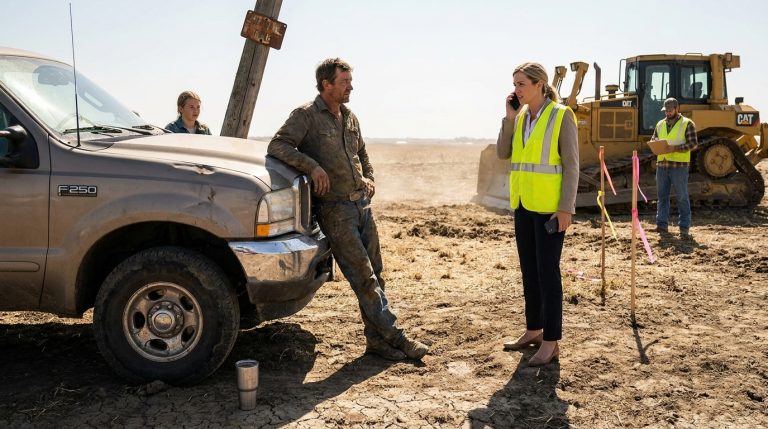
I didn’t drop the mug. The coffee inside was already the color of the river silt after a three-day turn, skinning over with a dull film in the humid Ozark air. Through the kitchen glass behind me, Maddie’s face was just a small white notch against the screen, her knuckles tucked under her chin, her eyes tracking the yellow steel frame of the backhoe as its tracks ground the wild mint into dark, greasy paste.
“Property values matter, sweetie,” Bethany Caldwell said. She didn’t look at the dirt. She looked at my boots, her manicured red nails tracing a sharp arc through the air toward the spillway crest. Her creamy white SUV was idling behind her, the tailpipe puffing thin, expensive heat against the cool shadow of the hollow. “Some of us aren’t trash. Some of us actually care about the sightlines.”
The backhoe operator was a local kid named Bobby. I knew his uncle down in Flat River. Bobby wouldn’t look at me; his eyes stayed glued to the control levers, his shoulders hitched up high inside his denim jacket like he was trying to hide behind his own collar. The diesel smoke smelled sour, full of sulfur and the old oil that leaks from a hydraulic seal when the pump is tired.
“That’s an engineered berm, Bethany,” I said. My voice didn’t have any gravel in it yet. It was just the flat tone I used for the field reports at the department. “It’s been under permit since seventy-three. If you drop that crest three feet, you change the head pressure on the entire lower channel.”
“The board votes Friday, honey,” she said, and her smile had the clean, hard edge of a fresh porcelain tile. She slammed the clipboard into the crook of her arm, her gardenia perfume fighting the diesel exhaust and losing. “Your alphabet soup doesn’t change the covenants. This pond is an unpermitted nuisance.”
She didn’t know about the low-pressure system currently spinning like a gray plate over Western Kansas, eight days out from the plateau. She didn’t know about the ten inches of rain the models were already stacking against the eastern slope.
I reached into my pocket, my thumb finding the cold glass of the phone screen. I didn’t stop Bobby when the bucket hit the sod. The first pull came away with a wet, tearing sound—the roots of the orchard grass giving up all at once, revealing the deep, gray clay underneath that my grandfather had compacted with an iron roller before I was born.
The metal teeth didn’t just move earth; they scraped against the rock apron with a screech that brought Maddie’s hen out from under the porch, its feathers ruffled in confusion. I hit the small red circle on the screen, keeping the lens level with the top of the mailbox, right where the bent eagle pointed toward the creek.
“Go ahead, Bobby,” I said quietly into the mic as the machine groaned into its second pass. “Get your depth. Make sure you get it all.”
CHAPTER 2: THE COVENANTS OF THE DUSTY GRAY
“A dollar and thirty-five cents, Mr. Brooks. Exact change only.”
The clerk behind the glass partition at the Phelps County Recorder’s office didn’t look up from her solitaire game. Her fingers, grayed by years of carbon paper and cheap graphite, flicked a black queen onto a red king with a dry, rhythmic click. The room smelled of wet basement, old ledger buckram, and the chemical bite of a copier that had been running hot since the mid-nineties.
I slid a single bill and two quarters through the scooped notch in the plexiglass. The metal tray was pitted with rust along the weld lines, the silver plating worn down to the dull copper underneath by ten thousand hands looking for deeds, liens, and foreclosures. It was the color of the entire county when you looked closely enough—just iron and age trying to hold back the grass.
“Forty-three pages,” I said, my thumb tracing the rough, yellow edge of the staple she pushed back to me. “That includes the ninety-eight infrastructure rider?”
“Everything on file for Brookside Ridge, Phase One through Three,” she muttered, her eyes already tracking the virtual cards. “Bylaws, amendments, and the shared infrastructure overlay. If it ain’t in that stack, it don’t exist under the seal.”
I took the bundle to a laminate table in the corner, beneath a window that looked out on a dead alley where a black walnut tree was shedding its dry hulls onto the gravel. The paper was heavy, legal-length stock that had been run through a flatbed scanner so many times the margins looked like charcoal.
My grandfather’s name wasn’t on the signature page. I knew it wouldn’t be, but seeing the blank space where his careful, draftsman script should have been felt like another shovel of clay coming off the spillway crest. Instead, there was a crooked line of blue ink—Elliot A. Brooks—with the middle initial tilted back toward the margin like an afterthought. My grandfather didn’t have an ‘A’ in his name. His name was Arthur. Whoever had copied the signature from his old nineteen-seventy-three easement had used a hand that was too fast, too greasy, and completely indifferent to the details.
The first page of the covenants didn’t contain anything about dams. It was all vinyl dimensions, the exact acceptable shade of sandstone for a three-car garage, and the prohibition of any vehicle over three-quarter ton parked within sight of a cul-de-sac. But on page fourteen, hidden beneath a paragraph about storm-water culvert maintenance, the text shifted into a different font—a smaller, tighter typeface that looked like it had been generated by an old daisy-wheel printer.
Section 4.2: The Board reserves the right to remediate, alter, or remove any non-conforming water retention structure within the adjacent watershed if said structure is deemed an aesthetic decrement to premium community sightlines.
The ink on that paragraph was slightly darker than the text above it. When I held the page up to the gray light coming through the alley window, the paper showed a faint, circular watermark—a crest with three stylized pines and the initials C.L.H.
It wasn’t the county’s paper. It was a sheet slipped into the recorder’s binder after the fact, a physical forgery that had been dropped into the state records the way a poacher drops a line into a deep pool. The toner had that slightly raised, oily texture of a cheap laser printer running on an empty cartridge.
The door to my truck creaked when I pulled it open, the hinge rusted through the lower pin from three winters of road salt. I sat under the black walnut tree for twenty minutes with a yellow highlighter, the engine ticking as the manifold cooled. The radio was murmuring in the background—the weather band out of Rolla was tracking the low-pressure system as it crossed the line into Kansas, its front edge already drawing down the humidity until the air felt tight and dry in the throat.
By four in the afternoon, I was back on the porch, the highlighted pages spread out across the gray-painted cedar planks. Maddie was down by the coop, her red Wyandottes clucking in short, low bursts as she threw cracked corn into the dirt. Every time the backhoe idled across the road—Bobby was still working on the lower ditch, his machine clanking every time the bucket hit a limestone stringer—the birds would lift their heads all at once, their black eyes turning toward the sound of the iron.
The letter arrived in a white envelope without a stamp. It had been slipped between the screen and the frame of the front door while I was at the courthouse, the paper crisp and smelling faintly of that sharp gardenia perfume Bethany wore like armor.
It wasn’t a standard notice. It was an invoice from the county code enforcement office, signed by Daniel Ross, the chief inspector for the district. The text demanded immediate compliance with the HOA’s demolition order within fourteen days, citing an “emergency safety determination” due to the structural instability of an unpermitted earthen impoundment.
The signature at the bottom was a grey photocopy, a low-resolution scan that had been lifted from some old county newsletter and dropped onto the letterhead with a clumsy digital crop. You could still see the pixelated edge of the white box around the ink, a tiny square of dead space that didn’t match the gray grain of the paper underneath.
I picked up the desk phone and dialed the county extension from memory.
“Ross,” a voice barked on the third ring. It was distant, full of the hollow echo of a speakerphone inside a room with concrete walls. Behind him, I could hear the high, rhythmic whistle of a boat engine and the flat slap of water against aluminum.
“Dan,” I said, my hand tightening on the plastic receiver until the grease from my palm showed against the black casing. “It’s Elliot Brooks. I’m looking at an emergency safety determination on my grandfather’s spillway. It’s got your name at the bottom.”
The silence on the line lasted long enough for the weather band to announce a flash-flood watch two hundred miles to the west.
“Elliot?” Ross said, his voice dropping an octave, the boat noise fading as if he’d pulled the handset close to his mouth. “I’m in Branson, man. I’ve been out on Table Rock since Saturday morning. My boys have the keys to the truck. I haven’t signed an enforcement order since the third of the month.”
“The copy I’ve got has your seal on it, Dan. The nineteen-ninety-eight version with the chipped eagle on the border.”
“That stamp is in my bottom drawer, Elliot. Under three years of tax assessments and a box of shotgun shells. The drawer’s locked.” He paused, and I could hear his breath against the microphone, heavy and sour with the heat. “Who delivered it?”
“It was on my porch,” I said. “Next to a forty-three-page covenant block that has a corporate watermark from Caldwell Lakeside Holdings on page fourteen.”
“Jesus,” Ross muttered. The line went quiet again, save for the static of the cellular tower over the lake. “Don’t touch nothing, Elliot. Don’t sign nothing. If Greg Caldwell has his fingers in my desk, I’m going to have to call the rangers. He’s been trying to get that section below your hill rezoned since the spring thaw.”
“He already did,” I said, looking out toward the creek where the water was running gray and silent past the three raw teeth Bobby’s backhoe had left in the sod. “He just didn’t tell the state.”
I hung up before he could answer. The plastic of the phone felt cold against my skin, the silence of the kitchen settling back down around me like the dust after a heavy truck goes by on the county road. I went back to the porch and picked up the ledger fragment from the table, my thumb finding that tiny, watermarked crest on the corner.
Maddie came up the steps, her boots leaving small, red clay circles on the cedar. She didn’t have her hen this time; her hands were tucked into her pockets, her face small and dark against the gray sky that was beginning to stack along the western rim of the hollow.
“Dad,” she said, her voice small, her eyes staying on the highlighted pages. “The boy with the yellow machine said we have to move the woodpile before tomorrow. He said his mom’s building a fence where the creek turns.”
I reached out, my hand finding the small of her back through her denim vest. The fabric was rough, worn thin at the seams from three summers of chores.
“We aren’t moving the wood, Maddie,” I said. “The wood stays right where your granddad stacked it.”
“But she has the paper,” she whispered. “The lady with the red nails.”
“The paper’s soft, sweetie,” I said, looking down at the twisted brass eagle on the mailbox at the edge of the drive. “The dirt’s hard. We just have to wait for the sky to show them the difference.”
CHAPTER 3: THE SHADOW INSPECTION
“Get your hand off the latch, Tyler.”
The gravel didn’t crunch under his work boots because he wasn’t moving. Tyler Caldwell stood right at the pivot point of the lower pasture gate, his fingers wrapped around the rusted chain link where the galvanized zinc had flaked off into white powder. He was wearing a fresh navy polo shirt, the creases from the store packaging still sharp across the ribs, and on the left breast was a stiff white disk. It was an ironed-on compliance patch, the red embroidery slightly crooked, with a couple of melted polyester threads trailing down toward his belt like loose cobwebs.
Behind him stood a stocky man I hadn’t seen around the valley. He had a clipboard tucked under a thick, hairless forearm and wore a matching polo, though his didn’t have the patch—just the faint, oily shadow where one had been peeled away.
“Agricultural violation, Elliot,” Tyler said, his smirk shifting the thin line of his mustache. He didn’t take his hand off the iron. He gave the gate a small rattle, making the loose hinge pins groan inside their grease sleeves. “Board issued a supplemental directive this morning. Section nine, paragraph two. Feral livestock within visual distance of a primary community corridor. We’re here to inventory the birds.”
“You’re four feet past the county easement marker,” I said. I didn’t come down off the second porch step. I kept my palm flat against the iron handle of the tire iron I’d been using to clear the mud out of the tractor blades. The steel was cold, pitted with dark gray craters where the salt had eaten into the finish during the spring ditch-clearing. “The corridor ends at the centerline of the blacktop. This dirt belongs to the deed.”
“The infrastructure overlay covers twenty feet from the culvert rim for drainage inspection,” the stocky man said. His voice was low, heavy with the flat drawl of the southern counties, the kind of voice that spends forty hours a week arguing over gravel tonnage at the limestone quarries. He didn’t look at me; he looked down at his clipboard, his thumb clicking the wire spring over a stack of pink carbon copies. “Compliance support. We’re tracking runoff vector contamination from poultry waste.”
“You managed the car wash at the truck stop three weeks ago, Tyler,” I said, my voice staying in the low register, the one that doesn’t carry across the creek but stays right between the fence posts. “What’s the legal definition of a runoff vector under the state clean water manual?”
Tyler blinked, his fingers twitching against the rusted chain. His face went that dull, patchy red that happens when the sun hits the limestone cliffs before noon. “My mother signed the warrant, Elliot. We don’t need your dictionary. Move the iron or we add a sixteen-hundred-dollar interference assessment to the lien.”
“Maddie,” I called out without turning my head. “Go inside the kitchen. Put the latch on the screen.”
The screen door gave that short, dry slap behind me, the spring rusty but tight enough to hold. Through the gray mesh, I could see the silhouette of her small shoulders, her hand resting against the pine frame right where her mother had carved a small notch to track her height in two thousand and twenty-two.
“We’re counting the cages, Brooks,” the stocky man said, taking half a step forward. His work boots were new, the yellow leather clean except for a smudge of dark clay near the heel where he’d jumped the roadside ditch. “We ain’t leaving until the sheet’s filled.”
“Then you’re going to be sitting in that gravel for a while,” a third voice said.
The sound of the cruiser came from the blind curve by the old iron bridge—not the siren, just the low, rhythmic thrum of an eight-cylinder engine idling down through the gears. The white paint on the doors was filmed over with the gray dust of the county roads, the gold star on the panel faded down to the color of an old leaf.
Deputy Marion Sutton didn’t turn the engine off. She let the big Ford rumble against the ditch bank, the exhaust pipe puffing thin blue smoke into the wild blackberries. When she opened the door, her leather belt gave a sharp, dry creak—the sound of old hide that had been oiled too many times with cheap tallow. Her hand stayed flat against her hip, her thumb hooked into the top of her holster right above the checkered walnut grip of her sidearm.
“Tyler,” she said, her khaki trousers stiff with starch as she walked up the grade. She didn’t look at the clipboard. She looked at the patch on his chest, her eyes narrowing until the small crow’s-feet around her temples turned white against her tan. “Your truck’s blocking the mail carrier’s turn-around.”
“Official board business, Deputy,” Tyler said, but his hand came off the gate latch like the iron had suddenly gone hot. He tucked his clipboard under his arm, his thumb slipping into his pocket. “Property inspection under the infrastructure overlay. We’ve got a reported code variance on the livestock.”
Sutton stopped three feet from his shoulder. She was short, but she carried her weight low, her boots planted in the red clay like she’d been poured into the driveway along with the gravel. She reached out with two fingers and nipped the loose polyester thread hanging from his compliance patch, giving it a sharp jerk until the knot buried in the seam popped.
“This looks like something your sister ran through a Singer machine in the basement, Tyler,” she said, her voice flat as an oak board. “I talk to the council on Tuesdays. The council hasn’t issued a support warrant since the county fair.”
“The overlay’s public record,” the stocky man started, his voice rising half a tone. “We have the right to inspect—”
“You have the right to get that white SUV off the state right-of-way before I call the county wrecker out of Rolla,” Sutton said. She didn’t raise her voice, but she stepped into his space until her brass badge was four inches from his clipboard. “The sheriff doesn’t like his deputies spending their afternoons clearing personal family business off private turn-pikes. Off the property. Now.”
The stocky man looked at Tyler, then down at his clean boots. He didn’t sign the pink sheet. He just turned and walked back down the bank, his heels digging deep into the soft sod where Bobby’s machine had peeled the grass back the day before.
Tyler stayed for three seconds longer, his face dark, his teeth catching the corner of his mustache. He looked past me toward the kitchen window where Maddie’s small hand was still visible against the screen.
“The lien goes in on Monday, Brooks,” he muttered, his voice dropping into that transactional rattle he’d learned from his father. “The whole fourteen thousand. Plus the demo costs. We’ll see how much that tractor’s worth when the county assessor comes by with the red tags.”
“The gate’s iron, Tyler,” I said, my fingers still resting on the tire iron. “It don’t care about the tags.”
He turned and went down the grade, his sneakers sliding on the loose shale near the culvert. Sutton watched him until the creamy white SUV backed out into the county lane, its tires throwing a small shower of river rock into the weeds before the transmission caught and pulled it out of sight around the creek bend.
She turned back to me, her hand still resting on her belt, the leather giving that little dry squeak as she shifted her weight.
“He’s got his father’s mouth, Elliot,” she said, looking down at the three raw gashes in the spillway crest across the road. “And his mother’s lack of sense. You got that machine running on the cloud?”
“Every ten seconds,” I said. “The lens is inside the birdhouse on the corner post.”
“Good.” She nodded once, her badge catching the gray light from the western ridge. “Keep it running. The sky’s looking greasy out toward Lebanon. If that low-pressure system stalls like the boys in Springfield are saying, we’re going to have more than clipboard inspectors in this ditch before the week’s out.”
CHAPTER 4: THE INUNDATION BLUEPRINT
“They didn’t just mismanage the books, Elliot. They cleared the vault.”
Dale Henderson didn’t look up from the three-ring binder when he spoke. His thumbs, thick and yellowed at the cuticles from forty years of handling rough bond paper, were pressed against a certified banking log from the Missouri State Corporation Commission. We were sitting in his Springfield branch office, a room that smelled of old tobacco, dry carpet, and the heavy zinc plating of the filing cabinets that lined the back wall from floor to ceiling. The window glass behind him was coated in a fine layer of gray limestone dust from the highway construction down below, turning the morning sun into a dull, flat smudge.
“Two hundred and sixty-seven thousand dollars,” Dale muttered, his pencil making a dry, scratchy track along the ledger columns. “Three separate wire transfers over an eleven-month window. Every dime went straight from the Brookside Ridge infrastructure reserve into a domestic entity called Caldwell Lakeside Holdings LLC. Registered agent: Bethany Caldwell. Consulting officer: Councilman Greg Caldwell.”
I reached across the dark walnut desk, my fingers trailing over a fresh blueprint sheet I’d pulled from the county tax assessor’s FedEx box an hour earlier. The paper had that distinct, pungent smell of ammoniac developer, the surface gritty under my palms like fine river sand. It was the newly revised parcel map, bearing a purple ink stamp from the Planning Commission dated three weeks back.
“Look at the boundary clarification line, Dale,” I said, my thumb nailing down the creekside margin where Cold Hollow Creek made its sharp southern loop. The ink was so fresh it had bled slightly into the coarse grain of the paper. “They pushed the HOA overlay six-tenths of an acre into my lower meadow. The line runs straight through the old willow grove. Right through the channel where my grandfather’s riprap apron used to drop the velocity.”
Dale leaned back, his leather chair giving a long, metallic groan that sounded like an old pump jack running dry in an empty field. He took his reading glasses off, letting them swing from the black cord around his neck. His eyes were small, pale, and entirely devoid of heat.
“They needed the title clean before they started pouring the foundations,” he said. He tapped the edge of the desk with his pencil stub. “A shared infrastructure overlay gives an HOA the right to claim state watershed intervention on adjacent land if they can prove the channel threatens community safety. Bethany used the demolition order she forged to create the threat, then used her husband’s seat on the commission to absorb the buffer zone. It’s a closed loop, Elliot. They used the homeowners’ own maintenance money to clear your dirt so they could build their luxury expansion down in the flat.”
“The flat is a Zone AE hazard designation,” I said, pulling the third document from the stack—the certified appendix from my grandfather’s original nineteen-seventy-three dam safety license. The paper was translucent with age, the linen backing fraying into small, white threads that looked like spiderwebs along the margins. “The FEMA regional maps haven’t been revised since the ninety-three pool rise. But page eleven of the state registry has the micro-model.”
I unfolded the cross-section, my fingers smoothing out the creases where the paper had grown stiff from decades in the Department of Natural Resources vault. Traced in my grandfather’s sharp, draftsman ink was the downstream inundation profile for an unmitigated hundred-year event. The numbers were written in his neat, vertical block lettering, the lines drawn with a hard lead pencil that had bitten deep into the wood pulp.
The blue line on his chart didn’t curve gracefully. It spiked like an iron wedge.
“Seventeen feet,” I whispered. “Within four hours of saturation. If the spillway crest is down, the velocity head doesn’t disperse through the lower willow brakes. It hits the limestone bluff and stacks up directly over the old rail line. Right where Bethany’s model home is sitting.”
Dale reached out, his thick fingers tracing the blue wedge until his fingernail stopped on the specific lot numbers labeled in my grandfather’s hand: Lots 4 through 12, Low Meadow Expansion.
“She bought the parcel for twelve thousand dollars at a tax sale five years ago,” Dale said, his voice dropping into that flat, transactional click he used when the trap was finally set. “She didn’t request the DNR appendix because she already knew what the zoning said. She just assumed a thirty-eight-year-old earthen berm with an old man’s name on the deed would stay there forever, holding the river back while she sold pre-construction deposits to realtors from St. Louis.”
“She’s throwing a party there tonight,” I said. I looked out the window toward the southwest, where the sky was already changing from the pale gray of the morning into a heavy, bruised violet that looked like iron slag. The air coming through the floorboards felt thick, cold, and electric with the first scent of petrichor. “The banner’s already up on the highway turn-off. Caldwell Lakeside: Living the Ozark Dream.”
Dale stood up, his joints popping like dry twigs under his trousers. He walked over to the old green safe in the corner of the office, his boots leaving dull gray tracks on the faded linoleum. He swung the heavy iron lever down—the latch clicking with a solid, greasy clunk—and pulled out a stack of white, notarized envelopes.
“We aren’t stopping her, Elliot,” he said, dropping the bundle onto the desk with a thud that sent a small puff of paper dust into the air. “We’re warning her. In triplicate. One to her house, one to the council office, one to the sheriff, and one to the regional FEMA director in Kansas City. Every single letter contains page eleven of this appendix and a copy of the National Weather Service radar forecast for the next forty-eight hours.”
“She’ll shred them,” I said.
“Of course she will,” Dale said, and for the first time his mouth twisted into something that resembled a smile, though it had no light in it. It looked like the split in a dry log. “But the return receipts will be in my briefcase by Friday morning. Once those cards are signed, every basement that takes water below your hill stops being an act of God. It becomes a personal, civil liability with a criminal signature attached. We flip the switch, Elliot. We let her keep digging her own foundation out from under her feet until the sky comes down to finish the job.”
I picked up the linen maps, my thumb catching the small, pencil-drawn initials A.B. at the bottom of the spillway cross-section. The paper felt thin, dry, and cold against my skin—the remnant of a man who had spent forty years counting rain drops with a slide rule, knowing exactly how much weight the earth could hold before the seams parted.
“Maddie’s down in Branson with Susan,” I said, folding the sheet until the blue wedge disappeared inside the legal sleeve. “I packed her favorite hen in the crate. She didn’t want to leave the hollow.”
“She’s smart,” Dale said, his hand coming down on my shoulder with a heavy, dry slap that felt like a piece of oak. “You get back to the ridge, Elliot. Clean the leaves out of your truck bed. Put your hip boots in the cab. It’s going to be a long Thursday, and I want you dry when we walk into that courthouse on Monday morning.”
I didn’t answer him. I took the binder and went out into the gravel lot, the air already turning cold enough to make my breath show against the dark paint of the truck door. To the west, across the limestone cuts of the interstate, the first lightning was just a thin, yellow thread passing through the belly of the clouds, silent and gray against the hills.
CHAPTER 5: WAITING FOR THE SKY
The rain was no longer a weather event; it was a physical weight, a continuous, heavy curtain of water that turned the valley into a pressurized chamber. I sat at the kitchen table, the laptop screen casting a pale, cold blue glow over the piles of documents, while the radar feed showed the Ohio Valley low-pressure system stalled directly over the plateau. The green and yellow blooms had deepened into a solid, impenetrable mass of red and white, the signature of a storm that had stopped moving and started carving.
My phone, sitting face-down on the oak table, buzzed with a sharp, insistent vibration that felt like a trapped insect. I waited for the third ring before I picked it up.
“Elliot, the creek is rising. It’s over the bridge pylons. The water—it’s hitting the cul-de-sac.”
Bethany’s voice was thin, stripped of all the polished, rehearsed cadence that usually defined her. It sounded like cracked glass. Underneath her words, I could hear a rhythmic, chaotic splashing and the distant, muffled shouting of a man—probably Tyler—trying to shout orders over the roar of the water.
“Bethany,” I said, my voice steady, the tone I used when checking the flow-gate settings on a spillway. “You’re in a Zone AE floodplain. The topographical modeling I sent you via certified mail—the one you refused to sign for—showed seventeen feet of inundation for a hundred-year saturation event. You’re at twelve hours into the sequence. You haven’t peaked.”
“Rebuild it!” she screamed, the sound distorting as the cellular signal struggled against the atmospheric pressure. “Get the backhoe! I’ll pay you, Elliot, just get that damn spillway back in! My husband is missing—the Cadillac is gone, it went into the channel—Tyler’s knee-deep in the driveway with a bucket!”
I watched the time-lapse feed on my laptop. A camera mounted on the north ridge showed the cul-de-sac. It was a surreal, nightmare tableau: the luxury model home, with its white pergola and manicured koi pond, was surrounded by a dark, swirling lake of mud and debris. The water wasn’t clear; it was thick, roiling with the churned-up clay of the hollow, and it was climbing the front porch steps with the terrifying, silent speed of a rising tide.
“I’m not licensed to modify a state-regulated structure during an active flood event, Bethany,” I said, my voice empty of anything but facts. “And neither are you. If I show up down there, the DNR will have me in shackles before I finish the first scoop. You pushed the county code officer into a forgery. You pushed the rezoning through the planning commission without a letter of map revision. You sold those houses inside a documented flood envelope.”
“You did this!” she shrieked, a sound of raw, unadulterated panic that didn’t care about sightlines or property values.
“No,” I whispered. “I warned you. I documented the warning. You chose the party.”
I hung up. I stood up and walked to the window, the floorboards cold beneath my bare feet. The hollow was a roar of water, the creek having reclaimed its ancient path with a hunger that defied the human geometry of cul-de-sacs and vinyl siding. I saw a flash of light in the distance—the strobing white pulse of a rescue helicopter, its rotors cutting through the rain with a deep, percussive thrum that shook the glass in the window frames.
It was an Air National Guard bird, likely diverted from the emergency response team Linda Pruitt had coordinated out of Jefferson City. It hovered over the Caldwell Lakeside development, its searchlight slicing through the sheets of rain like a giant, blinding eye. I watched as the winch operator dropped a basket into the roiling, mud-brown center of the cul-de-sac.
Bethany was there, a dark shape against the churning water, her arms wrapped around a soggy, shredded piece of fabric—the Caldwell Lakeside banner I’d seen her waving the night of the party. She looked like a ghost, a small, inconsequential smear of white against the rising weight of the creek.
I turned away from the window, the sight of it giving me no satisfaction, only a cold, hollow recognition. The system had worked exactly the way the physics dictated: when you remove the pressure-relief valve, the vessel eventually bursts. I walked over to the closet where I kept my boots and the heavy, yellow-slicker gear I used for the spring sediment checks.
I didn’t go out into the rain. I didn’t go down to the cul-de-sac to watch the end. I sat back down at the table and opened the evidence binder. I checked the page numbers. I verified the return receipts. I checked the timestamps on the digital logs.
Somewhere in the kitchen, the coffee pot ticked as it cooled—a small, domestic sound that seemed leagues away from the violence occurring down in the valley. Outside, the rain continued to hammer the roof, the sound steady, relentless, and absolute. The valley was breathing again, the water moving where it had wanted to go for ten thousand years. I picked up my pen and added a single note to the logbook: Friday, 01:47 a.m. Infrastructure failure complete. Civil liability established. Proceeding to legal consolidation.
The house remained dry. The foundation held. And outside, in the dark, the creek kept rising until there was nothing left to carry away.
CHAPTER 6: THE GYM FLOOR LEDGER
The gymnasium smelled of damp foam, stale pine cleaner, and the heavy, metallic tang of three hundred bodies packed into a space meant for half that number. Outside, the rain had finally quit, leaving the night air feeling thin and sharp, but inside, the atmosphere was pressurized, held in check by the buzzing of the mercury-vapor lights that hummed like a low-frequency warning.
I stood at the center of the basketball court, my boots scuffing against the painted white lines that marked the perimeter of a free-throw lane. Henry Whitcomb, the new acting board president, had given me the floor. He sat on a metal folding chair to my right, his face a map of weary lines, his hands resting on his knees as if he were bracing for a landslide. Across from me, near the exit signs, Maggie Whitfield’s photographer adjusted his lens, the shutter click muffled by the collective stillness of the room.
I didn’t have a speech. I didn’t have a weaponized tone. I just had the linen-backed appendix from nineteen-seventy-three, the paper yellowed to the color of old straw and frayed at the edges where my grandfather’s thumbs had rested decades ago.
“I’d like to read from the certified appendix of the dam safety license for the Brooks family spillway,” I said. My voice didn’t echo; the sound-dampening panels on the gym walls sucked the air right out of it, leaving the words stark, dry, and absolute.
I unfolded the document. The rustle of the paper sounded like a small fire starting in the quiet.
“This is page eleven,” I continued. I didn’t look at the crowd. I looked at the center of the document, where the blue wedge of the inundation profile cut through the technical diagrams. “Removal of this structure without DNR reauthorization will result in catastrophic flooding events with a calculated one-hundred-year recurrence interval. Downstream inundation will reach seventeen feet above the natural channel within four hours of saturation. Specific risk: Lots four through twelve of the Brookside Ridge expansion zone, the HOA amenity center, and any structure built within the certified flood envelope.”
I stopped. The clock on the wall—an old, circular face with a red sweeping second hand—made a loud, rhythmic clack as it moved. I could hear someone breathing heavily in the third row, the sound sharp and ragged.
“This document has been on file with the county since two thousand and nineteen,” I said, my thumb tracing the faint, handwritten initials at the bottom of the page. “It is public record. Any homeowner could have read it for a dollar and thirty-five cents at the recorder’s office. The president of this HOA had it served on her in writing by certified mail eight days before the storm. She chose to throw a party instead.”
A woman in the third row started to cry, a low, thin sound that broke the tension of the room. It wasn’t a cry of anger; it was the hollow, weary sound of someone who had just realized their entire life—the house, the mortgage, the manicured yard—had been staked on a lie.
I didn’t offer comfort. I didn’t offer a villain’s speech. I just folded the paper, the dry, precise sound of the creases marking the end of the narrative.
“My grandfather built that spillway with his hands,” I said, my gaze finally sweeping across the faces of the people who had lived in the shadow of the cul-de-sac. “My daughter signed the cornerstone in pencil. It was permitted, lawful, and protective. It does not belong to me. It belongs to this valley. And as long as I’m alive, no clipboard and no shade of deceit will take it down again.”
I turned and walked back toward the second row, where Maddie was waiting. She didn’t look at the crowd. She looked at me, her eyes clear and steady, her hands folded over her knees. When I sat down, she leaned into my side, her weight a grounding, solid anchor in the middle of a room that felt like it was finally, slowly, coming to a rest.
The gym exploded into applause—not the sharp, frantic clapping of a mob, but a low, rolling sound that felt like the earth shifting back into place. Maggie Whitfield’s photographer snapped a picture, the flashbulb’s white light momentarily bleaching the gym floor, capturing the moment the truth finally hit the hardwood.
I didn’t stay for the rest of the meeting. The legal work was done. The papers were filed. The system, corrupted as it had been, was currently chewing through the Caldwells with the same, slow, inevitable force as a river in flood.
Outside, the air was cold, smelling of wet earth and the sharp, clean ozone that follows a heavy storm. The creek was quiet, the water having retreated into its banks, leaving behind a layer of fresh silt that would feed the valley for another season. I held Maddie’s hand as we walked toward the truck, our shadows stretching long and thin across the gravel lot under the yellow glow of the parking-lot lamps.
The brass eagle on my mailbox would be bent for a long time, and the spillway would need to be rebuilt with better armoring and a wider channel. But the land was quiet, the boundary lines were where they were supposed to be, and the sky, for the first time in weeks, was clear, vast, and silent. I opened the door for Maddie, the metal latch clicking shut with a solid, final sound.
We drove back toward the hollow, the truck’s headlights picking out the path between the trees. The water had moved exactly where the engineering dictated it would, and we had recorded every inch of the journey. The case was closed, the ledger balanced, and the valley was finally, rightfully, at peace.