The Weight of Iron: A Retired Ghost Navigates the Fractured Legacy of a Buried War Operation
CHAPTER 1: The Perimeter Shift
The grip on Silas Kaine’s shoulder remained, the weight of Admiral Graves’ hand pressing through the frayed wool of his coat like a brand. It was a calculated display of authority, intended to signal ownership before the first of the families arrived for the memorial. Kaine didn’t flinch. He didn’t pull away. He simply lowered his head, his eyes tracking the way the wind moved the tall, neglected grass at the base of the granite wall.
Graves leaned in, his voice a low, gravelly vibration that bypassed Kaine’s ear and settled directly into the marrow of his bones. “We have ten minutes, Silas. The narrative is already written. The wreath is laid, the names are read, and the accident is recorded. Don’t make us rewrite history in front of the Gold Star mothers.”
Kaine exhaled, a dry, rasping sound. He felt the cold iron of the wall against his palm. “History isn’t written in ink, Admiral. It’s written in the dirt you buried them in.”
Behind Graves, Admirals Cho and Bennett stood like statues, their eyes darting toward the main gates. A line of sedans was slowing as they approached the checkpoint. The orderly, sterile world of the Navy was closing in, its relentless bureaucracy intent on scrubbing the surface clean of any anomalies. Kaine watched a speck of dust dance in the gray, flat light of the morning. It felt heavy. Everything felt heavy.
“We aren’t here to argue, Captain,” Bennett interjected, his voice tight, lacking the granite stability of his senior officer. “We are here to offer you the only thing that remains. A chance to leave this place, to disappear again, and to keep your name off the lists they’re digging up.”
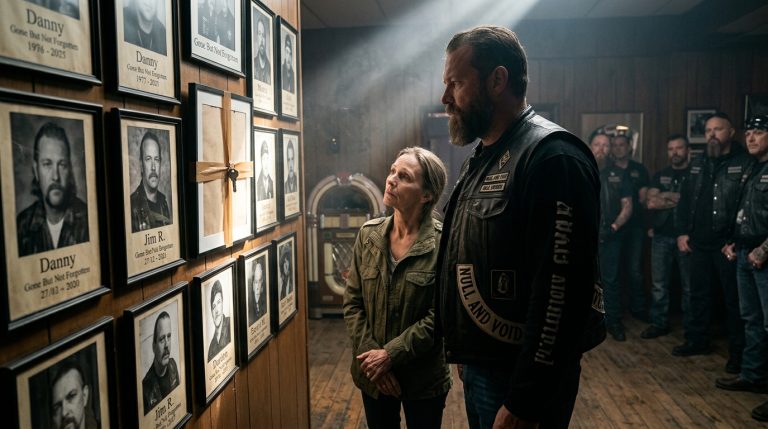
Kaine finally shifted his weight. The movement was a slow, agonizing slide of joints that had been crushed in a Honduras jungle four decades ago. He felt the phantom pressure of the past—the smell of burning fuel, the screaming of metal—but his gaze remained fixed on the name Hansen.
He reached into his pocket and pulled out a small, iron-filing-encrusted key, its surface pitted with rust. He didn’t show it to them, but he held it tight against his thigh, the sharp edge digging into his skin.
“You think you’re offering me a way out,” Kaine said, his voice barely audible over the growing hum of approaching engines. He looked at Graves, meeting the Admiral’s eyes. There was no fear there, only the cold, tired recognition of a man who had already died once. “But you’re just revealing how much you still have to lose.”
Graves’ hand tightened on his shoulder, his knuckles turning white. “And you, Captain? What exactly do you think you have left to gain?”
Before Kaine could answer, the sharp, rhythmic pop-pop-pop of a ceremonial rifle drill began in the distance, practicing their salute. Kaine’s heart didn’t race. It kept its slow, measured pace, a rhythm forged in long-abandoned trenches. He noticed something then: Admiral Cho’s right hand was resting on his belt, near his holster, but his fingers were trembling. It wasn’t the tremor of age. It was the frantic, erratic pulse of a man who knew exactly which file was sitting in Kaine’s desk at home.
The reality hit Kaine with the force of a sudden shift in wind. They hadn’t come to honor him. They hadn’t come to reconcile. They had come to identify a threat.
“I have the manifest,” Kaine whispered, the words so soft they might have been part of the wind.
The three Admirals froze. The world around them seemed to drop away, leaving only the cold granite, the rusted iron of the key in Kaine’s pocket, and the sudden, terrifying silence of men who realized their secret had finally walked out of the grave.
CHAPTER 2: The Tactical Appraisal
The air between the four men was thick, not with the morning mist of Arlington, but with the cloying scent of stale, suppressed history. Kaine’s hand remained in his pocket, the sharp corner of the iron key biting into his palm. He held the pressure there, a deliberate, grounding pain that forced his focus to the present. His right leg, long ago shattered in the jungles of Honduras and held together by nothing more than grit and poor surgery, flared with a dull, thrumming ache. It was his internal barometer; it told him that the stability of the space was failing.
Admiral Graves was still gripping his shoulder. The hand was heavy, a dead weight of synthetic authority. The other two, Cho and Bennett, had shifted their stance, their boots crunching on the manicured grass as they formed a semi-circle. It was a classic containment maneuver. They weren’t looking at the wall anymore; they were looking at him as if he were a piece of equipment that had suddenly decided to activate without authorization.
“The manifest,” Admiral Cho repeated, his voice dropping into a register that suggested he was testing the structural integrity of the situation. “Captain, you’re talking about a document that does not exist in any public or classified ledger. If you think that piece of paper has any weight here, you are misjudging the reality of the situation.”
Kaine allowed himself a slow, measured turn. He kept his movements minimal, an economy of motion that forced the three admirals to adjust their perimeter. He didn’t look at their faces—faces that were now lined with the anxieties of long-held power—but at their feet. They were polished, immaculate, and entirely separated from the damp earth beneath them.
“I don’t need the manifest to have weight,” Kaine replied, his voice a dry rasp that scraped against the clean, cool air of the morning. “The names are already on the wall. They’ve been there for thirty-eight years. You think that because you signed a paper to turn them into ghosts, they stopped being men?”
He felt the flicker of his own perception then, a wave of dizziness that made the granite wall seem to sway against the horizon. The phantom pain in his leg surged, a sharp, white-hot prickle that made him wonder, for a fleeting, dangerous second, if he was truly here or if he had finally succumbed to the slow decay of the last four decades. He blinked, the gray light of the cemetery sharpening back into focus. He was here. The key was still biting into his palm. The rust was real.
“Silas,” Graves said, his tone shifting from authoritative to a kind of strained, oily softness. “Look at us. We’ve spent our lives building the service. We have the perspective you lost in that jungle. We can offer you a solution. A private residence, a pension, a life where you don’t have to carry the weight of 1983 alone. All we need is for that… that object in your pocket to be surrendered, and for this conversation to be filed under ‘unfounded rumors’.”
The offer was so sterile, so perfectly composed, that Kaine almost laughed. It was a proposal for a slow, comfortable death in exchange for the only thing that kept him breathing: the debt he owed to Hansen and the others. He looked at Admiral Bennett, the youngest of the three, whose eyes were twitching with a frantic, uncontained fear. Bennett was the leak. He was the one who had been sweating through his dress blues since the moment they arrived.
“You aren’t offering me a life, Admiral,” Kaine said, shifting his weight. The movement caused his leg to protest, a grating, metallic sound in his own ears, like gears stripped of oil. “You’re offering me a shallow grave with a better view.”
The tension spiked. Graves’ grip on his shoulder tightened until it was painful, but Kaine didn’t recoil. He had endured worse in the dark. He watched as Bennett’s hand twitched again, a nervous tic that betrayed the presence of a sidearm beneath his immaculate jacket. Kaine wasn’t a threat to their lives—not today—but he was a systemic failure. He was the bug in the software of their perfect, legacy-driven lives.
“The families are arriving, Silas,” Graves warned, his voice now a low, menacing hum. “If you make a scene, you aren’t just hurting us. You’re destroying the memory of the very men you claim to be guarding. Is that what they would want? To have their name dragged through a political scandal?”
Kaine looked back at the wall. His thumb traced the cold, hard letters of Hansen once more. The wind whipped his hair, but he stood unmoving, a rusted, stubborn relic in a world of brushed chrome. He knew the cost of his silence; he had paid it in full every day for thirty-eight years. But he also knew the price of their complicity.
“They aren’t here for your ceremony,” Kaine whispered, the sound carried away by the freshening breeze. “They’re here to see if you finally run out of lies.”
He saw the flicker of realization in Cho’s eyes—a sudden, sharp understanding that Kaine wasn’t bargaining for his own life. He was bargaining for the truth, and he was more than willing to let the whole world burn to see it delivered.
CHAPTER 3: The Echoes of 83
The silence that followed Kaine’s accusation was not empty. It was pressurized, heavy with the weight of four decades of institutional burial. Admiral Graves did not pull his hand away, but his grip had lost its predatory edge, replaced by a tentative, almost fragile quality. He looked at Kaine, really looked at him, and for a fleeting instant, the granite mask of his face seemed to erode, revealing the frightened junior officer who had helped sign off on the original mission report in 1983.
“You don’t understand the environment of that time, Silas,” Graves muttered, his voice barely rising above the rustle of the surrounding trees. “The political cost of Shadowfall… it would have been the death of the entire department. We did what was necessary for the continuity of the mission.”
Kaine did not respond. Instead, he pulled his hand from his pocket, the rusted key still clutched in his fist. He didn’t look at the Admirals; he looked toward the perimeter of the cemetery, where the first of the families were beginning to congregate near the gates. The orderly, crisp lines of the military world were encroaching, and the window for this private, jagged reckoning was closing.
A sudden, sharp report shattered the quiet—a volley from the rifle detail, practicing their salute in the distance. The sound was a precise, rhythmic crack that echoed off the cold granite slabs. To anyone else, it was a drill. To Kaine, it was the sound of the C130’s tail section tearing away in the thin, unforgiving air of the Honduras mountains.
He staggered, the phantom force of that long-ago impact slamming into his chest. For a second, the manicured lawn of Arlington became the mud-slicked slope of a forgotten hillside. He could smell the acrid, biting stench of fuel burning against wet foliage. He could hear the desperate, ragged shouts of men whose names were now chiseled into the very wall he was leaning against.
“Captain?” Admiral Cho’s voice was sharp, urgent.
Kaine forced his eyes open, fighting the vertigo. He felt the cold, hard surface of the memorial wall under his palm, a lifeline that tethered him to the present. He forced his breathing to slow, a discipline he had honed in the dark, silent years of his exile. The world stopped spinning. The smell of fuel faded, replaced by the scent of ozone and dry, autumn earth. He was not on a mountainside. He was at a grave.
“I remember the sound of the metal,” Kaine said, his voice quiet but steady, cutting through the admirals’ uneasy hovering. He didn’t turn to look at them, but he felt their attention—the sharp, predatory focus of men who had spent their lives managing secrets. “It was the sound of a structural failure. Not an accident. A calculated choice.”
He felt the tension in the air shift. This wasn’t about the retirement offer anymore. They had realized that the key in his hand wasn’t just a physical token; it was a promise of proof.
“You were there, Graves,” Kaine continued, his gaze still fixed on the name Hansen. “You were the one holding the comms in Tegucigalpa. You heard the last transmission before the signal was scrubbed. You know exactly what went wrong. Or rather, who made it go wrong.”
Admiral Bennett took a half-step back, his boots scuffing against the grass. He was the weakest link, the man who had been recruited long after the incident, likely brought in to manage the ongoing maintenance of the lie. He clearly had no appetite for the raw, bleeding truth of what had happened in the mountains.
“We have to get him out of here,” Bennett whispered, looking frantically toward the approaching families. “If the press or the families start asking questions about who this man is, we’re finished. Graves, we need to neutralize this. Now.”
Graves didn’t respond immediately. He watched Kaine with a look of profound, weary calculation. He was weighing the cost of silence against the potential for an absolute, systemic collapse. He was a man who understood the utility of assets, and in this moment, he was realizing that Kaine was not an asset that could be managed or moved.
“Neutralize?” Kaine finally turned, his face a landscape of scars and deep, etched lines. He looked at Bennett, his eyes hard and unblinking. “You don’t have the leverage for that, son. You’re trying to contain a ghost with a clipboard.”
Kaine straightened his spine, the movement causing a sharp, grinding ache in his shoulder, but he held his ground. He sensed the proximity of the honor guard—the young, unsuspecting men who were trained to respect the uniform, not the men who wore it. He understood the tactical reality: he could not win a physical confrontation, but he didn’t need to. He only needed to be the friction that stopped the machine.
“You want me to disappear?” Kaine asked, his voice low, a flat, dangerous sound. “Fine. But I’m going to stay right here until the names on this wall are acknowledged for what they actually did, not the sanitized fiction you’ve been feeding the public for forty years.”
Graves stared at him, his mouth tightening into a thin, pale line. The silence that stretched between them was a chasm, deep and impossible to bridge. The sound of the approaching ceremony was getting louder—the murmur of voices, the rhythmic beat of a drum, the soft, somber cadence of a life being remembered.
Kaine realized then that the decoy game was over. The admirals were no longer trying to recruit him. They were now deciding whether they could afford to let him walk out of the cemetery. The air felt brittle, ready to shatter. Kaine reached into his pocket and turned the rusted key once, the motion feeling like the cocking of a hammer. He was ready for whatever came next.
CHAPTER 4: The Compromise
Admiral Graves did not signal his security detail, nor did he reach for his weapon. Instead, he let his hand fall from Kaine’s shoulder, a gesture that seemed to suggest a sudden, icy truce. The surrounding cemetery felt unnervingly still. The sounds of the arriving families—the low murmur of mourning, the distant, rhythmic shuffling of feet—seemed to recede, leaving the four men in a private, claustrophobic sphere of influence.
“You’re a tactical ghost, Silas,” Graves said, his voice dropping into a register of pragmatic, professional respect that was far more dangerous than his earlier threats. “You’ve survived this long because you know how to read the landscape. You know that if you go public with that key—if you force this truth into the light—you aren’t just killing us. You’re destroying the integrity of every service member who has ever stood for a cause.”
Kaine watched the older man carefully. The rust-colored shadows under Graves’ eyes were deep, etched by years of living with the architecture of the lie. Beside him, Admiral Bennett was still shifting his weight, his eyes locked on the horizon. Kaine’s gaze flickered briefly to Bennett’s pocket. The admiral’s hand had brushed against the outline of a sleek, encrypted comms device—something far more modern than a standard service issue. It was a digital tether, a way for Bennett to alert whoever was running the contingency plan in the shadows.
The decoy, Kaine thought. The admirals were already moving past the threat of a public scandal. They were setting the stage for a private containment.
“I’m not interested in your ethics, Graves,” Kaine replied, his voice a gravelly monotone. He didn’t move his hand from his pocket. The rusted iron of the key felt cold, a constant reminder of the physical weight of his burden. “I’m interested in why you’re still standing here instead of calling your teams to burn this place to the ground.”
Graves allowed himself a thin, humorless smile. “Because we need that key. Not to destroy it, but to verify it. There are things in that manifest that even we don’t fully understand. We have records that were scrubbed, yes, but we never found the primary source. We believe you might have kept it.”
It was a calculated pitch. They were pivoting from force to negotiation, trying to turn Kaine’s vigil into a consultation. They wanted to see if he was holding the original, unadulterated records of Operation Shadowfall. If they could get him to commit to a private meeting, they would have the time they needed to secure their assets and ensure Kaine never left that meeting alive.
“You think I’m going to walk into a room with you and hand over the leverage that’s kept me alive for four decades?” Kaine asked, his eyes narrowing.
“I think you’re tired of living in the dark,” Graves countered, his eyes flickering toward Admiral Cho. Cho remained silent, his expression a wall of impassive, disciplined neutrality, but Kaine noticed the way his boots were planted—solid, defensive, ready to move if the dynamic shifted toward violence.
Kaine took a slow, deliberate step back. His leg flared with that familiar, grinding protest, a reminder of the terrain he had crossed to reach this point. He looked at the memorial wall. He saw the name Miller, right next to Hansen. He remembered the sound Miller made when the fuselage gave way—a sudden, breathless gasp that was cut short by the scream of the wind.
“I’m not coming to your office,” Kaine said, his voice dropping to a low, serrated edge. “And I’m not giving you anything. If you want the truth, you’ll find it where you buried it. But if you touch these families—if you try to use this memorial as a stage for your cleanup—I’ll ensure the ghost of Shadowfall is the only thing the news cycles talk about for the next ten years.”
The air between them seemed to vibrate with the intensity of the standoff. Kaine turned his back on them, a risky, deliberate maneuver that signaled his total rejection of their authority. He began to walk away, his gait uneven, the rhythm of his footsteps heavy against the stone walkway.
He didn’t look back to see how they reacted. He could feel their eyes on him, a physical weight that pressed against his shoulder blades. He knew they were calculating, running through the implications of letting him leave. But he also knew the power of the secret he held—it was a toxin they had been injecting into their own lives for years, and now, he was the one holding the antidote.
As he reached the edge of the manicured lawn, he felt the vibration in his pocket. It wasn’t a phone. It was the key, shifting against his thigh as he walked. He was no longer just a ghost visiting a grave. He was the catalyst. And as he moved toward the exit, passing the families who were unknowingly walking toward the very men who had built their grief, he knew the next phase of this war had already begun. They wouldn’t let him leave the grounds without an attempt at intercept. He needed to get to his vehicle before they realized he wasn’t just a man in a coat—he was the archive of their ruin.
CHAPTER 5: The Cold Asset
The air in the cemetery had turned brittle. Kaine walked, his pace steady despite the protest of his joints, but his senses were screaming. The sound of the memorial ceremony—the crisp, practiced snap of the honor guard—now carried a different frequency. It wasn’t just a funeral anymore; it was a rhythmic background for a perimeter sweep.
He moved toward the eastern gate, his head low, the frayed collar of his coat turned up against the wind. Every step was an exercise in memory. He wasn’t just navigating the paved paths of Arlington; he was navigating the terrain of a trap. He felt the cold iron of the key in his pocket, a small, heavy anchor in the chaos. He knew the admirals wouldn’t risk an overt confrontation in front of the Gold Star families, but they would certainly try to contain him before he reached his vehicle.
The first sign of the shift was a subtle one: two men in nondescript civilian attire, their posture too disciplined for grieving relatives, breaking off from the crowd to move toward the eastern egress. Kaine didn’t look at them directly; he caught their reflection in the polished surface of a passing monument. They weren’t moving with the aimless drift of visitors. They were tracking.
He didn’t panic. Panic was a luxury he had surrendered in 1983. Instead, he stopped walking and turned into the narrow, overgrown space between two older, less-visited burial sections. The grass here was long and tangled, slick with the morning’s dampness. He wasn’t looking to hide; he was looking to create distance.
He navigated the uneven ground, his boots sinking into the soft earth. The rust-colored scent of iron and damp soil rose up, a familiar, earthy perfume. Suddenly, the gravel path ahead of him clicked with the sound of incoming traffic—a service vehicle, white and nondescript, was cutting across the main driveway, blocking the most direct route to the parking lot.
The security net was constricting. It was a classic move, the kind of tactical containment he had executed himself when he still wore the uniform of a Captain. It was efficient, cold, and entirely designed to minimize public visibility.
Kaine crouched behind the thick, weathered granite of a pre-war headstone. He watched the service truck. A driver was leaning out, checking his watch, his hand resting on the radio handset. This was no civilian contractor. This was a tactical insertion, disguised as maintenance.
He felt the weight of the key in his pocket once more, and he realized the irony of his situation. He was being hunted by the very infrastructure he had helped to secure. The admirals weren’t just protecting their careers; they were protecting the foundation of their entire existence.
He didn’t have a weapon, but he had the terrain. He knew these grounds better than the men who were trying to fence him in. He saw a gap in the dense row of pines to his left—a narrow, forgotten maintenance trail that led toward the service road, away from the watchful eyes of the main gate. It would be a difficult climb for his damaged leg, but it was his only path forward.
He didn’t hesitate. He pushed himself off the cold, hard stone and moved, his shadow stretching long and thin across the grass. Every movement was a calculation, a series of shifts and pauses that maximized his cover. As he scrambled over the low retaining wall into the shadows of the pines, he heard the faint, distorted crackle of a radio broadcast from the service truck nearby.
“Subject has moved into Sector Four. Containment is failing. Do not engage visually if civilians are present.”
The words confirmed his status: he was no longer an old man in a frayed coat. He was an asset—a cold, unpredictable asset that had to be recovered or permanently deleted.
Kaine didn’t look back. He pushed deeper into the trees, the low branches scraping against his coat, the smell of pine needles and damp earth filling his lungs. He was moving toward the truth, but the path was becoming narrower, and the darkness—the same darkness that had consumed his unit in 1983—was beginning to seep back in, colder and more persistent than before. He reached the edge of the service road, his breath coming in shallow, controlled bursts, and prepared to cross the final stretch to his car, knowing that the trap was closing, but that the truth was now closer than it had been in decades.
CHAPTER 6: The Paper Trail
The service road was a ribbon of cracked, heat-bleached asphalt that wound behind the main memorial structures, hidden from the sightlines of the tourists and families. Kaine stepped onto it, his boots striking the rough surface with a jarring vibration that traveled straight up his spine. He wasn’t safe; he was simply in the crosshairs now, rather than the periphery.
His car was parked in a restricted lot near the annex—a beige, unassuming sedan that blended into the fleet of government vehicles. But as he broke cover, he noticed the shift in the environment. A black SUV had positioned itself at the far end of the road, engine idling with a low, predatory rumble. No lights, no movement, just the presence of a predator waiting for the prey to cross the threshold.
Kaine didn’t break into a run. He maintained his slow, deliberate gait, even as his leg screamed in protest. He knew that any sudden movement would trigger the intervention he had been expecting since he left the wall. Instead, he pulled a small, worn notebook from his inner pocket—a relic from the days before secure digital comms—and gripped it firmly.
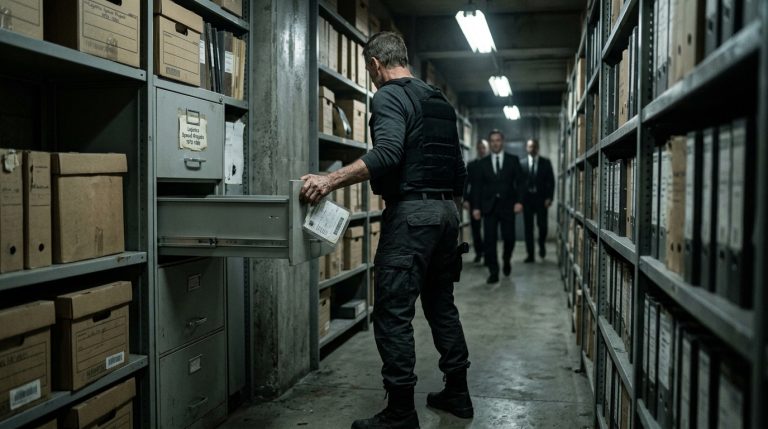
Inside that book was a name, written in shorthand that had been irrelevant for forty years. It belonged to an archivist, a man named Miller who had been the junior clerk in the G-2 office back in ’83. If Miller was still alive, he held the keys to the physical files that were never properly digitized—the raw, messy paper trail of Operation Shadowfall.
As Kaine neared his vehicle, he felt the familiar, cold flicker of his own fatigue-blurred perception. For a split second, the driver in the SUV transformed. The silhouette behind the wheel became his old handler, a man who had been dead since the mission. The phantom image lasted only a heartbeat, but it was enough to make Kaine stumble, his hand catching on the metal edge of a utility fence for support. The rust under his fingers was wet, cold, and grounding.
He reached his car, his movements fluid and practiced. He slid into the driver’s seat, the engine turning over with a rhythmic, healthy hum that contrasted sharply with the hollow, aching feeling in his chest. As the vehicle lurched into motion, he saw the SUV pull forward, mirroring his pace.
He didn’t head for the exit. He headed for the back of the lot, toward a maintenance gate that was rarely used. He was baiting them now, drawing them away from the public areas where they couldn’t act.
His phone—an ancient, burner-model flip phone he kept for emergencies—buzzed in his pocket. He didn’t answer it. He knew who it was. The Admirals weren’t finished; they were panicking. Every second he stayed mobile, the probability of the truth leaking increased exponentially.
He gripped the steering wheel, his knuckles white. The road ahead looked less like a path and more like a gauntlet. He wasn’t just driving to a location; he was driving into the heart of the archive. If he could reach the contact he had in mind before the Admirals’ teams managed to box him in, he wouldn’t just have the proof of their betrayal—he would have the leverage to force them to dismantle their own legacy.
The SUV accelerated, closing the gap. Kaine checked the rearview mirror, watching the headlights cut through the gloom of the late afternoon. He was exhausted, his body was failing, and the weight of the key in his pocket felt like it was pulling him toward the grave he had spent forty years avoiding. But as he turned the corner and saw the maintenance gate ahead, he felt a strange, cold clarity. They had spent decades building a wall of lies, but every wall, no matter how reinforced, had a single, rusted bolt that, if twisted just right, would bring the whole thing down.
CHAPTER 7: The Mirror Confrontation
The outskirts of Washington were a blur of gray concrete and steel, the muted colors of a city that thrived on hidden things. Kaine drove with his left hand gripping the wheel, his right hand never straying far from the rusted key still resting in his coat pocket. He wasn’t heading for a public place; he was heading for a quiet, neglected park on the edge of the Potomac, where the iron-wrought benches were flaking with age and the river’s current churned with the sediment of the city’s industrial past.
Miller was waiting there. Kaine saw him from three hundred yards away: a man stooped, like himself, blending into the landscape of dead grass and peeling paint. As Kaine pulled the car into the gravel turnout, the black SUV he’d been tailing suddenly peeled off onto a side street. They had decided to change tactics, moving to intercept him at the rendezvous. Kaine didn’t look back. He knew they were coming. He had five minutes—perhaps less—to get what he needed from Miller before the Admirals made their final move.
He stepped out of the sedan, his leg bracing against the uneven ground. The air here smelled of damp silt and rotting wood, a stark contrast to the sterile, manicured perfection of Arlington. Miller stood up as Kaine approached, his face a roadmap of long-term anxiety.
“You shouldn’t have come,” Miller whispered, his voice trembling like a reed in the wind. “I told you, Silas. The files were destroyed. All of them. The directive came from the top. Cho, Bennett, Graves—they were the ones who signed the burn orders.”
Kaine stood before him, a immovable, rusted object in a world of fragile people. He didn’t speak immediately; he just let the silence settle, letting Miller feel the crushing weight of the question he hadn’t yet asked.
“They’re offering me a retirement, Miller,” Kaine said, his voice flat. “They want the manifest.”
Miller’s eyes widened, a look of genuine horror crossing his features. “The manifest isn’t just a list of names, Silas. You know that. It’s the ledger of the accounts. It shows where the funding for the shadow-ops was diverted. It’s not just a mission report. It’s the entire architecture of the black-budget system that built their careers. If that surfaces, they aren’t just looking at scandal—they’re looking at decades of prison time.”
The distant sound of tires on gravel broke the quiet. Kaine glanced toward the park entrance. The black SUV was back, followed by a second vehicle, moving with a deliberate, aggressive speed. The Admirals had decided that containment was no longer an option. They were here for the purge.
“Give it to me, Miller,” Kaine said, his voice hard. “You kept a copy. I know you did. You were never the type to just burn the truth.”
Miller’s hands shook as he reached into a canvas bag slung over his shoulder. He pulled out a thick, sealed envelope, its edges yellowed with age. “They’ll kill you for this, Silas. They’ll make you look like a broken old man who lost his mind in a car accident. They’ve already written your obituary.”
Kaine took the envelope, the paper feeling heavy, substantial—a tangible piece of the truth he had been chasing through the rust and the shadows for forty years. He tucked it into his jacket, right against his chest. It felt like a weight, but it was the only thing that had ever made him feel light.
“Let them try,” Kaine replied.
He didn’t wait for Miller to say anything else. He turned back toward his car as the two vehicles roared into the park, their headlights cutting through the darkening air like searching eyes. He knew he wouldn’t be able to outrun them, and he wouldn’t be able to fight them off. But he didn’t need to win a battle. He only needed to reach the one person—the one public contact he had cultivated over the last six months—who could broadcast the contents of this envelope before the sun rose.
He climbed into his car and turned the key. The engine roared, a defiant sound that echoed off the river. He shifted into gear and looked at the approaching headlights. For the first time in four decades, the ghost was no longer hiding in the shadows; he was driving straight into the light, and he was taking the truth with him.
CHAPTER 8: The Dust Settles
The world collapsed into a singular point of kinetic violence. The impact spun Kaine’s sedan across the loose gravel, the metal groaning as it ground against the frame of the SUV. Airbags didn’t deploy—the car was too old—but Kaine braced, his hands locked to the wheel, his entire body a coil of survival instinct. When the motion finally ceased, the smell of burnt rubber and ruptured coolant flooded the small cabin.
Kaine didn’t wait for the doors to open. He kicked his own door outward, the metal hinge shrieking, and rolled onto the dirt. He felt the sharp sting of gravel embedding in his palms, but he didn’t stop. He scrambled toward the shelter of a thick, rusted maintenance shed, the envelope clutched to his chest like a holy relic.
Three figures emerged from the vehicles. Admiral Graves, Admiral Cho, and Admiral Bennett. They weren’t in uniform anymore; they looked like shadows in the dusk, their faces hardened by the desperate necessity of the moment. They didn’t draw weapons immediately—that would be too loud, too public—but they moved with the coordinated efficiency of a kill team.
“Silas, enough!” Graves shouted, his voice cracking, losing its polished edge. “You’re an old man holding onto a ghost. You want to bring us down? You’ll bring the whole house of cards with us. The families, the legacies—it all burns!”
Kaine stopped at the corner of the shed, his back to the cold, corrugated metal. He pulled the envelope out, his fingers trembling, not with fear, but with the sheer exhaustion of the fight. He looked at the men who had spent forty years pretending they were the protectors of the world, realizing now they were just scavengers feeding on the corpses of their own command.
“The house is already burning, Graves,” Kaine said, his voice rising, carrying over the churn of the river. “You’ve been standing in the flames for so long you’ve forgotten how to feel the heat.”
He took a step forward, exposing himself to them. Bennett finally drew a handgun, his hand shaking violently, his youthful, ambitious face twisted into a mask of pure, unadulterated terror. He was the one who would pull the trigger, the one who had the most to lose if the manifest proved his personal connection to the current black-budget funding.
“Don’t move, Captain,” Bennett snarled, his aim wobbling.
Kaine didn’t stop. He looked Bennett in the eye, seeing not a killer, but a scared, small man clutching a weapon he didn’t know how to wield. Kaine raised the envelope.
“Do it,” Kaine dared him. “But know that every name on that wall, every soul in that manifest, is being recorded by the satellite phone link I triggered the moment I turned into this park. The truth doesn’t need me to survive. It just needs you to make the mistake of pulling that trigger.”
The bluff was total, but in the brittle, paranoid minds of the Admirals, it was an absolute certainty. Bennett hesitated. His thumb hovered over the safety. Graves’ face drained of color, the granite facade finally shattering into dust. They had spent their lives manipulating the flow of information, and Kaine had just turned the faucet on full blast.
The silence that followed was the sound of a legacy dying. One by one, the Admirals’ postures collapsed. The rigid, militaristic order they projected was exposed as a thin, fraying skin over decades of rot. Bennett lowered the gun, his shoulders slumping. Graves looked at the ground, his gaze focusing on the rusted iron of the shed, the same rust that coated Kaine’s key, the same rust that was now consuming their power.
“It’s over,” Graves whispered. The admission wasn’t an apology; it was a surrender to the inevitable gravity of the truth.
Kaine didn’t feel a rush of victory. He felt only a profound, hollow stillness. He watched as the Admirals turned and walked back toward their vehicles, their steps heavy, the slow, rhythmic march of men who knew their time had run out.
The aftermath was quiet. Kaine remained by the shed as the sun dipped below the horizon, painting the sky in colors of bruised purple and dead gray. He walked to the riverbank and knelt, the gravel digging into his knees. He looked at the rusted key one last time, then tossed it into the dark, swirling current of the Potomac. It hit the water with a soft splash, disappearing instantly into the silt.
He didn’t need it anymore. He stood up, his leg aching with a dull, manageable throb. He turned toward the city, toward the place where he would finally let the truth go, not to destroy his enemies, but to bury the ghost of his own survival. He looked at his hands—weathered, scarred, and for the first time in forty years, empty. He took a breath, the air tasting of nothing but water and the coming winter, and began to walk, slowly, steadily, into a world that no longer owed him anything.