A Patch of Daylight: One Mother’s Journey to Reconcile the Memory of a Lost Son
CHAPTER 1: THE WEIGHT OF THE FRAME
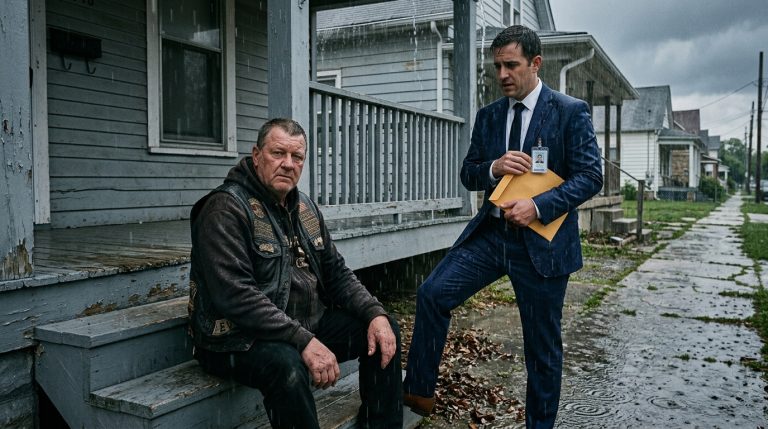
The threshold was a physical line drawn in the dust of the floorboards. Ruth stepped over it, and the world—the cold, the hunger, the relentless ache in her knees—faded into a dull hum. She didn’t see the heavy boots or the ink-stained skin of the men sitting in the dim light. She saw only the wall.
It was a gallery of ghosts. Framed faces stared back, some with names etched in bold marker, others with dates that looked like finality itself. Her hand, trembling with a tremor she usually hid in the depths of her pockets, rose toward the glass. Her fingers brushed the edge of a frame, the wood smooth and worn, smelling faintly of oil and polish.
There he was. Danny.
But it wasn’t the Danny of the yellow kitchen, the one who smelled of laundry detergent and fresh coffee. This Danny wore a leather cut that looked heavy enough to drag a man down. His hair was shorter, his expression held a kind of guarded stillness that made her breath hitch.
“Why is my son’s picture on that wall?”
The whisper sounded like a gunshot in the sudden vacuum of the room. The jukebox, which had been churning out a low-fi, rhythmic pulse, seemed to shudder into silence. Ruth didn’t look back. She couldn’t. If she turned, the illusion might evaporate, and she would be back on the sidewalk, shivering against the brick, clutching her plastic bag like a lifeline.
Behind her, a chair scraped—a slow, agonizing sound of wood against floor. Then, the steady, rhythmic thud-thud of heavy boots approaching.
Ruth didn’t pull her hand away from the glass. She felt the warmth of the man stopping beside her, even before he spoke. She didn’t recognize him, but she recognized the rhythm of his breathing. It was the rhythm of someone who had seen too much and said too little.
“Mom?”
The word was a tectonic shift. It wasn’t the voice of her son, yet it held the same cadence, the same unexpected gentleness that had carried her through the last decade of her life.
Ruth finally blinked, the dust motes dancing in the singular shaft of light from the window catching on her eyelashes. She didn’t recognize the face, but she recognized the eyes. They were fixed on the photo of Danny, not on her, as if the man was mourning him in real-time.
She turned, her coat heavy on her thin shoulders. The man, a wall of muscle and leather, looked down at her. He didn’t offer a hand, didn’t offer a shallow greeting. He simply looked at the frame, then back at her, his jaw tightening as if he were holding back a weight that no one else could see.
Then, he did something that shouldn’t have been possible. He reached out and touched the frame right next to her hand, his thick fingers hovering inches from her own, leaving a smudge of oil on the glass. The air between them felt thick, charged with a truth that was beginning to unravel the entire fabric of what she thought she knew about the last two years.
“My name is Thomas,” he said, his voice dropping into the quiet. “But everyone here calls me Bull. And we’ve been waiting for you to ask that question for a very long time.”
He stepped back, gesturing to a table bathed in a pool of fading amber light, but as Ruth went to move, she caught a glimpse of something tucked into the corner of the frame—a small, silver key taped to the backing. It hadn’t been there when she looked through the window. Or, perhaps, she simply hadn’t been meant to see it until this exact, devastating moment.
CHAPTER 2: THE ECHO OF A SILENT PROMISE
Ruth’s fingers remained frozen against the glass, the cold surface stinging her skin. The key—small, utilitarian, and utterly out of place—seemed to hum with the weight of unsaid things. Her pulse thudded in her fingertips. Two years of grief, two years of carefully curated memories of a son who worked in an office, who wore crisp shirts, who lived a life she thought she had archived in her mind, were beginning to blur at the edges.
“Mom?”
Bull’s voice was a deep, gravelly vibration that pulled her attention away from the glass. He hadn’t moved, but his posture had shifted. The protective, predatory hunch of his shoulders had softened, replaced by a guarded, almost weary stillness. He watched her hand—not the way a stranger might, but with the quiet, devastating recognition of someone who had shared a bunker with a ghost.
Ruth pulled her hand back, tucking it into the pocket of her worn coat. She felt the phantom weight of the key, though it remained on the wall. “He didn’t wear leather,” she whispered, her voice cracking. It was a pathetic, small protest against the reality standing in front of her, but it was all she had left of the world she used to inhabit.
Bull nodded once, a slow, solemn movement. “Danny had a lot of lives, Ruth. Most of the men in this room knew the version of him that kept them upright when the road got too long. But he never stopped talking about the version of him that belonged to you.” He gestured again to the table. “Please. It’s warm, and the coffee is better than the street.”
Ruth moved, her joints stiff from the damp evening air. She didn’t look at the other men, though she felt the shift of their collective weight—a subtle turning of heads, the cessation of low-volume chatter. They were giving her space, a perimeter of silence that felt like a protective veil. As she sat, the plastic bag at her feet—her entire, miserable, singular history—seemed to shrink, becoming less important than the wooden chair beneath her.
A man appeared from the shadows, placing a steaming mug in front of her. He didn’t speak. He just set it down, the ceramic clinking against the scarred wood of the table, and vanished back into the peripheral gloom.
“What is that?” Ruth asked, nodding toward the key on the wall as she wrapped her shaking hands around the mug. The steam rose, blurring the edges of the room, making everything look like a faded photograph.
Bull looked at the key, then back to Ruth. He took a long moment to respond, his eyes scanning the room, perhaps checking the perimeter, or perhaps just ensuring the sanctity of the moment. “That’s the key to a locker at the old terminal station. Danny put it there a week before he died. He told me if anything ever happened—if he didn’t make it back—that I was to hold it until the right person came asking.”
Ruth’s heart hammered against her ribs. “Why didn’t you look? Why didn’t you open it?”
Bull’s face hardened, the skin around his eyes tightening. “Because it wasn’t mine to open. Danny was many things, but he was a man of his word. He told me that box contained the only thing that would matter if the neighborhood went under. I didn’t know if he meant money, or secrets, or just memories. But I knew it was his legacy, and in this club, you don’t touch a brother’s legacy unless you’re ready to answer to him.”
Ruth sipped the coffee; it was dark, bitter, and painfully real. It grounded her. She looked at the men around the room—the grizzled, tattooed, intimidating figures who were currently acting as silent guardians. For the first time in years, she felt a strange, terrifying sense of belonging. Not because she understood their world, but because they understood hers—or rather, they understood the man who had been the architecture of her life.
“He died for this place, didn’t he?” she asked, her voice steadying. She didn’t mean the bar. She meant the streets outside, the blocks she had walked for decades, the fading textures of her home.
Bull’s silence was an admission. He leaned forward, his hands resting on the table, calloused and scarred. “He didn’t just die for the place, Ruth. He died trying to keep it from being erased. There are people with suits and pens who want this district gone, turned into glass and steel. Danny found the cracks in their foundation, and he spent his last months pouring himself into those gaps to keep the floor from falling out from under us.”
Ruth looked down into the dark liquid of her mug. She had thought she lost everything when the apartment went, when the savings dried up, when the silence of the house became unbearable. But she realized now that she hadn’t lost the house; she had lost the context of her existence. She had been living in a vacuum, grieving a son she didn’t realize was a warrior.
“The key,” she said, looking up at him. Her eyes were clear, the fogginess of grief replaced by a sharp, flinty resolve. “I want it.”
Bull didn’t hesitate. He stood up, his massive frame casting a long shadow across the table. “I thought you might. But I need you to understand, Ruth—once you open that locker, you aren’t just a mother looking for answers. You become a participant in the finish he never got to reach.”
Ruth stood up, her knees aching, but her posture straighter than it had been in years. She didn’t fear the participation. She feared the ignorance. “I’ve been living in the dark for two years, Bull. I think I’ve earned the right to see what’s in the box.”
Bull looked at her, and for a fleeting second, his expression cracked. He didn’t see the fragile, hungry woman anymore. He saw the woman who had raised a man like Danny. He gave a single, respectful nod and reached into his vest, pulling out a heavy, darkened iron key that matched the one on the wall. He laid it on the table between them.
“It’s not just a box, Ruth,” he said softly. “It’s a map back to everything you thought you lost.”
CHAPTER 3: THE ARCHITECTURE OF A GHOST
The transition from the warmth of the bar to the biting chill of the evening was like stepping into a different century. Ruth walked slowly, her legs feeling weighted by the iron key tucked deep into her coat pocket. Bull had offered a ride, but she had declined. She needed to feel the pavement beneath her, to navigate the familiar routes of her past while the heavy truth of the present settled into her bones.
The streets were changing, just as Bull had warned. Where there had once been a neighborhood bakery with a flour-dusted window, there was now a boarded-up storefront covered in bright, synthetic plastic sheets advertising luxury housing. The texture of the city had shifted from the worn, honest grit of brick and mortar to the smooth, indifferent plastic of progress.
Ruth kept her head down, her eyes scanning the familiar cracks in the sidewalk. She wasn’t just walking; she was reading the geography of the displacement. Every empty lot, every shuttered shop, felt like a silent witness to what Danny had been fighting. He hadn’t just been “riding” with a club; he had been standing guard over the memory of these streets.
She reached the terminal station just as the streetlights hummed to life, casting long, jaundiced shadows across the concourse. The air inside smelled of ozone, old floor wax, and the desperate, hurried lives of commuters. It felt like a mausoleum for forgotten things.
The locker was tucked away in a corner that the station’s cleaning crew seemed to have abandoned years ago. The metal was pitted with rust, a jagged orange bloom that mirrored the decay of the surrounding district. Ruth stood before it for a long time, the key hovering near the lock. Her hands were steady now—not with age, but with a sudden, sharp clarity.
The key turned with a reluctant, grinding protest of metal on metal. The door creaked open, revealing a sparse collection of items: a thick, leather-bound ledger, a bundle of blueprints tied with twine, and a small, tarnished silver compass.
Ruth pulled the ledger out first. It was heavy, the pages yellowed and filled with Danny’s meticulous handwriting. She flipped through it, her breath catching. It wasn’t a diary. It was a forensic map of the district’s history. There were names of families, dates of deeds, and intricate notes on zoning laws, all annotated in Danny’s precise, practiced script. He had been documenting the legal standing of every building, every plot, every homeowner. He had been building a case, a silent, methodical defense for the people who had lived here for generations.
She sat on the cold floor of the concourse, ignoring the grime that clung to the hem of her coat. As she read, the decoy secret she had suspected—that Danny was involved in some local dispute—shattered. This wasn’t a dispute. It was an inheritance. Danny had been protecting the legal DNA of the neighborhood, ensuring that when the developers came with their wrecking balls, they would find a locked vault of history they couldn’t just brush aside.
In the back of the ledger, she found a loose piece of paper, a folded notice from the city council regarding a zoning variance. Beside it, tucked between two pages of dense research, was a single, handwritten note: For Mom. If they take the house, they take the history. Don’t let them have the history.
The weight of it hit her then—the realization that Danny’s death wasn’t just a loss of a son; it was the loss of the only person who knew how to hold the line. He had been the architect of their collective survival, working in the shadows, fueled by the memory of the home they once shared.
She looked at the compass. It was old, the needle spinning aimlessly, unable to find North in the metallic maze of the station. She realized then that the “accident” wasn’t an accident. Danny had been documenting the exact assets that the developers needed to consolidate to break the neighborhood’s resistance. He hadn’t been fighting a war; he had been documenting the truth of the land.
She stood up, carefully tucking the ledger and the blueprints into her plastic bag, wrapping them in her coat to keep them dry. The station felt colder now, the shadows stretching and pulling as if they were closing in. She knew she couldn’t go back to her room and simply sit. The evidence in her hands was a target, and she was the only one who knew how to use it.
As she walked toward the exit, she noticed a shadow move near the ticket booth—a figure in a sharp, tailored coat, watching her from the periphery. They weren’t a biker. They were the kind of person who wore expensive shoes and avoided the grit of the station floor. The man didn’t move toward her, but his eyes locked onto hers with a sudden, predatory recognition.
Ruth didn’t flinch. She kept her pace, her chin lifted, the heavy ledger pressing against her ribs like a shield. She had spent two years feeling invisible, but as she stepped out into the night, she realized that visibility was exactly what she needed. She was carrying Danny’s truth, and for the first time in years, the city looked less like a graveyard and more like a battlefield.
She knew the man would follow. She knew the developers would not let this ledger reach the light of day. But as she merged into the flow of the night, she felt a quiet, humming strength. Danny had left her a map, and she was finally beginning to understand where it led.
CHAPTER 4: THE GARDEN OF RUSTED MEMORIES
Ruth turned the corner onto Oakhaven Street, her pace brisk but controlled. The man from the station hadn’t lunged; he had simply watched, a silent sentinel in a tailored coat. She knew he was behind her, a shadow detaching itself from the urban landscape. She needed a place that wasn’t a thoroughfare, a place where the concrete gave way to the softer, older memory of the city.
She turned into an alleyway that led to the “Old Block,” a pocket of land that had survived the wrecking balls because of a complex, unresolved property dispute. It was where the community gardens used to be—where, two years ago, she had spent her Saturdays kneeling in the damp, cool earth.
The iron gate groaned as she pushed it open. The space inside was a tangle of wild, unkempt beauty. Faded textures dominated: the graying wood of raised beds, the rust-colored skeletons of tomato vines, and the peeling paint of a garden shed that still stood as a testament to better years.
She stepped inside, the latch clicking shut behind her with a sound like a final period at the end of a sentence. The scent hit her instantly—damp pine and wet soil. It was the smell of Danny. It washed over her with such violent clarity that she had to lean against the side of the shed, her breath hitching in her chest. For a moment, the years compressed. She could hear his laugh, the sound of a shovel hitting dirt, the way he would wipe his forehead with a sleeve covered in mulch.
Stay focused, she whispered to herself. The ledger inside her bag felt heavy, a brick of reality in a world of ghosts.
She walked toward the back of the garden, where Danny used to keep his small, private plot. She needed to hide the ledger, to place it somewhere that wouldn’t be found by a man in expensive shoes. She knelt, her knees protesting the cold ground, and began to dig beneath the rotting wood of a planter box.
As she worked, her hand brushed against something hard and metallic. She pulled it out: a small, rusted tin, its lid fused shut by years of rain and neglect. She pried it open with the tip of her pocketknife. Inside wasn’t money or gold. It was a collection of seeds, neatly labeled in plastic bags, and a second, much smaller key—this one for a safety deposit box at a local community credit union.
Beside the key lay a scrap of paper, damp but legible, with a string of numbers. Her heart hammered against her ribs. Danny hadn’t just documented the land’s history; he had secured the access points. This wasn’t just a ledger of facts; it was a blueprint for the neighborhood’s legal counter-attack.
The silence of the garden was broken by the sound of footsteps on the other side of the gate. Heavy, measured, expensive.
Ruth didn’t stand. She stayed in the dirt, her heart a drumbeat in her ears. She looked at the rusted shed, then at the overgrown path leading to the back exit. She knew the garden’s layout better than any developer’s surveyor ever could. She knew that behind the shed, there was a loose panel in the fence that led to the service entrance of the old grocery store.
She tucked the ledger and the new key into her pockets, her movements silent, practiced. She stood, brushing the dark, loamy earth from her coat, and moved toward the back of the lot.
The man at the gate pushed it, the metal whining in protest. He didn’t enter immediately. He stood in the opening, a silhouette against the jaundiced glow of the streetlights, his eyes scanning the overgrown tangle of the garden.
“I know you’re here, Ruth,” he called out, his voice smooth, professional, and entirely devoid of warmth. “And I know what you’re holding. It doesn’t belong to you. It doesn’t even belong to this neighborhood anymore. It’s an relic of a future that’s already been written.”
Ruth didn’t reply. She kept low, pressing her body against the rough wood of the shed. The scent of pine was stronger now, a phantom presence that urged her to keep moving. She felt a flicker of fear—not for her own safety, but for the history she carried. If they took the ledger, they would erase the very foundation of the community’s legal right to the land.
She reached the back fence, her fingers finding the familiar, rusted latch of the loose panel. It hadn’t been touched in years, but it gave way with a screech that seemed to pierce the night. The man at the gate turned, his flashlight cutting a sharp, white beam through the gloom.
Ruth didn’t look back. She slid through the gap, her coat snagging on a splinter, and tumbled out into the narrow service lane behind the store. She didn’t stop running until she hit the main road, the rhythm of her feet against the concrete a desperate, defiant cadence.
She was no longer the invisible woman clutching a plastic bag. She was a runner in the night, carrying the blueprints of an entire neighborhood’s soul. And as she ducked into the shadows of an alley, she realized that Bull and his men were just a few blocks away. She didn’t need to be alone anymore. She just needed to reach the people who understood that some things in this city were worth more than glass, steel, and bottom lines.
She reached for the prepaid phone Bull had given her. Her fingers trembled, but she pressed the speed-dial button. One ring. Two.
“Bull,” she whispered, her voice tight with exertion. “I’m at the back of the old grocery store. And I have something that’s going to change everything.”
CHAPTER 5: THE CONFRONTATION AT THE CROSSROADS
The connection on the prepaid phone sputtered, a thin, electronic whine competing with the roar of a heavy engine approaching from the mouth of the alley. Ruth didn’t wait for Bull to confirm. She dropped the phone into her pocket and flattened herself against the brickwork of the alleyway, her lungs burning with the sharp, metallic tang of cold air and exhaust.
A black sedan, its headlights extinguished, rolled slowly past the mouth of the alley, its tires crunching over broken glass and debris. It didn’t stop, but the driver’s side window lowered, and for a heartbeat, Ruth saw the profile of a man—not the one from the station, but someone else, someone colder, someone who moved with the calculated indifference of a machine.
She couldn’t stay in the alley. It was a throat that was closing in on her. She turned and scrambled over a stack of wooden shipping pallets, her movements clumsy but driven by a singular, frantic focus. She had to get to the meeting spot Bull had mentioned—a small, nondescript garage behind the bar where the club kept their bikes.
As she sprinted, her mind raced. The ledger in her bag felt like lead. She realized now that this wasn’t just a local dispute. The developer, a man named Sterling, wasn’t just building luxury apartments; he was consolidating property to erase the legal history of the district entirely. He was using the land’s tangled records to create a “blank slate.” If she could get this ledger to someone who knew the law—to a lawyer who cared about the district’s roots—the entire project could be stalled, or better yet, dismantled.
She hit the street again, weaving through a labyrinth of shadows. The neighborhood was a maze of half-finished construction and long-neglected storefronts. She reached the rear of the bar just as a motorcycle roared to life inside the garage. The sound was a primal, rhythmic growl that cut through the silence of the night.
Bull stood in the doorway of the garage, his massive frame silhouetted against the amber light emanating from within. He didn’t ask questions. He saw the way she was running, the way she clutched the plastic bag to her chest, and he moved. He was at her side in three long strides, his hand firmly, but gently, gripping her arm to steady her.
“Inside,” he commanded, his voice a low, steady anchor in the storm of her panic.
They ducked into the garage, where the air was thick with the scent of gasoline and old rubber. Several other men were there, their faces etched with a grim, hard-won focus. They weren’t looking at her as if she were a victim; they looked at her as if she were a scout who had just returned from behind enemy lines.
“They’re coming, Bull,” Ruth gasped, handing him the ledger. Her hands were finally beginning to shake. “The man from the station. Someone else in a car. They know.”
Bull took the ledger with the same reverence he had shown the photo of Danny. He didn’t open it. He looked at the men, then back to Ruth. “You did good, Mom. Better than most. But they’re not just coming for the book. They’re coming to ensure no one speaks for the history you’re carrying.”
Suddenly, the air in the garage shifted. The distant, rhythmic sound of heavy machinery—a wrecking ball, or perhaps just a truck carrying one—vibrated through the concrete floor. The ground itself seemed to protest.
Bull’s face darkened. “They’re not waiting for morning. They’re going to force the demolition of the Old Block tonight.”
Ruth felt a cold wash of realization. The man at the station hadn’t been following her to kill her; he had been trailing her to see if she would lead them to the rest of the documentation. She had done exactly that. She had led them to the club.
“We have to move,” she said, her voice turning sharp. The Kintsugi logic clicked into place: the breakage was the point of connection. She wasn’t just a mother seeking answers; she was the catalyst for the defense of her home. “The ledger has the zoning precedents. If we can get them to the historical society’s lawyer before the wrecking crew reaches the site, we can trigger a mandatory stay.”
Bull grinned, a rough, jagged expression that lacked any humor. “That’s a twenty-minute ride in the best of conditions. And we’re about to have company.”
Outside, the screech of tires echoed again, followed by the heavy, authoritative thud of car doors slamming shut. The club members moved like a single organism, grabbing their gear, their expressions settling into a grim, professional resolve. There was no panic, only the calm, calculated movement of men who had spent their lives protecting things that the world deemed worthless.
Ruth climbed onto the back of Bull’s bike, her heart beating in sync with the engine’s idle. She tucked the ledger inside her coat, pinning it against her chest. She wasn’t afraid of the men in the suits anymore. She was a mother who had lost everything, and she had discovered that when you have nothing left, you become the most dangerous person in the room—because you are the only one with nothing left to lose.
As the garage door rolled up, revealing the cold, streetlit night, she saw them: a line of black cars blocking the alley exit. But for the first time in two years, she wasn’t standing on the outside looking in. She was at the center of the storm, and she was ready to fight for the ground beneath her feet.
CHAPTER 6: THE WEIGHT OF THE UNRAVELING
The garage door rattled shut behind them, sealing the scent of gasoline into the past. Ruth clung to Bull’s leather jacket, her knuckles white, as the bike accelerated into the narrow alley. The world transformed into a blur of jaundiced streetlights and jagged silhouettes. Ahead, the black sedan was still idling, its headlights cutting twin paths through the thick, nocturnal air like the eyes of a prowling beast.
“Hold on!” Bull shouted over the roar of the exhaust. He didn’t swerve. He leaned into the throttle, steering directly toward the gap between the sedan and the alley wall.
Ruth’s eyes narrowed. She saw the driver of the car reaching for something—not a weapon, but a radio. She realized with a jolt of clarity that this wasn’t about physical confrontation; it was about the control of information. If they could call ahead, if they could alert the demolition crew, the historical status of the Old Block wouldn’t matter. The wrecking balls would move, and by dawn, the physical evidence would be nothing but dust and twisted rebar.
As they burst out of the alley, the sedan lurched forward to block their path. Bull didn’t hesitate. He swung the bike onto the sidewalk, the tires skidding on the slick, oil-stained concrete. Ruth felt the proximity of the car’s fender, the hot air from its exhaust washing over her legs. They shot past the obstruction, the engine’s scream echoing off the canyon of abandoned storefronts.
They weren’t free yet. Behind them, the sedan swerved and gave chase, its tires burning rubber. Ruth felt a surge of vertigo. The reality of Danny—the son she had kept in a porcelain box of memory—was shifting into the silhouette of a man who lived in this lethal, high-stakes blur. She was riding on the back of a machine he had once mastered, chasing a truth he had died trying to preserve.
The sensory overload was a hammer against her senses: the smell of burning rubber, the icy wind tearing at her coat, the rhythmic flash of streetlights rhythmically strobe-lighting the night. She squeezed her eyes shut for a micro-second, and in that darkness, she saw Danny’s face—not the guarded, leather-clad stranger, but the boy who used to help her fix the leaky kitchen faucet. The contradiction was a physical ache in her chest.
He wasn’t a criminal, she whispered into the wind, a desperate mantra. He was a gardener.
They reached the main thoroughfare, the traffic thin and ghostly. Bull leaned into a sharp turn, the bike’s frame scraping the road in a shower of sparks that illuminated the asphalt like a constellation of dying stars. They were gaining distance on the sedan, but ahead, she saw it: the silhouette of a massive crawler crane, its long, skeletal neck looming over the Old Block like a prehistoric predator.
The lights of the demolition site were already bright, casting an artificial, unforgiving glare over the crumbling brick facades. Men in high-visibility vests were already swarming the perimeter, placing markers on the ground.
“They’re early,” Bull roared, his voice taut with suppressed fury.
He braked hard, the bike fishtailing before coming to a stop fifty yards from the site. Ruth scrambled off, her boots hitting the pavement with a jarring impact that traveled up her spine. She didn’t wait for Bull. She clutched the plastic bag—the ledger, the blueprints, the key—and ran toward the perimeter fencing.
A guard stepped forward, his hand held out in a warning gesture. “Construction zone. No admittance.”
Ruth didn’t slow. She didn’t speak. She reached into her bag, pulled out the legal notice she had found in the locker, and thrust it toward the man’s chest. “This is a registered historical protection notice,” she stated, her voice surprisingly steady, echoing the authority of the archives she carried. “Unless you want to be personally liable for the illegal destruction of a protected site, you will stop this operation immediately.”
The guard hesitated, his eyes flickering from the paper to the approaching motorcycle engines of the club behind her. Bull and the others had arrived, a phalanx of leather and shadows, their presence expanding to fill the empty space of the street. They didn’t threaten; they simply stood, a barrier of silence against the machine’s roar.
But then, the man in the tailored coat—the one from the station—stepped out from the driver’s seat of the sedan, which had pulled up to the curb. He wasn’t looking at the guards. He was looking at the ledger.
“That notice is void, Ruth,” he said, his voice dropping into the fray like a stone into a well. “The city council issued a supersede order an hour ago. You’re holding a map to a city that no longer exists.”
Ruth’s hand trembled. She looked at the paper, then at the ledger. The paper was clean, official, stamped with the city’s seal. The ledger was worn, handwritten, stained with the soil of the garden.
The weight of the betrayal was a physical blow. She had been the courier, but the enemy had been moving ahead of her, erasing the ground beneath her feet before she could even step on it. The decoy secret—that the property battle was a local dispute—was dead. This was something far larger, a systemic, administrative erasure that rendered her son’s meticulous work invisible.
As the crane’s engine groaned to life, the claw of the machine swung slowly, ponderously, toward the roof of the old library. The sound of bricks beginning to shift was a low, mournful rumble. Ruth felt a tear track through the dust on her cheek. She hadn’t failed Danny. She had been fighting a war in a world that had already signed the surrender.
But as she looked at Bull, who was already stepping forward toward the guard, she realized that the fight wasn’t over. It had just moved from the courtroom to the street.
CHAPTER 7: THE ARCHIVE OF RESISTANCE
The air grew heavy with the grit of pulverized mortar. The crane’s massive iron ball swung once, twice, a slow, predatory pendulum that seemed to taunt the very air. Ruth stayed pressed against the chain-link fence, the ledger clutched to her chest like a heartbeat. Beside her, Bull and the other men were a wall of leather and resolve, facing down the line of private security guards whose arrogance had begun to fray under the steady, silent pressure of the club’s presence.
“You’re wasting your time,” the man in the tailored coat shouted over the roar of the machinery, his composure finally beginning to crack. He stepped forward, his eyes darting toward the crane operator, signaling for the final drop. “This site is condemned. That book you’re carrying? It’s just paper. History is written by the people who own the land, not the people who once walked on it.”
Ruth didn’t look at him. She opened the ledger to the back, to the appendix she had skipped in the frantic dark of the station. Her eyes scanned the dense, cramped notes Danny had scrawled in the final days of his life. She had been looking for deeds and zoning laws, but there, tucked into the margin, were the coordinates and land-surveying reference points that didn’t just relate to property boundaries—they related to the district’s infrastructure map.
She saw it. A reference to an old, decommissioned municipal water easement that ran directly underneath the library and the adjacent warehouse. It was a protected, subterranean right-of-way that the city council had failed to formally vacate when they approved the developer’s consolidated permit.
Danny hadn’t just been documenting history. He had been identifying a fatal legal flaw. If the construction reached a certain depth—if the crane broke the surface of the land at the wrong spot—it would trigger an automatic, mandatory federal audit of the entire site’s underground utilities. It would stop the demolition instantly.
“Bull,” she breathed, grabbing his sleeve. Her voice was sharp, cutting through the ambient roar. “He’s wrong. The permit is based on a lie.”
Bull looked down at her, his eyes reflecting the harsh artificial glare of the work lights. He didn’t ask; he waited for the instruction.
“The library foundation,” she said, her voice rising, clear and authoritative. “If that machine drops the load there, it hits a municipal easement. It’s a federal violation. If we can get this document to the site engineer, they have to stop. They’ll lose their bond if they hit that line.”
Bull didn’t hesitate. He looked at his men, a single nod passing between them. They moved with the silent, practiced efficiency of a unit that had been preparing for this exact moment for years. They didn’t charge the guards; they flanked them, moving with a fluid grace that made the heavy-set security team hesitate.
Bull stepped directly into the path of the site engineer, a man in a hard hat who had been watching the scene with nervous, darting eyes. Bull shoved the ledger into the man’s hands. “Read page forty-two,” he commanded. His voice wasn’t a threat; it was a cold, absolute fact.
The engineer paused, the crane operator above them stalling the machine, the silence suddenly deafening. The engineer opened the book. He read. His face went pale. He looked at the site, then at the ledger, then back to the crane operator. He signaled a hard stop.
The developer’s man in the tailored coat realized the shift in momentum. He scrambled toward the engineer, his face contorted with rage. “Keep working! Ignore them! It’s all within the plan!”
But the engineer was already walking away, shaking his head, shouting back, “If this map is right, we’re digging into a state-regulated water line. I’m not losing my license for this project, Sterling. We’re done until the city clears it.”
The project sputtered. The massive crane, which had been poised to crush the legacy of the Old Block, went still. The mechanical growl faded, replaced by the ragged, uneven breathing of the men in the lot. The developer stood alone, his expensive coat out of place against the backdrop of rust and ruin, his authority dissolving into the cold night air.
Ruth stepped forward, out from behind the fence. She walked into the center of the light, her coat frayed, her face smudged with dirt, but her eyes burning with a clarity that made the developer look away. She held the ledger up, not as a weapon, but as a monument.
“You didn’t write the history,” she said, her voice carrying across the silent lot. “You just tried to bury it. But some things don’t stay buried.”
The man in the tailored coat glared at her, but there was nowhere left for him to go. The authority he had relied on—the permits, the seals, the arrogance of the boardrooms—had been shattered by a single, handwritten note from a man who had known this land better than any of them.
She turned to Bull. He stood a few feet away, watching her with a look of quiet, profound pride. They had bought the time. They had stopped the wrecking ball. The battle for the neighborhood had changed, but for tonight, the foundation remained intact.
She felt the fatigue finally crashing down on her, the adrenaline draining away, but in its place was a profound, quiet peace. She had finished the work Danny had left behind. She hadn’t just saved a library; she had validated the entire architecture of his life.
CHAPTER 8: THE FOUNDATION OF PEACE
The silence was the most startling part. For hours, the atmosphere had been thick with the grinding of steel and the shouting of men. Now, the construction lot felt like a cathedral—vast, hollow, and hauntingly still. Sterling, the developer, stood near the edge of the perimeter fence, his face pale under the glare of the work lights. He looked less like a titan of industry and more like a man who had suddenly realized he had stepped off a cliff and hadn’t yet hit the bottom.
Ruth walked toward him, the weight of the ledger finally gone from her arms. She stopped ten feet away. Bull and his men remained behind her, a silent, unmoving sentry line.
“You lost,” Ruth said. Her voice wasn’t triumphant. It was matter-of-fact, the way a person speaks when they are describing the weather or the time of day. “You lost the moment you decided that history was something you could trade for profit.”
Sterling looked at her, his eyes darting to the men behind her. He tried to reclaim his posture, his hands adjusting the lapels of his coat. “This is a minor administrative delay, Ruth. I have lawyers who can dismantle that water easement claim in a week. You haven’t won anything. You’ve just made the inevitable more expensive.”
“Maybe,” Ruth replied. She reached into her pocket and pulled out the small, tarnished silver compass she had found in the locker—the one that couldn’t find North. She held it out, showing him the spinning needle. “But you see this? It doesn’t find North. My son told me once that you don’t need a map when you know exactly what you’re defending. You built your empire on the idea that people like us are drifting, that we have no compass, that we’ll sell our homes for a quick check. You were wrong.”
She walked past him, toward the center of the lot, to the spot where Danny had spent so many nights documenting the foundations. She knelt, her knees sinking into the soft, upturned earth. She took the small, silver key—the one from the garden—and pressed it into the dirt.
“The library stands,” she said, her voice rising now, carrying to the edge of the lot where the city officials had finally begun to arrive, their flashing lights turning the site into a revolving kaleidoscope of blue and red. “And the archive is open. Everything Danny documented is now in the hands of the district’s legal committee. You can keep your lawyers, Sterling. They’ll be busy for the next ten years just trying to keep you out of court.”
Sterling watched as the police and city inspectors approached the lot. He realized, in that moment, that the game was truly finished. His leverage had evaporated. He turned on his heel, his expensive shoes crunching on the gravel, and walked toward his car without another word. He didn’t look back. He didn’t have to. The defeat was written in the way he walked—the gait of a man who realized that for all his money, he had been fighting a ghost he could never defeat.
The aftermath was a slow, quiet settling. The inspectors began marking the site with caution tape. The club members slowly began to disperse, giving Ruth the space she needed. Bull approached her last. He didn’t speak. He simply stood there, a towering, silent figure, watching as she finished pressing the key into the earth.
“He would have been proud of you, Mom,” Bull said finally. His voice was thick with a rare, raw emotion.
Ruth stood, brushing the dirt from her palms. She looked around the lot, at the dark skeletons of the old buildings. They weren’t just buildings anymore; they were stories. “He didn’t want me to be proud,” she said softly. “He wanted me to be home.”
She walked over to the library foundation, placing her hand on the cold, rough stone of the corner pillar—a small, chipped piece that had broken off during the early demolition attempts. She reached into her bag, pulled out a small tube of adhesive she’d carried from her old apartment, and carefully set the fragment back in place. It wasn’t a perfect fix, but it was an act of restoration. It was a promise.
The cool down was long and atmospheric. The city noise returned in a dull, distant hum—the sound of a world that continued to turn, but one that now felt kinder, more grounded. As the night turned toward dawn, the sky began to bleed a pale, hopeful gray.
Ruth felt a hand on her shoulder—not a burden, but a steadying touch. She looked up at Bull. There was no more tension, no more the predator-prey dynamic that had fueled their first meeting. There was only a shared, quiet recognition. She reached out and touched the sleeve of his leather cut, the texture of the material worn and warm.
“Come on,” he said. “Let’s take you back to the room. It’s quiet there.”
Ruth nodded. She walked out of the lot, her steps steady, her head held with a quiet, hard-won dignity. She had lost her son, but she had regained the world he had fought to save. She felt the cool air against her face, the promise of a morning that didn’t feel like an ending, but like a beginning. The history of the neighborhood wasn’t just in the books or the deeds; it was in her, and in the quiet, indomitable spirit of the people who chose to stay. She was home.