The Iron Cane on Ellison Avenue Proves That True Strength Never Retires Quietly
CHAPTER 1: THE HEAVY STREET
Walter Briggs adjusted the cuffs of his faded 1983 olive jacket, pulling the worn fabric tight against the autumn chill.
The morning air tasted like old coal smoke and wet asphalt as he stepped out of the corner deli with a small paper bag tucked securely under his arm.
Inside the bag were a loaf of plain white bread, a tin of cough drops, and a postcard meant for his grandson at the academy.
His boots crunched steadily against the gravel-strewn sidewalk of Ellison Avenue, following the exact route he had walked every Thursday for the past twelve years.
Across the street, a group of leather-clad bikers leaned against their polished machines outside the local tavern, filling the quiet morning air with loud, coarse laughter.
Walter paid them no mind, keeping his eyes fixed on the cracked pavement ahead and leaning his weight firmly into his metal cane.
As he edged past a row of parked bikes, his thick canvas sleeve grazed a chrome handlebar.
The heavy machine rocked slightly on its kickstand but remained upright.
Walter stopped instantly, turning his body back around with both hands raised in a gesture of simple, honest apology.
“My fault, son,” Walter said, his voice raspy but calm. “Jacket’s thicker than I thought.”
The tallest biker stepped forward, his mirrored sunglasses reflecting the dull noon sun.
Without a word of warning or an inspection of his machine, the man lashed out with an open palm, striking Walter squarely across the face.
The old man hit the pavement with a dull thud, one hand still desperately clutching the paper bag as it ripped wide open.
A single loaf of bread rolled clumsily into the gray gutter, speckled with fine dust and motor oil.
Inside the tavern doorway, the laughter paused for a fraction of a second, then resumed without a missing beat.
A customer shifted his chair to avoid looking at the curb, while a waitress peering through the diner window turned her back and wiped down a clean table.
Walter did not cry out, nor did he curse the cold concrete pressing into his bruised cheek.
He simply braced his trembling hands against the rough sidewalk, his jaw tightening into a hard, unyielding line as he began picking up the ruined pieces of bread.
CHAPTER 2: THE COLD BENCH
Walter did not reach for his stinging cheek.
Instead, he focused entirely on the mundane geometry of survival, folding the torn edges of the paper bag inward to protect the remaining groceries from the damp asphalt.
His knee trembled beneath his worn trousers, a dull ache throbbing deep inside the joint as he dragged himself upright by the metal post of the municipal bus bench.
The heavy wood of the bench felt freezing against his spine as he sat down, exhaling a thin cloud of vapor into the mid-morning air.
Around him, the street moved with the indifferent rhythm of a typical Thursday.
A delivery truck shifted gears down the block, its transmission grinding noisily against the pavement while a woman pushing a stroller crossed the street two lanes early to avoid the knot of bikers outside the tavern.
No one looked his way.
The silence of the onlookers was heavier than the blow itself, an invisible wall built of averted eyes and locked doors.
Walter reached into his inner coat pocket, his fingers brushing past a frayed receipt before locating the small, battered flip phone with the cracked screen.
The plastic buttons were worn smooth from years of use, but the display still glowed with a dim blue light.
He pressed a single button, dialing the direct emergency preset labeled Eagle 6 without hesitation.
The phone hummed against his ear with a low, dead tone for three long seconds before the line connected with a sharp click.
“Dad?”
The voice on the other end was immediate, carrying the sharp, flat cadence of a man who never slept deeply.
“I’m on Ellison,” Walter said, his voice level and devoid of self-pity. “Row of bikes by the tavern. Bring your truck.”
He didn’t explain the blood at the corner of his mouth.
He didn’t describe the broken loaf of bread or the laughter echoing from the open tavern door.
He simply clicked the phone shut, slipped it back into his pocket, and leaned his head against the cold metal slat of the bench.
Across the street, the tallest biker lit a cigarette, leaning back against a chrome fender and laughing loudly at something a companion said.
Walter watched them through narrowed eyes, his breathing slow and steady, waiting for the heavy thrum of an engine that had nothing to do with civilian trucks.
CHAPTER 3: THE IRON ARRIVAL
The rhythmic thrum grew thicker by the second, rattling the cheap glass windows of the tavern and causing coffee cups on the diner counters to ripple.
Across the street, the tallest biker stopped laughing, his hand freezing halfway to his cigarette pack as he squinted toward the end of the block.
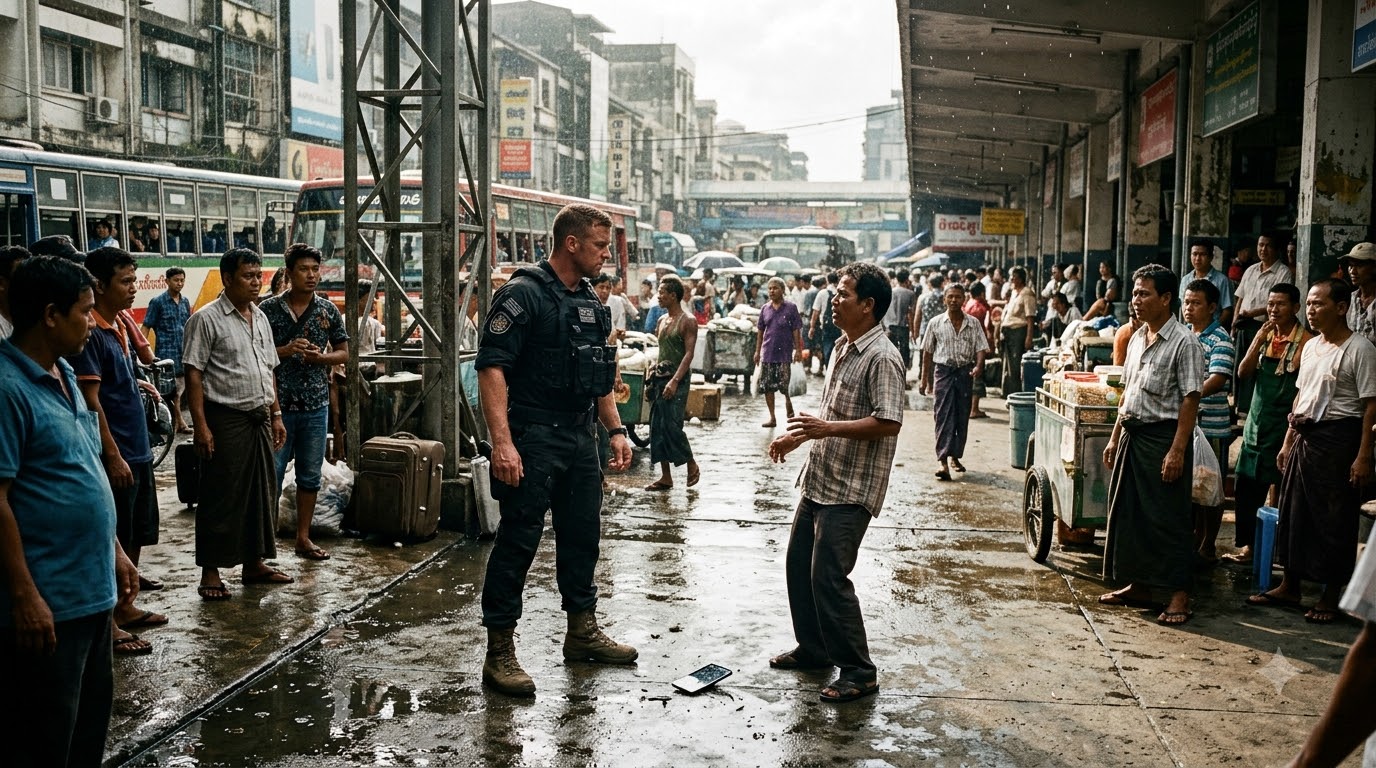
A matte black utility vehicle screeched around the corner tires chewing hard into the pavement before locking into a deliberate, unyielding block against the curb.
Doors opened in tight synchronization.
Men in heavy tactical vests stepped out onto Ellison Avenue with absolute, measured calm, their eyes scanning the perimeter with the cold efficiency of a machine.
They did not raise their voices, nor did they draw a weapon, but the sudden density of their presence made the air feel thin.
Passersby froze in their tracks, cell phones snapping out of pockets while shopkeepers ducked back behind their blinds.
The bar crowd shrank inward, the previous swagger dissolving instantly into nervous silence as the lead commander strode past the chrome row of motorcycles.
Walter remained seated on the metal bench, his hand resting steadily on the carved top of his cane.
Commander Briggs crossed the open pavement without breaking his stride, stopping directly in front of the old man.
He didn’t offer a crisp military salute or a flashy greeting; he simply dropped to one knee on the gritty concrete.
“Dad,” Briggs said quietly, his large hand gently brushing a smear of dust and dried blood from Walter’s cheek. “I got here as fast as I could.”
Walter didn’t blink.
He offered a slow, microscopic nod of acknowledgment, his gaze shifting past his son’s shoulder to where the bikers stood pinned against the brick wall.
The tallest biker took an involuntary half-step backward, his leather vest creaking tightly as his eyes finally locked onto the unit patch stamped on the commander’s shoulder.
The reality of Ellison Avenue shifted in that single heartbeat, transforming a quiet morning street into a reckoning built on thirty years of unacknowledged grit.
CHAPTER 4: THE PUBLIC RECKONING
Commander Briggs did not raise his voice to fill the morning air.
He simply stepped closer to the tavern’s threshold, his broad shoulders blocking the sunlight from the doorway where the tavern crowd hovered in uneasy silence.
“Which one of you struck an eighty-four-year-old man?” Briggs asked.
The question hung heavy, stripped of any hollow threat, carrying only the absolute gravity of a debt finally coming due.
No one answered from the shadows of the doorway.
The tallest biker shifted his weight from foot to foot, his mirrored sunglasses reflecting the silent row of tactical operators sealing off both ends of the block.
“Man, it was just some old guy,” the biker muttered, his voice cracking slightly as he tried to force a defensive laugh. “He bumped my bike. He didn’t look where he was going.”
Briggs did not blink, his jaw locked in a rigid line as he closed the distance between them.
“That old man served this country while you were still learning how to spell your own name,” Briggs said, his tone flat and relentless.
A murmur rippled through the small group of onlookers trapped behind the tactical perimeter, cell phones raised but trembling in unsteady hands.
The biker scoffed, throwing his hands up in a gesture of exaggerated disbelief.
“You military types think you can just roll in here like you own the town!”
Briggs took one final, measured step forward, stopping just inches away from the trembling leather vest.
“I didn’t come here to threaten anyone,” Briggs said, cold as a winter morning. “I came here because my father bled on a sidewalk while cowards watched.”
With a subtle nod of his head, one of the operators stepped back and spoke quietly into a chest-mounted radio.
Two minutes later, a local police cruiser slid silently around the corner, its blue lights dark and its engine idling low.
The two patrol officers stepped out with cautious steps, looking past the tactical unit and straight at the pinned antagonist.
Briggs did not need to issue an order; he simply pointed a steady finger toward the tavern wall.
The metallic click of handcuffs echoed sharply against the brickwork as the cold steel snapped shut around the biker’s wrists.
The man’s bravado dissolved instantly, his face turning pale as he was guided toward the cruiser without a single word of protest left to give.
CHAPTER 5: THE VILLAGE SQUARE
Weeks had passed since the morning on Ellison Avenue, but the heavy silence that once defined the block had dissolved into something enduring.
The town green was crowded under a pale autumn sky, surrounded by rows of temporary seating and a middle school chorus rehearsing the opening notes of the national anthem.
Walter arrived in a wheelchair, pushed smoothly by a neighbor who didn’t wait to be asked.
He didn’t wear medals or uniforms; he wore the same faded olive jacket, its patched sleeves catching the afternoon light.
When the mayor stepped up to the microphone, his prepared speech about community values echoed off the brick storefronts across the street.
Yet the crowd’s attention remained fixed squarely on the bench where Walter sat, his hands resting quietly on the carved top of his metal cane.
Commander Briggs took the podium next, his broad shoulders filling the space without pretense.
“My father didn’t raise his voice,” Briggs said, his flat, steady voice carrying clearly over the open green. “He didn’t fight back. He didn’t need to, because his life spoke louder than fists ever could.”
He paused, his eyes scanning the packed rows of local shopkeepers, veterans, and families who had once looked away.
“You taught me what true strength looks like, Dad,” Briggs added softly, turning his head toward the front row. “And now the world knows it too.”
The applause that followed didn’t feel like a polite political reaction.
It rose heavy and sustained, rolling across the square like a slow wave that demanded no spectacle, only a long-overdue accounting of respect.
Walter raised one weathered hand in a slow, deliberate gesture of acknowledgment, his expression unreadable beneath the brim of his cap.
He had never asked for a stage or a microphone, but as the crowd stood shoulder-to-shoulder in the crisp afternoon air, he knew the distance between being seen and being ignored had finally closed for good.
CHAPTER 6: THE DUSTY GRAY
Kyle stared down at the grain of the wood, his hands clenched tightly together like he was bracing for a blow that never came.
The heavy leather vest was gone, replaced by a simple, unadorned button-up shirt that hung loosely over his narrow shoulders.
Walter sat across the table with the same still, immovable posture he had maintained every Thursday of his life.
Neither man spoke for a long stretch, letting the heavy quiet of the small room absorb the echoes of Ellison Avenue.
“I didn’t know who you were,” Kyle muttered, his voice cracking slightly as he stared at the smudged ink lines of his own apology.
“That’s the problem,” Walter replied softly, his tone level and devoid of bitterness. “You didn’t care.”
The younger man swallowed hard, his eyes darting toward the institutional walls before dropping back to the table.
“My dad came back from overseas a different person,” Kyle said, his fingers twitching against the edge of the wood. “I grew up hating uniforms because I thought they took him from me.”
Walter nodded once, his gaze softening with a heavy, shared recognition of the silent wars fought behind closed doors.
“I knew men like him,” Walter said. “Lost just as much as they brought home.”
There was no lecture left to give, no grand speech about honor, and no demand for a harsher penalty.
Kyle slid a single folded form across the scarred surface, the paper carrying the signature of his newly assigned community service at the downtown VA clinic.
“I’m starting over,” Kyle whispered. “I want to earn something back.”
Walter looked at the paper, then raised one weathered, calloused hand to rest firmly over Kyle’s knuckles.
“You won’t earn it fast,” Walter said, his voice steady. “But every day you show up, you’ll get closer.”
Outside the window, the afternoon wind swept down Ellison Avenue, carrying the familiar rattle of gravel against the curb.
Months later, the corner looked different under the bronze plaque mounted on the polished stone wall, reading simply: A quiet shield between us and chaos.
Walter walked past it on a Thursday morning, his boots steady on the pavement, carrying his cane with a light, easy stride.
A teenager on a skateboard slowed down, offered a respectful nod, and continued on his way.
Walter tipped his cap in return, adjusted the pocket of his olive jacket, and kept walking down the dusty gray street.