The Measured Line: A Tale of Forged Deeds, High Society Hubris, and the Concrete Trap
CHAPTER 1: THE LIQUID EMERALD
The yellow steel of the excavator’s bucket hung suspended against the gray Larkspur sky for a fraction of a second before it dropped. When it hit the rear bumper of the Ford F-250, the sound wasn’t a clean snap; it was the heavy, groaning screech of cold-rolled steel folding under hydraulic weight.
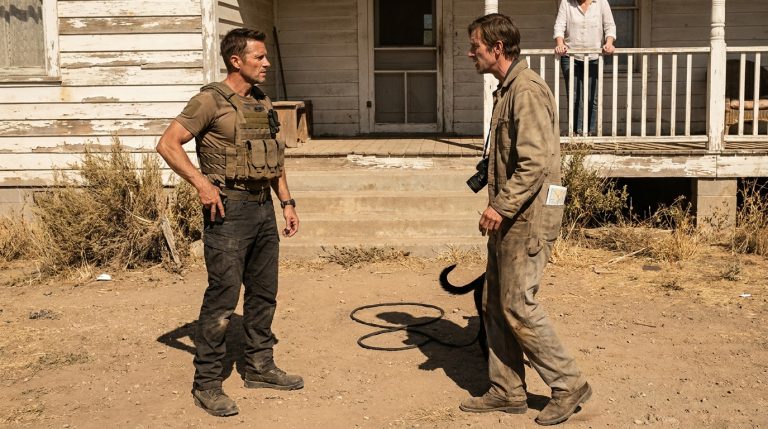
Daniel Brooks did not move from the center of the red dirt track. His boots were planted six inches behind the heavy iron pin that marked the westernmost coordinate of his land. In his right hand, the carbon-fiber shaft of the Trimble GPS rover was steady, its digital screen pulsing with a green light that confirmed his positioning down to the millimeter.
“Ma’am,” the equipment operator called out from the open cab, his hand shaking on the joystick. “He’s still standing by the line. I ain’t pushing no further with a person in the zone.”
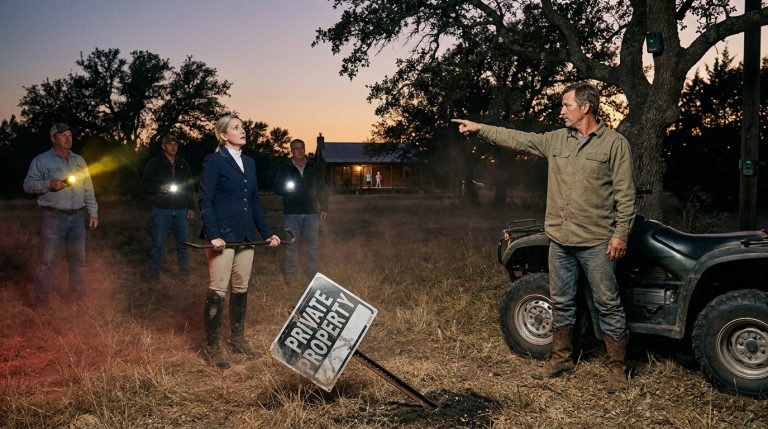
Tasha Holloway stepped onto the freshly churned earth, her cream cashmere coat catching the red dust at the hemline. Forty pounds of liquid foundation couldn’t hide the dark, violent flush creeping up her neck. She shoved a manicured finger toward Daniel’s chest, though she stayed exactly three feet back, clear of the tripod’s shadow.
“He’s a squatter!” she yelled, her voice echoing off the stucco walls of the Aspen Ridge chalets behind her. “He shows up here with a tripod and pretends to be a surveyor to extort my family. My husband is a prominent Denver surgeon. We paid for this view shed, and we have the county permits to clear it. Move that piece of trash truck or I’ll have the sheriff put you in a cell by midnight.”
Daniel looked at her. He didn’t look at the phone she had raised to his face, nor at the diamond bands catching the high-altitude light on her knuckles. He looked at the precise point where her designer house slippers met the dirt. She was eleven feet outside her plat line.
“The truck stays,” Daniel said. His voice was flat, carrying the quiet, mechanical weight of eleven years spent checking access roads for the Army Corps of Engineers. “The bumper is mine. The booster seat in the back is my daughter’s. And the ground under your feet is Brooks Land and Boundary.”
“We’ll see what your little business is worth when our attorneys are done with you,” Tasha spat, her thumb tapping furiously against her screen. “You think a piece of paper from some dead cattle rancher means anything in Douglas County? Sign the quick-claim when it hits your box, sweetheart, because we’re digging this basement with or without your permission.”
She turned on her heel, her slippers sliding in the loose gravel as she retreated toward the gated cul-de-sac.
Daniel remained still until the sound of the excavator’s diesel engine choked out, leaving only the sharp hiss of escaping air brakes. He turned his eyes slowly toward the rear seat of his cab. Through the cracked glass of the window, a thick library book sat on the fleece blanket where Lily usually read while he shot points. Beside it, tucked into the plastic pocket behind the driver’s seat, was a small, laminated card—the original county registration for the 1.8-acre parcel, stamped in black ink three weeks before his wife’s heart stopped beating in the Castle Rock clinic.
He reached into his breast pocket, his fingers brushing the small, cold square of the digital recorder tucked beneath the fabric of his canvas shirt. The red light was still solid. As he turned to inspect the crushed metal of his tailgate, his eye caught a strange glint in the fresh dirt turned up by the excavator’s tracks.
It wasn’t a pine root. It was a fragment of heavy, green-tinted plastic—the shattered corner of an official, state-sealed boundary marker that had been driven into the soil less than forty-eight hours ago. It wasn’t his. The stamped lettering on the plastic fragment didn’t bear his license number; it read Conway & Associates, a corporate name that didn’t exist on any public plat map in the state of Colorado.
CHAPTER 2: THE FROZEN OVERLAY
“Daniel, get up here. They’re cutting your trees.”
The voice of Mr. Coyle came through the truck’s speaker like gravel shifting under a boot. It was 11:14 p.m. The dashboard lights of the F-250 cast a pale, medicinal blue across the green-tinted plastic fragment resting in Daniel’s palm. The edges of the shard were razor-sharp where the excavator’s tracks had sheared it from the soil.
“How many machines, Arthur?” Daniel asked, his voice steady as he pulled out onto Highway 85, heading south toward Larkspur.
“Three,” the old Marine rasped. “A crew foreman flashed a county permit at me through his window. I told him the line was wrong. He told me to mind my own damn business. I’ve got twenty-two pictures on my flip phone already, but they aren’t stopping for the dark.”
“I’m forty minutes out. Don’t go back near the clearing.”
Daniel disconnected the call. The steering wheel felt cold, rigid beneath his calloused palms. A surveyor’s brain functions like a filing cabinet; every coordinate is an unyielding geometric truth, defined by iron pins driven into bedrock. Tasha Holloway wasn’t just testing a boundary line anymore; she was trying to overwrite the landscape before the ink on his deed could dry.
The high-beam headlights cut through the freezing mountain mist, illuminating the steep, black walls of the foothills. When Daniel turned the truck down the unpaved mountain road that led to his lot, the scent reached him before the headlights did. It was the heavy, chemical tang of crushed sap and fresh earth—the smell of sixty-year-old ponderosa pines being reduced to pulp.
The truck bounced over the washboard ruts, the headlights sweeping across the disaster. Where a dense grove of timber had stood that morning, there was only a raw, jagged void. Pale, bleeding stumps littered the snow-dusted meadow like broken teeth. In the exact center of the clearing, where Daniel had planned to frame his front door, a clean architectural rectangle of white string and yellow pine foundation stakes had been driven into the dirt. A forty-by-eighty-foot footprint. The skeleton of a mansion.
Taped to a wooden stake near the road, a laminated building permit fluttered in the freezing wind. The owner of record listed on the county paperwork was Bradford Holloway.
Daniel climbed out of the cab, his boots crunching on the frozen ruts. He didn’t yell. He didn’t let the heat of the anger reach his chest. He walked to the edge of the clearing, his eyes tracking the sharp, geometric lines of the stakes. They hadn’t just clipped his corner; they had centered the entire structure fourteen feet inside his property line.
A porch light flicked on across the dirt track. Mr. Coyle came down his gravel drive, his wool jacket buttoned to the chin, his gate hitching with the slow, weathered limp of an infantryman who had left his youth in the mud of Phu Bai.
“They worked fast, son,” Coyle said, stopping at the edge of the stumps. He held out an old Kyocera flip phone, its screen scratched and dull. “Foreman didn’t care about the marker. Said the Holloway name was all the authority he needed.”
“The authority is forged, Arthur,” Daniel said, his eyes fixed on the foundation lines. “They’re betting I’ll fold because their bank account is larger than my survey shop.”
“You going to let them pour the concrete?”
“I’m going to let them dig the hole,” Daniel murmured, his fingers tightening around the cold steel of his tape measure. “Every foot of wire they bury, every yard of concrete they pour on this side of my pin belongs to Lily the moment a judge signs the order. If they want to build me a two-million-dollar house, I’m not going to stop their labor.”
He pulled his phone from his pocket and dialed the Douglas County Sheriff’s Office. It was exactly 11:47 p.m.
The deputy arrived forty minutes later. His name tag read Whitaker—a young man with mud already drying on the heels of his boots and the tired, cautious posture of a late-shift patrolman. He swept his flashlight across the pale stumps, the beam catching the white sap weeping from the wood.
“Mr. Brooks?” Whitaker asked, looking from the survey rig in the back of the Ford to Daniel’s steady eyes. “Dispatch said you’re claiming a property dispute.”
“It’s not a dispute, Deputy. It’s a trespass,” Daniel said. He handed the officer a neat, clear plastic sleeve containing three documents: his recorded copy of the deed, the county-stamped survey plat from 1978, and his title insurance policy. “My western pin is thirty feet behind that fence line. The construction crew pulled my marker today.”
Whitaker read the papers twice under the beam of his flashlight, his thumb tracing the embossed county seal. He stepped away to key his radio, his voice dropping into a low, rhythmic murmur as he checked the administrative system. When he returned twenty minutes later, his face had hardened into an uncomfortable expression.
“Mr. Brooks, the system is showing an active residential permit issued three weeks ago for this exact legal description,” Whitaker said, tapping his notepad. “Issued to Bradford Holloway. The permit matches the parcel number on your deed.”
“Two pieces of paper,” Daniel said, his voice dropping into the low register he used when a calculation failed to close. “One belongs in my cabinet. The other shouldn’t exist.”
Before the deputy could answer, the sharp glare of high beams flooded the narrow road. A black Cadillac Escalade came down the washboard track, its tires throwing gravel against the pine stumps as it screeched to a halt behind Daniel’s truck.
The door flung open. Tasha Holloway climbed out, her fleece throw slipping from her shoulders to reveal a satin top. She didn’t look at the stumps or the ruined trees. She held her phone directly in front of her face, the small green light on the screen indicating an active video recording.
“Officer!” she called out, her voice carrying the shrill weight of an air horn. “This man is harassing our site. He’s been threatening our crew foreman for weeks, and now he’s trespassing on our construction zone at midnight. He’s a squatter!”
“Ma’am, keep your distance,” Whitaker said, placing a hand flat against his belt line. “Nobody is being harassed. Mr. Brooks called us to verify the line.”
“He doesn’t have a line!” Tasha shouted, pivoting the phone screen toward Daniel’s face. “My husband bought this parcel through an estate sale four months ago. We have the quick-claim deed recorded in Castle Rock. You are going to lose your daughter over this, Daniel. Do you understand what kind of attorneys my husband has? They will take your business, your truck, and everything you own before we’re done.”
Hearing Lily’s name come out of her mouth—uttered with the casual, venomous spite of a person who believed she was untouchable—caused the world to narrow to a single, cold point in Daniel’s mind. Something inside him went completely quiet, the way a torque wrench goes quiet right before the bolt snaps.
He didn’t step toward her. He didn’t raise his voice. He turned his face directly toward Deputy Whitaker’s shoulder-mounted body camera.
“Deputy,” Daniel said, his voice level and chillingly clear. “Please ensure your camera is recording that Mrs. Holloway has just referenced my nine-year-old daughter by name, along with an explicit threat regarding custody.”
Tasha’s thumb faltered on the screen. For a single microsecond, the smooth, expensive mask of her confidence slipped, revealing a sharp, jagged edge of panic beneath the foundation. She lowered the phone by an inch, her slippers shifting back into the shadow of the Escalade’s door.
“It’s a civil matter, officer,” she muttered, her voice dropping its performative volume. “The attorneys are handling the paperwork on Monday anyway.”
“I can see that, ma’am,” Whitaker said, his voice flat as he closed his notepad. He turned back to Daniel, his expression guarded. “Mr. Brooks, without an injunction from a district judge, I can’t stop the machines based on competing documents. The county system shows their permit as valid right now. This is a civil boundary dispute until a magistrate rules whose paper holds the superior title.”
“I understand,” Daniel said.
Tasha backed the Escalade down the driveway, her tires spinning in the loose dirt. As the red tail lights faded into the dark, Daniel walked back to the yellow string line. He knelt down, reaching into the fresh dirt beneath the foundation stake. His fingers brushed against something hard and metallic buried four inches below the surface—not an iron survey pin, but a small, heavy brass cylinder with a serialized tracking number that didn’t belong to the county surveyor’s office. It was a private investigator’s electronic tracking node, still warm from an active battery.
CHAPTER 3: THE VALUABLE LIE
The metallic click of the slate gray Tesla’s door closing was crisp, cutting through the high-altitude morning hush like a razor sliding through paper. It was Saturday, exactly 09:01 a.m., when Bradford Holloway stepped onto the gravel of Daniel’s driveway in Castle Rock.
He wore fine leather driving gloves and a pristine half-zip merino pullover that cost more than Daniel’s primary field generator. He was tall, tanned, fifty-ish, possessing the meticulously sanded smile of an individual who had never encountered a boundary he couldn’t pay to dissolve. A heavy gold class ring gleamed on his right hand; a vintage Patek Philippe sat dead-weight on his left wrist.
Daniel didn’t move from his spot on the porch step. He remained seated, a mug of black coffee cooling between his palms, his eyes tracking the sharp, flawless reflection of the pine trees stretching across the sedan’s polished hood. In his shirt pocket, the small digital recorder rested behind the heavy canvas fabric, its tiny red light pulsing in the dark.
“Daniel,” Bradford said, stopping five feet from the bottom step. He didn’t offer a hand, nor did he ask to ascend the porch. He simply stood there, his posture open, adopting the easy, performative warmth of a surgeon delivering a routine post-op update. “Look, I wanted to come out here and be an absolute gentleman about this. My wife is a little intense. I get it. I see the damaged truck. But you and I—we’re reasonable, professional men.”
Daniel let the silence stretch. He didn’t blink, didn’t shift his weight, didn’t offer a syllable to break the rhythm of the wind through the valley. A man who spends a decade calculating coordinates knows that the loudest voice in a room is rarely the one holding the superior title. Silence forces an adversary to fill the void with their own missteps.
Bradford’s smile remained steady, though the muscles around his jaw tightened by a fraction of a millimeter. He pulled off his driving gloves, slapping them rhythmically against his palm. “I’d like to make you a very generous offer. Fifty thousand dollars cash, right now, for the Larkspur parcel. We’ll handle the transfer fees, the title updates, everything. You’ll be entirely liquid by Monday morning.”
Daniel tilted his head, his fingers remaining loose around the ceramic mug. “Bradford,” he said, his tone low, carrying the flat resonance of iron driven into frozen earth. “Why would you offer fifty thousand dollars for a piece of ground your wife claims you already own?”
The surgeon’s eyes narrowed, the sanded smile resetting into a rigid, defensive line. He took a half-step forward, his leather shoes grinding a fragment of quartz into the dirt. “Look, the project is moving. The crew has already poured the footings. We’ve got six figures deep into that soil. It’s simply cleaner for everyone if your signature is flat on a quitclaim deed. You walk away whole, sport. Everybody wins.”
“Six figures,” Daniel repeated, his internal filing cabinet opening, logging every word as an administrative admission of knowing trespass. “How much exactly do you have in the dirt right now?”
“Around six hundred thousand,” Bradford said, a dismissive shrug suggesting the number was nothing more than static on a ledger. “Not counting the interior selection. The imported marble is another eighty. The custom chandeliers are fourteen. We aren’t going to let an administrative hiccup hold up a structure of that caliber.”
Daniel nodded slowly. He didn’t look down at his pocket where the red light was catching every syllable, every precise calculation of the adversary’s financial exposure. Under settled Colorado case law, a bad-faith builder who constructs a dwelling on land they know to be disputed forfeits the entirety of the improvements to the rightful owner. Bradford wasn’t offering a settlement; he was trying to buy his way out of an impending forfeiture he didn’t yet realize was legal reality.
“I’ll think about it,” Daniel said quietly, setting the coffee mug down beside his boot. “I’ll have my attorney send a formal response by Monday afternoon.”
“Take your time, sport,” Bradford said, the easy confidence returning as he slid back into the leather interior of the Tesla. The electric motor whirred, a silent, heavy machine slipping down the road toward the highway.
Daniel remained on the step until the dust settled. His hands were steady, but his pulse was a sharp, mechanical rhythm against his ribs. The front screen door creaked open behind him. Lily stepped onto the porch, holding two fresh mugs of cocoa, her eyes wide beneath her dark hair.
“Was that the husband, Dad?” she asked, sitting close enough that her shoulder pressed against his canvas sleeve. “The one from the big houses?”
“That was him, kiddo,” Daniel said, taking the warm mug from her hands. “He looked like an advertisement for something that isn’t real.”
A short, dry laugh broke from his chest—the first genuine sound of amusement he had made since the excavator hit his truck. It was the laugh of a tactical surveyor who had just been handed an unloaded weapon by his opponent and asked to measure the depth of the barrel.
He pulled the phone from his belt, extracting the digital audio file from the pocket recorder and routing it directly to Marshall Sutton’s secure Denver server. Below the attachment, he typed a single line: Defendant admits to construction value of $600k+ and explicitly acknowledges the title is disputed prior to execution of any quitclaim.
Before he could lock the screen, a notification flagged at the top of his display. It was an automated county alert from the Division of Water Resources, stating that his residential well permit for the Larkspur lot had been flagged for “parcel ambiguity” following an administrative challenge filed by an unnamed political action committee.
Daniel’s eyes focused on the tiny, serialized tracking number of the challenge. It matched the exact prefix of the private investigator’s node he had pulled from the mud under the foundation stake the night before. The strategy was shifting; the Holloway family wasn’t just building over his line anymore—they were using administrative levers to choke out the utility of his land before he could even file a complaint.
CHAPTER 4: THE FALSE FLOOR
The aluminum clipboard felt freezing against Daniel’s bare knuckles as the mountain wind whipped down the Larkspur canyon. It was Tuesday morning, 06:14 a.m. The sun hadn’t cleared the peaks yet, leaving the meadow in a flat, desaturated blue shadow that emphasized the sharp edges of the freshly poured concrete footings.
Beside him, Holden Pickett stood with his hands rammed deep into the pockets of a heavy waxed jacket. The title insurance investigator didn’t look like a bureaucrat; he had the patient, predatory stillness of a timber cruiser who spent his life waiting for small discrepancies to grow into fatal errors. Two paces away, Travis, the junior surveyor, was adjusting a high-grade robotic total station on a heavy steel tripod.
“They didn’t just clip the edge, Daniel,” Pickett said, his breath plume blooming white in the crisp air. “Look at the overlay link.”
Daniel looked down at the ruggedized field tablet mounted to the truck’s hood. The screen displayed a real-time vector map. The true boundary line—the one Daniel had verified through historical records—cut across the screen in an unyielding green streak. Overlaid in violent red was the architectural blueprint the Holloway crew had uploaded to the county system. The two lines didn’t intersect; they collided. The entire residential footprint, all three stories of framed timber and planned limestone, sat fourteen feet deep inside Daniel’s legal description.
“The footer forms run straight through where Lily’s window seat was pinned,” Daniel murmured. His voice was cold, flat, entirely devoid of inflection. “They’re building the kitchen island directly over my western corner marker.”
“It gets heavier,” Pickett said. He flipped open a thick manila folder resting on the truck’s tailgate. “This came from the electronic filing queue at the Douglas County Recorder’s office. It was entered four months ago, three weeks before the county approved their residential building permit.”
Daniel reached out, his thumb running across the crisp, photocopied paper. It was a quitclaim deed. The text claimed that ownership of the 1.8-acre parcel had been transferred from an individual named Eldon Brooks to Bradford Holloway for the sum of one dollar. At the bottom of the page, the signature line bore a name written in dark, jagged ink: Daniel E. Brooks.
Daniel looked at the handwriting. The letters were stiff, practiced, showing the distinct micro-tremors of someone who had traced the lines twice on a light box before committing the pen to the final document. The middle initial was wrong. The signature was a fabrication.
“I don’t have an Uncle Eldon,” Daniel said. “The only Brooks on this title since the ranch was subdivided in ’78 is me.”
“Look at the notary acknowledgment at the bottom,” Pickett pointed with a stubby finger. “Stamped by a Greta Conway. Registered in Douglas County. But when I checked the state licensing database last night, Conway’s active bond was revoked six months ago for failing to log her ledger. This instrument is a complete fabrication, Daniel. It’s a recorded, stamped, county-verified forgery.”
Daniel’s finger traced the sharp border of the forged notary seal. A conventional landowner would have felt the floor tilt; they would have panicked at the sight of their own name weaponized against their home. But Daniel only felt the quiet alignment of a mathematical calculation. The Holloways hadn’t just made a mistake with a tractor; they had actively engineered a fraud to steal the soil beneath his feet because they assumed a blue-collar surveyor wouldn’t have the financial stamina to audit the county archives.
“This shifts the parameters,” Daniel said, his eyes turning to the half-framed walls rising from the concrete foundation. “We aren’t looking at a boundary dispute anymore. This is criminal.”
“It’s a class five felony under Colorado Revised Statutes 18-5-114,” Pickett affirmed, his jaw tightening. “Offering a false instrument for recording. The moment I submit this report to the district attorney’s white-collar unit, the civil case is essentially frozen. But there’s a hitch.”
Daniel caught the shift in Pickett’s tone. “What kind of hitch?”
“The recording stamp on the back of this document carries an official administrative validation code from the clerk’s inner office,” Pickett explained, pointing to a tiny, alpha-numeric string in the margin. “That code can only be generated from a secure terminal inside the vault. Someone inside the building didn’t just overlook this forgery—they manually overrode the county verification flags to let it clear the system.”
A heavy silence settled over the truck bed. The implications settled into the red dirt like lead. The Holloways hadn’t just hired a slick real estate attorney; they had established an active line of influence inside the very office meant to protect land titles.
Daniel turned toward the mountain road as a low hum echoed through the pines. A flatbed commercial truck loaded with structural steel beams was grinding up the washboard ruts, its yellow strobe lights flashing against the pale stumps of his ponderosa pines. Behind it came Tasha Holloway’s slate gray Tesla, its smooth chassis glinting like a shard of river glass in the morning light.
She didn’t get out of the vehicle this time. She rolled the tinted window down by three inches, her dark sunglasses reflecting the image of Daniel standing beside the total station.
“The framing crew is on a daily bonus schedule, Daniel,” she called out, her voice flat, stripped of its previous theatrical rage, replaced by a cold, transactional certainty. “Every beam they lift adds another twenty thousand dollars of structural equity to this lot. My husband’s firm just signed the construction draw. By the time you get a hearing date from a magistrate, the roof will be dried in. You can’t afford the bond to stop this crane.”
She rolled the window up before he could reply, the Tesla gliding past the survey rig toward the active foundation.
Daniel didn’t shout. He didn’t look at the steel beams being unchained from the flatbed. He looked at the field tablet, watching the digital cursor pulse exactly where the green line of his deed met the red fraud of her mansion. The trap was already laid, and she was spending her own capital to make it deeper.
“Let them lift the steel, Travis,” Daniel said, his voice dropping into the quiet register of a commander marking a grid coordinate. “Every nail they drive is a nail we’re going to own.”
CHAPTER 5: THE EMBOSSED AMBUSH
The scent of seared rosemary and brown butter drifted across the manicured meadow, entirely obscuring the raw, chemical tang of the pine stumps buried beneath the temporary floorboards. It was the second Saturday in September, 06:42 p.m. Strings of warm filament bulbs draped from the surviving cottonwoods, casting a golden, artificial glow across the three-story structure of 1842 Stonecrest Trail. The mansion looked complete from the exterior—a monumental monument of glass, imported limestone, and hubris, built directly over the western corner pin of Daniel’s land.
Daniel stood by the unpaved shoulder of the road, his hands tucked into the pockets of a quiet navy blazer. He wasn’t there to hide. He wore a clean white collared shirt, his boots cleared of the daytime red mud, his posture perfectly still against the dark outline of his truck. Beside him, Cy Tolliver adjusted the lapels of a charcoal wool suit. Cy didn’t look like a process server; his gray hair and slow, deliberate gait gave him the air of a retired banker, except for the ruggedized body camera pinned flush against his breast pocket.
“Two hundred and forty cars registered at the gate,” Cy said, his fingers brushing the smooth leather edge of the portfolio under his arm. “The Larkspur Chamber is inside. Two state senators. And Linden is holding a glass at the center bar.”
“Howard Linden?” Daniel asked, his eyes tracking the glint of floor-length gold sequins moving behind the panoramic glass windows.
“The same,” Cy murmured, a thin, paper-dry smile touching his lips. “The retired magistrate who drafted the state’s white-collar fraud guidelines. Tasha invited him to show off the architectural crown molding. She has no idea he spent forty minutes reviewing our lis pendens filing on the state portal yesterday afternoon.”
Inside the gates, a jazz quartet played soft, rhythmic standards on a platform built directly over the area where Lily’s bedroom window seat was supposed to rest. Guests in tailored linen and silk held crystal flutes of champagne, their laughter carrying over the stone walls of Aspen Ridge Estates. At the center of the terrace, Tasha Holloway glittered on the arm of her husband, her hair perfectly blown out, her face fixed in the radiant expression of a woman who believed she had permanently altered the geography of the valley.
“Let’s close the line, Cy,” Daniel said quietly.
They didn’t rush. They walked through the open wrought-iron gates together, their boots clicking against the fresh flagstone path. The contrast was sharp—Daniel’s weathered skin and unlined blazer cutting through the crowd of polished, high-society investors like an iron wedge.
Bradford Holloway was mid-laugh, holding a flute of champagne near a state senator, when his eyes tracked Cy’s approach. The smile on the surgeon’s face didn’t drop; it frozen, the muscles around his nose stiffening as he recognized the deliberate, unhurried stride of an officer of the court. Tasha turned a fraction of a second later, the glass in her hand tilting as the color drained from her cheeks, leaving the thick foundation looking gray and dead under the filament lights.
Cy didn’t raise his voice. He stepped into the center of the circle, his movement fluid as he opened the leather portfolio.
“Mr. Bradford Allen Holloway, Mrs. Natasha Eileen Holloway,” Cy announced, his tone flat, carrying the mechanical clarity of a court reporter. “You are hereby served with a summons for quiet title, a complaint for civil trespass, slander of title, and a notice of lis pendens recorded against this parcel by order of the Douglas County District Court.”
He extended the thick, white sheets of paper. The top page bore the heavy, dark blue ink of the district court stamp, the words Brooks v. Holloway clearly visible under the golden patio lights.
The jazz quartet kept playing, but the conversation around the white-tented bar dropped into an absolute, freezing silence. Two hundred and forty pairs of eyes shifted from the gold sequins of Tasha’s dress to the white pages in Bradford’s gloved fingers.
“This is ridiculous,” Tasha said, her voice cracking as she tried to force her habitual volume, though her hand was shaking so violently that champagne spilled over her knuckles. “This is a nuisance filing by a deranged squatter. We have every permit, we have the recorded deed from the estate—”
“Tasha,” a soft, careful voice cut her off. Howard Linden stepped forward from the edge of the terrace, his eyes scanning the alpha-numeric verification code printed on the top margin of the document in Bradford’s hand. He didn’t look at her face; he looked at the court seal. “This isn’t a boundary dispute. This is a recorded lis pendens. It means the title is clouded. No one can buy, transfer, or refinance this structure until the matter is resolved. The house is locked.”
The state senator beside Bradford suddenly lowered his glass, looking at his watch with a look of sudden recollection. “I forgot the early departure confirmation for the Denver flight,” he murmured, stepping back into the shadow of the cottonwoods without looking back.
The Chamber of Commerce president quietly placed his flute on a passing waiter’s tray, turning his shoulder to the light. Within three minutes, the smooth, expensive fabric of the gala began to unravel from the edges. The sound of car doors closing at the valet station echoed down the dirt road, a steady, rhythmic retreat of wealth escaping an impending blast zone.
Daniel didn’t wait for the terrace to clear. He turned back toward the gate, his boots moving in a steady, unbroken rhythm over the flagstones. As he reached the dirt track where his truck was idling, the wind shifted, bringing the smell of cold sage and dry earth down from the foothills. The mansion behind him was still lit up like a stage, but the guests were gone, leaving only the jazz quartet playing to an empty frame of limestone and iron.
He climbed into the cab, his hand brushing the steering wheel. The text message icon on his phone was flashing. It wasn’t from Marshall Sutton. It was an encrypted file transfer from Katherine Reeves at the District Attorney’s office, containing a newly logged audio transcript with a timestamp from forty-five minutes ago. The name on the target log read Conway, Greta.
Daniel opened the file, his eyes reflecting the blue light of the text as the first line of the wiretap transcript appeared on the screen.
CHAPTER 6: THE FINAL MEASUREMENT
The brass handle of the courtroom door felt heavy, cold, and entirely unyielding under Daniel’s palm. It was Wednesday morning, precisely 09:54 a.m. Outside, a late November snow had blanketed the steps of the Douglas County District Court in Castle Rock, leaving the air tasting of salt and iron. Two regional television crews sat positioned near the granite pillars of the foyer, their camera lenses catching the sharp glare of the fluorescent overheads.
Inside Courtroom Four, the silence was total. The walls were lined with dark, polished walnut panels that cast deep shadows across the benches. Daniel sat at the plaintiff’s table in his clean navy blazer and his sharpest collared shirt. Beside him, Marshall Sutton sat surrounded by a single, perfectly indexed accordion folder.
Across the aisle, Bradford and Tasha Holloway sat perfectly frozen. The surgeon’s sanded smile had completely vanished, replaced by a gray, waxen pallor that made his high-end wool suit look loose around the shoulders. Tasha remained behind oversized dark sunglasses, her manicured fingers digging so hard into the fabric of her cream winter coat that the stitching strained. Their attorney, Wendell Cross, stood behind his podium, his broad shoulders unusually rigid as his eyes scanned the bench.
Judge Vivian Cornwall sat behind the high cedar dais. At sixty-one years old, with two decades of tenure on the county bench, she possessed the steady, clinical gaze of a master surveyor auditing an unbalanced ledger. She did not look at the cameras or the reporters filling the gallery. She looked down at the physical exhibits spread across her blotter.
“The court has reviewed the administrative records, the overlay data, and the certified verification logs provided by the District Attorney’s White Collar Crimes Unit,” Judge Cornwall stated. Her voice was flat, carrying the mechanical resonance of an iron rod striking concrete. “We will begin with the civil title.”
She turned a page, the crisp crackle of the bond paper echoing through the rafters. “The defense contends that the structure erected at 1842 Stonecrest Trail was initiated under a valid instrument of conveyance. However, the forensic analysis submitted by the state title investigator demonstrates that the quitclaim deed dated four months ago is an absolute fabrication. The seller, listed as Eldon Brooks, is a legal fiction. The signature of the plaintiff was traced manually.”
Wendell Cross shifted his weight. “Your Honor, my clients were third-party beneficiaries of an estate sale—”
“Sit down, Mr. Cross,” Judge Cornwall said. She didn’t raise her voice, but the sharpness of her tone cut through the room like a steel wire. “The court has already admitted the verified audio recording captured on the plaintiff’s porch. Your client, Bradford Holloway, explicitly acknowledged that the title was disputed and offered fifty thousand dollars in cash to bypass legal verification. That is not good faith. That is an intentional, calculated attempt to overwrite a registered land title through economic momentum.”
She leaned forward, her eyes locking directly onto Tasha’s sunglasses. “Furthermore, the court has reviewed the wiretap evidence logged on Sunday evening. The audio records the defendant, Natasha Holloway, delivering eighty-five hundred dollars in cash to an administrative clerk, Greta Conway, with explicit instructions to destroy the original county filing records during an active criminal investigation. This is an open-and-shut demonstration of administrative corruption.”
Daniel sat perfectly still, his eyes fixed on the small brass seal mounted to the front of the judicial bench. He didn’t feel a rush of heat; he didn’t feel the need to look over at the people who had threatened to strip his daughter’s future away from him in a dark mountain clearing. A surveyor does not celebrate when a boundary closes; he simply logs the coordinate as a verified fact.
“Under settled Colorado precedent,” Judge Cornwall continued, her gavel resting loosely beneath her fingers, “a bad-faith improver who constructs a dwelling on land they know to be unambiguously owned by another forfeits all right to the improvements. Therefore, quiet title to the parcel is granted exclusively to Daniel Brooks. The entire three-story residential structure, all materials, fixtures, imported limestone, and attachments currently standing on that dirt are now the unencumbered property of the plaintiff.”
Tasha’s head dropped by an inch. Behind the dark lenses of her glasses, a single, silent tear broke through her foundation, carving a sharp, pale line down her cheek. The expensive mask of her confidence had completely collapsed, leaving nothing but the raw, terrified outline of a person who had finally run out of administrative levers to pull.
“On the criminal counts,” Judge Cornwall stated, nodding toward the back of the room where Katherine Reeves stood flanked by two plainclothes investigators, “the court finds clear and convincing evidence of forgery, conspiracy, and bribery of a public official. Defendants Bradford and Natasha Holloway are hereby remanded into the immediate custody of the Douglas County Sheriff pending formal indictment.”
The metallic click of handcuffs closing over Bradford’s wrists was crisp and loud in the walnut-paneled room. He didn’t fight. He didn’t look back at the reporters as the deputies steered him through the heavy side door. Tasha followed a second later, her gold-ringed fingers trembling as the iron loops closed over her sleeves.
Daniel stood up slowly, helping Marshall Sutton close the accordion file. As they stepped through the heavy oak doors into the frosty afternoon light, the Channel Seven reporter pushed a black foam microphone toward Daniel’s chest.
“Mr. Brooks!” the reporter called out, his breath pluming in the mountain air. “The mansion’s structural value is appraised at over two million dollars. How does it feel to walk out of that courtroom owning a luxury estate you didn’t spend a single copper cent to build?”
Daniel stopped on the salted stone step. He thought about the pale ponderosa stumps leaking sap into the dark soil. He thought about Lily sitting on the porch step with her cocoa mug, asking if they were still going to build their home. He leaned slightly toward the microphone, his voice carrying the calm, unyielding precision of an iron boundary marker driven into bedrock.
“It feels,” Daniel said, “exactly like justice.”
The mansion didn’t stay on his mountain. Two weeks later, Daniel signed an agreement with a custom builder out of Sedalia, auctioning off the high-end timber, the marble counters, and the imported limestone piece by piece for one point six million dollars free and clear. By the time the spring rains came down the canyon, the concrete footings were gone, leaving only a level patch of dark red earth ready for the graph-paper cabin he and Lily had drawn together at the kitchen table.