The Bureaucratic Wall Shatters When One Fired Nurse Fights Back Against a Corrupt System With Unshakable Resolve
CHAPTER 1: The Cold Corridor
The metal locker door slammed shut with a hollow echo that sounded entirely too loud in the empty hallway.
Clare Morgan didn’t look back at the row of scrub-stained steel. Ten years of night shifts, double-shifts, and holding the hands of terrified strangers compressed into a cardboard box resting against her ribs.
“Policy is policy, Clare,” Director Richard Hail had said three minutes ago, his voice clipped and devoid of human warmth behind his mahogany desk.
No hearing. No formal review. Just a slip of paper and a cold exit into the fluorescent-lit corridor.
She adjusted the cardboard box in her arms, feeling the sharp corner of a laminated CPR certification digging into her forearm.
Down the hall, the double doors of the emergency room swung open with a familiar pneumatic hiss.
A tired resident wheeled in a stretcher, looking frantically toward an empty triage station that was already understaffed.
Clare instinctively took half a step forward, her muscle memory screaming to help clear the intake backlog.
Her foot stopped dead against the linoleum tile.
She didn’t belong here anymore.
Her badge was sitting on Hail’s desk, lifeless and deactivated.
She turned her shoulders away from the commotion, her jaw tightening as she swallowed the bitter taste of institutional betrayal.
Inside his second-floor office, Richard Hail tapped a heavy silver pen against a clean sheet of paper.
He didn’t look up as the door clicked shut down the hall.
He pulled his laptop closer, opening the formal incident report to log the termination under section four-b of the corporate liability manual.
His fingers moved rhythmically across the keyboard, steady and unbothered by the human cost of a signature.
To Hail, a hospital was a machine of balanced ledgers and risk matrices, not a sanctuary for bleeding hearts.
He typed the final paragraph, closed the document with a sharp click, and reached for his favorite ceramic coffee mug.
It was half-full, growing cold on the corner of his desk.
He took a slow sip, completely unaware that the dismissal he had just finalized was about to crack the foundation of everything he protected.
CHAPTER 2: The Empty Kitchen
Clare stared at the dark liquid, her thumb tracing the hairline crack running down the handle.
Outside her window, the neighborhood was quiet, waking up to suburban routines that felt a million miles away from the sterile, humming halls of Riverside General.
Her phone buzzed against the wood, sending a sharp, metallic shudder through the tabletop.
Another notification from the local veteran support network thread.
“They’re organizing a phone tree for Monday morning,” her neighbor, Dennis, said softly from the porch step just outside the open screen door.
Dennis didn’t step inside; he knew better than to crowd someone who had just spent ten years carrying the weight of an entire ER shift on her shoulders.
Clare picked up the phone, her screen illuminating a flood of shared posts and furious commentary from strangers across the state.
“They can’t fire the whole community, Clare,” Dennis added, leaning his shoulder against the doorframe.
“They didn’t fire the community, Dennis,” Clare said, her voice flat and steady. “They fired me to protect a balance sheet.”
She set the phone face down, cutting off the relentless vibration.
Her mind didn’t linger on the digital outrage swelling online; instead, it calculated the cold, hard mechanics of hospital administration.
Richard Hail didn’t panic over bad PR; he panicked when audit trails pointed toward unauthorized line items.
The silence in her kitchen was heavy, broken only by the distant hum of a delivery truck shifting gears down the asphalt street.
She stood up, walking over to the counter to stack her nursing textbooks higher against the wall.
All those years studying federal compliance manuals, triage protocols, and emergency liability waivers.
Not a single page explained what to do when an administrator weaponized those exact rules to hide a crumbling foundation.
Her gaze dropped to the kitchen counter where her mail sat untouched.
Among the junk flyers and electric bills rested a plain manila envelope with no return address, shoved halfway through her mail slot while she had been staring at her tea.
She picked it up, feeling the bulky weight of folded paper inside.
There was no stamp, no postmark.
She slid her thumb under the unglued flap, pulling out a set of photocopied spreadsheets covered in stark red and black highlighter marks.
The header at the top read Riverside General Fiscal Year Adjustments – Emergency Reserve Allocation.
Column after column listed ghost billing codes for trauma patients who had never stepped foot in the ward, funneling thousands of dollars into private administrative retention accounts.
Clare’s eyes locked onto the bottom signature line, initialed by Richard Hail himself.
She didn’t gasp or drop the papers.
Her jaw simply tightened into a hard, unbreakable line as the true reason for her sudden, ruthless termination crystallized in front of her.
They hadn’t fired her just because she treated an uninsured veteran off the books.
They fired her because she was observant enough to notice when the emergency supply closet was completely hollowed out.
The front gate latch clicked sharply in the driveway.
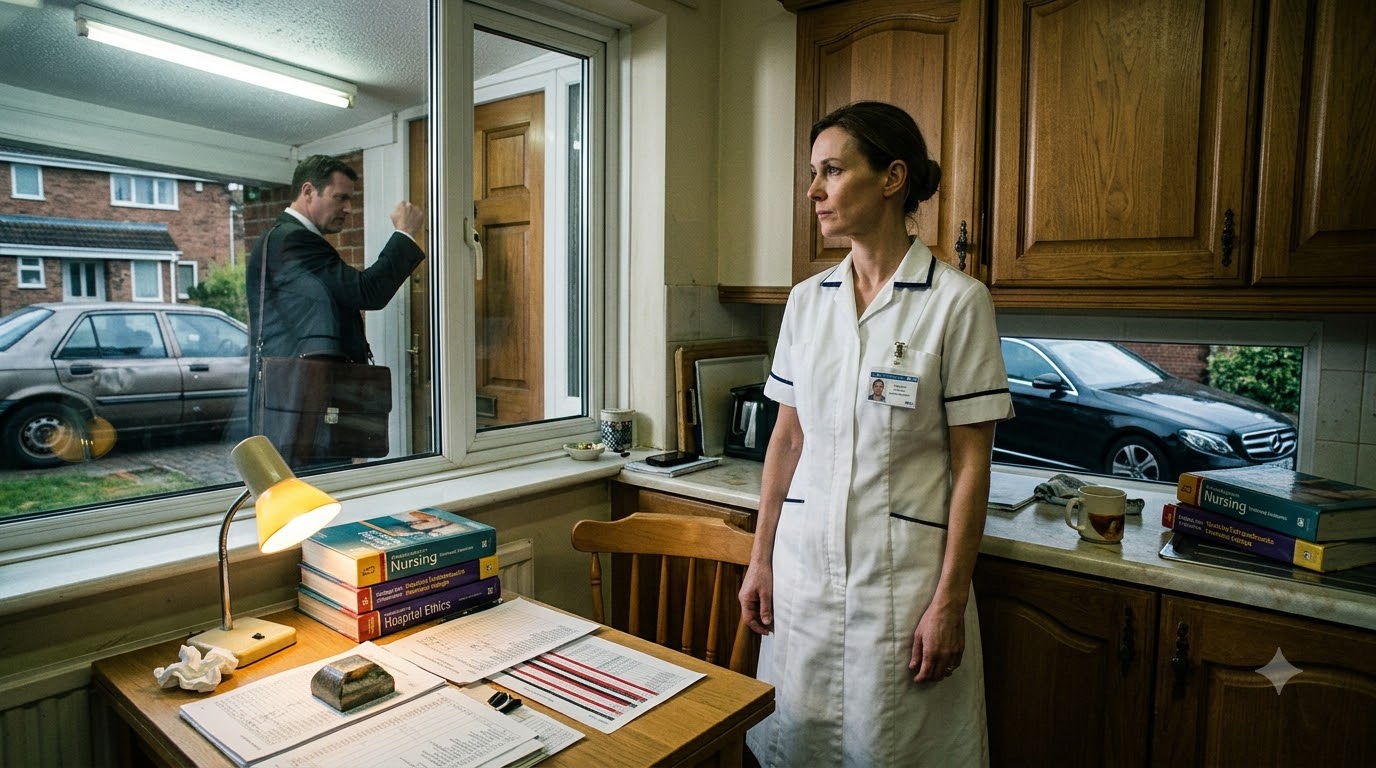
Clare walked to the window, peering through the blinds to see a beat-up sedan idling by her curb.
A familiar figure stepped out from the driver’s seat, holding a manila folder identical to the one in her hand.
It was Marcus, the former head of hospital procurement who had resigned three months ago without a word.
He didn’t knock on the front door; he walked straight to the side porch and tapped twice against the glass pane.
Clare unlocked the latch, pulling the door open just enough to let the damp morning air rush into the quiet kitchen.
“You shouldn’t have brought these here, Marcus,” Clare said, her eyes locked on the extra set of ledgers tucked under his arm.
“They were going to shred the physical copies by noon,” Marcus replied, his voice raspy and low as he scanned the empty street behind him. “Hail thinks he buried you with a simple policy violation.”
He stepped past her into the kitchen, dropping the thick stack of documents squarely next to her cold teacup.
“He doesn’t know you kept the digital inventory logs from the trauma bay, Clare,” Marcus said, tapping his finger against the edge of the paper stack. “And he definitely doesn’t know what happens when those ledgers land on the state health commissioner’s desk.”
Clare looked down at the papers, feeling the tangible weight of the institutional corruption laid bare across her kitchen table.
“He wants to play by the book?” Clare asked, her voice dropping into a dangerous, quiet calm.
“Then let’s give him the whole library.”
Marcus didn’t smile; he just nodded once, turning back toward the door before the neighborhood could wake up to what was coming.
Clare closed the door behind him, locking the deadbolt with a solid, definitive thud that echoed through the empty house.
She picked up the phone, bypassing the social media notifications entirely to dial a direct number she had memorized years ago.
The line rang twice before a tired, professional voice answered on the end.
“State Department of Health, compliance division.”
Clare didn’t hesitate, her thumb pressing hard against the edge of the financial ledger.
“My name is Clare Morgan,” she said, her voice cutting through the receiver like steel. “I have documentation regarding systemic fund diversion at Riverside General, and I’d like to file a formal whistleblower report.”
CHAPTER 3: The Redacted Ledger
Clare pressed the phone receiver harder against her ear, listening to the monotonous hum of the state compliance routing system.
The digital queue clicked over, and a sharp, bored voice answered on the line.
“State Department of Health, investigation intake. State your name and affiliation.”
“Clare Morgan, former head nurse at Riverside General,” she said, her voice cutting through the static with absolute clarity. “I am filing an emergency disclosure regarding systematic fund diversion and falsified trauma billing logs.”
A pen clattered against a hard desk on the other end of the line.
“Nurse Morgan? Your facility isn’t scheduled for an audit until next fiscal cycle. What kind of documentation are you looking at?”
“Internal reserve allocations from the trauma ward,” Clare said, sliding her finger down the red-highlighted column of ghost codes. “Funds meant for indigent patient care are being systematically funneled into executive retention accounts under director Richard Hail.”
A heavy pause settled over the phone line, punctuated only by the distant clatter of office keyboards.
“That’s a severe allegation, ma’am. Do you have physical verification or digital backups with signatures?”
“I have the signed variance reports right in front of me,” Clare replied, her eyes locked on Hail’s initials at the bottom of the page. “And I have the exact inventory logs proving zero patients occupied those beds during the billed windows.”
The compliance officer cleared his throat, his tone shifting from bureaucratic boredom to sharp caution.
“Hold your position, Nurse Morgan. Do not destroy, alter, or share those copies with outside media. An investigator will contact you within twenty-four hours to secure the physical payload.”
The line clicked dead with a sharp tone.
Clare lowered the receiver back onto its base, the plastic casing feeling cold beneath her palm.
She pulled a heavy paperweight over the edges of the financial sheets, anchoring them securely to the wooden desk.
She knew Richard Hail wouldn’t wait twenty-four hours once he realized those ledgers were missing from the administration vault.
He operated on tight timelines and absolute control.
Her phone buzzed against the desktop, a sharp, jarring vibration that rattled the base of the lamp.
An unknown caller ID flashed across the illuminated screen, pulsing in the dark room.
She let it ring twice, watching the digital numbers tick upward before sliding her thumb across the glass to accept the call.
“Clare Morgan,” she answered, her voice steady and devoid of fear.
“You’re playing a very dangerous game, Nurse,” a cold, clipped voice echoed through the speaker.
It wasn’t a state investigator.
It was Richard Hail himself, his breathing shallow and tight with suppressed rage.
“I’m just reviewing the hospital’s paperwork, Richard,” Clare replied evenly, leaning back into her wooden chair. “You always said policy matters most. Let’s see how the state health board interprets your balance sheets.”
A sharp intake of breath hissed through the receiver.
“You bring those files back to my office by midnight, or you won’t ever work another shift in this state again.”
“My badge is already on your desk,” Clare said, her eyes fixed on the glowing lamp shadow. “Come and get them yourself.”
She ended the call before he could answer, cutting the connection with a swift tap of her thumb.
The house fell back into a heavy, suffocating silence.
Clare stood up from the desk, walking over to the window to check the front street.
A sleek black sedan had just pulled up to her curb, its headlights cutting dark beams across her front porch.
The passenger door clicked open, and a tall, familiar figure in a dark corporate suit stepped out onto the damp pavement.
It wasn’t a state auditor.
It was hospital board attorney Vance Sterling, carrying a thick leather briefcase under his arm.
He didn’t walk up the path like a normal visitor; he marched straight to the front door and hammered his fist three times against the wood.
Bang. Bang. Bang.
Clare didn’t move from the living room doorway, her hands resting quietly at her sides as she stared down the dark hallway.
“Open the door, Nurse Morgan,” Sterling’s voice carried muffled through the solid wood. “We can settle this quietly right now, or we can watch your entire professional life get dismantled piece by piece.”
CHAPTER 4: The Boardroom Trap
Clare didn’t turn the deadbolt.
She stood frozen in the dim hallway, her eyes locked on the amber grain of the wood as Vance Sterling’s muffled voice echoed through the entryway again.
“We know you have the duplicate files, Morgan,” Sterling barked, his knuckles rapping a sharp, rhythmic tattoo against the exterior panel. “Administrator Hail is offering a clean professional exit package. Sign the non-disclosure agreement tomorrow morning, and we wipe your termination record entirely.”
Clare kept her hand resting flat against the wall, feeling the cool plaster anchor her nerves.
A sudden flash of memory cut through her thoughts—the image of Walter Briggs limping into the emergency room with an infected calf while the front desk clerk shrugged off his pain.
They weren’t offering a clean exit because they cared about her record.
They were offering a gag order to bury the ghost billing before the state investigators arrived.
“My record isn’t yours to clean, Mr. Sterling,” Clare called out through the barrier, her voice steady and loud enough to cut through the porch wind. “Tell Richard his ledgers are already logging hours with the state compliance office.”
A sharp curse muttered through the wood was her only answer.
Heavy footsteps retreated down the porch steps, followed by the muffled slam of a car door and the sharp crunch of gravel as the black sedan sped away into the night.
Clare let out a slow, measured breath, her shoulders dropping an inch as the immediate physical pressure eased.
She walked back into the kitchen, the blue glow of her desk lamp casting long shadows across the stack of incriminating documents.
The mid-point trap had sprung, but instead of trapping her in silence, it had confirmed every single fear she had carried during her ten years at Riverside General.
Her phone buzzed again, but this time it wasn’t an anonymous threat or an administrator’s demand.
It was an email notification from the state compliance investigator containing a direct confirmation number and a scheduled arrival time for the morning audit.
She picked up her pen, tapping the hard plastic barrel against the edge of the desk while she mapped out her next move.
She didn’t need military generals or political favors to dismantle an empire built on paper lies.
She just needed to hold the line until the state investigators unlocked the administrative vault.
The kitchen clock ticked softly in the background, measuring out the remaining hours before dawn.
Clare sat down in her wooden chair, pulling the final audit schedule closer to the lamp light as she prepared for the final confrontation at the hospital gates.
CHAPTER 5: The Public Collapse
She didn’t wait for an invitation when she reached the glass doors of Riverside General.
The morning shift nurses were gathered around the front desk, whispering over morning coffee while administrator Richard Hail paced the length of the carpeted lobby.
He stopped dead in his tracks as Clare walked through the entrance, her boots clicking sharply against the polished tile floor.
“You have no business being on hospital property, Morgan,” Hail snapped, his face flushing a mottled crimson as he stepped directly into her path.
“I have every right, Richard,” Clare said, her voice cutting through the lobby murmur without a single tremor. “Especially when the state compliance team is pulling into the back parking lot right now.”
She reached into her coat pocket, pulling out the exact photocopied ledgers Marcus had delivered to her kitchen table.
She didn’t scream or wave them in the air.
She laid them flat across the reception counter, right beside Hail’s expensive silver pen holder.
“Ghost billing codes for trauma beds that sat empty for six months,” Clare said, her gaze locked onto his tightening jaw. “Funneled directly into executive retention accounts while patients were turned away for lack of insurance.”
A heavy, suffocating silence dropped over the entire lobby.
The nurses stepped closer, their eyes darting from the red-highlighted columns to Hail’s pale, trembling hands.
“This is falsified garbage,” Hail choked out, his voice cracking as he reached out to swipe the papers off the desk.
Clare’s hand shot out, catching his wrist in a tight, unyielding grip that stopped his motion cold.
“Touch them, and you obstruct a state investigation,” she said quietly, her eyes burning with the raw, earned friction of ten years of service. “Your firewall is gone, Richard. The books are open.”
The double doors behind them swung open with a heavy pneumatic hiss, and two men in dark gray suits carrying federal inspection cases stepped into the lobby.
“Director Hail?” the lead inspector called out, flashing a state identification badge. “We’re here to review the fiscal reserve allocations.”
Hail’s knees buckled slightly against the edge of the desk, his carefully constructed institutional wall crumbling entirely under its own crushing weight.
CHAPTER 6: The New Standard
Clare ran her thumb across the engraved lettering of the brass plate, feeling the deep indentations of every word.
Compassion before protocol.
The hospital lobby was quiet now, stripped of the frantic energy that had defined her final weeks under Richard Hail’s regime.
Hail was gone, his desk cleared out by noon under the weight of federal indictments and financial audits that left no room for bureaucratic deflection.
The state compliance team had dismantled the ghost billing accounts, restoring the emergency reserves back to where they belonged—caring for people who walked through the doors regardless of what insurance card they carried.
A familiar, heavy footstep clicked against the linoleum tile behind her.
Clare turned around to see Walter Briggs standing near the triage desk, holding a small paper cup of lukewarm coffee in one hand.
His leg had healed clean, the torn jeans replaced by a simple, ironed jacket, but his eyes still carried the quiet, steady weight of a man who had seen too much and asked for too little.
“They’re keeping the coffee pot stocked in the break room now,” Walter said, his voice gravelly and low as he set a small American flag sticker right on the edge of the front counter.
“They have to,” Clare replied, offering a small, grounded smile. “It’s written into the new intake guidelines.”
A young resident walked past them carrying a stack of standard admission charts, pausing for a fraction of a second to nod respectfully toward Clare’s badge.
The badge read Veteran Care Liaison on one side and Emergency Coordination on the other.
It was an office built from the ground up, carved out of an old supply room with a single window overlooking the front driveway.
There were no generals with four-star epaulets coming to save her today, and there were no corporate lawyers pounding on her front door with gag orders.
There was only the steady hum of the emergency room, the rhythmic ticking of the wall clock, and the heavy, honest work of making sure nobody slipped through the cracks again.
Clare looked down at her desk calendar, marking off the morning appointments without a trace of hesitation.
The system hadn’t changed overnight because of luck or high-ranking favors.
It changed because someone finally refused to look away when a rule came face to face with a human being who simply needed help.
She took a slow sip of her coffee, the warmth settling deep into her chest as the morning sun broke fully through the glass doors.
Everything was where it belonged.