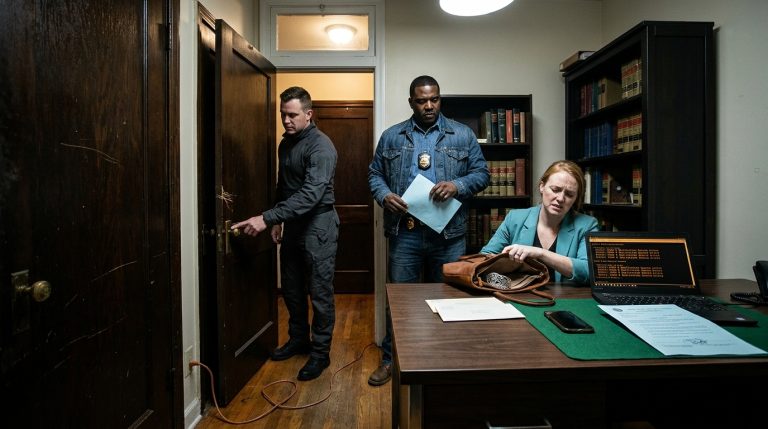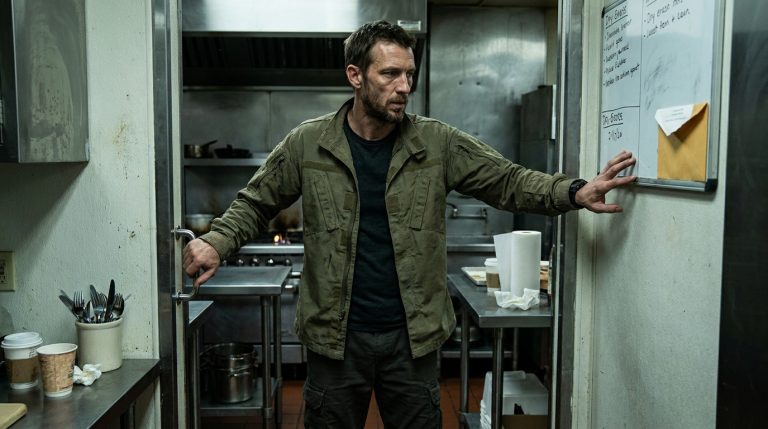
The Weight of Cedar and Iron: A Texas Surveyor’s Unyielding Fight for His Family’s Frontier Legacy
CHAPTER 1: THE TWILIGHT LINE
The smell of crushed juniper always gets heavier when the sun drops behind the limestone ridges. It’s a thick, resinous scent that sticks to your skin like iron filings, reminding you exactly how much sweat it takes to keep twelve acres of Texas from reverting back to wild brush. I sat on the idling four-wheeler, my calloused hands resting flat against the rubber grips, watching the cold glare of a Maglite rake across the live oaks.
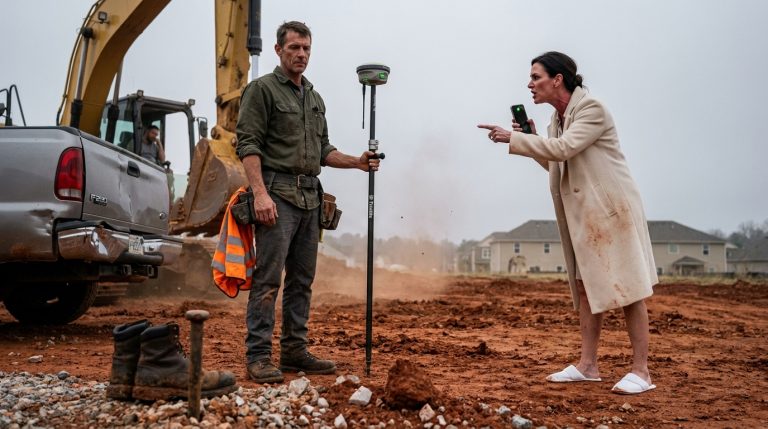
Brenda Lockwood was a foot deep into my legal boundary. She wore a pristine designer barn jacket that had never seen a day of actual labor, and her pearl earrings caught the dying orange light cutting through the canopy. In her hands, the heavy iron crowbar looked clumsy, but she had enough momentum to lever the metal stake clean out of the black dirt. The sign—Private Property, No Trespassing, Texas Penal Code Section 30.05—toppled forward into the dry grass with a dull clatter.
Behind her stood three members of the Cedar Bluff Estates HOA board, holding their flashlights like they were posing for a small-town newspaper photo. Sixty yards back, up the slope toward the cabin, the porch light cast a pale yellow square onto the dark wood. My twin sons, Jonah and Wyatt, stood perfectly still within that square. They didn’t shout. They didn’t move. They had been raised by a mother who taught them to watch the wind before opening the door, and they knew the shape of trouble when it walked onto our land.
“Brenda,” I said, my voice flat, catching the steady rhythm of the engine beneath me. “That’s the sign that says my land is my land. Please put the crowbar down.”
She didn’t flinch. She didn’t even turn around to face the headlamps of my utility vehicle. Instead, she drove the nose of the bar down into the next aluminum stake ninety yards down the track. “This is a community trail, Caleb,” she said, her breath fogging slightly in the October chill. “Your grandfather signed off on this trail decades ago. You’re disrupting an established amenity, and the HOA will be billing you for the restoration of the boundary.”
“My grandfather never signed a single easement,” I replied, cutting the ignition. The sudden silence of the woods felt heavier than the engine’s roar. “I have the 1971 survey of record on my kitchen table next to his old coffee pot. I have the deeds going back to the day the homestead was carved out. Step away from my fence.”
Hollis Underwood, the retired oilman who ran the grounds committee, took a half-step toward my front tire. His chest was broad under his canvas coat, his face weathered by years of commanding rigs and shouting over diesel generators. “Son, we’ve used this trail for six years. That’s adverse possession. Tell your lawyer to look up the statute before you start planting stakes where our seniors like to walk.”
I looked at him through the desaturated gray of the twilight, noticing the slight tremor in the hand holding his flashlight. “Adverse possession in the state of Texas requires ten years of open, notorious, hostile, and continuous use,” I said, the surveyor’s definitions coming to my tongue as naturally as breathing. “Six years isn’t ten, Hollis. And use with the unrecorded tolerance of a dying man doesn’t constitute a hostile claim. You’ve got four minutes before the county gets here.”
Brenda turned then, her face twisting into something sharp and pale under the trees. “You haven’t called anyone, Caleb. You’re bluffing to protect a patch of weeds.”
“Dad,” Wyatt’s voice carried down the slope, clear and small but carrying the steady weight of a boy who spent his afternoons tracking turtles. “The camera light just turned green.”
I pointed a single finger toward the low branch of the live oak eighteen feet to Brenda’s right. A small black Bushnell game camera sat nestled in the bark, its infrared sensors pulsing with a faint, invisible glow. Then I pointed to the second one on the fence post, and the third hidden near the limestone lip of the creek where the native Guadalupe bass were currently breaking the dark surface of the water.
“All three have been rolling since you hit the first stake,” I said softly. “Texas Penal Code 28.03. Criminal mischief, third-degree destruction of property with intent. The deputy’s already turning off the state highway.”
Brenda looked up at the lens in the tree, and for the first time, the crowbar slipped an inch against the rusted iron of the stake.
CHAPTER 2: THE PAPER STORM
The iron crowbar didn’t fall. Brenda held it frozen against the twilight, her knuckles white where the metal met her skin, her eyes locked on the tiny green iris of the Bushnell camera pulsing in the live oak. The silence between us stretched until it had a texture—the abrasive, dry scraping of cicadas dying out for the season and the low, ticking heat of my four-wheeler’s exhaust pipe.
Hollis Underwood was the first to break. He lowered his flashlight, the beam cutting a jagged yellow arc across the limestone gravel before dying against his boots. “Brenda,” he muttered, his voice stripped of the oil-rig thunder he’d used a minute ago. “Put the bar down. We’re on the wrong side of the wire.”
“We are on HOA property,” Brenda said, though the words lacked the structural weight they had five minutes prior. They sounded thin, like dry parchment pulling apart under grease. She didn’t look at Hollis. She kept her eyes on me, searching for a tremor in my face, looking for the soft spot where a normal homeowner would start negotiating to avoid a neighbor war. She didn’t find one. My face was the same face I used when mapping treacherous shoal waters for the Navy—flat, measured, and entirely clear of emotion.
“The county line road is three miles out,” I said, reaching down to click my pocket knife closed against my thigh. I hadn’t opened it, but the weight of the brass casing against my palm was a grounding habit. “Deputy Falls doesn’t like speed traps, but she doesn’t like criminal mischief on a Thursday night either. You’ve got about three minutes before that Lexus has to squeeze past a white-and-blue cruiser on a single-lane track.”
Brenda let the crowbar slide. It didn’t drop with a dramatic clang; it slid through her leather-gloved fingers until the flat spade end bit into the red dirt with a heavy, muffled thud. She didn’t look back at the three board members who had been filming on their phones. Those phones were already disappearing into jacket pockets, their screens going dark like dying coals.
“You think you’re the first stubborn old bastard with a piece of paper, Caleb?” she hissed, stepping back over the invisible boundary line, her designer boots skidding slightly on the loose flint. “Your grandfather was a ghost in this valley for ten years before he died. He didn’t maintain the culverts. He let the juniper choke out the south fence. This community is the only thing keeping your property value high enough to pay your taxes.”
“My property value is tied to the water,” I said, my voice dropping into that quiet register that makes horses stop turning their ears. “And the water doesn’t belong to the Cedar Bluff board. Now get off my dirt.”
She didn’t answer. She climbed into the passenger seat of the white Lexus parked at the trailhead, her door slamming with a pressurized, expensive whump that seemed entirely foreign to the smell of cedar and dry earth. The three board members scrambled into Curtis Brashier’s heavy Yukon, the tires spinning once on the public caliche road before gripping and throwing a screen of white dust into the headlights.
I didn’t move until the red taillights vanished around the bend of Old Crabapple Road. The dust settled slowly, coating the crushed aluminum Private Property sign in a fine, talcum-like film. I walked over, knelt down in the dark, and ran my thumb along the bent edge of the metal. The impact had sheared the top iron bolt clean through. It was an entry-level crowbar, cheap steel from a big-box store in San Antonio, but it had done the work.
“Dad?” Wyatt called down again. He and Jonah had left the porch square. They were standing ten feet away now, their small frames nearly lost in the deep shadow of the live oaks. Jonah had his brown notebook tucked under his arm like a shield.
“Go back up and check the latch on the chicken coop,” I said, standing up and hoisting the ruined sign by its cold iron post. “Then turn the stove down under the roast. I’ll be up in five.”
They didn’t ask questions. They turned in unison, their sneakers crunching rhythmically on the trail they knew by heart. I watched them go, then turned my flashlight toward the fence line. There was a specific point where my grandfather had driven a three-foot length of rusted iron oil-field pipe into the limestone back in sixty-two to mark the corner pocket. It was wrapped in three strands of old, un-galvanized four-point barbed wire that had turned the color of dried liver over the decades. I found it three feet inside the path Brenda had been clearing. The wire had grown directly into the heart of a cedar elm, the bark folding over the metal like a scar over a buckshot pellet.
The HOA hadn’t just rerouted the trail; they had chopped three inches into the elm’s trunk to clear a line for their gravel walkers. That wasn’t an oversight. That was design.
By nine the next morning, the response arrived.
I was at the barn workbench, scraping the old grease out of the three-horsepower pump I used for the stock tank, when the gravel down by the mailbox crunched. It wasn’t the mail carrier’s jeep; the timing was wrong. I walked to the barn door, wiping my hands on an oily rag, just in time to see a silver Mercedes wagon accelerating away from the gate.
Attached to the cattle latch was a heavy, legal-sized manila envelope. It was joined by two more on the front porch, weighted down by a limestone rock the delivery driver had pulled from my own decorative flower bed.
Every envelope bore the same heavy, gold-foil seal: Cedar Bluff Estates Homeowners Association. Office of the President.
I took them into the kitchen, sat at the long pine table my grandfather had built out of salvage timber from the old Fredericksburg mill, and used my pocket knife to slit the top of the first packet. The paper inside was thick, high-bleed stock that smelled faintly of laser toner and cheap perfume.
NOTICE OF COVENANT VIOLATION, the bold text at the top read. PARCEL ID: HAYWARD-01 (PROVISIONAL ANNEX). DETAILED FINE SCHEDULE ATTACHED.
I didn’t call Dalton Brisco right away. I didn’t get angry. A surveyor’s mind doesn’t look at the language of a threat; it looks at the coordination of the grid. I laid the pages out one by one across the wood until they covered the entire width of the table.
Violation One: Failure to clear Class IV invasive vegetative matter (Juniperus ashei) within thirty feet of a designated community access corridor. Fine: $500 per day, retroactive to October first.
Violation Two: Unapproved commercial vehicle parked within sight-line of primary residential views. That was my 2007 F-150 with the small magnetic door decal for my habitat consulting business. Fine: $250 per occurrence.
Violation Three: Unauthorized surveillance equipment mounted within seventy-five feet of a public easement without board review. The game cameras. Fine: $1,000.
The total at the bottom of the fifth page was $17,400, with an additional compound interest rider of twelve percent if unpaid within fourteen business days. It was signed with a thick, violet ink stroke that could only belong to Brenda Lockwood.
I picked up the third envelope—the one that had been hand-delivered to the porch. Inside was a copy of the same document, but across the bottom page, someone had written in pencil: We can settle this before the county court records the lien. Call the office.
I looked out the window. Down at the creek, a great blue heron was dropping its yellow stilts into the shallows, completely indifferent to the paper storm sitting on my kitchen table. The fines were fiction, but they were signed, stamped fiction with a legal seal. In Texas, a lien on a title doesn’t have to be legal to ruin your credit or stall a bank loan; it just has to be filed.
I pulled my laptop open, created a new directory named Cedar Bluff, and began the long, silent work of building the ledger that would eventually hang her.
CHAPTER 3: THE BUS STOP STAND
The gravel turnout off Old Crabapple Road was a desaturated patch of sun-baked caliche, bordered by a rusted five-strand barbed-wire fence and a cedar post that had split down the center under three decades of Central Texas heat. Dust hung in the afternoon air like ground glass, catching the low glare of the three-o’clock sun. I parked the F-150 forty feet back from the main lane, leaving the diesel engine ticking to keep the battery charged, my hand resting on the smooth, worn horn of the steering wheel.
Four other vehicles sat in the heat—mostly clean, white European wagons and dark domestic SUVs that had never seen a low-gear trail or a loaded cattle trailer. The parents didn’t step out into the dust. They stayed behind their tinted glass, engines idling to run the air conditioning, screens glowing small and blue against their steering wheels. They knew who I was, and they knew about the three manila envelopes currently sitting on my kitchen counter. News in the Hill Country travels through fence lines faster than flash floods, and Brenda Lockwood had been busy on the subdivision’s digital message boards since sunrise.
The yellow school bus rounded the bend near the iron cattle guard, its brakes giving a high, metallic squeal that cut through the low drone of the cicadas. It jolted to a stop, its red stop-arm clicking outward with a sharp pneumatic hiss.
Before the folding doors could even swing open, the long, white shape of a Lexus wagon cut across the opposing lane, its tires biting into the caliche shoulder with a dry, grinding crunch. It parked at an aggressive diagonal, blockading the path from the bus steps directly to my driver-side door.
Brenda Lockwood stepped out before her engine died. She wasn’t wearing the designer barn jacket today. She wore a tailored charcoal blazer that looked like it belonged in a limestone bank downtown, but her pearl earrings swung erratically against her jawline. Her fingers were curled tightly around a leather-bound folio, her face stiff under a layer of expensive powder that couldn’t quite mask the gray tint of exhaustion around her eyes.
My twin sons stepped down from the bus first. Wyatt had his canvas backpack slung over one shoulder, his boots hitting the gravel with a solid, deliberate thud. Jonah followed a half-step behind, his eyes fixed on the small brown notebook he kept tucked into his waistband. They didn’t see the Lexus until they cleared the front bumper of the bus.
“Wyatt. Jonah,” Brenda said, her voice carrying across the hot metal hoods of the parked cars. It wasn’t the polished tone she used for the annual subdivision barbecue; it had the hard, jagged edge of a woman who had spent five hours trying to get an Austin real estate lawyer to return her phone calls. “Stop right there for a moment, boys.”
The twins halted. Jonah’s hand went automatically to the spine of his notebook, his fingers gripping the frayed cloth. Wyatt didn’t shift his backpack. He stood square, his gray-green eyes lifting to meet hers with the unblinking stillness he’d inherited from his mother.
“You boys should go ask your father how it feels to ruin an entire community for everyone,” Brenda said, stepping closer, her heels sinking an inch into the loose caliche grit. She pointed the corner of her leather folio toward the back of my truck where the consulting decal was mounted. “Ask him why he thinks his ten acres of rocks are more important than eighty-seven families having a place to walk their children. Ask him how much he expects you to pay for the damage he’s doing to this valley.”
Two car windows down the line rolled down by two inches, the dark glass sliding down to reveal pale faces watching the exchange through the narrow gaps. The bus driver remained at the wheel, his hand hovering over the door lever, his jaw working a piece of tobacco as he tracked the movement in his massive side mirrors.
I unlatched my truck door, the old latch clicking with a heavy, ungreased crack of iron. I didn’t rush my feet. I stepped down into the dust, the heat radiating off the caliche through the thick soles of my work boots.
Before I could clear the front fender, Wyatt took a half-step forward, placing himself between Brenda and his brother. His twelve-year-old shoulders were small under his denim shirt, but his chin didn’t dip an inch.
“Ma’am,” Wyatt said, his voice dropping into the quiet, level cadence we used when a steer was pinned against a cedar gate. “My dad doesn’t ruin things. He fixes them.”
Brenda’s mouth opened slightly, her teeth catching the light, but the speech she’d rehearsed in her kitchen vanished into the dry air. She reached down, her manicured fingers tightening on the edge of the leather folio until the seams groaned. “You don’t understand what your father is—”
“That’s enough, Brenda,” a new voice cut across the gravel.
The door of the kindergarten van directly behind the bus clicked open. Mrs. Halverson, the principal of Fredericksburg Elementary, stepped out into the sun. She was a broad-shouldered woman who had spent thirty-four years managing the children of Gillespie County ranchers, and she wore her gray hair like a crown of old cedar. She didn’t look at me; she looked at Brenda’s Lexus, which was still idling three feet inside the school bus’s mandatory clearance zone.
“Mrs. Lockwood,” Mrs. Halverson said, her voice holding the absolute authority of a district court judge. “Your vehicle is obstructing a school transportation unit, and you are currently addressing students who are under my administrative care until they reach their parents’ vehicles. My dashboard camera has been recording since you crossed the yellow line.”
Brenda’s head snapped toward the van’s windshield, where a small black lens was mounted behind the rearview mirror. The color drained out of her cheeks, leaving the red spots of her blush looking like ink stains on dry wool.
“Get in the truck, boys,” I said quietly, opening the back door of the cab.
Wyatt and Jonah moved past Brenda without looking back, their boots synchronized against the running board. The door closed behind them with a solid, mechanical latch. I turned to look at Brenda one last time before climbing into the driver’s seat. She was still standing in the caliche, her folio pressed against her chest like an armor plate that had just been pierced by a low-caliber round.
“Dalton Brisco got your envelopes, Brenda,” I said through the open window as I shifted the F-150 into reverse. “He told me to tell you that fiction with a logo on it doesn’t hold ink in Gillespie County.”
I backed out slowly, leaving her standing in the white screen of our dust, her Lexus door still swinging wide in the afternoon heat.
CHAPTER 4: THE UNMARKED ENVELOPE
The dust from the afternoon run took nearly an hour to settle completely out of the barn’s air, leaving a fine white film across the top of my steel tool chest and the cast-iron housing of the drill press. I didn’t wash the caliche from my hands. The dry grit in the creases of my palms felt solid, a familiar friction that balanced the cold weight of the metal keys hanging from my belt loop. Jonah and Wyatt were in the cabin, the low sound of a baseball game drifting through the screen window to scratch across the seventy yards of juniper brush separating us. They were safe behind our walls, which meant I could focus entirely on the grid.
I walked down the length of the concrete floor to my office space—a small, partitioned room framed out of rough-sawn cedar planks in the back corner of the structure. The door was a solid slab of oak salvage that didn’t have an external handle, just an old commercial brass deadbolt that required a smooth, deliberate counter-turn to disengage. When the bolt slid back, the wood gave its familiar, ungreased groan.
That was when I saw it.
It hadn’t been delivered to the mailbox by the highway, and it hadn’t been dropped on the front porch where the other manila envelopes had been weighted down with stones. Someone had walked into the relative darkness of my barn, bypassed the open workspace, and slid a plain, white, unmarked letter-size envelope beneath the half-inch gap under my office door. It sat perfectly square on the dark green utility carpet, the paper unwrinkled and stark against the floor.
I didn’t pick it up immediately. I stood in the doorway, my eyes scanning the concrete outside the frame for any damp boot prints or fresh flakes of dried mud. The afternoon heat had baked the floor clean, leaving nothing but the old, dark patches of hydraulic oil near the tractor bay. Whoever had dropped it knew exactly how to move without making a racket on the corrugated tin roofing.
I knelt, my knees cracking slightly against the sill, and picked the envelope up by the corner. It had weight to it—not the thick, multi-page heft of the legal packages Brenda had been sending, but the stiff, dense texture of high-grade ledger sheets. On the upper flap, written in a cramped, precise hand using a fading blue fountain pen, were six words: Mr. Hayward, look at the second account.
I sat down at the gray steel desk, flipped on the swing-arm lamp, and used a thin brass letter opener to slide through the top adhesive line. Inside was a printed two-page spreadsheet, exported directly from an older version of standard accounting software. The columns were narrow, packed with dates, transaction codes, routing numbers, and balance totals going back six fiscal years.
Across the top header, someone had used a black felt-tip marker to draw a heavy line through the bank’s corporate logo, but they hadn’t crossed out the name of the primary depositor: Cedar Bluff Estates HOA – Amenity Fund.
My surveyor’s brain doesn’t track names first; it tracks numbers and their corresponding coordinates. My fingers moved down the columns, tracing the steady, rhythmic flow of capital. Every single month, on the fifth business day, exactly eighty-seven deposits of $100 entered the ledger. That was the monthly breakdown of the $1,200 annual creekside access fee that Brenda’s board had been collecting from every family in the development. The incoming balance was consistent, rising to a total that made the small plastic housing of my desk calculator groan when I totaled the years out loud. $626,400.
But the money didn’t stay in the account.
Every single deposit was followed forty-eight hours later by an outbound wire transfer. The destination field didn’t list the HOA’s operational pool, and it didn’t show payments to local landscape contractors or trail maintenance crews. Every dollar moved into an entity registered under the initials LHCR LLC.
I opened a separate browser window on my laptop, bypassed the county’s public land records, and pulled up the corporate database for the Texas Secretary of State. My fingers were loud against the keys in the small room. I paid the four-dollar filing fee with my consulting credit card and waited for the corporate charter to download.
The PDF cleared in seven seconds.
Lockwood Hill Country Recreation LLC. Filed in November of 2019. The corporate address wasn’t the subdivision’s management office; it was the exact street number of the wine bar Brenda’s husband operated on Main Street in downtown Fredericksburg. The registered agent, the sole corporate officer, and the single authorized signature on the account belonged to one person: Brenda Lockwood.
I leaned back in the steel chair, the old springs giving a sharp, metallic ping that echoed off the cedar walls.
The strategy was suddenly completely bare. The trail across my grandfather’s land hadn’t been an oversight by a sloppy board, and it hadn’t been a misunderstanding about ancient boundaries. It was a revenue-generating asset. Brenda had spent six years collecting over half a million dollars from her own neighbors for the privilege of walking along a creek they had no legal right to touch, then moving those funds directly into a private corporate pocket to finance the expansion of her family’s commercial ventures down the road.
She couldn’t back down from the fence line because if the trail went dark, the account went dry. If the members found out they were paying for access to private Hayward land, they would look at the books. And if they looked at the books, the whole house of cards would fold into the dirt.
A soft click behind me made my hand drop toward the desk drawer where I kept the old brass flashlight.
I turned around slowly. Through the small, wire-reinforced window of the office door, I could see the silhouette of Jonah standing in the darker twilight of the main barn. He had his brown notebook in his left hand, his pencil tucked behind his ear, his face half-hidden by the shadow of the rafters.
“Dad,” he said, his voice small but steady through the gap in the doorframe. “Aunt Susanna just called from Kerrville. She said the traffic on the state line is backed up, but she’ll be here before breakfast.”
“Alright,” I said, sliding the two-page spreadsheet into my desk drawer and locking it with the small brass key on my ring. “Tell her to watch the low-water crossing near the creek. The limestone gets slick when the dew hits it.”
He nodded once, his silhouette shifting as he turned back toward the cabin. I didn’t turn off the desk lamp immediately. I sat there in the quiet, watching the light pool across the old varnish of the oak desk, calculating exactly how many phone calls it would take to bring the outside world into Brenda’s boardroom.
CHAPTER 5: THE TACTICAL GATHERING
The air conditioning in Dalton Brisco’s office smelled of ancient parchment and the chemical bite of an old Xerox machine that had been running blueprints since the late eighties. There were no expansive glass panels overlooking the Austin skyline here; the windows were narrow, heavy glass blocks built into a three-story brick structure near the West Campus grid, covered in a fine layer of gray limestone silt from the street expansion outside. The conference table was solid oak, stained the color of dried liver, its surface scarred by forty years of heavy binders, coffee rings, and the metal edges of surveyor rulers.
Dalton sat at the head of the table, his white sleeves rolled up twice to reveal forearms that looked like weathered cedar posts. He didn’t use a tablet or a dual-monitor array. In front of him sat three separate stacks of property binders, each one tagged with a strip of frayed green surveyor’s tape. To his left sat Theo Wexford, the forensic accountant, whose thin, oil-spotted fingers were adjusting a calculated spreadsheet on a heavy, military-spec laptop that hummed like a low-gear water pump.
“The numbers aren’t sloppy, Caleb,” Theo said, his voice holding the dry, flat cadence of a man who spent his life tracking small-town municipal fraud. He tapped a single fingernail against the display screen. “They’re institutional. Brenda didn’t just stumble into this. She used the exact format the school district used for athletic facility expansions back in twelve. The transfers are scheduled down to the microsecond. Every fifth business day, sixty-eight thousand dollars leaves the general amenity fund and drops into Lockwood Hill Country Recreation LLC. The next morning, half of it goes into the Main Street wine bar lease, and the rest gets broken down into eight-thousand-dollar cash withdrawals at three different regional bank branches between Fredericksburg and Marble Falls.”
I leaned forward, resting my elbows on the hard oak surface. The skin of my knuckles felt tight, still carrying the faint gray stain of the pump grease from the barn. “Does she have a board vote backing those transfers?”
“She has three signatures,” Dalton said, his hand dropping onto the thickest stack of binders with a solid, paper-muffled thud. “Curtis Brashier, Lorraine Pettyjohn, and Hollis Underwood. They signed the annual declaration of operational solvency every December since twenty-nineteen. But here’s where the wire breaks, Caleb. They didn’t sign it as an HOA board. They signed it as minority partners in the LLC.”
I looked at the corporate structure document Theo had printed out. The paper was coarse, the text desaturated. “They think they’re protected by the subdivision’s liability clause.”
“They think they are,” Dalton replied, a small, cold smile breaking the line of his gray mustache. “But an HOA’s corporate immunity is an umbrella that only covers the acreage inside the plat. If you’re operating an unrecorded commercial venture on land that was never legally enrolled in the restrictive covenants, the umbrella stays in the closet. The second they crossed onto your grandfather’s sixty-two boundary line, they weren’t officers fulfilling a community duty. They were joint-venture partners operating a trespass for profit. That’s a first-degree felony under Texas Penal Code 31.03.”
“What about the trail itself?” I asked. “The county judge denied her emergency motion, but she’s still posting the fine notices on the community site.”
Dalton pulled a massive, yellowed blueprint from the bottom of the stack, unrolling it across the table until the iron paperweights at the corners groaned against the wood. The paper was the original 1971 county survey of the Hayward homestead, its margins marked with faint, hand-written ink notations from the surveyor who had set the iron pipes along the creek grid sixty years ago.
“Look right here,” Dalton pointed a blunt finger at the eastern margin, where a series of small, cross-hatched lines marked the border between my timber and the subdivision’s boundary. “When Cedar Bluff was platted in twenty-eighteen, the engineering firm didn’t run a fresh line. They copied the old county tax map from nineteen-eighty-four. But they missed a three-degree variance on the creek bend. Brenda’s engineers knew it. They saw the gap, and instead of filing an adjustment with the county clerk, they simply ran the gravel path over the line where your grandfather’s old fence had rusted down into the brush.”
“They assumed the land was abandoned because the tax records were still registered to an estate in probate,” I said.
“They assumed nobody was looking,” Dalton corrected. “They figured a hydrographic surveyor from the Navy wouldn’t come home with a GPS rig and a set of state conservation papers in his truck.”
Theo leaned back, his laptop screen casting a pale, cold square across his glasses. “The cash trail ends at the wine bar, Caleb. She’s leveraged the entire property value of eighty-seven families to secure a two-hundred-and-fifty-thousand-dollar commercial expansion loan from the regional bank. If the DA files the indictment before the annual meeting on Tuesday, the bank calls the note. If the bank calls the note, the wine bar goes to auction, and the HOA’s general operating fund gets frozen by the state.”
The room went entirely quiet then, save for the steady, mechanical hum of the computer’s fan. I looked down at the old survey map, my eyes tracking the thin blue line representing the creek where my boys had spent their morning watching the herons. The legal grid was clear, the lines were locked, but the execution had to be flawless. If Brenda felt the wind shift too early, she could file for corporate restructuring in a federal bankruptcy court, locking the records behind an administrative wall for eighteen months before a single deputy could step onto her porch.
“We don’t give her eighteen months,” I said, my voice dropping into that measured, quiet register. “We let her open the meeting. We let her call the vote on the next phase of the amenity fees.”
Dalton watched me for a long three seconds, his thumb trailing along the rusted iron edge of his paperweight. “That’s high-velocity steel, Caleb. If you walk into that hall without the grand jury signature locked down, she’ll have the county sheriff remove you for disrupting a private corporate assembly.”
“The grand jury sits on Tuesday morning,” I said. “Katherine Reeves told me she’ll have the sealed indictment by noon. We bring the outside world into that room all at once—the DA, the game warden, and the forensic ledger. When sunlight hits a closed box from four sides, the lock doesn’t matter anymore.”
Dalton nodded slowly, his hand coming down flat against the 1971 map, the old paper crinkling under the weight of his palm. “Then we don’t file the civil suit until Monday afternoon. Let her spend her weekend thinking she’s winning the paper war.”
CHAPTER 6: THE FRACTURED HABITAT
The steel teeth of the surveying chain dragged across the limestone shelf with a dry, rhythmic hiss that sounded like a diamondback crossing sun-baked flint. I held the zero-end of the tape flat against the rusted iron pipe marking my grandfather’s eastern corner pocket, my thumb pressing down until the rough scale of the corrosion bit into my skin. Ten feet away, knee-deep in the cold, cloudy flow of the creek, Lieutenant Mary Beth Callaway adjusted the optical lens of her handheld GPS unit. Her olive-green uniform was dark with river silt up to the shins, her badge catching the desaturated light filtering down through the canopy of live oak and cedar.
“The mud is deep here, Caleb,” Mary Beth said, her voice dropping into the low, flat register of someone who spent her winters pulling illegal gill nets out of the Llano river. She didn’t look up from her screen. “The bank profile is completely sheared. Joggers have cut a three-foot trench through the topsoil right where the native Guadalupe bass clear their nesting gravel. If this trail stays open another two weeks, the November spawn is completely dead in the silt.”
“The path runs forty-two feet inside my line along this bend,” I said, checking the tension on the wire. “The HOA laid down crushed granite over the exposed roots of these elms. The runoff is pure acid when the rains hit.”
Mary Beth stepped up onto the bank, her heavy leather boots sucking out of the gray mud with a thick, wet pop. She held a heavy aluminum clipboard covered in a protective grease film. “I’ve got enough topographical variance here to issue the emergency cease-and-desist under Texas Parks and Wildlife Code Section 66.01. This isn’t just a property line dispute anymore, Caleb. It’s a state-level habitat violation. The HOA won’t be allowed to move a single wheel or boot within fifty yards of this water once this gets stamped in Austin tomorrow morning.”
I let the tape slide back into its brass casing, the metal spring whirring sharply in the quiet canyon. The victory felt clean, almost too easy. We had the financial spreadsheet from Ruth Pruitt locked in the desk, Dalton Brisco was drafting the quiet title petition, and now the state was moving in to seal the creek from further damage.
Then the sound of a heavy diesel engine grunted from the top of the ridge.
It wasn’t a standard truck. The heavy, dual-wheeled roar belonged to a county maintenance unit, its transmission whining as it engaged its low gear to drop down the steep caliche incline toward my access road. I turned my flashlight toward the slope, the beam catching the white dust kicked up by a orange-striped Gillespie County Road Commission truck.
The vehicle halted thirty yards back, its air brakes releasing with a loud, aggressive snort that echoed off the limestone bluffs. Two men stepped down from the cab. The first was Curtis Brashier, his heavy frame stuffed into an insulated canvas vest, his flashlight beam swinging erratically across my fence line. Beside him walked a tall, wire-thin man in a white western shirt with a gold county commissioner badge pinned to the pocket. His name was Vance Theriot, the regional commissioner for Precinct 2, a man whose family had owned three ready-mix concrete plants along the Pedernales since the seventies.
“Mr. Hayward,” Vance said, his voice holding the nasal, slow-drawn drone of a career county politician. He didn’t walk down into the mud. He stopped at the edge of the caliche, his hands tucked into his leather belt. “We’ve got an emergency order here from the county court. You need to pull these stakes back fifty feet.”
I walked up the slope, my boots leaving deep, triangular tracks in the limestone silt. Mary Beth followed three steps behind, her hand resting naturally on the flat leather flap of her sidearm holster. “Commissioner,” I said, “this is private property. My grandfather bought this parcel in sixty-two. The county line ends at the road bed.”
Vance pulled a folded sheet of blue ledger paper from his shirt pocket. It didn’t look like a standard judicial order; it was stamped with a heavy, purple ink circle that bore the emergency seal of the Precinct 2 Road Variance Board. “The county recorded an unmapped public drainage easement along this branch back in nineteen-eighty-four, Caleb. Under the emergency infrastructure bill passed last session, the county has the authority to clear any obstruction within the secondary drainage channel during high-risk flood seasons. Your signs and your game cameras are interfering with the municipal water assessment.”
“The drainage easement was for the culvert under Old Crabapple Road,” I said, my voice dropping into that cold, level register. “It doesn’t extend six hundred yards into a private timber tract.”
“The map says it does,” Curtis Brashier cut in, a wet, triumphant grin breaking through the fat around his jaws. He held up a freshly printed county zoning chart, its margins still smelling of fresh ink. “The board reviewed the boundaries this morning, Hayward. The county has declared this trail an active flood-control levee. The Cedar Bluff HOA has been contracted by the precinct to maintain the gravel stabilization project along the bank. Your state papers don’t mean a damn thing if the county says the water is a municipal hazard.”
Mary Beth stepped forward, her aluminum clipboard clicking against her uniform buttons. “Commissioner Theriot, this creek segment is registered as a critical bass habitat with the state of Texas. Any municipal modification requires a ninety-day environmental impact assessment from Austin.”
Vance didn’t flinch. He didn’t look at her badge. He kept his eyes on me, his thumb tracing the brass buckle of his belt. “Austin is three hours away, Lieutenant. This order is signed by the county judge effective as of noon today. Until the district court holds a formal hearing on the variance, the county easement overrides the state habitat designation for public safety. The HOA’s contractors have the right to clear the fence.”
I looked down at the blue ledger paper in his hand. The stamp was fresh, the ink bleeding into the cheap fiber. It wasn’t a permanent legal title, but it didn’t have to be. It was a tactical delay. Brenda hadn’t just gone to her lawyers; she had used the oldest network in the county, leveraging her husband’s commercial ties with the road commission to manufacture an emergency municipal easement out of thin air.
The decoy secret—the financial siphoning through her LLC—was still safe because this county order effectively quarantined the property records, classifying the disputed line as an active public works site. If I pulled the signs down now, the walkers would return by morning, the path would be re-established under county protection, and my quiet title claim would be stalled in administrative loops until after the annual meeting had passed.
“You’ve got until sunrise to clear the stakes, Caleb,” Vance said, turning back toward the cab of his truck. “After that, the county road crews will bulldozer the wire to clear the channel. Have a good evening.”
The orange-striped truck backed up the ridge, its tires throwing a shower of sharp caliche flint into the cedar brush. Curtis Brashier stayed behind for three seconds, his flashlight beam illuminating the ruined aluminum sign at my feet before he climbed into his own SUV.
I stood there in the dark, the smell of diesel exhaust blotting out the clean resin of the junipers. The state cease-and-desist was dead in the mud. The financial records were locked, but without a clear, un-compromised boundary title, the DA wouldn’t be able to serve the grand jury warrant on Tuesday. Every line I had drawn was being erased by a purple stamp on a piece of blue paper.
Mary Beth looked at her GPS screen, her jaw set tight against the cold wind rising off the river. “He’s right about the administrative loop, Caleb. If the county claims an active infrastructure interest, my agency has to back off until the state legal team reviews the filing. That takes months.”
“They think the line is based on the eighty-four tax map,” I said, my fingers closing around the cold iron pipe in the ground. The metal was old, pitted by sixty years of river damp, but it didn’t budge an inch. “They think the homestead was part of the original subdivision platting.”
I looked up toward the cabin where Jonah’s window was still yellow against the ridge. The decoy was broken, the county had jumped the wire, but they had made their calculation based on a lie Brenda had been telling for six years. They didn’t know about the isolation of the sixty-two tract. They didn’t know that the ground beneath our boots had never been part of the county’s municipal grid to begin with.
“We aren’t waiting for Austin,” I told her, my voice turning as hard as the limestone shelf beneath the water. “Call Dalton. Tell him to pull the original land grant from the General Land Office in Bureau Case B. We aren’t fighting the county commission. We’re going to cut the ground out from under them.”
CHAPTER 7: THE GRAND AMBUSH
The heavy oak doors of the Pioneer Memorial Hall closed behind me with a solid, pressurized click that cut through the low hum of the rain beginning to needle the tin roof outside. The air inside smelled of stale damp, pine floor wax, and the burnt-metal aroma of an oversized commercial coffee urn sputtering in the back corner. Every row of folding wooden benches was filled. Eighty-seven families sat shoulder-to-shoulder under the high, exposed rafters, their whispers rising toward the roof like the sound of dry leaves scraping down a caliche road.
Brenda Lockwood stood behind the pine podium at the center of the raised stage. She looked exactly like the corporate brochure she had mailed out three weeks ago—her charcoal blazer crisply ironed, her hair swept back into a tight braid, her pearl earrings catching the harsh glare of the overhead fluorescent tubes. On the massive projection screen behind her, a digital slide deck titled Cedar Bluff 2030: Our Shared Horizon displayed a high-resolution photograph of children running along a generic, sunlit creek bank.
“And so, as we look at the upcoming fiscal expansion,” Brenda’s voice boomed through the PA system, smooth and rhythmic, the practiced cadence of an executive who had never been forced to stand her ground on a boundary line. “The board is asking the membership to ratify a modest adjustment to our signature amenity access structure. A flat increase to fourteen hundred dollars per family annually will permanently secure the future of our creekside trails.”
I stood in the shadows of the rear aisle, my back resting against the wood panelling, my arms crossed over my chest. The slacks I wore were dark gray, my button-down shirt fresh, but the thick leather belt looping through my denim loops belonged to my grandfather. Its brass buckle was cold against my skin.
To my left, leaned against the emergency exit doorframe, stood Lieutenant Mary Beth Calloway. Her green campaign hat was tucked under her left arm, her uniform immaculate, her face completely empty of emotion as she watched the stage. Directly behind her, sitting quietly on a low bench near the coat rack, were two plainclothes deputies from the Gillespie County Sheriff’s Department. One of them, a broad-shouldered man with a Marine Corps emblem pinned to his collar, had his eyes locked onto the side exit where Brenda’s husband stood near a display of champagne bottles.
“We will now open the floor to discussion on Item Seven,” Brenda said, her fingers tapping the edge of the podium as she clicked to the next slide. The screen changed, showing a grainy photograph of my aluminum private property signs bent over the wire. “Action regarding unauthorized obstructions on the eastern border.”
I didn’t shout. I didn’t rush down the center aisle. I walked with the slow, measured pace of a surveyor checking a benchmark point, my work boots striking the pine floorboards with a clear, rhythmic thud that made the families in the back row turn their heads.
“Madam President,” I said, my voice carrying cleanly without the aid of a microphone. “Point of order under Robert’s Rules. Item Seven directly addresses the legal boundary of the Hayward homestead. As the deed holder of record, I am requesting the floor.”
The hall went completely dead. The sound of the rain on the tin roof suddenly seemed twice as loud, a steady, mechanical drumming that filled the gap between the benches.
Brenda’s hand froze over the presentation clicker. Her eyes found me four rows back, and for a fraction of a second, the gray tint of exhaustion I’d seen at the bus stop broken through her composure. She looked at Curtis Brashier, who was sitting at the board table to her right, his heavy face flushed red under the fluorescent lights. He made a small, downward motion with his pen—a signal to cut the microphone.
“Mr. Hayward,” Brenda said, her voice dropping an octave, coming through the speakers with a sharp, electronic edge. “This is an internal corporate assembly for the enrolled members of Cedar Bluff Estates. You are not a member of this association, and you have no standing to address this floor. I’m going to ask you to leave the hall immediately or the sergeant-at-arms will have you escorted out.”
“I am not an enrolled member,” I said, reaching the edge of the stage and resting my hand flat against the unpolished pine banner rail. “Because my land was never part of your plat. The sixty-two Hayward tract was isolated fifty-six years before your developers turned a single clod of dirt in this valley. Your association has spent six years charging these families twelve hundred dollars a year for an amenity that sits entirely on private property.”
A sharp murmur broke out in the third row. An older man in a canvas jacket stood up, turning to look back at me. “Caleb, what are you talking about? The board gave us the easement maps when we signed the purchase contracts.”
“Theo,” I said quietly, nodding toward the AV booth at the side of the stage.
Theo Wexford didn’t ask for permission from the board. He bypassed the podium’s feed entirely, his heavy laptop overriding the projector stream via the hall’s auxiliary input line. The slide of the fictional family vanished. In its place came a clean, white ledger sheet titled Lockwood Hill Country Recreation LLC: Secondary Asset Tracking.
The rows of figures were stark. Black ink on a white background, marked with the official grand jury tracking number stamped in the upper right corner. The arrows were simple, mapping the flow of six hundred and twenty-six thousand dollars from the Cedar Bluff Amenity Fund directly into the private commercial accounts of the Main Street wine bar and a vacation home title in Marble Falls.
Brenda stepped away from the podium, her high heels catching on a speaker cable with a sharp, plastic rip. “Turn that off! Curtis, call the precinct deputy right now. This is a private corporate file that has been obtained illegally.”
“The file isn’t private anymore, Brenda,” a new voice said from the rear door.
Katherine Reeves, the assistant district attorney, walked down the aisle. She held a thick, blue manila folder with the gold seal of the State of Texas embossed on the flap. She didn’t look at the crowd; she looked directly at the stage where Curtis Brashier was currently trying to shove three ledger sheets into his leather briefcase.
“At eleven-fifteen this morning,” Katherine said, her voice echoing off the exposed rafters without the need for an amplifier, “the Gillespie County Grand Jury returned a true bill on three counts of first-degree felony theft by a fiduciary against Brenda Lockwood. A parallel warrant has been issued for tampering with governmental records regarding the fraudulent emergency drainage easement filed with Precinct Two yesterday afternoon.”
The hall erupted into a chaotic, multi-layered roar—benches scraping against the pine floor as parents stood up, shouting over each other, their faces turning toward the stage like a herd of cattle sensing a wire break.
The two plainclothes deputies moved up the aisle, their steps deliberate, their hands clearing the front buttons of their coats. The broad-shouldered sergeant reached the stage stairs, his hand coming down gently but with absolute physical authority onto Brenda’s forearm before she could clear the side exit door.
“Mrs. Lockwood,” the sergeant said, his voice level and cold in the heat of the room. “You have the right to remain silent. Please step away from the podium.”
I didn’t watch them slide the steel cuffs over her wrists. I turned away from the stage, my boots finding the clear path back toward the rear doors where the rain was still washing the caliche dust off the stone steps outside. The line was finally surveyed, the grid was locked, and the outside world had arrived exactly where it belonged.
CHAPTER 8: THE CLEAR WATER
The morning air three months later came in low and sharp across the limestone ridge, carrying the scent of frost-bitten juniper and the clean, sweet resin of wet cedar. The rain from the autumn meetings had long since soaked into the deep aquifer, leaving the creek bed scoured clean of the white caliche silt the joggers had kicked up during the summer. I stood by the bank, my hand resting flat against the top rail of a newly anchored corner post. The old oil-field pipe my grandfather had driven into the dirt back in sixty-two was still there, but I had wrapped it in fresh, zinc-coated four-point wire that caught the cold glare of the winter sun like a line of modern teeth.
The limestone shelf beneath the water was bare, polished by the steady, unhurried flow of the spring. In the deep pool below the roots of a massive live oak, three native Guadalupe bass hovered just above the gravel nests, their dark fins fanning the water in perfect sync with the current. The three black Bushnell game cameras were gone from the trees, packed away into the steel chest in the barn. They weren’t needed anymore.
Wyatt stood twenty feet downstream, his boots submerged to the ankle in the shallow runoff. He held an old split-bamboo fly rod that had belonged to his grandfather, his wrist moving in that tight, rhythmic ellipse I’d spent three years trying to teach him. The line curled out over the pool with a soft, clean whistle before the fly settled onto the surface without a ripple.
Jonah sat on a flat limestone boulder closer to the wire, his knees pulled up to his chest to support his brown notebook. His pencil was moving fast, tracing the jagged silhouette of a great blue heron that had just landed on the gravel bar across the boundary line.
“Dad,” Wyatt called out, his voice level and steady, free of the high, nervous energy that had hung over the bus turnout in October. “The fly’s floating true. No weed drag today.”
“The current’s dropped two notches since the freeze,” I said, my boots crunching over the dried flint as I walked down the bank. “Keep the tip low. If a bass strikes from under the root, you have to pull him clear before he can wrap the leader around the cedar snags.”
He nodded once, his eyes never leaving the tiny tuft of deer hair drifting toward the deep water. He didn’t look like a boy who had been threatened by an HOA board member in a bathrobe. He looked like his grandfather had when the work was done—quiet, active, and entirely at home on his own dirt.
The silver Mercedes wagon that pulled up to the boundary turnout twenty minutes later didn’t throw a screen of caliche dust. It stopped smoothly before the new cattle gate, its engine dying with a soft mechanical click. Henrietta Vance stepped down from the driver’s seat. She wore a heavy wool sweater the color of faded slate and a pair of mud-stained work gloves. She was sixty-two, her gray hair pinned back with a simple brass clip, and she carried a small, hand-painted wooden sign under her left arm.
She didn’t cross the wire. She stopped exactly at the boundary line where Brenda’s crowbar had hit the dirt three months before, waiting until I cleared the brush and reached the gate.
“Mr. Hayward,” Henrietta said, her voice small but clear in the crisp winter air. She extended the wooden board across the top strand of wire. “The new board approved the final budget restructuring last night. The last of the restitution checks cleared the Austin registry at noon yesterday. Every family received their twelve hundred back, plus the statutory interest Brenda owed them from the liquidation of the wine bar assets.”
I took the sign from her gloves. The cedar plank was thick, its edges planed square and rubbed with linseed oil to keep the grain from splitting in the sun. The lettering had been routed deep into the wood: Welcome. Please walk quietly. This land is home to our family and our neighbors.
“Dalton filed the final title isolation papers with the county clerk on Monday,” I said, running my thumb along the routed grooves of the letters. “The sixty-two tract is officially removed from the precinct tax maps. The road commission revoked the emergency drainage variance last Wednesday.”
“I know,” Henrietta said, a small, tired smile softening the lines around her eyes. She looked down toward the creek where Wyatt’s fly rod was flexing against the blue sky. “Vance Theriot resigned his seat on the commission over the weekend. The local paper said he’s spending more time with his concrete plants, but everyone in the county knows Katherine Reeves was looking at his signature on that blue ledger paper.”
“Quiet people see everything, Henrietta,” I said, leaning the new sign against the gate post where the boys could help me bolt it down after the sun got higher.
“They do,” she agreed, turning back toward her wagon. “The community has decided to name the new trail on the south ridge after your wife, Caleb. The paperwork’s already in Austin for the state conservancy grant. We’ll be funding the water testing out of the general fund from now on. No more separate amenity fees.”
I watched her drive away, the silver wagon disappearing down the caliche track until the sound of her tires was completely swallowed by the steady drone of the creek.
I walked back down to the water, sitting on the flat rock next to Jonah. He didn’t look up from his drawing, but he shifted his weight to give me room, his shoulder brushing against my denim jacket. The sketch was finished—the heron’s eye was sharp, fixed on the clear water beneath its stilts, its feathers detailed with precise, thin pencil strokes that showed every vein in the quill.
The cabin behind us was quiet, its chimney throwing a thin, blue spiral of oak smoke into the dry sky. My grandfather’s coffee pot was still on the stove, cold now, but the kitchen counter was clear of manila envelopes. The stack of twenty-seven violations had been shredded by a state auditor two weeks ago, their remnants packed into a cardboard box in the Austin district attorney’s evidence locker.
“Dad,” Wyatt said, his hand suddenly dropping the rod tip as the water beneath the oak root erupted in a small, green flash. “He took it.”
“Keep the line tight,” I said, not standing up, keeping my voice level so it didn’t disrupt the boy’s rhythm. “Don’t yank it. Just let the iron do the work.”
The bamboo rod bent into a clean, smooth arc, the old brass reel clicking sharply as the bass turned against the current. Wyatt held his ground, his boots planted deep in the limestone mud, his eyes tracking the movement of the fish through the transparent water until the green flank rolled over into the shallows. He reached down with his bare hand, lifted the five-pound Guadalupe bass by the lower lip, and held it up for his brother to see.
Jonah paused his pencil, looked at the fish for three seconds, then nodded once before returning to the margin of his paper. Wyatt slipped the bass back into the cold current, watching it disappear into the gray shadow of the live oak roots with a single, powerful sweep of its tail.
The water cleared instantly, the gravel bar showing bright and white beneath the surface, completely undisturbed by the storm that had passed over the ridge. My life was small again—measured by twelve acres of juniper, three strands of zinc wire, and the steady, unhurried flow of a creek that belonged to the people who knew how to read the ground.