A Legacy of Whispers: How a Rusted Patch Found Grace in the Shadow of the Forgotten
CHAPTER 1: The Weight of the Porch
The air in the valley had a way of turning thin in July, smelling of dry dust and the faint, sweet rot of late-blooming honeysuckle. I sat on the porch, my back complaining about the humidity, and watched the street. It was a quiet morning, the kind that usually offered peace, but today the air felt heavy, pushed down by the distant whine of a bulldozer—a new sound, a sound of teeth grinding against the earth.
I ran a thumb over the leather of my cut, the insignia faded by three decades of sun and rain. It was soft now, like worn skin. My hands, thick-knuckled and mapped with scars, rested on my knees. I looked at the envelope again. It was resting on the floorboards, white and sterile against the graying pine. No return address. Just my name, written in a hand that looked startlingly like my own from twenty years ago.
The world had decided we were extinct, a relic of a louder, meaner era. They saw the leather and the patch and they stopped looking. They didn’t see the man who spent his Tuesday mornings fixing leaky gutters for people who couldn’t climb ladders anymore. They didn’t see the men who stood in front of houses because someone needed to know they weren’t alone.
The bulldozer whined again, louder this time. It was working the far end of the block, near where George’s house used to be before the bank took it, before the developer tore it down for a parking structure that stood mostly empty. The neighborhood was fraying. It was losing its edges, the small, proud details that used to hold it together. The gutter on the house across the street was pulling away, mirroring the one I’d fixed for Earl back in ’88.
I picked up the envelope. My heart didn’t race—I was too old for that—but it settled into a cold, rhythmic thud. I opened it carefully, the paper thick and expensive. Inside was a single photograph: George on his porch, holding that tray of percolated coffee, his gaze fixed on the camera. Beside it, a clipping from a local paper, dated yesterday. It detailed the new “Urban Renewal Initiative.”
I didn’t need to read the fine print to know what it meant. They were coming for the last of the houses. They were coming for the last of the silence. I looked at the photograph of George, a man who had stood straight when he had every reason to break. The memory of his hands, firm and steady, flooded back. We had kept the secret for thirty-five years, burying the truth under layers of silence so that the world wouldn’t twist our mercy into something ugly.
But silence, I realized, was no longer a shield. It had become a wall, and the wall was cracking. A shadow stretched across the porch, and I looked up. A man stood at the bottom of my steps, wearing a suit that cost more than my first three bikes combined. He didn’t look like a monster. He looked like an accountant.
“Mr. Dutch,” he said, his voice polite, detached. “We need to talk about what you think you’re protecting.”
CHAPTER 2: The Echo of the Payphone
The man’s suit was a sharp, unnatural blue—the kind of color that never belonged in this neighborhood. He stood on the bottom step, his posture practiced, his hands relaxed in a way that signaled he had never worked a day of manual labor in his life. He didn’t look at me; he looked at the porch, his eyes cataloging the peeling paint and the cracked boards with a clinical detachment that made my skin crawl.
“Mr. Dutch,” he repeated, waiting for me to acknowledge him.
I didn’t move. I kept my hands on my knees, letting the rough, sun-faded leather of my cut ground me. The silence stretched, a taut wire vibrating between us. Behind him, the sky began to bruise—a heavy, low-hanging gray that threatened to swallow the valley. A sudden, sharp gust of wind tore through the street, rattling the screen door and sending a flurry of dead leaves skittering across the porch. The shift was immediate. The humidity that had been stifling only moments ago was being displaced by the metallic tang of an incoming storm.
“The name’s Dutch,” I said finally, my voice sounding like gravel hitting a tin roof. I didn’t invite him up. I didn’t tell him to leave. I just existed in the space, an immovable object waiting to see if he was the irresistible force he clearly imagined himself to be.
He took a half-step back, shielding his eyes as the first heavy, fat drops of rain began to hit the hot pavement. The sound was like static, a constant, abrasive hiss that filled the silence. He looked at his expensive shoes, then up at the porch cover, his composure flickering for the first time. The weather didn’t care about his schedule, and it certainly didn’t care about the Urban Renewal Initiative.
“I’m with the development firm,” he said, pulling a laminated card from his inner pocket. He didn’t hand it to me. He just held it out, a barrier between us. “My name is Elias Thorne. We’ve been trying to contact you regarding the plot on Carpenter Street. There’s a misunderstanding about the ownership status.”
Carpenter Street. The name hit me like a physical blow, bringing back the memory of the furnace we’d fixed in the dead of winter, the way the old woman’s kitchen had felt when the heat finally kicked in—a desperate, fragile warmth. That was decades ago. Those houses were supposed to be safe. They were part of the unspoken pact.
“There’s no misunderstanding,” I said, leaning forward. The motion caused my spine to protest, a sharp, familiar ache that I ignored. “Those properties belong to the people living in them. That’s not a legal status. That’s a life. You don’t get to erase it because you want a cleaner view from your high-rise.”
Elias tightened his grip on the card. The rain was coming down harder now, turning the dust into a slick, dark sludge. He looked uncomfortable, not just because of the weather, but because I wasn’t playing the part he’d scripted. He wanted me to be the caricature—the angry, unhinged outlaw who would give him a reason to call the police. Instead, I was just an old man on a porch who remembered things he’d prefer I forgot.
“Mr. Dutch,” he said, his voice lowering, turning into something meant to sound confidential. “The world has changed. The people you’re ‘protecting’ are gone. Most of them have passed on. The ones left are barely holding on. My firm is offering a path forward—relocation, compensation, a way to leave this behind.”
I watched him. Really watched him. I looked past the suit, past the polished words, and into the set of his jaw. There was something in the way he stood, the way he shifted his weight, that felt like a phantom limb. It was a familiarity, not of the man himself, but of a temperament. I’d seen that same arrogance, that same absolute certainty, behind the eyes of men I’d crossed paths with a long time ago.
“You’re not here because of the property,” I said, the realization settling into my chest like cooling iron. “You’re here because you think you can finish something that someone else started.”
He hesitated. For a split second, the clinical mask slipped, revealing a flash of something raw—frustration, perhaps, or a deep-seated, inherited grudge. The rain hammered against the roof, a relentless rhythm that drowned out the distant bulldozer. I stood up, my knees locking, my back straightening. I didn’t tower over him, but I carried the weight of the years.
“I’m not going anywhere, Mr. Thorne,” I said, stepping to the edge of the porch, putting my face into the spray of the storm. “And neither are the people who still live here. If you want to talk about ownership, talk to the people whose lives you’re trying to tear out by the roots. Don’t come here with your laminated cards and your sterile talk of progress.”
He looked at me, really looked at me, and I saw the recognition flicker in his eyes. He knew who I was. He wasn’t just a developer’s representative; he was here because he knew exactly what the Hells Angels had been, and he was here to settle a score he likely didn’t even understand the origins of.
“It’s not just business, is it?” I asked, my voice barely audible over the roar of the rain.
He didn’t answer. He turned, his expensive shoes splashing into the deepening puddles as he walked toward a dark sedan idling at the curb. He didn’t look back. He just climbed into the car and drove away, leaving behind the smell of ozone and the feeling of a clock starting to tick in the dark. I stood there as the rain soaked my shirt, my hands shaking—not from the cold, but from the realization that the past hadn’t just caught up; it had arrived in a tailored suit, ready to finish the job.
CHAPTER 3: The Fragile Geometry
The rain had settled into a steady, gray drizzle, turning the dust of the valley into a thick, clinging mud that smelled of iron and stagnant water. I remained standing on the porch long after the sedan had rounded the corner, the water soaking into the shoulders of my leather cut. It wasn’t the cold that bothered me; it was the stillness. The kind of stillness that usually precedes a collapse.
I looked at the house across the street—a narrow, two-story structure with faded yellow siding and a roof that sagged slightly in the middle. Mrs. Gable lived there. She was eighty-two, her hands gnarled by arthritis, her life narrowed down to the small, predictable circle of her kitchen table and the porch where she sat every afternoon to watch the world go by. She had been the one to slip the first note under our clubhouse door a decade ago, back when the neighborhood’s decay had started to feel less like a natural cycle and more like a deliberate dismantling.
I needed to see her. Not to talk about Thorne or the legal threats he carried, but to assess the structure of her reality. She was a pillar in the fragile geometry of this street. If she shifted, everything else would follow.
I stepped off my porch, my boots sinking into the soft earth. The weight of the house behind me felt suddenly tenuous, as if the foundation itself was waiting for a signal to give way. I didn’t take the bike. I walked, my gait slow and deliberate, my eyes scanning the street for any sign of Thorne’s presence—a watching car, a hidden observer. The street was empty, save for the rhythmic dripping of water from rusted gutters and the muffled sound of a television emanating from a nearby house.
Mrs. Gable’s front gate groaned as I pushed it open. It was a sound I knew by heart, a high-pitched protest of metal on metal that I had promised to fix three years ago and hadn’t yet found the time for. I stood on her walkway, staring at the front door. It was peeling, the paint curling away like dead skin. I knocked—three distinct, measured raps.
“Dutch?” Her voice was thin, brittle, filtering through the wood. She didn’t open the door immediately; she checked the chain, her movements hesitant. When she finally opened it, the smell of burnt toast and stale air wafted out. She looked smaller than she had a month ago, her frame wrapped in a cardigan that hung loosely off her shoulders.
“I just wanted to see how you were holding up, Martha,” I said, keeping my tone low. I didn’t cross the threshold until she gestured for me to enter.
Her living room was a museum of a life once lived in full color. Photographs of a husband long gone, children who had moved away and stopped writing, and a cat that had passed years ago still occupied their spaces on the mantel. She moved to the kitchen, her feet shuffling against the threadbare carpet. I followed her, my presence filling the small room, the leather of my cut squeaking as I moved.
“They were here,” she said, not looking at me. She was standing by the window, peering through the curtain. “Men in suits. They asked about the deed. They asked if I was… tired of the upkeep.”
I felt a coldness wash over me that had nothing to do with the damp air outside. “What did you tell them, Martha?”
“I told them I didn’t know what they were talking about,” she said, her voice steadying. She turned to look at me, and for a moment, the brittle fragility vanished. Her eyes were sharp, bright with an intelligence that defied her age. “I told them I wasn’t going anywhere until the Lord decided it was my time, and that the bank had no say in the matter.”
I nodded, a grim smile touching my lips. “Good. You keep telling them that. And if they come back, you don’t answer the door. You call me. Do you have the number I gave you?”
She tapped her temple. “I don’t need a piece of paper, Dutch. I know where you are.”
I stayed for twenty minutes. We didn’t talk about the developer or the legalities; we talked about the leaking roof in the back bedroom and the way the neighborhood’s rhythm had slowed to a crawl. It was a deliberate, almost ritualistic conversation. By centering ourselves on the mundane, we were reinforcing the fragile geometry of her world. We were maintaining the facade that this was a normal, quiet life, even as the storm gathered around us.
As I left, she handed me a small, wrapped bundle—leftover cookies, hard and stale. It was a gesture of normalcy, a reminder of the human connections that gave this neighborhood its weight. I accepted them, the simple act of taking the bundle feeling like an exchange of vows.
When I stepped back out into the rain, the street felt different. It was no longer just a collection of houses; it was a fortress, held together by the quiet, stubborn persistence of people like Martha. I walked back toward my house, my mind already running through the roster of my brothers. Big Carl, Wrench, and the others. They weren’t the men they had been in the eighties; their joints were stiff, their reflexes slower, and their lives complicated by the gravity of their own histories. But they were still here.
I reached my porch, the wood slick and dark with water. I didn’t go inside. I pulled my phone from my pocket—an old, brick-like device that served its purpose—and stared at the blank screen. I needed to assemble them. Not for a fight, not yet. But for a council. We had been silent for thirty-five years, letting the world believe what it wanted about us because we thought that was the price of our penance. Now, I understood the error of that logic. Silence didn’t protect the forgotten; it only left them vulnerable to those who knew how to leverage it.
The rain intensified, a low roar that filled the valley. I dialed the first number, the buttons clicking under my thumb with a metallic finality. The first ring echoed in my ear, a lonely sound in the damp, darkening afternoon.
“Dutch,” a voice answered after the second ring. It was Wrench. Even through the distorted signal, I could hear the age in his tone, the weight of the years.
“We need to talk, Wrench,” I said, my voice steady. “The past has come back, and it’s wearing a suit.”
There was a long silence on the other end, the kind of silence that held a decade of unspoken history. Finally, he spoke, his voice low and devoid of surprise. “I figured as much. I’ll be there by sunset.”
I hung up, the phone clicking shut. I looked out at the street, the yellow siding of Martha’s house fading into the gray mist of the evening. The fragile geometry held, for now, but the edges were fraying. The work of thirty-five years was on the line, and for the first time, I felt the true, heavy cost of the secret we had carried.
CHAPTER 4: The Unseen Thread
I didn’t intend to walk into the lion’s den, but the momentum of the morning had a gravity of its own. Wrench was on his way, but he wouldn’t arrive for hours. In the interim, the address on the business card Thorne had flashed—an address I had committed to memory—sat in my mind like a hot coal. I parked my truck three blocks away, blending into the sea of late-model commuters, and walked the rest of the way to the glass-and-steel monolith that housed the Urban Renewal Initiative.
The lobby was a masterpiece of cold, hard surfaces. Polished concrete floors, brushed aluminum accents, and air that smelled of ozone and filtered sterility. It was a space designed to make a man feel small, a space that stripped away the grit of the street in favor of corporate efficiency. I walked to the information desk, my boots leaving faint, muddy scuffs on the pristine floor. The receptionist, a young woman with a headset and eyes that seemed permanently fixed on a screen, didn’t look up until I was inches away.
“I’m here to see Elias Thorne,” I said. My voice sounded too loud in the cavernous room.
She looked at me, her gaze traveling from my weathered boots up to the faded patch on my chest. There was no judgment in her eyes, just a practiced, empty politeness. “Do you have an appointment, sir?”
“Tell him it’s about the Carpenter Street deeds,” I replied.
She typed a few keys, her expression unchanging. “He’s in a meeting, but you can wait in the lounge.” She gestured toward a cluster of ergonomic chairs tucked into a corner, far from the elevators.
I didn’t wait. I moved toward the elevators, my eyes scanning the directory. I didn’t need to see Thorne himself. I needed to see the architecture of the operation. As I stepped toward the bank of lifts, a door to my left swung open, and a man exited—not Thorne, but an associate, carrying a stack of files. He was distracted, adjusting his glasses, and as he turned, he stumbled slightly against the doorframe. A single file folder slid from the top of his stack, hitting the floor with a dull slap.
I moved before I realized I was doing it. I scooped the folder up, the paper cool and slick against my skin, and held it out to him.
“You dropped this,” I said.
He took it with a hurried, distracted nod, but in that fraction of a second, my eyes had locked onto a document at the front of the file. It wasn’t a development plan. It was an invoice, stamped with a company name I recognized—a private contracting firm that specialized in “structural removal.” And beneath the header, there was a handwritten note in the margin: Follow-up on the ’88 project site.
The ’88 project site. That was the year I had met Earl at the payphone. The year the secret started.
I handed him the folder, my pulse steady, my face an impassive mask. “Careful,” I said. “Some things are better off staying buried.”
He didn’t even register the weight of my words. He just hurried toward the revolving doors, and I was left standing in the quiet of the lobby. The revelation hit me with the force of a physical impact. This wasn’t just urban renewal. Thorne wasn’t just a greedy developer; he was excavating our past. The ’88 project site was the very first house we had ever repaired. If he was digging there, he wasn’t looking for building materials. He was looking for evidence.
I walked out of the building, the sun having broken through the clouds to cast a harsh, unforgiving light on the street. I felt the weight of the secret in my chest, a heavy, cold mass that had been dormant for thirty-five years. We had protected our work for the sake of the people, thinking that by staying in the shadows, we were keeping them safe. But we had also left a trail, a history written in the foundations of the houses we’d restored, and now, someone was following it.
I returned to my truck and sat behind the wheel, staring at the dash. I thought about the invoice, the name of the contractor, and the handwritten note. If Thorne was the son of someone we’d helped—perhaps someone whose life had been touched by our intervention in ’88—why was he trying to dismantle the very legacy of that help?
Unless it wasn’t the help he was targeting. Unless he had discovered something else. Something about the way we had operated, the lengths we had gone to, and the cost we had paid to keep the peace.
My phone vibrated in my pocket. It was Wrench. I flipped it open, my hand steady.
“I’m at the clubhouse,” he said, no preamble. “I saw the news, Dutch. They’re talking about a protest at City Hall tomorrow. Not about the houses. About the ‘history of criminality in the valley.’ They’re using our reputation as the reason to fast-track the demolition.”
“They’re not just using the reputation, Wrench,” I said, looking at the sterile glass monolith in my rearview mirror. “They’re digging for the proof. I just saw the paperwork.”
There was a long silence, the kind that held the weight of a thousand secrets.
“How deep are they digging?” Wrench asked.
“Deep enough to hit the bedrock,” I replied. “And if they hit it, the whole structure comes down.”
I started the truck, the engine turning over with a familiar, mechanical rumble. The path forward was no longer about defending porches; it was about protecting the truth of who we were before it was rewritten by someone who only saw the shadows we left behind.
CHAPTER 5: The Coffee Tray
I killed the engine, but my hands remained locked on the steering wheel, the leather grip familiar and grounding. The clubhouse was a low, cinder-block building on the edge of the industrial park, a place that had survived three decades of urban sprawl only by being too stubborn to move. Tonight, the windows glowed with a dim, yellow light—a flicker of life that felt fragile against the encroaching dark.
As I climbed out of the truck, the smell of damp earth and stale exhaust filled my lungs. My knees clicked, a reminder of the miles that had worn them thin. I reached into the passenger seat and picked up the bundle of cookies Martha had given me. They felt heavy, a small piece of the world I was trying so hard to protect.
I pushed open the heavy steel door. Inside, the air was thick with the scent of motor oil, old paper, and the sharp, metallic tang of cold coffee. Wrench was sitting at the scarred wooden table in the center of the room, his head bowed under the dim glow of a single hanging lamp. He didn’t look up when I entered, but the way his shoulders tensed told me he knew it was me.
“They’re not just digging for deeds, Dutch,” he said, his voice raspy from disuse. He pushed a stack of printed records toward the center of the table. “I spent the last two hours tracking the LLCs Thorne is using. They’re shell companies, but they all lead back to one source: a private equity fund that specializes in ‘distressed assets’.”
I pulled out a chair, the wood scraping against the concrete floor—a harsh, dissonant sound that set my teeth on edge. I set the cookies down, the paper crinkling in the quiet. “He’s not just a developer, Wrench. He’s an investigator. He’s looking for the ’88 site.”
Wrench looked up then. His face was a roadmap of the years we’d spent in the dark—deep lines carved by grief and the relentless demand of silence. “If he finds out about the incident at the mill… about why we were there that night… it won’t just be about the houses. He’ll paint it as a crime. A cover-up.”
The mention of the mill sent a shockwave through me. A phantom image flashed behind my eyes—the flickering light, the sound of splintering timber, the weight of a young man’s body in my arms, and the silence we had agreed upon afterward. It wasn’t a memory of an enemy; it was a memory of an failure. We hadn’t been fighting for power; we had been trying to prevent a catastrophe and failed, our silence born from the fear that our intervention would be misunderstood by a world that already had a verdict waiting for us.
“We did what was necessary,” I said, my voice barely a whisper. “We prevented something worse.”
“That doesn’t matter to them,” Wrench replied, his hand trembling as he reached for a cold cup of coffee. “To them, the silence is the crime. They don’t want the truth; they want a villain. And we’ve provided the perfect template for it.”
He was right. We had stayed in the shadows so long that we had become silhouettes, empty shapes that anyone could fill with their own fears and agendas. Thorne was simply the one with the spotlight.
I looked around the room. The clubhouse, once a hub of quiet, purposeful action, now felt like a tomb. The walls were lined with the remnants of our history—photos of men who were gone, tools that hadn’t been used in years, and the ghost of a code that had kept us together. But the code had been static. It hadn’t evolved. We had relied on the safety of being invisible, never realizing that the world would eventually develop the technology to see through our cover.
“We need a move,” Wrench said, breaking the silence. “We can’t fight them in the courts. We don’t have the paperwork, and we don’t have the standing. If we go public, we lose the control we’ve held for thirty years.”
“Then we don’t fight them in the courts,” I said, my eyes hardening. “We go to the site. If he’s digging for the ’88 incident, we need to know what he expects to find. If he’s looking for a confession, we give him something else.”
“What?”
“The truth, Wrench. Not the story they want, but the reality of what we did. If we’re going to be held accountable, let it be for the work, not the lies.”
Wrench stood up, his movements stiff and deliberate. He walked to a locked cabinet in the corner, the metal door creaking open to reveal a set of heavy, rusted wrenches and a stack of old ledgers—our only record of the hundreds of homes we had quietly restored, the people we had helped, and the gaps we had filled.
“It’s a gamble, Dutch,” he warned.
“It’s a choice,” I countered. “We stopped making choices a long time ago. We just maintained the status quo. It’s time we reminded them that we’re still here.”
I stood up, the chair falling back with a thud. I felt a strange, terrifying sense of clarity. For thirty-five years, I had walked with the weight of the past pressed against my spine. Now, I was finally turning to face it.
CHAPTER 6: The Decoy Secret
The rain had softened to a persistent, freezing mist that clung to the skin, but it did nothing to cool the heat in my chest. I stepped out of the clubhouse and into the dark parking lot, the gravel crunching beneath my boots with a sound that felt entirely too loud in the dead of night. Wrench followed me, his silhouette a jagged, heavy shape against the dim security light of the building. We didn’t speak. There was nothing left to say that hadn’t already been chewed over in the silence of the last three decades.
We drove in separate trucks, the headlights cutting weak, yellow paths through the fog. My destination wasn’t the clubhouse or the city offices. It was the ‘88 site—a derelict industrial strip on the north side of the valley, long since reclaimed by weeds and the slow, grinding machinery of neglect. It was the place where everything had begun, and the place I had avoided since the night of the fire.
When I arrived, Thorne’s SUV was already there, parked at an angle against a rusted perimeter fence. He wasn’t alone. Two men in dark windbreakers stood by the hood, their postures alert, their eyes scanning the dark perimeter of the lot. They didn’t look like contractors; they looked like muscle.
I killed my lights and sat in the dark for a moment, my heart beating a slow, steady cadence against my ribs. I felt the weight of the past not as a burden, but as a cold, sharp instrument. I wasn’t here to hide anymore. I was here to provide the narrative they were so desperately looking for—a narrative that might keep the rest of the neighborhood safe, even if it cost me my own peace.
I stepped out of the truck, the cold air hitting me like a physical blow. As I walked into the light of Thorne’s portable floodlamps, the two men stepped forward, their faces obscured by the harsh, artificial glare.
“Mr. Dutch,” Thorne’s voice called out from the dark. He stepped into the light, his suit now covered in a thin layer of grime, his usual composure replaced by a manic, high-strung intensity. He held a shovel in one hand, his knuckles white against the handle. “I expected you to be more protective of your, uh, legacy.”
“It’s not a legacy,” I said, my voice steady, carrying over the hum of the floodlamps. “It’s a graveyard. And you’re digging in the wrong spot.”
He laughed, a sharp, humorless sound. “Am I? We found the floorboards, Dutch. The ones you replaced in the winter of ’88. And we found the char marks beneath them. You didn’t just ‘repair’ a house. You were covering up a tragedy.”
The words struck with the precision of a scalpel. My memory of that night—the smoke, the heat, the frantic scramble to pull the family out before the structural beams buckled—felt suddenly blurred, as if his accusation was rewriting the very fabric of the event. Had I remembered it correctly? Or had the decades of silence allowed a more convenient version to take root?
“You think you’ve uncovered a conspiracy,” I said, stepping closer, ignoring the men who shadowed my every move. “You think you’ve found the key to my silence. But all you’ve found is the evidence of a failure.”
“A failure you kept hidden,” he hissed, pointing the shovel at me. “Because you knew that if the public ever learned what really happened, that the ‘heroes’ of the valley were responsible for the death of an innocent, your precious patch would be stripped away. You built your entire identity on a lie.”
He was so certain. He was so incredibly, dangerously certain. He had crafted a story that fit his own need for justice, a story that allowed him to be the avenging son of the valley’s perceived victim. But he was building it on a foundation of misinterpretation.
“You’re chasing a ghost, Thorne,” I said, my voice dropping to a low, dangerous register. “And you’re going to destroy a lot of innocent lives in the process. You want the truth? You want to know what happened at the mill? You won’t find it in the soil.”
I reached into the pocket of my cut and pulled out a small, worn notebook—the one Wrench had retrieved from the cabinet. It was the record of our work, the names, the dates, the specific details of every family we had helped, including the names of the ones we had failed. I held it out to him, my hand steady.
“Everything is in here,” I said. “The failures. The mistakes. The times we were too late. You want to prosecute someone? Start with the ledger.”
He stared at the book, his eyes darting back and forth between me and the small, bound volume. For the first time, he looked unsure. He had come here expecting a fight, expecting to unearth a hidden crime. Instead, he was being handed the history of a life lived in service to the very people he claimed to be representing.
“This is just… a distraction,” he said, though his voice lacked the confidence it had held moments before.
“No,” I said, stepping right up to him, our faces inches apart. “This is the reality. You’ve spent your life hating us for the monsters you thought we were. Now, you have to decide if you can live with the men we actually are.”
The tension in the air was palpable, the men in windbreakers shifting their weight, waiting for a signal. Thorne stood there, the ledger in one hand and the shovel in the other, suspended between the version of history he had written for himself and the messy, complicated truth I was forcing him to acknowledge.
CHAPTER 7: The Fault Line
Thorne stared at the ledger, his eyes skimming the entries with a frantic, darting motion. The silence deepened, broken only by the rhythmic drumming of rain against the rusted fencing and the low, guttering hum of the portable floodlamps. I didn’t move. I kept my weight distributed, ready to pivot if the men in windbreakers decided that this was the moment to intervene. But they, too, were frozen, caught in the unexpected gravity of Thorne’s hesitation.
Then, a page turned. It was a soft, dry sound—the rustle of thirty-year-old paper—but in that space, it sounded like a thunderclap. Thorne’s gaze stopped. He had found the entry for October 1988. He read it once, his lips moving silently, and then he read it again. I watched his face undergo a slow, agonizing metamorphosis. The sharp, corporate mask he had worn since our first meeting on my porch began to fray at the edges.
“This… this isn’t possible,” he whispered, his voice cracking. He looked up at me, his eyes wide and unseeing, as if he were staring through the person I was and into the man I had been three decades ago. “My father wasn’t an employee. He was the one who called. He told me you were the ones who took everything.”
“Your father was a broken man, Elias,” I said, my voice low and measured, cutting through the static of the storm. “He was drowning, and he blamed us because we were the only ones who saw him sinking. We didn’t take anything. We were trying to hold the roof up while his life caved in. That night at the mill… we were there because he asked us to be. We weren’t there to destroy; we were there to contain the damage he’d already caused.”
Thorne’s grip on the shovel handle finally gave way. The tool clattered to the asphalt, the sound sharp and jarring. He swayed, his knees buckling slightly, and he looked back down at the ledger, his fingers tracing the shaky, ink-stained handwriting of a man who had long since passed.
“He told me you were the reason we lost the house,” he continued, his voice barely audible. “He told me the ‘outlaws’ had burned his life to the ground. That’s why I joined the firm. That’s why I wanted this contract. I wanted to build something that would prove that we could be more than the rubble you left behind.”
“And you built a career on a phantom,” I said, stepping forward. I reached out and gently closed the ledger, the sound of the cover snapping shut echoing in the lot. “You spent thirty years fighting a version of us that only existed in your father’s grief. Look around, Elias. Is this what success looks like? Tearing down homes? Evicting people who are just like the man your father was in 1988?”
One of the men in windbreakers took a tentative step forward, but Thorne raised a hand, stopping him. He was trembling, the rain dripping from his chin, his expensive suit now ruined, plastered against his skin. The cold, analytical facade of the developer had vanished, replaced by the naked, raw confusion of a man whose life’s work had just been exposed as a misdirected act of vengeance.
The fault line had finally cracked. The secret we had held—the truth of that night at the mill, the struggle we had endured to keep that family’s life from scattering to the winds—was no longer a weapon for him to use. It was a mirror. And what he saw in it was something he didn’t know how to handle.
“You’re not the hero of this story, Thorne,” I said, my tone lacking any malice, just a weary, heavy honesty. “And neither are we. We were just men trying to fix a gutter while the house burned down around us. If you want to honor your father, stop burning the rest of them.”
He didn’t answer. He turned away, his shoulders hunched, and walked toward his SUV. He didn’t look at his men. He didn’t look at me. He just got into the driver’s seat and sat there, the engine silent, the interior lights glowing against the oppressive darkness of the industrial park. The men in windbreakers lingered for a moment, looking at one another with nervous, shifting eyes, before retreating to their own vehicle.
I stood there for a long time, the rain washing the grit of the day from my face. Wrench stepped out from the shadows of my truck, his silhouette heavy and still.
“Is it over?” he asked.
I looked at the ledger in my hand, the weight of it feeling different now—lighter, somehow. “It’s not over,” I said. “But the story has changed. Now, we have to see if he’s capable of writing a new one.”
The SUV pulled away, its taillights bleeding into the mist, and I felt the cold, hard reality of what lay ahead. We had stripped away the decoy, but the core of our penance remained. The truth was out, not as a weapon, but as a burden that he now had to carry alongside us.
CHAPTER 8: The Final Silence
The drive back to the neighborhood was a blur of gray light and the rhythmic thrum of tired tires on pavement. Beside me, Wrench didn’t say a word, his gaze fixed on the road ahead, his posture heavy with the aftermath of what we had unveiled. We didn’t stop. We didn’t look back at the industrial site. We drove straight into the heart of the valley, arriving just as the first thin fingers of dawn began to bleed over the horizon, painting the neighborhood in shades of bruised purple and pale gold.
When I pulled up to my house, the street was waking up. A neighbor was walking a dog; the distant chime of a school bell signaled the start of a Tuesday that felt impossibly normal. I stepped out of the truck, my joints stiff, my lungs burning with the sharp, clean scent of the morning.
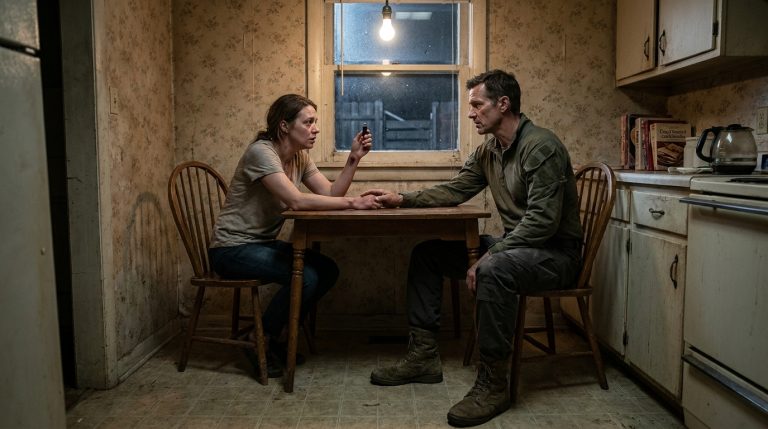
I walked to the front door, the wood cool beneath my palm, and entered the house. It was quiet—that specific, settled silence of a place that had long since stopped expecting visitors. I went to the kitchen, the linoleum cold against my boots, and set the percolator on the stove. The ritual was automatic. The sound of the flame igniting, the steady, rhythmic glug-glug of the coffee beginning to percolate—these were the sounds of a life built on maintenance, on the quiet, unnoticed labor of keeping things upright.
I sat at the table, my hands resting on the surface. I thought about the mill. The secret I had kept for thirty-five years—that we had been there, that we had failed to save the young man who died in the collapse, and that we had chosen silence because the truth felt like a betrayal of the life he had been trying to build—no longer felt like a prison. It felt like a stone I had finally set down.
A knock at the door broke the silence. I stood up, my movements slow, and opened it.
Thorne stood on the porch. He looked different—his suit was wrinkled, his tie loosened, and the sharp, defensive edge in his eyes had been replaced by a hollowed-out exhaustion. He looked like a man who had spent the night walking through the wreckage of his own life.
“I went back,” he said, his voice barely a rasp. “I went to the mill site. I spent the night there. I read the rest of the ledger.”
I opened the door wider, a silent invitation. He stepped inside, moving with a tentative, hesitant gait, as if he weren’t sure the floor would hold him. He sat at the table, his gaze wandering around the room, taking in the frayed edges of the curtains, the faded photographs on the wall, the sheer, quiet ordinariness of my life.
“Why didn’t you just tell people?” he asked, looking at me. “If you were trying to help, why let everyone think you were… what you were?”
“Because the story wasn’t about us, Elias,” I said, pouring two cups of coffee. I set one in front of him, the steam rising in the cool air. “It was about the people who needed to be left alone to rebuild. If we had made it about our ‘good intentions,’ we would have been the center of the narrative. We would have taken the credit, and the focus would have shifted. People would have looked at us instead of looking at the work.”
He took a slow, thoughtful sip of the coffee. “My father was wrong,” he whispered.
“Your father was a man in pain,” I corrected. “And you spent thirty years trying to avenge a man who was already lost. You don’t have to carry that anymore. The demolition contract is gone. The firm pulled it at midnight. They called it ‘due to unforeseen administrative complications.'”
He looked at me, a small, weary smile touching his lips. “I told them I wouldn’t represent the project. I told them there was nothing there to build on.”
We sat in the silence for a long time, the morning light filling the room, turning the dust motes into tiny, suspended jewels. It wasn’t an apology, and it wasn’t a forgiveness, but it was a beginning.
Later, I walked out to the backyard, the grass damp with dew. I pulled a hammer and a handful of nails from my pocket. There was a section of the back fence that had been leaning for months, a small, neglected detail that had been waiting for my attention. I knelt down, the wood soft and yielding beneath my hands, and began to work.
It was rhythmic, simple labor. Nail by nail, board by board, I secured the fence. My hands, which had once held a patch in place for decades, now focused on the immediate, tangible task of mending what was broken. I felt a sense of profound, quiet peace. The secret was gone. The truth was out. The neighborhood remained, a collection of homes held together by the quiet, stubborn persistence of those who lived there.
As I finished the last nail, I stood up and leaned against the fence, looking out over the alleyway. The valley was alive, the sound of a distant lawnmower, the barking of a dog, the everyday symphony of a life that continued, regardless of the shadows we had once lived in. I was an old man, my back was tired, and my time was short. But for the first time in thirty-five years, I wasn’t just a shadow. I was here. I was standing in the light. And that, I realized, was enough.