The Silhouette of Echoes: A Legacy Forged in the Quiet Space Between Supersonic Rounds
CHAPTER 1: THE SILENCE OF THE PARTS
The oil-stained towel spread across the maintenance bench was fraying at the edges, its green threads pulling apart under the weight of thirty pounds of parked American steel. Forward Operating Base Atlas didn’t sleep; it merely exhaled its heat into the dark. Through the high, unglazed vents of the armory, the Hindu Kush mountains were nothing but jagged tears against an orange-bled horizon, waiting for the sky to hit a hundred degrees before the morning chow lines closed.
I didn’t need the overhead fluorescent to see the gas piston. My thumbs knew the microscopic burrs on the metal, the slight ridge where the Parkerized coating had worn down to grey, naked steel from hundreds of recycles in the grit of the Sangan Valley. It was 0445 hours. The metal was cold, holding the late-night chill of the desert floor, but my palms left warm, fleeting fog patches on the receiver every time I shifted my grip.
“How long you been working with the Barrett?”
The voice didn’t startle me. I’ve lived inside the sound of boots on concrete long enough to separate the heavy, dragging heel of a senior non-com from the skittish stride of a short-timer. Master Sergeant Grayson Thorne stood at the edge of the bench, his shadow long and blocky under the dim yellow security light. His face looked like the maps pinned in the tactical operations center—deeply scored, dry, and grayed at the margins.
“Four years,” I said. My voice was flat, keeping the Texas from leaking through the enunciation. I didn’t look up. I didn’t need to. The firing pin assembly required a three-pound squeeze to seat correctly into the bolt sleeve, a small click that had to be felt through the meat of the thumb rather than heard. “Started on the M24 system in basic sniper school. Moved up to the M2010. Got certified on this beauty about six months before deployment.”
“You move like you’re playing an instrument, Captain.” Thorne stepped closer, the smell of burnt chicory coffee and old canvas moving with him. He picked up a disassembled spring from the oil-stained towel, turning it over between two scarred fingers. “Most Marine designated marksmen don’t grease the tracking rails that thin. The book says three drops of CLP.”
“The book doesn’t account for the dust out of Kajaki,” I murmured, my index finger tracing the geometric line of the trigger group before dropping it into the lower housing. Metal slid into metal with a perfect, friction-free hiss. “Three drops of CLP turns into grinding compound after forty minutes on a ridge. One drop, rubbed till the steel looks damp. That’s how you keep the tolerances from locking when the receiver gets hot enough to blister your cheek.”
Thorne didn’t argue. He set the spring back exactly where it belonged in the sequence, his eyes lingering on my hands. I could feel his inspection—not the look of a man checking a subordinate’s kit, but the heavy, calculating stare of an old instructor looking for the small, structural fractures in a replacement part. He was reading my tells, looking at the tightness of my hair bun, the way my uniform sleeves were turned back twice to mid-forearm, showing the corded muscle that didn’t belong on a five-foot-three frame.
I picked up the upper receiver, aligning the lugs. Behind us, the heavy iron door of the maintenance bay rattled, its hinges dry and complaining as it swung back against the concrete wall.
“Morning, Captain Blackwood,” Corporal Bryce Ashford called out, his grin audible before his boots even cleared the threshold. He walked with that wide, easy swing of a nineteen-year-old who still thought a plate carrier made him bulletproof. “Still playing with that big gun of yours? Maybe you ought to leave the long-range work to the boys today, ma’am. We’ve got actual miles on the road out here.”
My hands didn’t stop. The barrel assembly clicked into the receiver pins, but the metal felt suddenly heavier, the cold of the steel settling into my knuckles like old frost. In the corner of the towel, sitting in a small plastic tray, were two ancient brass casings, their heads stamped with the initials EB. Under the yellow light, the thin, dark lines running up from their rims looked less like scratches and more like deep, unresolvable splits.
CHAPTER 2: THE TULSA BRAVADO
The iron door hit the concrete wall with a hollow, vibrating thud that traveled straight through the floorboards and into the soles of my boots. Corporal Bryce Ashford didn’t wait for an invitation. He stepped into the yellow radius of the security light, his chest puffed against the rigid nylon straps of his plate carrier, a wide, unearned grin splitting his scrubbed Oklahoma features. The smell of cold grease and cheap mint gum cut through the heavy, oil-choked stillness of the bay.
“Got to keep it clean,” I said. My voice didn’t rise. It stayed inside the low, rhythmic hum of the base generator outside, flat and transactional. I didn’t lift my chin from the receiver lugs. My fingers went down to the small plastic tray, seeking the retaining pins by touch alone, feeling the tiny, microscopic burrs along the edge of the metal. “Never know when you might need to reach out and touch someone.”
Bryce let out a sharp, dry bark that wasn’t quite a laugh. It had a jagged edge to it, the kind of noise young men make when they are trying to crowd the silence out of a small room. He leaned his shoulder against the gun rack, his fingers tapping a restless, irregular beat against the wooden stock of a stowed M4. “Yeah, well, maybe next time leave the long-range work to the boys, ma’am. We’ve got actual experience with this stuff. Real miles on the road, not just range cards and ballistic spreadsheets in the air conditioning.”
The maintenance bay went dead. It wasn’t the comfortable, productive silence of two operators working the same piece of iron; it was the dense, curdled weight that settles into the dirt right before a thunderstorm breaks or a tripwire gives way under a heel. Across the bench, Master Sergeant Grayson Thorne didn’t move. His hand remained hooked into his rig, his fingers frozen over a worn canvas pouch, his deep-set eyes drifting from Bryce’s face down to the grease-blackened towel between us. I could see the tiny muscle at the corner of Thorne’s jaw flex once, a hard, geometric knot under the graying stubble.
I picked up the bolt carrier group again, the cold gray steel heavy against my palms. The faded texture of the green cloth beneath it was rough, the threads pulling free where the bolt’s sharp tail had chewed through the weave.
“Experience,” I repeated. I let the syllables hang in the close air, testing the grain of the word like it was a bad batch of propellant. I looked up then, letting my gaze settle right between the corporal’s eyes—clear, unblinking, the kind of focus that comes from hours of squeezing the world down into a twelve-mil red dot. “That’s an interesting perspective, Corporal.”
Bryce’s grin didn’t vanish, but it thinned out at the corners. He shifted his weight from his left heel to his right, his boots scraping against the grit on the floor. The bravado was still there, but it was sitting on uncertain ground now, his shoulders squaring slightly as if he felt the cold draft coming off the Hindu Kush through the vents. “Just saying, ma’am. Sangan isn’t Fort Benning. The dirt moves different when they’re clicking at you.”
“Noted,” I said, dropping my eyes back to the receiver block. Click. Click. The guide springs went in, their coils compressing under my thumbs with a uniform, fluid resistance. I could feel the tiny scrape of carbon score on the interior wall, a ghost of yesterday’s test fire that needed to be worked out with an oily patch before the noon heat hit.
Bryce turned his head toward Thorne, his eyes hunting for something familiar, that simple, unwritten understanding that usually exists between men who have shared the same dirt and the same basic rations. He cleared his throat, his hand dropping from the gun rack to hook into his belt loop. “Master Sergeant, you know how it is out in the draws. Conventional support can only do so much when the ridge lines start talking small arms.”
Thorne didn’t look up to meet the boy’s eyes. He didn’t offer the solidarity Bryce was angling for. He stood there like a block of weathered granite, his chest broad under his salt-stained utility shirt, his face completely empty of expression. When he spoke, his voice didn’t have any heat in it—just the massive, crushing momentum of thirty years of high-angle commands.
“Corporal Ashford.”
Bryce straightened automatically, his chin coming up an inch as his heels clicked closer together on the concrete. “Master Sergeant.”
“How many confirmed kills do you have?” Thorne asked. The question was clean. It didn’t have any judgment attached to it, no anger, just the dry metric of an audit.
“Seven, Master Sergeant,” Bryce said, the pride leaking back into his chest, lifting his shoulders. “Three separate engagements in the Sangen district. All verified by my platoon leader and the S-2 shop. Good hits, sir.”
“Good hits,” Thorne echoed, nodding once, very slowly. His large hand came down on the edge of the maintenance bench, the scarred skin of his knuckles white against the dark wood. “Combat is combat. A round downrange is a round downrange.”
He turned his head then, the yellow light catching the deep lines around his eyes as he looked across the table at me. The silence came back, heavier this time, filling the corners of the bay until the rhythmic clicking of the cooling Humvee engines outside sounded like a countdown.
“Captain Blackwood,” Thorne said, his tone dropping into that lower register used for reading logbooks and casualty manifests. “How many confirmed kills?”
My fingers went still against the receiver pins. The steel was warming up now, absorbing the heat from my skin, but inside my chest, everything stayed down near freezing. I didn’t look at Bryce. I looked at the little plastic tray where my father’s initials were stamped into the old, fractured brass. The memory of the March wind in 2010 came back, tasting like copper and dry shale, six seconds of flight time summarized by three observers who didn’t even know my name.
“I don’t discuss numbers, Master Sergeant,” I said. My voice was small, but it was firm, the words coming out single and distinct like spent casings hitting a canvas drop-cloth.
Bryce let out a small, wet breath through his teeth, his grin starting to creep back onto his face. He looked at Thorne, his eyes bright with the quick, easy victory of a young man who thinks silence means an empty ledger. “See? Probably hasn’t even—”
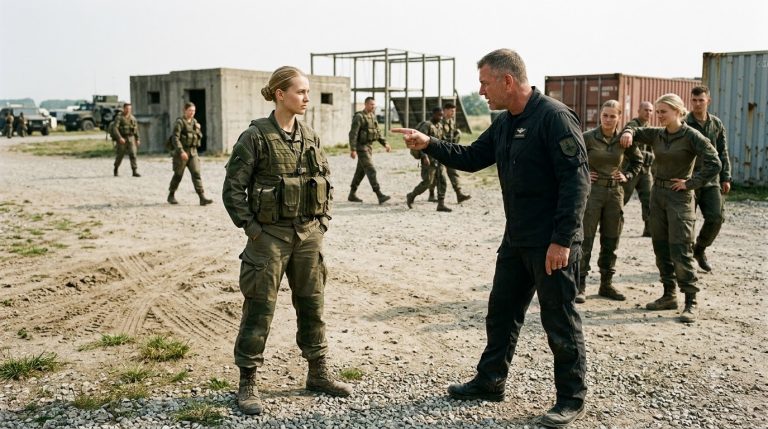
“She’s got more confirmed kills than your entire platoon combined, Corporal,” Thorne cut him off. His voice didn’t rise, but it had the flat, lethal edge of a cold blade sliding between ribs. “Now get out of my maintenance bay.”
The boy’s face went white before the red flooded up from his collar. His mouth came open, a small, choked sound caught in his throat, then it snapped shut again. He looked at me, his eyes wide and unfocused, as if he were trying to reconcile the five-foot-three frame and the neat hair bun with the weight of the number Thorne had just dropped into the grease between us. I didn’t give him anything back. I picked up the cleaning rod, threaded a fresh white patch through the eyelet, and pushed it into the breech, watching the clean cotton disappear into the dark line of the bore.
Bryce didn’t say another word. He turned on his heel, his heavy combat boots slamming against the floor as he headed for the exit. The iron door caught the frame with a shattering clang that echoed through the storage rafters long after the sound of his stride had died out in the gravel of the motor pool.
The bay settled back into its old rhythm—the drone of the generator, the dry heat rising through the vents, the smell of sulfur and CLP. I pulled the cleaning rod back out. The patch came out gray, stained with the greasy carbon of an old war that wouldn’t clear out of the metal no matter how many times I worked the bore.
“Why didn’t you shut him down yourself?” Thorne asked quietly, his stool creaking as he shifted his bulk.
I didn’t stop the rod. I took another patch from the tin, the white fabric soft and clean against my oil-stained fingertips. “Proving myself to people like him wastes energy I need for the work, Master Sergeant. Besides, he’ll figure it out eventually, or he won’t. Either way, it doesn’t change what I can do when the glass goes clear.”
CHAPTER 3: THE CRACKLE OF THE WIRE
The patch came away from the crown of the muzzle, gray and slick with the embedded soot of dead operations, just as the overhead horn speaker tore the remaining stillness to shreds. It wasn’t the standard morning perimeter alert. The tone was thin, frayed by bad signal strength and high-frequency distortion, an aggressive, rhythmic buzzing that made the wooden frame of the workbench click against the concrete floor.
“All units, Atlas TOC, we have troops in contact,” the watch officer’s voice cut through the electronic fog. The enunciation was too clipped, the vowels dry and short, a sign of a man whose throat had gone sand-dry in the space of three breaths. “Eagle Six convoy is pinned in the draw, three kilometers south of checkpoint alpha. Multiple casualties reported. Requesting immediate long-range asset routing. This is not a drill.”
Thorne moved before the horn finished its cycle. His heavy frame swung off the wooden stool with a calculated, silent momentum that didn’t look like fifty-five years of joint damage. His calloused fingers snapped around the handle of his spotting case, the green canvas fabric stiff and pale under the low-wattage bulbs.
“That’s Webb’s column,” he said, his voice dropping an octave into the gray gravel of a command tone. He didn’t look back at me. He didn’t need to check if the receiver was pinned to the stock; he had heard the locking screws seat. “They went out with three unarmored utility trucks at 0330. They’re sitting ducks if someone has the high ground in that gully.”
I slid the heavy forty-three-inch barrel into the fitted recess of the tactical drag bag, the zipper teeth biting together with a long, metallic scrape that sounded like teeth on bone. My fingertips were still cold from the carbon grease, but the small plastic tray containing my father’s initials—EB—stamped into the split brass was already tucked into the internal pocket of my plate carrier, resting right over the breastbone like an old coin.
We didn’t run through the motor pool. Running in the open invitation of a base common area creates the kind of panic that short-timers feed on. We crossed the hard-packed shale between the armory and the tactical operations bunker in seven-foot strides, our boots kicking up small, dry puffs of white alkaline dust that settled back onto the fraying cuffs of our trousers before we reached the blast door.
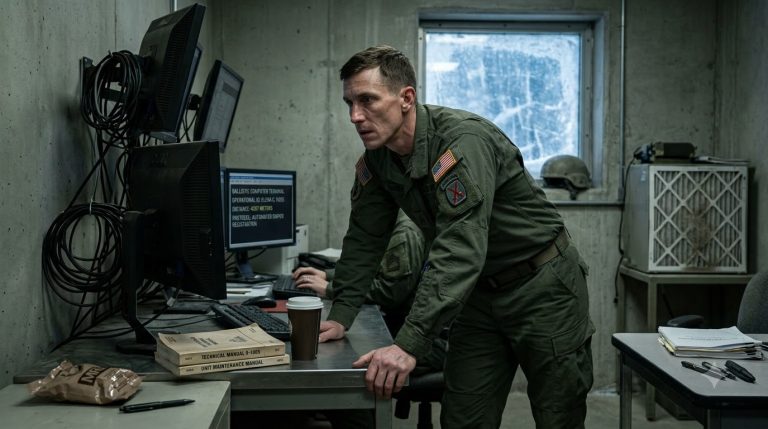
The air inside the TOC was different. It didn’t hold the smell of burnt chicory or old iron; it was cold, pressurized, and reeked of static electricity and the ozone coming off twelve banks of flat-screen displays. Intelligence officers were grouped around the central mapping table like birds over a carcass, their headsets giving off a tiny, collective insect chatter of radio traffic.
Colonel William Hayes stood at the head of the long table, his palms flat on the aluminum bezel of the primary satellite monitor. His posture was rigid, straight as an artillery cleaning rod, the silver star on his soft cap catching the white light of the digital terrain model.
“We don’t have fifteen minutes for the Apaches, Captain,” Hayes said, his eyes tracking up as the heavy steel seal of the bunker door groaned behind us. He didn’t offer a greeting. He simply pointed a blunt, grease-smudged finger at a section of the digital projection where the yellow topographic rings collapsed into a narrow, black V. “Webb’s lead vehicle took an unguided rocket through the engine block. They’re locked in the bottom of the shelf. Someone has three medium positions established along the northern lip, nine hundred meters out. They’re using the natural granite shelves for defilade fire. Standard infantry optics can’t even resolve the flash patterns through the noon mirage.”
I stepped up to the edge of the display, the cold air from the ceiling vents hitting the damp skin behind my ears. The mapping software was refreshing every three seconds, a pale green grid line sweeping across the black shadows of the ridge face. Through the background crackle of the main command loop, I could hear the rhythmic, heavy thump of a PKM machine gun—not the close, dry snap of a firefight, but the slow, hollow thudding of an unhurried operator firing from a position of absolute safety.
“The angle is the problem, sir,” I murmured, my thumb moving across the rubber edge of the display frame, tracing the elevation lines where the yellow numbers climbed into the high shelf. “Direct fire from the valley floor will just bounce off the overhang. If we deploy the heavy barrels from the southern knob, we’re shooting up through four layers of thermal cross-drift. The wind coming off the salt flats will belly the round thirty feet before it clears the half-mile mark.”
“Can you stabilize the trajectory?” Hayes looked at me, his gaze flat and measuring, the gray skin around his temples tightening as another burst of static-choked screaming broke through the speaker behind his shoulder.
“I can stabilize the weapon, sir,” I said, my fingers tightening on the nylon strap of the drag bag until the weave dug into my palm. “The air is something else. We’ll have to take the high perch on the spine. It means eight hundred yards of open shale to the lip, and we’ll be shooting with the sun coming over our right shoulders.”
Thorne stepped into the light of the map, his weathered face dark against the green glare of the satellite overlay. “The Humvee can get us to the base of the knob in twelve minutes, Colonel. But the trail terminates at the dry creek bed. After that, it’s a vertical crawl. If Blackwood is going to clear those shelves before Webb’s second squad runs out of ammunition, we need to be on the glass before the mirage starts to boil.”
Hayes didn’t look at the intelligence analysts behind him. He reached down, turned the volume knob on the tactical receiver until the sound of the incoming fire died down to a low, rhythmic vibration in the metal floorboards.
“Go,” he said. The word was short, heavy, and completely empty of options. “The mission is discrete. If you don’t break that machine gun within five minutes of setup, the convoy doesn’t come back.”
I didn’t look at the monitors again. I slung the bag over my left shoulder, the bulk of the Barrett resting against my kidney, and followed Thorne out through the pressurized seal of the blast door. The heat of the morning was waiting for us on the outer steps, thirty degrees higher than it had been when we went in, a thick, white wall of dust and sun that tasted of nothing but salt and old stone.
CHAPTER 4: CLIMBING THE SPINE
The transition out of the tactical operations bunker felt like slamming into a solid sheet of unyielding zinc. The midday glare didn’t merely light the valley; it dissolved the gray-green canvas hoods of the parked trucks into a blinding, featureless white. Behind me, the blast door’s hydraulic seal gave one final, low hiss, locking the cold air away inside the mountain, leaving only the smell of ozone and sulfur to burn out of my nostrils.
“Keep your spacing,” Thorne muttered, his boots grinding into the white alkaline dust as he headed toward the idling Humvee. The vehicle was vibrating against the dry shale, its tailpipe puffing out thin, bluish plumes of diesel smoke that flattened instantly under the weight of the air.
I hauled the heavy drag bag into the rear footwell, the coarse weave of the fabric catching on the raw metal edge of the door frame. My plate carrier creaked as I climbed in beside it, the hard ceramic inserts pressing into my ribs with every uneven bounce as the driver dropped the transmission into gear. We didn’t speak while the truck tore along the dry bed of the wash. The heat was a physical presence in the cabin, a thick, stagnant layer that turned the sweat on my forearms into a sticky, oil-filmed glaze before we even cleared the base wire.
Twelve minutes later, the Humvee’s brake pads squealed as the tires found the soft, collapsing sand at the base of the ridge. The driver didn’t look back; he simply held his hand up, fingers spread, counting down the seconds before he would have to pull the vehicle out of the open basin to keep the radiator from popping.
“This is the end of the line, Captain,” Thorne said. He dragged his long torso out of the passenger side, his knuckles catching on the frayed edge of the dashboard fabric. He already had his spotting gear slung high across his chest, the olive-drab strap cutting deep into his salt-scoured uniform collar.
The spine of the ridge rose straight up from the sand, an ancient, crumbling staircase of dark granite and fractured shale that looked completely desaturated under the direct sun. I hoisted the thirty-pound drag bag onto my shoulder, the nylon webbing biting through my shirt into the raw skin over my collarbone. Every step up the incline was an exercise in calculated friction. The stone wasn’t stable; it broke apart in small, dry clicks under our soles, sending streams of gray grit rattling down into the dry wash below us.
My lungs felt like they were drawing down wood smoke. At fifty-five, Thorne should have been lagging, his knees locking up on the steep pitches, but he moved with a rhythmic, mechanical stability, his large hand reaching out occasionally to steady his bulk against the sun-baked granite walls of the draw. He didn’t use the path; he used the shadows, shifting his frame from one narrow strip of dark stone to the next with the practiced economy of an operator who had spent half his life avoiding high-angle observation.
“Hold here,” Thorne whispered, his hand coming back to touch my knee as we reached a narrow shelf three-quarters of the way up the spine. He was breathing through his nose, his chest rising and falling in long, controlled counts.
A sudden, violent change in the air hit us before we could clear the next ledge. It wasn’t the steady, predictable draw of the valley wind; it was a hot, twisting thermoconvective shear that came roaring down off the high peaks of the Hindu Kush, whistling through the rock fissures like steam out of a pipe. The dust it carried was fine as flour, stinging the corners of my eyes and leaving a dry, metallic film across the rubber objective covers of my optic.
I dropped my frame flat against the gray shale, the small plastic tray in my breast pocket pressing hard against my collarbone. “The shear is coming from seventy degrees off the line, Master Sergeant,” I muttered, my fingers reaching up to clean the grit from the rim of the elevation turret. “It’s boiling off the upper face. If it holds like this when we reach the lip, the mid-range drift isn’t thirty feet—it’s closer to forty-five.”
Thorne pulled his pocket weather meter from his pouch, the frayed lanyard twisting around his thumb in the wind. He stared down at the tiny LCD screen, his eyes narrowing as the numbers shifted erratically. “It’s peaking at eighteen miles an hour up here, Elara. And it’s not consistent. It’s pulsing every four seconds as the heat hits the granite shelves below Webb’s trucks.”
He looked back down the draw. Through the white glare of the mirage, we could still hear the slow, rhythmic thud-thud-thud of the enemy machine gun, an unhurried, mechanical execution that meant the convoy was still trapped, still pinned behind the burning wreckage of their lead vehicle. Every second we spent recalculating the wind on the slope was another seventy rounds of heavy ammunition chewing through the thin sheet-metal doors of the utility trucks.
“We have to go manual on the lead,” I said, my palms flat against the crumbling stone as I pushed my torso upward into the dust. “The computer won’t resolve a pulsing shear across three different elevation bands. We’ll have to feel the drift through the glass.”
Thorne tucked the meter away, his face turning back to the dark line of the ridge crest. “Then let’s get to the edge. The sun’s already moving over our shoulders, and once the light hits the valley floor, the refraction is going to look like soup.”
We crawled the final forty yards on our bellies, the coarse granite grit tearing at the fabric of our knee pads, our fingers digging into the narrow cracks of the bedrock to pull our weight against the pulsing wind. When my eyes cleared the top lip of the stone, the Sangan Valley opened out below us—a vast, white-hot kiln where nothing moved but the black smoke rising from Webb’s vanguard.
CHAPTER 5: THE RICOCHET EQUATION
The white-hot bowl of the valley floor did not feature distinct landmarks through the glass; it dissolved into an active, shifting distortion. Pushing my torso flat against the loose granite lip, I cleared the objective lens with the edge of my sleeve, feeling the hot, uneven grit of the rock shelf catch against the skin of my chin. Beside me, Thorne was already down, his elbows dug into a shallow groove in the gray stone, the pale green aluminum casing of his spotting scope resting steady against his cheekbone.
“Range to primary flash is nine hundred twenty-seven meters,” Thorne murmured, his voice tight, stripped of everything but the metric. His thumb remained hooked over the focus wheel, his skin gray with alkaline dust. “Wind at the shelf is four to six miles an hour southwest, but the center basin is boiling. The thermal current is lifting the mirage six feet out of the draw. You have to drop the reticle below the target’s boots if you want the copper to find his chest.”
I unzipped the heavy canvas pocket of the drag bag, pulling the thirty-pound frame of the Barrett across the shale until the bipod legs locked into the shallow fissures of the bedrock with two dry, mechanical clicks. The metal of the receiver was already drinking the sun, growing hot enough to sting the palm, but the small white patch inside the bore was done. I slid my cheek down against the nylon riser, my eye meeting the clear, cold circle of the glass.
Through the magnification, the trapped unarmored utility trucks looked like crushed green tin cans scattered along a dry creek bed. A dark plume of diesel smoke was rolling sluggishly off the lead vehicle, its thick, oily rings distorting the air so heavily that the red line of the ridge behind it seemed to bend like wire. On the opposite lip, partially hidden behind a reinforced sandbag barrier, the black barrel of the PKM machine gun was still pulsing, sending small, distinct rings of white dust out into the glare with every three-round burst.
“I have visual on the gunner,” I said, my breathing dropping down into the four-count cadence, four beats in through the dry nose, four beats out across the cracked lips. “He’s tucked behind the granite overhang. Standard direct trajectory won’t clear the angle. If I fire high enough to drop the round over the sandbags, the wind shear at the crest will catch the tail and slide it into the basin.”
Thorne didn’t look up from his eyepiece. His calloused fingers adjusted the rangefinder, the small red laser indicator on his display clicking as it measured the density of the thermal layers between our perch and the target wall. “There’s an exposed granite face six inches to the left of his shield, Elara. It’s an old shear line, completely vertical, no moss, no loose shale. If the copper hits that surface at twenty-eight hundred feet per second, the fragmentation loop will spray the entire defilade pocket.”
“The ricochet calculation is messy through this mirage, Master Sergeant,” I whispered. My index finger slid inside the trigger guard, finding the flat, cold face of the iron pad. The contact was rough, the grit from the ridge having migrated into the internal springs during our crawl. “The angle of incidence is less than twelve degrees. If the jacket strips too early on the granite, the core will tumble into the rock face and drop like a stone.”
“Webb doesn’t have sixty seconds for a standard wind check,” Thorne said, his voice entirely flat, a rigid ledger of the reality below us. “The second truck’s rear axle is gone. They’re climbing out into the open dirt now. Take the rock face or watch them bleed on the gravel.”
My body went completely still, the muscle memory from Task Force Nightfall reasserting itself across my shoulders like an old coat. The world inside the scope narrowed down from a wide valley to a single, four-inch strip of gray granite that looked completely desaturated under the high sun. I didn’t think about the nine hundred yards of empty air; I thought about the pressure on the pad—four and a half pounds of vertical resistance that had to be met with uniform, micro-granular pressure.
I exhaled halfway, holding the breath in the natural respiratory pause, letting my pulse drop below fifty beats until the red crosshair stopped its tiny, upward dance against the stone.
The Barrett spoke.
The muzzle blast kicked up a semicircular wave of white dust from the lip of our hide, the heavy sound slamming back into my chest like a physical blow from an open palm. The supersonic round took roughly 1.3 seconds to cross the empty draw, a long, invisible arc through three layers of twisting thermal current. Through the glass, I didn’t see the bullet; I saw the instantaneous, white spark where the copper-jacketed projectile struck the vertical granite face six inches to the left of the barrier.
The stone exploded. A dense, gray cloud of pulverized rock and bullet jacket sprayed outward into the defilade pocket at supersonic speed, a jagged fan of shrapnel that tore through the canvas screen behind the gunner’s seat. The PKM went silent, its barrel tilting toward the sky as the operator lurched backward out of the cleft, his hands clawing at the shredded front of his utility shirt.
“Hit,” Thorne confirmed, his voice a brief vibration in the dust beside me. “Target is out of the pocket. Spotter is moving behind the secondary truck cab, eight hundred eighty-five meters, moving left to right at two miles an hour. He’s trying to salvage the ammunition boxes.”
My hands worked the heavy bolt carrier without instruction, the spent brass casing flying free with a hot, rhythmic clink that sounded distinct against the stone. A fresh round slid into the chamber, the steel lugs locking down with that same familiar hiss I had cultivated in the pre-dawn silence of the armory.
“I have the spotter,” I murmured, my eye tracking the small, dark silhouette through the shimmering waves of the mirage. “He’s leading the reticle by two widths. Firing.”
The rifle cracked again, the recoil digging the rubber butt-pad deep into the meat of my right shoulder until the bone throbbed. Through the scope, the rear window of the truck cab disintegrated into a white sheet of frosted glass, the dark form on the other side collapsing forward across the steering wheel before the sound of the blast could even reach the draw.
“Two down,” Thorne said, his hand reaching out to adjust the tripod legs as a new wind pulse shook the crest. “But don’t settle, Elara. There’s a third target on a moving frame—thirteen hundred yards out, accelerating across the shale on a motorcycle. He’s got the tactical radio on his hip. If he gets over that northern ridge line, he’ll have three more squads on Webb’s flank before the Apaches can clear the tarmac.”
I didn’t adjust the elevation turret. I simply lifted the crosshairs into the empty air above the rider’s head, aiming thirty-four feet into the white glare where the wind hadn’t yet begun to twist.
CHAPTER 6: THE NIGHTFALL DOSSIER
The heat from the barrel was still ticking when we cleared the outer perimeter wire, the long forty-three-inch chassis of the Barrett wrapped in its coarse canvas sheath. It took forty-four minutes of downward grinding through the loose granite shale to return to the sea-level pressure of the motor pool, my calves tight, the dry salt from my collarbone flaking off against the inner straps of my plate carrier. We didn’t slow our pace for the common lines. Thorne kept his massive shoulder angled forward, his heavy web belt clinking against his canteen cover with a slow, predictable rhythm that cleared a five-foot lane through the off-duty mechanics.
“Straight to the back room,” Thorne muttered, his thumb tracing the worn edge of his spotting case strap as he nodded toward the low, concrete archway of the tactical operations bunker. The gray paint on the entrance was chipping, exposing the pitted iron reinforcement bars beneath it to the salt air.
The blast door groaned as it accepted our weight, the pressurized seal closing behind us with a heavy, localized thump that cut the sound of the base generators down to a quiet vibration under our boots. Inside, the light shifted from the raw, unshaded white of the desert to the desaturated blue glare of the primary intelligence consoles. Colonel William Hayes was already waiting in the small briefing alcove behind the mapping tables, his sleeves turned up to mid-forearm, a folder marked with three thick, red classification blocks resting between his broad palms.
“Sit, Captain,” Hayes said, his tone flat, dropping into the room like a heavy ledger. He didn’t look up at the screen where the live feed of Webb’s column was showing the three utility trucks safely turning into the secondary checkpoint. “The S-2 shop just finished the electronic review of the Sangan grid. The third round—the motorcycle engagement at thirteen hundred yards—just cleared the formal validation loop. It’s a confirmed metric.”
I unhooked the side buckles of my plate carrier, letting the heavy ceramic tiles shift an inch from my chest so I could breathe the cold, stale air of the bunker. The fabric beneath the vest was damp, holding the coarse texture of the sand we had crawled through. I didn’t reach for the plastic tray on the table; I kept my hands flat on my knees, my skin still carrying the faint smell of burned CLP and gray carbon grease.
“The wind held at eighteen on the crest, sir,” I murmured, my voice small but steady in the quiet room. “The mirage was boiling off the shale, but the cross-drift thinned out once the round cleared the mid-basin shelf. It was a standard manual calculation.”
“This wasn’t a standard calculation, Blackwood,” Hayes said, his fingers sliding the top folder over the zinc surface of the table until the edge touched the canvas sleeve of my drag bag. “And this isn’t a standard designated marksman service record. I’ve spent the last three hours on a secure link with the Special Access Program repository at Fort Meade. Your file doesn’t have an empty eighteen-month window because of a clerical error. It’s sanitized under the Task Force Nightfall ledger.”
The room went completely still, the unique silence of a buried secret filling the corners of the alcove until the hum of the hard drives behind the partition sounded like a countdown. Beside me, Thorne didn’t move a muscle, his large hands resting flat against his trousers, his deep-set eyes locked on the red classification stamps as if he were measuring the depth of the ink.
“Task Force Nightfall was a discrete asset routing program, Colonel,” I said, my voice dropping an octave, the words coming out single and dry like brass casing hitting a rubber mat. “The parameters of that deployment are locked under a permanent nondisclosure directive. I am not authorized to detail the operational metrics.”
“I don’t need you to detail the metrics, Captain,” Hayes said, his thumb flipping the first page over to reveal a grainy, high-contrast drone photograph of a target courtyard in the Helmand interior. “I have the metrics right here. Forty-seven engagements over an eighteen-month cycle. Thirty-two of them verified beyond the fifteen-hundred-meter mark. And a final entry dated March 23rd, 2010, that lists a center-mass termination at thirty-two hundred and forty-seven meters.”
He paused, his gray eyes rising from the document to track the expression on my face. I didn’t give him anything back; I kept my gaze fixed on the lower border of the photograph, where a tiny, irregular static line in the digital header showed that the file had been pulled from an old, automated Soviet-era server routing system during the initial counter-sniper sweep.
“The target on that final entry was designated as the Surgeon,” Hayes continued, his tone slowing down, the words carrying the crushing weight of an old debt. “He was an advanced marksmanship instructor working the insurgent networks across three provinces. He was also the operator who pulled the trigger on Master Gunnery Sergeant Everett Blackwood through an armored viewport in 2009. Your father.”
“The tactical situation required lethal force, sir,” I whispered, the skin around my knuckles turning white as my fingers tightened against my uniform cloth. The memory of the cold March wind came back, tasting of salt and dry stone, the heavy steel receiver of my old rifle kicking against my cheekbone before the observers could even confirm the range card. “The distance was extreme, but the target was stationary.”
“The report says you had a direct capture order from the agency team on the ground,” Hayes said, his palm coming down flat over the drone image, covering the courtyard with his large, scarred hand. “They wanted him alive for interrogation regarding the Spetsnaz training protocols he was using. You took the head shot anyway.”
“It was center mass, sir,” I corrected him, my chin coming up an inch as the internal logic of the work reasserted itself. “At two miles, a limb shot has a high probability of total misses due to mid-range vertical deviation. I took the highest percentage opening available to protect the observation team on the reverse slope.”
Hayes leaned back in his steel chair, the metal frame creaking against the concrete floor. He looked at Thorne, then back at me, his face completely empty of anger, holding only the long, melancholic understanding of an officer who had seen too many good operators get eaten alive by their own history.
“The agency didn’t view it as a percentage calculation, Blackwood,” Hayes said softly, his fingers tapping a quiet, irregular beat against the closed folder. “They tagged you as operationally compromised. Revenge-motivated. They buried you in a conventional Marine battalion to keep your name off the grid and to ensure you wouldn’t have access to high-value targeting files again. They thought they were punishing you.”
He reached down, pulled a second, thinner document from the bottom of the stack, and slid it across the zinc. It didn’t have a red stamp; it had a single black line across the header, a fresh directive signed by the theater command three hours ago.
“But they were wrong about the utility of the asset,” Hayes said, his eyes narrowing as the blue glare of the console caught the silver star on his cap. “Dimitri Volkov just resurfaced in the Kajaki sector. The Chuvash sniper who trained the Surgeon. The man who designed the entire long-range tactical network that killed your father. The command needs an operator who can clear a four-thousand-meter window, Captain. And according to this ledger, you’re the only person inside this theater who has ever come close to that steel.”
CHAPTER 7: THE DATA OF DISCREPANCIES
The new directive felt cold and thin between my fingers, a single sheet of standard military bond that seemed out of place against the grease-stained canvas of my drag bag. I didn’t wait for Hayes to file the dossier back into his iron drawer. Hauling the weight of the rifle chassis onto my shoulder, I followed Thorne through the pressurized hatchway, our boots clicking a synchronized, rapid rhythm down the long concrete tunnel that led toward the open-air testing facility at the eastern margin of the base.
The heat was waiting for us like an unyielding block of iron at the tunnel’s exit. It was 1400 hours now, and the sun sat straight overhead, turning the white gravel of the long range into a flat, featureless sheet of salt glare that made the water in my eyes evaporate before I could blink.
“Set the blocks at thirty-five hundred,” Thorne said, his voice dropped to a gravelly murmur as he dropped his heavy spotter’s trunk onto the wooden bench. The wood was old, splintered by sun exposure and worn smooth at the corners where thousands of shooters had rested their elbows. “The base metrics only cover up to three thousand, Elara. Anything past that requires us to sight down the old service pipeline. The air over the buried iron pipes creates a secondary heat pocket that splits the vertical deviation by three inches every hundred meters.”
I knelt in the white dust, the coarse shale biting through my trousers into the skin of my knees. The barrel of the Barrett was still holding the dry heat of the Sangan crawl, but I didn’t use the automated torque wrench to reset the scope rings. Pushing my thumb against the anodized aluminum of the turrets, I felt for the physical clicks, counting each micro-movement until the internal reticle aligned with the zero mark we had established in the dark.
Through the clear circle of the scope, the thirty-five-hundred-meter silhouette looked small as a grain of rice, floating on a shifting sea of silver mirage. The air over the old pipeline wasn’t stable; it pulsed in wide, rhythmic ripples that made the square edges of the target plate look rounded, like stone worn down by river water.
“The computer is throwing an anomaly on the density altitude loop, Master Sergeant,” I muttered, my fingers adjusting the thin wire interface connecting my weather sensor to the cradle. “It’s pulling historical atmospheric data from an old partition instead of checking the live pressure. Every time I hit the calculation key, it drops the elevation recommendation by forty clicks.”
Thorne leaned over the spotting scope, his weathered skin crinkling as he pressed his eye against the rubber cup. He reached down to check the data stream on the backup terminal, his thumb rubbing a dark smudge of oil off the glass face. “The system isn’t reading the base weather array, Captain. It’s routing the ping through the old logistical server in the communications shack. The one they automated with the legacy routing code back during the initial stationing. The script is locked on a fixed loop.”
I stopped my hand on the turret. I didn’t look at Thorne, but my gaze stayed fixed on the small, flickering numbers on the terminal display. The cadence of the data transfer was wrong—it had a slow, irregular lag, an electronic hiccup every four seconds that looked identical to the static pattern I had noticed in the drone header back in the TOC alcove. It wasn’t a loose connection; it was a deep, underlying discrepancy in the way the base network was talking to our equipment.
“The server isn’t just old, Thorne,” I whispered, my voice flat, kept down below the whistle of the hot wind through the range wire. “It’s running a mirror routine. Every time our ballistic program updates the range card for a four-thousand-meter window, that partition logs the specific barrel profile and elevation vector into an unmonitored cache file.”
“Don’t dig into the software while we’re on the clock,” Thorne said, his voice taking on that heavy, instructional weight that allowed no shortcuts. He tapped the wood of the bench with his broad index finger. “The code won’t pull the trigger for you, and it won’t stop Volkov if he clears the ridge line tomorrow. We need five clean impacts on the steel before the sun drops behind the Kush, or Hayes won’t clear the flight manifest.”
I dragged my frame down behind the stock, the hard rubber pad finding the familiar groove in my right shoulder with a small, scraping crunch of uniform cloth. My breathing settled back into the four-count rhythm, the internal clock ticking down the seconds until my pulse fell away below the sound of the wind. The world inside the glass shrank down to that single, rice-grain silhouette floating in the boiling silver of the basin.
The rifle roared, the muzzle blast clearing a ten-foot circle of loose white gravel from the front of our bench. The sound didn’t clear out into the valley; it slammed back off the concrete retaining walls behind us, a sharp, metallic echo that made the iron pins in my lower jaw throb with the vibration.
“Miss,” Thorne called out, his eye still glued to the glass. “Six inches low, four inches right. The round hit the dry sand right at the base of the target plate. The thermal layer over that buried iron pipe just sucked the velocity out of the tail.”
I worked the heavy bolt without a word, the spent casing flying free to hit the white gravel with a bright, dry clink. My shoulder was already holding a deep, dull ache from the morning’s work, but I didn’t shift my posture. I adjusted the reticle by three manual clicks, ignoring the computer’s recommendations entirely, aiming into the empty white glare where the mirage seemed to break apart against the stone.
The second shot broke three seconds later, the blast tearing the air open with the same mechanical violence. Through the glass, I watched the invisible arc of the copper-jacketed round find the center of the steel plate, leaving a tiny, bright gray star where the paint disintegrated on impact.
“Hit,” Thorne said, his tone flat, dropping the metric into his ledger. “Center mass. Do it again.”
We stayed on the glass for four more hours, tracking the slow, downward slide of the sun until the orange light began to paint long, jagged silhouettes across the salt flats. By the time my fingers cleared the final pins on the receiver, twenty-four spent casings were scattered across the gravel behind us, their metal hot enough to scorch the loose threads of the cleaning towels. The number was there, the accuracy was climbing, but every time the terminal refreshed its data loop, that same four-second electronic lag ticked in the corner of the screen, a quiet, unresolvable whisper inside the machine.
CHAPTER 8: THE SHADOW ON THE BASE
The thin, metallic ticking of the twenty-four cooling casings in the range gravel was abruptly swallowed by the low, subterranean moan of the primary defensive horn. It wasn’t the rhythmic, broken pulse of an incoming mortar volley; it was a sustained, flat mechanical shriek that indicated a structural perimeter compromise. The orange light of the setting sun vanished instantly behind the thick steel shutters of the testing alcove, plunging the workspace into a dim, amber-tinted emergency reserve glare.
“Get the chassis packed,” Thorne said, his voice dropping into a tight, gravelly whisper that didn’t clear more than three inches from my ear hook. His heavy hand came down over the objective cap of the spotting scope, the pale green finish of the casing feeling cold and greasy against his calloused knuckles. “That’s a direct command circuit failure loop. They aren’t tracking external shell signatures; they’ve isolated an internal breach.”
I didn’t lift my frame from the dust. Dragging the heavy thirty-pound frame of the Barrett backward by its steel receiver lugs, I slid the weapon into the fitted groove of the canvas bag, the zipper teeth closing with a dry, jagged scrape. My palms were black with the granular residue of the testing rounds, the carbon score sticking to the fine lines of my skin like old ink. We didn’t move toward the main path; we crawled out through the rear maintenance egress, our boots dragging through the dry shale until we cleared the concrete support pillars of the range house.
The central corridor of the operations sector was an unbroken line of moving armor. Short-timers and logistical clerks were grouping at the intersection like livestock in a chute, their nylon vest straps clicking together in the narrow clearance. We broke through the line by force of momentum, Thorne’s broad shoulder acting as a wooden wedge against the mass of personnel until we reached the sub-level communications vault behind the primary server bank.
The blast door to the communications room was open three inches, its internal locking pins extended but unseated. Inside, the air was cold enough to freeze the breath, reeking of localized electrical heat and the bitter, sharp tang of fried insulation. Colonel William Hayes was standing over an exposed junction box at the back of the terminal island, his gray utility shirt dark with sweat between his shoulder blades.
“We have a shadow line on the transmission array, Master Sergeant,” Hayes said, his voice completely level, stripped of any volume but holding the absolute certainty of an iron spike. He didn’t look at us as our boots hit the zinc flooring; his fingers were deep inside the wiring trough, tracing a thin ribbon of oxidized copper that ran from the modern satellite modem down into an old, gray junction block bolted to the structural concrete. “It’s not an external hack. Someone uncoupled the old Soviet logistical link—the one left over from the seventy-nine garrison—and converted the legacy routing terminal into an open-ended transmitter loop.”
I stepped closer to the partition, my hand resting against the cold, rough concrete of the structural wall. The old terminal housing was covered in a thick layer of faded gray paint that had begun to pit and flake away at the margins, revealing the coarse Cyrillic stamps in the cast iron underneath. A small, secondary data cable was tapped into the terminal header, its green insulation frayed and dirty where it had been forced through a structural drainage crack.
“The four-second data lag we caught on the range, sir,” I murmured, my voice staying flat inside the hum of the cooling fans. “It wasn’t an atmospheric calculation error. Every time the ballistic computer verified our four-thousand-meter tracking parameters, this junction was broadcasting the specific elevation angles and initial velocity metrics directly out to the Kajaki sector. Volkov didn’t need to guess our approach trajectory; the base code was handing him our zero.”
“The link is active right now,” Thorne said, his long arm reaching past Hayes’s shoulder to point at a tiny, green diode blinking on the circuit board behind the iron plate. The light didn’t follow the standard operational rhythm; it had a fast, nervous cadence, a sharp stutter that showed it was unloading an archive file into an external receiver. “He’s pulling the deployment manifest for the morning insertion. He knows the exact helicopter routing and the coordinates of the perch on the ridge line.”
“Then the mission is dead before we hit the tarmac,” I said, my fingers tightening over the canvas strap of my drag bag until the nylon fibers bit into the meat of my palm.
“The mission goes forward as planned, Captain,” Hayes said, his gray eyes rising from the junction box to lock onto my chin with the unyielding weight of an officer who had already counted the cross-sheets. “But we change the delivery system. We don’t use the Blackhawk routing, and we don’t drop you at the base of the knob. If Volkov is tracking that old server loop, we feed him a ghost profile. We let the automated link send a false flight plan to the Kajaki receiver while you and Thorne take the low-altitude truck line through the salt flats in the dark.”
He reached down, took a set of heavy wire cutters from his web belt, and clamped the steel jaws over the ribbon cable. With a single, dry crunch of his wrists, the green insulation split, and the blinking light on the gray terminal block went black, leaving only the stale smell of dead copper to settle into the concrete floor.
“The mole is a problem for the counter-intelligence shop after we clear the theater,” Hayes muttered, his face completely empty of emotion as he slid the cutters back into his pouch. “But right now, Volkov thinks he has your geometry locked down. He’s going to be looking at the sky tomorrow morning, waiting for an insertion that isn’t coming. That’s the only six inches of clearance you’re going to get, Blackwood. Use it.”
CHAPTER 9: THE INITIALED CASING
The severed ends of the ribbon cable dropped into the darkness of the junction trough with a faint, rubbery click, leaving the communications room in an immediate, dead stillness. Colonel Hayes stood in the amber glare of the emergency backup array, his fingers still wrapped tightly around the handles of his wire cutters, his face cast in jagged lines of yellow shadow. Nobody spoke. The air in the vault remained freezing, but the scent of the freshly scorched insulation was already thickening, a sharp, bitter trail that stayed in the throat as I hoisted my drag bag and turned toward the low concrete corridor.
We didn’t take a vehicle to the prep area. To avoid triggering any tracking metrics on the computerized logistical logs, Thorne and I kept to the unmapped utility trenches, our boots crunching a steady, heavy pattern into the coarse gravel and sand beneath the floorboards. It took twenty minutes of low-amplitude walking to reach the small, forgotten annex behind the secondary armory—a concrete cube that smelled entirely of fossilized cosmoline, dry wood shavings, and the stale grease of old cleaning rods.
I set the thirty-pound canvas case down on an unpainted pine crate, the wood giving a sharp groan under the weight of the steel receiver. My fingertips were still dark from the carbon dust of the afternoon, the black soot worked deep into the fine lines around my cuticles. Pushing my hand inside the internal pocket of my utility shirt, I pulled out the small, clear plastic tray that held my father’s grandfathered ammunition.
“Don’t do it, Elara,” Thorne said, his voice coming out as a rough, low rumble from the dark corner of the annex where he was calibrating the hand-held laser rangefinder. He didn’t look up from the optical mirror he was wiping with a piece of frayed lint, but his shoulders were rigid beneath his salt-stained gear straps. “I looked at those casings under the magnifying lamp while you were clearing the range cards. The metal has reached its elastic boundary. Twenty-year-old brass from a Desert Storm deployment isn’t a sentimental token; it’s a localized pipe bomb waiting to split in your face.”
I picked up the first round, the sixty-eight-gram copper-jacketed projectile heavy and long between my index finger and thumb. The brass was dull, its original luster faded down to a dark, greenish-ochre hue from years of being carried in a canvas pocket through three separate combat zones. Under the yellow lens of the overhead utility light, the microscopic hairline fractures running up from the rim weren’t simple scratches. They were deep, dark splits in the metal matrix—veins of structural fatigue that went halfway through the casing wall.
“The headstamp is clean, Thorne,” I murmured, my thumb running over the coarse engraving where the initials EB were stamped into the metal face. The texture was rough, the metal burrs catching against the skin of my finger like a tiny brier. “My father calculated the throat erosion on his own reamer when he seated these primers. The seating depth is exactly two hundredths of an inch deeper than the standard issue stuff from the depot. It means the initial pressure spike drops by twelve percent before the copper hits the rifling bands.”
“And what happens when the gas gashes through those splits?” Thorne stepped out of the shadow, his large, weathered frame blocking the amber glare of the doorway. He pointed a broad, calloused finger at the base of the cartridge. “At four thousand meters, you’re running the chamber at maximum pressure. If the case head separates before the bolt lugs can unlock, the gas blowback will clear the receiver rails and drive the tracking tube straight into your right eye. You won’t get a second shot because you’ll be lying on the shale with a shattered skull.”
“The false flight manifest just cleared the tower, Captain,” Corporal Bryce Ashford’s voice cut through the iron frame of the door before his body could clear the threshold. He didn’t have his previous Tulsa grin; his face looked hard, scrubbed clean by seventy-two hours of waiting, his utility shirt buttoned tight to his throat. He held a manual manifest log between his palms, his knuckles white against the dark cardboard binder. “The Blackhawk routing file is active on the network. The automated loop is broadcasting the ghost coordinates toward Kajaki right now. The utility truck is parked behind the water tanks. No radio, no lights.”
I didn’t answer the boy. I slid the initialed round into the steel magazine housing, the heavy cartridge going down with a long, metallic clink that vibrated through the spring. The second round followed it, the flat face of its copper nose alignment resting perfectly against the forward guide ramp of the steel block. My hands were steady, holding no tremor, but inside my chest, the cold of the bunker felt like it had settled permanently into my collarbone.
“We’re using the old brass for the opener, Master Sergeant,” I said, my voice staying flat as I snapped the magazine floorplate home against the receiver lugs. A dry, solid double click echoed out into the annex. “The computer zero is compromised, and the base server is dead. If I have to feel the first four thousand meters through the glass without an automated correction loop, I want my father’s calculation in the throat. It’s the only part of the geometry that hasn’t been handled by a wire.”
Thorne stared at me for three long seconds, his gray eyes deep inside the shadow of his brow, reading the lack of compromise in my posture. He didn’t reach for the plastic tray; he simply picked up his spotting case, his fingers wrapping around the frayed canvas handle with a slow, heavy finality that left no room for secondary arguments.
“The road through the salt flats is completely unpaved, Captain,” Thorne said, his tone dropping back into the flat register of the command audit. “It’s four hours of low-gear grinding in the dark before we reach the foot of the knob. If you’re going to split that chamber, do it before the noon sun hits the courtyard. I don’t want to be dragging an operator with a missing face down that slope while Volkov’s squads are looking for the wreckage.”
I slung the drag bag across my shoulders, the weight of the steel plates and the grandpa brass resting heavy against my spine, and followed Thorne out through the annex door into the waiting dark of the motor pool.
CHAPTER 10: THE GEOMETRY OF THE COURTYARD
The unlit utility truck ground its teeth through the final wash, its low-gear transfer case vibrating against the floorboards until my ankles throbbed with the structural resonance. For four hours, we had navigated the pitch-black basin by the dim, green phosphorescence of Thorne’s handheld navigation screen, the vehicle’s headlights disconnected to keep our silhouette off the ridge lines. When the front tires finally wedged into the collapsing sand at the foot of the northern ridge, the silence that took the cabin felt like a physical blow.
“We have two hours before the noon window,” Thorne whispered, his breath a dry scrape against the dark frame of the passenger door. He rolled his bulk out onto the shale, the stiff canvas of his spotting kit clicking against the steel running board. “The wind is already gathering on the upper shelves, Elara. It’s dropping four degrees every twenty minutes as the basin heat bakes the lower flats.”
I hauled the thirty-pound drag bag from the rear deck, the coarse canvas fabric catching on the raw iron bolts of the seat frame. We didn’t use red flashlights; we climbed the vertical flint chimney by touch alone, our fingers finding the cold, razor-sharp edges of the mountain fissures to drag our gear up through the dark. Every three vertical yards required a full respiratory pause, my chest pressing hard against the gravel until the iron pins in my shoulder settled back into their sockets. By the time my chin cleared the top lip of the stone crest, the sky had shifted from a deep violet into a flat, desaturated white that made the edges of the mountains look like broken tin.
I deployed the heavy manual bipod legs into the loose flint, the steel spikes sinking three inches until they struck the solid bedrock beneath the dust. Pushing my right eye into the rubber cup of the scope, the forty-eight hundred and seven meters of empty air opened out before me like a dead sea. Through the glass, the distant compound didn’t look like a tactical stronghold; it was a small, square scar of baked mud walls floating in the gray ripple of the noon mirage.
“Range card is verified at four thousand eighty-seven meters,” Thorne murmured, his frame wedged into a narrow crevice two feet to my left, his pale green spotting optic resting steady against his cheekbone. “The wind at our perch is holding at twelve miles an hour northwest, Elara, but a sudden convective lift just kicked up a wall of crystalline salt dust across the mid-basin. The visibility in the low bowl is dropping by forty percent. The light is turning gray through the core.”
“I have the courtyard layout resolved,” I said, my voice staying flat as my thumb worked the knurled rim of the elevation dial. “The mirage is compressing the vertical rings. If I track the target by the standard reticle lines, the bullet will belly twenty-three feet low before the copper can even cross the outer wire. I’ll have to hold twenty-three feet into the empty sky above his head, and thirty-four feet into the blind glare to his left.”
“Movement at the central gate,” Thorne called out, his knuckles turning white over his focus ring. “Main portal is opening. Two fighters leading a single personnel asset. Hands bound behind his back with a heavy industrial chain. They’re driving a steel anchoring stake into the center of the dirt.”
Through the magnification, the details came through the silver soup of the mirage like faded oil colors. The prisoner was emaciated, his uniform utility shirt shredded at the shoulders, revealing the gray, bruised skin of his shoulder blades. He was dropped onto his knees in the dust, his head hanging low against his breastbone.
“Jesus, Elara,” Thorne’s breath caught, a sharp, cold rattle in his throat. “That’s Derek Ashford. He’s alive. They’re setting up a digital video camera on a tripod twenty feet from his shoulder. They aren’t waiting for a ransom loop; they’re going to execute him on the live link to break the command’s morale.”
My hand froze on the stock riser, the rough texture of the cheek-pad cold against my jawline. Inside the magazine house, the first grandpa round with my father’s initials—EB—sat waiting under the bolt face, its fractured brass casing holding fifty thousand pounds of chamber pressure behind a single copper nose. Volkov’s signature pattern was stamped across every inch of the display; he hadn’t left Derek alive as a gesture of mercy. He had left him as a living psychological anchor, an explicit bait trap designed to force any responding long-range team into a geometry where failure was absolute.
“The secondary target is on the balcony,” Thorne whispered, his voice dropping into the flat register of an executioner’s log. “Tall frame, Spetsnaz utility cap, pale eyes. He’s standing twenty feet northwest of the prisoner’s stake, lighting a cigarette. Dimitri Volkov. He’s completely stationary through the wind pulse.”
“The chain is a two-inch link of hardened steel at two and a half miles, Thorne,” I muttered, my pulse dropping down into the four-count cadence until the red crosshair stopped its horizontal drift across the glass. “If I miss the link by half an inch to the right, the fifty-caliber round will tear Derek’s ribs out through his chest. If I shoot for Volkov first, the guard behind the tripod will drop the blade before the first casing can even hit the flint.”
“The command authorization said tactical discretion, Captain,” Thorne said, his eye never leaving his glass, his voice an iron rail. “But your father would tell you there’s no math in a personal debt. Look through the wire. Look at what’s standing in the dirt, and make the percentage call.”
I didn’t answer him with a word. I pulled the heavy cocking handle back until the lugs locked into the breech face with a single, dry clank that took the remaining air out of the hide. The red lines of the reticle lifted out of the mud walls, rising into the blank, featureless white of the sky, tracking toward a point of absolute nothingness twenty-three feet above the chain.
CHAPTER 11: BREAKING THE LINK
The white of the sky inside the glass held perfectly dead, a featureless sheet of desert glare that hid the target beneath twenty-three feet of calculated error. My pad pressure crossed four pounds, the grit inside the trigger mechanism giving one final, microscopic crunch before the sear tripped.
The Barrett roared.
The muzzle blast was a physical hammer that hit my chest and drove the breath out of my lungs in a sharp, dry gasp. Across the forty-eight hundred yards of open basin, the seventy-grain copper projectile tore through the different thermal layers, stable but dropping in a massive, unhurried mathematical curve. I didn’t watch the flight path; my hands were already breaking my posture, my palm slapping the heavy steel bolt handle upward to run the carrier back before the sonic crack could even bounce off the opposite wall.
The spent brass container flew free—the first round with my father’s initials, EB, tumbling out into the hot shale with a sharp, hollow ring that was instantly cut short by the explosion in the distance.
Through the scope, the center of the courtyard disintegrated. The fifty-caliber round had struck the hardened steel chain exactly where it wedged into the grounding stake, the supersonic impact transferring fifty thousand pounds of kinetic energy into the metal matrix in a single micro-second. The chain didn’t snap; it detonated, spraying a jagged fan of hardened shrapnel and white stone fragments across the dirt. The stake split down its length, the iron tabs shearing off to send Derek Ashford tumbling forward into the loose dust, his torso suddenly freed by the blast.
Chaos took the frame. The Taliban guards around the tripod scrambled backward, their hands clawing at their faces as the stone splinters tore through their light vest straps. On the upper balcony, Volkov spun toward the commotion, his cigarette dropping from his lips into the dust, his hand dropping down toward the black holster at his kidney with the smooth, calculated speed of an elite operator.
He didn’t run for the doorway. He turned his face right toward our ridge line, his dead gray eyes widening as he recognized the origin of the geometry. He knew the zero. He knew the exact line of the approach, and his hand was already pulling the short frame of his weapon clear to finish the bait trap before the extraction loop could drop.
“He’s turning,” Thorne’s voice was a low, vibrating rattle against my ear, completely empty of volume but heavy with the weight of the second count. “He’s fixing his posture, Elara. Take him now or the prisoner doesn’t clear the gate.”
My cheek went back down onto the riser, the hot steel of the receiver tube stinging the raw skin of my jawline. The crosshairs dropped out of the blank sky, settling right onto the faded green fabric of Volkov’s utility shirt, just left of the sternum where his inner lining was exposed. I didn’t calculate the wind; I held the red dot on his heart and squeezed the final half-pound out of the iron pad.
The second shot broke, but the world didn’t stay clear.
The twenty-year-old brass of my father’s second cartridge split down its longitudinal axis under the massive chamber pressure, the structural fatigue lines giving way before the bolt lugs could fully unlock. A violent, hot geyser of burning gas and white carbon score blasted backward through the tracking rails, slapping into my right cheek like a handful of gravel. The scope ring recoiled violently, the aluminum edge catching my right eyebrow with a sharp, wet crunch that sent a stream of warm crimson running down into the socket of my eye.
The world went dark on the right side, a blinding, red haze filling the lens, but through the left eye, I stayed locked on the balcony.
The round had already cleared the muzzle. Moving at twenty-eight hundred feet per second, the second EB projectile crossed the remaining mile of salt dust, tracking straight through the center of the mirage. It caught Dimitri Volkov at the peak of his turn. The impact lifted his lean frame six inches off the zinc floorboards of the balcony, his chest cavity collapsing inward as the copper core found the bone matrix behind his uniform patch. He flew backward six feet, his shoulders hitting the mud wall with a dull, hollow thud before he slid down into a pooling crimson shadow, dead before his cap could touch the stone.
“Target down,” Thorne said, his voice dropping into a low, breathless whisper that was completely stripped of his old instructional distance. His hand came down over my shoulder, his large fingers steadying my frame as the adrenaline began to drain out of my joints, leaving my hands shaking against the receiver block for the first time in ten years. “Both hits. You just cleared four thousand meters twice in six seconds, Captain. The ledger is whole.”
Through the red mist in my left eye, I watched the low bowl of the valley erupt as the two Apache gunships cleared the southern knob, their thirty-millimeter cannons opening fire with a sustained, mechanical roar that turned the remaining defensive walls into red dust. A single Blackhawk dropped into the center of the courtyard, its rotors kicking up a massive white wall of salt shale as the extraction team dragged Derek Ashford over the side.
I sat back from the shattered receiver, the warm blood from my eyebrow dripping onto the initials stamped into the split brass casing by my foot. The compound was burning now, the legacy of Volkov’s network going up in long, oily columns of black smoke that flattened out against the white glare of the sky. The debt was settled, the project was ended, but as I reached down to gather the two dented pieces of iron from the flint, the metal felt completely light between my fingers, holding no heat at all.
CHAPTER 12: THE PASSING OF THE SCOPE
The two dented loops of grandfathered brass sat light and motionless against the palm of my utility glove, their green-ochre surfaces carrying no remaining heat from the chamber explosion. The smoke from the Kajaki compound was still flattening out into long, sluggish layers against the white horizon when Thorne reached down, his large, calloused fingers wrapping around the upper handguard of the ruined Barrett to take the dead weight off my collarbone. Blood from my right eyebrow had already dried into a stiff, dark crust along my cheek, the copper-tasting salt mixing with the alkaline dust that lined my lips.
We didn’t wait for a tactical pickup on the ridge crest. Pushing our frames through the narrow flint chimney, we re-traversed the four miles of loose shale step-by-step, the grinding of the gravel under our soles the only metric filling the basin until the low utility truck came back into view behind the water tanks. The four-hour return drive through the unpaved salt flats was entirely silent. The steering wheel thrummed a continuous, slow vibration through my wrists, a physical grounding that dragged the remaining kinetic adrenaline out of my joints until my shoulders dropped an inch under the grease-blackened vest straps.
The motor pool at FOB Atlas didn’t hold its typical mid-afternoon chaos when we cleared the western wire. The banks of regional utility trucks were parked in geometric lines, their engines cold, their drivers standing in a single, unmoving formation along the gravel lane. Colonel William Hayes was waiting at the margin of the tarmac, his utility cap pulled low over his gray temples, his palms resting flat against the seams of his trousers as our vehicle rolled to a definitive halt. Behind him, the entire base personnel stood at absolute attention, their silver uniform badges catching the long, orange rays of the sinking Afghan sun.
“The S-2 shop has finalized the electronic audit, Captain,” Hayes said, his voice dropping into the quiet square between us with the massive, unyielding weight of an official entry. He didn’t look at the white patch over my right eye; his gaze stayed fixed on the two spent casings I still held between my fingers. “The tracking loop through the legacy server has been quarantined. The Kandahar airfields are clear, and the medical transport just confirmed Derek Ashford is stable in the tactical recovery ward. You broke the loop.”
I didn’t lift my chin to meet the salute of the formation. I simply nodded once, a slow, economical gesture that allowed the tension in my jaw to break for the first time since the pre-dawn alignment. “The geometry was clean, sir,” I murmured, my voice dry as shale in the cool, descending air of the tarmac. “The rounds did the work.”
Two days later, the air inside the secondary maintenance bay held a different, quieter texture. The yellow fluorescent lamps were turned off, leaving only the soft, warm light of the setting sun to spill through the high vents, painting long amber blocks across the pine workbenches. I sat on the wooden stool, a fresh, unmarred replacement Barrett chassis resting across the fraying green towel between my hands. The metal was cold, holding that familiar scent of clean factory oil and fresh Parkerized coating that hadn’t yet been scoured by the Sangan dust.
The iron door didn’t rattle when it moved this time. Corporal Bryce Ashford stepped into the bay, his posture completely stripped of his old Tulsa swagger, his utility shirt buttoned precisely to the regulation mark. He didn’t stand at the edge of the light; he walked right up to the bench, his large hands holding a fresh, wooden cleaning rod case with a quiet reverence that didn’t belong to a short-timer.
“Derek is awake, Captain,” Bryce said, his voice rough, dropping into the low hum of the cooling generator outside. He set the wooden box down on the edge of the cloth, his fingers lingering on the brass latches for a brief second before he cleared his throat. “The first thing he asked when the morphine cleared out was who pulled the chain. When I told him it was the marksman I tried to crowd out of the armory, he laughed until his splints slipped. He knew someone was watching from God’s distance.”
I didn’t pick up the oil bottle. I kept my thumbs resting flat against the receiver lugs, looking at the smooth, unbroken reflection of the steel block. “The chain was a fraction calculation, Corporal,” I said softly, the words coming out single and clear in the stillness of the room. “Being a spotter out there isn’t about the numbers on the card. It’s about holding the space so the shooter doesn’t have to think about the wind.”
“I took the transfer loop yesterday, ma’am,” Bryce said, his shoulders squaring slightly as he looked across the wood at me. His eyes were clear, holding the long, sober metric of a man who had seen his family legacy pulled out of a mud wall by six inches of clearance. “I’m signed into the Advanced Scout Sniper School ledger. I want to learn the fundamentals from the person who handled the wire. If you’ll have me on the line.”
I looked past him toward the dark margin of the door where Thorne was standing, his weathered face split by a small, fleeting smile that didn’t break the deep lines around his eyes. He gave a single, slow nod of authorization—the final passing of the scope from one generation of instructors to the next.
“The work is manual, Bryce,” I said, my fingers sliding over the fresh steel of the replacement barrel, checking the tolerances by touch alone until the metal felt warm under my palms. “We start with the cleaning rods at 0400. No spreadsheets, no computer loops. Just the invisible air and the perfect pressure on the pad.”
I reached into the inner pocket of my utility shirt, pulling out the small silver pocket watch my father had carried through the salt flats thirty years ago. The hairline fracture across its glass face was still there, a thin, dark line that split the light into two distinct rings, but the balance wheel inside was ticking with a uniform, fluid rhythm that didn’t lag by a single micro-second. With a slow, unhurried movement, I set the watch down next to the new rifle frame, letting the steady clicking fill the quiet corners of the armory until the desert dark took the floorboards completely, leaving nothing but the peaceful texture of a legacy whole at last.