The debt of a thousand miles is paid in full when the iron line holds fast
CHAPTER 1: The Lakefront Travel Plaza.
The automatic doors hissed open, spitting a localized vortex of Lake Erie ice directly onto the salt-stained linoleum. The wind outside didn’t blow; it ground against the brickwork of the travel plaza like an ungreased gear.
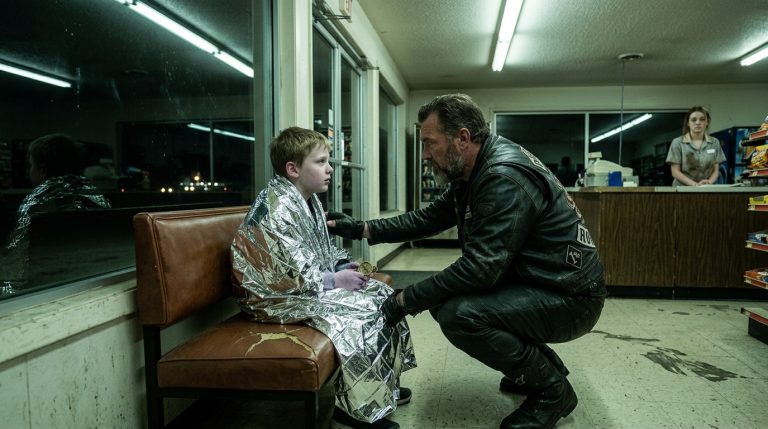
At the counter, a ceramic mug clinked against the formica—dull, heavy, chip-edged. The liquid inside was midnight black, filmed over with a thin sheen of industrial grease from the kitchen vent. Calvin “Grizzly” Mercer didn’t touch it. He sat in the corner booth, his broad shoulders wedged into the cracked vinyl, his palms resting flat on the table. The skin over his knuckles was thick, yellowed with old calluses, and split by a faint white line where an old primary sprocket had bitten him thirty years ago.
He didn’t look at the other fourteen people scattered across the diner. He didn’t have to. In Erie, when the lake-effect dropped three inches an hour, people either looked at their phones or the bottom of their bowls. They didn’t look at each other. Looking required a commitment the weather had already drained out of them.
Then the sound started.
It wasn’t the storm. It was a friction sound. Squeak. Squeak. Wheeze.
Grizzly’s eyes drifted toward the display of souvenir travel mugs. A hand had appeared on the edge of the rack. The fingers were small, the skin translucent enough to show the blue tracery of veins beneath, the nails bitten down to the quick. Above the sleeve of an oversized tan parka—held together at the waist by a length of rough hemp twine—was a distinct, yellowing contortion in the fabric. A thumb-shaped compression mark, old enough to have settled into the fiber, right over where the bone met the shoulder.
Squeak.
The child was seven, maybe eight, but his frame was narrow, the bone structure showing through the damp fabric like structural framing before the drywall goes up. He wore a navy knit cap so stretched that the pale circle of his scalp showed through the lint-pilled weave. His sneakers were cheap canvas, dark with frozen slush, the rubber soles separating at the toe with a wet, sucking gasp every time his weight shifted.
Grizzly didn’t move his hand from the table. He watched the boy’s eyes. They weren’t looking for food. They weren’t looking for a coin. They were tracking the exit sign by the restrooms, then the service door behind the counter, then the gap between the booths. It was the frantic, hyper-focused calculation of an animal that spent its life measuring the distance between itself and the nearest briar patch.
The boy stopped three feet from the edge of the vinyl booth. His teeth were clicking—not a shivering vibration, but a hard, rhythmic snap of bone against bone that sounded like a dying alternator.
Slowly, the small hand reached into the pocket of the damp parka. He didn’t pull out a weapon or a wallet. He laid a piece of yellowed scratch paper on the salt-filmed laminate between Grizzly’s coffee and the half-empty bowl of chili.
It was a crayon drawing. The wax was cheap, crumbling at the edges where the pressure had been too hard. It showed a heavy, black shape with two wheels and a pair of disproportionate, jagged wings rising from the tank. Underneath, written in shaky, single-stroke block letters that leaned heavily to the left, were two words: HELLS ANGEL.
Grizzly looked at the paper. The ghost of his old rocker patch—the faint, dark indentation where the thread had been ripped out of his leather jacket five years ago—seemed to tighten against his back.
The boy leaned forward. The air that came out of him smelled of stale dampness, the faint, sour tang of a basement that hadn’t seen lime in a decade, and something else—the sharp, chemical stink of unburnt fuel from a faulty exhaust.
“Please,” the boy whispered. His voice didn’t have enough breath behind it to carry past the edge of the table. “He’s coming to take me back.”
CHAPTER 2: The Weight of the Iron
The boy’s seven words didn’t dissolve into the hum of the travel plaza; they seemed to settle into the grease-filmed air, heavy and solid as a dropped transmission block.
Calvin “Grizzly” Mercer didn’t let his posture alter by a single degree. His left hand remained flat on the salt-pitted formica, the scarred skin over his knuckles stark under the flickering fluorescent tube. But beneath the heavy hide of his unpatched leather vest, his ribs tightened. His eyes, dark and unblinking, stayed locked on the child’s face. He didn’t look at the crayon drawing between them. He didn’t need to. He could smell the stale cellar rot and the distinctive, metallic tang of unburnt fuel rising from the boy’s damp parka. The child was telling the truth because a seven-year-old didn’t know how to fake the specific, shallow whistle of lungs that had been breathing carbon monoxide in a closed space.
“Sit,” Grizzly said. His voice wasn’t loud, but it carried the low, vibrating resonance of a diesel engine idling in an empty bay.
He didn’t reach out. He didn’t grab the boy’s sleeve over that yellowing, thumb-shaped bruise. He simply shifted his massive bulk three inches to the left, creating a clear pocket of space against the cracked vinyl wall of the corner booth.
The boy hesitated for the span of a single heartbeat, his canvas sneakers giving a wet, sucking gasp against the floor as his weight shifted. Then, like a machine whose main spring had finally snapped, he slid into the corner. He shrank into the dark fabric of the booth, trying to pull his sharp angles and shivering bones into the shadow cast by Grizzly’s broad shoulders.
Grizzly reached across the table, his thick fingers wrapping around the handle of his untouched coffee mug. The ceramic was cold now, the surfacefilmed liquid showing a distorted reflection of the neon sign outside. He slid the mug three inches toward the boy, then pushed the heavy ceramic bowl of chili alongside it.
“Drink the water first,” Grizzly commanded softly, his eyes already drifting away from the boy to map the room. “Slow. Your teeth are clicking hard enough to split an incisor.”
With the child secured against the wall, Grizzly’s focus shifted to the grid of the diner. A lifetime spent navigating the narrow, violent margins of asphalt had taught him to read a room by its friction points.
At booth four, the roadtripping couple from Ohio had stopped chewing. The woman’s shoulder was still angled away like a physical shield, but her head was tilted back just enough to catch the low rumble of Grizzly’s voice. She was looking at the salt-crusted edge of Grizzly’s boots, then at the faded, dark outline on the back of his vest where the Hell’s Angels rockers used to live. To her, the leather didn’t mean sanctuary; it meant danger. She nudged her husband’s knee beneath the table with the toe of her clean winter boot.
Behind the counter, the cashier’s phone had stopped clicking. Her thumb was hovering over the screen, her eyes darting from the child’s damp hat to the security guard by the magazine rack. The guard had already tucked his hands into his utility belt, his fingers resting an inch from his heavy flashlight. He was looking at the door, then at Grizzly, weighing the balance of a mortgage against the physical reality of a two-hundred-and-forty-pound mechanic who looked like he had been poured out of old iron.
“The phone,” the boy whispered from the corner of the booth. His hands were wrapped around the water glass now, the rims clinking against his teeth as he took a shallow sip. “He’s looking at the phone. He has the app.”
Grizzly didn’t look back at him. “Who has the app, son?”
“Trent,” Eli said. The name came out dry, like sand sliding down a chute. “Trent Holloway. He’s the deacon at the chapel on Tenth. He locks the utility door from the outside when the lake wind starts to rattle the glass. He says the frost keeps the bad thoughts out.”
Grizzly’s jaw clenched until the muscle behind his gray beard stood out in hard, white ridges. A deacon. A pillar. The kind of man who used a clean collar to cover the smell of rot. Grizzly knew the type; Erie was full of them—men who ran charities out of storefronts while their basements filled with damp laundry and broken promises.
“He locks it,” Grizzly stated, his tone flat, devoid of the rage that was beginning to pool in his belly like stagnant water. “And the space heater?”
“It’s big,” Eli murmured, his voice growing smaller as the heat of the diner began to make his frozen skin burn under the parka. “It smells like iron when it gets hot. He left the book on the counter. The book with the red warning line on the back. He said if I don’t stay quiet until the payout clears, I’ll go to the woods like Kayla did.”
Grizzly’s fingers closed around his spoon. The cheap metal flexed slightly under the pressure before he forced his hand to relax. Kayla. The name wasn’t in the source files he had stored in his head, but the specific structure of the boy’s words was too precise. $296,700. Children didn’t invent six-figure sums with odd numbers attached. They didn’t invent the specific layout of an industrial warning manual.
Outside, the lake-effect snow slammed against the plate glass window, a white wall that cut the travel plaza off from the rest of the city. The amber streetlights across the highway were gone now, swallowed by the gray blur of the squall. The storm was doing the work. If Trent Holloway was tracking the boy’s phone—or the tracker hidden in the lining of that oversized parka—he would be moving through the whiteout with the deliberate, unhurried pace of a man who knew the law wouldn’t interfere with a legal guardian.
Grizzly reached into the deep pocket of his leather vest. His fingers brushed against a collection of loose washers, an old spark plug gap tool, and finally, the cold, heavy chassis of his phone. He pulled it out, the screen illuminating his weathered face with a pale, blue glow.
He didn’t dial the local precinct. He knew what happened when patrol cars showed up at three in the morning for a domestic dispute involving a church deacon and an unpatched biker. They’d look at the registration, they’d look at the leather, and they’d hand the boy back to the man with the clean record and the smile.
Instead, Grizzly scrolled through a list of numbers he hadn’t touched since the day he took the rockers off his back. He stopped at a single name: Preacher.
He pressed the call button. The line crackled with the heavy, low-frequency static of a storm cell moving across the lake. It rang once. Twice. Then the connection clicked, and the sound of a quiet house ten miles away came through the small speaker.
“Grizzly,” the voice on the other end was dry, clear, and instantly awake. Daryl “Preacher” Cain didn’t ask why an unpatched brother was calling at 2:24 on a Saturday morning. He didn’t ask about the snow.
“I’m at the lakefront travel plaza,” Grizzly said. He kept his eyes locked on the front door, where the automatic sensor was beginning to hiss as the frost built up on the track. “I’ve got a seven-year-old boy in the booth. He’s running from Tenth Street. His wrists have the pink rings from zip ties, and his lungs are whistling from exhaust gas. The guardian’s name is Trent Holloway.”
There was a silence on the line—not the silence of hesitation, but the cold, heavy pause of a man calculating logistics. Preacher was sixty-one, a man who dealt in the legal governance of the club’s real estate and the strict administration of its borders. He knew every ordinance, every shift captain, and every broken seam in the county’s safety net.
“Holloway,” Preacher repeated, his voice dropping into a register that matched the iron of Grizzly’s tone. “The deacon at the winter outreach?”
“The same,” Grizzly said. “The boy says there was another one before him. A girl named Kayla. He’s got three hundred grand riding on a policy, and the storm is his weapon. He’s tracking him right now.”
“Stay where you are,” Preacher said. The sound of a heavy cotton sheet shifting came through the line as the old president sat up in his bed. “Don’t move the child. Don’t touch the local patrol. I’m turning the keys.”
“Bring Switchback,” Grizzly added, his eyes tracking the security guard, who had finally started to move away from the magazine rack toward the corner booth. “We’re going to need a badge that doesn’t smell like the county house.”
“He’s already rolling,” Preacher replied. The line went dead with a clean, metallic click.
Grizzly slid the phone back into his pocket. He looked up just as the security guard stopped two feet from the table. The guard’s leather belt creaked under the weight of his gear, the smell of cheap vinyl and sweat rising off his uniform shirt.
“Sir,” the guard said, his voice trying for authority but hitting a thin, defensive note instead. “The boy needs to step away from the booth. The cashier says he’s been loitering by the doors. If he’s not with a paying guest, he has to wait in the vestibule.”
Grizzly didn’t rise. He didn’t take his hands off the table. He simply tilted his head up, his dark eyes catching the flicker of the fluorescent bulb above until they looked like two pieces of polished flint.
“He’s with me,” Grizzly said. He reached down, took a single spoonful of the cold chili, and set the metal down with a sharp clack against the formica. “And I’m not done eating.”
The guard looked at the crayon drawing, then at the massive, grease-darkened shoulders wedged into the booth. He opened his mouth to speak, but the words caught in his throat as a low, deep-frequency vibration began to rumble through the floorboards of the travel plaza. It wasn’t the wind. It was the synchronized, heavy iron drone of two hundred engines cutting through the blizzard, moving down West 29th Street like an incoming tide.
CHAPTER 3: The Gathering of the Iron
The rattle in the floorboards wasn’t a sudden explosion; it was a rhythmic, industrial drag that worked its way up through the rust-eaten legs of the formica table. The cheap tin spoons in the sugar caddy began to dance, a low, metallic chatter that cut straight through the low-frequency hum of the building’s compressors.
The security guard didn’t step back, but his posture fractured. His boots, stiff and salt-filmed around the eyelets, shifted an inch on the linoleum as his hands dropped away from his utility belt. He looked past Grizzly’s shoulder toward the plate glass window, where the thick, white sheets of lake-effect snow were being sheared apart by a wall of high-displacement exhaust.
Outside, the squall hadn’t lifted, but it had changed color. The uniform gray of the blizzard was clotting into dark, heavy shapes—the massive, squared-off fairings of touring bikes and the low, wide silhouettes of custom choppers moving into the plaza’s secondary lot with military uniformity. They didn’t rev their throttles. There was no theatrical display of noise. Two hundred and seventeen heavy iron blocks simply drifted through the whiteout, their headlights cutting through the driving ice like amber needles, before their ignitions went dead at the exact same micro-second.
The silence that followed wasn’t peaceful. It was the heavy, pressurized quiet that lands right before an iron press drops.
“Grizzly,” the boy whispered from the corner of the vinyl booth. His fingers had tightened so hard around the cold ceramic water mug that his knuckles showed through the skin like small, white river stones. His gaze was fixed on the door track, where the frozen slush was beginning to drip into the drainage channel with a steady, rhythmic tap. “Is it him?”
“No,” Grizzly said. He didn’t lift his weight from the booth. He kept his hands flat, his thick palms catching the final, residual tremors of the asphalt outside. “It’s the family I told you about. The one that doesn’t leave when the wind turns sideways.”
The automatic door chime dinged—a single, clean note that sounded thin and ridiculous against the scale of the silence.
Daryl “Preacher” Cain crossed the threshold first. He had his leather cut pulled tight over a grease-stained canvas coat, the denim beneath it faded to the color of wet slate. His silver hair was pinned back with a strip of raw hide, his jaw set into the hard, flat line of an administrator who had spent thirty years balancing the ledger books of an outlaw operation against the county’s penal code. Behind him came Doc, his canvas medical kit slung over a shoulder that sloped like an old oak timber, and Switchback, whose eyes didn’t look at Grizzly or the boy. Switchback’s gaze went instantly to the ceiling corners, locating the gray domes of the security cameras, before tracking the layout of the back exit behind the fryers.
They didn’t swagger. They didn’t throw their shoulders back. They moved with the quiet, functional economy of machinery that had been oiled and maintained for forty years.
The roadtripping couple at booth four shrank back into their winter coats, the man pulling his phone down below the level of the table as if trying to disguise the white glare of his screen. The cashier had backed up until her spine hit the cigarette rack, her hand frozen over the cash drawer, her thumb trembling against the plastic edge of a receipt stack.
Preacher stopped three feet from the guard. He didn’t look down at the man’s badge; he looked at the space between the guard’s collarbone and his chin.
“The boy is with us,” Preacher said. His voice was soft, an old, gravelly register that had been worn smooth by thirty years of legal briefs and midnight phone calls. “Go back to the magazine rack, friend. The heat works better over there.”
The guard looked at the silver chain hanging from Preacher’s belt loop, then at Switchback, who had stopped by the display of souvenir travel mugs. Switchback didn’t say a word, but his hand was resting flat on his hip, right over the split in his heavy leather jacket where the old internal affairs shield used to sit before the city stopped paying his pension. The guard took a shallow breath, his boots making a dry, scraping sound on the salt grit, and walked back toward the magazines without looking behind him.
Doc didn’t wait for the space to clear. He dropped his canvas kit onto the table next to the half-empty bowl of chili, his thick, calloused fingers already unzipping the pocket before his knees hit the floor. He brought himself down to Eli’s eye level, his breath rising in a small, gray cloud that smelled of mint tobacco and cold oil.
“Eli,” Doc said. The name came out steady, the tone identical to the one he had used in the jungle behind Da Nang when the extraction choppers were still twenty minutes out. “My name is Doc. I’m going to touch your wrist now. I’m not going to pull, and I’m not going to squeeze. We’re just going to count the ticks.”
The boy didn’t flinch this time. He watched Doc’s hand—a massive, weathered palm that had the blue ink of an old navy anchor faded into the meat of the thumb—close gently around his left wrist. The skin there was raw, a bright, angry pink where the hard plastic edges of commercial zip ties had bitten down into the small bones during the previous freeze.
“Pulse is thready,” Doc said, his eyes tracking the second hand on his iron-cased wrist watch without looking up at Preacher. “Skin temperature at the extremities is sitting around eighty-four. Core is lower. His lungs have that wet, chemical rattle. He’s been sitting in a draft with a faulty flued heater for more than four hours.”
Grizzly’s phone buzzed in his pocket—a short, sharp vibration that didn’t repeat. He pulled it out, his thumb clearing the screen. It was a silent text block from Pixel, who was sitting three rows deep in the overflow lot inside a panel van with two marine batteries hooked to a modified server rack.
Insurance log recovered, the text read. Policy active July ’24. $296,700. Secondary file found: Kayla Benton, age 16, deceased Feb ’21. Guardian: Holloway. Payout cleared forty-one days post-mortem. Cause: Exposure. Checking bank logs now.
Grizzly slid the phone back into his vest, the iron frame of the device hitting the brass rivets of his pocket with a dull thunk. He looked over at Preacher, who was watching the automatic doors. The frost on the track was thick now, the glass vibrating as another gust of lake wind tried to push its way inside.
“The pattern is five years deep,” Grizzly said, his voice dropping into the lower register where the engine roar lived. “He doesn’t use iron, Preacher. He uses the weather. He waits until the lake turns gray, shuts the vent, and lets the county house write the certificate for accidental exposure.”
Preacher didn’t answer right away. He reached into his coat, pulled out a pair of small, wire-rimmed reading glasses, and set them on his nose before looking down at the crayon drawing of the winged angel. His finger traced the shaky, single-stroke letters at the bottom.
“The system doesn’t look under the carpet if the floor looks clean from the street,” Preacher whispered. He looked up at Switchback. “Call the captain. Tell him we have the financial line and the physical state of the asset. Tell him we’re moving on Tenth Street before the snow packs the grid completely.”
Switchback nodded, his hand already reaching for his internal radio unit as he turned back toward the rear vestibule.
Grizzly looked down at Eli. The boy’s cap had slipped back, showing the fine, white hair damp against his forehead. He was still holding the water glass, but his arms were shaking so hard the surface of the liquid was a blur of concentric rings.
“You’re going with Doc,” Grizzly told him, his voice softening until it was just a low hum against the child’s ear. “He’s got a warm truck with two heaters in the cab. I’m going to follow the light behind you.”
“But the man,” Eli stammered, his eyes tracking Grizzly’s leather sleeve. “The man with the book. He has the app on his phone.”
“Let him look at it,” Grizzly said, his hand closing over the edge of the formica table as he prepared to stand. “He’s about to see the whole map turn red.”
CHAPTER 4: The Paperwork Audit
Grizzly stood up from the vinyl booth, his massive frame uncoiling with a heavy, deliberate scraping of leather against the wall. His fingers left the salt-pitted formica table just as Doc stepped into the narrow gap, his massive navy-tattooed hands sliding beneath Eli’s small, shivering frame with the practiced, frictionless weight of a seasoned lifter. The child didn’t make a sound; he simply folded into the old medic’s canvas-jacketed chest, his wet sneakers hanging limply over Doc’s forearm like broken pieces of trim.
“The truck’s running three rows back,” Doc muttered to Preacher, his voice low enough to avoid carrying past the adjacent table where the Ohio couple remained frozen. “I’ve got the auxiliary heater locked at ninety. Tiny and Hammer are on the flanks.”
Preacher didn’t give a nod; he merely adjusted his wire-rimmed glasses, his eyes already tracing Switchback’s shape as the former detective returned from the rear entry. The cold wind from the drafty aluminum frame of the entrance door hissed against their boots, carrying the raw smell of highway salt and frying oil.
Grizzly reached into his vest pocket, his thumb catching the metal edge of his phone as it buzzed a second time. Instead of a text, a local network link flared onto the screen, routed through Pixel’s short-range transmitter in the panel van outside. The interface cracked open, illuminating Grizzly’s gray beard with a pale, grid-like glare.
“Look at the ledger sequence,” Preacher said, stepping closer until his shoulder pressed against Grizzly’s leather sleeve. His breath smelled of stale mints and iron. “Pixel just pulled the automated clearing house data from the Tenth Street parish account.”
The screen showed a series of micro-transfers. July 2024, eight thousand four hundred and fifty dollars, moved from a legal trust labeled Turner, E.C. to an commercial entity named Northlake Restoration LLC. Two days later, an identical sum left the Northlake account, terminating in an offshore portal registered to a digital blackjack operator in San Jose. There were five similar extractions spaced exactly twenty-eight days apart, each coinciding with a filed maintenance affidavit signed by the deacon.
“He wasn’t fixing the roof,” Grizzly stated, his voice flat as he watched the digital ink scroll upward. “He was clearing the margin on his table losses before the bank could flag the primary account.”
“It’s a standard extraction loop,” Switchback said, his hand resting on the frame of the souvenir display rack, his fingers tapping a slow, unhurried rhythm against the plastic molding. “He picks a non-parental guardianship with an active trust. He files for emergency oversight citing behavioral instability, which locks the child out of court representation for ninety days. Then he drains the liquid assets under the guise of habitability improvements while he waits for a hard freeze to clear the principal policy.”
Grizzly’s thumb flicked the screen down, revealing the second ledger line—the one from February 2021. Benton, K. The payout figure was lower—one hundred and sixty-four thousand nine hundred—but the clearing house path was identical. The money had entered the same shell company within forty-eight hours of the county medical examiner signing off on an accidental exposure finding during the winter storm of that year.
“He didn’t just stumble into this,” Grizzly said, his jaw tightening until the old white scar across his knuckle grew distinct against his skin. “The system gave him the blueprint when they accepted the first certificate without pulling the house logs.”
“The county didn’t have the staff to audit a licensed deacon with three character references from the district board,” Preacher murmured, his fingers sliding down to the silver chain on his belt loop. “They look at the collar, they look at the donation jars by the counter, and they sign the release form so they can clear the docket before the snow plows stop running.”
Behind them, the cashier’s register gave a sharp, electronic beep as her hand finally slipped off the phone, dropping the device onto the counter with a hollow plastic rattle. She looked at Preacher, her eyes wide, her lower lip vibrating against the edge of her collar.
“I didn’t… I didn’t know he was with you,” she stammered, her voice cracking under the weight of the silence that had settled over the rows of booths. “The policy says we can’t have people sitting without—”
“The policy’s fine,” Preacher interrupted, not looking back at her as he pulled a crisp twenty-dollar bill from his vest pocket and laid it flat on the grease-filmed linoleum of the counter. “Leave the chili where it is. We’re taking the paper.”
Grizzly reached down, his thick fingers gathering the crayon drawing from the table. The wax was cold now, stiffened by the drop in temperature near the floorboards, the edges of the angel’s wings rough against his thumb. He folded the sheet once, a clean, sharp crease that ran through the words HELLS ANGEL, and tucked it inside the internal zipper of his hide jacket, right next to the registration papers for his shovelhead.
“The captain’s three minutes out,” Switchback said, his eyes tracking the red glare of an emergency light that had just appeared through the white blur of the highway intersection. “He’s bringing two cruisers from the outer perimeter. He didn’t want the local detail touching the house until we had the financial line locked down.”
“Why?” Grizzly asked, his boots making a heavy, crunching sound on the salt grit as he turned toward the automatic doors.
“Because Holloway’s nephew runs the dispatch desk at the central station,” Switchback replied, his voice dropping into the cold, pragmatic register of an ex-cop who knew exactly how many links in a chain could be rusted through before the whole thing snapped. “If we had called 911 from the booth, the deacon would have received a text message before the patrol car cleared the garage doors.”
Grizzly didn’t answer. He pushed through the automatic doors, the sensor hissing as a fresh blast of Lake Erie ice hit his chest. The parking lot was a grid of silent, gleaming chrome and black leather—two hundred and seventeen men sitting on their machines in the driving snow, their kickstands down, their eyes fixed on the glass front of the travel plaza. Nobody was talking. The only sound was the steady, low-frequency hum of Pixel’s van and the distant, rhythmic thumping of a diesel plow clearing the secondary lanes three hundred yards away.
Grizzly walked down the asphalt lane, his boots sinking into the fresh two inches of powder until he reached his own bike. The iron of the engine block was cold, the exhaust pipes coated in a thin layer of white frost that began to steam as he turned the ignition key.
“Tenth Street,” Grizzly said to Preacher, who had taken his place at the head of the serpent formation. “We don’t use the sirens.”
CHAPTER 5: The Perimeter at West 29th
The first stroke of the shovelhead’s internal piston didn’t catch clean. The iron cylinder block, chilled through by four hours of stagnant lake air, gave a hard, dry metallic grunt before the heavy fuel mix ignited. Then the case caught. A low, concussive throb pounded through the short pipes, instantly blasting a dark circle of cleared concrete through the white ice layer behind Grizzly’s rear tire.
To his left, Preacher’s engine was already breathing in a tight, mechanical rhythm. The old president didn’t turn his head; his goggles were pulled low over his high cheekbones, the black strap cutting into the salt-crusted canvas of his hood. He dropped his left boot into the fresh powder, his worn leather heel catching a hidden lip of asphalt as he clicked the transmission into first gear with a hollow clunk.
Behind them, the serpentine column began to fold into motion. Two hundred and seventeen machines didn’t move as an arbitrary crowd; they formed a double-line grid, spaced exactly six feet apart to absorb the grease-slick ice patches forming beneath the snow. The convoy slid out of the plaza’s secondary lot, their wide rear tires chewing through the drift until they hit the salt-truck tracks on the main avenue.
The journey down the arterial toward West 29th Street was an exercise in pure structural friction. The storm wasn’t dropping flakes anymore; it was driving sheets of granular lake ice that rattled against the aluminum fork shields like birdshot. Grizzly kept his speed locked at twenty-two miles per hour, his gloved thumb constantly working the manual throttle slide to counter the steady drag of the wind coming off the water.
Two miles out from the Tenth Street corridor, the lead patrol cruiser from the outer perimeter skidded into the lane ahead. Its red and blue roof rack was a spinning blur that turned the falling ice into a violet fog. Captain Miller’s car didn’t use its siren, but the wide steel bumper was already caked in white slush as it tracked the centerline.
Suddenly, a hard, rhythmic shudder tore through Preacher’s front wheel hub. The lead bike’s front tire hit a hidden iron drainage grate that had buckled under the freeze. The rubber lost its tracking, the front forks twisting three degrees to the left with a loud, mechanical snap of metal chains hitting the oil pan.
Grizzly didn’t touch his front brake. He shifted his weight into the low seat frame, using his boots to track the grade of the asphalt while his right hand adjusted the lean of his machine. He closed the gap by eighteen inches, positioning his heavy iron case directly into the wind-shadow of Preacher’s sliding rear tire, giving the older rider a clear pocket of dead air to catch his alignment before the column could compress. Preacher’s boot scraped the ice once, a loud, abrasive hiss of rubber on salt, and then the iron straightened. The grid held.
When the column turned onto the gravel approach of West 29th, the porch lights of the small beige bungalows started flicking on like a row of small, yellow teeth. The houses here were old, the aluminum siding pitted by fifty years of industrial soot and lake salt, their roofs bowing under the weight of the four-inch shelf of fresh powder.
Grizzly killed his ignition before his front tire cleared the curb line of the bungalow at number 418. The sudden drop in engine noise was instantaneous, replaced by the rhythmic ticking of hot iron cooling down in the freezing wind.
The two hundred and seventeen bikers formed a solid crescent across the width of the residential street. They didn’t dismount. They sat on their machines, their boots planted flat in the snow, their visors down, facing outward away from the house. They created an absolute wall of leather and rusted steel that cut the deacon’s property off from the rest of the county.
Captain Miller’s boots made a dry, hollow crunch as he stepped out of the patrol car. He didn’t look at the line of bikes. He looked at the front door of the bungalow, where a painted wooden sign reading God Bless This Home hung from a single rusted screw.
Switchback walked on his left, his hands tucked deep into the pockets of his canvas coat, his eyes mapping the basement window frames where the frosted glass had been blocked from the inside by heavy pieces of insulation board.
“The nephew didn’t drop the flag,” Switchback said, his voice barely carrying over the whistle of the wind through the porch screen. “The dispatch desk is still logging the routine route blocks on the west side. Holloway thinks he’s got until dawn before the morning shift checks the regional trust logs.”
Miller didn’t answer. He reached the wooden steps, his heavy leather uniform boots cracking the thin ice layer on the rise. He didn’t use the bell. He pounded his gloved fist against the center panel of the door, the vibration causing the painted sign to swing two inches to the left.
“Police,” Miller barked. “Open the frame.”
Inside, a television was playing. The sound of a canned laugh track came through the thin aluminum storm window, flat and tinny, followed by the dull, rhythmic thud of a heavy refrigerator door closing in the kitchen.
Grizzly stood at the bottom of the steps, his hands resting on the brass zipper of his jacket. His thumb could feel the stiff edge of Eli’s crayon drawing through the hide. He didn’t look at the police or the door; his eyes were locked on the small basement vent near the foundation, where a thin, pale trail of white exhaust gas was slowly curling up through the snowbank like a gray snake.
“He’s not loading a bag, Captain,” Grizzly said, his voice dropping into the cold, pragmatic register that made Preacher look over. “The vent’s taped shut. The line is already open.”
Miller didn’t wait for the second call. He nodded to the patrol officer behind him, who was already lifting a twenty-pound steel ram from the trunk of the cruiser.
CHAPTER 6: The Cold Room Investigation
The steel ram didn’t hit with a hollow thud; it struck the deadbolt housing with a sharp, structural crunch that tore the wood grain straight out of the pine frame. On the second impact, the latch sheared completely. The front door swung inward, hitting the interior plasterboard wall with a heavy smack that rattled the small ceramic knick-knacks lining the entryway shelf.
Grizzly crossed the threshold directly behind Captain Miller, his heavy leather boots leaving gray slush prints across the cheap floral rug. The air inside the bungalow didn’t carry the standard warmth of a winter shelter; it was thin, sharp, and carried the heavy, chemical tang of unburnt fuel oil mixed with a flat layer of institutional bleach.
In the kitchen, the television was still humming, the flat laugh track whistling through the speaker grid while Trent Holloway stood paralyzed by the laminate counter. He was wearing ironed flannel lounge pants, his hand frozen over a half-spread loaf of white bread, a silver butter knife balanced between his thumb and index finger like a stylus. He didn’t drop the steel. He simply watched the officers fill the narrow space, his eyes rapidly blinking behind a pair of wire-rimmed spectacles that looked identical to Preacher’s.
“Search the perimeter lines,” Miller ordered, his hand resting on his utility belt as his patrol team moved down the narrow hallway toward the bedrooms. “Verify the occupant logs.”
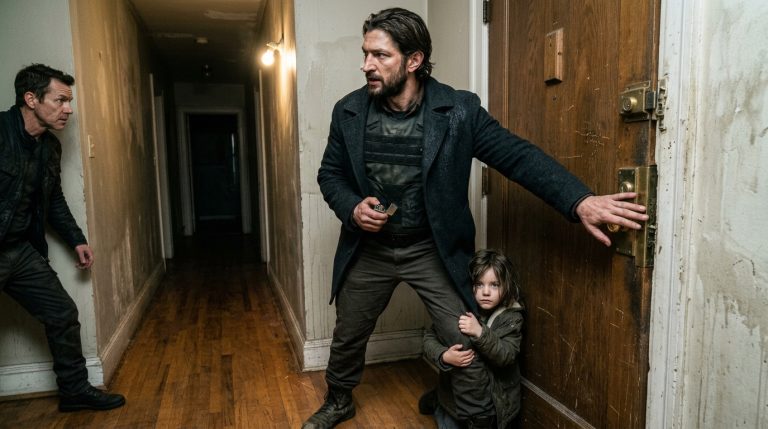
Grizzly didn’t look at Holloway. He tracked the draft. The freezing air wasn’t coming from the fractured front door; it was rising in a steady, high-pressure stream from the rear utility alcove past the laundry hookups. He walked down the corridor, his wide shoulders catching the edges of the narrow drywall frame, his fingers lightly brushing the wood grain until he reached the heavy oak door at the end of the line.
The door didn’t use a standard residential brass knob. A heavy-duty iron slider latch had been bolted directly into the exterior casing at chest height—the kind of crude galvanized hardware manufactured for livestock gates or industrial tool sheds. The iron surface was pitted with red rust along the screw tracks, showing where the moisture from the interior room had consistently condensed against the cold metal.
Click.
Grizzly’s thumb slammed the latch rod back. The mechanical sound was loud, a sharp, ungreased crack of steel on iron that matched the description Eli had whispered into the water glass at the travel plaza. He threw the door wide.
The temperature inside the room dropped forty degrees in the span of an inch. There was no bed frame. A thin, synthetic gray blanket lay twisted on the bare concrete floorboards, puddled around a rusted galvanized bucket that served as a waste line. The room had no windows, only a single low-intake floor vent that had been sealed tight from the inside with three layers of cross-hatched silver duct tape.
“Look at the shelf,” Switchback said, stepping onto the bare concrete behind Grizzly. His leather coat gave a dry creak as he pointed a flashlight toward a narrow plywood ledge bolted above the laundry drop.
Resting on the wood was a heavy, square block of industrial iron—an unvented kerosene utility space heater, its tank dry but its casing coated in a fresh, sticky film of black soot. Laying exactly three inches from the fuel cap was a white paper manual, its cover clean except for a bold red line running across page fourteen.
Grizzly didn’t touch the paper. He leaned down, his eyes tracking the red text block printed beneath the manufacturer’s logo: WARNING: Operation in unvented enclosed spaces will result in immediate accumulation of lethal carbon monoxide gas. Ensure all intake paths remain clear.
Beside the manual lay a small plastic tray containing four unused, heavy-duty commercial zip ties—eleven inches long, their nylon edges sharp and clean, identical to the pink scarred rings Doc had documented on Eli’s wrists three hours earlier.
“The system didn’t just miss the room,” Grizzly said, his voice dropping into the low, vibrationless register of a closed engine casing. “The system signed off on the shelter clearance because the latch was on the back side of the frame where a routine walk-through wouldn’t register the block.”
“He had the compliance certificate from the regional board pinned to the front hall,” Switchback murmured, his camera shutter clicking as he documented the duct tape on the intake grill. “They checked the kitchen, they checked the pantry reserves, and they logged the child as ‘restless but secure’ before they took their mileage voucher.”
Grizzly reached out, his thick thumb catching a loose seam in the silver tape over the vent. He peeled it back two inches, the adhesive dry and brittle from the intense cold, revealing the rusted steel iron mesh beneath. The iron was choked with dark gray soot—the residual skin of a machine that had been run hot and dirty until the air inside the block ran out of oxygen completely.
“He didn’t need a weapon,” Grizzly stated, looking toward the hallway where the muffled sound of Holloway’s high-pitched protests was beginning to flatten against the walls. “He just needed forty-eight hours of lake wind to cover the discharge.”
“The nephew’s log is already flagged,” Switchback said, turning back toward the kitchen frame. “The captain’s moving the booking line through the regional court before the family desk can file for an injunction.”
Grizzly stayed in the doorway for another heartbeat, his boots remaining planted on the threshold of the cold concrete. He reached into his internal zipper pocket, his calloused skin brushing against the cold wax of Eli’s crayon drawing. The paper was still safe against his ribs, a slight shield against the industrial chill that had settled into the wood of the house.
CHAPTER 7: The Processing of Trent Holloway
Grizzly turned his heavy hide boots away from the dry, soot-choked frame of the utility room door, his spurs catching a loose edge of the hallway runner with a sharp, fibrous tear. The air rolling out behind him remained forty degrees below the house baseline, a concentrated drafting channel that flattened the fine hair against the back of his neck as he walked back toward the kitchen.
In the center of the linoleum floor, Trent Holloway was no longer holding the silver butter knife. An officer had pinned the deacon’s forearm flat against the synthetic wood laminate of the counter, the steel blade clattering into the sink basin with a hollow, metallic ring. Holloway’s wrists were already clamped within the zinc-plated loops of the county cuffs, the locking mechanism clicking six times in rapid succession as the officer drove the notches home.
“This is an unmitigated overreach,” Holloway said. His voice didn’t rise to a shout; it stayed in a narrow, high-frequency vibrato that matched the hum of the old refrigerator. He didn’t look at the floor. He kept his spectacles fixed on Captain Miller’s brass collar pins, his chest expanding in short, defensive jerks against his ironed flannel shirt. “The parish logs are completely transparent. The child has an documented history of fugue states during regional weather shifts. I have three signed affidavits from the municipal welfare desk confirming the safety baseline of this address.”
“The desk didn’t audit the external slider latch,” Switchback said, stepping out of the corridor with his small digital camera resting flat against his palm. He didn’t lift the lens to his eye; his thumb simply cleared the interface, showing the pale blue glare of the room’s sealed vent logs to the captain. “They checked the kitchen stock and the front room seating. The ledger matches the Northlake transaction sequence exactly, Captain. He was running the clearing house lines through the parish clearing portal before the winter freeze could set the insurance parameters.”
Miller didn’t offer a nod. He took the folder from Switchback’s hand, his fingers tracing the printed wire logs where the offshore gambling withdrawals had cut through Eli’s trust balance.
“Move the entity to the transport unit,” Miller barked to the patrolmen. “Log the manual from the shelf as direct evidence of premeditation. I want the regional desk notified before the morning shift logging clears.”
The officers lunged forward, their heavy duty belts creaking as they hoisted Holloway by the armpits. The deacon didn’t fight the leverage with mass; he went limp, his thin leather house slippers dragging across the salt-stained rug as they maneuvered his frame toward the broken entryway.
Grizzly walked down the porch steps three inches behind the moving line, his heavy boots crushing the fresh powder down to the frozen gravel baseline. The storm outside had reached its peak density, the lake wind shearing the falling snow into flat, horizontal bars that blurred the shapes of the two hundred and seventeen machines waiting at the curb line.
The column hadn’t shifted. The bikers remained wedged into their low seats, their boots planted flat against the white grade, their helmets tilted forward to catch the violet pulse of the cruiser’s emergency rack. Two hundred pairs of eyes stayed locked on Holloway’s face as the officers dragged him down the icy approach.
The deacon slipped once on the rise, his knee striking a patch of gray road salt with a dull, wet thwack. He looked up, his glasses fogging instantly from the heat of his breath, his eyes widening as he registered the sheer mass of the iron crescent blocking the residential exit. There was no shouting from the line. No tire irons were lifted. The only sound was the low, rhythmic ticking of cooling steel fins and the steady, dry whistle of the wind through the frozen spokes.
“They’re vigilantes,” Holloway hissed, his voice dropping into a frantic, reedy whisper as he caught Captain Miller’s sleeve with his cuffed fingers. “They have no legal standing within this district. The guardianship remains active until a county judge signs the formal revocation order.”
“The order was logged thirty minutes ago through the third circuit desk,” Preacher said, his machine idling two feet from the transport van’s rear door. He didn’t look down from his handlebars; his wire-rimmed spectacles reflected the spinning blue strobes like two small, cold coins. “The asset has been reassigned to a temporary municipal holding block under Doc’s medical oversight. You’re done with the ledger, Holloway.”
The officer slammed the rear door of the cruiser, the heavy steel panel cutting off the deacon’s final protest with a thick, pressurized clunk. The squad car shifted into gear, its studded snow tires chewing through the frozen slush with a sharp, grinding hiss before the chassis cleared the intersection at Tenth Street.
Grizzly stood by his shovelhead, his thick palm resting on the cold leather of his seat. He could feel the small, hard square of the folded crayon drawing shifting against his ribs with every breath. The white trail of exhaust from the basement vent had finally thinned out to nothing, leaving only the sharp smell of stale fuel soot hanging over the clean drifts of the yard.
“St. Bridget’s is clear,” Preacher muttered, his boot clicking his transmission back into first gear as the cruiser’s red taillights dissolved into the gray blur of the avenue. “Doc’s got the re-warming line running on the third floor. The school logs are already being pulled by the administrative desk.”
Grizzly didn’t answer. He turned his ignition key, the cold iron cylinder block catching clean on the first stroke this time, its deep, concussive throb instantly filling the empty space left by the squad car.
CHAPTER 8: The Return to the Asphalt
The deep, concussive throb of the shovelhead’s cylinder blocks didn’t fade until Grizzly cut the ignition switch with a blunt, greasy thumb. The sudden mechanical drop-off was filled instantly not by ice wind, but by the steady, dry chirp of grasshoppers in the wild chicory along the drainage ditch.
July in Erie had baked the road salt down into a fine, gray flour that drifted up off his front tire as he kicked the stand down with a dull clank. The air smelled of cut clover, hot exhaust chrome, and the heavy, sweet rot of the lake basin under a midday sun. The small bungalow at the end of the suburban cul-de-sac had its windows wide, the clean aluminum screens reflecting the bright blue sheen of the horizon instead of the white dark of a January freeze.
Grizzly unzipped his heavy leather jacket, the old cowhide stiff with salt rings along the underarm seams but warm from the three-mile run up from the shop. He reached into the internal pocket, his calloused fingers passing over the registration logs to touch the crumpled corner of Eli’s crayon drawing. The paper was dry now, the wax lines of the winged machine settled permanently into the grain after six months against his ribs.
In the backyard, the sound of an engine wasn’t present; it was replaced by a sharp, rhythmic thump-thump of a small pair of sneakers hitting the packing sod.
Eli Turner wasn’t shuffling. His canvas shoes were new—thick-soled rubber that didn’t squeak or hold the moisture of a slush trench—and his frame had filled out until the sharp angles of his collarbones were buried beneath a clean, gray cotton shirt. He was tracking a red plastic disc as it cut through the dead air over the clover, his stride long and uncalculated. He didn’t look at the lane gates or the side fence lines. His face was flushed with the oily heat of a normal summer afternoon, his hazel eyes fixed entirely on the spinning edge of the toy until his boots left the ground to catch it.
“Keep the nose up!” Switchback called out from the shade of the porch overhang. The former detective was sitting on an upturned wooden crate, an ungreased sprocket tool resting between his knees as he scraped the old grease out of a rear hub assembly with a strip of emery cloth. His shaved head was dark with sweat, the blue ink of his old department insignia fading into the tanned muscle of his forearm. “If you let the rim dip, the cross-wind off the bay catches the pocket.”
Elena, Switchback’s wife, walked out through the screen door, carrying a heavy glass pitcher that sweated cold water onto the rusted iron tray in her hands. She didn’t look at the road or check the horizon for patrol cars; she set the glass down with a small, clean clink against the wood panel of the table before looking down at Eli’s turn on the sod.
“The regional desk signed the final settlement logs at noon,” Preacher said, his low, gravelly register breaking through the hum of the cicadas from the shadow of the garage bay. He was leaning against a stack of unmounted touring tires, his wire-rimmed spectacles resting on the bridge of his nose as he marked a clean line through a multi-page ledger sheet with a black pen. “The parish clearing account has been dismantled by the state auditor. The offshore blackjack portal in San Jose was seized by the federal detail forty-eight hours ago under the corporate fraud extension.”
Grizzly walked over to the porch, his boots making a dry, crunching sound on the gravel skirt. “And the principal?”
“Locked into a three-way state trust until the asset hits eighteen,” Preacher replied, sliding the pen into his vest pocket with a sharp click. “The Northlake recovery log cleared the original trust fund losses. The bank had to refund the eighty-four hundred dollar withdrawals under the municipal compliance clause because the deacon’s signature didn’t match the third-party authorization form.”
Grizzly reached down to the porch deck, his hand closing over an old, unthreaded primary nut that had rolled off Switchback’s crate. He turned the metal over in his palm, his thick thumb tracking the rusted inner threads where the machine bolt had stripped the casing during the previous winter’s run. He took a scrap of steel wool from the tool kit and began to work the face, the rough iron wool making a dry, abrasive hiss as it cut through the red corrosion down to the clean silver steel beneath.
“Holloway’s nephew didn’t clear the internal affairs review,” Switchback muttered, not looking up from his emery cloth. “They logged his central desk access logs from January. He had three direct pings to the deacon’s cellular location while the patrol cruisers were still clearing the garage on Tenth. He’s taking twenty-four months at the state house in Mercer for obstruction.”
The deacon himself hadn’t regularized his bail line. The three-day trial had ended with an immediate directive from the circuit bench—twelve years under the state penal code for attempted secondary murder, with the Kayla Benton file remaining open on the county prosecutor’s desk as the forensic team re-indexed the 2021 medical certificates. He hadn’t made a sound when the guards moved him through the side gate; his spectacles had been logged into the property box, leaving his eyes small and flat under the holding room lights.
Doc stepped out from the kitchen screen, his massive navy-tattooed arms glistening with grease from the broiler line. He laid a platter of thick beef patties onto the iron tray, his dark eyes tracking the cadence of Eli’s breathing as the boy ran another loop across the sod after the retriever.
“Lungs are clear,” Doc said to Grizzly, his voice identical to the low, steady drone he had used when the IC room was still ringing with the sound of the monitors. “The thready sequence in the lower lobes is completely gone. Core temp is solid at ninety-eight point six. He’s putting down three thousand calories a week without the metabolic lag.”
Eli stopped by the edge of the gravel skirt, the red plastic disc tucked under his arm, his shirt damp against his ribs. He looked at Grizzly, his hazel eyes tracking the movement of the steel wool against the stripped primary nut. He didn’t shrink back. He walked directly to the seat of the shovelhead, his hand reaching out to touch the heavy leather fringe of the saddlebag where the frost had caked six months before.
“Grizzly,” the boy said, his voice deep enough now to carry across the width of the porch without a whistle behind it. “The wings on the tank. Are they going to stay black?”
Grizzly set the cleaned iron nut back onto Switchback’s crate, the silver surface bright under the July sun. He walked over to the machine, his wide shadow falling over the tank as he lifted Eli up onto the wide leather saddle, his calloused palms steady against the boy’s ribs.
“They’re staying black, son,” Grizzly told him, his thumb catching the brass zipper of his vest where the crayon angel lay safe against the hide. “The iron doesn’t need a new coat of paint to hold the asphalt.”
The boy didn’t look behind him at the gate or the road. He gripped the wide chrome bars of the handles, his small fingers closing over the rubber grips with an unhurried, muscular squeeze that didn’t let go as the sun began to drop its long, golden shadows across the quiet length of West 29th Street.