The Heavy Brass Watch: How One Exhausted Commander Calculated the Collapse of an Entire Empire
CHAPTER 1: THE CHANCELLERY MAPS
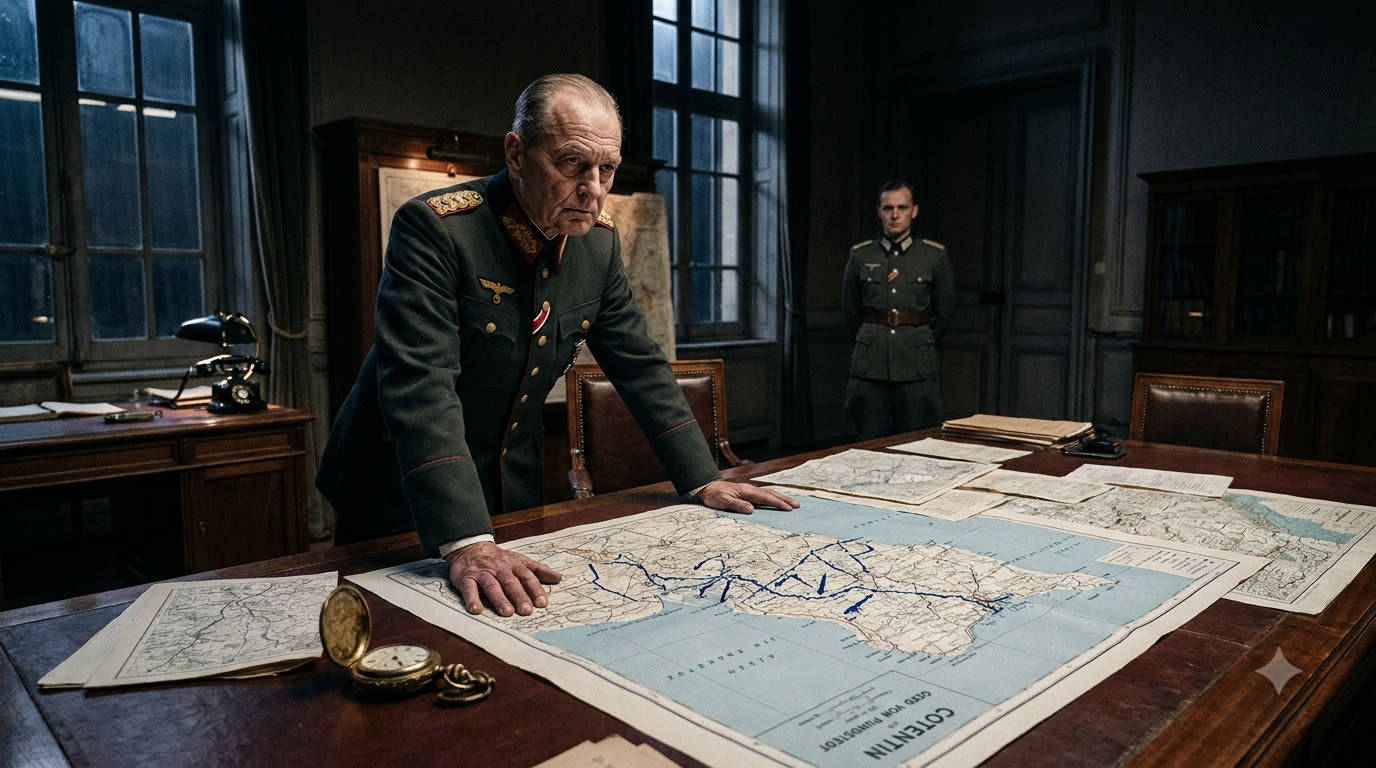
The evening light filtered through tall windows onto maps covered with red and blue markings showing the disposition of forces across Normandy.
Field Marshal Gerd von Rundstedt stared at the jagged blue lines representing Allied positions, his fingers resting heavily on the polished mahogany table.
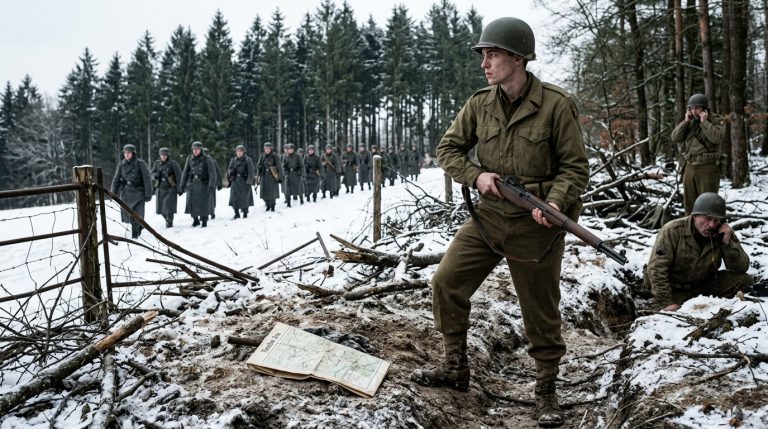
Twenty-five days had passed since the landings on June 6th, and the front was dissolving inch by inch under an unrelenting rain of steel.
Across the room, a junior staff officer cleared his throat, the sound thin and nervous in the quiet space of the grand headquarters at Saint-Germain-en-Laye.
“Another division has ceased to exist on the Cotentin Peninsula, sir,” the officer said, his voice dropping at the end of the sentence.
Von Rundstedt did not look up from the map, his mind calculating the brutal mathematics of consumption versus replacement.
The telephone on the side desk began to ring, a sharp, metallic sound that cut through the heavy silence of the map room.
CHAPTER 2: THE IRON WALL
The telephone receiver remained wedged between von Rundstedt’s ear and shoulder while his thumb absently traced the worn casing of his heavy brass pocket watch.
“The reserves cannot move without a direct order from the Berghof,” the voice crackled through the static, tight with bureaucratic terror.
“They are sitting one hundred miles inland while Allied naval guns chew our infantry down to the bone,” von Rundstedt said, his voice a low, gravelly rasp that refused to raise its pitch.
The staff officer across the room stared fixedly at a red pin marking a shattered division near Caen, unwilling to breathe too loudly.
“Field Marshal Rommel insists every battalion must crowd the waterline,” the telephone wire hummed back, reciting Berlin’s impossible dogma like a shield against reality.
“Rommel is trying to stop an ocean with a wet shovel, and the man in Bavaria is buying phantom armies,” von Rundstedt replied, snapping the brass watch shut with a sharp, final click.
A faint, sickly scent of stagnant bunker air drifted from the hallway ventilation, smelling of damp concrete and old paper.
Von Rundstedt set the receiver down on its cradle without a word of farewell, leaving the distant voice hanging in empty space.
“Get the maps for the southern sector,” he told the quiet room, his eyes fixed on the blue lines advancing across the paper.
CHAPTER 3: THE MOUNTAIN RETREAT
The motorcade had crawled upward for hours through winding switchbacks before finally depositing von Rundstedt at the iron-reinforced gates of the Bavarian redoubt.
Inside the subterranean briefing room, the air was stale and heavy with the chemical tang of prescription sedatives and cheap tea.
General Wilhelm Keitel stood rigidly by the central table, his fingers twitching against the edge of a dispatch folder detailing phantom divisions across the channel.
“The Führer expects complete compliance with the forward defense mandate,” Keitel announced, his voice vibrating with defensive tension.
Von Rundstedt kept his thumb planted squarely on the map crease, feeling the cold fiber beneath his nail.
“Compliance does not patch torn metal, Wilhelm, and telling the maps they are winning does not stop an artillery shell,” von Rundstedt replied, his tone flat and devoid of professional courtesy.
A sudden, sharp rattle echoed from the adjacent corridor as a messenger dropped a stack of casualty manifests onto the stone floor.
Keitel’s eyes darted toward the doorway and back, his jaw tightening into a hard, defensive knot.
“You are failing to grasp the grand strategy of our redeployment,” Keitel snapped, his voice rising an octave to mask a mounting panic.
Von Rundstedt slowly raised his gaze from the map, staring at the younger officer with the heavy, weary patience of a man watching a child argue with gravity.
CHAPTER 4: THE PHANTOM ARMY
Von Rundstedt watched the tip of a blue grease pencil circle a sector north of the Seine where intelligence reports insisted an entire hostile army group was staging.
“General Patton’s forces are massing across the channel at Dover,” the staff officer muttered, reciting the official doctrine like an incantation against panic.
Von Rundstedt pressed his knuckles harder into the wood until his skin turned pale, feeling the phantom weight of divisions that existed only on colored paper in Bavaria.
“There is nothing across that water except fishing boats and empty tents,” von Rundstedt said, his voice dropping into a gravelly monotone.
The radio operator froze mid-stroke, his pencil hovering a millimeter above the paper as if fearing the sound of reality itself.
“The high command insists the primary blow will land at Calais,” the officer whispered, glancing nervously at the double-locked filing cabinet holding decrypted intercepts that no one dared read honestly.
“The blow landed twenty-five days ago, and our armor is still sitting here waiting for a ghost to show its face,” von Rundstedt replied, pulling his heavy brass watch from his waistcoat.
CHAPTER 5: THE STATIC LINE
The afternoon sun cut through a choking haze of diesel smoke and pulverized brick dust hanging over the convoy routes.
Rows of armored personnel carriers sat stranded along the shoulders, their dry fuel tanks baking under an unfiltered summer glare while exhausted crews scavenged for spare parts.
General von Kluge stepped out from beneath a camouflage net, wiping a layer of black grease from his forehead with the back of a bare hand.
“The replacement batteries have been rerouted toward Calais again,” von Kluge said, his voice carrying the brittle edge of a man realizing too late that the machine he joined was broken.
Von Rundstedt stopped beside a rusted fender, his boot heel grinding into the gravelly dirt of the clogged supply road.
“There is nothing waiting at Calais except ghost divisions and empty air, Heinrich,” von Rundstedt replied, his eyes scanning the endless line of motionless machinery.
Von Kluge stared down the empty road toward the interior, his jaw muscles clenching in bitter realization.
“They expect us to hold a crumbling front with willpower and bad maps,” von Kluge muttered, kicking a stray shell casing into the ditch.
Von Rundstedt reached into his coat and let his fingers close around the cold, heavy metal of his pocket watch.
CHAPTER 6: THE FINAL WIRE
Von Rundstedt lifted the heavy receiver off its cradle while his thumb slid across the cool metal casing of his timepiece.
“The high command demands an immediate explanation for the unauthorized withdrawal near Caen,” Keitel’s voice barked through the static, vibrating with frantic desperation.
The room around von Rundstedt remained entirely motionless, the air smelling faintly of old paper and the cold shadow of a collapsing front.
“The front is gone, Wilhelm, and the maps you are staring at are covered in ink and fairy tales,” von Rundstedt said, his voice a low, gravelly rasp that refused to shake.
“You will retract those words or face immediate dismissal for treasonous defeatism,” Keitel shouted over the humming wire, doubling down on the madness of a dying system.
“End the war, you idiots,” von Rundstedt replied, his thumb snapping the brass cover shut with a sharp, final click.
“What else can you do?”
The line went dead, leaving only a low, empty hum vibrating against his ear in the gathering dusk.
Von Rundstedt placed the receiver back onto its rest, his posture settling into an immovable, heavy calm as the weight of decades of service finally slipped from his shoulders.
Outside the tall chateau windows, the European twilight deepened over the silent gardens, stripped of illusions and delivered entirely to the cold, hard touch of reality.