The Iron Horizon: A Neo-Western Chronicle of Legacy, Rust, and the Unspoken Vow
CHAPTER 1: THE WEIGHT OF THE SAUCER
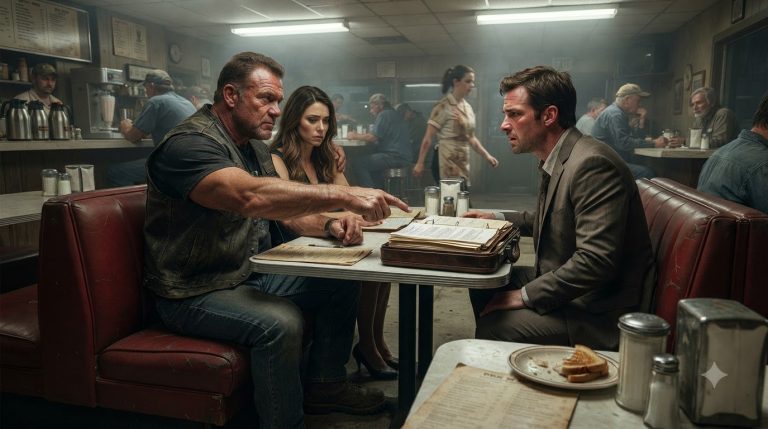
The silver-plated spoon hit the ceramic saucer with a small, rhythmic chime that wouldn’t stop. It was the only light sound in the Redwood Trail Diner; everything else smelled of heavy grease, burnt tater tots, and the low, vibrational hum of five big-twin engines cooling down under the noon sun. The iron-gray dust of Route 9 sat thick on the windowpane, filtering the light into something yellow and ancient.
Cole watched the old man approach. He didn’t look up from his mug—black coffee, three minutes off the boil—but he watched the reflection in the polished chrome of the napkin dispenser. The veteran’s boots were shined, but the leather was splitting across the toe box, showing the grey canvas underneath. Every step looked calculated, a negotiation between arthritic hip joints and the slick vinyl floor.
When the old man stopped at the edge of the booth, the air between them went stiff. The guys on Cole’s left shifted their weight, the leather of their vests groaning like dry saddles. Nobody reached for anything, but the silence became transactional.
“Sir,” Walter Hayes said. He wasn’t looking at the others; his eyes were locked onto the small silver tie-pin Cole wore through his collar—a simple skull with a cross-wrench baseline, rusted at the hinges. “I know this is strange. I know I shouldn’t be asking.”
Cole took another slow draw from the mug. The porcelain was thick, chipped at the rim, tasting faintly of the dish soap Lena used in the back. “You’re standing in the draft, old man,” Cole said. His voice was flat, dried out by three hundred miles of alkali flats.
Walter didn’t move back. Instead, he pressed a manila envelope against his ribs. The paper was dark with sweat where his thumb rested. A distinct scent came off it—not just old pulp, but the sharp, acidic tang of fresh legal toner, the kind used in corporate offices downtown where the dirt didn’t stick to the shoes. “My nephew is meeting me here in about fifteen minutes,” Walter said, his chin twitching once before he clamped his jaw down. “He’s bringing papers. Legal ones. I was told it would be quick, just signatures. But I’ve learned.”
“Learned what?” Cole asked, his thumb tracing the worn edge of his pocketknife through his jeans.
“I’ve learned it isn’t what he says it is,” Walter whispered. The spoon in his other hand rattled against the saucer again, a tiny, frantic telegraph of panic. “I don’t have anyone with me today. Would you… just for today… pretend to be my son?”
Across the table, Tex snorted, a quick puff of air through his nose that died instantly when Cole raised two fingers off the tabletop. The silence came back, heavier this time, smelling of cold iron and old oil.
Cole looked at the envelope. Through the cheap paper, he could see the faint outline of a blue ink stamp—something official, something that looked like a court clerk’s seal, already affixed before the old man had even agreed to sign. It was too clean. It didn’t belong in a diner where the salt shakers were sticky with corn syrup.
“Sit down, Dad,” Cole said. The words were heavy, dropping into the booth like an iron counterweight. He slid his boots back, clearing five inches of gray vinyl. “You look like you’ve been standing too long.”
Walter’s knees didn’t just bend; they seemed to give out, his small frame dropping into the corner of the booth with a dry rustle of poplin fabric. As he settled, the manila envelope slipped an inch, revealing a pre-printed header through the plastic window of the internal sleeve: State Department of Health and Human Services – Verification of Total Incapacity.
CHAPTER 2: THE SHADOW AND THE PEN
The plastic sleeve containing the Verification of Total Incapacity form felt greasy under Cole’s thumb. The blue state clerk seal stamped in the corner wasn’t just a mark; it was an eviction notice printed in a basement office fifty miles away by a bureaucrat who had never smelled the chain-lube and fried onions of the Redwood Trail. The ink was dry, but it looked thick, raised off the cheap pulp paper like a scab.
Beside him, Walter’s small frame stayed frozen, a bird caught in the headlights of an oncoming Peterbilt. The old man’s breath came in short, dry clicks, his ribs shifting against Cole’s leather vest with a rhythmic friction that felt like a dying battery trying to catch a spark.
Then the bell above the entrance didn’t just jingle; it rattled against its iron housing.
Evan Brooks brought the outside heat with him, a blast of dry dust that cut through the diner’s stale grease. His leather briefcase didn’t swing; it stayed pinned against his thigh, the brass latches scratched but bright, catching the yellow light from the window. Behind him, Maryanne’s heels made a sharp, drilling sound on the linoleum—two counts of hard plastic hitting old tile, stopping cold when her eyes hit the corner booth.
Cole didn’t move his arm from Walter’s shoulders. He let the leather stay heavy, a thick horizon of steerhide between the old man and the briefcases. Through the chrome reflection on the salt shaker, he watched Evan’s face do the math. The corporate smile didn’t break; it just went stiff at the corners, the muscles around his jaw tightening until the skin over his cheekbones looked like stretched parchment.
“Uncle Walt,” Evan said, his voice carrying that smooth, oiled cadence of a man who spent his mornings reading probate law and his afternoons collecting interest. He stopped three feet from the table, his fingers adjusting the knot of his silk tie. It was a city tie, blue and unspotted, completely out of place against the grease-filmed wood of the booth. “I thought we agreed this would be quick. The notary is waiting at the branch office, and the traffic on the bypass isn’t getting any lighter.”
Walter’s fingers dug into his manila envelope, the paper tearing slightly under his fingernail with a sound like a dry leaf breaking underfoot. “We aren’t going to the branch, Evan,” the old man said. The tremor was still in his throat, but the pitch had dropped, anchored by the weight of the men sitting on his flanks.
Maryanne took half a step forward, her fingernails clicking against the leather handle of her purse. Her eyes didn’t look at Walter; they measured Tex’s width, then dropped to the grease-blackened knuckles of Cole’s left hand resting on the table. “Walter, we discussed this on Tuesday,” she said, her voice thin, like wire being drawn through a narrow die. “The medical evaluation is already logged. This is just the administrative finalization. It’s for the Cedar Lane property preservation. You know how the county taxes are since the rezoning.”
Cole didn’t let the silence breathe. He reached out with his left hand, his index finger tapping the plastic sleeve on the table, sliding it two inches closer to the edge of the wood. The friction of the plastic against the Formica made a low, scraping hiss. “The clerk’s stamp is dated three weeks ago,” Cole said, his voice flat, a stone dropped into a dry well. “But the signature line for the applicant is blank. That’s a strange way to run an emergency filing.”
Evan’s eyes flicked from the document to Cole’s face, the gray iron of Cole’s hair apparently registering as a different kind of authority than he’d prepared for. “This is private family business, friend,” Evan said, his tone dropping the nephew routine, the corporate metal showing through. “I don’t know who you are, but my uncle has short-term memory deficits documented by the clinic. He needs his family to manage the structural liabilities.”
“He’s got his family,” Cole said evenly. He didn’t raise his voice, but across the table, Tex leaned his elbows on the wood, the heavy silver rings on his fingers making a solid thud against the Formica. The three other riders behind them didn’t stand, but their shadows crossed the table, cutting the yellow light off Evan’s polished shoes. “I’m his son.”
The phrase didn’t just hang; it settled like iron filings on a magnet.
Evan let out a dry, rattling breath that was supposed to be a laugh but ended up sounding like gravel shifting under a boot. “Uncle Walt doesn’t have a son. His boy died in Germany forty years ago. Don’t play games with me, mister. That house is standard estate transition under Section Four.”
“He had two,” Cole said, his thumb finally shifting off the plastic sleeve to press directly onto the table, the iron ring on his finger leaving a faint, grease-ring impression on the wood. “The one you forgot about just got back from the coast. And he doesn’t like the look of your ink.”
Maryanne reached into the open mouth of her briefcase, her hand coming out with a heavy, black-barrel fountain pen—the expensive kind with the gold nib that didn’t skip on legal bond. She didn’t offer it to Walter; she held it like a weapon, the point directed at the space between Cole’s knuckles. “We have the power of attorney provisional activation right here,” she said, her voice rising an octave, the polished veneer fracturing to reveal the dry red clay underneath. “He signs the waiver today, or the state receiver takes the keys on Monday morning anyway. You aren’t fixing this with a leather jacket.”
Cole looked at the pen. He looked at the gold tip, clean and sharp, then up at Evan’s eyes, which had gone wide and dark, calculating the distance between the booth and the diner’s glass door. The air in the room was so dry the smell of the tater tots had turned to pure ash.
“Let me see the waiver,” Cole said.
CHAPTER 3: THE SOUND OF TEARING FIBER
Maryanne’s fountain pen remained frozen in the thick, grease-heavy air of the diner, the gold nib catching a streak of harsh noon light that reflected off the chrome napkin holder. Her hand hovered over the open briefcase, the skin around her knuckles white and strained. Evan didn’t hand the folder over immediately; his fingers twitched against the leather binding, his mind visibly running through the legal math, measuring the five heavy vests blocking his path against the single exit behind him.
Cole kept his palm flat on the scarred laminate of the table, his skin feeling the microscopic grit of old salt and dried road dust. He didn’t look at Evan’s face; he watched the specific angle of the man’s wrists. If Evan bolted, the weight of the briefcase would tilt his left shoulder down first. If he reached inside, the linen of his jacket would rustle against the vinyl booth.
“The waiver,” Cole repeated. His voice didn’t rise, but it carried the low, mechanical rattle of a cold diesel generator settling into its rhythm. “Let’s see what kind of price you put on an old man’s life.”
Evan’s jaw worked silently for three full seconds before he made his move. With a stiff, jerky motion that lacked any of his previous legal precision, he pulled the thick, manila folder from the case and let it drop onto the table. It landed with a dull, heavy thunk, sliding across the sticky Formica until it hit the edge of Cole’s iron ring.
The document inside wasn’t a standard medical release. Even from the top sheet, Cole’s eyes caught the dense, fine-print clauses tucked beneath the official state headers. It wasn’t just about healthcare decisions; hidden under the jargon of Sub-section Eight was a full, immediate liquidation authorization for all physical real estate assets on Cedar Lane, including the tool shed, the small acreage behind the creek, and the structural contents of the main dwelling.
“It’s standard procedure,” Evan muttered, though his heels shifted half an inch backward on the slick tile floor. “The probate court requires a complete asset consolidation before the medical receiver takes over the liability. We’re just avoiding the state tax grid.”
Cole didn’t answer him with words. He reached down, his thick, grease-stained fingers hooking into the top margin of the folder. The fiber was heavy, high-grade bond paper designed to last fifty years in a climate-controlled vault. Cole didn’t hesitate. He twisted his wrists in opposite directions, the muscle in his forearms tightening under his grey-dusted sleeves until the seam of his leather vest pulled taut against his shoulders.
The sound of the first tear was loud, sharp, and dry, like a cedar branch snapping under a winter frost.
Maryanne let out a short, choked gasp, her hand flying to her throat as the golden pen slipped from her fingers, clattering against the Formica before rolling into an old puddle of spilled tea. Evan took a full step back, his polished shoes scuffing hard against the floorboards, his face draining of whatever color the morning sun had given it.
Cole didn’t stop. He folded the shredded halves together, his knuckles turning dark as he applied the full leverage of his shoulders, tearing the stack again. The sound became a rhythmic, grinding crunch of fiber breaking apart—thick legal bond turning into useless gray confetti under the friction of his palms. He didn’t look up until the final handful of shreds dropped onto the center of the table, burying the pre-signed clerk’s seal under a mound of torn margins and fractured paragraphs.
“That’s not happening,” Cole said, leaning back into the corner of the booth, his broad arm returning to Walter’s shoulders. The old man was shaking now, but it wasn’t the frantic tremor of the diner entrance; it was the slow, deep release of a pressure valve that had been jammed shut for six months. “Any doctor you bring near this property will answer to our logistics team. Any county clerk you call will be speaking to an office that doesn’t use your post office box. And you?” Cole met Evan’s dilated eyes, his expression as flat and gray as a slab of highway asphalt. “You’re done with Cedar Lane.”
Evan’s mouth opened, his teeth clicking together once before he found his footing. He didn’t look at his wife; he grabbed the handle of his empty briefcase with a frantic, white-knuckled grip that almost missed the leather entirely. “This isn’t legal,” he whispered, his eyes darting toward the counter where Lena stood with the coffee pot held high like a iron club. “You can’t just destroy a state-noted instrument. We have copies at the firm.”
“Go get them,” Tex said from across the table, his heavy silver rings tapping three times against the wood in a slow, funeral cadence. “We’ll be right here. We like the pie.”
Without another word, Evan turned on his heel, his corporate jacket bunching around his shoulders as he lunged toward the glass door. Maryanne scrambled after him, her high heels making a frantic, uneven clicking on the linoleum that sounded like a wounded animal trying to find cover in the brush. The bell above the door didn’t just jingle as they hit the sunlight; it shrieked against the frame, the small brass tongue striking the iron cup three times before the door slammed shut, cutting off the heat of the road.
The diner stayed under a thick, silent canopy for five long seconds. The only sound was the low, steady tick of the kitchen clock and the ragged, wet rattle of Walter Hayes finally letting go of his breath.
CHAPTER 4: THE ESCORT TO CEDAR LANE
The final echo of the brass bell died against the glass pane, leaving nothing but the dry, rhythmic ticking of the wall clock above the griddle. Walter’s shoulders didn’t un-square, but the frame inside his poplin jacket seemed to shrink, the brittle line of his spine curving back toward the torn vinyl padding. His hand stayed clamped on the manila envelope, his skin the color of old salt under the grease-filmed light.
Cole stood up first. The heavy leather of his vest crackled, the stiff cowhide resisting the motion after an hour in the booth. He didn’t look at the counter where Lena was wiping down the chrome taps with a shaking rag, but his hand dropped onto the table, his grease-darkened knuckles knocking twice against the wood.
“Get your cap, Walter,” Cole said. The voice was flat, carrying the dry rasp of a man who had cleared too many gravel blockades before noon. “The wind’s shifting from the north. It’s going to bring the limestone dust off the quarries.”
Walter reached for his service cap with an unhurried, trembling precision. The wool was faded, the green turning the color of dry moss around the brass insignia, but he set it square on his crown before his boots hit the floorboards. He didn’t look at the mound of shredded bond paper resting in the center of the Formica like an ash heap. He just looked at Cole’s iron ring, then at the heavy boots of the four men rising behind him.
The transition across the threshold was a slow negotiation with the midday heat. The moment the screen door clicked behind them, the smell of burnt grease was replaced by the hot, metallic scent of primary tubes and blistering asphalt. Five big-twin choppers sat in a diagonal line against the curb, their chrome pipes turning deep blue near the cylinder heads from the heat of the run. Next to them, Walter’s old Buick sedan looked like a rusted block of river silt, its paint scoured gray by thirty years of gravel roads.
“I’ll drive the sedan,” Tex said, his voice coming low from behind his beard. He didn’t wait for Walter to answer; he took the heavy iron master key from the old man’s palm, his rough skin making a dry scraping sound against the brass ring. “The linkage on these old Dynaflows gets sticky when the transmission oil gets this hot. You sit shot-gun, old man.”
Cole didn’t mount his machine yet. He stood by the driver’s side of the Buick, his hands tucked into the waist of his belt, watching the far bend of Route 9 where the blacktop disappeared into the scrub pine. The road was empty, but the air carried a thin, chemical vibration—the distant hum of a late-model V8 engine accelerating toward the county line. Evan wasn’t the type to stop at the first crossroads; men with leather briefcases always went back to the office to check the property maps before they tried a second gate.
“We go by the old creek road,” Cole called out to the three riders checking their primary chains. “Avoid the bypass. The gravel’s loose near the bridge, so keep the speed down to forty. I don’t want anyone throwing a stone through Walter’s glass.”
The engines didn’t fire with a roar; they caught one by one, a low, mechanical thunder that started in the ground before it hit the air. The vibration beat against Cole’s shins as he kicked his own starter pedal down, the iron arm resisting his boot for a split second before the cylinder caught, spitting a blue plume of oil smoke into the dry weeds by the ditch.
The journey to Cedar Lane was an exercise in real-time friction. The Buick led, its rusted exhaust pipe rattling against the rear bumper with a dry, metallic clatter every time Tex shifted gears. Cole rode three feet off the left rear quarter-panel, his front tire tracking the white line where the asphalt was crumbling into the dirt. Behind him, the other three choppers formed a tight triangle, their wide handlebars blocking the lane, forcing the occasional logging truck to drop its speed to a crawl.
Through the scoured rear glass of the Buick, Cole could see the back of Walter’s head. The green service cap didn’t move; the old man sat perfectly straight against the faded fabric of the seat, his eyes locked onto the road ahead as if he were riding the lead personnel carrier through an unsecured valley. He didn’t look back at the highway they were leaving behind.
By the time the convoy turned onto the hard-packed dirt of Cedar Lane, the sun had passed its apex, turning the pine needles into a dark, brittle carpet that smelled of turpentine and dry earth. The lane was narrow, the low branches of the scrub oaks scraping against Cole’s leather sleeves with a dry, rhythmic hiss. The house at the end of the track didn’t have a lawn; it sat on a bed of gray gravel, the timber siding turned the color of an old horn by seventy years of frost and limestone dust.
Tex brought the Buick to a halt three feet from the front porch, the brakes giving a long, high-pitched squeal as the iron drums heated up. The engine died with a wet, heavy cough, the fan belt whistling once before the silence of the woods came back, thicker than it had been at the diner.
Cole dropped his kickstand into the gravel, the iron foot sinking two inches into the loose stone before it found the hard clay beneath. He didn’t take his helmet off; he just unbuckled the strap, his eyes scanning the perimeter of the small yard—the rusted pump handle by the well, the sagging wire of the wood-lot gate, and the small, dark space beneath the porch where the pine needles had drifted three feet deep.
Walter didn’t get out immediately. He waited until Tex opened the heavy door, his old boots finding the gravel with a small, unsteady crunch that sounded remarkably like the papers tearing back at the Redwood Trail.
CHAPTER 5: SECURING THE PERIMETER
The gray gravel gave under Walter’s heel with a dry, grinding resistance that seemed to take the last of the afternoon’s momentum with it. The old man stood between the open sedan door and the splintered edge of the porch, his hand resting on the Buick’s hot roof panel, his fingers leaving small, pale smudges in the scoured dust. The heat off the engine compartment shimmered in waves, warping the straight lines of the weathered timber siding behind him.
Cole didn’t wait for Walter to collect his breath. His heavy boots cleared the gravel with a crunch that was wider, more deliberate. He walked past the Buick’s bumper, his eyes already tracking the perimeter lines where the property met the dense growth of scrub pine and blackberry brambles.
“Tex, stay with him on the wood-lot side,” Cole said, his voice dropping into the quiet of the woods like a heavy chain falling into loose sand. “Check the shed door. If the padlocks are the old brass ones from the cooperative, swap them out for the case-hardened steel pins from my tool pouch.”
Tex didn’t nod; he simply hooked his thumbs back into his belt and shifted his weight toward the side yard, his wide shadow falling across the Buick’s cracked windshield.
Cole moved toward the back door, his boots finding the narrow flagstone path that had been nearly swallowed by wild clover and dry pine needles. The friction of his leather sleeves against the low-hanging oak branches made a sharp, dry rasp. Every five feet, he stopped, his jaw tightening as he measured the distance from the road to the house’s blind spots. It was a habit carved into his shins by three winters of tracking perimeter fences in the upper valley—you didn’t look at the gates; you looked at where the wire had been clipped and spliced back together with rusted baling twine.
When he reached the small, square latch that led to the crawlspace beneath the kitchen floor, he stopped.
The iron latch was old, coated in a thick, flaky skin of dark orange rust that usually took a solid kick to dislodge. But today, the metal was clean at the hinge. A distinct patch of dark clay had been freshly turned right beneath the rim of the cedar sill, the damp earth showing deep spade marks that hadn’t been dried out by the midday wind yet. Tucked an inch into the loose soil was a tiny, shredded fragment of red plastic marking tape—the heavy, commercial grade used by municipal survey crews when they laid out new easement stakes for the county road extension.
Cole knelt, the leather of his trousers straining against his kneecaps as he pressed his thumb into the turned clay. The earth was cold three inches down, holding the moisture of the creek bed. He pulled the red scrap out, the plastic crackling between his fingers with a dry, chemical sound. Evan hadn’t just been printing waivers at the office; he’d already had a crew out here measuring the boundaries before the old man even had his Thursday soup.
“Cole,” a voice called out from the front of the house. It was Walter, his cadence dry but distinct, carrying that old infantry clip that didn’t allow for extra syllables. “The gate hinge is down. The wood’s rotted through the lag bolts.”
Cole stood up slowly, slipping the red fragment into the small watch pocket of his vest where it sat against his knife casing. He walked back around the kitchen corner, his boots tracking the dark clay onto the gray gravel of the main yard.
Walter was sitting on the second step of the porch now, his green service cap resting on his knee, his white hair cropped close and neat against the dark grain of the cedar logs. Beside him, one of the riders—a quiet kid named Rooster—was kneeling by the post of the perimeter gate, his hands greasy from a small tube of graphite lubricant he’d pulled from his saddlebag. The heavy iron gate was hanging at a five-degree tilt, the bottom rail dragging a deep, semi-circular groove into the dirt every time the wind caught the pickets.
“The wood’s soft from the rain last November,” Rooster said without looking up, his fingers working a fresh three-inch lag screw into the dry grain of the timber with an old stubby wrench. The metal made a rhythmic, dry clack-clack-clack as the threads bit into the heartwood, forcing a small spiral of yellow shavings out onto the gravel. “It’ll hold for now, but if someone puts their weight on it, the whole post is going to split down the seam.”
“Double the bracket,” Cole said, stopping at the base of the steps. He looked down at Walter, whose pale eyes were fixed on Rooster’s greasy fingers. “We’ve got two lengths of iron channel-strap in the truck bed back at the shop. I’ll have Tex bring them out tomorrow morning before the noon run.”
Walter didn’t thank him. He didn’t offer any of the polite, empty phrases that city folks used when someone fixed their fences. He just reached into his shirt pocket, his old fingers pulling out a small, nickel-plated pocket watch with a cracked crystal. He wound the crown three times, the internal spring giving a faint, dry click with every turn.
“They’ll be back on Tuesday,” Walter said, his voice flat, his gaze shifting back toward the narrow mouth of the lane where the pine shadows were starting to stretch across the dirt road. “The tax assessment notice comes on the first of the month. Evan always handles the mail from the town box.”
“The town box has a new lock on it as of one o’clock today,” Cole said, his hand dropping onto the wooden newel post of the porch, his palm feeling the rough, sun-checked splinters of the pine. “And the key stays in my pouch. Sit tight, Walter. The fence is up.”
CHAPTER 6: THE EMERGENCY CONTACT
The cold grease on the iron newel post left a gray smudge across Cole’s palm as he released his grip. The shadows of the scrub pines had fully reached the porch steps now, burying Rooster’s fresh cedar shavings under a dull, violet dark. The small pocket watch in Walter’s hand snapped shut with a sharp, brassy ping that seemed to signal the official departure of the daylight.
Cole didn’t mount his chopper until the tools were fully cleared from the gravel. He reached into his internal vest pocket, his fingers passing over the small watch pocket containing the scrap of survey tape, and pulled out a heavy, black-cased prepaid telephone. The plastic casing was thick, ribbed for a solid grip, and completely stripped of branding—a simple tool from the commercial hardware store down in the flats.
“There’s one number programmed,” Cole said, his boots striking the gravel as he stepped toward the first porch riser. He held the brick of plastic out by its corners, not letting his skin cover the single, raised green button in the center of the pad. “You press it, the receiver in the back room of the shop rings. Someone answers. Doesn’t matter if the frost is on the glass or the sun’s up.”
Walter looked at the phone for three full seconds before his hand moved. His fingers, stiffened by seventy winters and the damp lime dust of the county, closed around the plastic with a dry, papery friction. He didn’t thank Cole; he just slipped the block into his flannel shirt pocket, right behind the stiff fabric of his service cap where the shape of it flattened out against his ribs.
“The wind’s coming out of the bottom-land tonight,” Walter muttered, his eyes tracking the red taillights of Tex’s Buick as the big sedan crawled toward the narrow neck of the lane. “The pipes in the crawlspace like to rattle when the pressure drops.”
“They won’t rattle long,” Cole said. He kicked his starter arm down, the engine catching with a single, heavy thud that vibrated through the steel stirrups of his footrests before settling into an iron idle.
The next three days came with the slow, grinding indifference of an un-greased axle.
Cole stayed in the main bay of the shop, his knuckles black with primary chain oil as he ran the legal logistics through the county probate log. The digital records on the screen were clean, but the physical ledger down at the district office still carried the name of the old receiver firm Evan Brooks used for his estate assessments. It was a cold game played with paper filings and administrative quiet—no one came down the lane with an iron crowbar, but the county tax map had already been updated with a small yellow dot right where the Cedar Lane crawlspace latch sat in the clay.
On the fourth morning, the temperature in the valley dropped ten degrees before the fog could clear the ridge.
Cole was adjusting the tappets on an old shovelhead cylinder when the secondary line on the workbench began to buzz. It wasn’t a bell; it was a short, rhythmic vibration that made the brass washers in the parts bin dance against the galvanized steel. He didn’t wipe the grease off his palm before he lifted the receiver.
“Walter,” Cole said.
There was a five-second canopy of pure static over the line—the sound of water rushing through a narrow aperture, followed by the heavy, metallic clang of an iron wrench striking a wet floorboard. Walter’s breath came through the speaker in ragged, wet clicks.
“The union joint under the sink gave out,” the old man said, his voice stripped of its infantry clip, leaving nothing but the brittle edge of an eighty-year-old framework trying to hold back a river. “The copper line… it’s split down the seam where the frost hit it last winter. The cellar step is submerged.”
Cole didn’t ask how many inches had cleared the sill. “Stay on the porch, Walter. Keep your boots out of the lime mud.”
He dropped the receiver onto the bench before the connection could clear. He didn’t look for Tex; he grabbed a heavy pipe-wrench from the wall rack—a twenty-inch length of cast iron with teeth scoured white by ten years of hard threading—and unhooked the master key bundle from his belt loop.
The run back to Cedar Lane was twenty miles of gray asphalt turned slick by the low-hanging valley mist. Cole kept the chopper at sixty, the front tire throwing a steady plume of cold road water against his leather chaps until the hide turned the color of wet river silt. The wind off the quarries tasted of wet stone and sulphur, cutting through his collar until his jaw felt like a piece of rusted iron.
When he turned the chopper into the narrow lane, the Buick was already parked by the wood-lot gate, its exhaust pipe coughing a pale, white cloud of condensation into the scrub oaks. Tex was already on his knees by the kitchen entrance, his heavy shoulders wedged into the narrow cellar opening, his leather vest scraping against the cedar sill with a wet, heavy friction.
“The main valve is jammed with lime deposit,” Tex called out from the dark, his voice muffled by the floor joists. “I can’t get the iron handle to turn without snapping the pipe off at the main meter. We need the big jaw.”
Cole didn’t speak. He dropped his boots into the wet clay by the crawlspace, his knees sinking two inches into the turned earth where he’d found the red survey tape three days before. He slid the twenty-inch iron wrench into the gap between Tex’s ribs, his fingers finding the greasy adjusting screw in the dark by touch alone.
The metal met the pipe with a sharp, solid clink that echoed through the empty kitchen above. Cole braced his heel against the foundation stone, his forearm muscles tightening until the old scar across his wrist turned a dark, bright purple under the grease. The rust inside the valve didn’t give easily; it resisted with a low, groaning screech that sounded like an old train wheel breaking on a curve.
Then, with a sudden, wet snap, the iron wheel turned. The rushing sound of the well pump died instantly, replaced by the slow, rhythmic drip of cold water hitting the mud five feet below the floorboards.
Cole pulled his shoulders out of the gap, his face grey with limestone dust and wet soot. He stood up slowly, his boots sucking out of the clay with a heavy, wet pop. Through the screen door of the kitchen, he could see Walter sitting in the wooden chair by the dead stove, his green service cap held between his knees, his old fingers tracing the silver rim of his empty tea saucer in the quiet gray light.
CHAPTER 7: THE CURRENCY OF CHILI
The cold grease from the basement valve clung to Cole’s knuckles as he pulled his tall frame through the low kitchen doorway. Walter didn’t look up immediately; his right index finger maintained its slow, repetitive loop around the chipped silver plating of the saucer, the metal making a tiny, scratchy click every time it passed the split rim. The kitchen smelled of iron, wet floorboards, and the cold, damp soot that always rose from the crawlspace after a winter leak.
“The main line’s dry,” Cole said, his voice grating out into the quiet room like a shovel hitting dry clay. He reached into his vest pocket, pulled a clean rag from his tool roll, and began working the dark grease out of the lifelines of his left palm. “The union joint is braced with a steel sleeve. It’ll hold until the hardware store gets the three-quarter inch galvanized couplers on the Tuesday freight.”
Walter’s hand finally stopped its loop. He cleared his throat, a dry, rattling cough that shook his narrow rib cage under the flannel shirt. “There’s a pot of red beans and chuck on the back burner,” the old man said, his eyes flicking toward the black iron Dutch oven sitting on the cold ring of the stove. “Made it yesterday before the pressure fell off the well. It’s got enough tallow to keep the cold out of your shins.”
Cole didn’t say no. He hung his grease-filmed jacket over the back of the pine chair by the door, his boots making a heavy, dull thud against the wide floor planks as he moved toward the counter. The wood beneath his fingers was deeply grooved, scoured by decades of yellow lye soap and rough steel wool until the grain stood up in white ridges.
By the time Tex came up from the cellar hole with the iron wrenches, Walter had three tin plates laid out on the table. The chili was thick, dark as well-bottom mud, smelling of dried cayenne peppers and the sharp, gamey fat of grass-fed beef. Nobody spoke while the iron spoons cleared the first layer of grease off the plates; in the timberlands, dinner wasn’t an exchange of phrases—it was a maintenance routine for the body.
It was Tex who broke the rhythm, his spoon clattering against his plate as he leaned back, his wide shoulders blocking out the pale grey light coming through the small window pane. “The nephew’s office called the shop line an hour before we came out,” Tex said, his thumb working a stray piece of grit out of his beard. “They aren’t filing the incapacity waiver yet. But a title search clerk was down at the registrar’s cage this morning asking for the original homestead charter from forty-six.”
Walter’s spoon stopped three inches above his plate. A single drop of dark red tallow fell back onto the tin with a soft, wet splat. He didn’t look at Tex; he looked down at the small iron latch of his personal lockbox sitting on the low shelf beneath the breadboard. The box was an old military surplus container, its olive paint flaking off in dry, green scabs that revealed the pitted grey steel underneath.
Cole’s eyes followed the old man’s gaze. Through the unlatched seam of the iron box, a corner of white bond paper was visible—not the legal blue of the state waivers, but a crisp, linen sheet bearing the stamped watermark of Vanguard Land & Mineral Trust. The date on the visible margin was three years old, well before Evan Brooks had started his Thursday diner visits.
“They’re looking for the timber rights on the upper creek,” Walter said, his voice dropping into that quiet, rhythmic cadence he used when the memories came back too fast. “My father didn’t just sign the surface rights when he built the sill. He kept the deep iron and the pine limits under a separate stone marker near the ridge. Evan found the surveyor’s journal in my sister’s attic after the funeral.”
Cole didn’t ask to see the linen paper. He reached down, his thumb tracing the worn edge of his pocketknife casing through his jeans, his mind silently calculating the layout of the upper ridge where the red survey tape had been buried. The decoy secret was clear now—the nephew wasn’t just after a place to put an old man in a chair; he was clearing the title for a commercial limestone quarry extension that had been stalled at the county line since the winter of ninety-eight.
“The marker’s still there,” Cole said, his eyes locked on the old man’s pale, steady gaze. “The limestone company doesn’t cross the creek until the state confirms the receiver signature. And we haven’t signed the book.”
Walter took a slow sip of his black tea, his teeth clicking faintly against the tin rim of his mug. “The winter I turned nineteen,” the old man said, his eyes drifting toward the cold stove pipe, “we spent three weeks in the Ardennes forest clearing frozen hemlock with two-man crosscuts. If you didn’t keep the blades oiled with lard, the resin would freeze inside the teeth until the steel snapped like glass. You didn’t talk about the cold; you just kept the saw moving because the man on the other end of the wood was counting on the stroke.”
Cole didn’t answer. He reached across the table, picked up the iron ladle, and dropped another heavy portion of the dark meat onto Walter’s plate, the thick sauce burying the silver rim of the saucer entirely.
CHAPTER 8: THE LEGAL BACKBURNER
The ladle came down with a heavy, greasy smear that completely obscured the remaining silver filigree on the rim of Walter’s saucer. The kitchen table stayed perfectly still under the extra weight, its thick pine legs dug deep into the grit that had collected between the floorboards. Across the room, the unlatched mouth of the iron military lockbox seemed to widen in the fading grey light, the crisp linen paper inside catching the dull reflection of the cold iron stovepipe.
Cole watched the old man’s thumb return to the edge of his fork. It was small, the skin translucent enough to show the blue, twisting lines of the veins beneath, but it didn’t shake. Seeing that hand—stubborn, dry, holding the tin tool against the porcelain—tripped a sudden, cold lever in the back of Cole’s chest. The smell of the grass-fed lard in the chili vanished, replaced by the sudden, memory-stale scent of industrial floor wax and generic lime bleach. He was thirty-two again, standing in the basement corridor of the county farm on the lower flats, watching a state clerk run a grey rubber eraser over a ledger line that had carried his father’s initials for less than nine months. They hadn’t called the shop until the cot was already stripped down to the blue ticking.
“Tex,” Cole said, his voice dropping an octave until it hit the resonance of the iron kettle on the griddle. “Go down to the creek crossing before you turn the Buick back toward the state line. If the title company had a crew at the registrar’s window, they’ve already got a truck parked near the limestone section marker.”
Tex stopped his spoon mid-arc, his gray beard dark with beef fat. He didn’t look at Walter; he looked at the specific way Cole’s left index finger was pinned against the wood. “The county surveyor’s jeep has been running the north boundary since the hard frost on Monday,” Tex muttered, his voice flat as a gravel bed. “Rooster saw their orange stakes tucked into the brush behind the old lime kiln. They aren’t waiting for Tuesday’s court call.”
Walter didn’t raise his eyes from the tin. “The kiln hasn’t burned a stone since fifty-two,” he said, his cadence slowing down to that heavy, rhythmic infantry pace. “My brother and I hauled the last three tons of grey slag down to the cooperative using the mule team. The deed has a boundary waiver clause under Article Nine—if the state road team widens the culvert by the bridge, the township takes the right-of-way but the deep mineral core stays with the primary line.”
Cole stood up from the bench, the leather of his trousers making a loud, dry protest against the pine wood. He didn’t touch the lockbox, but his boots tracked a thin trail of dry lime mud across the floorboards until he reached the small window pane facing the ridge. The glass was cold against his forehead, grease-filmed from forty years of kitchen smoke, but through the yellowed distortion, he could see the far line of the scrub pines turning black against the winter sky.
The decoy was failing. Evan Brooks wasn’t just working the probate desk to secure a quick signature for the timber lot; he’d already tied the homestead’s title to a larger municipal infrastructure bond that required the local drainage easement to clear before the state highway department would release the construction funds for the bypass. The asset transfer form Cole had torn up at the diner wasn’t the primary trap—it was just the clean-up tool to keep the old man from filing an injunction once the bulldozers hit the lime kiln.
“They’re going to use the tax lien clause from the ninety-eight assessment,” Cole said, his hand dropping to the iron latch of the kitchen screen door. The metal was cold, covered in a gritty layer of grey frost that bit into his palm. “Evan’s firm didn’t buy the debt from the bank. They bought it directly from the county treasurer’s office during the private sale after the flood.”
Tex set his tin plate down with a solid, metallic clink that made the salt shakers rattle. “That means the thirty-day redemption window closed when the old man was in the VA ward for his hip.”
“It means the title’s already split,” Cole said, his thumb lifting the screen latch with a sharp, dry click. He didn’t look back at the table. “The surface is Walter’s until Monday noon. But the dirt underneath belongs to whoever holds the clerk’s receipt from the courthouse basement.”
Walter didn’t look up from his plate, but his fingers tightened around the handle of his fork until the tin prong bent half an inch against the wood grain. Outside, the first low hum of a late-model V8 engine began to drift through the pine branches from the direction of the bridge road—not fast, but steady, zeroing in on the lane with the slow, mechanical confidence of a machine that had already cleared the gates.
CHAPTER 9: PORCH LIGHT VIGNETTES
The wire-mesh of the screen door vibrated beneath Cole’s thumb, a steady, mechanical chatter that matched the low-frequency rumble of the car idling out past the tree line. The headlights didn’t hit the porch directly; they threw long, sweeping bars of yellow across the high pine canopy, catching the frozen mist until the air looked like spinning glass.
Cole didn’t let the latch drop. He kept his boots planted on the top cedar step, his skin feeling the sharp, intense bite of the mountain frost sinking through his boot soles. Behind him in the kitchen, the tin fork in Walter’s hand stayed perfectly still, pinned against the scarred grain of the table by five stiff fingers.
“Tex,” Cole said, his voice dropping into that quiet, gravelly register that didn’t travel past the edge of the roofline. “Kill the lantern in the corner. If they’re running the boundary with the high beams, they’re looking for a surveyor’s pin, not a fight.”
The small glass globe on the kitchen shelf went dark with a short, smoky pop as Tex turned the brass key. The sudden absence of the yellow flame brought the winter sky down onto the gravel yard, turning the Buick’s rusted hood into a flat sheet of blue steel.
The car out on the road didn’t turn down the lane. It slowed to a dead crawl at the bridge culvert, its heavy tires crunching over the loose shale of the road shoulder before its headlights swung thirty degrees north, cutting toward the old lime kiln. The sound of the engine was thick, choked by a heavy factory muffler—the specific, expensive thrum of a county municipal cruiser or an assessment unit from the district engineer’s pool.
Cole watched the tail-lights disappear behind the scrub oaks, their red glare staining the dark brush like dried tallow before the blackness came back. He let his thumb slide off the frosted iron latch, the wire screen snapping shut against the cedar frame with a small, flat slap.
He didn’t go back to the table. Instead, he pulled an old wooden crate from the wall—a rough, iron-bound box that had once held tractor pins—and sat down near the porch railing. His leather vest was stiff, the cold hide turning into a solid piece of armor that resisted the curve of his ribs as he leaned back against the support post.
Walter came out five minutes later. His boots didn’t crunch on the boards; they shuffled with a slow, practiced rhythm, his small frame draped in an old army wool blanket that smelled of cedar chests and dry mothballs. He didn’t sit on the steps; he stood by the railing, his pale eyes tracking the cold mountain wind as it whipped through the dry grass by the well pump.
The silence between them wasn’t the kind that needed filling with town gossip or legal talk. It was the heavy, transactional quiet of men who spent their lives measuring distance by the weight of their packs or the length of the road ahead. Every few minutes, the old iron pump handle would give a tiny, frozen creak as the internal leather gaskets contracted in the frost.
“My father bought this timber lot off the cooperative for four hundred dollars in silver,” Walter said, his voice coming out so thin it was nearly swallowed by the rattle of the pine needles. He didn’t look at Cole; his eyes stayed on the black shape of the lime kiln ridge. “He didn’t use a lawyer. He used a three-pound branding iron and a stone marker by the creek. The state registry didn’t keep books back then; they just kept a map in the leather case behind the sheriff’s desk.”
Cole reached into his internal pocket, his fingers finding the rough edge of his pocketknife. He didn’t open the blade; he just ran his thumb over the rusted hinge, feeling the friction of the old steel against his skin. “The maps changed when they put the railroad line through the lower valley,” Cole said, his gaze fixed on his own boots. “They ran the tracks right through the middle of my grandfather’s orchard because the clerk downtown used a different colored ink for the township lines. He didn’t come out to look at the trees. He just drew the black line where the grade was flat.”
Walter’s shoulders shifted beneath the olive wool, his fingers tightening around the blanket’s frayed edge. “The line stays where the stone is,” the old man whispered. “Evan thinks the paper is the truth because it’s got a gold stamp on it. But the dirt doesn’t care about the stamp. The dirt remembers the spade.”
They sat together until the moon cleared the high ridge, its light turning the gray gravel into a solid floor of white salt. Neither of them moved when the timber wolves started calling from the upper creek bed—a long, dry wail that carried the cold of the limestone quarries across the flats. They just watched the lane, their breaths forming small, twin clouds of gray steam that rose into the dark pine branches and vanished before they could freeze.
CHAPTER 10: THE GUARDED CORRIDOR
The moon cleared the serrated edge of the limestone ridge, turning the frosted gravel of the yard into a blinding sheet of white salt that seemed to sap the remaining heat from the timberlands. The last traces of gray steam from Walter’s breath froze against the wool collar of his army blanket, leaving tiny, brittle needles of ice that didn’t melt. Beside him, Cole stood up from the wooden tractor pin box, his leather vest crackling as the frozen cowhide resisted the sudden, heavy expansion of his chest.
“The air’s dropped another five degrees,” Cole said, his voice grating out into the white dark like iron slides on an ungreased rail. He looked down at the Buick sedan. The scoured metal of the hood was covered in a thick, crystalline fur of white rime that had completely swallowed the red tint of the primer coat. “Tex, kick the starter on the sedan. If the block freezes solid before we hit the county line, the oil rings are going to snap when the starter motor draws.”
Tex stepped off the lower porch riser, his heavy boots sinking into the loose, crusted gravel with a sharp, hollow crunch. He unhooked the master brass ring from his belt, rammed the iron key into the door cylinder, and twisted. The lock didn’t click; it gave a dry, frozen squeal as the internal tumblers fought the white moisture that had seeped into the frame after sundown. When he finally forced the door open and hit the ignition button, the starter didn’t turn the engine over—it gave a single, flat thud, followed by the thin, frantic clicking of a distributor cap shorting out against the cold block.
“The moisture in the cap turned to frost,” Tex called out, his gray beard venting a thick cloud of steam into the open engine bay. “The carbon pin’s split down the middle from the thermal shock. We aren’t moving the sedan until the sun hits the iron on Tuesday morning.”
Cole didn’t double-check the wire. He walked down the steps, his hand sliding along the split grain of the railing until his boots hit the hard-packed clay by the Buick’s front tire. The iron wrench in his pocket felt like a block of ice against his hip, its weight dragging at the leather seam. “Rooster, double up on the choppers,” Cole ordered, his eyes locked on the narrow throat of the lane where the scrub oaks were cracking under the weight of the ice. “We take the old quarry track. The gravel’s wider there, and the wind doesn’t drift the pine needles across the ruts.”
But before Rooster could kick his starter arm down, a wet, rattling cough came from the top step.
Walter hadn’t moved from the porch railing, but his small frame was leaning heavily against the cedar post, his fingers hooked into the splintered wood to keep his knees from buckling into the wool blanket. His breath didn’t form a steady cloud anymore; it came in short, shallow gasps that caught in his throat with a dry, whistling rattle—the unmistakable, fluid sound of congestion locking down an old man’s lungs after three hours in the mountain draft.
“Walter,” Cole said, his boots clearing the gravel in three long strides until he reached the base of the steps. He didn’t look at the old service cap; he looked at the gray, sunken skin around Walter’s jawline. The flesh was cold, translucent as lard under the moonlight.
“The creek… it’s rising under the floor,” Walter whispered, his eyes dilated, looking past Cole toward a road that hadn’t been open since the winter of forty-four. His hand came off the post, his fingers twitching in a slow, phantom loop as if he were trying to find the silver rim of a saucer that wasn’t there. “The sergeant said… we don’t dump the grease in the snow. It brings the wolves down from the ridge.”
Cole didn’t ask Tex for the truck keys. He reached up, his thick arms sliding beneath the wool blanket, hoisting Walter’s narrow frame off the cedar planks before the old man’s boots could hit the frost. The veteran didn’t weigh more than a bundle of dry hemlock sticks, his ribs clicking against Cole’s leather vest with a frantic, shallow vibration that felt like a machine running out of oil.
“Get the big bike,” Cole shouted to Tex, his jaw locked tight against the wind. “We don’t wait for the county ambulance to clear the bypass. Wrap him in the second hide.”
The transition into the hospital corridor two hours later was a blur of fluorescent glare and the clean, stinging scent of chemical bleach that made the back of Cole’s throat taste like zinc. The rubber tires of the gurney made a long, screaming hiss against the white linoleum as the orderly wheeled Walter through the double doors of the west wing, leaving Cole and Tex standing in the small alcove by the admissions cage.
The clerk behind the glass was young, her fingers tapping a black plastic pen against a stack of entry forms that carried the blue header of the state welfare receiver pool. She didn’t look at Cole’s face; her eyes stayed locked on the dark grease smudges on his leather sleeves and the gray lime dust that had dried into the wrinkles of his boots.
“He needs a provisional guarantor signature before we allocate the private room,” she said, her voice carrying that flat, administrative drone that didn’t change for the frost or the dead. She slid a clipboard through the slot in the glass, her fingernail tapping the line marked Responsible Party – Next of Kin. “The Brooks firm called from the town office on Friday afternoon. They said if Walter Hayes was admitted for respiratory distress, the state receiver would handle the structural billing under the provisional tax lien.”
Cole looked down at the paper. Through the small plastic window of the clipboard sleeve, he could see the tiny stamp Evan had left—the neat, blue circle of the District Probate Clerk, already authorized for emergency asset escrow.
Cole didn’t take the pen she offered. He reached into his vest pocket, his thumb passing over the watch pocket with the red survey tape, and pulled out his own black grease-marker—the heavy, industrial wax pencil he used to mark tire sizes on the shop floor. He pressed the thick black point onto the white bond paper, his hand moving with a slow, heavy pressure that ripped the top layer of pulp as he wrote his own name across the next-of-kin block, burying Evan’s blue seal under a thick, black line of solid wax.
“The Brooks firm is off the book,” Cole said, his voice dropping into the quiet alcove like an iron bar hitting a concrete floor. He leaned against the glass, his broad shoulders blocking the light from the corridor behind him. “Tell the administrator that if anyone else comes in here with a leather briefcase asking about the Cedar Lane estate, they’ll be talking to the logistics manager for the Iron Serpents. And we don’t do our filings by mail.”
The clerk didn’t look up again. She took the clipboard back, her fingers moving fast to file the page under the grey steel divider before the black wax could smudge her clean desktop. Behind the glass, the small clock on the wall gave a sharp, dry click as the minute hand dropped to midnight, locking the entry into the logbook where the paper couldn’t be torn out.
CHAPTER 11: THE GOLDEN BURN
The sharp click of the wall clock hand dropping past midnight left a small, dry vibration in the glass of the admissions cage. The young clerk’s fingers didn’t stay on the grey steel divider; she pulled her hand back as if the black industrial wax Cole had left on the registration form carried a heat she hadn’t anticipated. Cole didn’t look back at the double doors where Walter’s gurney had disappeared. He stood perfectly still in the narrow alcove, his boots tracking two dark circles of damp limestone grit onto the white floorboards.
The years didn’t pass with a leap; they accumulated like the layers of dark rime on the old Buick’s manifold back on Cedar Lane. Five separate winters came down from the northern gap, each one dropping three feet of heavy limestone dust and wet shale across the lane until the track was wider, harder, and scoured clean of the orange surveyor stakes Evan Brooks had left in the brush. The anonymous report Cole had logged with the district board hadn’t stayed on the back-burner; it had moved through the probate registry with the slow, crushing weight of a hydraulic ram, tracing the pre-signed seals back to a private ledger box in the courthouse basement until Evan’s firm sold its brick facade and moved past the state line.
On this autumn afternoon, five years after the glass door of the Redwood Trail Diner had slammed shut against the highway heat, the wind off the quarries didn’t carry the frost. It carried the dry, sweet scent of burning poplar leaves and hot engine oil.
Cole sat on the second step of the Cedar Lane porch, his back resting against the same iron-bound tractor box he’d pulled from the wall during the first hard freeze. His leather vest was unbuckled, the heavy hide showing deep, grey creases across the ribs where the road salt had dried into the seams. Next to him, Walter sat in the low pine rocker, his green service cap resting flat on his left knee. The old man’s frame was thinner now—the skin over his cheekbones looked like dry butcher’s paper—but his eyes were clear, holding the reflection of the gold trees across the creek bed.
“I only asked you to pretend,” Walter said. His voice was softer than it had been during the winter of the leak, the old infantry clip replaced by a slow, dry rattle that matched the ticking of the leaves against the gravel. He didn’t turn his head; his fingers maintained a steady, light pressure against the arm of the rocker. “Just for that one afternoon while the notary was sitting at the branch bank. I didn’t have five dollars to put into your fuel tank.”
Cole reached down, his thumb finding the worn brass hinge of his pocketknife. He didn’t lift the blade; he just cleared a small wedge of dry lime dust out of the slot with his thumbnail. “We’re bad at pretending, Walter,” Cole said, his gaze staying on the far turn of the dirt track. “The shop line doesn’t run on provisional signatures. If you give a man a tool, you stay until the job is out of the lathe.”
Walter chuckled, a dry, papery sound that didn’t bring the congestion back into his ribs. “You gave me more than a signature, boy. You gave me the three-acre lot without the county receiver sitting on the well-head.”
Cole didn’t answer him with a speech. He looked down at the gravel where a single, rusted washer from Rooster’s old tool kit lay embedded in the clay. Seeing the round piece of iron—pitted, brown, losing its edges to the rain—brought the sterile smell of the hospital alcove back into his nose for a split second, but the gray shadow of the county home didn’t catch this time. The black wax line he’d drawn across the next-of-kin block had stayed in the book. His father had died behind a grey screen with a number tagged to his ankle because Cole had been three hundred miles down the coast running a freight haul for twenty dollars a day; he hadn’t known the name of the receiver clerk until the registry was already closed. But Walter’s cap was still on his knee.
The low, mechanical thunder started at the bridge culvert before the sun could drop behind the limestone quarry. It wasn’t the fast, screaming pitch of the state highway cruisers; it was the heavy, rhythmic thrum of four big-twin engines running in low gear, their primary tubes vibrating against the dry pine needles as they turned into the lane.
Tex led the line, his wide sedan replaced by his own black chopper, the front tire tracking the deep groove Walter’s old Buick had left in the dirt thirty years ago. Behind him, Rooster and the others rode in pairs, their wide handlebars clearing the low oak branches with two inches of space to spare, their chrome pipes turning a dark, brilliant gold under the fading light. They didn’t roar into the yard; they dropped their throttles one by one, the iron cylinders catching with a single, synchronized thud that filled the small clearing with the smell of hot primary grease and dry asphalt.
Walter watched the front tires find the edge of the gravel. His old hand didn’t rattle against his knee anymore; it stayed square, his fingers smoothing the faded green wool of his cap as the shadows of the riders crossed the steps and covered his boots in a solid wall of leather.
CHAPTER 12: FAMILY SHOWS UP
The black rubber of Tex’s front tire met the white gravel of the yard with a final, grinding slide that brought the dust up around the lower porch steps. One by one, the four heavy iron engines dropped their idle, their primary chains giving a short, metallic slap inside the aluminum casings before the ignition switches cut the circuit. The sudden absence of the mechanical thunder didn’t leave a void; it let the quiet of the timberlands settle back down over the cedar logs, heavy with the smell of scorched oil and curing pine resin.
Tex dismounted first. His knee joints gave a loud, dry pop as his weight hit the stones, his large, grease-filmed hands hooking directly back into his brass-buckled belt loop. He didn’t say a word about the town box or the county line. He just walked up the first two risers, his wide shadow crossing the pine boards until it reached the edge of Walter’s rocker. Behind him, Rooster carried a heavy iron pot wrapped in a grey weld-blanket—the unmistakable, thick scent of parched corn and smoked salt trailing off the lid.
Cole didn’t rise from the tractor pin box. He kept his spine anchored against the rough cedar post, his left hand remaining flat on the wood where the sun-checked splinters had been smoothed down by five years of shared afternoons. He looked at Walter’s profile. The old man’s green service cap was perfectly square on his crown, the small brass eagle catching the final, deep orange glare of the sun as it dropped behind the limestone quarry.
“The wind’s holding from the south,” Walter said, his voice coming out as a dry, steady rattle that didn’t miss its cadence. He didn’t look at Tex or the pot Rooster was setting on the wooden bench; his eyes stayed on the black gap where the lane met the main road. “The loggers won’t pull the heavy trailers through the bottom-land if the silt stays this soft. It saves the springs.”
“The logging line’s clear,” Cole said, his voice low, matching the flat rasp of the gravel beneath the choppers. He reached into his pocket, his fingers passing past the empty watch pocket—the red survey tape had been burned in the shop stove three winters ago—and pulled out his pocketknife. He didn’t open the gold-nibbed point; he just used the flat iron handle to press a loose copper rivet back into the seam of his leather vest, his palm applying a steady, grinding pressure until the metal flattened out against the hide. “The highway department updated the section map at noon. The bypass stays on the north side of the creek permanently. The clerk downtown stamped the ledger ‘Structural Exclusion’ under the homestead charter.”
Walter nodded once, a slow, deliberate drop of his chin that didn’t carry any of the old tremors from the diner booth. “The charter was signed with a three-pound iron stamp,” the old man murmured, his gaze shifting from the road to Cole’s blackened knuckles. “You can’t erase a line once the slag’s cooled into the stone.”
The disclosure of the registry hadn’t brought Evan Brooks back down the track; the law firm had been stripped of its state corporate seal three months after the hospital filing when the district auditor traced the pre-signed tax liens back to a series of dummy receiver addresses in the lower valley. It had been a clean, mathematical extraction—no speeches, no court-room shouting, just an administrative eraser running over a series of forged signatures until the corporate names were completely struck from the county record.
Cole let his thumb slide off the knife handle, the small iron tool dropping back into his pocket with a dry thunk. He looked at the tree line where the amber light was turning the gold poplar leaves into a solid wall of dark copper. The memory of the state home on the lower flats didn’t rise with the dark; the sterile smell of the generic bleach had finally been scoured out of his leather sleeves by five seasons of hard limestone dust and primary oil. He hadn’t been there when his own father’s cot was stripped down to the blue ticking, but the iron latch on Walter’s gate was holding its alignment. The channel-strap Tex had bolted to the post was pitted with orange rust now, but the wood underneath hadn’t split down the seam.
Rooster pulled the grey weld-blanket off the iron pot, the sudden cloud of white steam carrying the scent of the chuck fat straight into the rafters of the porch. He didn’t wait for a legal call; he handed Walter a heavy tin plate and a short iron spoon, the metal making a solid, familiar clink against the old man’s lap.
“The beans are dry this year, Walter,” Rooster said, his hand grease-darkened as he set the ladle down. “The cooperative didn’t get the late rain before the threshing.”
Walter took the plate, his fingers closing around the tin rim with a steady, unhurried grip that matched the weight of the stone marker on the ridge. He didn’t look up at the riders sitting on the porch steps; he just took his first spoon of the dark tallow, his face holding the quiet, settled expression of a man who had outlived the cage.
“They’ll hold the heat,” Walter said, his voice dropping into the quiet gray dark of the clearing as the first stars came out over the limestone ridge. “The tallow keeps the frost off the metal.”
Cole didn’t reach for his own plate yet. He leaned his head back against the cedar post, his eyes tracking the red tail-lights of his own machine as the chrome primary tubes began to cool in the mountain breeze, their iron cylinders giving a single, final contraction click in the silent yard. The family was here. They hadn’t come for a day or a performance; they had come for the long, ordinary stretch of grey gravel and dry timber that remained before the lane went dark.