The Sovereign Edge: How a Retired Combat Engineer Dismantled a Suburban Tyrant with Surgical Precision
CHAPTER 1: THE LINE IN THE MUD
The brass surveyor’s pin was off by three inches.
I knew the exact coordinate. I’d set the laser level myself six months ago when I poured the concrete footings for the backstop. The fresh turn of dark Carolina loam around the metal cap wasn’t from rain. Someone had kicked it.
“This entire monument to your inadequacy is coming down, Mr. Caldwell.”
The voice sounded like gravel grinding in a blender. It carried across the property line, heavy with cheap lavender perfume and absolute authority.
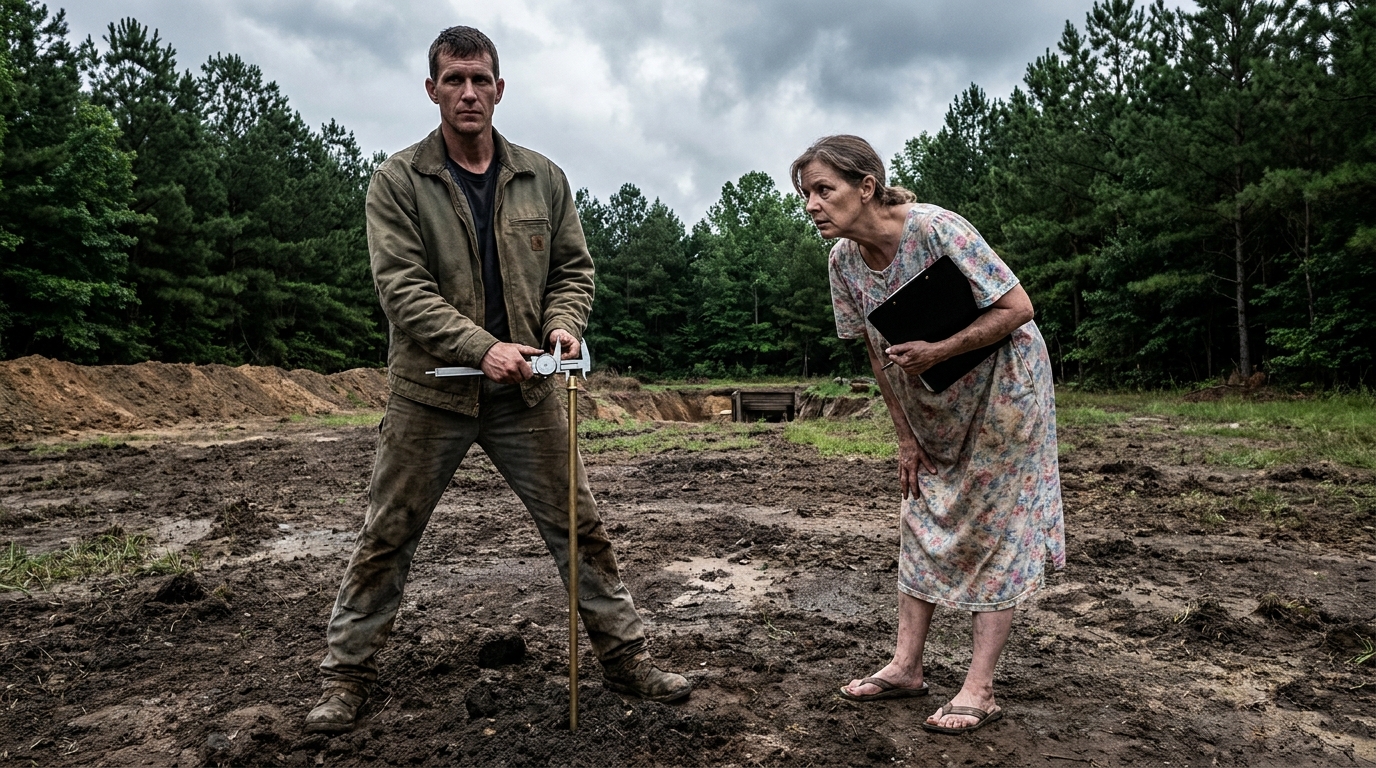
I didn’t turn around immediately. I slowly tightened the thumb-screw on the stainless steel dial caliper in my right hand. Click. Click. Click. Zeroed at 0.00 millimeters.
“I will personally see to it that a bulldozer reduces it to dust,” she said, her floral mumu rustling against the humid pine needles. “And I will bill you for every single glorious second of it.”
Karen stood three feet inside her side of the easement. She held a black plastic clipboard like a commander holding a field manual. Her small, puffy eyes scanned the twenty-foot earthen berm sitting in the natural depression half a mile from the main road.
Twenty-five yards of engineered soil. Fortified side walls. Designed to stop 7.62 NATO rounds cold. Twenty-five years in the Army Corps of Engineers teaches you how to move earth so it stays put.
“You’re standing on county land, Karen,” I said, keeping my tone flat. S-V-O. Direct. No rise in blood pressure.
“This subdivision has standards,” she snapped. Her thumb tapped against the metal clip of her board. “Article Nine prohibits unapproved outbuildings, shooting facilities, and industrial earthworks.”
“Parcel 75-B,” I said, turning my body just enough to frame her in my peripheral vision. “Check your plat map.”
“I don’t need a map. I have the board.”
“My deed predates your developer’s first survey by forty-eight months,” I said. “Silas drew the boundaries in ’98. Standalone carveout. No access covenants. No HOA.”
She smiled. It wasn’t a pleasant expression. It was the tight, bureaucratic sneer of a person who had never been denied a permit in her life.
“We’ll see what the county sheriff says when the noise complaints start stacking up at five hundred dollars a day.”
“The sheriff inspected the baffle layout on Tuesday,” I said, rolling the caliper wheel against my index finger. “Signed the range safety clearance at 1400 hours.”
She stiffened. Her grip tightened on the clipboard until her knuckles turned the color of lard.
“You think you’re clever because you served in some war, Caldwell. But this isn’t a combat zone. This is Lakeside Meadows. You obey the rules or we break you.”
She turned on her heel, her sandals digging ugly trenches into the wet red clay.
I didn’t call after her. I didn’t raise my voice. I looked down at the brass pin in the mud, noted the three-inch offset, and pulled a small green notebook from my chest pocket.
1412 hours, I wrote. Boundary pin displaced. Threat of unlawful demolition issued by K. Miller. Witnesses: none.
I closed the notebook, slipped the steel caliper into my pocket, and walked toward the house. The air smelled like ozone and pine sap. A storm was coming from the west.
In the engineering corps, when an adversary starts probing your perimeter, you don’t reinforce the fence. You map their supply lines.
CHAPTER 2: PAPER ARMOR
The blade of the brass letter opener made a clean, dry whisper as it sliced through the heavy manila stock.
I stood at my mahogany desk, the stainless steel dial caliper resting on the blotter next to a fresh glass of cold tap water. Condensation ran down the glass, pooling on the dark wood. The air in the study carried the sharp, familiar scent of gun solvent and old paper. Outside, the rain had started, a steady, rhythmic drumming against the windowpane that mirrored the pulse in my throat.
I pulled the contents from the envelope. Five sheets. High-grade bond paper. The Lakeside Meadows Homeowners Association emblem was embossed at the top in gold foil—a stylized pine tree inside a crest.
Certified Mail. Return Receipt Requested.
I didn’t sit down. You read intelligence briefings on your feet. It keeps your posture sharp and your eyes moving.
NOTICE OF MONETARY PENALTY AND DEMAND FOR IMMEDIATE REMOVAL OF UNAPPROVED STRUCTURE
PARCEL IDENTIFICATION: 75-B (Lakeside Meadows Sector 4 Extension)
TO: Jack Caldwell
DATE OF ISSUANCE: October 12
Be advised that as of the date above, the structure designated as an “Earthwork/Target Facility” constructed upon the above-referenced parcel is in direct violation of the Lakeside Meadows Master Declaration of Covenants, Conditions, and Restrictions:
Article 9, Section 4: Unauthorized Alteration of Topography and Non-Conforming Outbuildings.
Article 6, Section 2: Nuisance, Excessive Noise, and Discharge of Ballistic Implements.
Article 7, Section 8: Hazardous Activity Endangering Common Areas.
ASSESSED FINES: $500.00 per diem, retroactive fourteen (14) calendar days to initial observation.
TOTAL BALANCE DUE: $7,000.00
Failure to remit full payment within ten (10) business days will result in additional administrative levies, suspension of community access privileges, and the immediate filing of a statutory real property lien.
Seven thousand dollars.
I picked up the caliper, my thumb rolling the fine-adjustment wheel back and forth. Click. Click. Click. The steel jaws opened to 7.00 millimeters, then closed to zero. A muscle in my jaw flexed once, then set like mortar.
“Jack?”
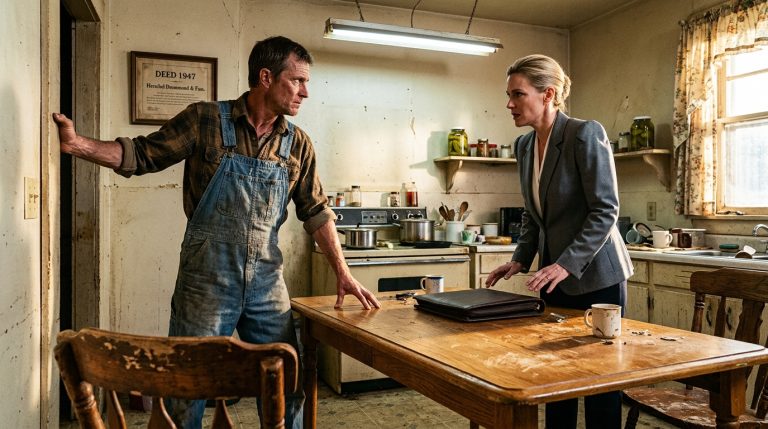
Sarah stood in the doorway of the study. She wore her thick knit sweater, her hands wrapped around a ceramic mug. She didn’t come all the way in. She knew the layout of my desk when I was working; she knew the line where the military habits ended and the domestic space began.
“It arrived,” I said. My voice was low, devoid of inflection.
“What does it say?”
“She wants seven thousand,” I said. I laid the paper flat on the desk, aligning the left edge precisely parallel with the wooden border of the blotter. “And she calls Parcel 75-B ‘Sector 4 Extension.'”
Sarah set her mug on the side table and stepped closer, her eyes scanning the gold-embossed letterhead. “Sector 4? Jack, this development didn’t even have four sectors when we bought the acreage. Silas swore—”
“Silas was right,” I interrupted gently. “Silas knew the land. She’s inventing geography.”
I opened the bottom right drawer of the desk. It slid out smoothly on oiled steel runners. Inside were six thick, color-coded binders. I pulled the green one—labeled PARCEL 75-B: TITLE & EASEMENTS—and laid it beside the notice.
Memory hit me then, unbidden—the heat of an Iraqi afternoon in ’04, staring at an overlay map while a staff officer explained why a supply route had been routed through a dry riverbed without checking the soil density. Bad data kills people, my old colonel used to say. Good paper saves them.
“Is she going to send someone?” Sarah asked. Her hand rested on my shoulder, her fingers pressing through my canvas shirt.
“No,” I said. “People like Karen don’t send troops. They send ink. They expect you to read the number, panic, and sign a check to make the feeling go away.”
“We’re not signing a check.”
“We’re not paying a dime.” I opened the green binder. The first page was a certified copy of the county land patent from 1998, bearing the heavy blue ink seal of the Registrar of Deeds. “She thinks she’s established a beachhead. I’m going to show her the boundary line.”
I sat down in the leather chair and pulled a fresh pad of yellow legal paper into the center of my field of view. I uncapped a black gel pen.
“What are you building?” Sarah asked softly, her eyes tracking the movement of my hand as I drew a clean, straight margin line down the left side of the legal pad.
“An armor plate,” I said. “The kind that shatters the round on impact.”
For the next four hours, the only sounds in the study were the rain against the glass and the steady, rhythmic scratching of my pen. I didn’t write an angry letter. Anger is a weak foundation; it leaves gaps in the construction. I wrote a technical dossier.
Section One: The Deed. I transcribed the exact metes-and-bounds description of Parcel 75-B, highlighting the language that explicitly severed it from all future subdivisions created out of the original Miller tract.
Section Two: The Law. I cited North Carolina General Statutes Chapter 47F—the Planned Community Act—specifically the clause requiring explicit, written consent from a property owner to join a homeowners association created after the date of purchase.
Section Three: The Proof. I attached a copy of the county tax plat showing Parcel 75-B shaded in white, while the Lakeside Meadows HOA track was shaded in tan.
I didn’t stop to drink the water. I didn’t check my phone. When the draft was complete, I made three copies on the heavy-duty scanner behind my desk, collated them into crisp black folders, and secured each with a heavy steel clip.
On the front cover of the primary folder, I affixed a white label printed with a single line of text:
RESPONSE TO UNLAWFUL DEMAND — PARCEL 75-B / FILE REF: CALDWELL-HOA-001
I slipped the document into a cardboard mailer, sealed the adhesive strip with a firm slide of my thumb, and stood up. My back crackled like dry twigs, but my eyes were clear.
The first trench was dug. The concrete was setting.
I walked to the hallway window and looked out toward the tree line. Half a mile through the pines, past the natural depression where the berm sat silent and secure under the rain, a single streetlamp flickered at the edge of Lakeside Meadows.
Karen was in one of those beige houses, probably sitting at a kitchen table with her clipboard, ticking off names, assuming she had backed another retiree into a corner.
I tapped the steel caliper against the window sill once. Cold metal against wet glass.
“Your move, Karen,” I whispered to the dark.
CHAPTER 3: THE COUNTERSTRIKE
The tap of the caliper against the windowpane made a flat, dull ring that died in the damp glass.
I held the sealed mailer under my left arm, feeling the stiff weight of the cardboard edge against my ribs. Out on the tree line, the single streetlamp flickered twice and held steady. Karen was over there, behind two hundred yards of loblolly pines and six inches of vinyl siding, waiting for my panic.
I didn’t give her a night to celebrate.
“I’m taking this to the courier downtown,” I said, turning back toward the study desk.
Sarah leaned against the doorframe, her thumb tracing the worn blue glaze of her coffee mug. Her knuckles were white. “It’s past seven, Jack. The rain’s coming down harder.”
“The late drop box at the federal building clears at 2100,” I said, sliding my pocket calendar into my breast pocket alongside the gel pen. “Certified, return receipt, tracking logged before midnight. Time-stamps build a wall she can’t climb over.”
I picked up my canvas jacket, stiff with waterproofing wax, and stepped out into the garage. The smell of copper grease, damp concrete, and motor oil settled over me. I grabbed my flashlight—a heavy, anodized aluminum tube with a scratched lens—and loaded the mailer into my leather briefcase.
Fourteen miles to the county seat.
The windshield wipers of the truck beat a steady, heavy tempo against the glass. Slap. Thud. Slap. Thud. Route 218 was slick, black asphalt reflecting the dim glare of yellow streetlights. Every three miles, another suburban enclave broke the darkness—gated entrances, manicured brick walls, illuminated signs with names like Whispering Oaks and Lakeside Meadows. Kingdoms built on sand and five-hundred-dollar fines.
I pulled into the gravel lot of Anne Davies’ office on Broad Street at 0815 the following morning. I had called her at 0700 from my desk after confirming the tracking delivery of my parcel to the HOA registered agent.
Anne’s office sat on the second floor of a converted brick bank building from 1920. The stairs creaked under my boots. The air in the hallway smelled like old carpets and lemon oil.
She didn’t offer me coffee when I walked in. She was forty-eight, wore a dark gray wool suit with no lapel pins, and had a stack of legal pads arranged on her oak desk with the precision of artillery shells. Her father had served in the 2nd Marine Division. She understood terrain.
“Sit down, Jack,” she said, her voice dry as parchment. “I read the draft you faxed over at dawn.”
I placed my briefcase on the floor beside my left heel and sat. I took out the steel caliper, placing it flat on her desk next to a silver pen tray. Click.
“Did I miss a statute?” I asked.
“No,” Anne said. She pulled a blue-lined folder toward her, her short nails tapping the paper. “Your statutory defense under Chapter 47F is airtight. Parcel 75-B is an island. They have no jurisdictional hook to fine you five dollars, let alone seven thousand.”
“Then we stand on the response.”
“We stood on the response until ten minutes ago,” she said, pulling a single sheet of paper from beneath her blotter. She rotated it across the desk so it faced me. “Then the county clerk’s online registry updated.”
I leaned forward. The paper was a printout of an official filing index.
RECORDING ENTRY: Notice of Statutory Real Property Lien
GRANTOR: Lakeside Meadows Homeowners Association, Inc.
GRANTEE: Jack Caldwell & Sarah Caldwell
PARCEL ID: 75-B
AMOUNT CLAIMED: $21,500.00 (Inclusive of accrued per diem penalties & administrative fees)
FILED BY: Miller, K. (President, Board of Directors)
Twenty-one thousand five hundred.
The number sat on the page like a physical obstacle. My eyes didn’t widen. My heart rate stayed locked in the low sixties. I felt the cold, clear focus of an engineer evaluating a structural collapse.
“She skipped the statutory notice period,” I said flatly. “The letter gave ten business days. This was recorded sixteen hours after issuance.”
“She didn’t just skip the notice period, Jack,” Anne said, her voice dropping an octave into something dark and sharp. “She bypassed her own board’s legal counsel. I called their firm thirty minutes ago. Their lead attorney didn’t even know this lien was drafted. She filed it directly at the registrar’s window using a standardized county template.”
“Slander of title,” I said.
“Slander of title, cloud on deed, and intentional interference with real property rights,” Anne replied. She reached into her drawer and pulled out a fresh legal pad. “She stepped out of the trench, Jack. She’s standing in open ground.”
“What’s the cost?”
“A full civil complaint in Superior Court,” she said. “We sue the association for slander of title and quiet enjoyment. We name Karen Miller personally for ultra vires actions—acting outside her corporate authority as board president. We seek actual damages, an immediate judicial order expunging the lien, and punitive damages.”
I looked down at the caliper resting on her desk. The stainless steel reflected the overhead fluorescent tube in a sharp white line.
“She wants a war of attrition,” I said. “She thinks I’m worried about the title.”
“Are you?”
“The house is paid for,” I said. “The land is paid for. My son ships to basic in three months. I don’t need a mortgage. I need the line held.”
Anne picked up her fountain pen and unscrewed the cap with a decisive metallic click. “Then we don’t just file a response. We file a counter-strike. I’m drafting the summons now. We serve her at her home address by special courier before five o’clock.”
“Add one thing,” I said.
Anne paused, the pen tip hovering a millimeter above the yellow paper. “What?”
“During my land audit last night, I pulled the HOA’s historical filing records from three years ago,” I said, reaching into my coat for a folded ledger sheet I’d printed from the county archive. “Look at the boundary harmonization vote from June ’23. She tried to re-zone Sector 4. The document mentions a commercial survey commissioned by a entity named Vanguard Land Holdings.”
Anne took the paper, her eyes narrowing as she scanned the small print at the bottom of the municipal registry page. A subtle shift occurred in her posture—the quiet, intense focus of a hunter spotting a fresh print in the mud.
“Vanguard?” she whispered.
“It’s listed as a third-party consultant on the annexation notes,” I said. “Seed money for the survey came from their corporate filing code. I don’t know who Vanguard is yet, but Karen didn’t write that annexation ordinance alone.”
Anne folded the sheet carefully and slipped it inside her primary trial folder.
“We start with the lien,” she said, her eyes meeting mine. “We cut off her legs in court first. Then we dig up the foundation.”
I stood up, picked up my caliper, and slid it back into my pocket.
“Serve the papers, Anne,” I said.
Twenty minutes later, I was back in my truck. The rain had stopped, leaving the streets black and wet, reflecting a pale Carolina sky. I turned the ignition, pulled out of the parking lot, and headed back toward the ridge.
The lien was on the title. The glove was off. Now we’d see how well her structure held under a direct hit.
CHAPTER 4: FEDERAL FRICTION
The starter motor turned twice, and the diesel V8 caught with a heavy, shuddering pulse that rattled the steering column.
I sat in the cab of the truck for five seconds, watching the wiper blades clear a film of fine street mist from the windshield. Through the glass, the brass sign of the law firm reflected in a dull yellow streak against the wet brick. Anne was already at her desk drafting the summons. The summons would land on Karen’s porch by five.
Four days passed in a quiet, deceptive stillness.
I spent the mornings on the range, clearing brush back from the drainage culverts at the base of the twenty-foot earthen berm. The gravel crunched under my boots as I hauled three armfuls of oak limbs toward the burn pile. No notices arrived in the mail. No lawn cars patrolled the easement. The HOA board had gone silent, the way an enemy line goes quiet right before they shift artillery coordinates.
On Tuesday at 0930, I was at the workbench in my workshop, cleaning the bolt assembly of my bolt-action .308 rifle. The smell of Hoppe’s No. 9 solvent hung thick in the cool air, sharp and chemical. I held the firing pin assembly up to the overhead fluorescent light, checking the lug faces for wear.
Outside, gravel tires crunched on the drive.
Not Karen’s oversized suburban SUV. The cadence was wrong—slower, heavier, two vehicles moving in tandem.
I laid the bolt down on a clean rag, wiped my thumbs on a shop towel, and stepped out into the doorway of the shop.
Two dark sedans—standard government-issue American sedans, spotless despite the road grime on Route 218—sat parked near the house. Federal plates. Two men in charcoal suits stepped out from the lead vehicle, their coats unbuttoned just far enough to clear their hip holsters.
“Jack Caldwell?” the taller agent asked. He had hard, gray eyes and short-cropped hair salted with white at the temples.
“I am,” I said, staying on the workshop threshold. I kept my hands open, resting casually against the hem of my work shirt.
The tall one flipped open a leather case, displaying a gold shield and laminated credential card. “Special Agent Miller. ATF. This is Agent Evans. We need to discuss a complaint filed with our field office.”
I didn’t flinch. I felt the same cold, tactical calculus settle into my chest that used to hit when an EOD team flagged an unexploded shell near a bridge site.
“What’s the nature of the complaint, Agent Miller?”
Miller held a manila folder under his arm. He tapped the cardboard cover with two fingers. “Anonymous tip to the regional office. Allegations of an unregistered automatic weapons facility, illegal explosive storage, and active paramilitary training on non-permitted residential land.”
I almost smiled, but my mouth stayed set in a hard, thin line. Karen had bypassed county deputies. She went for the federal throat.
“I’ve spent twenty-five years in the Army Corps of Engineers, Agent,” I said softly. “I know what a federal 404-ATF inquiry file looks like when a false report is filed.”
Miller’s left eyebrow twitched up a fraction of a millimeter. He didn’t look angry; he looked exhausted, the look of an officer who had driven two hours to check a box on a political grudge call.
“We have a duty to verify, Mr. Caldwell,” Evans said, his hand resting casually near his belt line.
“You have a duty to inspect,” I corrected smoothly. “And you’re going to get a full tour. Step into the shop.”
For forty minutes, I took them through the perimeter. I didn’t hide a single tool, container, or paper record.
I opened the fire-rated steel powder cabinet, pulling out the manufacturer’s batch numbers for three five-pound tubs of smokeless reloading powder, all stored well below the legal NFPA limit. I handed Miller my bound acquisition-and-disposition logbook, every serial number indexed with date of sale and transfer background check approvals.
Finally, we walked down the gravel path to the shooting range. The wet pine needles deadened our steps.
Miller stood at the firing line, looking up at the massive twenty-foot earthwork berm. He ran his hand over the treated timber retaining walls, noting the double-reinforced angle irons and the baffled sound-dampening acoustic foam fitted under the roof of the bench shelter.
“This isn’t an outbuilding,” Miller muttered, stepping up to the earth face and pressing his thumb into the packed clay. “This is a fortified backstop.”
“Engineered for 7.62 NATO,” I said. “Designed it myself using Corps field specifications. Sheriff signed off on the acoustic footprint.”
Miller turned, looking past the berm toward the thick timberland separating my acreage from Lakeside Meadows. “The tipster claimed you were running full-auto bursts at night.”
I reached into my pocket, pulled out the stainless steel dial caliper, and opened the jaw to precisely 7.62 millimeters. I handed him a spent brass casing from the bench tray.
“I reload single-stage .308 bolt-action rounds for target practice with my son,” I said. “He ships to Fort Moore in three months.”
Miller held the brass casing between two fingers, looking down at the caliper setting, then at the plaque mounted beside the range bench—the wooden crest of the 36th Engineer Brigade presented upon my retirement.
He closed his eyes for a long second, letting out a slow breath through his nose.
“36th Engineers?” Miller asked, his tone dropping the rigid, clipped federal edge.
“Combat Engineer Battalion,” I said. “Twenty-five years.”
Miller handed the brass casing and caliper back to me. “I did eight years with the 82nd Airborne. Jumped into Kandahar.”
The air between us shifted instantly. The federal tension didn’t dissolve—it transformed into something far more dangerous for Karen Miller.
“This tip,” Miller said, pulling out a small notebook from his breast pocket, “came from a VOIP number routed through a local IP address registered to a residential line on Meadowview Court. Person claimed to represent a ‘community safety task force.'”
“Karen Miller,” I said flatly. “President of the HOA. I served her with a slander-of-title lawsuit yesterday afternoon.”
Agent Evans cursed under his breath. Miller took out a black pen and wrote two words across the top of his field report file.
FALSE REPORT.
“Filing a fraudulent terror or illegal ordnance report with a federal agency isn’t an HOA violation, Mr. Caldwell,” Miller said, his gray eyes turning cold as iron. “It’s a Class E felony under Title 18.”
He handed me his business card from his coat pocket.
“Our inquiry on your facility is closed,” Miller said, extending his hand. “Our investigation into File 404-ATF and the caller is open as of 1015 hours today.”
I shook his hand firmly. “Thank you, Agent.”
I watched the two dark sedans back down my gravel drive and turn out onto Route 218. The rain had picked up again, a cold drizzle that slicked the pines.
Karen had called down thunder, assuming it would strike my house. She didn’t know the rod was already grounded on her roof.
CHAPTER 5: THE AMMUNITION
The business card felt thin and stiff between my thumb and index finger. I stood at the edge of the driveway, the smell of damp pine needles and exhaust smoke lingering in the cool air long after the tail lights vanished into the trees.
I didn’t go back into the workshop. I walked straight up the gravel path to the house, wiped the wet red mud from my work boots on the porch mat, and stepped inside.
“Jack?” Sarah called from the kitchen. She appeared in the hall, holding a dish towel, her posture tense. “I saw the federal plates from the window. What happened?”
“Agent Miller closed File 404-ATF,” I said, setting the card on the hall table beside the brass key tray. “He opened a false report file against Karen. Title 18 felony.”
Sarah let out a slow, quiet breath, her shoulders dropping three inches. “Did he say what happens next?”
“Anne takes care of what happens next,” I said. “Call her office. Tell her we need the full discovery dump from the HOA’s bank repository by three o’clock.”
By two in the afternoon, I was sitting at Anne’s oak desk downtown. A three-inch stack of white paper, hot off her high-speed laser printer, sat between us. The pages smelled faintly of ozone and warm ink.
“The subpoena hit their bank and email provider seventy-two hours ago,” Anne said, her fountain pen laid neatly in its silver tray. She tapped a red divider tab marked EXHIBIT E. “Karen’s personal board account wasn’t encrypted. She thought deleting items from her inbox wiped them from the server.”
I pulled the binder toward me. My thumb slid under the top sheet, flipping through administrative notices, board vote tallies, and routine maintenance quotes. Then I reached the email thread dated October 14, three hours after my first legal response was delivered by certified mail.
FROM: [email protected]
SUBJECT: RE: Parcel 75-B Notice
He can have his fancy lawyer send all the letters he wants. I told our guy to file the lien immediately, even if he thinks we should wait. It’s time to crush this soldier boy and run him out of our neighborhood. He has no idea who he’s messing with.
I read it twice. My right hand rested flat on the desk. My thumb rolled the steel caliper’s fine-adjustment wheel inside my coat pocket. Click. Click. Zeroed.
“Look at the second thread,” Anne said, her finger pointing to a printout four pages down, dated the morning of the ATF visit.
FROM: [email protected]
SUBJECT: File 404-ATF Update / Option Agreement
The federal complaint is in. Agents are dispatched to Parcel 75-B today under File 404-ATF. Once the tactical risk assessment tags the parcel as an illegal firearms hazards zone, county code enforcement will issue the emergency condemnation order. We execute the option purchase for Vanguard Land Holdings at 30% below tax appraisal before he can clear the title.
The room went dead silent, except for the quiet hum of the mini-fridge in the corner.
The entire picture unlocked in a single micro-second.
It was never about noise complaints. It was never about a twenty-five-yard earthwork berm or an unapproved garden structure. Parcel 75-B was fifteen acres of high-ground timber sitting directly between Route 218 and the commercial bypass strip. Karen wasn’t defending a suburban neighborhood; she was engineering an artificial default to trigger a forced distress sale for Vanguard Land Holdings—an entity operating on an option contract she stood to pocket a commission on.
“She used federal law enforcement as a land-clearing tool,” I said, my voice dropping into a low, flat whisper.
“It’s bad faith,” Anne said, her eyes burning behind her glasses. “It shatters corporate immunity. The HOA insurance carrier will deny coverage the second they read this thread. Every board member who voted with her is personally liable for civil conspiracy.”
“When is the special board meeting?” I asked.
“Tomorrow night at 1900 hours,” Anne said. “The petition signed by David Garcia and the other twenty-five percent of residents forced it onto the calendar. She thinks she’s coming to defend her enforcement budget.”
I stood up, picked up the binder, and snapped the three-ring mechanism shut with a sharp, heavy clack.
“Print three copies of Exhibit E,” I said. “One for the board secretary, one for the court file, and one for me.”
“What are you going to do at the meeting, Jack?”
I picked up my leather briefcase and slid the binder inside.
“I’m going to present the evidence,” I said. “And then I’m going to trip the charge.”
CHAPTER 6: THE CHECKMATE
The heavy leather handle of my briefcase felt solid and cool in my palm.
I paused at the threshold of Anne’s office, the distant chime of the street door below echoing up the stairwell. Rain had given way to a low, heavy fog that clung to the brick facades of downtown.
“Seven o’clock sharp at the clubhouse, Jack,” Anne reminded me from her desk, her fountain pen capped and stored in its tray. “Don’t give her a chance to adjourn early.”
“She won’t get the chance,” I said, and stepped out into the damp evening air.
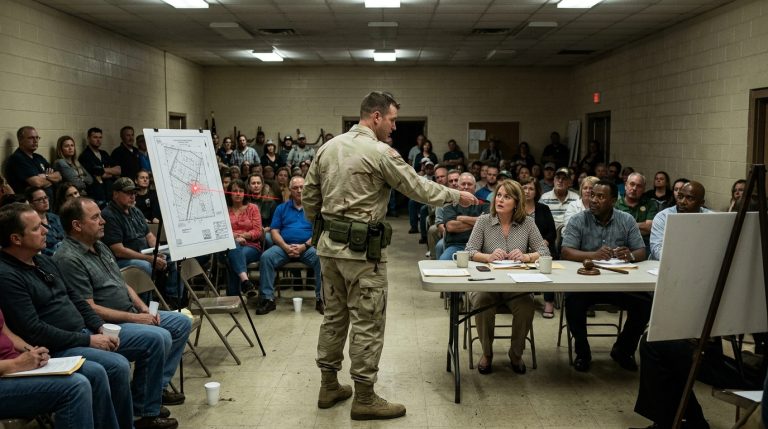
A Match Cut of silent hours passed as dusk turned to pitch black. By 1850, the parking lot of the Lakeside Meadows clubhouse was overflowing onto the grass shoulders. Headlights cut through the mist as pickup trucks and sedans squeezed into every available inch of space. Over sixty residents packed the folding chairs inside, their voices humming in a low, tense buzz under the buzzing fluorescent light tubes.
I walked down the central aisle carrying the black briefcase. David Garcia sat near the third row with his wife; he gave me a silent, firm nod as I passed. Mrs. Henderson sat two seats down, her hands folded over a small floral purse, her jaw set tight.
At the front of the room, five board members sat behind a long folding table draped in a blue table cloth.
Karen sat dead center. She wore a bright red blazer, her clipboard resting on the table like a shield. Her face was flushed, her small eyes darting across the unusually large crowd. She slammed a wooden gavel down on a brass striking pad.
Bang.
“This special meeting of the Lakeside Meadows Homeowners Association will come to order,” she barked, her voice amplified by a portable PA speaker that squealed with feedback. “The sole item on tonight’s agenda is the ongoing enforcement action regarding non-compliant outbuildings on Sector 4 Extension.”
She didn’t look at me. She kept her eyes fixed on the back wall.
“Due to pending litigation,” Karen continued, her fingers white around the handle of her gavel, “public comments will be restricted to two minutes per resident. The board will first hear from legal counsel regarding the valid enforcement of our covenants—”
“Point of order, Madam President,” a voice called out.
Frank, the board treasurer sitting two seats to her left, leaned into his microphone. His face was pale, his tie loosened.
“We don’t have board counsel present, Karen,” Frank said clearly into the mic. “They withdrew their representation thirty minutes ago by emergency fax.”
A murmur rippled through the audience like wind through dry corn.
Karen turned on him, her mouth twisting. “Frank, you are out of line! That is a confidential administrative matter—”
I stood up from my chair in the front row. I didn’t raise my voice. I didn’t rush. I unlatched the brass clasps of my briefcase. Snap. Snap.
“It’s not confidential, Karen,” I said, stepping up to the wooden podium in front of the board table. “It’s public record.”
“You are not recognized to speak, Caldwell!” Karen slammed the gavel down twice. Bang. Bang. “You are a non-member trespasser on HOA proceedings! Sergeant-at-arms, please—”
“There is no sergeant-at-arms, Karen,” David Garcia called from the floor, his voice booming over the crowd. “Let him speak!”
A chorus of shouts rose from the rows of folding chairs.
Let him speak!
What are you hiding?
Explain the twenty-thousand-dollar legal bill!
Karen’s throat worked silently, her mouth opening and closing like a landed fish. Her two loyalist board members leaned away from her, their hands flat on the tablecloth, putting distance between their bodies and hers.
I opened the black binder, pulled out the three collated sets of Exhibit E, and laid one set directly in front of Frank. I laid the second in front of Brenda, the board secretary. The third set remained under my hand at the podium.
“For three months,” I said into the microphone, my voice steady and rhythmic, “this board has claimed jurisdiction over Parcel 75-B under a purported boundary harmonization vote from June 2023.”
Karen lunged forward, reaching across the table to grab Frank’s copy, but Frank slammed his forearm down over the binder, shielding it.
“Read page four, Frank,” I said calmly.
Frank turned the page, his eyes scanning the printed text. His breath hitched audible over the PA system.
“This…” Frank stuttered, looking up at Karen with open horror. “This is a direct communication between you and Vanguard Land Holdings.”
“It’s fake!” Karen screamed, her voice cracking into a high, shrill screech. “He forged it! He’s a disgruntled military veteran trying to sabotage our property values!”
“Page six,” I continued, rolling the steel caliper wheel in my coat pocket once. Click. “The email dated October 14. In her own words, Karen Miller explicitly confirms instructing the board’s secretary to file an illegal property lien despite knowing Parcel 75-B was excluded from the master deed. She explicitly cites her intention to ‘crush the soldier boy.'”
The room erupted. Residents stood up from their chairs, shouting over each other.
“And page eight,” I said, my voice cutting through the noise like an iron bar. “The email sent to Vanguard Land Holdings at 0830 on Tuesday morning. In it, she details her fraudulent tip to the Bureau of Alcohol, Tobacco, Firearms and Explosives under File 404-ATF, attempting to trigger a federal tactical land seizure so Vanguard could acquire Parcel 75-B at thirty percent below appraisal.”
Karen stood up so fast her metal folding chair fell backward, clattering against the wall.
“You have no right!” she shrieked, her hands shaking uncontrollably as she pointed a trembling finger at me. “I built this community! I protected your home values from people like him! You owe me!”
“Special Agent Miller of the ATF signed an official false report affidavit four hours ago,” I said, looking her directly in the eyes. “The United States Attorney’s Office has unsealed an indictment under Title 18 for perjury and obstruction of justice.”
Karen’s face drained of all color. The red in her cheeks collapsed into a gray, pasty white. She looked at Frank, then at Brenda, then at her two allies. None of them met her gaze. They stared at the table, their hands pulled tight into their laps.
Frank slowly leaned into his microphone. His voice was trembling, but firm.
“I move,” Frank said, “for an immediate vote of no confidence in Board President Karen Miller, her instant removal from office, and the total, permanent rescission of all fines and liens against Parcel 75-B.”
“Second!” Brenda shouted immediately.
“All in favor,” Frank said, raising his hand.
Every single hand in the clubhouse shot into the air. Sixty residents stood in absolute, unified silence, their arms raised like a forest of iron posts.
Karen looked around the room, her breath coming in short, ragged gasps. She picked up her plastic clipboard, pulled her purse to her chest, and stumbled toward the side exit door. No one moved to stop her. The crowd parted silently, leaving a six-foot wide corridor of cold, hard linoleum for her to walk through.
The heavy steel exit door slammed shut behind her with a dull, echoing thud.
The denouement settled over Lakeside Meadows over the next three weeks like the slow, clean arrival of autumn.
The formal retraction arrived by certified mail ten days later—a notarized document signed by Frank as acting board president, officially expunging the $21,500 lien from the county registry at the HOA’s expense, alongside a formal written apology printed on official letterhead.
On a quiet Tuesday afternoon, I sat at the workbench in my workshop. The air was crisp, carrying the scent of dry leaves and pine sap.
The brass surveyor’s pin at the boundary line had been reset. I had spent two hours that morning with a two-pound mallet and a laser level, driving the metal stake four feet into the solid red clay, securing it with a six-inch concrete collar. Exactly on the coordinate. Zero deviation.
On the workbench lay the stainless steel dial caliper. The thumb-screw had worked slightly loose during the weeks of tension.
I picked up a tiny jeweler’s screwdriver, placed the blade into the locking screw, and tightened it down with a slow, deliberate twist of my wrist. Firm. Locked.
I walked out of the shop and down the gravel path toward the shooting range.
My son, Mark, stood at the bench shelter in his new olive-drab fatigue pants and boots, his hair cropped close to his scalp. He had his gear bag packed by his feet. He leaves for basic training at Fort Moore tomorrow morning.
“Berm held up good through the rain, Dad,” Mark said, looking out at the twenty-foot earthwork sitting quiet and solid in the natural depression.
“It’s built on a solid foundation,” I said, stepping up beside him at the firing line.
I reached into my pocket, pulled out a single polished .308 brass casing, and laid it on the wooden bench between us. The afternoon sun broke through the thinning gray clouds, catching the bright yellow reflection of the metal.
“Remember the rule when you get to the range down there,” I said softly, looking out over the timberland toward the quiet, peaceful rows of houses in the distance.
Mark picked up the casing, feeling its weight in his palm, and smiled. “Measure twice. Hold the line.”
“Hold the line,” I agreed.
The woods were silent. The wind rustled gently through the loblolly pines, clear and cool. The line was clear, the border was secure, and the land was mine.