The Weight of Iron: A Veteran’s Silent Burden in a World of Rusted Truths and Forgotten Costs
CHAPTER 1: THE FRICTION OF PRIDE
The air in the motorpool was thick enough to chew, a humid slurry of diesel fumes, floor degreaser, and the metallic tang of cooling iron. Arthur Corrian did not look up, though he could feel the heat radiating off the stalled Humvee. It sat like a gutted beast, its hood yawned wide to reveal a tangled nest of wiring and cold, dark steel.
Torres was pacing now, his crisp coveralls pristine compared to the grime that clung to the floorboards. He was a creature of schematics and digital readouts, a man who believed the world was only as real as the code on his screen. Every step he took was a dismissal of the seven decades Arthur had spent breathing in the dust of real-world physics.
“Well, Pops?” Torres’s voice cut through the stagnant air, sharper than a razor. “Are you going to keep haunting my floor, or are you going to get to work on that waste of space in the corner?”
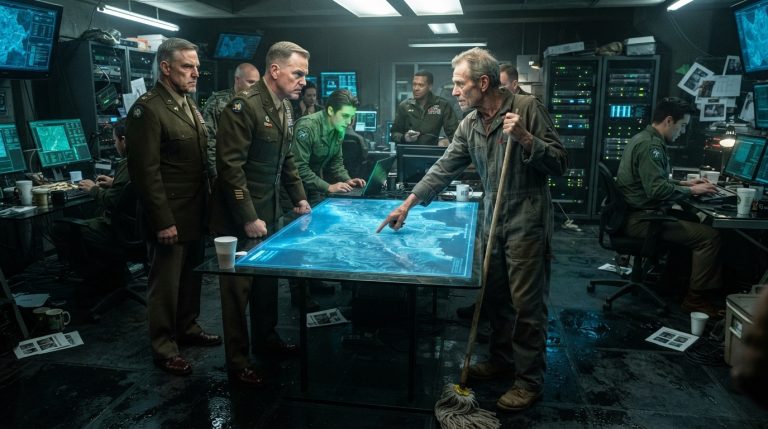
Arthur didn’t answer immediately. He leaned his push broom against the heavy, rusted metal of a nearby support beam. The handle was smooth, polished by years of repetitive, honest labor. He focused on the Humvee, but he wasn’t looking at the diagnostic laptops perched precariously on the fender. He was looking at the way the vehicle settled on its suspension, the slight, uneven tilt of the front driver’s side—a geometry only someone who had spent his life under these machines would notice.
There was a hairline leak, just a whisper of dark fluid staining the concrete near the transfer case. It was a detail hidden from the digital sensors, a physical anomaly the young engineers had walked over a dozen times.
“She’s not breathing, son,” Arthur said, his voice a low, gravelly rumble that seemed to vibrate in the hollows of the concrete floor. “You’re chasing a ghost in the control module. It’s the lift pump relay. It shorts when it heats up. Once you pull it for testing, it cools down and passes every time.”
Torres let out a sound that was half-laugh, half-sneer. He stopped pacing and stood directly in front of Arthur, forcing the older man to look up. “A janitor explaining the fuel system to a lead engineer? I’ve heard some wild things in my time, but the idea that you, with your little bucket and mop, know more than a team of experts is insulting. Did you read that in the janitorial handbook?”
The other engineers chuckled, a nervous, jagged sound. Arthur didn’t blink. He felt the weight of his own history—a lifetime of machines that had been pushed to their breaking points. He saw the way Torres’s hands shook with a subtle, hidden tremor of insecurity.
“She’s dead in the water, Torres,” Arthur continued, his tone devoid of malice, which only seemed to make the younger man angrier. “You can swap the ECM, but you’ll be doing it for six hours, and at the end of it, the engine will stay exactly as cold as it is now. There’s a short in the harness. Third box from the left. Check the contact points for heat damage.”
Torres’s face flushed a deep, frantic crimson. He stepped closer, invading Arthur’s space, his finger jabbing into the air between them. “You are interfering. You are a civilian contractor with no clearance to touch this hardware. I have a mind to have you thrown off this base for unauthorized tampering.”
Arthur looked down at the leather pouch on his belt. It was cracked, the leather worn so smooth it felt like soft skin. He felt the cold iron of the multi-tool inside. For a heartbeat, the motorpool shifted. The fluorescent lights blurred into the harsh, blinding sun of a desert road, and the smell of grease was replaced by the acrid, biting stench of cordite. He wasn’t in a base in the States; he was under an MRAP, his hands working by touch alone while the world exploded around him.
He blinked, pulling himself back. The motorpool returned, but the tension had curdled. Torres wasn’t just arrogant; he was terrified.
“You’re scared,” Arthur said softly, and in the silence of the shop, the words were like a physical strike.
Torres’s expression twisted, his jaw locking tight. “I’m calling the MPs.”
As Torres reached for his radio, Arthur’s gaze drifted toward the service entrance. Gunnery Sergeant Evans was standing there, his arms crossed over his chest, his eyes narrowed as he watched the scene unfold. Evans was a man who knew the smell of a real threat, and he wasn’t looking at the Humvee. He was looking at the way Torres’s hand trembled as it hovered near his belt.
The air shifted again. A heavy, unnatural stillness descended. The distant, unmistakable roar of an official convoy began to build outside, the frequency low and powerful enough to rattle the tools hanging on the bay walls. Arthur didn’t turn. He knew the sound. He knew exactly what it meant. And he knew that the peaceful, quiet life he had built for himself was about to shatter against the harsh reality of the truth.
CHAPTER 2: THE ANCHOR IN THE DUST
The low-frequency roar of the convoy had not yet arrived, but the vibration of its approach was already being transmitted through the concrete floor of the motorpool. It was a rhythmic pulse, a herald of authority that turned the air in the bay from stagnant to electric. Arthur remained still, his weight balanced on the balls of his feet, his posture that of a man who had stood on the edge of craters and lived to walk away.
Gunnery Sergeant Evans stood at the threshold of the bay, his arms crossed over a chest draped in a camouflaged uniform that seemed too small for the sheer mass of his presence. He wasn’t watching the Humvee. He was watching Torres. Evans’s eyes were narrow slits of calculation, the gaze of a predator who had smelled a rot in the organization and was finally finding the source.
Torres’s radio crackled, the static sounding like a gunshot in the high-ceilinged bay. He fumbled with the device, his face a mask of sweating, frantic motion. He was trying to bypass the reality in front of him—the reality of a janitor who had diagnosed a failure with a level of precision that made his own engineering team look like children with plastic toys.
“Get him out of here, Gunny!” Torres snapped, his voice hitting a shrill, cracking register. “He’s interfering with a mission-critical repair. I’ve already called base security. This is an official, restricted, and highly sensitive military operation!”
Arthur didn’t turn. He looked at the relay box, then down at his leather pouch. The scent of motor oil was suddenly overwhelmed by the phantom sharpness of burnt cordite. For a fraction of a second, the motorpool evaporated. He was back in the Fallujah heat, his hands slick with a mixture of hydraulic fluid and blood, trying to bridge a circuit on an MRAP while the sky rained down jagged metal. He remembered the error that day—the micro-second of hesitation when he chose speed over safety—and how it had cost a man his leg.
The phantom memory made his fingers twitch, an involuntary reaction to a past that was never truly gone. He suppressed the shiver, his hand locking onto the multi-tool at his belt, the metal cold and biting against his palm. He had spent years ensuring that such errors never repeated, that the machinery was always held together by more than just hope.
Evans walked forward, his boots hitting the concrete with a slow, deliberate cadence that commanded silence. He didn’t look at Arthur. He moved past him, his massive frame effectively pinning Torres against the fender of the disabled Humvee.
“Step back, Torres,” Evans said, his voice a low, gravelly monotone that carried more weight than any shout.
“You don’t understand, Sergeant,” Torres stammered, his bravado leaking away like oil from a cracked casing. “The ECM… the diagnostics… he’s just a janitor! He’s trying to sabotage the inspection!”
Evans leaned in, his face inches from the younger man’s. “I understand that you’ve been standing here for four hours and the only thing you’ve accomplished is making a spectacle of your own incompetence. You’re not calling security. You’re going to sit there, you’re going to be quiet, and you’re going to watch how a professional handles an asset.”
The shift in the room was palpable. The other engineers, previously buzzing with the importance of their laptops and jargon, had fallen into an absolute, paralyzed silence. They were staring at Arthur, who had returned to his work with a calm, methodical slowness.
Arthur’s hands were steady, his movements devoid of wasted energy. He didn’t reach for the laptops. He didn’t look at the screen full of false negative diagnostic codes. He reached deep into the engine bay, his fingers navigating the labyrinth of piping and wire harnesses by memory, finding the precise point where the vibration of the engine had worn a contact point down to the bare copper.
It wasn’t a logic fault. It was physics. It was the brutal, unrelenting friction of a poorly routed cable rubbing against a vibrating heat shield.
“Look here,” Arthur said, not looking at anyone, his voice calm.
He held up a short segment of wire that he had extracted from the bundle. It was scorched, the insulation brittle and flaking away like rusted iron. It was a small, almost insignificant piece of debris, but in the context of the Humvee’s failure, it was the only piece of truth that mattered.
“The relay wasn’t the problem,” Arthur said, his eyes scanning the surrounding harness. “The relay was the victim. Someone installed this shield three millimeters too close to the main power line. Every time the engine hits three thousand RPM, the heat bleeds through. It doesn’t break the circuit, it just makes the resistance drop. The computer interprets that as a failing ECM.”
Torres looked at the wire, his mouth opening and closing. The arrogance that had defined his morning was being hollowed out, replaced by a dawning, sickening realization of his own fallibility. He looked at the laptop screen, then at the wire in Arthur’s hand.
“That’s… that’s not possible,” Torres whispered.
“The machine doesn’t care about the engineering manual,” Arthur replied, his voice devoid of satisfaction, only the cold, hard pragmatism of a man who cared more about the vehicle than the ego of the person driving it.
Gunnery Sergeant Evans let out a long, slow breath, a sound of relief and grim confirmation. He knew now. The incompetence wasn’t just a lack of training; it was a systemic failure of the process. He turned and looked toward the service door, where the sound of the convoy was no longer a vibration, but a tangible, encroaching reality. The heavy vehicles were slowing, the engines shifting into a lower, growling gear as they prepared to turn into the motorpool.
Arthur felt the weight of it all—the past, the present, and the impending arrival of men who would expect answers he wasn’t yet ready to give. He reached into his pouch, pulled out a spool of electrical tape and a soldering iron, and began to work, his movements precise and uncaring of the storm gathering outside the door. He wasn’t just fixing a Humvee; he was patching a hole in the armor, and he knew, better than anyone, that once the pressure increased, the cracks would only widen.
CHAPTER 3: THE ECHO OF FALLUJAH
The air in the motorpool grew heavy, saturated with the rising temperature of the machines and the cooling sweat of the men. Arthur’s hands remained inside the engine bay, his fingers working with a rhythm that defied the frantic energy of the room. He was conscious of the convoy’s arrival, the thunderous, low-frequency roar now rattling the dust from the rafters above.
He didn’t look up. He felt the cold iron of the multi-tool in his palm, a familiar, grounding weight. Beside him, Torres was frozen, his eyes fixed on the charred wire segment Arthur had pulled from the harness. The younger man’s breathing was shallow, his shoulders hunched in a posture of involuntary defeat. Gunnery Sergeant Evans, meanwhile, held his position like a stone bulwark, his gaze shifting between the bay entrance and Arthur’s steady, rhythmic progress.
“Hand me the tension gauge, son,” Arthur said, his voice low and clinical.
Torres blinked, momentarily confused by the address, before his instincts as an engineer surged back. He reached for the tool on the nearby bench, his movements shaky but precise, and placed it into Arthur’s outstretched hand.
“The routing,” Arthur muttered, more to himself than to Torres. “It’s not just the heat. It’s the torque.”
He adjusted the cable, sliding it away from the jagged, heat-scored metal of the intake manifold. He saw it then—not just the friction-worn insulation, but the deliberate, clean score marks on the manifold itself. It wasn’t wear. It was a gouge, carved by a blade.
The realization hit Arthur with the weight of a physical blow. He froze, his hand suspended inside the machine’s dark, greasy heart. This wasn’t a maintenance failure. It was sabotage. Someone had intentionally weakened the manifold, forcing the vibration-induced short.
“What is it?” Evans asked, stepping a fraction closer. The Gunny’s voice dropped, the protective instinct surfacing.
Arthur didn’t answer immediately. He looked at the logbook sitting open on the nearby workbench, the one Torres and his team had been using to track the “logic faults.” He reached out, his grime-covered fingers flipping back through the pages. The entries were inconsistent—dates missing, diagnostics logged for systems that hadn’t even been accessed yet. The entire maintenance history of the vehicle had been scrubbed and rewritten.
“The logbooks,” Arthur said, his voice hard, lacking its usual placid edge. “They’ve been doctored.”
Torres leaned in, his face pale. “Doctoring the logs? That’s impossible. These files are digital, encrypted.”
“Digital can be overwritten,” Arthur said, sliding the final piece of the wiring back into place. “But physical metal remembers the tool that carved it.”
He clicked the final housing into place and pulled his hands free, wiping the oil from his skin with a rag. He stood up, his back popping with the stiffness of his years. The convoy was outside now—he could hear the screech of brakes and the heavy, metallic clatter of doors opening.
Arthur turned to Evans, his gaze unreadable, the pale blue of his eyes clouded with a sudden, sharp clarity. “Gunny, don’t let them near the vehicle until I’ve had a chance to look at the other command units. This wasn’t an accident. This is a pattern.”
Evans didn’t hesitate. He turned, his presence suddenly looming, as he blocked the main entrance to the bay. “You heard the man,” he barked at the engineers. “Back away from the vehicle. Now.”
The motorpool’s main door rumbled upward, the light of the morning sun flooding into the bay, turning the swirling dust into shimmering, blinding gold. Colonel Wallace stepped through the threshold, followed by the imposing presence of the base commander and the stiff, precise lines of the honor guard.
The silence that followed was absolute. It was the silence of a battlefield after the artillery had ceased, the ringing in the ears of the soldiers finally beginning to fade. Colonel Wallace walked toward the Humvee, his boots clicking with rhythmic finality on the concrete. He stopped, his gaze falling upon the Humvee, then on Arthur, and finally on the wire segment still resting on the workbench.
Arthur stood in the shadow of the lifted hood, his posture stooped, his face illuminated by the flickering, dying light of the overhead lamp. He wasn’t the janitor anymore; he was a man who had seen the gears of the world grind and had spotted the grit that was trying to force a seizure.
“Mr. Corrian,” Wallace said, his voice resonant and devoid of the confusion he had shown on the phone. “I’m told we have a situation.”
Arthur looked at the Colonel, then at the base commander, and for a fleeting, agonizing second, the scent of burning oil was replaced again by the bitter smell of the desert. He saw the path ahead, a road built of broken things and silenced truths, and he knew that for the sake of the men who relied on these machines, he could not step aside.
“We have a problem, Colonel,” Arthur replied, his voice calm, yet carrying a resonance that silenced the entire motorpool. “And it’s buried deeper than anyone wants to admit.”
CHAPTER 4: THE HONOR GUARDS SHADOW
Colonel Wallace didn’t retreat. He stood his ground, the pristine polish of his dress blues contrasting sharply against the grime-streaked floor of the motorpool. The base commander, Peterson, remained a step behind him, his eyes surveying the scene with the cold, clinical detachment of a man who dealt in outcomes, not excuses. The four-man honor guard, their rifles slung with rhythmic perfection, stood like statues of obsidian against the sun-washed opening of the bay.
Arthur remained under the hood of the Humvee, the metal of the intake manifold still radiating a dull, residual heat. He felt the weight of their collective gaze—a heavy, invasive pressure that made the skin between his shoulder blades itch. He kept his hands moving, his fingers systematically tracing the lines he had already inspected, but his mind was already mapping the next move.
“Mr. Corrian,” the Colonel repeated, his voice lower now, stripped of the initial shock and replaced by a brittle, dangerous edge. “You mentioned a problem. Explain.”
Arthur didn’t look at them. He reached for a small mirror on an extendable wand, angling it to see the underside of the mounting bracket where the cable had been scored. He clicked a small light on. The reflection showed a series of cross-hatched marks—deliberate, machine-tooled, and impossible to ignore. They weren’t the result of vibration or fatigue. They were the result of a deliberate, calculated calibration error in the factory-spec mounting process, a flaw designed to fail at a specific, high-stress heat threshold.
“This isn’t wear, Colonel,” Arthur said, his voice as steady as the rhythmic drip of oil from a nearby rack. “It’s a structural defect, but not the kind that happens on an assembly line. This was carved. Someone wanted this vehicle to lose fuel pressure at a moment of maximum load.”
Torres, who had been standing in a state of catatonic shock, took a sudden, involuntary step forward. “That’s impossible. That component is sealed at the manufacturer. No one on base has the authorization or the equipment to open that housing without breaking the tamper-proof seals.”
Arthur finally pulled his head out from the engine bay. He turned to look at Torres, his pale blue eyes devoid of judgment, which made the engineer flinch more than any shouting match could have. He reached into his pocket and pulled out the small, black plastic seal he had found wedged in the cooling fins. He held it up between his thumb and forefinger. It was pristine, the embossed security code barely scratched.
“You’re right, Torres,” Arthur said, his tone conversational, almost polite. “No one on base has the tools. But someone who has access to the manufacturing supply chain before these parts reach the base? They’d have the seal, the tools, and the motive.”
He turned back to Colonel Wallace. “Check the inventory logs, sir. Not the digital ones. The physical shipping manifests. Look for a discrepancy in the transit time between the manufacturer and the depot. I’d wager you’ll find this vehicle wasn’t the only one that spent an extra week sitting in a secure warehouse.”
Colonel Wallace turned to his aide, a quick, silent gesture that sent the lieutenant scrambling toward the command center with a tablet in hand. The base commander, Peterson, moved forward, his polished boots silent on the oil-stained concrete. He stopped next to the Humvee, looking not at the machine, but at Arthur.
“You’re suggesting sabotage, Arty,” the commander said, using the name from a lifetime ago. “On a command vehicle slated for a general’s inspection.”
“I’m suggesting that someone is playing a game with the logistics of this base, Colonel,” Arthur replied, his voice dropping to a whisper that only the men closest to him could hear. “And if this Humvee is the only one they’ve tampered with, then they’re just warming up.”
The tension in the room thickened, a tangible, suffocating force. Arthur reached for a wrench, his movements once again mechanical, his mind cycling through the mechanics of the crime. If they had rigged the intake manifold, they could just as easily have rigged the cooling system, the brakes, or the communications array. Every single one of these vehicles was a potential liability, a ticking clock waiting for the right frequency to trigger a cascade failure.
As he tightened the bolt, Arthur noticed something else. A small, secondary security tag attached to the new relay he had installed—a tag that shouldn’t have been there. It was a factory-grade indicator, but the barcode was misaligned, printed with a slightly different ink density than the standard issue parts. He pulled it off, sliding it into his pocket without being seen.
“Torres,” Arthur said, not looking up. “Go to the supply bay. Get me the crate that the replacement relays came from. Don’t let anyone else touch it. Don’t look inside. Just bring it here.”
Torres hesitated, his ego shattered but his professional instincts warring with his fear. He looked at Colonel Wallace, who gave a curt, almost imperceptible nod.
“Do it,” the Colonel commanded.
Torres turned and ran, his movements frantic, the echo of his footsteps fading into the deeper, quieter spaces of the motorpool. Arthur watched him go, then looked at the remaining engineers.
“The rest of you,” Arthur said, his voice authoritative, commanding the space without raising his volume. “Check the primary wiring looms on the other three command Humvees. Look for the same score marks on the intake manifolds. And do it without letting your supervisors see what you’re doing. If you find one, tell the Gunny. Not the office. The Gunny.”
Evans stood straighter, his eyes locking with Arthur’s in a moment of unspoken pact. The Gunny understood—the rot went deeper than the machines, and the only way to excise it was from the ground up, in the dark, where the observers couldn’t see the scalpel moving.
Arthur turned back to the Humvee, his hands busy with the final adjustments. He was a ghost in the machine, a man who had chosen to be invisible until the moment he was needed. He knew that by the time the supply crate arrived, the game would have changed. They were no longer just fixing a vehicle; they were building a perimeter around a threat that was already inside the wire.
CHAPTER 5: THE UNRAVELING MANIFEST
The sound of the crate hitting the concrete floor was like a gavel strike. It was a heavy, industrial-grade wooden box, reinforced with steel strapping, smelling of damp cedar and long-term storage. Torres returned, his face flushed with the exertion of dragging it across the bay, his eyes wide and darting as he looked at the gathered officials.
Arthur moved toward the crate, his joints stiff. He didn’t ask for tools. He reached into his belt and pulled out a small, flat-headed prying instrument. The metal screeched against the steel strapping—a harsh, dissonant sound that seemed to draw the oxygen out of the room. He worked with a deliberate, slow-motion precision that made the wait excruciating for the men in dress blues.
As the lid finally gave way, the smell of ozone and synthetic lubricant wafted out. Inside, the replacement relays were nestled in anti-static foam, looking perfectly legitimate at first glance. Arthur reached in, pulling one out. It was heavy, well-weighted, and stamped with the official insignia of the manufacturer. But he didn’t look at the insignia. He held it up to the harsh, overhead bay light, rotating it slowly.
“It’s not in the hardware,” Arthur said, his voice barely above a whisper. “It’s in the frequency of the pulse.”
He placed the relay on the workbench and grabbed a multimeter. He didn’t connect it to the vehicle. Instead, he connected it to the relay itself, his hands moving with a surgeon’s delicate caution. The digital display on the meter flickered, the numbers climbing into a range that shouldn’t have been possible for a simple electronic switch.
“The resistance is being modulated,” Arthur explained, looking up at Colonel Wallace. “Every tenth cycle, the relay creates a microscopic spike—a surge so small it wouldn’t even register on a standard diagnostic computer. But over the course of a duty day, the accumulation of those spikes effectively fries the engine control module’s internal logic. It’s designed to die when the engine reaches peak operating temperature, long after the testing protocols are complete.”
Colonel Wallace leaned in, his face tight. “You’re saying this isn’t just one bad part. You’re saying the entire shipment is compromised.”
“I’m saying the supply chain has been infected,” Arthur corrected.
He didn’t mention the memory—the phantom scent of the desert—that was beginning to bleed into the present. He felt a moment of vertigo, a sudden, jarring shift where the bay lights seemed to dim, replaced by the flickering, low-wattage bulbs of a tent in the green zone. He had seen this before. The same pattern, the same subtle, calculated degradation. He had called it out then, and he had been told to be quiet.
He gripped the edge of the workbench until his knuckles went white, forcing the vision back into the cage of his mind. He couldn’t trust the memory. He couldn’t trust the way the shadows in the motorpool seemed to lengthen and crawl. He focused on the physical texture of the relay in his hand, the cold, unforgiving surface of the plastic.
“Gunny,” Arthur said, his voice turning raspy. “Close the bay doors. No one leaves. No one gets on a phone.”
Evans didn’t hesitate. He turned, signaling to the soldiers standing at the perimeter. The heavy steel doors groaned as they began to descend, cutting off the view of the base’s exterior. The motorpool was now a sealed chamber, a pressure cooker of shifting loyalties and exposed secrets.
“Sir,” the aide-de-camp said, his voice trembling as he stepped forward, clutching a tablet. “I’ve checked the manifests. You were right about the delay in transit. The shipment sat in a commercial holding facility for three weeks. The facility is owned by a shell company under the umbrella of the same firm that supplies the diagnostic software for our engines.”
The room seemed to tilt. Arthur felt a surge of exhaustion, the weight of his seventy-eight years settling into his bones. The scope of it was staggering—an industrial-scale subversion of the military’s own logistical spine. They hadn’t just been tinkering with a Humvee; they were effectively crippling the fleet from within, one relay at a time, disguised as simple, inevitable mechanical wear.
“They’re not just waiting for the general’s inspection,” Arthur said, his voice now flat, devoid of emotion. “They’re waiting for the next deployment. If this fleet deploys with these relays, they’ll all be dead in the water before they even clear the port.”
Colonel Wallace looked at the base commander, the color draining from his face. The stakes had just shifted from a local disciplinary issue to a national security crisis.
“Mr. Corrian,” the Colonel said, his voice dropping, “what do we do now?”
Arthur reached for his broom, leaning on it as if it were a staff. His eyes scanned the bay, searching for the hidden eyes he knew had to be watching. “We stop playing the game,” he said, his gaze fixed on the shadows near the back wall. “We stop checking the diagnostics, and we start checking the supply chain. And we do it quietly. If they know we’re onto them, they’ll purge the servers before we can track the source.”
He looked at Torres, whose face was a study in pure, unadulterated terror. The young engineer had realized that his career, his reputation, and his very world were built on a foundation of corrupted data.
“You want to be an engineer, son?” Arthur asked, his voice low and dangerous. “Then start looking at the world as it is, not as your software tells you it should be. Pick up the wrench. We have three more bays to clear before dawn.”
As the group moved toward the next row of vehicles, Arthur felt the ghost of the past whispering in his ear again—the same doubt, the same fear—but he pushed it aside. He had a machine to build, and for the first time in a long time, he realized that he wasn’t doing it alone. But even as he felt the surge of shared purpose, he saw a flickering movement in the rafters above, a shadow that detached itself from the gloom and vanished into the ceiling vents. They were being watched, and the cage they had sealed themselves into was, perhaps, already being opened from the other side.
CHAPTER 6: THE PRICE OF THE REPAIR
Arthur’s hand hovered inches above the wire loom, his fingers frozen in mid-air. The sensation was subtle—a slight, unnatural resistance in the movement of the insulation, a micro-deviation from the standard factory layout. He held his breath, the air in the motorpool suddenly feeling thin and cold. Beneath the primary power line, someone had wedged a thin, piezoelectric wafer—a pressure-sensitive trigger. If he had tugged that wire a millimeter further, the electrical surge would have been enough to fuse the entire diagnostic block, leaving behind no evidence of the sabotage, just a “spontaneous” short circuit.
He exhaled slowly, a long, controlled release of tension. Behind him, the engineers were still scattered, waiting for his direction, their faces tight with the realization that they were operating in a minefield.
“Don’t touch anything,” Arthur said, his voice a low, raspy command. “Everyone back away. Now.”
Torres and the others retreated, their movements frantic, their boots scuffing the concrete. Arthur remained stationary, his eyes locked on the delicate, lethal geometry of the trap. He knew this signature. It wasn’t the work of a disgruntled technician or a botched logistics chain. This was the work of someone who had been trained to turn a vehicle into a coffin—someone who knew exactly how to make a repair turn into a catastrophe.
Suddenly, a sharp, static-filled burst erupted in the silence of the bay—a voice coming over the radio frequency he had been monitoring. * “Bravo-Two, do you read? We are at the perimeter. The package is compromised.”*
Arthur’s heart hammered against his ribs. The voice was distorted, clipped, and deeply, impossibly familiar. For one jarring heartbeat, he wasn’t in the motorpool. He was back in the dust, the sun-baked heat of a forgotten road, listening to the final transmission of a man who hadn’t come home. The sensation was so intense, so visceral, that he nearly collapsed against the fender. The room swirled; the scent of oil and iron vanished, replaced by the suffocating, dry heat of the desert.
“Arty? Do you read? Arty, respond!”*
The hallucination shattered as a heavy, metallic clang echoed through the bay. Gunnery Sergeant Evans had dropped a heavy crate, the sudden noise snapping Arthur back to the present. He blinked, the motorpool rushing back into focus—the flickering lights, the grease-stained walls, the tense, waiting faces of the Colonel and the engineers.
“Mr. Corrian?” Evans asked, his brow furrowed in concern. “You alright? You look like you’ve seen a ghost.”
Arthur took a deep breath, the taste of stale grease once again filling his lungs. “I’m fine, Gunny,” he muttered, his voice barely audible. He looked back at the trap. He had to disable it, but he had to do it without leaving a footprint. He reached for his multi-tool, his movements agonizingly slow. He didn’t use the pliers; he used a thin, non-conductive probe from his pouch, gently easing the wafer away from the live wire.
As the pressure-sensitive contact clicked off, the tension in his shoulders dropped. He had the device. He held it in his palm—a small, sophisticated piece of hardware that had no business being inside a military vehicle.
“They aren’t just sabotaging the fleet,” Arthur said, standing up and turning to face Colonel Wallace. “They’re monitoring us. This isn’t just a trap; it’s a transmitter.”
He walked toward the Colonel, extending his hand. Resting in his palm was the small, sinister wafer. “Every time one of these triggers is tripped, someone, somewhere, is getting a signal. They know exactly how many vehicles we’ve inspected, and they know exactly how much progress we’ve made.”
Colonel Wallace’s face hardened. He signaled to his aide, who began to make calls on a secure, encrypted line. “Get the signal intelligence team in here,” the Colonel barked. “I want a full-spectrum sweep of this motorpool, and I want it done five minutes ago.”
“It won’t work, sir,” Arthur interrupted, his voice calm, pragmatic, and utterly devoid of hope. “If they’re using these wafers, they’re piggybacking on the vehicle’s own internal diagnostic bus. The signal is being broadcast every time a vehicle starts up. As long as the engines are running, they’re sending out a ping. The only way to stop them is to go completely dark.”
The implication hung in the air like a death sentence. To go dark meant the inspection was off. It meant the general’s visit would be a failure. It meant the entire motorpool would have to be stripped down to the chassis, piece by piece, an operation that would take weeks and grind the base’s logistics to a total, humiliating halt.
Colonel Wallace looked at the base commander, then at the rows of Humvees—the monolithic, silent blocks of steel that were the pride of the base. “If we do this,” Wallace said, “if we go dark, we’re admitting we’ve been compromised. The fallout will be astronomical.”
“The fallout of letting them deploy,” Arthur replied, his eyes cold and unwavering, “is a lot worse.”
As the Colonel turned to issue the order, Arthur felt the weight of the moment pressing down on him. He wasn’t just a janitor anymore. He was the man who had just dismantled the foundation of their current reality. He walked back to his cart, his gait slow and deliberate, the leather pouch on his hip feeling heavier than it ever had. The ghost in the machine was no longer a metaphor—it was a tangible, living threat, and as the lights in the motorpool began to flicker, Arthur knew that whoever had planted the trap was already moving to close the circle.
CHAPTER 7: THE ARCHITECTURE OF BETRAYAL
The shift from the bright, sterile white of the bay lights to the pulsing, rhythmic crimson of the emergency cycle turned the motorpool into a cathedral of shadows. Arthur stood beneath the Humvee, his hand still gripping the multi-tool, his eyes scanning the rafters. The shadow had moved—a silent, fluid motion that lacked the clumsy gait of a human, more like the shift of a predator that knew exactly where the blind spots were.
“Gunny,” Arthur hissed, his voice cutting through the mechanical hum of the building’s emergency ventilation. “Kill the power to the external grid. Whoever is in the rafters, they’re piggybacking on the base’s internal comms. They’re listening to every move we make.”
Evans didn’t question him. He turned and sprinted toward the main circuit breaker panel, his heavy boots hammering against the concrete. Colonel Wallace, however, stayed by the vehicle, his hand resting on the holster at his side. He looked at Arthur, his expression shifting from confusion to a dawning, terrible clarity.
“You didn’t just stumble onto a bad shipment, did you, Arty?” Wallace asked, his voice low and serrated. “The Ghost Consultant program… it wasn’t dissolved after the Gulf War. It was reclassified.”
Arthur didn’t answer. He couldn’t. The truth was a weight he had carried for thirty years, a secret that had cost him everything—his rank, his family, his life outside the fence. He was a piece of software that had been marked for deletion, a ghost allowed to haunt the halls of the military machine only as long as he stayed within the lines.
“I am the contingency,” Arthur whispered, his voice sounding foreign in his own ears. “When the machines break, when the systems are compromised, I’m the one they send in to make sure the evidence is buried in the grease.”
“And tonight?” Wallace pressed, his voice tightening. “What’s the contingency for tonight?”
Arthur looked at the Humvee, at the wiring loom he had just stripped bare. He saw the final, hidden component—a small, black-box transmitter integrated directly into the core engine block, a device that wasn’t just monitoring the vehicle. It was a failsafe, designed to initiate a total system-wide wipe of the base’s primary digital architecture if the “Ghost” was ever identified.
“The contingency,” Arthur said, his voice turning cold, “is me.”
He reached into the engine block and, with a precision that bordered on the divine, extracted the device. As soon as it left the engine block, the red emergency lights died, plunging the motorpool into absolute, suffocating darkness. The silence that followed was total, save for the sound of breathing—the collective, terrified intake of air from the men in the room.
Then, from the rafters above, came the metallic, rhythmic clinking of boots—tactical boots, the kind used by special operations units.
“They’re here to sanitize,” Arthur said, the realization settling into his bones. “Not to investigate. To sanitize.”
He reached into his pocket and produced the multi-tool, but this time, he wasn’t looking for a wire to splice. He was looking for a leverage point. He knew the layout of this motorpool better than any architect. He knew the conduits, the pressure lines, and the weaknesses in the structure that could be turned into a tactical advantage.
“Wallace,” Arthur said, his voice commanding, the voice of the warrant officer he had been decades ago. “Get the Gunny and the engineers to the basement level. There’s a reinforced bunker below the supply room. Take the manifests, take the physical evidence, and do not—under any circumstances—let them see your faces.”
“And you?” Wallace asked, his voice strained.
“I have to close the loop,” Arthur replied. He moved toward the shadows, his silhouette merging with the darkness of the heavy equipment. He wasn’t the janitor. He wasn’t the broken old man. He was the architect of his own destruction, and he had been waiting for this moment to finish the work he had started in the desert all those years ago.
As he crept through the maze of heavy machinery, the clinking of boots above grew louder, more urgent. They were descending now, rappelling from the rafters like spiders. Arthur paused, his hand finding the main hydraulic release for the heavy lift cranes above the center bay. If he could trigger it, he could bring the entire ceiling structure down on top of them, creating a barrier that would buy the others the time they needed to escape.
He didn’t think about the cost. He didn’t think about his own safety. He only thought about the machines—the silent, inert monsters he had spent his life tending. They were more than just metal; they were the legacy of his generation, and he would be damned if he let a group of corporate saboteurs turn them into a weapon against the soldiers they were meant to protect.
He reached the control panel, his fingers finding the lever, the rusted metal biting into his skin. He pulled. A low, grinding groan echoed through the motorpool as the overhead cranes began to descend, the heavy steel chains rattling like the teeth of a dying beast. The circle was closing, and Arthur, the ghost in the machine, was ready to finally fade into the light.
CHAPTER 8: THE LAST CALIBRATION
The screech of tearing metal was deafening. The overhead cranes, heavy with the weight of years of neglect and industry, buckled under the forced hydraulic release, slamming into the concrete floor in a chaotic tangle of chains and girders. The impact sent a cloud of pulverized dust and rust into the air, creating a jagged, impassable barricade between Arthur and the figures descending from the rafters.
Arthur didn’t wait to see the results. He pivoted, his breath coming in ragged gasps, and sprinted toward the rear of the bay. His lungs burned—a sharp, stinging reminder of his age—but the adrenaline propelled him forward with a singular, driving focus. He didn’t look back at the chaos, at the shadowy figures pinned beneath the debris or the frantic shouts of the saboteurs. He was already thinking three steps ahead, calculating the geometry of the escape.
He reached the heavy steel door of the supply room, his fingers fumbling with the latch. It was locked, but he didn’t need a key. He pulled his multi-tool, the worn steel gleaming in the emergency red pulse of the room, and jammed it into the hinge, applying the precise, measured leverage he had spent a lifetime mastering. The pin gave way with a sharp, metallic snap, and the door swung open.
Inside, the bunker access was already illuminated. Colonel Wallace and Gunnery Sergeant Evans were waiting, their expressions carved from stone. Beside them, the engineers looked like children caught in the wake of a hurricane, their faces streaked with oil and panic.
“Move,” Arthur rasped, ushering them toward the narrow, concrete staircase that led to the sub-level bunker. “They’re coming. If you have the data, get it down there and seal the bulkhead. Don’t open it for anyone—not even for me.”
“Arty, come with us,” Evans barked, grabbing Arthur’s arm. The Gunny’s grip was like a vice, but Arthur pulled away, his eyes locked on the motorpool floor where the debris was already shifting.
“I can’t,” Arthur said, his voice dropping to a calm, hollow finality. “There’s a master switch for the fire suppression system in the engine bay. If they get to it, they’ll purge the entire facility with nitrogen. The machines will be gone, but so will the evidence. I have to lock the valve.”
Before Evans could argue, Arthur turned and ran back into the red-lit chaos of the main bay. The saboteurs were climbing over the wreckage now, their silhouettes sharp against the pulsing light. They were fast—trained, tactical, and utterly ruthless. Arthur reached the control console for the suppression system, his hands dancing across the interface.
He didn’t just lock the valve; he rewired the pressure logic. He set it to dump the gas locally, focused solely on the wreckage-filled central bay, creating a containment zone that would suffocate the intruders’ technology and freeze their communication link to the outside. As he finished, a sharp, cold sting blossomed in his side—a ricochet from a silenced weapon.
Arthur stumbled, his hand clutching his ribs. He felt the warm, wet spread of blood beneath his coveralls, but he didn’t fall. He leaned against the console, his vision blurring. The saboteurs were close now, their weapons raised. He looked at the Humvee he had repaired, then at his own scarred, oil-stained hands. He had done his part. The Ghost Consultant program was exposed, the data was secured in the bunker, and the saboteurs were effectively trapped in the very machine they had intended to destroy.
He slowly slid to the floor, his back against the cold steel of the console. The motorpool faded into a rhythmic, metallic hum—a song of gears and pistons, of work done well. The silhouettes of the saboteurs loomed over him, but they didn’t look like men anymore. They looked like shadows, like the ghosts of the desert he had fought so long ago.
As the bunker bulkhead slammed shut, a sound of absolute, final security, Arthur allowed his eyes to close. He felt the cold iron of the floor beneath him, the scent of grease and dust filling his nostrils one last time. He reached into his pocket, his fingers brushing the smooth, worn leather of his pouch. He felt the multi-tool, the artifact of a lifetime of quiet valor.
In the weeks that followed, the base transformed. The “Living Legends” program flourished, but Arthur Corrian was no longer in the motorpool. He wasn’t in the bunker, and he wasn’t in the records. He was gone, a phantom who had served his purpose and vanished into the gears of history.
In the center of the motorpool, a new Humvee stood, pristine and gleaming. Torres, his movements now deliberate and humble, stood over the engine. He reached for a wrench, his hand pausing for a second as he remembered the old man’s voice—the gravelly rumble that had taught him more in one morning than four years of engineering school. He checked the wiring loom, running his fingers along the harness, ensuring every connection was secure, every path cleared.
The motorpool was quiet, save for the rhythmic, steady beat of work. The machines were running—healthy, powerful, and clean. Arthur’s repair held, as it always had. The truth of the sabotage was buried deep in the archives, a ghost story that only the men in the bunker knew, but the legacy remained. Every machine that rolled out of that bay carried the silent, invisible mark of the man who had taught them that pride was the heaviest tool in the box, and that the only thing that mattered was making sure the machine, no matter how broken, continued to move forward.