The Concrete Kingdom: A Chronicle of Suburban Extortion and Strategic Retribution
CHAPTER 1: THE CROWBAR PROTOCOL
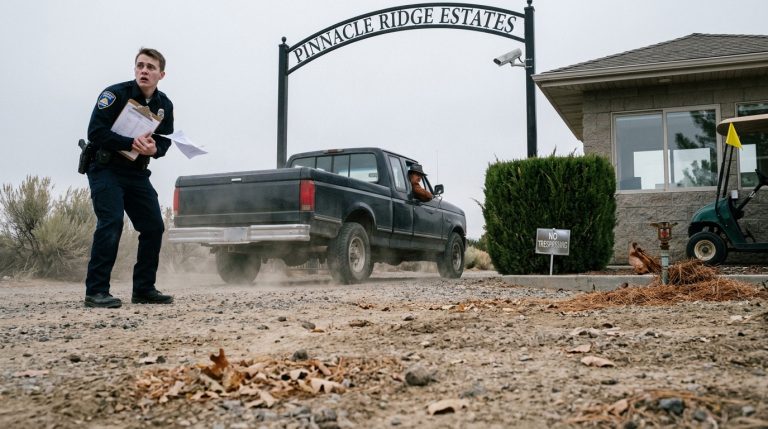
The frost on the windshield didn’t melt; it starred, then dissolved into thousands of granular cubes that cascaded down the silver hood like heavy rain.
Marcus kept his thumb pressed against the ceramic curve of his coffee mug, feeling the localized heat bleed into his skin while the rest of his fingers stayed numb. It was 6:02 a.m. The air smelled of burnt regular roast and the sharp, chemical tang of uncombusted diesel idling thirty feet away. Through the double-paned glass of the kitchen window, the silhouette of the flatbed tow truck looked like a low-slung predatory animal parked across the imported gray gravel of the driveway.
“Hit the edge,” a voice rasped from the driveway. The sound passed through the window frame, stripped of its treble by the insulation but carrying the distinct, flat cadence of Jake’s voice. “The frame’s reinforced. Drop it right where the pillar meets the seal.”
Inside, the house was silent save for the rhythmic, low-frequency hum of the refrigerator. Elena hadn’t come downstairs yet. Her dress uniform—the crisp wool trousers, the gold-plated insignia of the county’s highest office, the stiff leather of the utility belt—hung from the valet stand in the upstairs hall, catching the first blue rays of the mountain dawn.
Marcus didn’t yell. He didn’t drop the mug. He moved with the measured, unhurried gait of an engineer who spent his days calculating load bearings and structural tolerances. When his boots hit the porch, the cold air lunged into his lungs, dry and tasting of high-altitude pine.
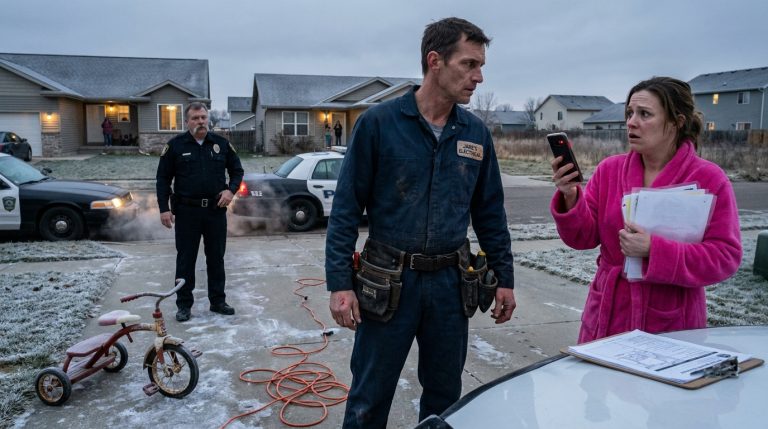
Delilah Thornwick stood on the edge of the grass line, her designer heels sinking exactly two inches into the damp earth. Her right hand held an iPhone at shoulder height, the lens tracking the arc of the crowbar. She wore a cream-colored trench coat that looked too thin for a Colorado morning, her jaw locked into a rigid line that simulated civic duty.
“Luxury vehicle display violation,” Delilah said to the screen, her voice rising an octave to cut through the diesel rumble. “Community standards code 47B. Enforcement team is executing emergency removal protocols due to persistent non-compliance.”
The crowbar came down again. This time, the impact was duller—metal against the reinforced track of the window frame. Jake shifted his weight, his cheap polyester security shirt rustling like dry paper. A dark patch of sweat was already spreading between his shoulder blades despite the thirty-degree air. He didn’t look at Marcus. He kept his eyes fixed on the silver door handle, his knuckles white around the rusted iron grip.
“You’re tracking mud onto the aggregate,” Marcus said, his voice flat, devoid of the anger Delilah seemed to be filming for. He stopped three paces from the truck’s hydraulic lever.
“The board doesn’t negotiate during active enforcement, Mr. Ramirez,” Delilah said, not lowering the phone. A small spark of static electricity jumped from her coat to the plastic housing of her device. “Your property is an attractive nuisance. It alters the architectural density index of the sector.”
“Code 47B doesn’t exist,” Marcus replied. He looked down. Near Jake’s boot, a single, perfectly square shard of tempered glass lay wedged between two pieces of gravel. It reflected the blue sky like an artificial tooth. “I checked the registry before we signed the title. The bylaws stop at 45.”
Jake paused, the crowbar hovering inches from the side mirror. His breath came in short, white plumes that vanished against the truck’s radiator grill. He glanced toward his aunt, his confidence wavering beneath the weight of Marcus’s stillness.
Before Delilah could answer, the front door of the house clicked open. The sound of polished leather soles hitting the concrete porch was quiet, but Jake turned his head instantly. Elena stood in the shadow of the overhang, her uniform immaculate, the silver chief’s star on her chest catching the first direct ray of the sun. She wasn’t carrying her weapon, but her hands were clasped loosely behind her back—the universal stance of an officer observing a crime scene they already knew how to clear.
“Keep filming, Delilah,” Elena said, her voice dropping into the driveway like a heavy stone. “Don’t stop the recording. I want the metadata clean.”
CHAPTER 2: THE VOID MATRIX
“The camera didn’t blink, Marcus. Delilah did.”
Elena shifted her weight against the polished mahogany desk in the home office. The morning light filtered through the wooden blinds, throwing sharp, slate-gray bars across her uniform. Her fingers didn’t shake as she unclipped her badge, laying it flat onto a leather blotter. The silver star made a clean, heavy clack against the hide. Every movement was calculated, a sequence of learned efficiencies from fifteen years of watching people look for a place to hide their hands.
Marcus stood by the window, the cold glass refracting a distorted view of the street below. Delilah’s flatbed had retreated, leaving two parallel scars of dark fluid on the aggregate driveway where the engine had strained against its own oil seals. Jake had left his crowbar behind—a cheap, thirty-inch bar of carbon steel with a chipped blue finish, now resting on a sheet of newspaper by the doorway.
“She wasn’t looking at my camera,” Marcus said, his eyes tracing the line of the aggregate. “She was looking at the streetlights. Every time Mrs. Patterson’s kitchen light flickered, Delilah checked her watch. She’s tracking something on a schedule.”
“She’s tracking the filing window,” Elena murmured. She pulled a stack of leather-bound municipal code volumes toward her, the sharp corners catching the fabric of her sleeve. “If you file a vehicle removal notice under an emergency municipal clause, the digital ledger has to timestamp it within twenty-four hours of the initial citation. Look at the printing format on this slip she left.”
She slid the watermarked paper across the desk. The edges were cut with a straight blade—clean, unperforated, but the ink density wasn’t uniform. In the lower left quadrant, the official seal of the Willowbrook Heights Community Association was slightly skewed, its alignment off by less than two millimeters.
Marcus leaned down, his rough palms pressing against the cool timber of the desk. His contractor’s eye caught the variance instantly. “The logo is a vector reproduction. The serif on the letter W doesn’t match the master deed documentation we signed at closing. This wasn’t run through a commercial press. It’s a high-grade inkjet using heavy-gauge linen stock to mimic official county stationery.”
“It’s better than that,” Elena said, her voice dropping into the low, transactional register she used when an interrogation room went small. “I ran the corporate ID listed on the footer through the Colorado Secretary of State’s digital portal while you were checking the driveway. The identification number belongs to a dissolved agricultural cooperative in Weld County that went belly-up in 2021. The Willowbrook Heights HOA doesn’t have an active registration file. It’s a ghost entity, Marcus. A shell without a legal skeleton.”
The room grew quiet enough for the grandfather clock in the hall to reassert its rhythm—a steady, mechanical pulse that felt like a countdown. Marcus picked up the check stub Betty Kowalski had delivered the previous evening. The paper was crisp, but the texture felt different from standard commercial checks—the paper stock had a higher iron content, intended to prevent alteration but indicating a private printing batch.
“If the association is a legal void,” Marcus asked, his finger tracing the perforated edge of the stub, “where has the money been going? One hundred and twenty-seven thousand dollars from this block alone over seven years. You don’t hide that kind of volume in a personal checking account without the IRS flagging the structural variance.”
“You do if the account is tied to an active corporate ledger that doesn’t belong to the neighborhood,” Elena said. She stood up, her uniform trousers rustling softly as she walked to the dry-erase board mounted on the wall. She picked up a black marker, the tip making a sharp, squeaking sound against the white enamel. She drew a single circle, labeling it Delilah, then drew three lines radiating outward.
“Line one: Jake. Forty thousand a year as an enforcement officer. But look at his public filings—he doesn’t own a car, and his address is registered to a P.O. Box in Aurora. Line two: the tow company. It’s a private contractor called Vanguard Logistics, registered out of Delaware. Line three is where it breaks.”
She drew a heavy box around the final terminal point.
“This check stub Betty gave us has an escrow routing number that isn’t connected to a local bank. It routes back to a commercial clearing house in Denver called Apex Development Partners. The same outfit that cleared the initial title for these lots before the bankruptcy five years ago.”
Marcus felt the cold logic of the situation click into place like a deadbolt. “The developer didn’t just walk away when the company folded. They left a scavenger in place to bleed the remaining assets before the county could seize the infrastructure.”
“A scavenger with a clipboard and a legal mask,” Elena corrected. She turned back to the desk, her expression tightening as she looked toward the window. “But we have a structural leak. If Delilah knows I’m pulling these corporate filings, she’s going to execute her counter-move before we can lock down the secondary ledgers. She’s already tried to clear the vehicle; next, she’ll try to clear the paper trail.”
A sudden, sharp vibration cut through the stillness. Elena’s personal cell phone began to slide across the polished wood of the desk, its screen illuminating with an unlisted seven-digit number from the local exchange.
Elena didn’t pick it up immediately. She let it pulse three times, the blue light reflecting off the silver star of her badge. When her thumb swiped the screen, she didn’t say hello. She simply held the device to her ear, her breathing shallow and controlled.
“Chief Ramirez,” a voice said on the other end. It wasn’t Delilah. The voice was male, older, carrying the flat, dry drone of a legal representative reading from a prepared document. “This is Arthur Vance from Morrison and Associates. We represent the primary creditors for the Willowbrook Heights estate. We have a signed order from the regional administrative judge regarding an ongoing structural audit of your property line. An enforcement team will be entering your perimeter at midnight to secure non-compliant engineering assets. Please ensure your personal vehicles are cleared from the gravel buffer.”
The line went dead before Elena could reply. The dial tone that followed sounded thin, mechanical, and entirely unyielding.
Marcus looked at his wife. “They aren’t trying to tow the car anymore, are they?”
“No,” Elena said, her fingers locking onto the edge of the desk until the wood groaned beneath the pressure. “They’re coming for the office. They know exactly what’s in these drawers.”
CHAPTER 3: THE MIDNIGHT AMBUSH
The rain started at 11:42 p.m., dropping out of the black Colorado sky in thin, freezing needles that rattled against the aluminum gutters. Marcus didn’t clear the condensation from his watch face; he knew the time by the rhythmic hum of the county transformer down the block. He sat on a low crate in Mrs. Patterson’s dark detached garage, three houses down from his own property line. The smell of old motor oil, fertilizer, and wet rust hung heavy in the uninsulated space. Through a cracked slat in the rotting wooden siding, he had a clear, unblinking view of his own back perimeter.
Elena was forty feet away, positioned in the deep shadow of the Hendersons’ cedar hedges. She wasn’t wearing her dress uniform tonight. She had swapped the brass and polished leather for a black tactical windbreaker and steel-toed utility boots. Her hand rested on her secondary radio, the volume dialed down to a micro-frequency that hissed like a nesting snake against her collarbone.
“Two vehicles turning off the main artery,” her voice came through Marcus’s earpiece, stripped of tone by the low-band encryption. “No headlights. Utility vans. Low suspension clearance.”
Marcus adjusted his grip on a heavy iron torque wrench. His palms were dry despite the freezing damp. “They aren’t using local tow contractors. Those chassis are too heavy for standard municipal repossessions.”
“Vanguard Logistics signatures,” Elena murmured back. “They’re using private tactical recovery teams. This isn’t a regulatory seizure; it’s an asset purge. Look at the lead vehicle’s roof rack.”
Through the vertical gap in the cedar siding, Marcus watched the first van roll past the aggregate stone mailbox. The tires made no sound on the wet asphalt, the tread completely smoothed down like custom tracking rubber. The vehicle stopped directly in front of the Ramirez driveway, its rear doors aligned with the side entrance to the garage where the home office files were locked behind two inches of reinforced plate steel.
The side door of the van slid open with a sharp, hydraulic hiss. Three figures stepped onto the gravel, their movements synchronized, devoid of the sloppy hesitation Jake had shown six hours earlier. They wore identical dark canvas jumpsuits with no markings, their faces obscured by low-profile protective visors that glinted like wet obsidian in the dark. The lead man didn’t carry a clipboard; he carried an industrial cordless angle grinder, its diamond-tipped blade reflecting the dull yellow amber of a distant streetlamp.
“They’re bypassing the primary lock,” Marcus whispered, his eyes narrowing as he noted the angle of their approach. “They aren’t checking for citations. They’re going straight for the structural shear walls.”
“Stand by,” Elena commanded. “Let them breach the exterior threshold. If we move before the steel fails, the corporate intent remains ambiguous under county statute. We need the tool to bite the frame.”
The high-pitched whine of the electric motor tore through the midnight air, a screaming, metallic shriek that set the neighborhood dogs off in a chain-reaction chorus two blocks over. Sparks flew in a brilliant, cascading crescent of white and orange heat, casting jagged, violent shadows across the gray siding of the house. The smell of melting industrial zinc and vaporized primer drifted across the wet grass, sharp and caustic.
Marcus moved out of the garage before the scream of the blade hit its second octave. He kept his weight on the balls of his boots, utilizing the rhythmic noise of the grinder to mask the crunch of his footsteps on the wet soil. He crossed the property line through the gap in Mrs. Patterson’s broken wire fence, his fingers tracing the cold steel handle of the torque wrench.
The second intruder was standing watch by the van’s rear bumper, his head rotating in a slow, professional sweep of the dark street. He didn’t see Elena move from the hedges. She didn’t use a nightstick or a weapon; she utilized the simple momentum of her weight, striking the man directly below the shoulder blade with her forearm while her boot hooked his left ankle. The intruder went down without a shout, his face hitting the wet aggregate with a dull, wet thwack that was entirely swallowed by the roar of the angle grinder.
The lead man with the cutter didn’t notice the drop. He had already carved a six-inch vertical laceration into the reinforced locking plate of the office door, the sparks bouncing off his heavy protective apron in angry swarms.
“Step back from the frame,” Marcus said, his voice coming from less than three feet away.
The man froze. The grinder stayed live, its blade spinning at ten thousand revolutions per minute, whistling in the damp air like a dying turbine. Slowly, the intruder tilted his head, the dark glass of his visor reflecting Marcus’s cold, unblinking expression. He didn’t drop the tool; instead, he shifted his weight, rotating the screaming edge of the blade toward Marcus’s chest with a fluid, deliberate twist of his hips.
The motion was precise, but it lacked the understanding of leverage. Marcus didn’t step back; he drove the heavy iron torque wrench forward, striking the aluminum motor housing of the grinder with a single, short blow that shattered the plastic fan casing. The blade seized instantly, the torque twisting the tool out of the intruder’s grip with a violent snap that sent a spray of broken composite teeth into the wet gravel.
Elena was already behind him, her zip-ties clicking into place around the second man’s wrists before the broken blade stopped skittering across the driveway.
“Search his right utility pocket,” Elena snapped, her breath white in the dark as she pinned the first intruder against the ruined door frame. “He didn’t come for the paper files. Look for the secondary override.”
Marcus reached down, his fingers plunging into the heavy canvas pocket of the downed man’s jumpsuit. His hand closed around a small, heavy object wrapped in oiled rag stock. He pulled it free, letting the cloth unroll under the blue beam of his penlight.
It wasn’t a digital key or a lock-pick. It was a solid, double-bitted iron skeleton key, its surface pitted with age, stamped with a single five-digit serial number that matched the original 1990 municipal drainage plat maps for the entire county subdivision.
“This doesn’t belong to our office door,” Marcus said, turning the heavy iron teeth over in his hand. The key felt freezing against his palm, heavy and functional. “This is for the old vault under the municipal center building.”
Elena leaned closer, her eyes scanning the stamped digits. The cold rain trickled down her cheek from her dark hair, but her gaze remained fixed on the iron. “Delilah didn’t send them to destroy our evidence, Marcus. She sent them to retrieve this before we found out what the original developer left in the municipal basement.”
The man pinned against the door frame let out a short, dry laugh that sounded like gravel shifting in a tin bucket. “You’re looking at the wrong door, Chief. The association didn’t close five years ago. It just changed its routing protocol.”
CHAPTER 4: THE SUBURBAN EXPOSURE
The double doors of the Willowbrook Heights Community Center didn’t open; they slammed back against the beige drywall, the strike plates vibrating with a heavy metallic ring. Marcus stepped through first, his hand resting flat against the edge of a heavy cardboard box packed with highlighted corporate filings. The air inside the assembly hall tasted stale, smelling of institutional floor wax, industrial heater dust, and the sour note of seventy-eight households worth of quiet panic.
Fluorescent light tubes buzzed overhead, casting a harsh, desaturated glare over the rows of metal folding chairs. At the front podium stood Harold Kowalski, his weathered face set in a hard, uncompromising mask as he clicked through a digital slide displaying the state registry database’s blank space.
“Every single dollar,” Harold’s voice boomed over the PA system, cutting through the low, terrified murmurs of the crowd. “Seven years of structural assessments. Paid to a ghost.”
Delilah Thornwick didn’t look like a prisoner yet. She sat in the front row, flanked by a tired-looking public defender who kept shuffling through yellow legal pads, his pen scratching erratic marks against the stock. Her posture remained straight, her chin tilted upward with the defensive arrogance of someone who still believed the brick-and-mortar weight of the subdivision belonged to her clipboard. Beside her, Jake leaned against the linoleum wall, his fake safety badge torn from his shirt, his fingers twitching against the seams of his jeans.
“This assembly has no regulatory authority under the master deed,” the public defender stood up, his voice cracking slightly under the pressure of seventy-eight pairs of hostile eyes. “My client is advising an immediate cessation of these activities. Any disclosure of private financial ledgers constitutes a civil infraction.”
Elena walked down the center aisle, her boots striking the linoleum with a steady, military precision that forced the lawyer back into his seat without a word. She wore her full dress uniform now, the silver chief’s star pinned over her heart, cold and unyielding under the white lights. Her eyes locked directly onto Delilah.
“The master deed was a fabrication, Counselor,” Elena said, her voice dropping into the silent space like iron weights. “I’ve just returned from the county filing basement. The original certificate of incorporation hanging in Mrs. Thornwick’s office wasn’t an administrative error. It was an active misdirection.”
She dropped a secondary stack of documents onto the speaker’s table. The sharp edges of the paper scraped against the wood, sending a small cloud of dry paper dust into the light beam of the projector.
“Layer one was simple,” Elena continued, turning her head toward the rows of residents. “She let you think she was a local dictator protecting your property values. She let you think she was just an overzealous neighbor making up codes like 47B to keep the lawns green. But look at the corporate routing numbers on the screen behind me.”
Harold clicked the remote. The image of the blank database shifted, replaced by an illuminated bank spreadsheet. Columns of seven-digit numbers marched down the screen, each one marked by a small, red tracking indicator from the State Department of Revenue.
“One hundred and twenty-seven thousand dollars didn’t stay in Colorado,” Elena said, her finger pointing at the primary destination line. “Every fine collected for a mismatched beige paint job or a misplaced garden gnome was systematically routed through an escrow clearing account held by Apex Development Partners. Delilah wasn’t collecting neighborhood fees. She was fulfilling an extraction quota.”
A sharp, collective intake of breath swept through the room like cold wind through dry grass. Mrs. Adrienne stood up in the third row, her fingers white around the strap of her purse. “The wheelchair ramp on Maple Street. The fine for the flag size. That wasn’t about the rules?”
“It was about creating a continuous paper trail of liability,” Marcus said, stepping up to the podium beside Harold. He pulled the heavy iron skeleton key from his pocket and set it onto the microphone base, the metal clack echoing through the speakers. “They used the association’s fake authority to force compliance, then leveraged those files to challenge the original land valuation. They were driving the property assessments down on paper so their parent company could buy back the adjacent development plots for pennies on the dollar.”
Delilah’s mask broke. Her hand reached for her briefcase, her nails clicking violently against the brass latches, but she didn’t stand up. Her eyes shifted toward the rear exit where two county patrol units stood in the shadows, their arms crossed over their utility vests.
“You don’t understand the scope,” Delilah whispered, her voice carrying over the front rows without the aid of a microphone. “The developer didn’t leave us. They still hold the underlying utility easements. If the capital flow stops, they cut the main pump line from the reservoir.”
Before Elena could answer, the fire doors at the back of the hall hissed open. Three men in gray wool suits stepped into the room, their movements completely detached from the local chaos. The lead man held a black leather folder embossed with a federal seal, his eyes quickly scanning the room before landing on Elena’s star.
“Chief Ramirez,” the lead agent said, his voice level and entirely devoid of heat. “Federal Bureau of Investigation. We’re taking over the perimeter ledger. Your local warrant just hit a secondary tracking barrier. The Apex corporate accounts were liquidated twenty minutes ago from a server in Delaware.”
Elena’s hand tightened against her belt line, her calculating calm hitting its first true fracture. The decoy secret had shattered, but the final truth was sliding deeper into the dark.
CHAPTER 5: THE RECOVERY PARADIGM
“The local assets were a buffer, Chief. You’ve been measuring the teeth while the jaw was snapping behind you.”
The federal agent didn’t wait for Elena’s permission to break the seal on the basement bulkhead. The iron door screeched, rust sliding off the hinges in dark flakes that dusted the wet concrete floor. The air down here smelled entirely of subterranean damp, high-voltage battery banks, and the distinct, metallic tang of unventilated storage vaults.
Marcus walked two paces behind Elena, his heavy boots sounding loud against the stone. The iron skeleton key they had pulled from the intruder’s pocket felt freezing against his bare skin, its double-bitted teeth aligned perfectly with the lock cylinder on the primary infrastructure crate.
“The accounts weren’t liquidated from Delaware,” Elena said, her voice dropping to a low, analytical tone as she stepped under the flickering cage light of the utility vault. Her eyes never left the steel cabinet lines. “They were mirrored. Delilah wasn’t running an extraction quota to clear the ledger. She was running it to hide the real volume passing through the municipal grid lines.”
She rammed the iron key into the slot. The mechanical tumbler inside gave a heavy, distinct thunk that echoed through the concrete room like a piston firing. The steel door swung outward, exposing not file folders or cash boxes, but an industrial fiber-optic termination bank, its green and amber data lights pulsing in rapid, silent sequences.
The federal agent stopped, his leather folder freezing mid-air. The desaturated light from the rack reflected off his clean glasses. “This isn’t an HOA ledger bank.”
“No,” Marcus said, his rough fingers tracing the heavy armored conduit cables that disappeared through the floor into the municipal bedrock. “This is the primary routing nexus for the regional utility matrix. The development company didn’t walk away during the bankruptcy five years ago. They built the infrastructure, pocketed the state construction grants, and then used Delilah’s fake association to enforce a digital monopoly over the local grid access. Every household in this subdivision wasn’t just paying false fines—they were paying a premium surcharge directly into a multi-state crypto-mining loop hidden inside the county’s own basement.”
Elena reached into the terminal slot, pulling a single, stamped aluminum master drive plate from the chassis. The metal edges were sharp, biting into her palm as she pulled it free. The status lights on the main board immediately shifted from green to a hard, solid crimson.
“The fraud wasn’t a localized scheme, Agent,” Elena said, turning the drive over under the blue beam of her flashlight. The surface was laser-etched with the master corporate seal of Apex Development Partners. “Delilah was the shield. She thought she was building a petty empire out of beige paint regulations, but she was just the high-profile distraction to keep the county from looking at the electrical load variances. The money she stole from the residents was used to float the overhead for a fifty-million-dollar institutional embezzlement network.”
Across the hall, the sound of standard municipal sirens began to rise through the ventilation shafts—low, rolling waves of sound that signaled the arrival of the full county transport detail. The perimeter was locked down.
Marcus watched the red light bleed across the concrete floor, his tactical calculation concluding with a cold sense of absolute finality. The structure was exposed. The paper trail was closed. The concrete kingdom had fallen back into the hands of the people who built it.