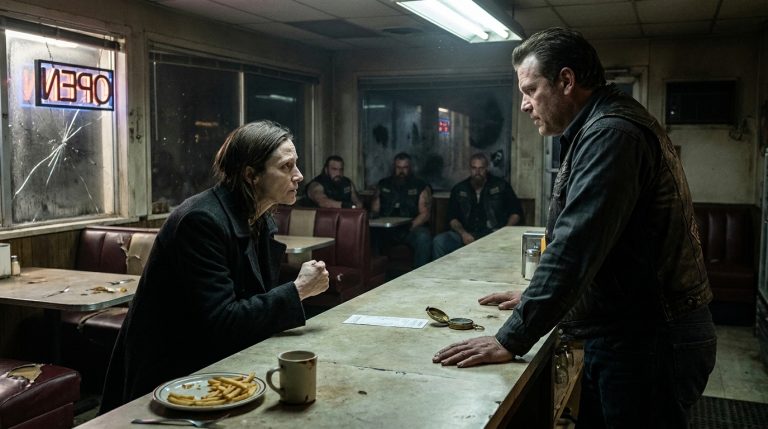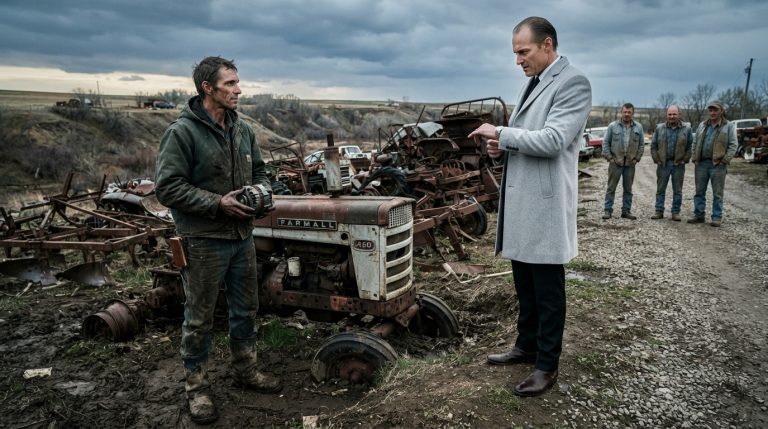
The Frozen Ledger: A Calculated Dismantling of Suburban Tyranny in the Colorado High Country
CHAPTER 1: THE SOUND OF BROKEN STEEL
The driveway of 142 Pinewood Circle was not a place of transition; it was a graveyard of ambition. My $15,000 plow, once a monument to fifteen years of reliable labor, lay in a twisted heap of mangled steel and weeping hydraulic lines. The windows had been shattered inward, the glass glittering like fallen frost in the harsh porch light.
I stood on my threshold, the sub-zero air biting into my lungs, feeling the familiar, heavy gravity of loss. But underneath the anger, something else was pulsing—a quiet, rhythmic calculation. I didn’t scream. I didn’t rush out into the snow to confront the phantoms who had done this. I simply turned back inside, my boots crunching on the gravel, the sound muffled by the thick, encroaching silence of the Colorado night.
Inside, the house felt too large. The darkness was absolute. I walked to the home office, my movements economical, stripped of any wasted energy. I sat before the bank of monitors—a luxury I had resisted for years, until the first fine arrived. The screen glowed with a sterile, blue intensity.
I hit the playback button.
The infrared footage was grainy, but the details were forensic. There, walking with the swagger of a man who owned the very air he breathed, was Blake Ashworth. He was laughing, his breath a puff of fog against the darkness, swinging an aluminum bat with the careless violence of an entitled child. He hit the control panel of my plow, and the plastic exploded in a spray of shrapnel. Behind him, two shadows watched—accomplices, or perhaps just witnesses to a crime they didn’t yet realize would define their futures.
I paused the footage on Blake’s face. He was mid-laugh, his eyes vacant, his jaw slack with the arrogance of immunity. He thought he was untouchable because his mother held the gavel. He thought this was a local spat, a matter of “neighborhood aesthetics.”
He had no idea that every swing of that bat was a step closer to a prison sentence.
My phone vibrated on the desk. A motion alert. Someone was still out there, prowling the perimeter, perhaps checking for a reaction. I didn’t give them one. I kept the house dark. I kept my breath steady. I pulled up the log of the previous three months—the fines, the aggressive letters, the late-night visits from the city inspectors who seemed to have a supernatural talent for showing up at the wrong time.
The pieces weren’t just falling into place; they were locking.
I reached for my notebook, a leather-bound relic from my grandfather, and opened to a fresh page. At the top, I wrote a single name: Vivien. Below it, I listed the dates of every violation, every dollar lost, and every moment of calculated silence I had endured.
The anger was a tool now, sharp and focused. I didn’t need to win the battle; I needed to survive long enough to ensure the war was won on my terms. As the first light of dawn began to bleed over the mountains, I didn’t see a destroyed business. I saw the opening move of a game that would leave the Ashworths with nothing but their pride—and a debt they could never repay.
Then, the doorbell rang. It was soft, hesitant. I checked the perimeter camera. Dorothy stood on the porch, wrapped in a heavy wool coat, holding a damp manila envelope. She looked up at the camera, her eyes sharp, knowing. She didn’t have to speak. She knew what I saw on the screens. And she had come to tell me that I wasn’t the only one who had been watching.
CHAPTER 2: THE PAPER TRAIL OF WINTER
“She didn’t just smash your plow, Garrett. She invited her son to dinner to toast to it.”
Dorothy’s voice was as dry as the dead pine needles littering my walkway. She stood in the center of my kitchen, the manila envelope pressed against her chest like a shield. She didn’t wait for an invitation to sit. She walked to the table—the same table where my grandfather had once taught me that a contract was only as strong as the man willing to enforce it—and laid the contents out.
I watched her hands. They were steady, the skin mapped with the translucent veins of eighty-three years, but there was no tremor. She pulled out a series of blurry, timestamped photos and a printout of an Instagram story.
“Tommy caught this before the boy sobered up and deleted it,” she said, her eyes tracking mine. “Look at the geotag. Look at the caption.”
I leaned in. The screen of my phone, reflecting the harsh fluorescent light of the kitchen, showed a video of Blake Ashworth, face flushed and eyes glassy, standing in front of my own driveway. He was holding a heavy pry bar. The caption was a testament to suburban entitlement: Teaching the snow guy his place. #neighborhoodwatch #cleanstreets.
“It’s not just vandalism, Dorothy,” I said, my voice sounding foreign in the quiet room. “This is premeditation. She’s feeding him. She’s giving him the coordinates and the justification.”
“She’s terrified,” Dorothy replied, tapping a finger against the photos. “She’s been moving money around, Garrett. I don’t know the specifics—not yet—but the Hendersons mentioned she’s been pushing for ‘emergency reserves’ every single month. For a neighborhood that’s been built for forty years, we seem to have a lot of emergencies.”
The cold of the morning felt like it had seeped through the walls. I looked at the photos, then at the black screen of my security monitor where my broken plow sat in the dark. The pain wasn’t in my muscles anymore; it was in the friction of the gear-works in my mind, shifting into a configuration that didn’t leave room for mercy.
“Why tell me now?” I asked.
“Because they aren’t stopping at the plow,” she said, sliding a final sheet of paper across the wood. It was a copy of the HOA meeting agenda for the upcoming week. Proposal to amend vehicle restrictions.
“She’s going to use this destruction as the argument for why I’m a liability,” I realized, the truth settling in my gut like lead. “She wants to ban the equipment, sell the property, and claim the ‘nuisance’ is gone. If I don’t have the plow, I can’t work. If I can’t work, I can’t pay the property taxes. If I leave, the ‘problem’ disappears.”
“She thinks you’re a blue-collar ghost,” Dorothy said, her gaze hardening. “She thinks you’ll pack up and move to a rented apartment in the city because you can’t afford the legal fees to fight her. She doesn’t understand that for you, this isn’t just a home. It’s a border.”
I stood up and walked to the window. The sky was an iron-gray, the clouds heavy with the next front, the air smelling of ozone and impending snow. I watched the street. A white Tesla glided by, silent and frictionless, moving at a speed that ignored the ice beneath its tires. It didn’t stop. It didn’t even slow down.
“She’s banking on me reacting,” I said, mostly to myself. “She wants a fight in the driveway. She wants me to pull a gun or start a fistfight. That’s what the cameras are for. That’s why she sends Blake.”
“So don’t fight in the driveway,” Dorothy whispered, her voice dropping to a conspiratorial frequency. “Fight in the ledgers.”
I turned back to her. She had a small, digital voice recorder sitting on the table, next to a stack of neighborhood grievances she had collected from the Johnsons and the Kellys. She wasn’t just my neighbor; she was my intelligence officer.
“What do you have?”
“I have a woman who thinks she’s the only one who knows how to read between the lines,” she said, a ghost of a smile playing on her lips. “But she forgot that the people who lived here before she moved in aren’t just ‘property owners.’ We’re a community. And we’ve been keeping logs for a very, very long time.”
I looked at the recorder, then at the evidence of the destruction outside. The stakes had just shifted. It wasn’t about the $15,000 piece of steel anymore. It was about exposing the rot that was currently masquerading as the neighborhood’s prestige.
“Tomorrow,” I said, my voice steady, “I’m going to the city records office. I want every permit, every amendment, and every board meeting minute from the last three years.”
“I’ll be there at eight,” Dorothy said, standing up. “I know the clerk. She doesn’t like Vivien either.”
As she walked to the door, the wind howled against the side of the house, a long, low moan that sounded like the earth itself was preparing for a struggle. I didn’t see the broken plow anymore. I saw the map of Vivien Ashworth’s downfall, laid out in black and white, waiting for me to connect the dots.
CHAPTER 3: THE BUREAUCRATIC BLIZZARD
The air inside the municipal building smelled of dry paper and overheated floor wax. It was a sterile, suffocating environment that felt like the antithesis of the mountain air I usually breathed, yet it was here that the real war was being fought.
Dorothy was already at the main counter, her back straight as a yardstick. The clerk behind the plexiglass, a man with tired eyes and a tie that had seen better decades, was currently shaking his head.
“I’m sorry, Mr. Holbrook,” the clerk said, his voice barely audible over the hum of the ventilation. “But the files for the Milfield Heights Homeowners Association are currently under administrative review. Access is restricted until the end of the month.”
I felt the familiar tension return to my shoulders. “Restricted by whom?”
“The President’s office,” the clerk muttered, not looking me in the eye. “Vivien Ashworth filed a formal request for document preservation. Something about potential litigation regarding neighborhood covenants. My supervisor says we aren’t to release anything until the legal department clears it.”
I leaned against the counter, my knuckles white. This wasn’t a mistake. It was a blockade. Vivien knew I was coming, or at least she knew someone would eventually. She had weaponized the very system she claimed to be protecting.
“Dorothy,” I said, my voice low. “Go check the property tax assessments on the back terminal. If she’s blocking the covenant records, she might have missed the filings at the County Assessor’s office.”
Dorothy didn’t hesitate. She moved to the public access station with the speed of a younger woman. I stayed at the counter, locking eyes with the clerk. He was terrified, and in that fear, I saw my opening.
“I don’t need the whole file,” I said, leaning in. “I just need the signature on the last amendment to the vehicle code. The one from February. Was it filed by the board, or was it a personal submission?”
The clerk shifted, glancing at the security camera mounted in the corner. “I could lose my job, Garrett.”
“And if you don’t show me, you’re looking at an accomplice charge when the state auditor eventually looks at these books,” I lied, keeping my tone flat and dangerous. “I’m not the one you should be afraid of, Mr. Henderson. I’m the one who’s actually going to do something about the fraud taking place in our zip code.”
The clerk hesitated, then turned to his keyboard. He typed a string of commands, his fingers dancing nervously. He pulled up a digital scan, hovered for a second, then hit print. The paper hissed out of the tray. He slid it toward me face-down.
I didn’t look at it until we were back in the truck, the heater blasting, the scent of stale coffee and damp work gloves filling the cabin.
“She didn’t file it as a board action,” I said, reading the document. “She filed it as a personal petition, claiming ’emergency neighborhood stabilization.’ It’s a complete fabrication.”
Dorothy was staring at the screen of her own laptop, her brow furrowed. “Garrett, look at this. The HOA reserve fund has been depleted by sixty percent in the last eighteen months. It’s categorized as ‘Consulting Fees’ for a firm called Alpine Landscape. I’ve never heard of them. Have you?”
“Never,” I said, taking the laptop and scanning the entries. They were massive, irregular withdrawals—amounts that had no business being associated with landscape consulting in a subdivision that didn’t have a landscaping budget.
“She’s bleeding us dry,” I whispered, the realization hitting me with the force of a head-on collision. “She’s not just clearing out the working families. She’s using the HOA as a personal ATM to cover whatever debt she brought with her from California.”
“The vandalism,” Dorothy said, her voice trembling with a mix of fury and understanding. “She had to get rid of you because you were the only one who looked at the snow removal invoices. If you had kept the books, you would have seen the Alpine payments. She wasn’t just clearing the view of your plow. She was erasing the auditor.”
I looked out the window at the parking lot, the gray expanse of asphalt reflecting the low, winter sky. Vivien thought she was untouchable. She thought she was the puppet master pulling the strings of a community that didn’t know it was being played.
But she had made a critical error. She had treated me like a simple laborer who wouldn’t know how to look for the trail of breadcrumbs she was leaving behind. She hadn’t realized that for fifteen years, I had been watching the ground, learning the patterns of the storm.
“She’s planning that emergency town hall for Friday,” I said, putting the truck in gear. “She thinks she’s going to finalize the removal of my contract and put this all behind her.”
“And what are we going to do?” Dorothy asked, her eyes reflecting the cold fire of our growing plan.
“We’re going to let her hold the meeting,” I said, shifting the truck into drive. “But she’s not going to be the one who finishes it.”
As we pulled out of the municipal lot, a black SUV sat idling at the exit, its windows tinted deep. It didn’t follow us, but it watched us pass. Vivien was watching. She was waiting for me to lose my temper, to give her the excuse she needed to have me arrested or evicted.
I kept my eyes on the road, my grip firm on the steering wheel. She could watch all she wanted. I had the ledger, and for the first time in three years, I had the truth. And the truth, I knew, was a far more destructive force than any sledgehammer.
CHAPTER 4: THE INSPECTORS RACKET
The knock at the door was not the polite rap of a neighbor, but the heavy, authoritative thud of someone who expected the door to swing open on command. I didn’t rush. I finished tying my work boots, the leather stiff and cold, and took a long breath of the morning air that had begun to carry the metallic tang of an approaching storm.
When I opened the door, Inspector Rodriguez stood there, his clipboard tucked under his arm like a weapon. He didn’t offer a greeting. He just glanced past me, his eyes landing on the row of plows parked along the side of the house.
“Mr. Holbrook,” he said, his voice clipped. “I’m here for the follow-up. Noise complaints and emissions testing.”
“It’s six in the morning, Rodriguez,” I replied, staying in the doorway. “My operation doesn’t start until dawn.”
“Code doesn’t have a schedule,” he shot back, his pen already poised over his forms. He pushed past me with an arrogance that made my teeth ache.
I followed him into the yard. The morning was crisp, the frost on the grass crunching like breaking glass under our boots. Rodriguez moved with a practiced, predatory rhythm. He walked to the main plow, the one Blake had decimated with his bat, and began poking at the engine casing with a metal rod.
“Modified exhaust system,” he muttered, scribbling notes. “Non-compliant. You’re looking at a five-hundred-dollar fine and an immediate cease-and-desist on all commercial engine work.”
I stepped into his personal space, my shadow falling over his clipboard. “That’s a standard cold-weather adapter, Rodriguez. Every serious contractor in this state uses them. It’s not an emissions modification; it’s a survival requirement.”
He looked up, his eyes cold and devoid of anything resembling professional integrity. “I don’t make the policy. I just enforce the code. And the code says this unit is a hazard.”
As he spoke, I noticed something in the pocket of his high-visibility vest. A business card, partially visible, with a logo that didn’t belong to the city. I stepped back, feigning resignation, and reached into my own pocket, thumbing the record button on my phone.
“Maybe there’s another way to handle this?” I asked, my voice feigning a desperate, weary tone. “I can’t afford a five-hundred-dollar hit right now. Is there a company that handles these kinds of ‘retrofits’ you keep talking about?”
Rodriguez’s expression shifted, the predatory mask softening into something more transactional. He pulled the card from his pocket and held it out, not quite handing it to me. Mountain Air Solutions. “They’re the only ones the city trusts for residential filtration systems. Expensive, but they keep the inspectors happy. Keep the inspectors happy, and the citations stop.”
“I see,” I said, taking the card. The paper was glossy, high-quality, and completely out of place in this neighborhood. “And I assume they’re recommended by your office?”
“They’re the industry standard,” he said, turning back to the plow. He spent another ten minutes measuring the noise levels, his movements theatrical. He wasn’t conducting an inspection; he was performing a play, and I was the captive audience.
After he left, I didn’t go back inside. I walked over to the plow and looked at the damage Blake had done. It was worse than I thought. The hydraulic lines were slashed, not just cut—a deep, surgical laceration. I pulled out my phone and dialed Hamilton Pierce.
“Hamilton,” I said as soon as he answered. “Rodriguez is playing the game. He’s pushing a filtration company called Mountain Air Solutions. He’s running a racket.”
“That’s excellent, Garrett,” Hamilton replied, his voice calm and sharp. “If he’s using his position to funnel work to a private entity he has a stake in, that’s not just a zoning issue. That’s a federal crime. Keep that card. Keep the recording.”
I hung up and looked down at the shiny business card. It was a piece of evidence, but more than that, it was a glimpse into the architecture of Vivien’s desperation. She hadn’t just hired a bully; she had hired a mercenary who was using the law to squeeze the neighborhood for every penny.
The morning sun finally crested the mountains, bathing the street in a harsh, unforgiving light. I saw Vivien at her mailbox, her white Tesla parked perfectly behind her. She looked over, saw me standing by the plow, and for a split second, her composure fractured. She didn’t wave. She didn’t nod. She turned and retreated into her house, the door clicking shut with a finality that felt like a lock being turned.
She thought she was cutting me out. She didn’t realize she was building the very trap that would consume her. I went into the garage, picked up a wrench, and began to work on the plow. The work was physical, repetitive, and grounding. Every bolt I tightened, every line I patched, was a declaration of intent.
The storm was coming, the air getting colder, the sky bruising into deep shades of purple. Let her have her town hall. Let her have her inspector. I had the mechanics of a machine that worked, and I had the proof of a system that was fundamentally broken.
CHAPTER 5: THE IRREVERSIBLE BREACH
The night did not arrive with a whisper; it arrived with a violence that shook the foundations of my ranch house. At 1:47 a.m., the silence of Pinewood Circle was obliterated by the piercing beam of my driveway floodlights. I was already awake, sitting in the dark of my bedroom, watching the monitors.
The infrared feed was crisp. Blake Ashworth was there, his movements erratic, his gait heavy with the weight of cheap whiskey and expensive entitlement. He wasn’t alone. Two figures trailed behind him, obscured by the hoods of their heavy parkas, their faces hidden in the harsh, high-contrast shadows.
I didn’t call the police. I didn’t reach for my coat. I watched, my heart rate a steady, rhythmic thrum, as Blake raised the aluminum bat—a blunt, soul-less object—and swung it into the side panel of my secondary equipment trailer. The sound didn’t travel through the glass, but I could see the metal deform, the paint flying in a spray of white flakes against the black.
“This will teach that working-class piece of shit,” Blake’s voice drifted through the microphone, amplified and arrogant. “Mom says people like him are ruining the neighborhood character.”
There it was. The justification. The articulation of the hatred that had simmered for months. He was a child acting out a script written by a woman who saw people as variables to be subtracted from an equation.
I reached for the DVR, my finger hovering over the record override. I needed this. I needed every second, every angle, every slur caught in high definition. But then, the screen flickered. The feed from the primary camera—the one mounted directly above the main plow—suddenly turned to static.
“What?” I hissed, scrambling to the keyboard.
I toggled to the secondary feed, but it was lagging, frame-dropping as if something were interfering with the wireless signal. Then, a massive surge of feedback screeched from the speakers. I lunged for the volume, but it was too late; the entire system had gone into a protective lock-down.
Panic, cold and sharp, flooded my veins. This wasn’t just vandalism. It was a digital siege. They were jamming the signal.
I grabbed my coat and burst out the back door, the sub-zero air hitting me like a physical blow. The ground was frozen hard, a treacherous landscape of ice and gravel. I ran toward the driveway, my boots sliding, my breath coming in jagged, freezing gasps.
By the time I rounded the corner of the house, the floodlights were dark. A thick, artificial fog—likely from a smoke canister—hung over the driveway. I could hear the wet, rhythmic crunch of footsteps retreating toward the street.
“Hey!” I shouted, the sound swallowed by the wind.
A figure turned, a dark silhouette against the streetlamp. A heavy object—a wrench, perhaps—whistled through the air, clattering against the fence inches from my head. I ducked, feeling the spray of wood splinters against my cheek. When I looked up, the driveway was empty.
I sprinted to the trailer. The damage was catastrophic. They hadn’t just used the bat. They had used industrial-grade cutters on the hydraulic lines. A thick, viscous black fluid was oozing out of the severed hoses, pooling in the snow like oil. It smelled of chemicals and ruin.
I checked the backup camera on the trailer’s side. It had been spray-painted black.
I stood there, surrounded by the wreckage of my livelihood, and felt the weight of the night settle into my bones. This wasn’t a win. It was a tactical disaster. They had blinded me. They had destroyed the core of my business, the very thing that proved I was the essential worker this neighborhood needed.
I walked back into the house, my legs feeling heavy, as if the cold had seeped into my marrow. I sat back down at the desk and tried to restart the server. It wouldn’t boot. The hard drive had been wiped, the system logs corrupted by a remote script.
I hadn’t just lost the equipment. I had lost the evidence of the son’s involvement. Without the footage, I had nothing but a misdemeanor complaint and a mounting bill for damages. Vivien had played her hand, and she had won this round. She had moved the goalposts while I was still trying to find the ball.
The house felt silent, impossibly cold. My phone buzzed on the desk. It was an email from the HOA board.
Emergency notice: Following the recent, regrettable incidents of vandalism involving commercial equipment on Pinewood Circle, the board has voted to move the emergency town hall meeting to tomorrow night to address immediate infrastructure and safety concerns.
She was rushing the end game. She was going to present the wreckage—the very wreckage she had ordered—as proof that I was a liability, that my presence brought nothing but destruction to the neighborhood.
I stared at the screen, the blue light stinging my eyes. I was exhausted, outgunned, and effectively bankrupt. I leaned back, looking at the ceiling, trying to find a way out of the trap.
Wait.
I reached into the back of the computer tower. I pulled out a small, secondary SD card, the one I had installed as an offline fail-safe, the one I’d forgotten to mention to even Hamilton. It was a raw, low-resolution capture that saved to a localized buffer.
I pushed it into the reader.
The screen flickered. The file was small, corrupted, but there—the footage of a third person, someone who had been holding the jammer. I zoomed in, adjusting the contrast, and froze.
It wasn’t a stranger. It was a local security consultant, someone I’d seen working on Vivien’s house just last week. She had hired a pro to kill the feed. But the pro had been sloppy. He’d walked right past the hidden motion-sensor light on the neighbor’s fence—a light I’d installed for Tom Martinez months ago, a system I’d wired into a separate, independent power grid.
The footage from Tom’s yard clearly showed the consultant, the jammer, and the license plate of the SUV they’d used to escape.
I let out a breath I’d been holding for an hour. It wasn’t the footage I wanted, but it was the footage I needed. She hadn’t destroyed the evidence; she had just made me work harder to find the true depth of her conspiracy.
I closed my laptop and looked at the clock. 4:00 a.m. The storm was still howling, but for the first time, the sound didn’t bother me. I had a weapon. Now, I just had to make sure I detonated it at exactly the right time.
CHAPTER 6: THE ARCHAEOLOGY OF GREED
“It’s not just a pattern, Garrett. It’s an excavation.”
Hamilton Pierce’s office was a tomb of legal history, lined with floor-to-ceiling shelves that smelled of dust, old glue, and the slow decay of secrets. He didn’t offer me a seat. He was standing, his back to the window, the late-afternoon sun carving deep shadows into his face. He gestured toward a sprawling, chaotic array of documents laid out across his mahogany desk like a murder board.
“I spent the last forty-eight hours digging through the HOA’s reserve accounts,” he said, his voice stripped of his usual courtroom polish. “I didn’t find a snow removal company. I found a vacuum.”
I moved toward the desk, my hands still stiff from the cold of the garage, where I’d spent the morning trying to bypass the trailer’s mangled harness. “Alpine Landscape Consulting?”
“A ghost,” Hamilton said, tapping a document with a fountain pen. “Registered in Denver. The address leads to a UPS store in a strip mall. But that’s not the interesting part. Look at the payment schedule.”
He pointed to a series of dates. They coincided exactly—to the day—with the HOA board’s major capital improvement projects. Every time a new roof was approved, or a paving contract was signed, a “consulting fee” of ten percent was wired to Alpine.
“She’s been skimming,” I said, the gravity of it beginning to settle. “She’s not just trying to force me out. She’s embezzling from the entire neighborhood.”
“And the reason she’s forcing you out,” Hamilton added, his eyes narrowing, “is because your grandfather’s contract is the only document in this subdivision that requires a yearly independent audit of the community’s infrastructure spending. If you stayed, if you continued to maintain the roads, the audit would have been triggered by default. She had to eliminate the contractor to avoid the audit.”
I looked at the bank statements, the neat, digitized rows of numbers that represented the lifeblood of our community being drained away. The anger I felt wasn’t the hot, reactive flash of a man whose equipment had been destroyed; it was the cold, dense pressure of a tectonic plate shifting.
“She’s ruined people,” I said, remembering the Johnsons, who were forced to sell their home after a ridiculous series of zoning fines. “She was pushing them out because they were the ones who were going to notice the money missing from their home values.”
“She’s a predator, Garrett,” Hamilton said. “And like all predators, she’s become sloppy. She thinks she’s protected by the board, by her husband’s position on the council, and by the fear she’s instilled in the residents. But she made one fatal error.”
He reached into a secondary folder and pulled out a single, grainy document. It was a wire transfer request, signed by Vivien Ashworth, dated the day after the first time she’d cited me for the plow.
“She used her personal account to facilitate the final payment to the shell company,” he said. “She was so eager to get rid of you that she skipped the usual middle-man account she’d been using for years. She made it personal. And in doing so, she put her signature on the proof of the crime.”
I felt a sudden, sharp surge of adrenaline. This was it. The pivot point.
“We go to the police?” I asked.
“No,” Hamilton said, his face darkening. “If we go to the police now, she’ll be warned by the council. She’ll burn the records. She’ll blame her son. She’ll have the resources to tie this up in court for a decade while she sells the house and disappears with the remainder of the funds.”
“Then what?”
“We wait,” he said, leaning back. “We wait for the town hall meeting on Friday. She’s going to stand up in front of the entire community, in front of the news crews she’s already invited to witness your ‘removal.’ She’s going to testify under oath that the infrastructure is being managed properly.”
“And when she does,” I said, feeling the weight of the evidence in my pocket, “I’ll hand the proof of the shell company to the county prosecutor.”
“And the inspector,” Hamilton added, his voice low. “I’ve already contacted the ethics committee. They’re ready to move.”
I turned to leave, but Hamilton grabbed my arm, his grip surprisingly firm for a man his age.
“Garrett, listen to me. This isn’t just about the money. Once you open this door, there is no closing it. She will lose her life in this community. She will lose her reputation. And her son… Blake will be in the eye of the storm. Are you ready for the fallout?”
I looked at my reflection in the window. My face was lined, tired, and hard. I thought about the broken plow, the feeling of the sledgehammer smashing into steel, and the way Vivien had smirked as she watched it happen.
“She didn’t care about the fallout when she destroyed my family’s legacy,” I said, pulling my arm free. “Why should I care about hers?”
I walked out of the office, the late-afternoon sun blinding as I hit the street. The air had turned bitingly cold, the smell of woodsmoke and exhaust mixing in the stillness. I had the ledger, I had the proof, and I had a town hall meeting that was going to become the end of the world for the Ashworth family.
But as I reached my truck, my phone buzzed. It was a text from Tom Martinez.
Garrett. Don’t go home. The police are at your place. Vivien filed a restraining order. She’s claiming you threatened her life.
The world didn’t tilt; it shattered. She hadn’t just been planning; she had been anticipating our every move. She’d made the first strike, and she’d used the law to turn my own home into a trap.
CHAPTER 7: THE PUBLIC DETONATION
The Milfield Heights Community Center felt less like a public meeting space and more like the cockpit of a sinking ship. The fluorescent lights buzzed with an aggressive, industrial frequency that seemed to vibrate against my teeth. Rows of plastic folding chairs were packed with faces—teachers, contractors, tech executives, retirees—all of them tense, all of them waiting for a version of the truth that was about to be obliterated.
Vivien Ashworth stood at the front, framed by the projection screen. She wore a navy suit that looked like armor, her posture impeccable. She clicked her remote, and a slide appeared: Infrastructure Safety: The Reality of Commercial Encroachment.
“We have reached a tipping point,” she said, her voice smooth, rehearsed, and utterly hollow. “For the safety of our families, for the preservation of our property values, we must act tonight. The presence of industrial-grade machinery in residential driveways is a liability we can no longer afford.”
She gestured to the slide behind her—the grainy, out-of-context photos of my equipment. She was painting me not as a neighbor, but as a contagion.
I sat in the middle row, flanked by Dorothy and Hamilton. I felt the weight of the evidence in my coat pocket: the encrypted drive, the notarized statements, the proof that the “Consulting Fees” paid to Alpine Landscape were actually funding Vivien’s lifestyle.
“I move to amend the covenant, effective immediately,” Vivien announced, her eyes sweeping the room, stopping briefly on me with a flicker of triumphant malice. “We have the support of city code enforcement. Inspector Rodriguez has verified the hazards—”
“Point of order,” I said, standing up.
The room went still. The air grew heavy, almost gelatinous. Vivien’s hand tightened on the remote. “Mr. Holbrook, you are not permitted to interrupt—”
“I think the neighborhood wants to hear about Alpine Landscape Consulting,” I said, my voice steady, stripped of the fatigue I’d felt only hours ago.
Vivien’s face didn’t change, but the rhythm of her breathing hitched. “That is irrelevant—”
“Is it?” I took the first step toward the aisle. “Because it’s interesting that the HOA has paid forty-seven thousand dollars to a company that doesn’t exist, owned by a woman who is your sister.”
The silence that followed was total. It was the kind of silence that precedes a landslide. Vivien’s armor didn’t break, but she looked suddenly, dangerously exposed.
“This is a smear campaign,” she said, her voice rising, losing its polished edge. “These are fabricated documents, stolen from private files—”
“They’re wire transfers, Vivien,” Hamilton said, rising to stand beside me. “Publicly accessible via banking requests once we secured the necessary subpoenas. You didn’t just steal from the reserve fund. You stole from the people sitting in this room.”
Chaos erupted. It wasn’t a roar; it was a confused, jagged explosion of shouting and movement. Neighbors turned to neighbors, faces flushed with the sudden, violent realization that they had been played. A woman in the third row stood up, her hand over her mouth. A man near the front began shouting about his own landscaping fines.
Vivien looked at the crowd, her eyes wide, searching for an ally, a way to spin the narrative, but there was nowhere left to run. She was pinned by the very expectations of the perfection she had cultivated.
Then, the back door of the community center swung open. Two officers, their uniforms dark and official, stepped inside. They didn’t look at the crowd. They walked straight toward the podium.
“Vivien Ashworth?” the lead officer asked, his hand hovering near his belt. “We have a warrant for your arrest regarding charges of embezzlement, fraud, and conspiracy.”
The room grew so quiet I could hear the hum of the heater kicking in. Vivien stood frozen, the remote still clutched in her hand, the slide behind her showing a picture of my plow, now a mockery of her failed campaign. She looked at the officers, then at the crowd, and finally, she looked at me.
In that moment, the smirk was gone. There was no defiance, no superiority. There was only a hollow, terrifying exhaustion. She had spent two years building a fortress of lies, and she hadn’t realized that the foundation was made of nothing but sand.
As the officers moved in, I turned to Dorothy. She was watching the spectacle with a grim, hard-won satisfaction.
“Is it over?” she whispered.
I looked at the screen, at the projector, at the face of a woman who had tried to erase my life to cover her own crimes. I thought about the broken plow, the cold, and the sleepless nights.
“It’s over for her,” I said. “But the neighborhood still has to clean up the mess.”
As the officers led Vivien out, the room began to stir. People were already talking about the reserve fund, the audit, the future. I stood there, watching them, feeling a strange, hollow sense of peace. I had won. But as I looked at the exit, I saw Blake standing by the door, his face pale, his phone in his hand, recording the entire thing for an audience that would never see it.
The game hadn’t ended; it had simply shifted. The secrets were out, but the consequences—the real, bitter consequences—were only just beginning.
CHAPTER 8: THE THAW
The morning after the town hall was quieter than any I had experienced in years. The air was still, heavy with the scent of pine and damp earth, the kind of stillness that only follows a massive, systemic upheaval. I walked out to my driveway, the gravel crunching under my boots—a sound that felt, for the first time, like the foundation of a real home.
My plow was back in its place. It was battered, scarred, and still showed the jagged weld marks from the repairs, but it held its ground with a stubborn, iron-willed permanence.
I stood by the driver’s side door, watching the neighborhood wake up. Across the street, the Hendersons were packing their car, not to leave, but to take their kids to school. Tom Martinez was out on his porch, holding a mug of steaming coffee, his gaze drifting toward me. He didn’t wave—he just lifted the mug, a silent, pragmatic salute.
The police had cleared out the Ashworth house by midnight. It had been a sterile, efficient process. No dramatic scenes, no final shouting matches. Just the slow, methodical removal of a life built on calculated deceit. Vivien had been led away in a gray sedan, her silhouette small and utterly unremarkable against the backdrop of the mountain.
I climbed into the cab. The leather was cold, biting through my gloves, but the engine roared to life with that familiar, throaty growl—a sound that resonated in my chest. It wasn’t just a machine; it was the pulse of everything I had fought to protect.
I pulled out of the driveway, the blade scraping against the pavement, and began the slow, rhythmic crawl down Pinewood Circle.
The neighborhood looked different in the dawn light. It wasn’t the pristine, manicured suburban paradise that Vivien had tried to engineer. It was messy. It was real. There were patches of brown grass, uneven fence lines, and driveways that still held the remnants of the storm. But it was ours.
I stopped in front of Mrs. Patterson’s house. She was standing at her door, wrapped in a thick, floral-patterned bathrobe, her face pressed against the glass. As I cleared the drift blocking her path, she stepped out onto the porch and waved—a simple, honest gesture that bypassed the politics, the legal fees, and the corruption.
I kept driving. I saw Sarah Smith out for her morning run. She didn’t wave from a window; she stopped, leaned against a mailbox, and watched me work. She was smiling.
It occurred to me then that Vivien had been fighting a war against reality itself. She had wanted to curate a community that didn’t exist—a sterile, frictionless ideal where the labor that kept the world running was invisible. She had spent two years and forty-seven thousand dollars trying to erase the very people who were the only reason the neighborhood functioned.
I reached the end of the loop and turned the plow around. The sunlight was hitting the peaks of the mountains now, turning the snow into a blinding, fractured diamond field.
My phone buzzed in the holder. It was a message from Hamilton. The audit is underway. The prosecutor says they have everything they need. The HOA board meets at noon to officially restore the original charter.
I tapped the screen, but I didn’t reply. There was nothing left to say. The work was the only thing that mattered.
The “Cold Resolve” I had cultivated—that sharp, predatory focus—was beginning to thaw. In its place was something heavier, more grounded. It was the responsibility of knowing that when the next storm hit, the people on this street would be looking at my driveway, waiting for the sound of the diesel engine. They wouldn’t be looking to the HOA president. They would be looking to the man who stayed.
I rounded the corner to my own house. The driveway was clean, the gravel neatly pushed aside. I parked the plow, cut the engine, and stepped out into the quiet.
I walked to the front door, the key feeling heavy and solid in my hand. Inside, the house was warm. My kids were awake, their voices drifting from the kitchen, the ordinary, chaotic noise of a life that had almost been taken away.
I sat down at the kitchen table, the wood scarred and familiar. I pulled out my grandfather’s notebook. I flipped past the pages of logs, the dates of storms, and the lists of violations. I turned to a blank page at the end.
I didn’t write about revenge. I didn’t write about the victory. I wrote a single line, the first entry in a new ledger: Community is not a commodity; it is a debt we pay to each other every day.
Outside, the first light of the day touched the roof of the house. The storm had passed, the ice was breaking, and for the first time in fifteen years, the road ahead was finally, perfectly clear.