The Iron Shallows: How an Army of Prehistoric Guardians Reclaimed the Morrison Sanctuary from the Iron Grip of Progress
CHAPTER 1: THE INTRUSION OF BLESSED IRON
The morning mist did not rise from the Cypress Springs wetlands so much as it clung to it, a heavy, desaturated gray shroud that smelled of sulfur, unburnt diesel, and the sharp, metallic tang of rusted iron gates. Jake stood at the edge of the freshly turned plot where Earl Morrison had been laid three weeks back. The soil was still loose, dark as spent coffee grounds, but someone had already trampled the edges. Sitting directly atop the head of the grave was a synthetic fiber welcome mat, its neon-pink lettering reading Camp Happy Trails in an aggressive, loops-and-curls font that felt like a slap against the damp quiet of the swamp.
Fifty yards away, the friction of real life was tearing the silence to ribbons. A two-stroke generator sputtered into life, coughing a blue plume of exhaust directly into the Spanish moss hanging low from a centennial cypress tree. A teenager in neon swim trunks swung a metal shovel, clearing a patch of gray sand right over a sun-baked, mud-crusted mound. Jake knew the geometry of that mound down to the inch. It wasn’t an aggregate of river silt; it was a live, defensive incubator packed with three dozen leather-shelved eggs, and the heat radiating from it wasn’t just from the Florida sun.
“Hey!” Jake’s voice cut through the damp heat, dry and granular. He didn’t run—you don’t run in the shallows unless you want to invite a chase response from the reeds—but his boots sank deep into the iron-stained mud as he closed the distance. “Drop the shovel. Move those kids back to the gravel path right now. You’re sitting on thirty yards of prime breeding territory.”
A man turning strip bacon on a portable propane grill looked up, a grease-spattered apron tight across his ribs. “Relax, buddy,” the man said, waving a pair of stainless-steel tongs toward a large, professionally printed sign fixed to a nearby pine. “The lady with the Lexus said the signs are just for the insurance companies. Legal boilerplate to keep the state out of our hair. We paid our two hundred bucks.”
The sign he was pointing to was an official Fish and Wildlife warning, its orange reflective paint pitted and peeling from years of brackish moisture. But someone had driven a galvanized roofing nail directly through the center of it, suspending a hand-painted piece of plywood over the top: Wildlife Viewing Area—Please Keep a Respectful Distance.
The mud behind the picnic table hummed. A low, sub-audible vibration rattled the stagnant water in a nearby tire rut, sending tiny, concentric rings outward. It wasn’t a sound yet—it was a pressure in the center of the chest, the unmistakable territorial signature of a nine-hundred-pound bull gator anchoring himself to the bottom of the channel.
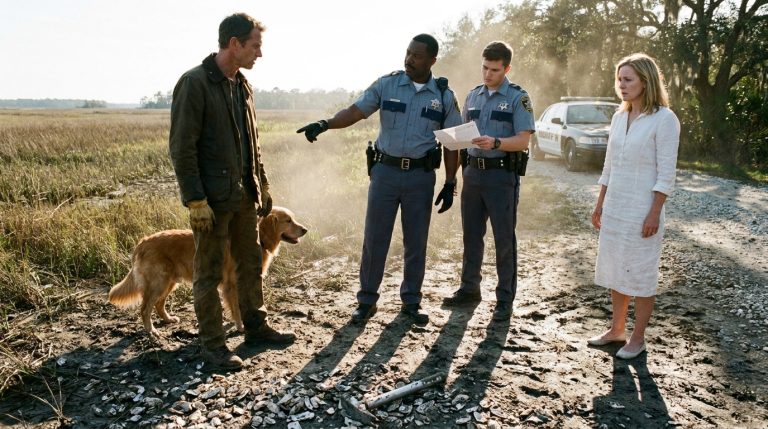
The high-pitched whine of a luxury sedan’s transmission cut off the warning. A white Lexus SUV rolled through the rusted perimeter gate, its tires grinding over the limestone gravel with a wet, heavy crunch. The license plate frame read BLESSED in chrome plating. The door clicked open, and Gladys Hutchinson stepped into the humidity without losing a single line of the pressed crease in her green HOA polo shirt. Her hair was a lacquered helmet; her eyes had the flat, calculating gray of a ledger sheet. Behind her, the blue-and-white cruiser of Deputy Rick pulled to a stop, its engine idling with a loose, mechanical knock.
“Officer,” Gladys said, her voice dropping into the scene like iron filings into oil. She didn’t look at Jake; she looked at the clipboard clutched against her ribs like a breastplate. “That’s the individual I called about. The grandfather’s estate is unresolved, he’s been loitering on association-managed property, and he’s currently harassing our short-term recreational tenants.”
Jake pulled the notarized copy of Earl’s will from his oilskin coat, the paper soft and damp from the air. “The land passed to me three days ago, Rick. You know the boundary lines. You helped Earl haul the fence posts twenty years ago.”
Deputy Rick didn’t look at the paper. He kept his hand resting lightly on the plastic grip of his utility belt, his boots crunching on the dry grass as he stepped between Jake and the grill. “The paperwork Gladys filed says different, Jake. Palmetto Pines has a fifteen-thousand-dollar maintenance lien on the drainage right-of-ways through here. Until the county judge clears the title, this acreage is under corporate receivership.”
Gladys smiled, a quick, bloodless movement of her lips that didn’t reach her eyes. She reached into her manila folder and pulled out a fresh packet, her long, acrylic nails clicking against the paper. “We’re opening the morning booking window now, sweetie. If you don’t want to be removed in hardware, I suggest you take your flowers and find a public road.”
From the dark water behind the cypress knees, twenty yards out, a single log-shaped snout broke the film of green duckweed. The nostrils flared, exhaling a hot, musky breath that smelled of old river rot and cold blood, completely unnoticed by the children building sandcastles on the mound.
CHAPTER 2: THE CHUMMED WATERS
“Your granddaddy didn’t leave you a sanctuary, Jake. He left you a debt,” Gladys said. Her voice had the dry, screeching scrape of an ungreased gate hinge. She didn’t drop the clipboard. Instead, she adjusted her grip, the plastic edges snapping against her ironed shirt with a sharp, rhythmic click.
Jake looked down at the cuffs around his wrists. The cold steel teeth of the local-issue restraints bit hard into his skin, grinding against the fine, granular grit of dried swamp mud. Deputy Rick didn’t look him in the eye; the deputy’s boots made a soft, wet sucking sound as he shifted his weight on the slick bank, his gaze drifting toward the white Lexus idling near the main gate. The heat was shifting now, turning from a morning dampness into the heavy, suffocating pressure of a mid-July noon. The sun beat down on the corrugated tin roof of Earl’s old pump house, making the rust scale bubble and flake like scabs.
“Get him out of the workspace, Rick,” Gladys directed, her thumb already flicking through a stack of brightly colored reservation flyers. “The noon safari group from Orlando just cleared the interstate. I want this path clear of distractions.”
“You’re putting kids fifty feet from a territorial den, Gladys,” Jake said. His tongue felt thick, coated with the taste of sulfur and the sour diesel exhaust hanging in the stagnant air. “Earl spent thirty years keeping people off these specific shallows for a reason. The bull in this channel doesn’t turn back for a whistle.”
“Earl is beneath three feet of lime-dirt, sweetie,” she replied without looking up. “And his ledger books belong to the association now.”
Rick took Jake by the elbow, his grip heavy and mechanical. There was no hatred in the deputy’s touch, only the flat, unyielding compliance of a man whose pension was signed by the same county board Gladys spent her winters hosting. He led Jake toward the shade of the old equipment lean-to, away from the families who were now unpacking coolers onto the weathered picnic tables.
The ground beneath the lean-to was strewn with the detritus of a working preserve—shattered plastic gears, dry-rotted fan belts, and empty fifty-pound sacks of standard commercial aquaculture feed. Jake’s boot struck something heavy and metallic near the bottom of a discarded utility bucket. He glanced down, his eyes narrowing through the glare. Half-buried under a crust of dried, rancid fish meal was a heavy brass key. It wasn’t standard hardware; it was long-stemmed, its barrel smooth and dark with a thin sheen of industrial machine oil that had kept the rust from taking hold. It bore no markings, but the precise, square-cut notches on its tooth didn’t match any padlock on the perimeter gates.
“Stay put,” Rick muttered, anchoring Jake against a rusted iron support pillar before walking back toward the Lexus to consult with Gladys.
Jake leaned his back against the rough iron, his fingers working blindly behind him. The steel cuffs were tight, but his hands were slick with sweat. He didn’t look at the deputy. He watched the property line.
Two of Gladys’s hired maintenance workers—local day laborers wearing faded neon safety vests—were currently working their way down the north ridge. They weren’t clearing brush. They were hauling the heavy, steel-framed Fish and Wildlife danger signs out of the palmetto scrub. One man used a crowbar to lever a post out of the sandy loam, the dry metal screeching in protest as the concrete footer broke loose. They dragged the markers backward, burying the bright orange reflections behind a dense wall of invasive Brazilian pepper trees where no tourist looking through a camera lens would ever spot them.
In their place, the second worker dropped small, decorative wooden stakes into the mud. They were painted a cheerful, soft cream color, topped with laser-engraved silhouettes of stylized, smiling reptiles. Wildlife Viewing Area—Please Maintain Respectful Distance.
“They’re moving the breeding perimeter,” Jake muttered to himself, his chest tightening.
Across the channel, the water had gone completely flat, a sheet of desaturated green glass under the harsh noon light. But the duckweed wasn’t drifting with the sluggish current. It was parting in a straight, narrow V-line that pointed directly toward the shallow lagoon where the slip-and-slide had been pegged into the mud. The movement was silent, beneath the surface, recognizable only by the subtle, rhythmic pulse of displaced water hitting the cypress knees.
A hundred yards to the east, the family from the grill had finished their lunch. The father, his skin already turning a raw, sun-burnt pink, was currently emptying a grease trap directly into the weeds at the water’s edge. The thick, white residue of bacon fat spread across the shallows like an oil slick, catching the light in a greasy, iridescent rainbow.
Jake worked his right wrist against the iron pillar, using the hard edge of the structural seam to force the metal cuff up his forearm, gaining an inch of leverage. His skin tore, the hot sting of salt and rust entering the scratch, but he didn’t stop. His fingers reached toward the rim of the utility bucket, his tips brushing the cold, oil-slicked edge of the brass key.
Gladys was on her phone now, her voice carrying clearly over the rattle of the generator as she walked toward the news van that had just turned into the entry lane. “Yes, Channel 7? We’re fully operational. Authentic encounters. The real Florida, completely managed, completely safe.”
She reached down, grabbed a five-pound bucket of raw chicken quarters from the back of her Lexus, and handed it to one of the laborers. “Go ahead and prime the upper pool,” she said, her voice dropping into a flat, businesslike tone. “The cameras want to see them surfacing before the live hit at five.”
The worker took the bucket and walked toward the wooden dock, his heavy boots shaking the loose pilings. Jake watched the grease slick from the bacon travel outward, joining the scent trail of the raw meat as it hit the water with a dull, heavy splash. The swamp didn’t roar. It didn’t explode. It simply changed its breath. The low-frequency rumble began again, deeper this time, vibrating through the soles of Jake’s boots like a heavy machine idling deep beneath the limestone crust of the earth.
CHAPTER 3: THE HATCH UNDER THE ZINC SINK
The edge of the brass key bit into Jake’s thumb as he drove it blindly behind his back, his fingers hunting the narrow alignment of the lock cylinder. Under the shadow of the equipment lean-to, the heat was suffocating, thick with the oily smell of old machinery and sun-baked rubber. His skin caught on the rusted seam of the structural iron pillar, leaving a thin, dark line of blood that mixed with the coarse grit of the fish-meal bucket. Fifty yards away, Deputy Rick’s back was turned, his uniform sweat-stained as he shook hands with an advance cameraman from the news van.
With a wet, metallic click that vibrated up his forearms, the restraint mechanism slipped. Jake pulled his right hand free, leaving a smear of red on the gray steel cuff, and immediately dropped to one knee behind the stacked bags of aquaculture feed. He grabbed the long-stemmed key from the bucket and crawled flat through the dry sand toward the back wall of Earl’s old workshop.
The building was framed in corrugated zinc panels, white-spotted with oxidation and warped by decades of seasonal shifts. The bottom track of the side utility door had completely rusted out, filled with compressed river silt and dried leaves. Jake forced his fingers into the gap beneath the metal sheet, lifting up until his shoulder blades ground against the dry siding. The metal gave way with a low, scraping groan that was instantly swallowed by the distant, rhythmic thumping of a bass speaker from a tourist’s truck. He slid underneath, the loose earth grinding against his chest.
Inside, the workshop was an architectural kiln, trapping thirty years of stagnant, unyielding heat. The air smelled intensely of iron filings, dried tallow, and the bitter dust of dry-rotted fan belts. Light pierced the darkness in sharp, thin needles through the nail holes in the roof, illuminating a dense cloud of suspended pollen and skin flakes.
Jake didn’t waste time on the tool benches. He went straight to the corner where an ancient, porcelain-lined basin sat supported by iron plumbing pipes. The basin was stained with rust rings from three decades of mineral-heavy well water. Beneath the framework, hidden under a pile of rotted canvas tarps and a cracked leather welding apron, was a false flooring section.
He dragged the heavy canvas aside, exposing a hatch covered in a thick layer of desaturated gray dust. The hatch didn’t use a standard latch; it was secured by a heavy, industrial-grade padlock that had been greased so thoroughly the surface felt like cold lard. He slid the notched tooth of the brass key into the core. It turned without resistance, the internal tumblers releasing with a muted, oiled thud.
Jake pulled the hatch upward. The hinges were made of zinc-coated steel, heavy and silent. Below lay a shallow concrete trench packed with neatly aligned equipment that looked less like environmental research and more like tactical engineering.
Stacked inside were three weatherproof cases containing high-output acoustic sound amplifiers, their control dials marked not with volumes, but with specific frequency ranges labeled in Earl’s tight, precise handwriting: 30Hz – Territorial Warning, 15Hz – Infrasonic Challenge, 8Hz – Nest Defense. Next to the amplifiers lay three dozen small, cylindrical scent dispensers encased in green plastic housings, designed to look exactly like the standard birdhouses Earl had spent twenty winters mounting along the preserve’s perimeter paths.
Jake reached down and pulled out the thick, leather-bound notebook resting atop the master console. The pages were yellowed, their edges stiff and brittle from the humidity. He flipped through the technical schematics, his eyes tracking the red ink lines that mapped the entire property.
Section 4: Optimal positioning for defensive encounters. Scent trails that trigger protective aggression. The animals do not follow human orders; they follow the parameters of their biology. If the perimeter is breached by state or corporate actors, the acoustic emitters in the birdhouses can be daisy-chained through the primary pump circuit. One push of the master switch under the sink house will lock down every water access point by shifting the territorial boundaries fifty yards inland. Use only if the sanctuary’s integrity is permanently compromised.
Jake’s hand tightened on the leather binding as he read the final entry, dated less than a week before Earl’s heart had failed.
Gladys has been running dummy core drills along the eastern ridge. She’s not looking at the gators as a tourist draw; she’s waiting for the first major incident to trigger a safety condemnation from the county. The HOA has already drafted the limestone backfill contracts. They want the water gone.
A heavy thud against the external zinc panel made Jake freeze. The shadow of a man blocked the thin line of light beneath the utility door.
“Jake?” Deputy Rick’s voice was muffled through the metal, heavy with irritation. “You still back there? Gladys wants to clear the lean-to for the VIP tent. Don’t make me come looking for you in the weeds.”
Jake didn’t answer. He carefully slid the master acoustic remote into his oilskin coat pocket and reached for the master switch beneath the framework of the console, his fingers tracing the cold, copper wire that ran out through the concrete base of the wall and straight into the dark, waiting waters of the main channel. The system was live, but the true trap had already been set by Gladys’s own buckets of chicken; she had built the engine, and Earl’s journals had just handed Jake the steering wheel.
CHAPTER 4: LIVE FROM THE SOVEREIGN SWAMP
The heat radiating from the concrete boat ramp felt like an open furnace door, baking the smell of rancid fat and fish blood into the very weave of Jake’s oilskin coat. Across the main channel, three television news vans had sprouted telescoping aluminum masts into the heavy gray sky, their generators humming in a staggered, mechanical chorus that set the dock pilings to vibrating. Gladys Hutchinson stood near the water’s edge, the white-hot glare of a production light reflecting off the laminated surface of her clipboard like a shard of broken mirror.
“We’re live in thirty seconds, folks,” a floor director shouted, his hand dropping in a slow arc toward the primary camera rig.
Jake stood jammed between two parent volunteers under the lean-to, his hand resting in his pocket, fingers clamped around the cold, zinc-plated remote unit he’d pulled from Earl’s concrete cache. His skin was raw where the cuffs had scraped him, the dried blood sticky against his palm. Through the crowd of tourists, he watched Gladys’s maintenance men hefting three more five-gallon industrial pails toward the upper pool. The stench was unmistakable—pure slaughterhouse runoff, an engineered scent trail designed to pull every biological entity in the channel straight toward the shallow gravel bank.
“Look at the water,” Jennifer Walsh whispered beside him, her thumb nervously clicking the plastic housing of her hidden camera. “Jake, they aren’t slowing down. There are children sitting right on the edge of the timber slats.”
The water wasn’t just moving; it was boiling with silent, sub-surface weight. The green duckweed had been swept clean, replaced by a series of overlapping V-tracks that carved through the brackish scum with calculated precision. A fourteen-foot bull gator, its head wide as a cross-tie and blackened by years of bottom-mud, slid its snout onto the concrete ramp just ten feet from a toddler’s abandoned plastic bucket. The animal’s rib cage expanded, a slow, heavy breath that forced a spray of red-tinted water across the stone.
“Watch this, Central Florida,” Gladys chirped to the lens, her voice rising into a sharp, practiced pitch that didn’t show a single tremor of fear. She reached into an open cooler, pulling out a raw chicken quarter by the yellowed skin. “Our residents here live in perfect harmony with the association’s vision. No fear, just mutual respect.”
“She’s going to trigger a dominance charge,” Jake muttered, his thumb sliding the protective plastic guard off the remote’s primary frequency toggle.
He didn’t click it yet. He needed the depth. If he hit the 30Hz warning frequency too early, the bull would simply anchor itself to the ramp, treating the acoustic vibration as an invitation to defend its immediate territory. He had to wait until the animal shifted its weight backward, breaking its point of leverage against the concrete.
The bull gator’s throat sac ballooned, the armored scales along its flanks beginning to shudder with an infrasonic rumble that set the water around the dock sloshing against the timber. It wasn’t a feeding posture. The animal was sizing up the production crew, its vertical pupils locked on the black, velvet-covered microphone boom hovering three feet above its snout.
“Gladys, step back from the apron,” Deputy Rick called out from the shade of the news van, though he didn’t move his boots an inch closer to the muck. His hand stayed clamped on his belt, his posture stiff with the realization that the local jurisdiction he’d claimed wasn’t worth the weight of the meat surfacing in the channel.
“The animals are completely conditioned, Rick,” Gladys shot back over her shoulder, her smile frozen for the live feed as she stepped six inches closer to the water, her white leather deck shoes sinking into the bloody loam. “We manage this habitat down to the ledger.”
She extended her arm, the raw meat dangling just above the bull’s nostrils.
Jake hit the switch.
The green-painted birdhouses mounted along the tree line didn’t make a sound human ears could define, but the corrugated zinc roof of the workshop behind them instantly shrieked as the 15Hz frequency resonated through the metal framework. The water in the tire ruts didn’t splash; it dance-stepped, tiny geysers of mud jumping two inches into the air as the sub-audible pressure wave slammed through the shallows.
The fourteen-foot bull didn’t strike. It recoiled. The massive tail slapped the water with the force of an iron bar, sending a sheet of red-tinted foam directly into the front lens of the Channel 7 camera. At the same instant, three breeding females broke the surface twenty yards to the left, their bodies arching as they launched their weight backward away from the acoustic pulse, their jaws snapping against the empty air in a synchronized defensive perimeter.
The crowd didn’t wait for Gladys’s next marketing pitch. The parents under the lean-to grabbed their children by the straps of their life vests, their boots grinding into the gravel as they scrambled toward the high ridge where Father Miguel was already holding the emergency exit gate open.
“Stay where you are!” Gladys screamed, her voice cracking as the production light tipped over, its halogen bulb shattering against the concrete ramp with a sharp, electrical pop. “The demonstration is fully controlled! No refunds for early departure!”
She turned toward the news crew, but the cameraman had already hoisted his rig onto his shoulder, his boots splashing through the mud as he retreated toward the vans. Gladys reached for her clipboard, her fingers slipping on the greasy plastic surface as she looked down at the lockbox sitting in the open trunk of her Lexus—the metal box where the forged liens were stored. The latch had popped from the vibration of the acoustic line, exposing the bright blue ink of the limestone backfill blueprints to the live broadcast feed still running through the secondary van.
Jake walked past her, his hand still inside his oilskin coat, his eyes fixed on the tree line where the blue federal transport vehicles were already breaking through the outer perimeter fence.
CHAPTER 5: THE FINAL FORFEITURE
“The local receivership is void, Gladys. Step away from the vehicle,” Agent Sarah Martinez said. Her boots made a dry, rhythmic crunch against the limestone gravel as she stepped into the glare of the flashing blue light bars. She wore a dark, wind-resistant jacket bearing the crisp, white block lettering of the Federal Wildlife Crime Division, and her hand didn’t rest on a utility belt—it held a clipboard wrapped in clear, waterproof plastic to protect a single, thick document bearing a golden federal seal.
Jake didn’t lift his hand from the remote transmitter in his pocket. The low-frequency thrumming in his palm was dying down now, the acoustic amplifiers tapering off as the marsh water settled back into its prehistoric groove. The bull gator had retreated into the black shallows, its heavy scaly spine vanishing beneath the carpet of green duckweed with a slow, heavy swirl.
Gladys stood frozen by the open trunk of her Lexus, her acrylic nails dug so deep into the edge of the aluminum lockbox that the plastic skin of her clipboard began to warp. “This is private community property, Agent. The county court granted the Palmetto Pines Association full structural administration over these drainage basins. We have over fifteen thousand dollars in unpaid maintenance liens signed by the deceased owner.”
“The deceased owner didn’t sign a piece of paper after his heart stopped, Gladys,” Jake said, his voice level and gravelly as he stepped out from beneath the lean-to. He pulled the leather notebook from his coat, the yellowed pages rustling in the rising wind. “And this acreage was never under county jurisdiction to begin with.”
Agent Martinez stepped between Gladys and the Lexus, handing the plastic-wrapped packet directly to Deputy Rick, who had slowly backed his cruiser up until his bumper pressed against the perimeter fence line. “Federal Wildlife Preservation Document Number Eighty-Eight-A, Deputy. Earl Morrison placed this entire forty-acre wetland into a permanent, locked sanctuary trust with the Department of the Interior in nineteen-eighty-eight. It’s officially designated critical habitat. Any commercial activity, any alteration of the topography, and any disruption of the protected species is a felony carrying immediate asset forfeiture.”
Rick looked down at the document, his thumb tracing the gold seal. The color drained from his face, leaving his skin the shade of wet river silt. He didn’t look at Gladys. He slowly reached down, unclipped his radio from his shoulder, and placed his hands flat on the hood of his vehicle. “This wasn’t on the county registry, Agent. I was just enforcing the association’s civil lien.”
“The lien is a federal forgery, Rick,” Martinez replied, her voice dropping into a flat, professional tone that left no room for negotiation. She turned her head toward the two workers who were still holding the wooden viewing signs. “Drop the stakes. Sit on the bumper of the truck and keep your hands clear of your pockets.”
The news cameras were still rolling, but the angle had shifted completely. The live feed wasn’t broadcasting a family-friendly eco-adventure anymore; it was capturing the systematic dismantling of a corporate land grab. The Channel Twelve reporter was standing three feet from the open lockbox, her microphone pointed directly at the exposed limestone backfill contracts that bore Gladys’s signature next to a corporate development logo.
Gladys didn’t yell. Her mouth opened, but the only sound that emerged was the dry, whistling rasp of a woman who had spent her entire career believing that a corporate title could override the physics of a swamp. “The fees,” she whispered, her fingers slipping from the lockbox as a federal agent stepped behind her with a pair of heavy, matte-black restraints. “The deposits are already cleared. We have contracts for the Memorial Day weekend.”
“The deposits are evidence now,” Martinez said, clicking the steel mechanisms around Gladys’s wrists with a clean, sharp snap that echoed across the quiet lagoon. “The asset forfeiture protocol includes the entirety of the Palmetto Pines management accounts. Two point three million dollars will be diverted by tomorrow morning to fund the permanent expansion of the Morrison Preserve.”
Jake walked past them, heading down to the concrete ramp where the water had cleared enough to expose the sandy bottom. He reached behind the primary cast-iron pump valve, his fingers finding the heavy, brass-sealed marker that Earl had driven three feet into the bedrock decades ago. It was stamped with the official insignia of the federal sanctuary trust, pristine and uncorrupted by the lime-dust Gladys had tried to spread over it.
Six months later, the damp air of the cypress channel smelled of nothing but sulfur and wet earth. The generator noise was gone, replaced by the natural, hollow calling of great blue herons fishing in the shallows. The white Lexus was sitting in a federal storage yard in Jacksonville, but the money it had generated was currently running the automated monitoring line that kept the perimeter clear of the corporate progress that had tried to bury it.
Jake stood on the bank, his hand resting on the smooth, weathered top of the iron fence post Earl had set. The bull gator surfaced twenty yards out, its nostrils clearing the duckweed with a slow, rhythmic puff of air, anchoring itself to the center of the dark water where the boundaries were finally, permanently locked.