The Compass of Kootenai: A Lesson in Honor, Responsibility, and the Weight of Quiet Survival
CHAPTER 1: THE RIDGE
The wind didn’t howl. That was for the movies. In the high drainages of the Cabinet Mountains, the wind was a low-frequency vibration that rattled the bones inside your chest. It was a constant, pressing weight, and right now, it was trying to erase everything in front of us.
Tyler’s GPS unit was dead. Not flickering. Not struggling. Dead. He shook it, a frantic, rhythmic movement that was clearly doing nothing, while Brandon and Chase hovered behind him, their faces raw from the sudden bite of the temperature drop. The three of them looked like boys playing soldier, lost in the woods behind their father’s house, except the woods were seven thousand feet up and the sky had turned a bruised, impossible color.
I didn’t say a word. I didn’t need to. I watched Tyler—his shoulders tight, his jaw locked—staring at the black screen as if staring hard enough could force the electrons back into life. He was terrified, though he’d never admit it to himself.
“It’s not working,” Tyler finally croaked, his voice thin against the roar of the trees. He turned to me, his eyes wide and searching for something I wasn’t sure he could handle. “The unit. It’s done. What… what do you think?”
I didn’t answer him. I was busy. I set my canvas pack down in the snow, the weight of it settling with a solid, reassuring thud. It was a pack that held no expensive tech, no blinking lights, no lithium batteries. It held a folding saw, a hank of fatwood, a spare wool blanket, and a brass-cased lensatic compass that had been vibrating against my hip for the last two miles, telling me exactly where we were even when the horizon disappeared.
Tyler’s gaze drifted to the pack. He looked at it, then at me, then at the desolate expanse of white that had swallowed the trail. I saw the flash of doubt—the way he looked at my worn canvas jacket, the cane, the age-spotted hands—and I knew exactly what he was thinking. Why did I bring the old man?
But the storm didn’t care about his frustration. The storm only cared about the physics of heat and cold.
I reached out, my fingers brushing the cold brass of the compass in my pocket, and felt the sudden, sharp shift in the air. The light was dying. The clouds were descending like a curtain. I could hear the mountain preparing to close its doors for the night.
“Tyler,” I said, and my voice didn’t waver. It was steady, low, and completely out of place in the panic-stricken clearing. “Stop looking at the screen. Look at the trees.”
He blinked at me, shivering. “What?”
“The trees,” I repeated, gesturing toward the timberline where the pines were bowing toward the east. “They aren’t just moving. They’re telling you which way the pressure is pushing. You’re looking for a signal, son. You need to start looking for the truth.”
I turned away from him, my knee throbbing in a familiar rhythm, and began to clear a space in the snow. I didn’t rush. I didn’t panic. I worked with the economy of a man who had spent thirty years knowing that the only thing between him and the ground was his own two hands.
Then, the first heavy flakes of the real storm began to fall, turning the air into a white blur, and for the first time, I saw Tyler realize that the gear in his trunk wouldn’t save him. His chest heaved—a jagged, sharp breath—and he looked down at his own empty, shaking hands. He was waiting for me to do something, and I was, but not what he expected. I was starting the fire that would be the only thing keeping us alive until morning.
CHAPTER 2: THE ANATOMY OF A FIRE
The fire pit wasn’t just a place for warmth; it was a geometry of survival. I moved with a deliberate, slow-motion precision, my fingers dancing around the edges of the flame. The wind groaned through the hemlock canopy above us, a low, guttural sound that seemed to press down on the very air we were trying to claim.
Tyler was pacing, his boots crunching in the fresh powder. Every few seconds, he’d stop and stare into the darkness, his head cocked as if he expected a rescue helicopter to materialize out of the gale.
“Tyler,” I said, my voice cutting through the wind’s roar. It wasn’t loud, but it had that weight—the weight of a gear clicking into place. “Stop. You’re burning calories you don’t have to spare.”
He turned, his face flushed with a mixture of cold and frustration. “We can’t just sit here, Harlan. We’re three miles from the cabin. We know the terrain. We can make it back before the drifts get too high.”
I didn’t look up from the fire. I was feeding it a thin sliver of fatwood, watching the resin catch. “The terrain looks different in a whiteout, son. Rocks become cliffs. Creek beds become traps. You move now, you’re not hunting for the cabin. You’re hunting for a funeral.”
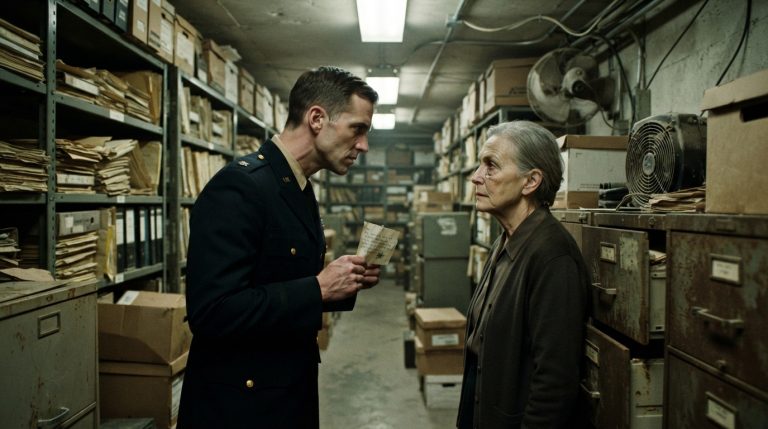
As I spoke, the biting cold against my neck pulled me backward, a sudden, sharp tug of memory. I was twenty-six again, standing in a dim, drafty supply room at Fort Bragg. The air there had smelled of industrial oil and old paper, not pine needles and snow. Sergeant Cal Emmons was standing in front of me, his face a map of hard places, his eyes as cold as the November wind in the Cabinet Mountains. He had pressed the heavy, brass compass into my palm and closed my fingers around it. It does not lie, Harlan. When the map is wrong and the stars are hidden, this is the only thing that won’t betray you.
The phantom pressure of that compass in my hand stayed with me even as I reached for another dry twig. The irony wasn’t lost on me—Emmons had taught me to survive in a world where I didn’t officially exist, and here I was, teaching a kid who thought he owned the world how to survive a mistake he didn’t realize he’d made.
Brandon sat closest to the flames, his hands tucked deep into his armpits. He was staring at me now, not with the skepticism he’d had back at the trailhead, but with a raw, nascent hunger for instructions. Chase was quieter, his back against the reflector wall I’d built, his eyes scanning the periphery as if he were trying to find a threat in the shadows.
“What do we do, then?” Brandon whispered.
“We wait,” I said. “We manage the fire. We manage our core temperature. And we keep our heads attached to our necks.”
I reached into my canvas rucksack and pulled out the wool blanket, folding it into a compact square. I handed it to Chase. “Wrap your legs. The ground is going to try to steal your heat.”
Chase took it, his fingers fumbling slightly from the cold. He looked at me, a flicker of hesitation in his eyes. “You don’t seem worried,” he murmured.
I looked at him then, really looked at him, letting my gaze linger on the way his shoulders were hunched. “Worry is just a tax you pay on things you can’t control,” I said. “I can control this fire. I can control our position. That’s enough.”
Tyler finally stopped pacing and slumped down near the outer edge of the warmth. He kept his eyes on the forest, watching the swirling white curtains of snow. I could see the internal struggle in the set of his jaw. He was a man who had been handed a business and a truck and a life of certainties, and he had no idea how to handle a reality where his influence meant nothing.
I sat back, my knee protesting with a dull, familiar ache. I closed my eyes for a heartbeat, listening to the rhythm of the storm. The wind wasn’t a monster; it was just physics. The cold wasn’t a punishment; it was just a state of being. And the three boys watching me were not just hunters who had lost their way—they were, for the first time in their lives, men who were beginning to understand the difference between the noise of their status and the silence of their own mortality.
The fire crackled, a small, bright orange heart in the vast, hollow ribcage of the mountain, and I watched the smoke rise, dissipate, and become part of the storm.
CHAPTER 3: THE STANDOFF
The wind had shifted again, pressing the smoke of our small, desperate fire back down toward us. It tasted of acrid resin and damp earth. I adjusted my position, the damp wool of my jacket heavy against my shoulders, and looked at Tyler. He was no longer pacing; he was sitting, his knees drawn up, his gaze fixed on the flames with a hollow, wide-eyed intensity. The silence between us had thickened, no longer just the absence of noise, but a tangible, suffocating weight.
“You’re cold,” I said, breaking the quiet. It wasn’t a question.
Tyler didn’t look up. “I’m fine, Harlan.”
“You’re not fine,” I replied, my voice steady, stripped of the condescension he’d come to expect from the old men he’d crossed paths with in the valley. “You’re burning up your energy trying to pretend this isn’t happening. If you want to get through tonight, you’ll drop the act.”
Chase shifted on the far side of the fire, his movements jerky and uncoordinated. He pulled the wool blanket tighter, his knuckles white. “How long?” he asked. “How long until the wind stops?”
I took a slow breath, feeling the freezing air bite at my lungs. “The wind doesn’t work on a schedule, Chase. We watch the sky. We maintain the heat. We don’t worry about the clock.”
“That’s easy for you to say,” Tyler snapped, his head snapping up. The spark of his old temper was there, but it was dampened, soaked through with the same exhaustion that had flattened Brandon. “You’re just… waiting. Like it’s just another afternoon on your porch.”
I leaned forward, the firelight catching the deep lines in my face. “I am waiting because I have learned that haste is the fastest way to get yourself killed when the world turns against you. You want to move? Go ahead. Step out past that tree line. You’ll be lucky if you make it fifty yards before the disorientation takes you.”
Tyler opened his mouth to retort, but stopped. He looked at my hands—still steady, still occupied with feeding the fire the right size of wood, at the right intervals. There was a rhythm to it, a practiced, lethal efficiency that even he, in his arrogance, couldn’t ignore. He looked at the compass, resting near my knee, its brass casing dulled by age and the cold. He had mocked that compass. He had mocked the man who carried it. Now, it was the only thing standing between him and the frost.
“Why are you doing this?” Tyler asked, his voice softer, stripped of the vitriol. “You could have stayed home. Carl said you were… you were just an old man who needed a break from the farmhouse.”
“I am an old man who likes the quiet,” I said, keeping my eyes on the embers. “But I also know that when a front moves this fast, the forest changes. It stops being a place to hunt and starts being a place to survive. I don’t leave people behind.”
“You don’t even know us,” Brandon added, his voice thin.
“I know enough,” I said. “I know that you’re unprepared, I know that you’re scared, and I know that you’re human. That’s enough for tonight.”
I watched them. The dynamic had shifted. The hierarchy Tyler had built—based on paychecks and inherited authority—was dissolving in the sub-zero air. They were looking to me not for permission, but for a reason to keep breathing. It was a weight I had carried many times, in many different latitudes, under much darker skies.
I reached into my pocket and pulled out the small piece of dried chocolate I’d saved. I broke it into four pieces and handed them over. The gesture was small, almost insignificant, but the way they accepted it—with a quiet, solemn nod—told me everything. The wall was cracking. The vanity was receding.
“Eat,” I said. “Slowly. It’ll help the internal temperature.”
Tyler took his piece, his fingers grazing mine. For a second, he held my gaze. In that brief moment, I saw the flicker of something new—the realization that his strength, his Ford F-350, and his father’s reputation were ghosts. They meant nothing here, in the lee of the hemlocks, where the only thing that mattered was the temperature of the fire and the steadiness of the heart.
“What’s next?” Tyler asked, the words forced, as if the admission of needing a plan was physically painful for him.
“Next,” I said, looking up toward the narrow, darkening seam of the sky, “is waiting for the stars. When the wind breaks, we’ll know where we are. Until then, we stay put. We keep the fire alive. And we don’t say another word until I tell you it’s time to move.”
I leaned back, pulling my coat tight, and let the silence return. It was a heavy, cold silence, but it was no longer fearful. It was the silence of men waiting for a signal, a lesson I had been teaching—and learning—for over fifty years. The mountain was testing them, stripping away the layers of their modern comfort, and all I could do was wait to see what kind of people they would be when the morning light finally hit the ridge.
CHAPTER 4: THE STAR TABLE
The wind didn’t leave; it receded, pulling back like a tide across a pebbled beach. I watched the last of the heavy, snow-laden clouds tear themselves away from the ridgeline, leaving behind a sky so clear it felt thin, brittle enough to shatter. The change was abrupt. One minute, the forest was a chaotic, howling void; the next, the world had been hollowed out, leaving only the biting, star-dusted dark.
I moved first. My joints complained—a rhythmic, grinding protest—but I ignored them. I stood in the center of the clearing and tilted my head back. Polaris hung there, a steady, unblinking anchor. Around me, the boys were still huddled by the dying fire, their shadows cast long and erratic against the snow. They were looking at me, waiting. They didn’t know the stars, not really. They knew light pollution and city glows; they didn’t know the language of the heavens, the way the Dipper’s pointer stars could lead a man out of a grave.
“Get up,” I said, my voice cutting through the sharp, crystalline air. “The storm is taking a breath. We don’t have much time before it decides to circle back.”
Tyler climbed to his feet, his movements slow and stiff. He looked at the sky, his brow furrowed, but he didn’t ask questions. That was the most significant change—the absence of his defensive, blustering skepticism. He stood there, wrapped in his layers of expensive, now-frozen polyester, and looked at me as if I were a puzzle he couldn’t quite solve.
I reached into my inner jacket pocket and withdrew the oilcloth wrap. My fingers were cold, but they knew the geometry of this ritual. I unfolded the laminated card. It was crinkled, the edges soft from decades of friction, but the ink—the meticulous, hand-drawn star tables—remained as legible as the day I’d sat in a windowless room in North Carolina and committed them to memory.
I didn’t use the GPS. I didn’t need the satellites that Tyler had spent all afternoon mourning. I looked up, triangulated the angle of the Dipper, and then lowered my gaze to the brass compass. I opened the lid. The click was tiny, but in the sudden, eerie silence of the high country, it sounded like a door being unlatched.
“Come here,” I told Tyler. He stepped forward, his boots crunching in the crusty snow. I held the compass level in my palm, the glowing needle a pale, steady finger in the dark. “Look.”
He leaned in, his breath a white plume in the starlight. He stared at the compass, then up at the sky, his eyes darting back and forth.
“You’re using the stars,” he whispered, a note of genuine awe surfacing in his voice. “Like… like an old-world map?”
“It’s not a map, Tyler. It’s a confirmation,” I said. “The compass gives me the magnetic bearing. The stars give me the truth. You want to know where the cabin is? You stop trusting the batteries and you start trusting the geometry of the world.”
I held the compass so he could see the alignment. I didn’t lecture him; I didn’t need to explain the mechanics of declination. I just showed him the intersection of the needle and the constellation. It was a moment of quiet, brutal clarity. The decoy secret—that I was just an old, eccentric man—was being eroded by the physical, undeniable reality of my competence. But the Layer 2 truth, the fact that this compass was a relic of a war that hadn’t been recorded in any history book, remained tucked safely behind my teeth.
Brandon and Chase had drifted closer, drawn by the dim, flickering light of the compass dial. They stood in a circle around me, their faces upturned, their expressions a mix of confusion and wonder. They were looking at me not as a neighbor, not as a hunter, but as something else—a relic of a different kind of survival.
“285 degrees,” I murmured, the number settling into the space between us like a command. I folded the card and stowed the oilcloth. My hands were beginning to lose their sensitivity, the cold finally leaching past my defenses. “We move on this bearing. We don’t deviate. We don’t stop for the wind. We walk until the light starts to turn gray in the east.”
“Can we really make it?” Brandon asked, his voice barely audible.
I looked at him, then at the ridgeline, the dark silhouette of the Cabinet Mountains looming like a jagged, unyielding wall. “If you follow my pace, if you keep your footing, we make it. If you try to run, you fail.”
Tyler looked at his companions, then back at me. He reached out, his hand hovering near my shoulder, but he didn’t make contact. He was finally, truly listening. The bravado he’d carried up the mountain had been stripped away by the thin air and the endless, indifferent dark, and what remained was a raw, malleable space where the responsibility of leadership was finally taking root.
“Okay,” Tyler said, his voice firming. “285 degrees.”
I nodded, my knee throbbing with a dull, insistent rhythm as I shifted my weight. I gripped the hickory cane—the only crutch I’d ever permitted myself—and turned toward the slope. We were moving into the dark, into the terrain that had claimed better men than us, guided by a slip of paper and a compass that had never, not once, pointed me toward a lie.
The silence of the mountain settled back in as we stepped away from the dying fire. It was no longer a weight; it was a path. We were leaving the comfort of the fire, the sanctuary of the hemlocks, and stepping out into the vast, indifferent geometry of the night.
CHAPTER 5: THE TREK
We moved in a line, a thin, jagged string of humanity stretched across the white belly of the mountain. I led, my hickory cane biting into the crust of the snow with every step. Behind me, Brandon followed, then Chase, and Tyler brought up the rear—a reversal of the order we’d started with, a tactical necessity I’d enforced to ensure the strongest of them could check the progress of the others.
The world had narrowed to the three feet of space in front of my boots and the glowing, steady needle of the compass in my left hand. The stars were brilliant, distant pinpricks that offered light but no warmth.
“Pace,” I murmured, keeping my voice low. “Maintain the count. Do not look at your feet. Look at the bearing.”
I didn’t need to look back to know they were struggling. I could hear it—the hitch in Brandon’s breathing, the occasional clumsy slide of a boot that hadn’t been planted with sufficient intent. They were fighting the mountain, and more importantly, they were fighting the impulse to panic. Every time a gust of wind caught a drift and sent a spray of powder into our faces, I felt the column shudder.
Then, the ground betrayed us.
We were skirting the edge of a steep draw when the snow beneath my leading foot lost its integrity. It wasn’t an avalanche—nothing that dramatic—but a sudden, treacherous collapse of a hidden wind-slab. I felt the ground give way, a sickening, weightless drop of six inches that sent me pitching forward.
My training, buried deep in the muscle memory of thirty years, took over before I could think. I planted the cane, dropped my center of gravity, and shifted my weight onto my braced right leg, catching myself in the same motion.
“Stop!” I barked, a sharp, guttural sound that sliced through the night.
The line behind me skittered to a halt. I didn’t turn around. I stayed fixed, my core braced against the slope, feeling the hollow echo of the slab settling beneath us. It was a subtle, dangerous sound—a soft, wet whoomp that meant the structural bond of the snowpack had been compromised.
“Step back,” I ordered. “Back up. Slowly. Put your weight on your heels.”
Tyler, at the back of the line, started to surge forward, his panic overriding his caution. “What happened? Is it going to slide?”
“Back up, Tyler!” I didn’t shout, but the command was absolute, a vibration that seemed to freeze him in place. “Do not move your center of mass forward. Back up.”
He obeyed, his breathing ragged. We retreated, step by agonizing step, until we reached a patch of timber that offered more stable footing. My heart rate was steady—not from lack of fear, but from the habit of control. I turned finally to look at them. They were pale, their faces ghostly in the starlight, their eyes wide and reflecting a fear that had nothing to do with the cold and everything to do with the realization that they were walking on a knife’s edge.
“That’s why you don’t run,” I said, my voice quiet. “That’s why you don’t guess. The mountain knows where the weak spots are, even if you don’t.”
I checked the compass again. The needle held true to 285 degrees. The detour was necessary, a loop around the instability that would cost us precious time. I could see the fatigue settling into their shoulders, the way their movements had become heavier, more labored. They were burning out.
“We have to go around the draw,” I said, pointing toward a stand of twisted, wind-stunted pines. “It adds half a mile. We do it in silence. We do it on the bearing.”
“I’m tired, Harlan,” Brandon said, his voice cracking.
I looked at him, then at the others. There was no pity in the landscape, and there would be no pity from me. “I know you’re tired. Tired is a luxury you can’t afford until we reach the cabin. Keep your hands moving. Keep your eyes on the person in front of you.”
We set off again. The trek became a blur of physical exhaustion, a grinding, repetitive cycle of planting the cane, stepping, counting, and checking the bearing. The cold began to work its way through our layers, a persistent, invasive presence that sought out every weakness in our gear. I kept my internal temperature managed by focusing on the mechanics of the walk, on the feel of the snow beneath my boots, and on the steady, rhythmic ticking of my own pulse.
I found myself wondering, in the quiet, what Ray Mackey would think if he could see us now. He’d been a lieutenant, green as spring grass, when I’d last dragged a man through the winter dark. He’d learned the lesson I was teaching now—that the gear is just a tool, and the man is the only thing that holds the line. I wondered if Tyler was learning that, or if he was still waiting for a screen to tell him he was alive.
As we slogged forward, the trees thinned, revealing a wide, open expanse of alpine meadow that led toward the creek bed I’d scouted. The moonlight hit the snow, turning the world into a vast, shimmering desert of white. It was beautiful, in a terrifying, absolute way. It was the kind of place where a man could disappear and never be found, a place that stripped away all the pretense of civilization until only the raw, biological drive remained.
We reached the edge of the meadow, and I stopped. I held up my hand, and the line halted behind me. I looked at the compass one last time before we dropped into the creek drainage. The bearing held. We were close, but the hardest part—the physical, draining work of the final climb—was still ahead of us.
I looked back at Tyler. He was looking at his hands, his knuckles raw and red, but he wasn’t shaking anymore. He looked up at me, and for the first time, he didn’t look for a miracle. He looked for a direction.
“Ready?” I asked.
Tyler nodded, a sharp, decisive movement. “Ready.”
We stepped into the creek bed, the sound of our boots crunching in the deep, undisturbed powder the only noise in the infinite, freezing night.
CHAPTER 6: THE CREEK BED
The creek bed was a tunnel of shadow. The towering hemlocks and the steep, jagged walls of the drainage conspired to block out the starlight, leaving us in a deep, bruised purple darkness. The temperature had plummeted again, the kind of cold that doesn’t just touch your skin—it reaches inside and pulls at your marrow.
We walked. We didn’t talk. Words were a waste of oxygen we needed for our lungs. I kept my head down, my gaze fixed on the compass in my left hand, the luminous dial a ghostly, pale eye in the dark. Beside it, the red tape on my sleeve offered a flickering, rhythmic beacon for the men behind me to follow.
The sound of my own boots became a mantra: crunch, slide, plant, repeat. But beneath that, there was something else. A phantom echo. Every time I stopped to check the bearing, I heard a second crunch—a footfall that didn’t belong to me, or to Brandon, or to Chase, or to Tyler.
I paused, bracing my cane against a frost-slicked rock. I held my breath, letting the silence rush back in. Nothing. Just the settling of snow in the canopy and the low, distant moan of the mountain.
Paranoia, I told myself. The oldest ghost in the woods. I had felt it in the Fulda Gap, and I had felt it in the high, dark forests of the borderlands. It was just the mind’s way of filling the gaps when the sensory input grew too thin.
“Harlan?” Tyler’s voice was ragged, coming from the back of the line. “Why did you stop?”
“Check,” I said, my voice hoarse. I didn’t look back. I just held the compass steady, the needle hovering on 285. “We’re still on track. Keep the interval.”
We moved again. The creek bed was a chaotic obstacle course of fallen cedar logs, ice-slicked stones, and deep, deceptive pockets of powder. Every few yards, one of them would stumble. Every time, I heard the sharp intake of breath, the scramble of gear, the muffled curse. They were losing their center. The exhaustion was past the point of simple fatigue; it was becoming a mental disintegration.
I felt the weight of them behind me—three lives tethered to my own, three men who were learning, in the most brutal way imaginable, that the mountain demanded a price for every step. They were no longer the men who had stepped out of that diesel truck with their loud laughs and their unused gear. They were hollowed out, stripped to the bare, functional essentials of survival.
My left knee was a screaming, white-hot center of pain. I shifted my weight, leaning harder into the hickory cane, using it as a fulcrum to haul myself over a massive, snow-covered cedar trunk. My movements were no longer fluid; they were mechanical, jagged, a series of calculated efforts to keep the structure of my own body moving forward.
“Chase, watch your footing!” Brandon’s voice was sharp, uncharacteristically firm.
I heard a slide, a frantic scramble, and then the dull thud of a body hitting snow.
“I’m okay,” Chase wheezed. “I’m okay.”
I didn’t stop. I couldn’t. If I stopped, the cold would settle into my joints, and the mountain would start to look like a place to rest. I kept my eyes on the compass. 285 degrees. The cabin was out there, somewhere in the dark, a small, cedar-sided hope.
As we climbed out of the lower drainage, the terrain began to rise, the slope steepening as we hit the shoulder of the ridge. This was the moment I had feared—the climb that would force them to look up, to see the scale of the world they were trying to conquer.
The clouds had pulled back entirely now, and the moon, a thin, icy sliver, cast everything in sharp, monochrome relief. The mountain looked massive, indifferent, and absolute.
“God,” Tyler whispered from behind me. It wasn’t a prayer; it was an admission of defeat.
I stopped. I didn’t turn around, but I could hear the way his breathing had stalled. He was looking at the summit above us, the dark, jagged teeth of the peaks cutting into the night sky.
I looked at the compass. I looked at the stars. I took a slow, deep breath, tasting the ozone and the ice. I knew where we were. I knew the distance. I knew the exact number of steps left to walk.
“Look at your boots, Tyler,” I said, my voice cutting through his panic. “Don’t look at the summit. Don’t look at the miles. Look at your boots. That’s the only world you have right now.”
He didn’t move. He was frozen, his spirit caught in the sheer, staggering vastness of the landscape. I knew that feeling. I had stood in that same place, in different wars, in different lifetimes, and felt that same paralysis. It was the moment the scale of the world tries to convince you that you don’t exist.
I turned then, my movements slow and deliberate. I looked at him. His face was a mask of frost and exhaustion, his eyes wide and vacant. He looked like a man who had finally realized that his father’s reputation and his company and his life in the valley were nothing more than a thin coat of paint on a cold, hard truth.
“You are going to take one step,” I said, my voice low, firm, and uncompromising. “And then you are going to take another. And you will not stop until I tell you to. Is that understood?”
Tyler blinked, the ghost of his old self flinching at the command, then settling into a new, harder shape. He nodded. “Understood.”
“Then move.”
We turned back to the slope. The trek continued, a slow, grueling ascent into the teeth of the night. Every step was a negotiation with the ice, every breath a battle against the thinning air. The phantom footsteps still haunted the periphery of my hearing—a rhythmic, shuffling companion that I chose to ignore. We were not alone on this mountain, but we were the only ones who knew how to walk out of it.
CHAPTER 7: THE CABIN ARRIVAL
The cabin didn’t look like salvation; it looked like a mirage. It sat in a hollow near the ridge’s spine, a dark, geometric interruption in the chaotic white sprawl of the high country. My eyes were burning, the frost clinging to my lashes like tiny, sharp needles, and every time I blinked, the cabin seemed to drift out of focus.
“There,” I whispered, though my voice was little more than a dry rasp.
Behind me, the line shifted. Tyler, who had been dragging his left boot for the last half-mile, pulled his head up. He saw the structure, and the change in his posture was instantaneous. The hunch of his shoulders, the listless shuffle of his stride—it all vanished, replaced by a desperate, jagged surge of adrenaline.
“Is that it?” Chase wheezed. His voice was a thin, whistling sound, stripped of the bravado he’d carried up the mountain.
“Stay in line,” I warned, my voice cutting through their sudden, frantic hope. “The terrain around the porch is drifted. Keep your eyes on your footing. We aren’t inside yet.”
The air was so cold it felt like inhaling ground glass. My lungs burned with every breath, and my knee—the left one, the one that had carried me through so many hard places—was nothing more than a source of white-hot, rhythmic agony. I leaned into the cane, my hand white-knuckled around the hickory shaft. I wasn’t feeling the cold anymore; I was feeling the mechanics of the final hundred yards.
We reached the base of the clearing, the snow suddenly deepening to our knees. I broke the trail, my boots punching through the crust, every movement a deliberate, conscious act of will. I was not Harlan Vance, the neighbor who mended fences in the Kootenai Valley. I was a ghost of a man I had been in 1974, a man who moved through dark country because he had a package to deliver, or a life to extract, or a bearing to keep.
Then, out of the corner of my vision, I saw them: searchlights.
Twin, brilliant beams of white light cut through the gloom near the cabin, sweeping across the snow in a frantic, uncoordinated search. My heart stopped for a beat, an old, hard-wired instinct sparking in the dark. Hunted. The phantom phantom sensation of eyes on my back, of a perimeter being breached, washed over me. I pivoted, my cane swinging up, my body dropping into a low, defensive crouch before I realized what I was looking at.
Search and rescue.
The realization was a heavy, dull thud in my chest. The world had moved on. The wars were over. The men I had served with were either dead, buried, or gray-haired and tired, just like me.
“Harlan!” Tyler’s voice broke through the hallucination. He was stumbling toward the porch, his arms outstretched. “They’re here! They’re already here!”
He didn’t wait for my command. He surged forward, breaking the formation, his boots tearing through the drifts as he ran toward the lights. Brandon and Chase followed, their discipline shattering in the face of the encroaching warmth and safety.
I didn’t run. I couldn’t. I watched them go, watched their frantic, stumbling dash toward the sheriff’s vehicles that had somehow managed to reach the trailhead. I stood there for a long moment, the wind buffeting my frame, the hickory cane my only anchor against the vast, indifferent slope.
I looked down at the brass compass in my palm. The needle was still steady, pointing north, indifferent to the flashing lights and the shouts echoing off the ridge. I felt a strange, hollow sense of finality. The mission wasn’t to lead them to the cabin; the mission was to make sure they understood the weight of the compass, the weight of the path, and the truth that there was no such thing as being truly “saved.” You only ever saved yourself, over and over again, until you ran out of steps.
I began to walk. The final few yards were a slow, grinding process, each step a negotiation between my failing body and the frozen earth. When I reached the edge of the porch, the lights were blinding. I saw Ray Mackie—a face from a memory that had been frozen in amber for forty years—stepping out of a truck. I saw the flash of badges and the hurried, panicked movements of men who didn’t know what they were looking at.
I didn’t look for them. I looked at the porch. I reached the steps, leaned my weight against the cedar post, and let out a breath I felt like I’d been holding since we left the clearing.
“You’re late, Lieutenant,” I murmured to the air, though I knew he couldn’t hear me.
Tyler was standing on the porch, his back to me, talking to his father. He was shaking, the adrenaline crash hitting him with the force of a landslide. I watched him. I saw the way he clutched his own arms, the way he kept looking at his father’s uniform as if he were trying to understand the geometry of the world.
He was changed. The man who had mocked the pack, the man who had treated the mountain like a playground, was gone. In his place was someone quieter, someone who knew the exact, freezing weight of the dark.
I took one more step, and the wood of the porch creaked beneath my boot. The sound was small, a quiet, resonant protest in the night, and as I reached the door, I felt the final, crushing weight of the journey settle into my bones.
CHAPTER 8: THE ECHO OF SERVICE
The heat inside the cabin was a physical blow. It smelled of scorched cedar, drying wool, and the faint, metallic tang of cold blood. My senses, sharpened by the mountain’s blade, felt frayed and oversized in the enclosed space. I leaned heavily against the doorframe, my cane rattling once against the wood, and let the door swing shut behind me, sealing out the wind.
The room was crowded with silhouettes—the deputy, the medic, the men I had dragged through the whiteout—but my eyes went straight to the plank table where Colonel Ray Mackie sat. He looked older than the man I remembered from 1986. His hair had thinned, his face etched with the specific, weary lines that only come from decades of commanding men in places that do not exist on maps.
“Sergeant Major,” he said, his voice dropping into the familiar, ingrained cadence of command. He rose, a slow, stiff motion. The room went quiet.
I took a shuffling step forward, the floorboards groaning under my boots. I wasn’t just tired; I was hollowed out, the mountain having taken everything that wasn’t essential. I looked at Ray, and for a moment, the years between the Fulda Gap and this Idaho cabin dissolved. I saw him as he was then—the young, terrified lieutenant I had hauled out of the whiteout—and I saw the man he had become.
“Lieutenant,” I said. It wasn’t a correction, but a recognition of the bond.
Ray stepped toward me, his movements deliberate. He stopped six feet away, and then, in front of the others—the wide-eyed boys, the confused deputy—he came to a rigid, disciplined attention. His right hand snapped up in a salute, sharp and crisp, an act of defiance against the years that had passed.
“I’ve spent thirty-nine years waiting to say this,” he said, his voice cracking, betraying the stone-cold composure he’d spent a career cultivating. “You saved my life, Sergeant Major. You showed me what it meant to hold the line when there was no one left to watch.”
I returned the salute, my hand feeling like it was made of lead. It was a gesture I hadn’t made since my own discharge. I held it for a beat, letting the weight of the moment settle over the room, and then I lowered it, feeling the relief of the motion.
Tyler sat nearby, his face pale, his eyes darting between his father and me. He was clutching a warm mug of coffee, his knuckles still raw from the frost. I looked at him, and I saw the shift. The arrogance, the thin veneer of inherited entitlement—it was gone. In its place was a flicker of something far more difficult to hold: perspective.
“Tyler,” I said, my voice soft.
He looked up, startled.
“You think you were saved,” I said, my voice gaining a steady, iron resonance. “You think this was about the cabin, or the GPS, or the storm. It wasn’t. The mountain didn’t care who you were. It didn’t care about your truck or your father’s name. It only cared about whether you were willing to put one foot in front of the other when you had no reason left to move.”
I walked over to the table and reached into my jacket, pulling out the brass compass. It felt heavy, a solid, immutable object in a world of shifting surfaces. I laid it on the wood between us. The tarnished brass caught the low light of the stove, the scratches and dings a visible history of the places it had been.
“My sergeant gave me this in 1974,” I said, not to Ray, but to the three young men who were watching me with a hunger I knew well. “He told me it didn’t lie. He told me it didn’t quit. He told me it was the oldest friend I would ever have.”
I pushed the compass across the table toward Tyler.
“I didn’t lead you home, Tyler. I just showed you how to find your own way back. That is the only inheritance that matters. You take it, you look after it, and when the time comes—when the storm gets bad and the maps are gone—you make sure the next man knows how to use it.”
Tyler touched the compass, his fingertips grazing the cold brass. He looked at me, and I saw the final shedding of his old self. He wasn’t just a boy anymore; he was a link in a chain that stretched back to Sergeant Cal Emmons and forward into a future I wouldn’t see.
I turned away, the exhaustion finally pulling at my knees, and walked to the chair by the stove. I sat down, my joints settling into the familiar, aching rhythm of a life lived on the edge of the map. I closed my eyes, and for the first time in fifty years, I didn’t feel the need to keep watch.
The silence in the room was not the silence of the mountain—it was the silence of a task completed. I sat there, the heat of the stove soaking into my bones, and listened to the low, steady murmur of the men talking, the sound of a life being passed forward, one degree at a time, into the dark. I didn’t need the compass anymore. I was already home.