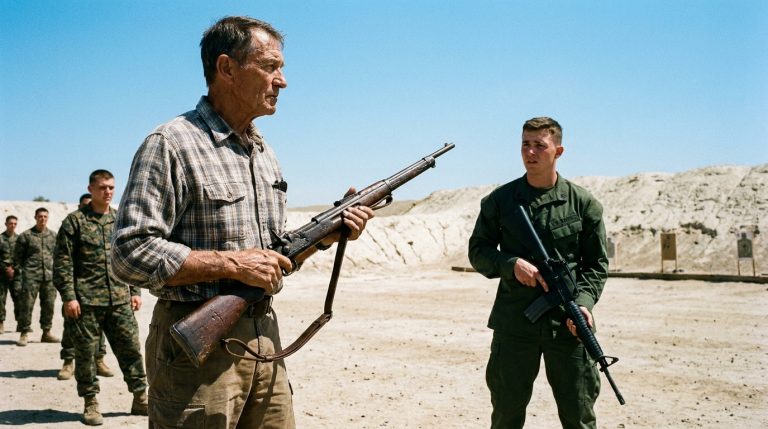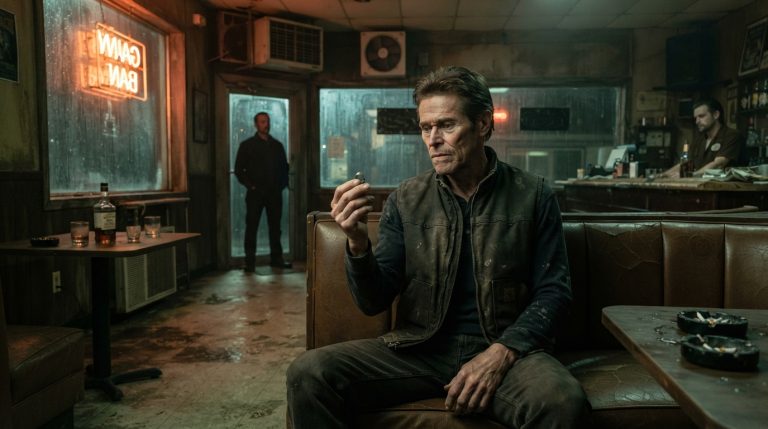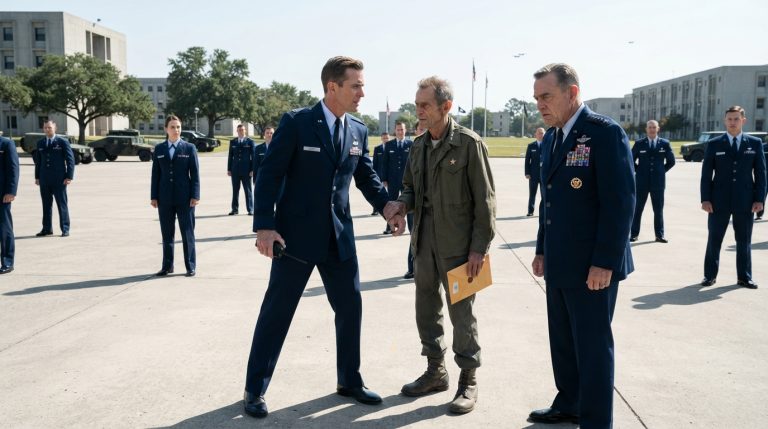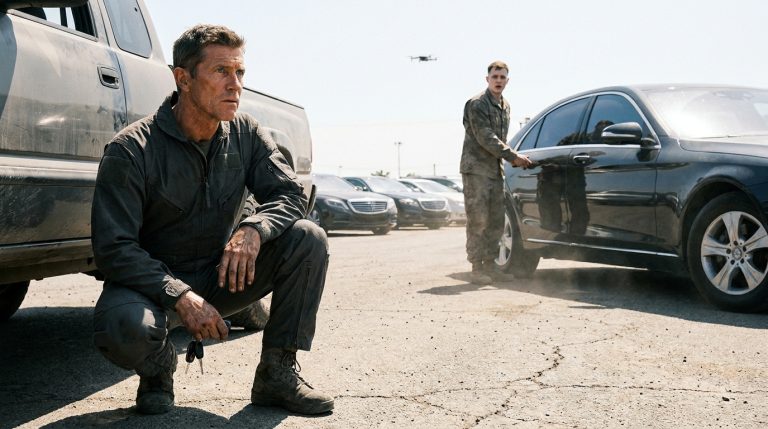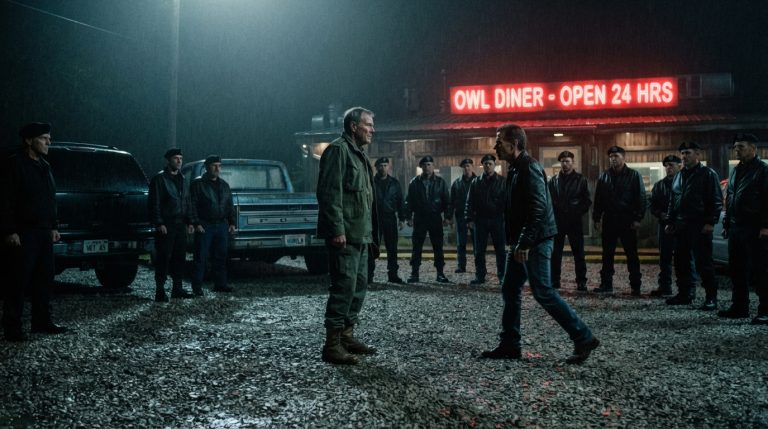
The red thread of a forgotten sacrifice unravels the fragile lies of an unyielding classroom
CHAPTER 1: The classroom air chills as Mr.
The red dry-erase marker clicked against the bicep of a cheap polyester tie.
“Is this supposed to be a history presentation or a creative writing exercise, Lily?”
Mr. Henderson did not lower his arm. He stood rigid beside the green whiteboard, his posture mimicking the clean, unyielding lines of the state syllabus hanging beneath the clock. The air in Room 204 smelled faintly of floor wax and sour milk from the morning cartons, a heavy, institutional scent that seemed to thicken as the silence stretched.
Lily adjusted her grip on the rough wool sleeve beside her. Her ten-year-old fingers were small against the crimson fabric, her knuckles white. She could feel the faint tremor passing from the old man’s arm into her own palm—a steady, rhythmic vibration like an engine idling in a distant garage.
“It is history,” Lily whispered. The hum of the ceiling fan swallowed the words, chopping them into small, insignificant pieces before they could reach the back row.
“I have state testing parameters to meet by next Tuesday,” Mr. Henderson said. He leaned forward slightly, his eyes tracking the way Roger Clayton’s slacks bunched in heavy, awkward folds around his ankles. The fabric was thin, weathered by decades of laundry detergent and bench-sitting. “The Navy SEALs do not recruit from thrift-store clearance racks, Lily. This is an educational environment, not a space for family folklore.”
In the low plastic chair, Roger didn’t look up. His eyes, a pale, watery blue that seemed almost translucent under the fluorescent tubes, remained fixed on the small gold eagle perched atop the classroom flag standards. His right hand, mottled with dark liver spots and crisscrossed by thick, silver scars that didn’t follow the natural lines of his knuckles, tightened around the curved head of a plain hickory cane. The wood gave a slight, dry creak against the linoleum floor.
“He’s not a liar,” Lily said. A hot, stinging pressure built behind her eyes, blurring the edges of the colorful alphabet banners tracking the wall. She reached deep into the pocket of her denim skirt and pulled out a small rectangle of glossy paper. The corners were soft and rounded from years of thumbing.
She held it out. The image was dark, a grainy silver-halide print of five men standing in knee-deep surf. Their faces were blackened with greasepaint, their expressions lost to the low resolution of an old military camera, but their shoulders were broad, unyielding blocks against the white foam of an unnamed shore.
Mr. Henderson stepped across the linoleum, his black oxfords making a sharp, squeaking sound that caused three children in the front row to wince. He took the photograph with two fingers, barely glancing at the surface before laying it flat on the corner of his oak desk, face down.
“Stolen valor is a federal infraction, Lily,” the teacher said, his voice dropping into the smooth, practiced tone of a disciplinary lecture. “Enabling these kinds of delusions isn’t healthy for a child your age. You need to understand the boundary between a nice story and actual service.” He turned his back to the old man, focusing his gaze entirely on the rows of small desks. “Sir, I’m going to have to ask you to step out into the corridor. The office can contact Lily’s mother to arrange an early pickup.”
Roger’s head turned. The motion was slow, accompanied by a faint, dry click from his cervical vertebrae. For a fraction of a second, the heavy, hooded lids lifted, and the watery blue vanished behind a gaze that was perfectly clear, cold, and entirely still. It was the look of a man who had measured distances in inches through dark water, completely devoid of anger or emergency.
“I’m just here for the girl,” Roger said. The voice was a low, dry rasp, like two bricks being rubbed together in the sun.
In the back row, near the wooden cubbies where the lunchboxes lined up, Jim Miller shifted his weight against the wall. He had been waiting to sign his son out for a dental checkup, his eyes tracking the interaction with a slow, tightening knot in his chest. He didn’t look at the teacher. His eyes were locked onto the left lapel of that frayed red tweed jacket.
Buried deep within the fuzzy, pilled wool, nearly invisible beneath the shadow of the collar, was a tiny, blackened metal pin. It had no shine. The three prongs of the trident were worn flat at the tips, the eagle’s wings corroded by a green patina that only grew on metal exposed to heavy salt fog.
Jim’s breath caught in his throat. His hand went into his pocket, his thumb moving across the screen of his phone with a rapid, mechanical precision.
CHAPTER 2: The Silent Signal
The low-resolution glare of the smartphone screen cast a pale, bluish tint across Jim Miller’s thumb as his fingernail clicked against the glass. The sound was microscopic, completely buried beneath the heavy, humid drone of the classroom’s old ventilation system and the sharp, administrative squeak of Mr. Henderson’s oxfords shifting on the linoleum.
Jim didn’t look up from the screen. His spine remained pressed against the faux-wood laminate of the student cubbies, his shoulders squared with the heavy, instinctual discipline that six years in the Marine Corps permanently carves into a man’s frame. To anyone else in Room 204—to the cluster of fourth-graders shifting uncomfortably in their plastic chairs, or to the teacher waiting with a thin, impatient smirk by the whiteboard—Jim was just another parent waiting on a dentist appointment slip. But his focus was entirely split, one eye tracking the room’s geometric exits, the other anchoring the short, transactional string of text characters that would pull the pin on the afternoon.
Ten feet away, the old man in the red tweed jacket remained perfectly still. The fading texture of the wool seemed to absorb the harsh, unyielding light from the overhead fluorescent tubes. Up close, the jacket didn’t look like a statement; it looked like a shield. The cuffs were visibly thinning, the weave pulling apart into tiny, fibrous webs where Roger Clayton’s wrists rested against the curve of his hickory cane. The wood of the cane itself was deeply scratched near the brass collar, showing the raw, pale grain beneath the dark varnish—evidence of years of heavy, uneven leaning.
Jim’s thumbs flew across the keyboard, the letters forming with an efficiency born of tactical radio logs.
Roger Clayton. The Roger Clayton. Wearing a red tweed jacket. Teacher is calling him a stolen valor case. It is ugly.
He didn’t look at the screen when the reply came. He felt the double-vibration against his palm, a sharp, metallic shudder.
Do not let him leave. We are training a tier 1 unit 3 mi away. We are rolling. Give us 10 minutes.
Jim quietly slipped the phone back into the pocket of his canvas trousers. The fabric let out a soft, dry rustle that died instantly in the quiet room. He slowly crossed his arms, his knuckles tucking beneath his biceps, his gaze drifting back to the front of the class.
Mr. Henderson had already reached for the photograph on his desk. He didn’t pick it up by the edges; his fingers slid across the face of the print, leaving a faint, oily smudge over the grainy silhouettes of the men on the beach. He checked his watch again, the metal band clicking sharply against his wrist.
“Mr. Clayton,” the teacher said, his voice carrying that smooth, deliberate edge used to manage uncooperative students. “I’m sure you have a great deal of memories, but we have a rigid curriculum to maintain before the state assessment matrix next week. Fantasy doesn’t translate to test scores. I’ve already flagged the main office. Lily can wait with you in the reception area until her mother arrives to clear the absence.”
Lily’s head remained dropped, her small shoulders trembling beneath the straps of her backpack. The hot, stinging tears had finally spilled over, leaving dark, circular spots on the knees of her denim skirt. She didn’t look at her grandfather, and she didn’t look at the photo face-down on the oak desk. The weight of the room’s collective, secondhand embarrassment had settled over her like a physical coat, pulling her down into the small, plastic frame of her seat.
But Roger didn’t move to stand. His pale, watery eyes didn’t leave the limply hanging American flag in the corner. The tremor in his hand hadn’t increased; it remained a steady, mechanical vibration, a rhythmic hum that seemed less about age and more about an internal engine that refused to shut down completely.
“The school has protocols regarding outside visitors, Lily,” Mr. Henderson continued, turning toward the whiteboard to retrieve his red marker. The cap came off with a hollow pop. “Especially those projecting narratives that don’t align with verified records. It sets a poor example for academic integrity.”
Jim Miller watched the teacher’s shoulder blades move beneath his thin dress shirt as he began to sketch a chronological timeline on the board—dates, names, institutional bullet points. He was entirely blind to the shift in the room’s gravity. He didn’t see the way the old man’s knuckles had locked onto the wood of the cane, or how the tiny, blackened metal trident pin hidden beneath the tweed collar seemed to catch a stray angle of the light, its salt-corroded prongs pointing silently toward the floor.
Jim leaned his head back against the wall, his jaw tightening into a hard, unyielding line. His eyes moved from the teacher’s rhythmic, sweeping arm to the glass windowpanes facing the eastern parking lot. The air outside was bright, a warm southern California noon, but the light coming through the glass felt thin, almost brittle.
He could feel the minutes ticking down in the small of his back. Ten minutes from Coronado meant they were already clearing the coastal highway. They would be moving in heavy, armored Suburbans, the diesel engines running hot, their tactical tires humming against the asphalt with a specific, synchronized frequency that Jim could still close his eyes and hear from his own time in the mud.
“Lily,” Roger said. The rasp of his voice broke the room’s silence again, low and completely unhurried. He didn’t look at the teacher. He reached out his right hand, the silver scars across his knuckles stretching as he placed his palm flat against the girl’s trembling shoulder. The weight of his hand was solid, an anchor of thick, calloused skin that didn’t waver despite the micro-tremors. “Look at the flag, sweetheart.”
Lily blinked, her eyelashes wet as she slowly lifted her chin from her chest. She followed the direction of his gaze, her small face turning toward the faded red and blue fabric hanging from the wooden staff in the corner.
“The color don’t run,” the old man whispered, his voice holding a strange, rhythmic cadence that felt completely foreign to the sterile, institutional room. “No matter how much dust gets on the weave. Remember that.”
Mr. Henderson paused, his red marker hovering an inch from the whiteboard. He didn’t turn around, but his neck went rigid, the cheap polyester tie hanging completely straight against his chest. “Mr. Clayton, I explicitly requested that you move this conversation to the hallway. We are currently in an instructional block.”
Jim Miller didn’t move from his position by the cubbies, but his hand silently drifted back toward his pocket. He didn’t need to check the screen this time. Through the heavy, double-paned glass of the classroom window, a low, subsonic vibration had just begun to stir the air. It wasn’t a sound yet—it was a pressure, a deep, rhythmic thrumming that started in the soles of Jim’s boots and crept up through the floorboards, shaking the sour milk cartons left by the sink.
The transition had begun. The real-time counter was running out, and the small, administrative world of Room 204 was about to collide with the cold, calculated weight of a reality it wasn’t built to contain.
CHAPTER 3: The Gathering Thunder
The cold, white light overhead seemed to flicker, though the fluorescent tubes remained physically unchanged. It was the air itself that had begun to alter, thickening into a dense, compressed mass as the deep acoustic pressure from the parking lot rolled through the exterior brickwork of Lincoln Elementary. Near the small stainless-steel sink at the side of the room, a half-inch of gray rinse water left in a plastic beaker began to form a pattern of tight, concentric rings, its surface dancing to a mechanical pulse that arrived through the foundation.
Mr. Henderson didn’t turn around immediately. His hand remained suspended in the air, the red dry-erase marker held between two fingers like an institutional scalpel. But his thumb twitched, and the tip of the marker left a jagged, bleeding red dot where his hand had frozen against the plastic timeline.
“Mr. Clayton,” the teacher began again, his voice lifting a fraction of an octave to clear the growing bass note vibrating through the linoleum. “If you are refusing to follow the directive of the administration, I will have to—”
He stopped. The glass panes in their aluminum tracks didn’t just rattle; they hummed. A long, low, aluminum-on-steel scream resonated through the window frames as the exterior noise shifted from a vibration into an absolute wall of sound. It was the specific, complex roar of heavy-duty, twin-turbo diesel blocks running low-gear synchronization, their exhausts spitting thick, hot layers of ozone and unburnt fuel into the midday air just beyond the security fence.
Jim Miller didn’t move his spine from the wooden laminate of the cubbies, but his crossed arms tightened. His eyes, tracking the window, saw the shadow first. A massive, matte-black silhouette cut across the bright southern California sun, blotting out the colorful chalk drawings taped to the glass. It was followed instantly by a second, then a third, the heavy armored bodies of three non-descript Suburbans swinging into the drop-off lane with a precision that didn’t take the painted yellow curbs into account. The tires didn’t just screech; they bit into the loose gravel at the edge of the asphalt with a dry, heavy crunch.
Inside the room, the sudden loss of light hit the children like a physical blow. A girl near the front row dropped her pencil box, the cheap plastic latch snapping open to scatter two dozen crayons across the floor with a series of sharp, micro-clicks that were instantly swallowed by the roar outside. Lily’s hand didn’t release her grandfather’s sleeve. Her small, thin fingers twisted deeper into the red tweed, feeling the stiff, coarse texture of the fibers beneath her palm.
“Pop Pop,” she whispered, her voice completely lost to the air, but her lips forming the shape against the crimson wool.
Roger Clayton didn’t shift his weight in the low plastic chair. The bad hip—the one that clicked when the weather turned damp—remained locked at an awkward, painful angle, but his posture didn’t shrink. His pale blue eyes remained fixed on the limp flag in the corner, though the fabric of the flag had begun to stir now, rippling faintly as the exterior pressure changes forced their way through the school’s old ventilation slits. The tremor in his right hand, the one anchoring the hickory cane, had ceased entirely. His knuckles were dry and white, clamped onto the wood like an iron fitting.
Beyond the classroom door, the ordinary background noise of the school—the distant, high-pitched chatter of the cafeteria, the administrative click of the front office typewriter—was obliterated. In its place came a sound that Jim Miller recognized in the center of his chest: the rhythmic, synchronized thud-thud-thud of heavy, thick-soled combat boots moving down a corridor not in a march, but in a dead-weight, high-velocity tactical sweep. It wasn’t the sound of people walking; it was the sound of an iron curtain being drawn shut at forty miles an hour.
Mr. Henderson finally lowered his arm. The red marker slipped from his fingers, hitting the oak desk with a hollow roll before dropping to the floor. His face, usually flushed with the authority of the grade-book, had begun to drain from the cheekbones down, leaving his skin looking like the cheap, unlined paper of his lesson plans. He took one step back, his heel striking the plastic baseboard beneath the whiteboard, his shoulder blades flattening against the green surface.
“What is…” he started, his eyes darting toward the heavy wooden door of Room 204. “Is there an unscheduled drill?”
Jim Miller let out a short, dry exhalation through his nose—a sound that was less a laugh and more a clearing of air. He didn’t answer the teacher. His eyes remained locked on the brass handle of the classroom door. The metal handle didn’t turn with the ordinary, lazy click of a fifth-grade hall pass. It rattled once, a sharp, violent vibration, and then the door didn’t open—it swung back until the rubber stopper on the baseboard smashed into the plaster with a dull, explosive crack that shook the alphabet banners loose from their pins.
Two men came through the threshold first. They didn’t look at the children, and they didn’t look at the teacher. They moved with a low, weighted stance, their bodies widened by the bulk of heavy multicam plate carriers loaded with three-point magazine stacks. Their faces were dark, hidden behind the black synthetic weave of low-profile balaclavas, leaving only their eyes visible—sharp, shifting points of light that swept the room’s corners in three-quarter sectors, their short-barreled carbines held low but ready, the muzzle caps pointing in a strict downward angle toward the linoleum.
The silence that followed their entry was absolute. The ventilation system seemed to die. The children sat completely frozen, their small hands locked onto the edges of their desks, their breath held so tightly that the room felt devoid of oxygen.
Mr. Henderson’s mouth opened, his lower lip twitching against the collar of his tie, but no sound came out. The small, administrative reality of his classroom had just been completely dissolved, replaced by the cold, metallic smell of gun oil, fresh nylon, and the raw, heavy presence of an element that didn’t belong in a fourth-grade syllabus.
CHAPTER 4: The Weighted Room
The threshold of Room 204 stayed wide, its heavy oak face pinned flat against the plaster board by the sheer momentum of the entry. The metallic smell of fresh gun oil and damp cordura canvas rolled inward, overriding the faint, stale tang of floor wax within three heartbeats. The two giant silhouettes positioned themselves at precise forty-five-degree vectors from the doorframe, their boots perfectly parallel, their bodies projecting an absolute, unyielding density that seemed to physically compress the rows of tiny plastic desks.
Jim Miller remained motionless by the cubbies, his arms crossed over his chest, his knuckles digging into his sleeves to check the sudden, sharp spike of adrenaline in his own veins. He knew the choreography. He recognized the mechanical precision of the sweep—the way the operators’ eyes didn’t fix on individual children, but instead sliced the room into strict threat-containment quadrants, their lowered carbines trailing their gazes by fractions of an inch.
Then came the second wave. Six more operators filed through the opening, moving with a silent, synchronized glide that defied the massive weight of their plate carriers and ballistic helmets. They didn’t speak. They filled the narrow perimeter of the classroom, their shoulders almost touching beneath the colorful construction-paper suns dangling from the ceiling tiles. The sheer volume of their presence sucked the remaining air out of the space, turning the fourth-grade classroom into a sterile, high-velocity secure zone.
Through the center of the corridor stepped a man whose rank was spelled out in the worn, desaturated fabric of the patch on his chest: Master Chief. He was broader than the others, his face uncovered, revealing a thick, jagged ridge of scar tissue that split his left eyebrow and ran down toward his cheekbone. His eyes were not wide with the adrenaline of the breach; they were small, dark, and holds-everything still, reflecting the flat glare of the overhead tubes.
Mr. Henderson’s spine stayed fused to the green whiteboard, his fingers clawing blindly behind his back for the metal edge of the marker tray. His breathing had turned into a series of short, shallow hitches that barely moved his polyester tie.
“Who…” the teacher’s lower jaw caught on the first syllable, his voice dropping into a dry, paper-thin squeak. “You can’t… this is an active instructional—”
The Master Chief ignored him completely. His boots didn’t squeak on the linoleum; they left dark, matte prints of packed gravel as he moved past the oak desk, past the face-down photograph, his focus locked entirely on the low plastic chair in the middle row.
The hard, granite line of the Master Chief’s jaw suddenly cracked. His eyes softened into an expression that Jim Miller had only seen twice in his entire enlistment—an absolute, quiet reverence that bordered on the religious. He stopped exactly three feet from the red tweed jacket. His heels came together with a sharp, dry clack that sounded like a firing pin striking an empty chamber.
His right hand came up. The salute was razor-sharp, his fingertips resting precisely against the edge of his brow, his elbow locked in a perfect, geometric line.
“Master Chief Clayton,” his voice boomed, the depth of the tone rattling the gray water still circling in the plastic beaker by the sink.
Roger Clayton slowly let go of Lily’s shoulder. His fingers, stiff with the damp air coming through the open door, moved down the length of the hickory cane until his palm cleared the wood. He began the process of lifting his right arm. The movement was mechanical, heavy with the friction of eighty-two years and the thick, permanent scar tissue in his shoulder socket. The red tweed sleeve bunched around his bicep, the pilled, frayed fabric dragging against his slacks as his hand finally reached his temple.
The salute wasn’t perfect. His fingers trembled with a steady, uncontrollable micro-vibration, and his elbow sat slightly low to accommodate the ruined bone beneath his skin, but the form was undeniable. It was an ancient muscle memory, surviving beneath decades of quiet civilian silence.
“At ease, son,” Roger said. His rasp was still low, but the dry sandiness had cleared, replaced by a flat, unmoving clarity.
The Master Chief dropped his hand instantly. Behind him, the seven masked operators in the perimeter snapped their heels together in a single, explosive unison, their hands hitting their brows before returning to their weapons.
Lily didn’t look up from her grandfather’s side, but her eyes had grown wide, the tears drying into thin, salty tracks across her cheeks. She looked at the giant man standing over them, her gaze tracking the small, dark morale patch on his shoulder—a skull layered over a three-pronged trident. She felt the old man’s left hand return to her shoulder, the weight of his palm holding her steady as the entire world around them shifted its axis.
The Master Chief turned his head by five degrees, his eyes landing on Mr. Henderson. The warmth that had touched his face a moment prior vanished, replaced by a cold, predatory focus that seemed to lower the room’s temperature by ten degrees. He took a single, weighted step forward, the tactical nylon on his chest creaking against his magazine pouches.
“I believe there was some confusion,” the Master Chief said, his voice dropping into a quiet, conversational register that was infinitely more dangerous than a shout. “Regarding the legitimacy of this unit’s lineage.”
Mr. Henderson didn’t answer. His lips were dry, a faint line of white foam forming at the corner of his mouth as he looked at the short, black muzzles of the carbines ringing his back wall. The small red marker lay forgotten by his shoe, a tiny, bleeding cylinder of ink on the floorboards.
CHAPTER 5: The Red Camouflage
Mr. Henderson did not answer the Master Chief. His shoulder blades squeezed tighter against the green laminate of the whiteboard, his breath coming in shallow, ragged gaps that failed to rattle the starch in his collar. The silence in Room 204 stretched, unyielding and heavy, until the only audible sound was the tiny, rhythmic drip of the leaky classroom sink faucet splashing into the stainless-steel basin.
Master Chief Hayes maintained his cold, locked focus for three final seconds, ensuring the weight of the moment was permanently etched into the plaster walls. Then, without a word of dismissal to the teacher, he pivoted cleanly on his heel, his heavy combat boots making a dull, authoritative thud on the linoleum as he faced the center of the room.
“Master Chief Clayton,” Hayes said, his tone dropping from tactical steel into a quiet, gravelly warmth. “We have an armored transport idling in the loading zone. The boys down at the amphibious base heard the Reaper was within five miles, and the grinder cleared out in under two minutes. It would be our highest honor if you and your granddaughter would join us for the noon meal.”
Roger Clayton looked down at Lily. His left hand, still resting gently against the faded denim of her shoulder, patted her twice in that slow, familiar code they had shared since she was an infant. The rough texture of his fingertips caught slightly on the fabric. “What do you think, kiddo? Think we can skip the rest of this particular history lesson?”
Lily’s eyes, still tracing the intricate details of the blackened metal pin hidden beneath her grandfather’s collar, suddenly brightened. The heavy, suffocating embarrassment that had held her small frame captive for the last hour evaporated into the clean, metallic smell of the operators’ gear. She nodded vigorously, her chin lifting with a new, instinctive pride. “Yes, Pop Pop.”
Roger turned back toward his hickory cane, his knuckles clamping down onto the curved handle as he prepared to stand. The process was slow, a real-time negotiation with eight decades of accumulated friction. His bad right hip let out a dry, audible click as it rotated into place. Two young operators stepped forward instantly, their massive, plate-carrier-widened frames moving with an absolute fluidity to flank him, providing a silent, physical buttress without touching his arms or diminishing his sovereignty.
Roger adjusted the lapels of the red tweed jacket, tracking the fraying fibers at his cuffs with a slow, deliberate thumb. He looked across the oak desk one final time, reaching out his spotted hand to retrieve the grainy black-and-white photograph from where Mr. Henderson had cast it face-down. He slid it back into Lily’s small palm, ensuring her fingers locked securely around the edges.
“One thing, instructor,” Roger said, his low rasp slicing through the quiet room as he reached the open doorway. He paused, his mechanical, arthritic frame turning slightly to look back at the whiteboard where the red marker lay flat on the floor.
Mr. Henderson managed a single, dry nod, his throat working visually against his tie.
“My wife bought me this coat thirty years ago at a storefront down in San Diego,” Roger whispered, his voice holding an unmoving clarity that made the entire perimeter of operators go entirely rigid. “She told me the red was bright enough to find me in any crowd when the fog rolled off the harbor. I wear it because she’s been gone six winters now, and the wool still carries the weight of her hands. It keeps the cold out of the places where the river water got into my bones.” He let the words hang in the air, a final, tactile truth that no textbook could catalog. “Try to teach the children a little kindness next time. It lasts longer than dates.”
The transition out of the school happened in unbroken, real-time sequence. The squad of eight operators formed a moving phalanx around Roger and Lily, their heavy tactical boots striking the concrete of the elementary corridors in a synchronized, thunderous rhythm that brought the office staff to the front counter in absolute silence. They bypassed the glass-paneled double doors of the lobby, stepping directly out into the blinding heat of the southern California sun.
The three black Suburbans stood idling in the fire lane, their dual-exhausts sending visible heat waves shimmering across the asphalt. Jim Miller walked thirty paces behind the unit, his arms loosely at his sides as he watched his son’s school fade into the background. An operator held the heavy, armored rear door open, his gloved hand guarding the upper frame as Roger systematically lowered his bad hip into the deep, plush leather seat. Lily scrambled in beside him, her small canvas sneakers kicking up against the rubber floor mat.
The journey down the coastal highway was a continuous, unskipped progression of humming tires and shifting gears. The three vehicles held a tight, aggressive formation, clearing the intersection signals with a smooth precision that brought the convoy through the security gates of the Naval Amphibious Base in Coronado precisely twelve minutes later.
By the time the armored doors unlatched in the courtyard of the mess hall, the environment had shifted completely. The sterile, paper-thin world of Mr. Henderson’s classroom was gone, replaced by the vast, open concrete of the grinder and the heavy, industrial scent of salt water, diesel fuel, and the distant Pacific surf breaking against the rocks.
Inside the mess hall, the long wooden tables had been pushed flat against the cinderblock walls, creating a wide, open circle under the high steel rafters. Fifty tier-one operators—men with the same dark, holds-everything eyes as Hayes—stood at rigid attention along the perimeter of the room. They weren’t moving; they weren’t speaking. Every gaze was locked onto the doorway as the old man in the red tweed jacket walked through the threshold, his hickory cane striking the polished concrete with a steady, resounding thunk.
A long table sat in the dead center of the room, laid out with plain white porcelain bowls and heavy stainless-steel cutlery. Master Chief Hayes guided Roger to the head of the table, pulling out the heavy oak chair with a slow, respectful nod. Lily took the seat immediately to his right, her small hands flat against the grain of the wood. A large bowl of vanilla ice cream was placed in front of her, a plain plastic spoon resting against the rim.
“So there we were,” Roger said, his voice stronger now, the deep rasp smoothed out by a small swallow of ice water from a heavy glass tumbler. He rested his elbows on the table, the frayed wool of his cuffs pressing into the white linen napkin tucked into his collar. “No ammo left in the magazines, the radio mast was split by a mortar fragment, and the tide in the delta was turning five minutes ahead of the charts.”
The room was completely dead silent. Not a single plate rattled; not a single boot shifted on the concrete. Fifty of the most lethal assets on the planet leaned forward by three inches, their breathing synchronized to the old man’s cadence.
“What did you do, Master Chief?” a young lieutenant in the second row asked, his voice low and entirely devoid of the classroom’s earlier skepticism.
Roger winked at Lily, his pale blue eyes crinkling at the corners into a web of ancient, weathered lines. “Well, I remembered I still had a flare gun, a dry pocket of matches, and a very bad attitude.”
The mess hall erupted into a warm, rolling wave of laughter—a deep, respectful sound that bounced off the steel rafters and filled the vast space with a clean, unyielding solidarity.
Master Chief Hayes stood three paces back in the shadow of the pantry entrance, his phone held flat in his palm. A notification cleared the screen—an official email from the district superintendent’s office, confirming that Room 204’s lesson plans had been permanently altered, and a mandatory sensitivity review had been logged for the administrative staff. Hayes smiled quietly, slipping the device away as he watched Lily lift a spoonful of ice cream, her eyes glowing with a profound, unshakeable understanding of the man sitting beside her. She didn’t see an old man in a thrift-store coat anymore; she saw the steel beneath the skin.
“You know, Pop Pop,” Lily whispered, her voice carrying clearly through the low murmur of the room as she leaned her head against his crimson sleeve. “I think red is the best color there is for a frogman.”
Roger smiled, his large, spotted hand returning to the frayed cuff of his jacket, smoothing down the loose threads that his wife had chosen thirty years before. “It’s the best camouflage there is, Lily. It lets you hide right in the middle of the crowd.” He looked out across the sea of young, hard faces lining the tables—the new generation of engines that would carry the flame he had lit in the dark water so long ago. “But sometimes… sometimes it’s good to be seen.”
On the green whiteboard back in Room 204, the jagged red dot left by Mr. Henderson’s marker remained untouched. Directly beneath it, written in the steady, unhurried print of a permanent marker, a single sentence tracked the laminate: Heroes don’t always wear capes. Sometimes they wear tweed. The line would stay there for a week, the most honest piece of history the room would ever hold.