The Geometry of Order: How a Widower’s Calculated Silence Dismantled a Suburban Dictatorship
CHAPTER 1: THE WAVELENGTH OF WAR
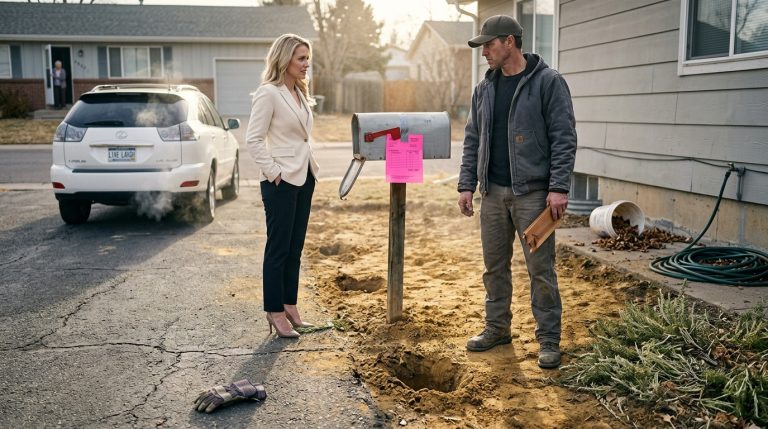
The stiletto heels were not walking; they were striking. Each impact against the sun-baked aggregate of my driveway sounded like a gunshot in the stagnant morning heat. I stood by the window, Sarah’s ceramic mug balanced between my palms, feeling the heat bleed into my skin. The lavender perfume arrived seconds before she did—a cloying, synthetic fog that tasted of chemical desperation.
Karen Whitmore didn’t just stand on a porch; she occupied it. She was clutching her clipboard like a shield, her knuckles white, her bleached-blonde bob vibrating with the sheer intensity of her indignation.
I opened the door before she could raise her hand to strike it.
“Mr. Delacua,” she spat, her voice a serrated edge. “The network identifier. Now.”
I took a slow sip of the coffee, letting the silence stretch until it became an active, heavy thing between us. I wasn’t just looking at a woman in a pastel pant suit; I was calculating the velocity of her descent. Every time she spoke, she revealed a vulnerability—a gap in her defenses that I could leverage.
“The Wi-Fi name?” I asked, keeping my tone deliberately flat. “It’s a broadcast, Karen. A public frequency. It’s not harassment to name a network after a public figure, is it?”
She shrieked—a sharp, sudden sound that sent a startled bird fleeing from the nearby cactus. “It’s cyber-terrorism! I’ve called the Sheriff. They’re on their way to dismantle this entire operation.”
I felt the familiar, cold clarity wash over me. For months, the grief had been a blur, a static that made it hard to breathe. Now, the static was gone, replaced by the sharp, focused frequency of a problem to be solved. She thought she was the predator, circling a broken man who couldn’t defend his territory. She had no idea that I had spent three decades mapping fiber networks that connected the world—I knew how to track a signal, and more importantly, I knew exactly how to sever one.
“You’re making a mistake, Karen,” I said, my voice steady. “The FCC regulates public airwaves. If the Sheriff comes, he’s going to be very interested in why you’re attempting to suppress a legal, licensed amateur radio operator’s broadcast.”
She laughed, a harsh, brittle sound. “This isn’t about radio waves. This is about control. I own this neighborhood, and I will burn your house down before I let you mock me.”
The screen behind me blinked. A red alert icon flared on my router dashboard. Someone was attempting a brute-force ping on the network. She wasn’t just here to yell; she had someone on a laptop in her Escalade, trying to hack the gateway.
I turned back to the kitchen, leaving her on the porch. The Zeigarnik effect took hold; she couldn’t leave, and she couldn’t stay. And as I watched the data packet stream onto my monitor, I realized that for the first time since Sarah died, the path ahead was perfectly, terrifyingly clear. There was a missing entry in the neighborhood’s public ledger, a discrepancy in the recent mailbox fines that didn’t just suggest incompetence—it suggested theft.
CHAPTER 2: THE PAPER TRAIL
The front door didn’t just close; it locked with a sound of finality that seemed to vibrate through the foundation. I didn’t wait for Karen to stomp back to her Escalade. I turned my back on the porch and moved into my workspace, the sanctuary I’d built out of spare parts, copper wire, and my own need for silence. My pulse was a steady, rhythmic thud against my ribs, matching the mechanical clicking of the cooling fans in my server rack.
She had someone in that car. That was the first lesson of the morning. Karen didn’t work alone; she operated with the confidence of someone backed by a system. I sat down, my chair squeaking in the quiet, and pulled up the router logs. The brute-force attempt was still active, a digital heartbeat of attempted intrusion. She was trying to bypass my firewall, probably hoping to access my files or broadcast something disruptive back through my local network.
I didn’t panic. Panic was for people who didn’t understand the physics of data. Instead, I tightened my grip on Sarah’s mug, letting the warmth ground me, and started typing. I didn’t block her. Blocking was a temporary barrier; it was a wall that could be climbed. Instead, I redirected. I set up a honeypot—a dummy directory filled with mundane files, photos of my amateur radio logs, and a handful of perfectly innocuous HOA documents. If she wanted to play hacker, I’d give her a labyrinth to wander through while I did the real work.
My focus wasn’t on the Wi-Fi. It was on the ledger.
For weeks, I’d been keeping a digital file of every violation notice she’d slapped on my door, but I’d also been quietly pulling the public records for the Willowbrook Estates HOA. It was a tedious, ugly job, involving dozens of broken links on the association’s archaic website and poorly scanned PDFs that looked like they’d been copied in the dark.
I opened the folder labeled ‘Financials’ and stared at the latest vendor list. Whitmore Property Solutions. It appeared in the expense reports with the regularity of a metronome. Landscape consultation. Irrigation repair. Emergency fence reinforcement. The numbers were large, round, and entirely devoid of itemized breakdowns.
I leaned closer, my eyes tracing the lines of red ink that marked the quarterly summaries. There. A recurring error in the vendor payment ledgers—a specific date-code discrepancy where the payout to the landscaping firm occurred exactly forty-eight hours before a major community assessment was announced. It was a digital fingerprint. She wasn’t just managing the neighborhood; she was feeding it into a grinder.
I picked up a pen, the plastic cold against my skin, and began to map the dates onto a physical notepad. My movements were surgical. I needed to build the case not in my head, but in ink. If she was going to play the role of the neighborhood dictator, I would be the architect of her audit. I thought of the way she stood on my porch, her stiletto heels biting into my driveway, the perfume so thick it still hung in the air of my living room like a toxic fog. She believed she was untouchable. She believed that because I was a widower, because I was ‘the new guy’ with a truck and a radio, I was a victim.
She hadn’t calculated for the fact that I spent thirty years finding faults in fiber networks that spanned hundreds of miles. I knew how to find the break in the line.
The sound of her Escalade engine finally roared to life, the tires spinning on the gravel as she backed out, leaving a trail of kicked-up dust that caught the morning light. She was retreating, but she’d be back. The ledger was the key. I needed the deeper documents—the ones the HOA didn’t post online. I needed to see the bank transfers that linked the ‘Property Solutions’ account to whatever individual account was pulling the strings.
My phone buzzed against the desk—a ping from the home security camera I’d mounted facing the street. I tapped the screen. A figure in a dark jacket was walking past my mailbox, slowing down, their head turning to linger for a fraction too long on my ham radio array. They weren’t a neighbor. They had the stiff, purposeful gait of someone conducting a survey.
I watched them on the screen, the grain of the video making them look like a ghost in the morning heat. They weren’t there for the Wi-Fi. They were checking the perimeter.
I stood up, the chair pushing back with a screech, and walked to the window. The street was empty now, just the shimmering heat haze rising from the pavement. The scent of lavender still clung to my drapes, an offensive, artificial reminder of the intrusion. I reached out and touched the curtain, the fabric coarse under my fingers, and felt a strange, cold resolve crystallizing in my chest.
She wanted a war. She had picked the wrong man to test. I went back to the ledger, my hands steady, and started searching for the next break in the line. If the money was moving, it had to leave a trail. And I was going to follow that trail until it led me directly to the front door of her own collapse.
CHAPTER 3: THE ACCOUNTANTS GAMBIT
The air in Mike Patterson’s garage smelled of motor oil and the sterile, sharp tang of a floor that had been scrubbed with industrial-grade degreaser. It was the only place in Willowbrook that felt honest. Mike didn’t look up as I spread the manila folder across his workbench. His eyes, keen and shadowed by the brim of a ball cap, were fixed on a stack of invoices I’d pulled from the county clerk’s deep archives.
“You’re missing the obvious,” Mike said, his voice a low, gravelly rasp. He pushed a yellow legal pad toward me. On it, he’d scribbled three names: Whitmore Property Solutions, Desert Sage Irrigation, and a shell company called ‘Apex Maintenance.’
“Look at the registration address,” he commanded, tapping a finger on the paper.
I leaned in, the LED desk lamp casting harsh, flat light across the documents. My eyes traced the fine print. Apex Maintenance was registered to a P.O. Box in a strip mall in north Phoenix. I shifted the folder and found the filing for Whitmore Property Solutions. I froze. The address was identical. A single, shared P.O. Box serving two distinct entities that supposedly competed for the same HOA maintenance contracts.
“She’s bidding against herself,” I whispered. The realization felt like a physical weight in my gut. “The HOA board votes on competitive bids for landscaping and repair work. She presents these three companies, makes it look like a fair market process, and then gives the contract to the one that maximizes her personal profit.”
“It’s not just self-dealing, Miles,” Mike said, finally looking up. His gaze was icy. “It’s a pattern. If she’s using the same P.O. Box, she’s not worried about being caught. She’s arrogant. She’s so used to ruling this subdivision that she’s stopped bothering to hide the tracks.”
He handed me a third document—a photocopy of an insurance claim. It was for a roof repair that the HOA had also paid ‘Whitmore Property Solutions’ to fix. “She filed the claim under her own name, saying she paid for the repair out of pocket, while the HOA budget paid the invoice. She’s dual-billing. She’s draining the treasury and the insurance provider simultaneously.”
The sound of a heavy-duty drill hummed in the background, a sharp, dissonant contrast to the quiet malice of the paperwork. I felt the familiar, cold shift in my mindset. This was no longer about grass height or mailbox colors. This was a criminal operation, and Karen was the nexus. But as I looked at the sheer volume of paper, the scale of it started to itch at my brain. Why this neighborhood? Why this specific suburb in the middle of Arizona?
“She’s too organized,” I muttered, flipping through the pages. “The invoicing is too precise. Even her lies have a bureaucratic rhythm. She’s not an accountant, Mike. She’s a soccer mom with a power complex. Who’s teaching her this?”
Mike leaned back, his lawn chair creaking in the silence. “That’s what I’ve been wondering. I spent twenty-five years in Phoenix PD’s financial crimes unit. I’ve seen this playbook before. It’s too polished. Someone is providing these board members with a template—the shell companies, the false insurance claims, the language for the violation notices.”
I thought of Karen’s clipboard, the way she clutched it like a holy relic, and the way she’d shrieked about ‘Section 4.7’ of the bylaws. She hadn’t written those bylaws; they were too litigious, too restrictive, designed to strip away rights rather than preserve aesthetics.
“We need more than just the invoices,” I said, a new, sharp edge creeping into my voice. “If she’s part of a larger network, she’s sending money out. There has to be a secondary transfer—a ‘management fee’ or a consulting payment that goes somewhere other than her personal account.”
“Check the board meeting minutes,” Mike suggested, pointing to a stack of records I’d barely glanced at. “Look for ‘administrative oversight fees.’ That’s usually where they hide the kickbacks.”
I spent the next three hours in the stifling heat of that garage, my eyes burning from the glare of the LED lamp. I found it at 2:00 a.m. A line item for a ‘Strategic Revenue Optimization Seminar’ that the HOA had paid for twice. It was a fee for thousands of dollars, authorized by a signature that wasn’t Karen’s. It was signed by a name I didn’t recognize: V. Sterling.
I felt a prickle of adrenaline. “Mike,” I started, but the garage door suddenly shuddered.
A bright, high-intensity beam of light swept across the driveway, cutting through the darkness and hitting the glass of the garage door like a physical blow. We both went still. The sound of a heavy engine—the distinct, aggressive growl of a white Escalade—idled at the curb.
She was outside. And she wasn’t alone. I could hear the muffled, sharp sound of voices—one of them unmistakably Karen’s, the other a deep, measured tone that sounded professional and entirely out of place in a residential suburb at this hour.
Mike stood up, his hand sliding toward a heavy wrench on his workbench. “Kill the light, Miles.”
I flipped the switch, plunging us into total darkness. My heart hammered against my ribs, a chaotic, frantic rhythm that I forced myself to steady. I had the documents. I had the proof. But as I watched the shadows of two figures move past the garage window, I realized the game had changed. We weren’t just investigating a bully anymore. We were being hunted by something far more competent.
CHAPTER 4: THE FEDERAL BRIDGE
The silence in the garage was absolute, pressurized by the low hum of distant traffic and the frantic beating of my own heart. Through the crack in the garage door, I watched the shadows. Karen was pacing, her silhouette flickering in the harsh glow of the Escalade’s headlights. The man beside her was taller, his movements economical, lacking the manic, high-strung energy that usually defined Karen’s every motion. He was holding something—a handheld scanner, the small red light dancing across the exterior of my garage door, searching for a signal.
“He’s running a sweep,” Mike whispered, his voice barely audible. “They aren’t looking for us. They’re looking for the source of the data leak.”
I looked at the documents on the workbench, the paper trails that spelled out the ruin of a suburban queen, and then at the router sitting near my laptop. I had rerouted the external traffic to a virtual machine, but if they found the physical connection, the masquerade would end.
“They can’t get in,” I murmured, my mind racing through the protocols I’d installed weeks ago. “I’ve got an air-gapped backup in the crawlspace.”
Mike didn’t reply. He was watching the man with the scanner. The figure paused, tilting his head as if listening to something only he could hear. Then, without a word, he turned and gestured back toward the Escalade. Karen scrambled into the passenger seat, her body language radiating a desperate, clawing impatience. The vehicle reversed, tires spitting gravel, and vanished into the night.
The sudden absence of the threat was more unnerving than its presence. I waited, counting the seconds, until the red glow of their taillights had faded into the desert dark.
“That wasn’t just a threat,” I said, finally breathing. “That was a tactical assessment.”
“Who is he?” Mike asked, his hand slowly relaxing from the wrench.
“Someone who knows how to find a leak.” I reached for my phone, my fingers brushing the screen. The screen felt cold, the glass slick with a light sheen of sweat. I pulled up a contact I’d been hesitant to use, the one provided by a friend in the telecommunications sector back in Phoenix. Agent Sarah Martinez.
I didn’t wait for morning. I sent a short, encrypted message, detailing the vehicle description, the man’s behavior, and the nature of the financial discrepancy I had unearthed. I didn’t frame it as a neighborhood dispute. I framed it as a breach of protected communications—a trigger for federal interest.
Minutes later, my phone vibrated. It was a simple, stark command: Move to secondary location. We are inbound.
The reality of what I was doing settled over me like a shroud. I was crossing a threshold. I had started this to protect my home, to guard the quiet, hollow space where Sarah’s memory still lingered. But this wasn’t about the quiet anymore. I had stepped into a current, and it was moving much faster than I had anticipated.
I began to pack. I moved with a practiced, efficient rhythm, wrapping the hard drives in static-shielded bags, sealing the manila folders into waterproof cases. Every motion felt like a betrayal of the life I had moved to Willowbrook to build, yet there was a grim, crystalline satisfaction in it. Karen Whitmore thought she was the center of the world, but she was just a small, buzzing insect caught in a web much larger than the boundaries of our subdivision.
“You’re leaving?” Mike asked, watching me work.
“For now. If they’re looking for the leak, they’ll be back here.” I glanced at the ham radio, the wires reaching out into the dark like skeletal fingers. “I need to get this evidence into a secure channel. If this goes higher than the local board, I need a federal witness to acknowledge the chain of custody.”
“Miles,” Mike said, stepping forward. He hesitated, his expression caught between a warning and a respect for the path I’d chosen. “Once you cross this line, there’s no coming back. You’re not just going to stop her. You’re going to dismantle the whole machine. You sure you want to be the one to turn the key?”
I thought of the red ink on the ledgers, the theft, the predatory arrogance that had tried to steal my wife’s memory from the only place I had left to keep it.
“I didn’t start this,” I said, my voice as steady as a dial tone. “But I’m going to be the one to finish it.”
As I stepped out of the garage, the desert air was biting and sharp, filled with the scent of dry earth and sagebrush. The lights of the distant city glittered like a cold, indifferent ocean. I didn’t look back at my house. I just kept moving, my hands gripping the case containing the evidence, my mind already calculating the next move. The federal bridge was ahead, and I was going to cross it, regardless of what had to burn behind me.
CHAPTER 5: THE EMERGENCY DISSOLUTION
The air in the community center was thick enough to chew—a stale mixture of industrial floor wax, cheap coffee, and the suffocating, cloying scent of Karen’s lavender perfume. The room was packed. Residents sat on folding chairs that groaned under the weight of their collective agitation, their faces turned toward the front table where Karen sat, her clipboard once again functioning as a fortress.
I stood at the back, near the exit, feeling the weight of the hard drive in my jacket pocket. My movements were slow, calculated. I watched Karen lean into the microphone, her voice vibrating with a practiced, manufactured vulnerability.
“Mr. Delacua’s presence is not just a disruption,” she announced, her eyes sweeping the room with the practiced gaze of a predator. “It is a violation of our community safety standards. He is here to weaponize misinformation, to distract from the necessary work we are doing to stabilize our property values.”
I didn’t wait. I walked to the front of the room. The floorboards creaked under my boots, a sharp, piercing sound in the silence. I didn’t look at her. I walked to the presentation podium, plugged my drive into the main terminal, and waited for the screen behind her to flicker to life.
“Stabilization?” I asked, my voice cutting through her monologue like glass. “Is that what we’re calling embezzlement now, Karen?”
The room gasped. I clicked a key, and the projection hit the wall: a sprawling, intricate map of financial transactions. Whitmore Property Solutions was displayed in bold, red ink, connected by a web of arrows to her personal bank accounts.
Karen’s face went rigid. She didn’t scream; she didn’t even blink. For a fraction of a second, the mask slipped, and I saw something behind the panic—a flicker of cold, calculating fear that had nothing to do with being caught and everything to do with the man she’d seen outside my garage.
“This is falsified,” she hissed, standing up. “He’s a disgruntled resident with an agenda. Look at the equipment he’s using! He’s been monitoring our private communications. This is a crime!”
“It’s evidence,” I retorted. I clicked again, showing the insurance claim for the roof repair. Then, the double-billing invoice. Then, the bank transfer to an ‘Apex Maintenance’ account—registered not in Arizona, but in a state three hundred miles away where Karen had never set foot.
The room erupted. Mrs. Rosalie stood, her knuckles white as she gripped her cane. “You told us the assessment was for the retaining wall, Karen! Where did the money go?”
Karen’s lapdog, Deborah Finch, the treasurer, looked as if she were about to be physically ill. She stared at the projection, her hands trembling as she pulled a ledger from under the table to check it against the data on the screen. The reality was settling in: the math didn’t just fail; it collapsed.
Karen saw the tide turning. She didn’t surrender. Instead, she turned to the side door, where I expected to see the police—but instead, I saw the man from the garage. He was standing in the shadows of the hallway, watching the screen. He wasn’t reaching for a badge. He was watching the data, his eyes narrowed, calculating the extent of the exposure.
The moment of absolute triumph I had anticipated—the feeling of the trap snapping shut—evaporated. This wasn’t a win. It was a detonation. By exposing the embezzlement, I hadn’t just ousted Karen; I had triggered a protocol. I saw the man in the shadows tap his phone, a swift, deliberate movement.
“You think you’ve won, Miles,” Karen said, her voice dropping to a whisper that was somehow louder than the shouting of the neighbors. “You’ve just ensured that no one walks away from this clean.”
Before I could reach for the drive, the man in the shadows stepped forward and pulled the fire alarm.
The screech of the siren was deafening, a visceral, mechanical wail that sent the room into a blind panic. People shoved toward the exits. The projection flickered and died as the power in the community center cut out. In the darkness and the strobe of the emergency lights, I lunged for the terminal, but the man was faster. He slammed his shoulder into me, throwing me back against the podium.
He didn’t strike me again. He grabbed the drive from the slot and vanished into the chaos of the crowd.
I scrambled to my feet, my chest heaving, the metallic taste of blood on my tongue. I looked for Karen, but she was gone, swallowed by the surging mass of terrified residents. I had exposed her, yes—but I had lost the evidence. And as I stared at the blank, darkened screen, the cold realization set in: I hadn’t just triggered her collapse. I had drawn the attention of the machine she served.
My phone vibrated in my pocket. A single, encrypted message: The investigation is closed. Do not contact us again.
CHAPTER 6: THE RUSTED TRUTH
The alarm stopped, but the ringing in my ears continued, a high-pitched, mocking frequency. I pushed myself off the floor, my palms scraping against the gritty linoleum. The community center was a ghost town; chairs were overturned, a discarded coffee mug lay shattered near the podium, its contents pooling like dark, cooling oil.
I was alone. The man who had taken the drive was gone. Karen was gone. The evidence that I had spent weeks meticulously assembling—the maps, the bank transfers, the smoking gun of Apex Maintenance—was gone.
I didn’t scream. I didn’t reach for my phone to call the police, because I knew who would answer. I walked toward the side exit, my movements feeling sluggish, like I was wading through deep, freezing water. I stepped out into the night. The Arizona air hit me, dry and smelling of cooling asphalt and the metallic tang of an approaching storm.
My home was three miles away, but I walked. My thoughts were a feedback loop of failure. I had followed the ledger, I had connected the dots, and I had walked right into a calculated trap. They hadn’t just stolen the drive; they had measured my response. The man in the hallway—he wasn’t a local thug. He was a professional, someone who knew exactly how much noise to make and exactly when to disappear.
I reached my house at 3:00 a.m. The streetlights flickered, casting long, jagged shadows across the drive. I stopped, my breath catching in my throat.
My ham radio antenna, my only connection to the world beyond this stifling, corrupt suburb, was gone. It had been sheared off at the base. The heavy metal wires lay in the dirt like a discarded carcass, twisted and snapped. But it wasn’t the damage that made me stop; it was the object sitting in the center of the wreckage.
It was a key. A simple, heavy brass key, resting on a flat piece of rusted metal.
I picked it up. It was cold, heavy, and felt purposeful. I stood there, under the indifferent desert stars, and looked at my house. The front door was slightly ajar. I hadn’t left it like that. I didn’t reach for my keys. I didn’t call out. I walked into the dark, my hand wrapped tightly around the brass key, my other hand instinctively searching for the familiar weight of Sarah’s mug—but it wasn’t there.
Inside, the house was silent. My workspace had been tossed. Drawers were pulled out, papers scattered across the floor like leaves. But they hadn’t taken the old, physical files—the ones I’d hidden beneath the floorboards in the crawlspace weeks ago, back when I still trusted the system. They had been looking for digital footprints, for the cloud-based backups, for the things they could easily erase. They didn’t realize that I was a creature of the old world, a man who believed in paper, in ink, and in the permanence of a physical record.
I knelt in the center of the room, my fingers finding the loose floorboard under the desk. I pried it up. The files were there.
But there was something else. Beneath the files sat a second envelope, pristine and unmarked. I opened it. Inside wasn’t a threat, but a map. It wasn’t of Willowbrook. It was a floor plan of a corporate office in Scottsdale—the headquarters of a holding company I had never heard of: V. Sterling Holdings.
The realization hit me with the force of a physical blow. The ‘Revenue Optimization Seminars’ weren’t a side hustle. They were a centralized, corporate-managed training program for white-collar theft. Karen hadn’t been the architect; she was a student. And ‘V. Sterling’ was the teacher.
I held the brass key in my hand, looking at the map. The key wasn’t to a house or a car. It was a key to a specific, high-security storage unit in the heart of the city, a place where, if I was right, the digital backups of this entire criminal franchise were being held as insurance.
The storm finally broke, the first heavy drops of rain hitting the roof with a sound like scattered gravel. I stood up, the brass key burning a hole in my palm. They thought they had neutralized me by taking the digital drive, but they had made a fatal mistake. They had left me with the key to their entire architecture.
I wasn’t the prey anymore. I was the one holding the map. I looked at the dark, empty space where my antenna used to be, and for the first time since Sarah died, I didn’t feel the silence. I felt the weight of the truth, and it was a weapon I was finally ready to wield.
I took a final look at my home, the place I’d hoped would be a sanctuary, and realized it was never going to be. It was just a point on a larger map, and I was done being a passenger. I locked the front door, turned my back on the ruin of my suburban life, and headed toward the city.
The hunt had changed, but it hadn’t stopped.
CHAPTER 7: THE ARCHIVE OF THE RUSTED TRUTH
The key turned in the lock with a heavy, grinding metallic protest, a sound like teeth chewing on grit. The storage unit door slid upward, revealing a space that smelled of ozone, stale air, and the chemical bite of excessive toner. It wasn’t just a storage unit. It was a command center.
Rows of metal shelving stretched into the dimness, packed with blue bankers’ boxes. Each one was meticulously labeled: Henderson Home Services, Garcia Grounds Management, Willowbrook Estates Audit, 2024–2026.
My pulse quickened, a staccato drumbeat in the quiet. I stepped inside, the light from the overhead fluorescent strip flickering into life as I hit the switch. The sheer volume of it was staggering. Karen’s ‘Whitmore Property Solutions’ was just a single, insignificant chapter in a massive, multi-state encyclopedia of theft.
I moved to the nearest shelf and pulled down a box. It wasn’t just bank statements; it was a manual. Standardized HOA Revenue Optimization Protocols. I flipped through the pages. It detailed exactly how to identify vulnerable, grieving, or elderly homeowners, how to manufacture ‘code violations’ that couldn’t be disproven, and—most chillingly—how to use local legal statutes to bury those who complained.
This was the architecture of the machine.
In the back of the unit, a workstation sat illuminated by a desk lamp. A laptop was open, its screen glowing with a map of the entire Southwestern United States, dotted with red markers. Each marker represented a managed community. There were dozens of them, a web of nodes connecting suburban dreams to a single, centralized corporate entity in Scottsdale.
I sat down at the chair, the metal cold and unyielding. I opened the digital files, my fingers moving across the keyboard with the precision of a technician restoring a downed line. I didn’t look for the embezzlement this time. I looked for the structure.
There, in the root directory: Sterling_Master_Ledger.xls.
I opened it. The list rolled on for hundreds of rows. Name after name, HOA after HOA, all linked to the same parent corporation. Every dollar stolen, every fee assessed, every life upended—it was all accounted for, a perfect, bloodless accounting of human misery. And at the top of the hierarchy, the name V. Sterling was listed not as an individual, but as a board of directors. A shell. A ghost.
I was looking at the truth, but it was hollow. The real power behind the machine wasn’t a person; it was an idea—the idea that you could systematize the greed of a suburban dictatorship and scale it across a nation.
A shadow fell across the concrete floor.
I didn’t turn around. I knew the weight of that presence. It was the man from the hallway—the one who had smashed the drive, the one who had cleared the room.
“You have a knack for finding things that don’t want to be found, Miles,” a voice said. It was smooth, devoid of malice, and entirely terrifying.
I slowly turned. The man stood in the doorway, his silhouette framed by the flickering light of the facility’s hallway. He wasn’t carrying a weapon. He was holding a file folder, identical to the ones on the shelves.
“You think you’ve stumbled onto a crime,” he continued, stepping into the room. “You think this is about money. It’s not. It’s about infrastructure. Communities are failing, Miles. The housing market is a mess, the oversight is nonexistent, and the government doesn’t care about a mailbox color or a weed height. We provide the structure that people crave. We enforce the rules they’re too lazy to enforce themselves.”
“You steal from them,” I said, my voice steady.
“We tax their complacency,” he countered, coming to a stop just out of reach. “Karen was a useful idiot. She enjoyed the power, the petty dominance. But she was a liability. You didn’t just expose her; you damaged the integrity of the entire regional network.”
He laid the file folder on the desk. “You have two choices. You take the hard drives you came for, you walk out of here, and you disappear. You take your ham radio, you go to a different state, and you live out the rest of your life as a man who learned the hard way that the world doesn’t change because of one widower’s grief. Or, you try to go to the FBI again.”
“And if I do?”
He smiled, a thin, fleeting expression that never reached his eyes. “The FBI already knows we exist, Miles. We aren’t criminals to them. We’re partners. We keep the suburbs running, we keep the tax base stable, and we keep the peace. Who do you think keeps the records? Who do you think pays for the lobbyists?”
I looked at the map on the screen, then at the man—the embodiment of a system I had spent thirty years of my life building, not realizing I was helping to pave the way for something that would eventually consume me.
“I’m not a partner,” I said, my fingers hovering over the ‘delete’ key on the console.
“I know,” he replied, and for the first time, I saw a flash of something like regret. “That’s why you’re not going to leave this room with the choice.”
He reached for his jacket, and the silence in the room became a scream.
CHAPTER 8: THE SIGNAL THROUGH THE STATIC
The man’s hand closed around the file on the desk, but I didn’t reach for him. I reached for the console. In the micro-second before his grip tightened on my collar, I slammed the ‘Execute’ command on the terminal. The laptop screen flickered, a progress bar erupting across the display: Transmission to Federal Secure Server – 15% Complete.
He threw me against the metal shelving. The impact knocked the wind from my lungs, the world tilting into a blur of grey metal and harsh, unforgiving light. My shoulder hit a rack, and a dozen boxes cascaded down, burying me in a literal avalanche of fraud. He moved toward the laptop, his face a mask of cold, surgical indifference.
“You’re a stubborn man, Miles,” he said, his voice cutting through the ringing in my ears. “But you’re also an engineer. You know better than anyone that systems don’t care about individuals. You delete this file, we restore from a mirror. You stop me, someone else takes my place. The machine is self-healing.”
He reached for the laptop, his fingers hovering over the kill switch. I didn’t get up. I didn’t have the strength. Instead, I reached into my inner jacket pocket—the one place I hadn’t emptied—and pulled out the only piece of hardware I’d salvaged from my house: the custom-tuned transmitter from my ham radio.
It wasn’t a weapon. It was a bridge.
“The machine might be self-healing,” I rasped, the taste of copper thick on my tongue, “but it still relies on a signal.”
I tapped a sequence into the small, battered device. I wasn’t just transmitting to the FBI. I was broadcasting the unencrypted raw data from the server—the master ledger, the names, the shell company addresses, the banking routing numbers—across the public ham radio frequencies. It was a digital scorched-earth policy. Every amateur operator in the Southwest, every truck driver monitoring the airwaves, every federal intercept station, was receiving the signal.
The man froze, his head snapping toward the device in my hand.
“What are you doing?” he asked, his voice losing its composure for the first time.
“I’m democratizing the information,” I said, my thumb locking the broadcast. “You wanted to keep the structure hidden? Now it’s public property. It’s on every hard drive from here to California. You can’t mirror your way out of a public broadcast.”
He lunged for me, but the laptop chimed. Transmission Complete.
The room went silent, save for the rhythmic, pulsing heartbeat of the transmitter. He looked at the screen, then at me, his composure finally shattering. He didn’t finish the attack. He turned and ran, his boots clattering against the concrete floor as he sprinted toward the exit. He knew that in less than sixty seconds, every federal agency in the region would be flooded with the data they had been trying to suppress.
I stayed on the floor, the cold concrete seeping into my bones. I watched the door swing shut, the darkness reclaiming the storage unit.
The weight of the last six months—the grief, the anger, the methodical, grinding search for the truth—suddenly shifted. It wasn’t about Sarah anymore, and it wasn’t about the quiet of a house in Willowbrook. It was about the static. I had spent my life listening to voices crackle through the interference, learning how to distinguish a signal from the noise. And today, I had cut through the noise of the entire system.
I pulled myself up, leaning against the shelving. My phone was vibrating incessantly—a flood of notifications, alerts from the secure server, messages from Agent Martinez, pings from the local news networks. The signal had hit. The machine wasn’t just stalling; it was screeching to a halt under the weight of its own exposure.
I walked out of the storage unit into the dawn. The desert sky was bruising into a pale, clear blue. I still felt the ache of the impact in my ribs, and I knew the next year would be filled with depositions, lawyers, and the cold, bureaucratic grind of federal trials.
But as I stood there, I looked at the horizon. The sun was rising, casting long, sharp shadows across the desert. I had finally managed to breathe. I took the brass key from my pocket—the key to a nightmare I had successfully dismantled—and dropped it into the dust. It landed with a soft, final thud.
The silence that followed wasn’t the heavy, suffocating silence of a widower’s home. It was the silence of a clean frequency. I started the walk back to the city, my pace slow but steady, my mind already drifting to the next task. I had a house to sell, a community to rebuild, and a new, quiet life to build in the space I’d cleared.
The bully was gone. The corporation was exposed. And for the first time in a long time, the air didn’t smell like lavender or decay. It just smelled like the desert, cold and honest and waiting.