The Weight of the Wire: A Neo-Western Tale of Rusted Justice and Ancestral Soil
CHAPTER 1: THE SLAP OF THE PARCHMENT
The stadium lights of Real County didn’t just illuminate the field; they baked the dust into a yellow haze that tasted like zinc and stale popcorn. At halftime, the noise from the bleachers dropped into a low, vibrating hum as Diane Whitlock cut through the crowd by the snack bar. She didn’t belong on the caliche. Her white pumps looked brittle against the crushed limestone, and the turquoise dress she wore had the crisp, synthetic stiffness of a high-end country club catalog.
“Have you been served, Mr. Brookhart?”
The HOA’s process server—a kid from San Antonio who looked like he’d never smelled cattle manure—slapped the 47 pages into my palm. It had the heavy, clean weight of high-grade legal bond. Two feet to my left, Caleb was holding a Frito chili pie, the steam from the meat smelling thick and salt-heavy in the cool October air. He didn’t drop the paper boat, but his thumb dug into the cardboard until the grease came through.
Diane smirked. Her teeth were too white, the product of a marketing seminar smile that had been practiced until the edges were sharp. “We’re taking 47 acres of that south pasture, Wyatt. Don’t bother fighting. The board has decided.”
I didn’t say a word. I didn’t look down at the text, though my thumb felt the indentation of the staple through the blue backing sheet. In the Hill Country, when a person leads with that much iron in their voice, they usually think they’ve already bought the judge. What she didn’t know—what her husband Paul hadn’t found in his bank records yet—was that I’d spent eight years in Houston dissecting energy easements until my eyes bled. I knew every cross-tie, every right-of-way, and every square inch of the limestone ridges she was trying to clear-cut for a golf course extension.
“Come on, son,” I said, putting a hand on Caleb’s shoulder. His small frame was rigid under his denim jacket.
We walked back to the Ford F-250 in the dark behind the field house, the sound of the second-half kickoff thudding against the metal cab like a distant heartbeat. The truck smelled of old leather, mineral blocks, and the dried cedar fronds Pete had tracked in from the cedar brakes three days ago.
I sat in the cab with the engine idling, the yellow dash lights throwing long, desaturated shadows across the interior. I flipped the first page. Cause of Action: Encroachment, Trespass, and Willful Obstruction of a Historical Access Easement. They were digging up a 1953 grazing license that my grandfather Henry had signed with an old cattleman who’d been buried before Reagan took office. It was a joke. It was a paper trap designed to cost me twenty grand in defense fees until I traded the ridge just to keep the bank from pulling my operating note.
Caleb looked out the passenger window, his reflection small against the black glass of the pastureland rolling past. “Daddy? Is she going to take the calves?”
“No, Caleb,” I said, the steering wheel rough under my palms. The friction of the old leather felt solid. “She isn’t taking a blade of grass.”
I drove the five miles home with the high beams cutting through the gray caliche dust. The Bar K was dark, the limestone bluffs rising up like teeth against the lavender night sky. When I shut off the engine, the silence was absolute—save for the slow, regular tick of the exhaust manifold cooling down in the dry air. I had forty-seven pages of San Antonio ink in my hand, but out past the fence line, three miles into the dark, the high-voltage lines of the Hill Country Cooperative were humming on timber poles that had been rotting in our soil since 1972. I knew the dates. I knew the terms. And as I looked at the white paper under the dome light, I realized Diane Whitlock had just walked into her own wire.
CHAPTER 2: SOFT CARDBOARD AND COLD COFFEE
“The board voted three hours ago, Wyatt. It’s out of my hands.”
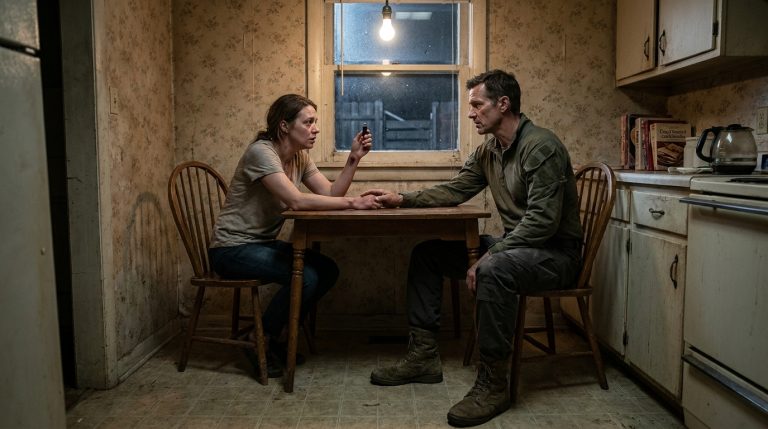
Hal Sutter’s voice sounded thin over the landline, stripped of the heavy, multi-generational warmth that usually came with a third-generation Hill Country lender. On the corner of my grandfather’s desk, the brass desk lamp vibrated slightly from the rhythm of the wind pushing off the limestone ridges outside.
“Material adverse change, Hal?” I let my thumb run down the rusted steel edge of my father’s old wire-cutter sitting on the blotter. The cold metal had a pitted, rough tooth to it. “I haven’t missed a note since I took over the brand in 2018. My calf crop is already contracted for December.”
“It’s the litigation risk,” Hal mumbled, the sound of paper shifting on his end carrying through the wire like dry leaves. “A million-four in damages on an encroachment claim creates an unsecured liability the oversight committee won’t carry. You’ve got ninety days to clear the two hundred and ninety thousand, or we freeze the operating line.”
He didn’t mention Paul Whitlock’s name. He didn’t have to. Paul sat on the regional bank’s executive board, his signature probably still wet on the compliance audit that had triggered the notice. They weren’t just trying to cut my grass; they were trying to choke the oxygen out of the kitchen before the first court date even hit the county docket.
“I appreciate the call, Hal,” I said, and hung up before the old man could offer an apology he didn’t mean.
The silence that followed was heavy, smelling of the dry caliche dust that always found its way through the window seals when the south wind blew hard off the Sage Mesa fence line. I didn’t pour another bourbon. Instead, I stood up and walked to the back corner of the office, where four bankers boxes sat stacked against the cedar paneling. The cardboard was soft, water-stained from fifty years of Hill Country humidity, the lids sagging under their own weight like old hides.
When I cracked the first lid, the scent hit me—brittle parchment, old leather reins stored too close to the floor, and the unmistakable sharp tang of mouse droppings. Three generations of Brookhart men didn’t throw away a receipt. They didn’t trust the county clerk’s digital transition, and they damn sure didn’t trust a handshake once the oil companies started laying pipe in the seventies.
I pulled a straight-backed wooden chair up to the stack, set my cold coffee on the floor, and began to dig.
The work was slow, a deliberate crawl through tax receipts from 1964 and handwritten livestock bills of sale on yellowed ledger sheets. My great-grandfather Henry’s script was a series of dark, aggressive slashes; my father Tom’s was smaller, precise, the handwriting of a man who spent his nights calculating feed costs down to the penny while his stroke was already waiting for him at the kitchen sink.
By midnight, the desk was buried under yellow highlighters and numbered pencils. I found the 1953 grazing license Diane had cited in her forty-seven-page ambush. I ran my finger over the ink. Term: Twenty years from date of execution. Termination absolute on December 31, 1973. There was no renewal clause. No implied continuation. It was a dead piece of paper, as useless as a dry well, yet Hargrove’s San Antonio firm had billed six hundred an hour to dress it up like a permanent easement.
But it was the third box, near the grease-stained bottom, that stopped my hand.
I pulled out a manila folder with a rusted steel clip. The tab was marked in my father’s faded block letters: U T I L H B 72. Inside lay thirty-eight pages of legal parchment, the blue backing sheet crisp despite the damp storage conditions. It was a utility right-of-way agreement granted by my grandfather to the Hill Country Electric Cooperative, dated October 17, 1972.
I leaned into the low circle of yellow light from the desk lamp, my eyes tracking lines of boilerplate until I hit the term clause. My breath went shallow.
…for a primary term of fifty (50) years, terminating on the anniversary of execution, after which renewal shall require the mutual written covenant of both the Grantor and the Cooperative…
Fifty years from October 1972 was October 2022.
I looked out the dark window toward the southern horizon. Three miles away, past our line, the night was broken by the uniform, sprawling grid of Sage Mesa Estates—three hundred and eighty custom-built limestone fortresses with their heated pools, their lighted tennis courts, and their fake Spanish bell tower glowing under mercury-vapor floodlights. Every single kilowatt keeping those AC compressors humming and those golf course pumps turning had to cross a four-mile corridor of the Bar K Ranch.
The line was running right now. I could hear the faint, high-frequency vibration of the transformers through the limestone floorboards if I kept my boots off. It was running on a permit that had died nineteen months ago, five weeks before my father’s heart stopped at the sink.
I flipped further into the folder, looking for a countersign. Nothing. Just two certified letters from the cooperative’s headquarters in Junction, addressed to my father’s estate, marked Unopened – Return to Sender during the height of the probate mess when I was still trying to untangle our cattle notes from the state tax lien.
My thumb pressed against the heavy paper. Diane Whitlock thought she was playing a short-game squeeze with a local rancher who’d forgotten how to read a statute. She’d spent months coordinating with the county judge, tracking my cattle movements with agricultural drones, and weaponizing her husband’s loan committee to break my back before the winter freeze.
But she hadn’t checked the wire running right above her vanity plate.
I picked up the desk phone and dialed Walt’s home number in Leakey. It rang four times before his gravelly, sleep-rough voice broke the line.
“Walt,” I said, my eyes fixed on the expiration date on page three. “Get your Bronco warmed up. We aren’t just filing an answer on Monday.”
“Wyatt? It’s two in the morning, boy. What are you looking at?”
“I’m looking at the switch that turns off Sage Mesa,” I said.
CHAPTER 3: THE AUSTIN COUNTERSTRIKE
The glass table in Maggie Vance’s conference room was thick enough to stop a caliber round, reflecting the white dome of the state capitol like a pale eye in the sky outside. Maggie didn’t look up when I sat down, her Mont Blanc rollerball slicing thin, dark tracking marks down the margin of the 1972 right-of-way document. Her senior associate, Trevor, sat to her left, his fingers snapping against the keys of a slim black laptop with a rhythmic, mechanical click that sounded like an engine cooling.
“It’s not just a breach, Wyatt,” Maggie said, her tone level, stripped of the casual law-school shorthand we’d traded for twenty years. She set the pen down with a small, sharp tick against the glass. “The Hill Country Electric Cooperative has been operating in active, un-renewed default across fifty-six acres of your family’s limestone since October 2022. You have the statutory right to serve a ninety-day notice of non-renewal. If they don’t pull the structures, they’re trespassing.”
“And the downstream customer?” I asked, my thumb tracing the rough, raw edge of the leather belt I’d notched myself back at the ranch.
“Sage Mesa Estates is an incidental beneficiary,” she said, leaning forward until the glare from the window caught the hard lines of her jaw. “They have zero standing to compel a utility renewal. But here’s where the floor drops out from under Diane Whitlock. We forced the expedited discovery on her initial encroachment suit before their San Antonio counsel realized how deep the well went. Spencer Hargrove’s clerks dropped eleven boxes of internal HOA records at my office yesterday afternoon to avoid a contempt citation.”
Trevor tapped a single key, turning the laptop screen toward me. A scanned ledger sheet filled the glass display.
“Look at the line item under infrastructure maintenance, 2018 through 2022,” Maggie muttered.
My eyes tracked down the columns of digital print. Annual Neighborly Contribution to Brookhart Ranch for ongoing easement courtesy: $2,400. At the bottom of the section, the signature was small, sharp, and instantly recognizable: Diane Whitlock, Treasurer.
“She’s been assessing the Sage Mesa homeowners twenty-four hundred a year for an ‘easement courtesy’ she claimed she was paying your father,” Maggie said, her voice dropping into a dry, precise cadence. “The money left their capital improvement account every single June. It never hit your father’s bank account. It never hit yours. She knew the easement existed, she knew it was expiring, and she used the money as an internal slush fund while drafting a strategic plan to annex your pasture before the renewal hit your radar.”
“The encroachment lawsuit wasn’t an accident,” I said.
“It was a defensive screen,” Maggie replied. “She wanted to lock you into heavy defense costs so you’d settle the boundary dispute in their favor, giving them the pasture before you ever pulled the boxes out of your father’s office. It’s clean fraud, Wyatt. We’re filing the counterclaims for trespass, unjust enrichment, and tortious interference by noon today.”
The drive back from Austin took four hours, the sun sinking down until the Edwards Plateau looked like a sheet of hammered iron under a violet sheet of sky. The caliche road up to the Bar K was white with dust, the dry oak leaves rattling against the windshield like gravel.
When I pulled the truck into the corral, Pete was standing by the equipment shed, his hat pushed back so far the white skin of his forehead gleamed in the dusk. He wasn’t working. He was holding a heavy iron crescent wrench, his eyes fixed on the front porch of the main house.
“Wyatt,” Pete said as I stepped out of the cab, his voice coming out slow and rough. “She was here.”
My hand stayed flat against the truck door. “Diane?”
“Drove up about three o’clock in that white Lexus with the lawyer,” Pete said, spitting a dark stream of tobacco juice into the dirt near the tire. “Claimed she had a right to conduct an inspection of the disputed fence line. I told her she was crossing onto private deeded ground. She laughed right in Sarah’s face. Then she looked at Caleb—he was sitting right there on the swing—and she said Tom Brookhart was a stubborn old goat who didn’t know how to run a lease, and his boy was shaping up to be the same.”
The silence that followed was different than the silence of the pasture. It had a weight behind it, a heavy, cold pressure that settled directly behind my teeth.
I didn’t go inside the house immediately. I walked out to the south fence line where the big timber transmission poles cut across the limestone ridge. The copper wires hummed above me in the dry air, a low, constant vibration that carried the power for three hundred and eighty luxury homes straight out of my dirt.
Diane Whitlock had code enforcement writing citations for my herd. She had her husband pulling my line of credit at the county seat. She’d stood on my porch and left my son sitting in the dark of his own home, believing the family name was something to be taken by a process server at a football game.
I reached out and touched the creosote-soaked wood of the nearest utility pole. The surface was rough, splintered by forty years of west Texas weather, the iron bolts rusted red where they held the cross-arms to the sky.
The ninety-day clock had already started at 8:47 this morning when Maggie’s courier hit the cooperative’s office in Junction. Diane thought she’d found a country boy she could out-paperwork with a San Antonio firm and a forty-seven-page bluff. But she hadn’t looked at the ledger, and she hadn’t looked at the clock.
I pulled my cell phone from my pocket and dialed Maggie’s direct line.
“File the public notice,” I said, my boots sinking into the loose caliche dirt. “Don’t hold anything back. Let’s see how long her lights stay on.”
CHAPTER 4: THE DAY THE LIGHTS WENT OUT
The grease on my saddle horn was hot enough to slide under my thumb as three hundred head of black Angus hit the southern fence line. The air was a thick, moving wall of alkaline dust and animal sweat, the low, gut-deep vibration of the herd shaking the limestone shale beneath the horses’ hooves. Pete rode twenty yards out on my left flippin’ a braided leather pop-strap against his chaps, his blue heeler cutting small, silent arcs through the brush to keep the stragglers from drifting into the cedar brakes.
“Keep ’em bunched, Trace!” Pete shouted toward the back, his voice dry as a cracked creek bed. “They smell the water tank in the south paddock. Don’t let ’em spread across the corridor yet.”
I pulled my grandfather’s Stetson down against the white glare of the noon sun. To our right, the high-voltage transmission lines of the Hill Country Electric Cooperative cut across the sky like giant black stitches, thirty feet above the grass. The timber poles looked grey, desiccated by fifty summers of Hill Country heat, their iron cross-braces groaning slightly under the heavy tension of the copper cables.
At exactly 7:45 a.m. by my watch, I pulled the hand-held Kenwood radio from my oilskin vest. My fingers were slick with grease and grit. “Cliff. We’re at the crossing marker. The flankers are in position above the low-water gate.”
The speaker cracked twice, a burst of static that made my horse prick its ears. Cliff Donovan’s voice came through from the sub-station house three miles south, flat and heavy with state-utility precision. “Copy that, Wyatt. OSHA safety variance forty-two alpha is active. We’ve logged your personnel clearance height at eight feet with the ATVs. Commencing de-energization sequence on feeder line three now.”
I held my breath, my boots locked deep in the oxbow stirrups.
For three seconds, nothing changed. Then came the sound—not a blast, but a deep, structural snap that traveled through the soil before it hit the air. It was the sound of three massive oil-circuit breakers tripping in sequence at the high-pressure switchyard. The faint, high-frequency hum that had vibrated through the Bar K pasture since my childhood died instantly, replaced by a sudden, unnatural silence that seemed to make the oaks drop their leaves.
Across the south fence line, Sage Mesa Estates vanished from the grid.
Even from the ridge, you could feel the momentum of three hundred and eighty homes dropping dead at the same micro-second. The distant, rhythmic throb of the golf course pumping station cut out. The massive mercury-vapor floods on the fake Spanish bell tower flickered twice and died, leaving the main gated entrance looking like a grey tooth against the limestone cliff. The country band’s PA system, which had been thumping a soundcheck for Diane’s victory festival since sunrise, withered into a dull hiss. Air conditioning compressors wound down inside three-story brick facades, their giant fans spinning to a lazy, rattling stop.
“They’re crossing,” Pete muttered, his reins held low and steady. “Look at that gate.”
Through my binoculars, the luxury development looked like a machine with its main drive belt sliced clean. The electronic gates had slipped their magnetic locks, swinging open on their hinges like broken shutters. In the parking lot of the amenity center, white luxury SUVs began to cluster like ants in a disturbed hill, their brake lights flashing red as the automated security systems began to chime in the sudden dark.
“Drive ’em slow, Pete,” I said, clipping the radio back to my vest. My palm left a dark streak of grease on the leather. “The cooperative’s safety variance gives us a four-hour window for livestock clearance above six feet. Let the heifers take their time on the limestone.”
“They won’t move any faster anyway,” Pete said, a hard, dry grin splitting his sunburned face. “They’re country cattle, Wyatt. They don’t give a damn about a country club festival.”
We kept the line tight, a slow brown river of hide and horn moving across the fifty-foot easement corridor. Every hoof-beat kicked up a fresh layer of pink caliche dust that hung in the still air, settling over the transmission poles like salt. To the east, down by the secondary access gate, I could see the blue Subaru belonging to Linda Garrett, the photographer’s long lens poking through the brush like a rifle barrel to capture the dead grid behind our fence.
By eleven o’clock, the tail-end of the herd had cleared the wire, their flanks wet and steaming as they dropped into the shade of the live oak draws in the south paddock. I pulled the horse up near the main corner post, my back stiff from four hours in the tree of the saddle.
The cell phone in my pocket was vibrating continuously, the screen choked with fifteen missed calls from Spencer Hargrove’s San Antonio office and three text alerts from Maggie with attachments from the state utility commission’s emergency docket. Diane had already attempted to file an injunction for malicious disruption of civil infrastructure, but the cooperative’s legal counsel had already entered our ninety-day certified notice and the signed safety protocol into the record before the judge could even finish his breakfast at the club.
I reached down and wiped the sweat from my horse’s neck with the brim of my hat. The leather liner inside was dark with my own sweat, cold against my forehead as the wind shifted from the west.
We’d delivered the notice. We’d moved the herd. The lights were back on now—I could hear the distant click of the relays resetting as Cliff re-energized the lines at eleven-forty-eight—but the paper trail we’d left in the county registry couldn’t be un-signed. The story was already live on the Austin wire, and the boxes Maggie had unsealed were sitting on the state attorney’s desk before the smoke from Diane’s dead festival pits could even clear the ridge.
Pete rode up next to me, his blue heeler panting in the shadow of his stirrup fender. He looked at the white Lexus that had just pulled up to the gated fence line three hundred yards away, its vanity plate gleaming in the high noon sun.
“She looks like she wants to spit fire, Wyatt,” Pete said softly.
“Let her spit,” I said, turning my horse back toward the house. “The ground’s too dry for it to catch.”
CHAPTER 5: THE BROOKHART RULE
“We’re moving to item three on the emergency agenda,” Russell Eaton said, his voice straining against the tinny rattle of the portable Fender PA system. He was a retired aeronautical engineer who lived in one of the phase-two cul-de-sacs, his face looking grey and drawn under the orange flare of the tiki torches. “The floor is open for public comment regarding the ongoing infrastructure litigation with the Bar K Ranch.”
The amenity center parking lot was packed until the caliche shoulders were choked with folding chairs and lawn seats. Two hundred and forty-three homeowners sat under the August heat, the air smelling heavy of insect repellent, damp asphalt, and the sharp, chemical soot from the fuel canisters. Behind them, the main clubhouse sat completely dark, its massive commercial HVAC units dead on their concrete pads after taking secondary compressor damage during the morning’s line drop.
I didn’t stand up when my name was called. I stayed in the back row, my boots hooked behind the aluminum rungs of a folding chair, my grandfather’s stained Stetson low over my eyes. Pete sat to my right, slowly turning a splintered toothpick between his teeth.
When I reached the microphone, the metal housing was hot, greasy with the sweat of three previous speakers who had spent their five minutes demanding Diane’s resignation over the blackouts. I didn’t look at the television cameras lined up by the press table, or at Linda Garrett, who was actively uploading live quotes to the Austin wire from her laptop. I looked down at a single sheet of yellow legal pad paper.
“I’m going to read three numbers,” I said into the screen. The static from the speaker box popped twice, loud enough to make a horse whicker in the holding paddock across our south fence line. “First number: two point one million dollars. That is the exact amount the Sage Mesa Estates HOA owes the Brookhart estate in retroactive easement fees, calculated from October seventeenth, 2022, to eight o’clock this morning.”
A low, collective rumble went through the front three rows.
“Second number,” I leaned closer to the iron neck of the stand. “Four point seven million. That is the cooperative’s engineering estimate to relocate the feeder lines, the substation transformers, and the cellular array off our pasture land if this board decides it doesn’t want to sign a renewal.”
“This is extortion!” Paul Whitlock’s voice cut through from the third row. He stood up, his linen shirt wrinkled from the humidity, his fingers shaking as he pointed toward the podium. “The bank has already reviewed your operating lines, Brookhart. You don’t have the liquidity to carry this to a district court!”
“Sit down, Paul,” Russell Eaton snapped, his gavel hitting the wooden folding table with a dry, hollow crack. “Mr. Brookhart has the floor.”
“The third number,” I said, my voice dropping into the same flat, transactional rhythm I used to use in the Houston deposition rooms. “Is zero. That is the number of acres this community will ever annex from the south pasture. Not forty-seven. Not seven. Not one.”
I looked past the microphone, straight into the third row where Diane Whitlock sat. Her blonde hair was pulled back tight, her mouth a hard, bloodless line that looked grey under the torchlight. Her white Lexus was parked fifty yards away under the fake Spanish bell tower, its vanity plate—EQUITY THREE—catching the yellow glare of the floodlights.
“My grandfather, Henry Brookhart, let the cooperative set those poles on a handshake in 1972,” I said, the paper steady in my hand. “He did it because the people down the valley needed their pumps to run. He didn’t know the subdivision that grew up across the wire would forget his name, and he damn sure didn’t know the president of this board would come onto his porch and call him a stubborn old goat in front of his great-grandson.”
I didn’t wait for the vote. I folded the yellow sheet, slid it into my denim vest, and walked back toward the shadow of the equipment shed where Pete was waiting.
The applause didn’t start until I hit the gravel, but when it came, it was a heavy, rhythmic roar that traveled all the way up the limestone ridge. The hand vote to remove Diane from the executive chair took less than ninety seconds—two hundred and twenty-one hands raised in the dark against twelve.
By midnight, the parking lot was empty save for the news vans and the grey smoke from the dying torches. Maggie Vance walked up from the press table, her leather portfolio tucked under her arm, her heels clicking against the caliche.
“Hargrove called my cell while you were speaking,” she said, her thumb tracing the brass latch of her case. “They’re pulling all three lawsuits with prejudice by nine a.m. Monday. The new board already authorized Eaton to sign the master settlement. They’re reimbursing your defense fees and executing a twenty-five-year renewal at forty-eight thousand a year, indexed to inflation.”
“And the bank note?” I asked.
“Paul resigned from the executive committee an hour ago,” she said, looking out toward the highway where the taillights of Diane’s Lexus were disappearing under the limestone arch. “The regional branch is issuing a formal clearance on your operating line before the morning ledger closes.”
I looked down at my palms. They were stained grey from the creosote on the utility pole I’d checked before the meeting, the grease deep in the lines of my skin. It was a clean win—the kind that gets recorded in the county deed boxes with a red seal and a notary stamp.
But as I looked out over the darkened pasture, my phone buzzed in my pocket. It wasn’t a text from Sarah or a legal alert from Maggie’s clerks. It was a private number, the connection scratchy with the low-frequency static of a regional line.
“Wyatt?” The voice was old, thin, matching the gravelly tone of Walt Sheppard’s Bronco idling by the gate. “Don’t lock that vault in the office just yet. Paul Whitlock’s clerks didn’t leave the courthouse when the board meeting broke. They’re pulling the 2018 probate filings for your father’s estate. There’s a signature missing on the deed transfer Tom signed before he went down at the sink.”
The wind shifted from the west, bringing the cold smell of wet limestone and the dry rattle of cedar fronds against the wire. The lights were back on in Sage Mesa, but out on the ridge, the dark was still wide open.
CHAPTER 6: THE PROBATE REOPENING
“They’re using a digital scan from the 2018 county archive, Wyatt. They didn’t even wait for the clerk to open the side door.”
Walt Sheppard’s voice sounded like it had been dragged through thirty miles of Hill Country river gravel. Through the windshield of the F-250, the headlights cut two yellow holes into the caliche dust outside the county annex building in Leakey. It was forty-two minutes past midnight. The concrete steps of the building looked bleached under the security floods, the iron handrails pitted with old rust that had flaked away into the dirt below.
“What exactly is missing, Walt?” I kept my hand flat on the gearshift, the vibrating steel hum of the idling diesel coming up through the palm of my hand.
“The second page of the short-form warranty deed,” Walt said, his heavy frame emerging from the dark beside the county clerk’s lockbox. He held a grease-stained legal folder against his stomach like it was a shield. “Your dad Tom signed the master conveyance form in front of the notary at the kitchen sink three days before the stroke. We know that. But the auxiliary parcel rider—the one that specifically covers the southern forty-seven acres bordering the Heartwell fence—was never countersigned by your mother as a co-administrator. It was an oversight by the abstract company during the probate crunch.”
“Paul Whitlock found it,” I said.
“His title lawyers have been digging through the manual indexes since the lights went out this morning,” Walt muttered, spitting into the caliche. “They’re filing an emergency cloud-of-title action with the district judge by seven a.m. If the deed transfer was defective in 2018, the land belongs to the un-probated residue of your father’s estate. That means Paul’s bank can freeze the entire ranch as an un-administered asset under the material default clause of the original operating note. The settlement Maggie just signed won’t be worth the ink on the parchment.”
The chill that hit the cab wasn’t the air conditioning. It was the dry, unyielding weight of old paper catching up with sixty years of cattle labor. In the Hill Country, a fence line is only as tough as the signature at the bottom of the ledger block. If the 2018 transfer lacked a co-signature, the Bar K wasn’t my ranch to defend.
“Where is the original carbon copy, Walt?” I asked, looking out at the limestone cliffs rising behind the courthouse like teeth against the night sky. “The one Tom kept before the notary took the master file to San Antonio.”
“It’s either in the vault back at the house, or it’s out at the western line camp,” Walt said, his thumb running along the rusted edge of his pocket knife. “Tom spent the last week of that October clearing cedar out by the old water well memorandum tract. He kept his working field books in the iron locker out there so the mice wouldn’t chew the binding.”
I didn’t answer. I dropped the truck into reverse, the tires spitting loose limestone gravel against the concrete foundation of the county vault as I spun the wheel.
The drive across the western pasture was five miles of raw limestone ledges and cedar draws that chewed at the Ford’s suspension. The truck bounced over the rough rock, the headlights sweeping across old cedar posts that had been notched by hand back when the ranch was won in the settlement. The air smelled of hot iron, scorched oil, and the dry, bitter tang of crushed juniper berries under the tires.
When I hit the gate of the western line camp, the structure looked like a grey husk under the moon. It was an unpainted cedar shack built in 1947, the corrugated iron roof rusted into dark, horizontal streaks that looked like dried blood in the yellow beam of the high beams. The padlock on the door was an old Yale brass tumbler, seized with decades of river silt and lime dust.
I didn’t use the key. I pulled the heavy iron wire-cutter from the glovebox—the one that had belonged to my father—and used the flats of the handles to smash the brass shackle until the tongue sheared out of the housing.
Inside, the cabin smelled of dry decay, old wool blankets, and the stale grease of dead stoves. My flashlight beam cut through the dark, reflecting off an old green military footlocker sitting beneath the iron cot. The latch was rusted solid, the metal flaking into red dust under my fingers as I forced the bar up.
There were three leather field books inside, their bindings stiffened by years of moisture until they cracked like dried hide when I opened them. I flipped past pages of handwritten cattle tallies from 1982, past salt-block receipts and rainfall logs written in my father’s small, mechanical block letters.
Near the bottom of the box, tucked inside a grease-stained copy of the 1989 water memorandum, lay the carbon copy of the 2018 short-form deed.
I held the paper up to the flashlight beam. My thumb found the second page. The signature block for the co-administrator was blank. There was no ink. No notary stamp. Just the dry, purple outline of the carbon paper where my father’s signature had pressed through from the page above, leaving the critical parcel rider completely unsigned by the estate’s heirs.
The trap had a false bottom. Diane Whitlock’s public defeat at the town hall wasn’t the end of the line; it was the decoy that had kept me looking at the utility poles while her husband Paul went behind the courthouse with a title searcher to cut the ground out from under my boots.
I sat on the edge of the iron cot, the silence of the line camp heavy enough to make my ears ring. Outside, three miles south, the lights of Sage Mesa Estates were still glowing against the plateau, every window bright with the power crossing my pastures. But beneath my boots, the deed to the soil was as hollow as a dry bone.
I picked up the iron wire-cutter from the floorboards, its weight solid and cold in my palm. The land remembered every handshake, every mile of wire, and every drop of sweat my father had left at the kitchen sink. Paul Whitlock thought he’d found the missing link that would break the brand, but he’d forgotten that old men who keep receipts don’t leave their loose ends in a county archive.
I reached back into the footlocker, my fingers brushing against a second manila envelope hidden beneath the ledger books—one that hadn’t been opened since the 1989 water dispute with the old Heartwell ranch.
CHAPTER 7: THE RUSTED LEDGER
“The courthouse steps open in thirty minutes, Wyatt. If you aren’t at the side entrance with something recorded, Paul’s lawyers are going to freeze the cattle accounts before the first teller drawer drops.”
Walt Sheppard’s voice through the dashboard speaker was nearly drowned out by the rattling vibration of the diesel engine as I pushed the truck through the dry bed of Hackberry Creek. The headlights caught the pale, exposed roots of the sycamores along the banks, looking like bleached bones against the dark caliche mud.
“I have the 1989 folder, Walt,” I said, my left hand holding the wheel steady against the ruts while my right stayed flat on the grease-stained manila jacket on the passenger seat. “Tell Maggie to stay on the land registry wire. We’re not fighting the probate file.”
“What do you mean we’re not fighting it?” Walt growled, the background noise on his end filled with the high, thin hiss of static from his Bronco’s old regional antenna. “If that 2018 rider is invalid, the bank owns the fence.”
“The bank owns nothing,” I said, hitting the hard pack of the county highway just as the first line of lavender light broke over the eastern bluffs of the Edwards Plateau. “Tom didn’t sign the auxiliary rider because he didn’t need to. The 1989 livestock water sharing memorandum with the old Heartwell Ranch had a cross-collateralization clause. It locked the boundary lines to the deep aquifer wells under a mutual-indemnity rider that can’t be severed by probate. Carl Whitlock signed it himself when he bought the original parcel before the subdivision layout was ever drafted.”
The silence on the other end of the line lasted three full gear shifts.
“Carl signed it?” Walt’s voice dropped into a lower, slower gear. “The grandfather?”
“He signed it as the sole managing partner of Heartwell Development Group,” I said, looking down at the purple carbon script catching the first glare of dawn through the windshield. “The rider states that any future alteration of the southern forty-seven acres automatically triggers a permanent, non-revocable agricultural exemption easement for the Bar K, backed by the groundwater rights of the entire downstream aquifer. Diane didn’t find a loophole. She found the exact fuse her own father-in-law laid down thirty-seven years ago to keep my grandfather from cutting off their water during the drouth.”
I spun the truck into the parking lot of the Real County annex at exactly 6:52 a.m. The limestone building was cold, the long shadows of the live oaks stretching across the concrete steps like black grease lines.
Paul Whitlock was already standing by the double glass doors, flanked by two men in dark wool coats who carried matching leather briefcases with polished brass latches. His face looked grey in the morning light, the skin under his eyes sagged from a night spent digging through automated index files.
“You’re late, Brookhart,” Paul said, his voice level but carrying the dry, brittle rattle of a man who’d spent his leverage too early. “The clerk logged our cloud-of-title filing five minutes ago. The operating line is locked. You can’t clear the December cattle delivery without the bank’s release.”
I didn’t stop walking until my boots hit the first concrete riser, six inches from his wingtips. The smell of cold limestone, old creosote, and the diesel grit from my jacket hung between us in the damp air.
“Your clerks pulled the 2018 probate archive, Paul,” I said, pulling the 1989 rider from the folder and holding it flat against the glass of the door between us. The paper was thin, the corners frayed and stained with the grease from my father’s old line-camp footlocker. “But they didn’t pull the manual deed registry from volume forty-two, page eight. Your father-in-law, Carl, executed this mutual-indemnity water rider three decades before you laid the asphalt for Sage Mesa.”
The senior lawyer to Paul’s left leaned in, his glasses slipping down his nose as his eyes tracked the handwritten notary stamp at the bottom of the parchment. His fingers stayed frozen on the handle of his briefcase.
“What is that?” Paul muttered, his eyes darting from the paper to his counsel’s face.
“It’s the title to the water under your wife’s swimming pool, Paul,” I said, my voice dropping into that flat, quiet cadence my father used when he was checking a corner brace. “The moment your lawyers filed that cloud-of-title action on the forty-seven acres, you triggered paragraph four of this rider. You just legally converted every main line feeding the Sage Mesa subdivision into a permanent, non-taxable right-of-way for my cattle herd. If you want to freeze my operating note, go ahead. But by noon, Maggie Vance is filing the attachment that caps the deep wells at the switchyard.”
The lawyer stepped back from Paul, his mouth opening slightly before he looked down at the concrete steps. “Paul… he’s right. The cross-default provision runs with the water rights. Carl signed away the severability to secure the infrastructure loans in eighty-nine.”
The silence that hit the courthouse steps was absolute, broken only by the slow, regular tick of my truck’s exhaust manifold cooling down in the morning shade. Paul didn’t reach for his phone. He didn’t look back at his council. He stood there on the concrete, his face looking as white and brittle as the limestone cliffs behind him.
The heavy glass door clicked open from the inside, the county clerk standing there with a brass key ring in her hand, her eyes looking from the dark coats to my grease-stained vest.
“Morning, Wyatt,” she said softly.
“Morning, Miss Clara,” I said, stepping past Paul without looking at his shoulder. “I need to record a certified boundary correction rider. Volume forty-two, page eight.”
The master settlement was stamped, signed, and filed before the noon sun could clear the cedar bluffs. The $1.8 million cash settlement for retroactive fees hit our refinanced account at the Farm Credit Bureau forty-eight hours later, the numbers clearing the ledger with a clean, final electronic chime. The twenty-five-year easement renewal was locked in, the text explicitly naming The Brookhart Rule as a permanent structural covenant on every deed within five miles of our wire.
Six months later, the south pasture was quiet.
I pulled the Ford up to the ridge overlooking the fence line, the wind coming off the plateau clean and cool, smelling of wet oaks and wild winter grass. Pete was already down by the corner post, his horse tied to the cedar brace while he worked a new strand of four-point barbed wire through the iron clips with his old wire-cutters.
Caleb sat in the passenger seat beside me, a manual volume of Texas agricultural statutes open on his knees, his thumb running down the margins just like Maggie had done in the Austin office.
“Daddy?” he asked, looking out over the three hundred head of black Angus moving like black stones through the valley below. “Are we going to keep the western well line camp open?”
“We’re keeping it open, son,” I said, reaching down to touch the brim of my grandfather’s Stetson sitting on the seat between us. The leather liner was old, stained with generations of Texas dirt, but the crown was still whole. “That’s where we keep the receipts.”
Down in the draw, the lines of the Hill Country Electric Cooperative hummed softly against the winter sky, a low, steady vibration that carried the power across our ground, completely legal, completely paid for, and finally quiet in the stone. The land breathed. The boundaries were set. And out past the fence, the wire was tight.