The Weight of Concrete and Iron: A Narrative of Ancestral Soil and Calculated Friction
CHAPTER 1: THE FRICTION OF EXCLUSION
The gravel beneath Garrett’s work boots didn’t yield. It had been packed down by thirty years of trucks, iron deliveries, and the slow, heavy passage of time on land his grandfather had cleared when Cedar Oaks was nothing but low corn stalks and black mud. The pink paint of the Porsche Cayenne looked violent against the dull gray morning sky, its polished hood reflecting the desaturated outline of his workshop.
Vivian Ashford didn’t step down onto the dirt; she balanced on it, her designer heels sinking slightly into the rim of the driveway. Her oversized sunglasses stayed on, two black mirrors hiding her eyes, reflecting Garrett’s weathered face and the grease-stained collar of his canvas shirt back at him.
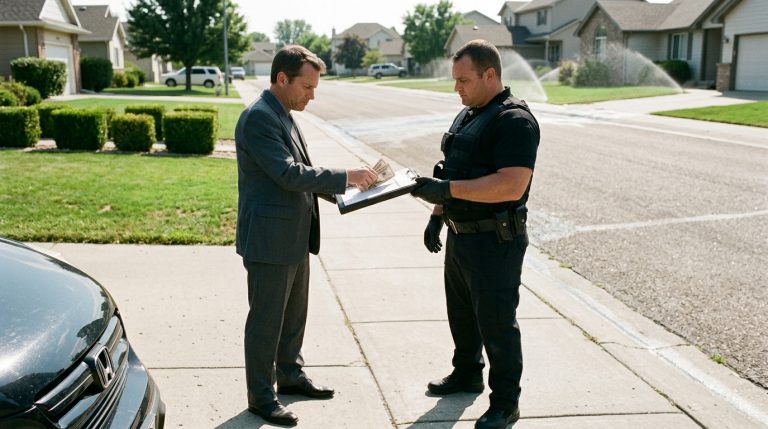
“You’re fifteen years behind the neighborhood standard, Garrett,” she said, her voice carrying the practiced, rhythmic clip of a real estate deposition. She held a thick, cream-colored folder against her ribcage like a shield. “The board voted unanimously. The community enhancement assessment applies to every parcel within the geographic perimeter of Cedar Oaks. Twenty-eight hundred dollars. Initial compliance is due within thirty days.”
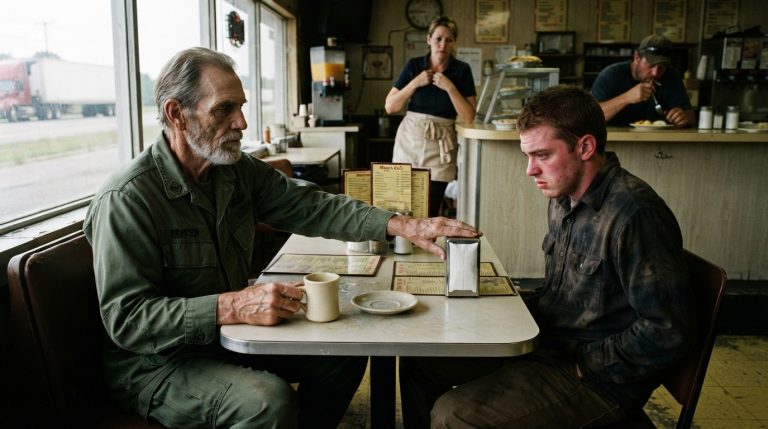
Garrett didn’t reach for the folder. He kept his hands dropped at his sides, his fingers resting near the seams of his trousers. His palms were rough, mapped with the faint white scars of marine-grade weld spatters and the heavy serrations of hydraulic wrenches. He could smell the exhaust from her idling engine—the high-octane, sweet stench of a machine that had never seen a hard day’s labor—and it mixed poorly with the familiar, metallic tang of iron filings and cutting fluid drifting from his open garage door.
“My grandfather bought this dirt in 1987,” Garrett said. His voice was low, flat, stripped of the cadence of argument. It was the tone he used when evaluating a cracked cylinder wall or an out-of-spec piston sleeve. “Your association filed its articles with the county clerk on September third, 2002. I don’t sign contracts retroactively, Mrs. Ashford. And I don’t pay maintenance fees for a pool I don’t swim in.”
Vivian smirked, a quick, sharp movement that didn’t reach her jawline. She stepped half an inch closer, the hem of her white athletic leggings catching a burr from the un-mowed ditch line. “The county passed the unified enhancement ordinance last winter, Mr. Riverside. It gives the dominant association the legal authority to remediate any property that deflates the local tax base through aesthetic neglect. We have three law firms on retainer. We run the zoning line.”
She reached out, dropped the heavy folder onto the hood of his truck—a 1994 flatbed with faded clear-coat and a custom steel rack he’d welded himself—and turned back toward her car. “Read the non-compliance section. It’s one hundred dollars a day after the thirty-day window. We will place the lien, and we will take the house.”
Garrett watched the pink door click shut. The glass was tinted dark enough to turn the interior to ash. As the Porsche backed down his drive, its wide tires spitting two parallel lines of gray flint into his ditch, Garrett walked over to the flatbed. He didn’t look at the paperwork yet. Instead, his eyes dropped to the base of his mailbox post.
Tucked into the weeds directly beneath the cedar crossbeam was a fresh, bright orange plastic stake driven six inches into the dark earth, its synthetic ribbon fluttering in the exhaust-chilled wind.
CHAPTER 2: THE CHEMICALLY ALTERED BOUNDARY
The high-idle whine of a two-stroke commercial engine tore through the damp morning mist before Garrett could finish his first mug of black coffee. It wasn’t the distant, polite hum of a neighbor’s lawnmower; it was close, vibrating through the small paned windows of his workshop. He set the ceramic mug down on a rusted anvil, the iron absorbing the heat instantly, and reached for the heavy shop rag hanging from his belt.
Through the oil-filmed glass of the garage window, the desaturated gray of the dawn was broken by a flash of bright white commercial steel. A flatbed truck belonging to a commercial landscaping outfit sat idling directly in his gravel turn-around, its exhaust casting a blue, heavy cloud over his grandfather’s vintage iron slag heap. Three men in dirt-stained high-visibility vests were already lifting heavy flats of greenhouse-forced flowers from the rack.
Garrett stepped through the side door, the rusted hinges giving a short, metallic squeAL that was swallowed by the engine roar. The air outside didn’t smell like early spring anymore; it smelled of wet diesel, burnt oil, and a sharp, synthetic chemical stench that made the bridge of his nose itch.
“Step off the flat,” Garrett said. He didn’t shout. He kept his posture straight, his shoulders square with the military bearing that decades in shipyards had hammered into his spine.
The crew foreman, a thick-necked man with skin cured to leather by the sun, stopped with a flat of pink and white impatiens balanced against his hip. He looked at Garrett’s grease-smeared shirt, then down at the heavy steel-toed boots buried in the gravel. “Got a work order here, buddy. Cedar Oaks Homeowners Association. Community enhancement directive for the Riverside perimeter lot. We’re putting down seasonal color and soil amendments along the road frontage.”
“This isn’t road frontage,” Garrett said, his voice dropping into the low, dangerous register of an engineer spotting a catastrophic failure in a high-pressure line. He walked forward, each step deliberate, his boots crunching heavily against the stone. “This is private property. Look at the ditch line. You crossed the county easement three yards back.”
The foreman didn’t drop the flat, but his grip shifted. He reached into his back pocket and pulled out a folded piece of paper, its edges crinkled and stained with green thumbprints. “Look, I just run the crew. The lady in the pink Porsche handed this to our front office yesterday afternoon. Said it’s an official county ordinance compliance sweep. Said if anyone tried to stop us, we were to show them the structural citation code at the bottom and keep digging.”
Garrett took the paper. The texture was wrong—cheap copy paper, too light for an official county document. At the bottom ran a long string of legalistic jargon, capped by a blurred digital signature under the header: Department of Environmental Aesthetics & Structural Integrity. His engineer’s mind, trained to spot the slight discrepancies in fraudulent procurement contracts, noted the font mismatch on the tracking number. But before he could call it out, the metallic scrape of a spade hitting dirt cut through the damp air.
Ten yards away, near his perimeter garden, a younger laborer had already driven a flat-head shovel into the rich, dark earth where Garrett’s prized tomato seedlings were just beginning to take root. These were heirloom varieties, cultivated over three winters in his indoor germinator, grown from seed stock his mother had saved from the old farm.
“Hold,” Garrett barked, the command cracking like a dry timber snapping under load.
The laborer froze, the spade tilted at an angle. But the damage was done. The steel blade had sliced clean through the root system of three prime plants, exposing the pale, tender fibers to the cold morning air. The worker had already tipped a black plastic bag of commercial mulch over the open soil.
Garrett strode past the foreman, his eyes locking onto the dark, granular material spilling across his garden bed. He didn’t look at the gaudy pink flowers; he knelt, picking up a handful of the fresh soil amendment the crew had brought. It felt dry, gritty, lacking the soft, loamy texture of his own compost. Then the smell hit him—not the rich, earthy scent of decomposing vegetation, but a sharp, biting aroma of ammonium nitrate mixed with a strange, oily residue that left a slick film on his calloused skin. It was an invasive compound, something designed to alter the pH of the soil so drastically that nothing native could survive the season.
“Pack it up,” Garrett said, rising slowly. He wiped his stained hand against his canvas trousers, leaving a dark, oily streak. “Take your trucks, take your shovels, and get off my dirt before I treat this as a criminal trespass under Section 14 of the state property code.”
The foreman spat into the weeds, his eyes wandering toward the open garage where the massive hydraulic press stood like a silent iron sentinel. “The lady said you’d be difficult. She said the daily fines started running five minutes ago.”
“Let them run,” Garrett said, his voice cold as a winter river. “And tell Mrs. Ashford that the next time she wants to alter the structural composition of my land, she’d better bring a judge with a federal warrant, because this cheap photocopy won’t hold the weight of what’s coming.”
The foreman stared at Garrett for three long seconds, measuring the absolute lack of give in the older man’s eyes. Finally, he gave a short, jerked nod to his crew. “Load it out. We’re not getting paid enough to argue with the locals.”
Garrett watched them throw the flats back onto the steel rack, the plastic containers rattling with a hollow, cheap sound. The truck backed out, its tires slipping on the wet gravel, leaving behind the torn remnants of his seedlings and the lingering, chemical stench of the altered soil. He walked back to his workshop, his mind already calculating the grid lines. He needed the old brass compass. He needed to verify the absolute edge of his world before they tried to slide the boundary line another inch into the dark.
As he reached for his logbook on the workbench, his toe clipped something metallic buried in the gravel just outside the door frame. He looked down. It was a fresh, unweathered survey cap, made of bright brass, stamped with a registration number that didn’t belong to the county surveyor. It had been driven into the ground less than twenty-four hours ago, directly under the shadow of his own eaves.
[CEDAR OAKS PROPERTY LINE]
|
Garrett’s Workshop | HOA Encroachment Zone
+——————-+ | (Proposed Garden)
| | |
| [Anvil] | | [Invasive Soil/Mulch]
| | | x x x x x
+———+———+ | x x x x x
| |
v | <– [New Brass Cap Found]
(Gravel Driveway) |
CHAPTER 3: THE STRATEGIC STRATAGEM
“You’re thirty minutes late for your medication, Eleanor, because these men don’t know how to read a private property sign,” Garrett said, his hand resting flat against the cold, pitted steel of his mother’s car door.
The white SUV sat squarely across the mouth of his gravel driveway, its exhaust pipe coughing a steady, acrid cloud of gray smoke over the roadside ditch. The engine vibrated with a rhythmic, low-frequency rattle that shook the loose gravel around its wide tires. Inside, two men in identical navy polo shirts stared straight through the windshield, their faces desaturated by the deep green tint of the glass. The cheap security logo glued to the door panel—Falcon Oversight Management—was peeling at the corners, showing gray residue underneath.
Garrett tapped his knuckles against the driver-side window. The glass rolled down halfway, releasing the chemical stench of cheap air freshener and cold tobacco.
“Private security patrol, sir,” the driver said, his hair cropped into an uneven buzz that didn’t look official. He didn’t look at Garrett; he kept his fingers wrapped tightly around a clipboard, his eyes scanning the horizon. “We are authorized by the Cedar Oaks Community Enforcement Division to monitor a structural compliance violation on this lot. Access is restricted until outstanding environmental mitigation fees are settled with the board.”
“This is a private driveway,” Garrett said. His voice was level, carrying the heavy, mechanical resonance of a man who spent thirty years managing steam lines on amphibious assault ships. “The county easement ends four feet from the blacktop. You’re blocking a private citizen’s access to a state-maintained road. Move the truck.”
The younger passenger snickered, tapping a finger against a digital tablet. “Check the county log, old man. Public safety easement for community enhancement. We stay until the administrative lien is cleared.”
Behind them, inside the idling sedan, eighty-three-year-old Eleanor Riverside rolled down her window. The skin on her hands was thin as wax paper, her fingers trembling slightly as she adjusted the woolen shawl around her shoulders. She had lived through three factory closures and a house fire; her eyes had the hard, unyielding clarity of cold flint.
“Young man,” she called out, her voice thin but sharp enough to pierce the diesel rattle. “Are you going to clear this path, or do I need to call my sister’s boy over at the precinct? He doesn’t care much for private security firms using county time to bully old women.”
The driver didn’t move the vehicle, but his jaw tightened, a small muscle twitching near his ear. “It’s a civil matter, ma’am. Take it up with the association president.”
Garrett reached down, his fingers catching the rough, rusted rim of a iron pry bar leaning against the fence post. He didn’t raise it; he simply let the weight of the metal rest against his thigh, the rust transferring to his palm like dry blood. “My mother has been sitting in this car for forty minutes. If that engine is still running in sixty seconds, I’m going to hook my flatbed’s recovery winch to your front axle and see which piece of iron shears off first.”
The passenger’s smile died. He looked at the heavy steel bumper of Garrett’s 1994 flatbed parked twenty yards up the rise, then at the thick, grease-darkened cable coiled around the industrial winch drum.
For three minutes, the silence between the vehicles grew heavy, filled only by the thick, mechanical ticking of the cooling engines. Then, without another word, the driver dropped the SUV into reverse, the transmission grinding with a dry, metallic wail as the tires bit into the soft mud of the ditch bank. They pulled back just far enough to clear the gravel entrance, the passenger slamming his clipboard against the dashboard as they went.
Eleanor shifted her car into drive, her tires crunching slowly over the stones. As she passed Garrett, she didn’t smile; she simply gave a single, firm nod. “They’re trying to wear you down, Garrett. People like that don’t look at the dirt; they look at the paper. Check the county records yourself. Don’t trust what they bring to your door on a copy sheet.”
Garrett watched her old sedan pull up to the house, its rusted muffler rattling against the bumper. He didn’t follow her inside. He walked down to the edge of the ditch where the white SUV had been idling.
Deep in the wet clay, where the heavy tires had torn up the grass, something bright caught the pale sunlight. Garrett knelt, his boots sinking into the gray mud. It was another orange plastic marker, but this one had been snapped in half by the vehicle’s retreat. Buried beneath it was a small, zinc-plated cylinder—a professional grade boundary stake used by industrial developers, stamped with an orientation code that matched the construction layout of the Cedar Oaks clubhouse down the road.
He pulled the metal cylinder from the mud. The surface was cold, heavy, smelling of zinc and raw iron. They weren’t trying to enforce a landscaping fine; they were mapping something out, creating a physical record of occupancy where their paperwork couldn’t reach. He slipped the piece of metal into his pocket, his mind already cross-referencing the coordinates with the 1987 deed locked in his grandfather’s brass chest. The friction was increasing, but the system wasn’t broken yet; it was just out of alignment.
+——————————————————-+
| CEDAR OAKS HOUSING DEVELOPMENT (SUBDIVISION PLAT) |
| |
| [CLUBHOUSE & POOL COMPLEX] |
| +—————————+ |
| | | |
| | ======================= | <– Cantilever Deck |
| +—|———————–+ |
| | ^ |
| | | [15-Foot Encroachment Area] |
|======|===============V================================|
| | |
| +–> [True Survey Line – 1987 Deed] |
| |
| GARRETT’S PARCEL (TWO-ACRE LOT) |
+——————————————————-+
CHAPTER 4: THE MEASURE OF THE BASE
The ink on the original 1987 county plat map was dry, flaking away in tiny black scales where his grandfather’s fingers had pressed against the vellum forty years ago. Garrett ran his thumb along the eastern boundary line, feeling the coarse friction of the paper against his calloused skin. The workshop was dead silent save for the heavy, rhythmic thrum of the well-pump beneath the concrete floor.
Beside the historic deed lay the certified survey results that Mike Henderson had hand-delivered an hour before midnight. The fresh blueprint smelled aggressively of ammonia and chemical toner, a sharp contrast to the old, oil-and-dust scent of the garage.
Garrett held the brass surveyor’s compass down against the intersection of the two maps. The needle swung, quivered, and locked onto true north. His engineer’s eye didn’t need the red ink marker to see the mechanical failure in the subdivision’s layout. The red line—his property line—ran straight through the blue footprint of the Cedar Oaks community clubhouse deck.
“Fifteen feet,” Garrett said to the empty room. The words hung in the air, cold and definitive.
It wasn’t an oversight. The technical drawings for the clubhouse pool foundation, pulled from the county’s digital archive under an unrelated maintenance permit, showed the structural footings ending precisely at his boundary. Yet the physical timber and poured concrete of the cantilevered sun deck extended fifteen feet into his gravel lot, anchoring itself deep within his grandfather’s cleared soil. They had built a multi-million dollar asset on stolen ground, calculation by calculation, assuming a retired maritime mechanic would never look past his own fence line.
He stood up, his knee joints cracking slightly in the morning chill. He walked to the storage rack at the back of the shop, where three industrial-grade hydraulic cylinders sat coated in amber packing grease. They were salvage units from an old amphibious docking platform, rated for forty tons of continuous shear force.
His hands moved with practiced velocity. He didn’t use a blueprint for the manifold; the hydraulic loop was already mapped in his mind, clean and absolute. He clamped a thick steel mounting plate into the industrial vice, the iron teeth biting into the metal with a sharp, grinding screech. He picked up the heavy air-wrench. The tool kicked against his palm, its pneumatic exhaust spitting a freezing mist against his forearm as he drove the grade-8 bolts home.
“If they want to play with structural lines,” he muttered, his breath pluming in the unheated air, “we’ll adjust the pressure.”
He spent the next four hours tapping into the auxiliary hydraulic lines he had installed beneath his drive for the workshop press. Using a manual directional valve salvaged from a marine steering gear, he routed the high-pressure steel-braided lines through a shallow trench toward the eastern fence line. Every connection was torqued to three hundred foot-pounds; every fitting was wiped clean of grit. He wasn’t building a weapon; he was establishing a mechanical counter-weight.
By noon, the control panel was mounted inside the small window frame of his kitchen, obscured by the faded canvas curtain. It was a crude iron box, its surface scratched down to the gray primer, fitted with a single hydraulic pressure gauge and a three-way selector lever: Support, Neutral, Adjust.
The system was fully pressurized, holding five thousand pounds per square inch against the subterranean bedrock. He could feel the faint, high-frequency vibration through the floorboards of the kitchen—the silent potential of fluid power waiting for a change in resistance.
He walked out to his back porch, a mug of cold tea balanced in his hand, and stared through the chain-link divider. Less than twenty yards away, across the true boundary line, the Cedar Oaks pool complex was already alive with the afternoon crowd. The high, clear voices of children playing in the water drifted over the wire, mixed with the smell of chlorine and burning charcoal from the community barbecue.
Vivian Ashford stood near the concrete steps of the pool house, her white sundress standing out against the bright blue of the tiles. She was holding a clipboard, gesturing sharply toward Garrett’s lot while talking to a man in an expensive gray suit. They were looking at his newly constructed perimeter fence, their faces tight with the administrative anger of a system that had hit a hard, unyielding obstruction.
Garrett took a slow sip of the tea, the liquid bitter on his tongue. They thought they were building a legal paper trail to condemn his garden. They didn’t know that the very ground beneath their designer lounge chairs belonged to the man they were trying to fine out of his home. He turned back toward the kitchen door, his fingers finding the heavy zinc survey stake in his pocket. The baseline was set. The structural load was about to shift, and no amount of corporate paperwork would hold the weight when the foundation began to slide.
+——————————————————-+
| HYDRAULIC COUNTER-WEIGHT CONTROL LOOP (WORKSHOP) |
| |
| [Main Press Manifold] –> [3-Way Directional Valve] |
| | |
| v |
| +————————+ |
| | Lever Position: | |
| | [Support] [Neutral] | |
| | > ADJUST < | |
| +————————+ |
| | |
| =======================V========= |
| | High-Pressure Braided Steel Line |
| | (5,000 PSI Subterranean Loop) |
| ================================= |
| | |
| v |
| [40-Ton Hydraulic Cylinder] |
| [Anchored into Bedrock] |
+——————————————————-+
CHAPTER 5: THE RETRACTION OF THE INTRUSION
“Step away from the control lines, Kevin,” Garrett said, his hand resting on the chilled iron handle of the manual valve inside the kitchen window. The rusted brass frame scraped against his knuckles as he leaned forward, eyes locked on the pool deck twenty yards away.
Kevin Murphy, the Blackstone Security supervisor, froze near the perimeter wire. He had been adjusting an earpiece, his posture rigid with tactical focus, but his eyes dropped instantly to the newly trenched ground where the high-pressure steel-braided lines ran beneath the dirt. He didn’t move toward his holster; his hands stayed open, palms down, calculating the mechanical physics of the situation. He was smart enough to recognize a hydraulic lock when he heard one—the faint, metallic hiss of five thousand pounds per square inch vibrating through the subterranean bedrock.
“Mr. Riverside,” Murphy said, raising his voice to cut through the splashing water and pop music bleeding from the subdivision pool. “Let’s let the legal teams handle the boundary plat on Monday. There are forty families on that platform right now. The liability footprint is too heavy.”
“The liability footprint belongs to the woman who signed the construction layout,” Garrett replied. His voice was raw, stripped of anything but the dry finality of an engineer completing a stress test.
Through the glass, Vivian Ashford stood at the absolute edge of the cantilevered sun deck, her white sundress catching the hot afternoon light. She was holding a microphone connected to a portable PA system, her voice booming over the water as she addressed the board members gathered around her. “We will not be intimidated by illegal fencing or vintage machinery! This property has been structurally integrated into Cedar Oaks for four years!”
The crowd cheered, plastic cups raised, entirely unaware of the red deed lines flaking to dust in Garrett’s workshop.
Garrett didn’t yell a warning. He checked the master pressure gauge on the iron box. The needle was pinned right at the red line, vibrating against the stop pin. He gripped the heavy selector lever, his calloused palm catching the rusted edges of the steel handle, and pulled it down from Support through Neutral straight into Adjust.
The reaction was instantaneous, structural, and loud.
Deep beneath the manicured turf of the community complex, the forty-ton salvaged cylinders groaned. It was a visceral, low-frequency screech of metal sliding against metal, a dry iron shriek that traveled through the soles of everyone standing within fifty yards of the water. The primary manifold opened with a heavy, hollow thump that rattled the dishes in Garrett’s sink.
On the deck, the music stopped. The concrete beneath Vivian’s designer heels groaned as the cantilevered steel support beams began to withdraw, reversing the pressure that had held them extended across Garrett’s property line for forty-eight months.
It wasn’t a collapse. It was a precise, measured retraction—the entire fifteen-foot section of premium timber and poured aggregate began to slide backward toward the true legal boundary at a steady, hydraulic crawl of three inches per second.
The friction was immense. The edge of the deck tore away from the main pool structure with a rhythmic, machine-gun crackle of snapping masonry anchors and shearing reinforcement bolts. Concrete dust exploded into the air in gray, choking plumes, coating the bright blue pool water in a dull film.
“What is happening! Turn it off!” Vivian screamed, her voice cracking through the PA system before the power cable stretched, went taut, and snapped out of its junction box with a blue electrical flash. She lost her footing as the boards beneath her shifted, her clipboard slipping from her fingers and splashing into the shallow end.
The crowd erupted into chaotic movement. Parents lunged for children as lounge chairs tipped sideways, sliding down the newly created fifteen-degree pitch of the retracting structure. Murphy was already moving, his expensive suit trousers dragging through the mud as he hauled two screaming toddlers off the moving platform before it cleared the wire frame.
Garrett watched the pressure gauge sink slowly, the needle tracking the movement of the pistons as they reached their mechanical stroke limits. The retraction stopped exactly fifteen feet from where it had started, locking into place with a heavy, metallic clang that vibrated the ground like a minor tremor.
The centerpiece of the Cedar Oaks country club was now completely bifurcated. A fifteen-foot chasm of raw dirt, shattered PVC conduits, and exposed iron rebar lay wide open between the pool and the shifted deck. Half the association board stood waist-deep in the water, shivering in their soaked swimwear, staring across the fresh trench at the retired marine engineer standing on his back porch.
The news vans from Channel 7 were already rolling through the gravel lot, their roof-mounted antennae extending into the gray afternoon sky. The field reporter was out before the tires stopped spinning, her microphone thrust toward the edge of the newly established boundary line where concrete dust still hung like fog.
Vivian crawled out of the shallow end, her white dress ruined by gray cement slurry and green pool algae. Her hair clung to her face in wet, erratic strands as she pointed a shaking finger at the iron box in Garrett’s window. “He ruined it! That machine… he built a weapon! He tried to kill us!”
Garrett stepped off his porch, the brass surveying compass from 1987 heavy in his pocket. He walked down to his perimeter wire, his boots settling into the dirt right where the orange plastic stakes had been driven. He looked past her, past the ruined deck, straight at the crowd of neighbors who were now looking down at the exposed structural footings of their multi-million dollar mistake.
“The structure didn’t fail, Mrs. Ashford,” Garrett said, his voice carrying clearly across the ruined lawn. “It was simply returned to its proper alignment. If your association wants to use fifteen feet of my grandfather’s land to work on your plumbing, the fair market rent is fifty-eight thousand a year, paid in advance. Otherwise, keep your lounge chairs on your own side of the iron.”
Murphy walked over to the wire, his wet earpiece dangling against his shirt. He looked at the shattered concrete, then up at Garrett, a slow, grim smile appearing on his weathered face. “Precision work, sir. The cylinders held the load exactly where the plat map said they should.”
Garrett didn’t reply. He turned back toward his workshop, the smell of burnt hydraulic fluid and wet earth trailing behind him. The pink Porsche was still parked near the road, its engine off, looking small and useless against the gray expanse of his lot. He walked inside the garage, picked up his cold mug of coffee from the anvil, and listened to the distant, frantic shouting of the board members realizing that their administrative power didn’t extend an inch past the true, iron lines of the dirt.