The Echo of the Unspoken: A Veteran’s Silent Lesson in Honor, Resilience, and Human Connection
CHAPTER 1: THE WEIGHT OF THE WOODEN GRAIN
The sun hung high and unforgiving over the range, bleaching the color from the landscape until everything looked like a tired, sepia-toned photograph. Private Kyle Harper stood at the center of the arc, his posture an over-practiced display of modern confidence, his boots braced firmly against the hard-packed, sun-baked earth. He didn’t look at the targets. He looked at the old man.
Elias Walker stood a few paces away, his shoulders bowed not from age, but from the invisible burden of a history he chose not to name. In his hands rested the rifle—a dark, gnarled piece of wood that seemed less like a weapon and more like a splintered fragment of a different era. The finish was long gone, replaced by the deep, oil-soaked sheen of a thousand miles of grit.
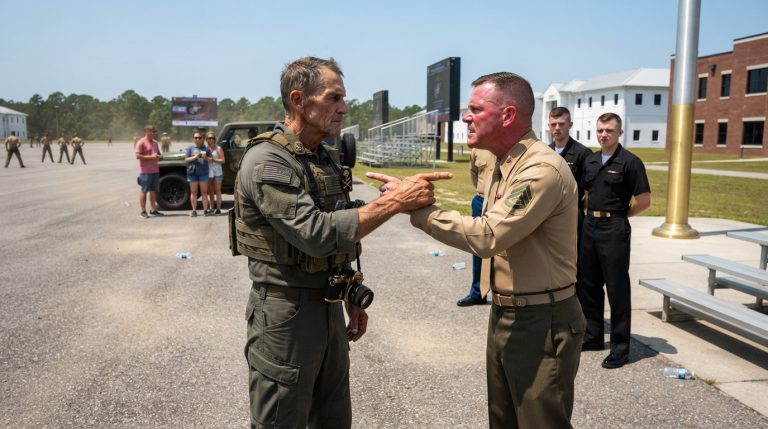
“Is that a museum piece, old man?” Harper’s voice cut through the air, sharp and transactional. He let out a laugh that was joined by a chorus of murmurs from the recruits behind him. “Did you lose your way from the Civil War reenactment?”
Elias didn’t turn. His gaze remained fixed on the distant, shimmering heat haze of the 1,000-yard berm. He held the rifle with a stillness that felt profound, almost unnatural in the chaotic buzz of the modern range. His hands, thick and weathered, were perfectly, agonizingly still.
“It’s a rifle, Private,” Elias said, his voice a low gravel, devoid of the irritation Harper was fishing for.
“It’s junk,” Harper countered, stepping closer, the smile on his face curling into a challenge that felt like a test of character he hadn’t yet realized he was failing. “Cracked wood. Scratched metal. How are you supposed to hit anything with that relic? You’d have better luck throwing it at the target.”
A ripple of laughter went through the line, a nervous, jagged sound that filled the space between them. Elias did not rise to the bait. Instead, he simply adjusted the sling, his fingers moving with a rhythmic, quiet precision that ignored the noise entirely. He was not looking for a fight; he was looking for the horizon, checking the wind as if he could feel it tugging at the fibers of his own skin.
Harper leaned in, his confidence swelling to fill the silence Elias had created. “You’re in the way of a real firing exercise. Don’t you have a nursing home to get back to?”
Elias slowly turned his head. His eyes were not angry—they were merely tired, ancient, and deeply observant. They passed over Harper as if the Private were nothing more than a shifting shadow on the wall.
“Every job,” Elias said, the words falling into the air with the weight of granite, “needs to be done right.”
He turned back to the table, his movements fluid and disciplined. He worked the bolt of the rifle—a clean, sharp click-clack that echoed with an authority no modern plastic-molded weapon could replicate. The sound died instantly, but the resonance hung in the air, leaving Harper blinking, his mocking laughter catching in his throat, suddenly unsure why he felt so small under the gaze of a man who hadn’t even looked at him.
CHAPTER 2: THE VOID OF SILENCE
The silence that followed the bolt-lock was not merely the absence of sound; it was an active, heavy entity. It sat between Elias and the younger Marines like a physical barrier, thicker than the dust of the range itself. Private Harper stood frozen, his mouth still slightly agape from his last failed attempt at a taunt. The laughter, so fluid and collective seconds ago, had evaporated, leaving behind a group of men who suddenly realized they were standing in the presence of something they couldn’t categorize.
Elias did not look at them. He didn’t need to. He focused his attention on the texture of the wooden stock under his palm. It was worn, smoothed by decades of contact—a history of sweat, rain, and cold that Harper’s brand-new, synthetic-handled weapon could never hope to possess. He began to wipe the receiver again, his movements methodical, deliberate.
Click.
The sound of the bolt pulling back echoed in the sudden quiet. For a fleeting second, the sharp, metallic snap wasn’t just metal on metal; it was the sudden, jarring vibration of a rifle bolt in a dark, rain-slicked trench. The phantom sound hit Elias with the force of a physical blow. He felt the cold mud of a hillside he hadn’t walked in years, the biting sting of rain that smelled of ozone and cordite, and the suffocating weight of men who relied on the steadiness of his hands to keep the dawn at bay.
He closed his eyes for a heartbeat. The psychological ghost—the memory of a comrade’s frantic, whispering breath—threatened to pull him back into the abyss. He fought the urge to tighten his grip until his knuckles turned white. Instead, he forced his breathing to slow, following the same cadence that had kept him alive when the world was falling apart. In through the nose, out through the mouth. The mud faded. The rain ceased. The cold trench dissolved back into the hot, dry air of the range.
“Is… is it broken?” one of the younger Marines whispered. The question was tentative, stripped of its earlier arrogance.
Elias finished wiping the metal. He didn’t look up. “It’s a tool, son,” he said, his voice quiet, carrying the faint rasp of someone who had spent too many years talking only to himself. “Tools don’t break if you know how to hold them.”
Harper shifted his weight. The boot-tap against the hard-packed earth, which moments ago sounded like a defiant challenge, now sounded erratic and small. He looked at his own weapon, then back at the antique, and a flicker of confusion crossed his face. He was searching for a reason to reclaim the narrative, looking for a way to dismiss the old man as a relic, but the silence Elias had constructed was too expansive. It forced Harper to look at himself—to realize that the “junk” he had insulted possessed a dignity that his own posture lacked.
Elias finally straightened up, his movements stiff but precise. He took the cloth, folded it into the same meticulous rectangle, and tucked it into his pocket. He didn’t feel triumph. He felt only the heavy, familiar ache of being an outlier in a world that prioritized the flash of the new over the endurance of the old. He had been “White Knight Walker” once, a name whispered in briefings by officers who assumed he had been swallowed by the same landscape he had defended. Now, he was just a man collecting brass, a man who survived, which was a different kind of burden entirely.
He picked up the metal container holding the spent shell casings. The weight was grounding. As he began to walk past the line of Marines, he didn’t adjust his path. He walked straight, his gaze fixed on the storage shed at the end of the range. He didn’t see them as enemies, nor as students. To him, they were just young men waiting for a reality they weren’t yet prepared for.
“You’re walking away?” Harper called out, his voice a notch lower, lacking the bravado that had colored his earlier words.
Elias stopped. He didn’t turn fully, just tilted his head so he could see Harper in his peripheral vision. The sunlight hit the dust motes dancing around them, turning the air into a shimmering, faded tapestry.
“The range is yours, Private,” Elias said. His voice was not a dismissal, but a statement of fact. “Make sure you respect the distance.”
He kept walking. The Marines watched him go, the collective energy of their group fractured. The camaraderie they had shared through their mocking laughter had dissolved, leaving them standing in the void that Elias had left behind. They weren’t looking at him anymore; they were looking at the space he had vacated, realizing—without words—that they had failed a test they didn’t even know they were taking.
Harper watched the old man’s back until the figure grew smaller, blending into the heat-drenched backdrop of the base. He looked down at his own hands, then at the rifle he carried. He felt the cold synthetic grip, and for the first time, he wondered if he had ever truly held a weapon, or if he had only ever been holding a toy. He turned back toward his fellow recruits, but the rhythm of the training day was broken. The discipline was no longer a matter of rote command; it had become something deeper, something that required a steady heart and a quiet mind.
Elias walked on, the weight of the brass in his hand a reminder of the thousands of rounds he had fired in his life, and the thousands of silences he had kept. He was not looking for resolution. He was simply moving forward, step by step, as he had always done, leaving the new generation to grapple with the echo of his presence.
CHAPTER 3: THE RECKLESS CHALLENGE
The silence persisted long after Elias had rounded the corner toward the storage shed. It was as if the range itself were holding its breath, waiting for the equilibrium to return. But the baseline had shifted. The usual rhythm—the sharp, erratic staccato of rapid-fire drills—was muted.
Private Harper remained standing at the firing line, his feet planted in the same dirt where Elias had stood moments ago. He looked down at the ground, tracing the indentations left by the old man’s boots. They were deep, deliberate prints. He felt a sudden, inexplicable urge to sweep them away, to restore the pristine, untouched surface of the training ground, as if erasing the physical evidence of Elias’s presence could somehow revert the morning to what it had been before.
“Harper?”
The voice belonged to a fellow recruit, thin and edged with hesitation. “Are we going to finish the cycle, or what?”
Harper didn’t answer immediately. He looked toward the 1,000-yard berm. The distance, which had always seemed like a standard metric to him—a technical challenge of windage, bullet drop, and elevation—now seemed to stretch outward into an infinite, daunting void. He looked back at his weapon. It felt lighter than it should, devoid of the density that the old wooden stock seemed to radiate.
“One thousand yards,” Harper muttered, the words barely audible over the gust of wind that suddenly swept across the range. The flag at the end of the line snapped violently, its nylon fabric cracking like a whip.
The wind was a variable he had practiced for, a simple calculation on a tablet or a mental shorthand. Now, as it buffeted the range, it felt less like a physical force and more like a warning. He watched the flag, waiting for the shift to stabilize, but the wind continued to dance, shifting from a left-hand quartering gust to a direct cross-breeze.
“The wind’s moving too fast,” Harper said, his voice stronger now, seizing on the technical excuse to avoid the psychological weight of the moment. “We can’t hit a reliable grouping in this.”
“We’ve shot in worse,” another Marine replied, stepping up to the line.
Harper shot him a look—a sharp, defensive glare. “I said we’re waiting.”
He walked away from the line, his stride not quite as confident as it had been that morning. He needed to be alone for a moment. He walked toward the periphery, where the base of the perimeter fence met the dry, scrubby earth. He needed to find a way to justify why the old man’s words had rattled him so profoundly. Respect is how you treat someone when you don’t know who they are. The phrase echoed in his mind, rhythmic and unrelenting.
He reached the fence and gripped the cold chain-link, the wire biting into his palms. He wasn’t thinking about the range. He was thinking about his own reflection—not the one in the mirror, but the one he had seen in the eyes of the man he had called an old relic. He had seen a mirror of his own insecurities, a reflection of a version of himself that lacked the very discipline he had been trying to project.
As he stood there, his eyes drifted toward the maintenance area. He could see Elias Walker in the distance, a small, hunched figure moving steadily between the storage shed and the cleaning station. The old man was working with a brush, his motions steady, repetitive, and utterly devoid of the frantic need for validation that Harper felt in his own chest.
Elias was cleaning a pile of casings, tossing them into a bin one by one. The rhythmic clink-clink-clink carried on the wind, a sound of absolute, unhurried purpose.
Harper watched for a long time. He saw a second man approach Elias—a technician with a clipboard. He saw them exchange a few words. He couldn’t hear what was said, but he saw the technician hand Elias a crate of equipment, and he saw Elias accept it with the same quiet, measured grace. There was no ego there, no defensive posturing, no attempt to prove his worth.
A wave of frustration and clarity washed over Harper. He had spent his entire career in the Corps trying to become someone worth noticing, someone who would be heralded for their scores, their speed, their precision. He had viewed the rifle as an extension of his own ambition. But watching Elias, he realized the weapon was never meant to be a tool for ambition. It was meant to be a weight, a commitment to something that existed outside of his own need for approval.
The wind surged again, and Harper let go of the fence. His hands were red from the pressure of the wire. He turned back toward the range. The other Marines were still standing there, waiting for him, looking to him for the signal to resume.
He didn’t return to the line immediately. He walked to the edge of the firing platform and looked down at his own gear. He picked up his own rifle, feeling its balance. It was sophisticated, engineered for efficiency, a marvel of modern manufacturing. But it felt hollow.
“We start again,” Harper said, his voice calm, stripped of the arrogance that had defined his earlier commands. “But not for the score. We start by checking the stance. If your base is wrong, the shot doesn’t matter.”
He walked past the recruits and took his place. He didn’t look at the berm. He looked at his own boots, making sure they were placed exactly as he had seen Elias place his. He focused on the ground, the solid, unmoving earth that supported him, and he took a deep, steady breath—in through the nose, out through the mouth—exactly as the old man had.
The silence returned, but this time, it was purposeful. It was the silence of a group of men who were beginning to understand that the real challenge wasn’t hitting the target at 1,000 yards. The real challenge was remaining standing when the wind shifted, without needing someone else to tell them they were doing a good job.
CHAPTER 4: THE SOUND OF TRUTH
The transition was not instantaneous, but cumulative. Over the next hour, the range had become a pressure cooker of focused, grueling labor. Harper had stopped them from firing altogether. He had them checking bolt-actions, cleaning receivers, and repeating the same, agonizingly slow trigger-pull drills until the muscle memory of the modern, rapid-fire doctrine was eroded away by the demand for something deliberate.
Elias, from his station near the shed, watched the spectacle. He didn’t intervene, but his eyes tracked every faltering movement. He was currently wiping down a bin of brass, his hands moving with that same relentless, grinding consistency. He stopped for a moment, his gaze drifting back to Harper, who was currently bent double, checking the alignment of a recruit’s scope.
Then, it happened. A sound broke the low hum of the range—a sharp, metallic ping followed by a jarring, discordant rattle.
Harper froze. He had been demonstrating a bolt-cycle on his own rifle, but instead of the clean, dampened click of a modern mechanism, his rifle had emitted a strange, hollow vibration that seemed to originate from the stock itself. He pulled the bolt back, then slammed it home again. Rattle.
The silence that had been cultivated over the last hour shattered. A few recruits stood up, their faces etched with confusion. Harper stared at his weapon, his expression shifting from frustration to a deeper, more profound alarm. He shook the rifle, and the internal rattle persisted. It sounded like loose metal—or worse, a fragment of something that shouldn’t be there.
He looked around, his eyes locking onto Elias, who was still standing by the shed, his cloth mid-wipe.
“Elias!” Harper’s voice cut through the air, less a shout and more an urgent, desperate plea. “Come here. Now.”
Elias didn’t rush. He placed the cloth into his bin, closed the container, and walked across the sand. His pace was the same—measured, unbothered, and terrifyingly calm. He reached the firing line, his boots crunching in the dirt.
“What is it?” Elias asked, his voice neutral.
Harper held out the rifle. “It’s rattling. The stock, the receiver—it’s vibrating.”
Elias took the rifle. He didn’t look at Harper; he looked at the weapon. He felt the cold, synthetic grip, the mass-produced weight that had always felt alien to him. He didn’t just hold it; he listened to it. He turned the rifle, tilting it at a slight angle. He worked the bolt once—not with the aggression Harper had used, but with a gentle, inquisitive touch.
Clack. The rattle was there, faint but distinct.
Elias’s brow furrowed. He didn’t need to strip the weapon to know what was wrong. He touched a specific point near the trigger guard, pressing his thumb into the synthetic material. It was loose. A structural failure, something that shouldn’t happen on a piece of gear this new.
“It’s not just broken,” Elias said, his voice low, “it’s failing because it wasn’t built to be held with intent.”
“What are you talking about?” Harper demanded, his brow sweating in the heat. “It’s a standard-issue loadout. It’s supposed to be perfect.”
“Nothing is perfect,” Elias replied. He looked up at Harper, and for the first time, there was a flash of something hard and unforgiving in his eyes. “You treat the weapon like an extension of your own ego. You pull the trigger because you want to see the target fall. You don’t pull it because you understand the weight of the shot.”
He handed the rifle back, but Harper didn’t take it. He just stared at the weapon in Elias’s hands.
“I don’t know how to fix it,” Harper whispered.
“You don’t need to fix the weapon,” Elias said. He looked toward the 1,000-yard berm, where the wind was now whipping up a small, frantic dust devil that spun across the range. “You need to fix the disconnect.”
As he spoke, the range’s PA system crackled to life. It was a distorted, static-filled sound that usually heralded the arrival of base command, but today, it seemed to carry a different weight. A high-ranking officer’s voice drifted over the intercom, calling for a review of all current training protocols. The reality of the situation—the failed gear, the faltering squad, the atmosphere of confusion—suddenly surged toward a breaking point.
The decoy mystery of the “broken gear” was crumbling. The recruits weren’t looking at the rifle anymore; they were looking at Harper, waiting to see if he would collapse under the pressure of his own failed standard, or if he would look to the old man for the truth that lay beneath. Elias stood there, the aged, worn-down rifle slung over his own shoulder like a silent anchor, his posture immovable as the wind began to howl, signaling the end of the relative calm that had allowed them to pretend that everything was still in order.
CHAPTER 5: THE RECOGNITION
The intercom died with a final, flat pop of electricity, but the silence that replaced it was far more dangerous than the static. Colonel Reynolds didn’t arrive with a flourish; he simply appeared at the edge of the firing platform, his posture a taut, vertical line against the shimmering heat haze. His gaze was not on the recruits, nor on the failed, rattling rifles strewn across the tables. It was locked entirely on Elias Walker.
Harper felt the blood drain from his face, leaving him feeling thin and hollow, as if he were made of the same compromised synthetic material as his weapon. He looked at the Colonel, then at Elias, who stood with his head slightly bowed, his hands resting naturally against the worn wood of his rifle—the rifle that Reynolds was now staring at with a look of dawning, painful disbelief.
“Walker?” The Colonel’s voice wasn’t a command. It was a question, stripped of its usual iron.
Elias didn’t look up immediately. He seemed to be measuring the distance between his past and the present, a space that suddenly felt much smaller than he had intended. He moved his feet—a slow, deliberate shift that placed him firmly in the center of the platform. “It’s been a long time, Colonel.”
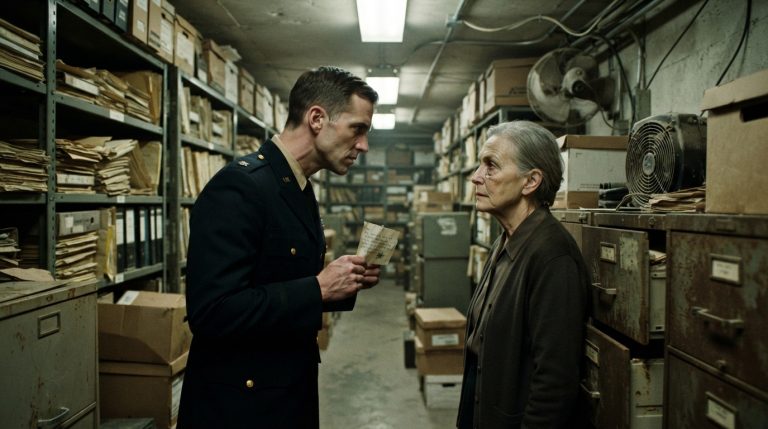
The recruits shifted, a nervous, kinetic wave passing through the line. The name—Walker—had hit them with the force of a physical impact. Harper realized then that the decoy mystery he had been wrestling with—the idea that this was just an old man with an antique—had been a fantasy, a comfort he had constructed to keep the world simple. The truth was far more uncomfortable. He was standing in the presence of a ghost, a man who, according to the archives of the Corps, had ceased to exist on a rain-drenched hillside years ago.
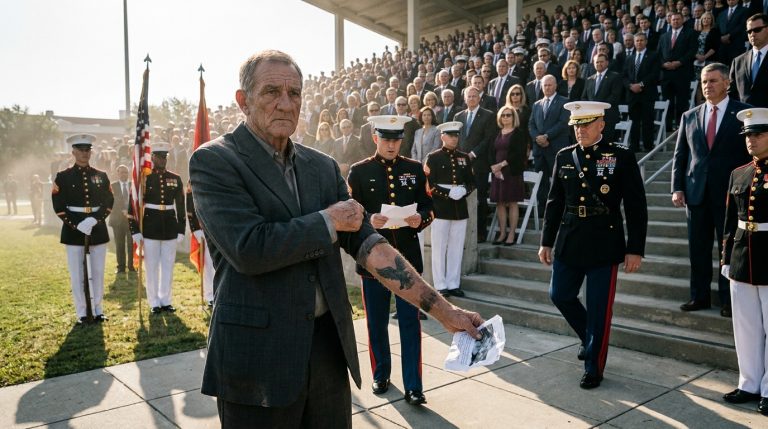
Colonel Reynolds took a step forward, the dry earth crunching beneath his boots. “We filed the report. We held the ceremony. You were listed as missing, presumed—” He stopped, his throat working. “We believed you were gone.”
“I was where I needed to be,” Elias said, his voice low, steady, and entirely devoid of the defensive edge he had shown Harper earlier. He looked up, and for the first time, Harper saw the true depth of the man’s eyes—not just tired, but haunted, reflecting a landscape that was nowhere near this sun-baked firing range.
The atmosphere in the range changed, the heat becoming stifling, pressing against the lungs. The recruits weren’t breathing. They were witnessing a collision of timelines. Harper felt a sudden, frantic need to bridge the gap, to understand why the man who had humbled him so thoroughly was also a figure of such profound, tragic history.
“Colonel,” Harper interjected, his voice trembling before he could steady it. “I… I didn’t know.”
Reynolds didn’t even glance at him. He remained focused on Elias, his face a mask of restrained emotion. “Three nights, Walker. You held the line for three nights. And the platoon… the platoon said you refused to fall back even when the ammunition ran dry.”
“I held the line because it was the only thing I had left to hold,” Elias replied. His hands tightened slightly on the rifle’s stock, the worn grain appearing almost luminous in the harsh, bleaching sunlight. “The rifle didn’t betray me. It was the only constant.”
Harper looked down at the brass casing he had been holding in his pocket—the one Elias had given him. He pulled it out, the metal warm from his palm, and felt the weight of it. It wasn’t just a piece of brass. It was a link to that hillside, to that rain, to the three nights of silence. He understood now why Elias had been so calm, so unbothered by the mockery. When you have survived the end of your own world, the petty insults of a drill range are nothing but the humming of flies.
“We thought you were lost,” Reynolds repeated, his voice barely a whisper now. “The board… we listed you as a casualty of the conflict.”
“I wasn’t lost,” Elias said, a faint, sad smile touching his lips. “I was just waiting for the noise to stop.”
The tension in the range had reached its apex, a taut wire pulled so tight it was vibrating. The recruits were beginning to recognize the gravity of the scene, the way the history of the Corps was suddenly, violently present. Harper felt his own arrogance evaporating, replaced by a cold, sharp clarity. He looked at Elias not as a rival, but as a standard—a standard he had been nowhere near meeting.
“You need to come with me,” Reynolds said, his hand extending slightly, as if to guide Elias away from the range. “There are protocols… there are accounts that need to be corrected.”
“The accounts are fine, Colonel,” Elias replied, gently pushing the offer aside with a subtle movement of his hand. “Let the dead remain in the reports. I’m just here to make sure they know how to hold the line.”
He turned to look at Harper, his expression unreadable, and for a fleeting, terrifying moment, Harper saw himself through the lens of a man who had seen everything worth seeing and everything worth losing.
“You asked me what respect was, Private,” Elias said, his voice soft but carrying across the hushed range. “Respect isn’t a score on a board. It’s knowing exactly what you’re standing for when the last shot is fired.”
He stepped off the platform, his gait steady, the worn-out rifle slung over his shoulder like a promise. He didn’t look back. The range remained frozen, the recruits caught in the wake of a revelation that had just rewritten their understanding of everything they had been taught about honor. The silence was complete, absolute, and for the first time that day, it felt heavy enough to carry.
CHAPTER 6: THE STANDARD RESET
The range did not explode into chaos. There was no shouting, no sudden shift in the weather. Instead, it was as if a heavy, rusted gear had finally clicked into place. Colonel Reynolds stood motionless, his gaze following the path Elias had taken until the old man vanished behind the silhouette of the maintenance buildings. When he finally turned, his expression was not one of authority, but of a man who had been handed back a piece of his own soul he hadn’t known was missing.
He looked at the recruits, his eyes lingering on Harper. The Private was still holding the brass casing—the token of a history he couldn’t possibly comprehend, yet now felt responsible for preserving.
“You were asking about the standard,” Reynolds said. His voice was not loud, but it carried across the platform with the clarity of a bell. “You wanted to know why this range was built the way it was. You wanted to know why we emphasize the slow, the deliberate, the quiet.”
He walked toward the center of the line, his footsteps rhythmic, controlled. “You saw it today. Not as a lecture, not as a manual, but as a life. The rifle you saw? It wasn’t a relic. It was a witness.”
Harper stepped forward, his posture reflecting a humility he hadn’t possessed an hour ago. “Sir, I… I understand now. About the silence.”
“The silence is the work,” Reynolds said. He looked at the recruits, his gaze firm. “The work isn’t the shot. The shot is just the conclusion. The work is the discipline of the wait. The work is standing your ground when everything you know is falling apart. That is what Walker taught us, and that is what you were mocking.”
Harper looked down at the shell casing in his hand. He felt the metal—warm, worn, and heavy with implication. He didn’t just hold it; he closed his fist around it, letting the edges press into his skin. It was a physical reminder that his arrogance had almost blinded him to the greatest lesson he would ever receive.
The denouement began not with words, but with action. The recruits didn’t look at their tablets or their scoreboards. Instead, they began to clear the range. But they did it differently. They worked with the same methodical, slow grace Elias had demonstrated. They didn’t rush. They didn’t leave a single stray casing behind. They treated the ground with care, as if it were hallowed, as if they were cleaning the floor of a cathedral.
As the sun began to dip behind the horizon, painting the sky in deep, bruised shades of orange and violet, the range fell into a profound, peaceful stillness. The atmosphere of competition had been completely replaced by an atmosphere of service.
Harper moved to the rack where his weapon lay—the synthetic-handled, modern rifle that had felt so hollow in his hands. He took his cleaning cloth and began to work, not with the frantic, ego-driven strokes he had used that morning, but with steady, linear motions. He wiped the barrel, the receiver, the stock—not to polish it for a score, but to maintain it because it was his duty. He repaired a small, loose screw near the rear sight that he had ignored for weeks, tightening it with a quiet, persistent pressure.
He was performing the symbolic closure, repairing the small, damaged parts of his own discipline.
Reynolds watched from the side for a long moment, then nodded once—a sharp, almost imperceptible gesture of approval—before turning to leave.
When the last of the recruits had finished their work and the range was left in a state of perfect, quiet order, Harper stayed behind. He stood at the firing line and looked out at the 1,000-yard berm. The distance was still there, vast and unforgiving, but he didn’t fear it anymore. He recognized it for what it was: a space to be earned, not conquered.
He reached into his pocket, took out the casing, and placed it on the wooden table where Elias had stood. He left it there, not as a souvenir, but as a marker—a silent, metallic testament to a standard that had been set, a reminder that the loudest moments in a soldier’s life are often the ones where he chooses to say nothing at all.
He turned away, walking toward the base barracks with the steady, measured pace of a man who had finally begun to understand what it meant to walk with weight. The range remained in the deepening twilight, a field of dirt and shadow, but it felt different now. It felt anchored. It was no longer just a place to test machines; it was a place where people learned how to be, how to hold, and how to stay when the fire began to burn.
Elias Walker, miles away in the quiet corners of the maintenance sector, was finishing his day. He locked his tools, checked his lights, and stepped into the cool, darkening air. He didn’t think about the range. He didn’t think about the Colonel or the recruits. He thought only of the simple, satisfying rhythm of a day well-measured. He walked toward his quarters, his back solid, his stride consistent, leaving behind a legacy that required no monuments, no ceremonies, and no names—only the quiet, enduring echo of a man who had done his job right.