Echoes of the Sangin Tunnels: A Veteran and His Dog Reconstruct a Shattered Life Together
CHAPTER 1: THE WEIGHT OF THE LEASH
The sound was what stayed with you—the metallic ringing of the muzzle against the guard. It wasn’t the sound of an animal acting out. It was the sound of a closing door.
Cole Reeves knelt in the center of the Camp Lejeune training field, his knees sinking into the grit. He could feel the eyes of the crowd on his back, a thousand gazes pressing down like invisible pressure. He didn’t care about them. He didn’t care about the Colonel watching from the high window, or the Staff Sergeant whose face had gone pale as bone. He only cared about the tremor in the Belgian Malinois standing five feet away.
Ajax was a knot of wire and lightning. His hackles were raised, a ridge of coarse hair standing against the sky. He wasn’t looking at Cole; he was looking through him, his eyes scanning for a threat that lived only in the synapses of his own brain.
Cole reached into the pocket of his jacket, his fingers brushing against the cold, tarnished surface of the ultrasonic whistle. It felt heavy—a piece of dead history he had carried across the country like a penance. He pulled his hand out slowly, keeping his movements fluid, devoid of the jagged intensity the other handlers used.
He didn’t make a sound. He just waited for the wind to shift.
Ajax’s head twitched. The dog’s ears rotated, independent of his body, searching for the frequency. Cole saw the moment the dog’s internal architecture shifted. The rage, which had been a solid, opaque wall, suddenly fractured.
Cole didn’t move toward the dog. He made himself small. He let his shoulders slump, dropping the posture of a handler and adopting the posture of a man who had seen the same ghosts. He brought the whistle to his lips. He blew—a sharp, thin note that felt like nothing to the air, but to Ajax, it was a thunderclap.
The dog’s muscles went slack. The lunging, the desperate, thrashing energy that had sent three men to the hospital, vanished, replaced by a sudden, terrifying stillness. Ajax didn’t just stop; he collapsed into a crouch. He looked at Cole, and for the first time in eight months, the dog’s gaze was not a mirror of aggression, but a question.
Cole felt his own heart stutter. He reached into his other pocket and pulled out the old, faded nylon collar—Titan’s collar. He held it out, palm open, exposing the frayed stitching and the faded name.
He didn’t use English. The words felt too brittle for this moment.
“Kabul. Sector seven,” Cole whispered, his voice a rasp of sandpaper. “Nomad clear.”
Ajax didn’t run. He walked. The dog’s steps were rhythmic, deliberate, moving with the gait of a patrol that had never truly ended. When he reached Cole, he didn’t snap. He simply pressed his forehead against Cole’s chest, his breathing ragged, matching Cole’s own.
Cole’s hand came up to the dog’s neck, fingers trembling as they touched the fur. Beneath the warmth of the animal, he felt something else—a small, hard lump tucked into a tactical pouch on Ajax’s original, government-issued harness, something that hadn’t been mentioned in the handover report. It was a metal disc, stamped with a number he recognized from the Sangin files, but it was engraved with a name that had been officially listed as ‘unknown’ in the after-action report.
The realization hit Cole with the force of a physical blow. The mystery wasn’t why the dog was acting out. It was why someone had been trying so hard to keep this specific dog quiet.
CHAPTER 2: THE ECHO IN THE FILES
The air in the command office smelled of high-grade floor wax and ozone, a stark, antiseptic contrast to the damp, musky grit of the training field. Cole stood near the doorway, his boots leaving faint, gray dust patterns on the polished linoleum. He kept his hand deep in his jacket pocket, his fingers curled tightly around the small, cold metal disc he had retrieved from Ajax’s harness.
Colonel Finch sat behind a desk that looked more like a mission control console. Her eyes were fixed on the screen, but her attention—sharp, observant—remained on him.
“You’re not supposed to have that,” she said, her voice dropping to a low, measured tone. She wasn’t looking at the disc, but she knew it was there.
Cole didn’t move. He felt the phantom weight of the past shift behind his ribs. The scent of the room—sterile, cold—suddenly warped. For a jagged second, the office walls dissolved, replaced by the suffocating, dark narrowness of the Sangin tunnels. He could smell it: the thick, acrid stench of burning rubber, the copper tang of cordite, and the wet, heavy rot of an earth that had swallowed too much history. His breath hitched, his chest tightening as if the tunnel ceiling were lowering, inch by agonizing inch.
“It was in his harness,” Cole said, his voice sounding hollow in his own ears. He focused on the faded texture of the Colonel’s desk blotter, forcing the vision of the tunnels to recede. “This dog has been carrying it for months. Maybe years.”
Finch sighed, a sound that carried the weary weight of someone who had spent a career managing secrets that were never meant to be kept. She gestured to the chair opposite her. “Sit, Cole. You look like you’re about to collapse, and I need you standing for the next hour.”
Cole moved to the chair. He sat with the calculated ease of a man who didn’t trust furniture to hold him. Ajax sat beside him, his gaze fixed on Finch with the same unblinking intensity he had shown on the field. The dog’s presence was a steady, rhythmic pressure against Cole’s thigh.
“That disc,” Finch began, leaning forward, “was part of a supplementary data dump from the 2011 recovery operation. The official reports stated the unit was wiped out. They didn’t mention the casualty numbers in Sector Seven because the numbers didn’t align with the political narrative we were pushing at the time.”
Cole watched her. The room felt smaller. Every shadow cast by the afternoon sun through the blinds seemed to slice across the floor like the jagged edges of a broken life. “You’re telling me this dog is a whistleblower?”
“I’m telling you he was a witness,” Finch replied. She tapped a key, and a map of the tunnel complex appeared on the screen, crisscrossing the terrain like a spider’s web. “He wasn’t just clearing IEDs, Cole. He was moving through tunnels that were being used as a makeshift data-storage site for regional intelligence. He saw things the handlers weren’t trained to interpret. And when the collapse happened, he kept moving.”
Cole’s hand tightened in his pocket. He thought of Titan. He thought of the way his partner had alerted—the low, guttural whine in his throat, the way he had braced himself, a living shield against an invisible death. Cole had felt the dog’s hesitation, felt the vibration of warning, and he had pushed forward anyway because the radio had told him the path was clear.
The silence in the office grew heavy, pressurized. The phantom smell of the tunnels—the cordite and the rot—lingered in the back of his throat. He realized then that the reason he couldn’t leave, the reason he had lived under that bridge for four years, was that he had never actually left the tunnel. He had stayed behind to guard the truth he had tried to silence.
“Why give him to me?” Cole asked, his voice barely a whisper. “If he’s holding onto that much heat, you could have just erased the data. You could have euthanized him months ago.”
Finch looked at him, her expression unreadable. “Because, Cole, I didn’t want the data. I wanted the handler. I wanted to see if someone who had truly walked through that fire could finally look at it without burning down the rest of the forest.”
She stood up and walked to the window, looking out toward the barracks where the other veterans were training their own dogs. “You aren’t just here to train dogs. You’re here to decompress the system. Start with him. Unlock what he’s holding, and I’ll give you the authority to take this program as far as it needs to go.”
Cole stood. The disc in his pocket felt like lead. He looked at Ajax, who was watching him with a calm, expectant gaze. The dog wasn’t waiting for a command; he was waiting for the truth to be spoken out loud.
“I need access to the original logistics logs,” Cole said, his voice hardening. “Not the sanitized versions. The raw feed from the 2011 Sangin incident. If I’m going to finish this, I need to know exactly what Titan was trying to tell me.”
Finch nodded slowly. “They’re in the secure archive. I’ll have them sent to your quarters by 1800. But be warned, Cole—some memories aren’t meant to be reclaimed. They’re meant to be buried.”
Cole didn’t answer. He turned and walked out of the office, the dog falling into step perfectly beside him. He walked out into the cool, fading light of the late afternoon, but his mind remained trapped in the dark. He had the key, but as he felt the metal disc in his pocket, he knew that the door he was about to open might very well be the one that ended him.
CHAPTER 3: THE WEIGHT OF A GHOST
The transition from the Command Office to the assigned barracks felt like a descent into a different atmospheric pressure. Outside, the base was winding down; the harsh, clinical light of the training field was being replaced by the orange, hazy glow of floodlights. Cole walked slowly, his gait echoing against the concrete paths, while Ajax matched his pace with a terrifying, rhythmic precision.
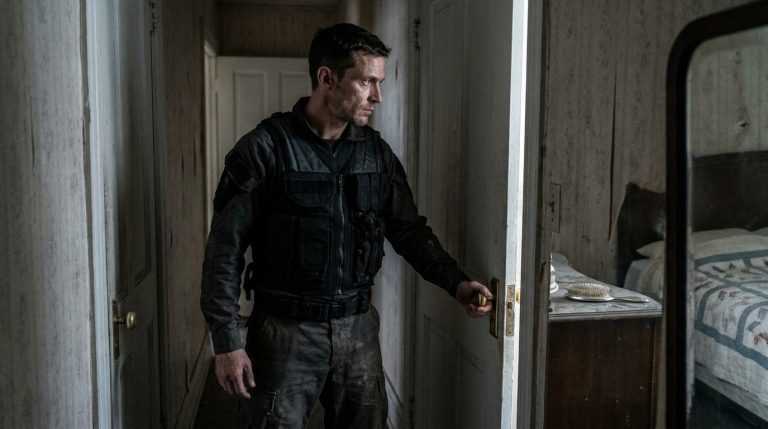
Inside the barracks, the air was stagnant, smelling of old pine floor cleaner and the metallic tang of unwashed gear. It was a space designed for transition, for soldiers moving from one point of exhaustion to another, but for Cole, it felt like a tomb. He crossed to the narrow cot, his muscles screaming from the long, unaccustomed walk, and slumped onto the edge of the mattress. It creaked under his weight, a sharp, jarring sound in the heavy silence.
Ajax paced the small perimeter of the room, his claws clicking against the linoleum. He wasn’t settling. He moved with a restless, prowling energy, his nose twitching as if he were cataloging every scent, every memory of human habitation embedded in the walls.
Cole reached into his pocket and pulled out the metal disc again. Under the dim, flickering fluorescent light, the surface looked even more battered than before. He ran his thumb over the stamped number: 7-A-1-4. It was an alphanumeric string that meant nothing to anyone else, but to him, it was a sequence of coordinates—the exact point in the Sangin tunnels where the ground had begun to groan.
There was a soft, tentative knock at the heavy steel door.
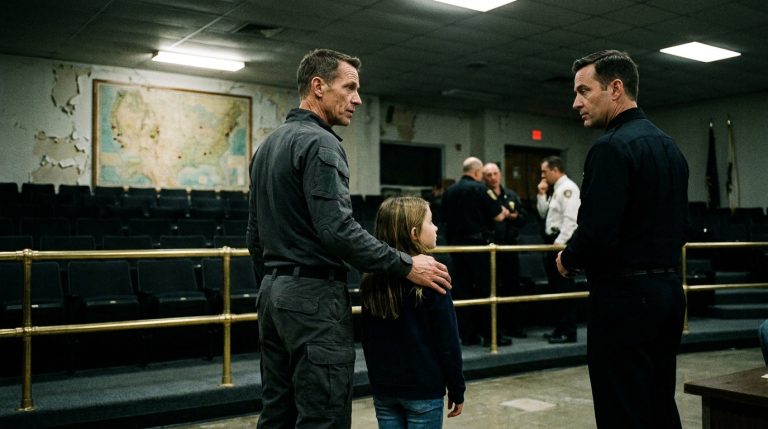
Cole didn’t call out. He didn’t have the energy for the social choreography of a ‘come in.’ He just waited. The door creaked open, revealing a young lieutenant—Finch’s aide from the afternoon. He stood in the threshold, clutching a heavy, dust-caked cardboard box. His face was pale, his eyes darting toward Ajax, then quickly away, as if looking at the dog were a violation of some unspoken protocol.
“The Colonel’s orders,” the lieutenant said, his voice clipped. He set the box down on the floor with a dull thud. “These are the raw logs from the 2011 recovery. She said you’d know what to look for.”
Cole looked at the box, then up at the aide. The young man wasn’t just nervous; he was afraid. His fingers were locked white around the strap of his duty belt, and his pulse was visible in the hollow of his throat. He looked like a man who knew exactly what was inside that box and was terrified of the possibility that Cole might actually find it.
“You’ve seen these?” Cole asked, his voice low.
The lieutenant hesitated, the fraction of a second lasting long enough to feel like an interrogation. “I was told to transport them, not to read them. That’s all.”
He turned to leave, his boots making a hasty, uneven rhythm against the concrete. He didn’t look back.
Cole stared at the closed door. The ‘V-1’ variance of the moment—the aide’s obvious fear—sank into his gut. Finch was playing a high-stakes game of transparency, but her staff was still operating on the old rules of obfuscation. He turned his attention to the box. The tape was dry, brittle, snapping like bone under his fingernails as he peeled it back.
Inside were stacks of handwritten reports, printouts from satellite thermal imaging, and a series of black-and-white photos of the tunnel complex. Cole pulled the first file out, the paper yellowed and smelling of damp storage. It wasn’t the logistical data he had expected. It was a casualty manifest.
His eyes scanned the columns. Name. Rank. Unit. The names were familiar—men he had served with, men who had died in the dust of Sector Seven. And there, near the bottom, was a notation in a different, frantic handwriting: Dog Handler Team: Nomad/Titan. Alert status: High. Command Override: Immediate Advance.
The words were a physical strike. He hadn’t just been ordered to advance; the command had been a direct, documented override of his partner’s signal. He had been a tool in someone else’s political calculation, a piece of hardware that had been forced to trigger the trap.
Ajax stopped pacing. The dog walked over and nudged the paper with his cold, wet nose. Cole looked down at him. For the first time, he realized that the dog’s ‘aggression’ wasn’t a glitch in his programming. It was a symptom of a mind that had been forced to watch the people it loved be destroyed by the very authority it was trained to obey.
Cole stood up, the box of papers suddenly feeling like a bomb he had to defuse. He needed to find the specific thermal data for the moment of the tunnel collapse. If he could prove that Titan had signaled the threat before the override, he could finally name the ghost that had been haunting his life for four years. But as he reached for the next file, he heard the faint, rhythmic sound of a radio crackling in the hallway—not a normal duty radio, but the hushed, urgent tones of someone reporting his progress to an unknown source.
He wasn’t alone in the barracks. The walls were thin, and the shadows underneath the door were shifting, someone standing guard in the corridor, keeping watch on the man who was finally reading the secrets of the dead.
CHAPTER 4: THE SHADOW IN THE CONDUIT
The silence in the barracks was shattered by the sharp, electric pop of a circuit breaker dying somewhere in the bowels of the building. The fluorescent lights flickered, hummed with a dying, yellow intensity, and then plunged the room into absolute, suffocating darkness.
Cole didn’t move. His body had been trained to exist in the absence of light. He remained frozen at the edge of the cot, his hand hovering over the box of files. The metallic scent of ozone spiked in the air—the smell of a deliberate override. The security team hadn’t just lost power; they had cut it to force him out of the room.
Ajax was a shadow within a shadow, his breathing low and controlled. He was still, but Cole could feel the tension radiating off the dog’s flank—the way his weight shifted, his ears tracking the sound of heavy, booted feet approaching the door. The cadence was too heavy for the young lieutenant. This was a tactical squad, moving with a synchronized, rhythmic thud that vibrated through the concrete floor.
“Cole,” a voice drifted through the heavy steel door. It was Pullman, his tone strained, devoid of the earlier curiosity. “Step away from the gear. The Colonel is retracting the access order. There’s been a security breach.”
Cole didn’t respond. He reached into the dark, his fingers finding the edge of the box. He slid it beneath the cot, then stood, moving with the fluid, silent grace of a man who knew the geometry of the room by memory. He grabbed the ultrasonic whistle from his jacket, but he didn’t blow it. He waited.
“Reeves, this is your last warning,” Pullman continued. “If you don’t open the door, we are authorized to conduct a sweep. We don’t want to hurt the dog.”
The threat hung in the air, cold and definitive. Cole felt the familiar, bitter pull of the Sangin tunnels—the same sensation of being boxed in, the same pressure of a ‘superior’ force demanding he ignore his own instincts. But this time, he had a partner who knew the language of the walls better than any tactical squad.
Cole leaned down and whispered into Ajax’s ear, his voice barely a breath. “Nomad, tunnel-low.”
The dog understood. He moved like smoke, disappearing into the deepest shadow under the desk. Cole followed, pressing himself into the corner where the wall met the floor, his back to the door. He was no longer just a man in a barracks; he was a soldier in a defensive formation.
The lock on the steel door shrieked as a heavy breaching tool bit into it. A beam of white, blinding tactical light pierced the room, sweeping across the floor like a searchlight. It illuminated the dust motes dancing in the air, the discarded papers, the empty chair—but it didn’t catch the two figures huddled in the absolute dark of the corner.
The squad flooded in, three men in tactical vests, their weapons raised but held low in a ‘low-ready’ position. They were disciplined, professional, and entirely focused on the center of the room.
“Target not in visual,” the lead man reported. His voice was muffled behind a mask.
They split, moving in a diamond formation. Cole watched them from the corner, his pulse steady, his mind dissecting their movements. They were treating this like a hostage scenario, not a veteran welfare check. They were here to retrieve the records, and they were willing to tear the building down to find them.
One of the men passed inches from the desk, his boots scraping the floor. Cole saw the man’s shadow stretch long and thin, distorted by the tactical light. The man paused, his head turning, sniffing the air—or perhaps just sensing the presence of something that shouldn’t be there.
Cole moved.
He didn’t attack; he utilized the environment. He shoved the heavy metal desk frame, sending it skidding across the concrete with a deafening, jarring screech. The men spun, their lights converging on the noise. In that momentary lapse of tactical cohesion—the ‘butterfly detour’ of their own momentum—Cole blew the whistle.
It was a silent, high-frequency command that only a dog trained in the Sangin tunnels could interpret.
Ajax exploded from beneath the desk, not with a bark or a growl, but with the silent, terrifying focus of a predator. He didn’t hit the men; he hit the power junction box on the far wall, his teeth snapping through the secondary cable that had been powering their tactical gear.
The room plunged into a shower of sparks. The tactical lights flickered and died. A confused shout erupted from the squad as they lost their primary illumination. In the chaos, Cole scrambled for the window, grabbing the box from beneath the cot with his free hand.
He kicked the window frame, the glass shattering outward, and slipped into the cool, dark night, Ajax right on his heels. They didn’t run; they moved, melting into the shadows of the base, headed not for the perimeter, but toward the one place no one would think to look: the memorial garden, where the names of the dead were etched into cold, silent stone. He needed to be among the ones who couldn’t lie, the ones who had paid the price for the very data now tucked under his arm. The war wasn’t over. It had just moved into the light.
CHAPTER 5: THE WEIGHT OF THE RECORD
The memorial garden was a labyrinth of cold, dark granite, a place where the air seemed to hang heavier, laden with the names of the men who had been sacrificed to the fog of war. Cole moved through the columns, his boots barely making a sound on the manicured gravel. Every rustle of his jacket sounded like a gunshot in the oppressive quiet. Behind him, Ajax kept his head low, his tail tucked, his hackles barely raised—he didn’t recognize this place as a combat zone, but he felt the sorrow that clung to the stone like lichen.
Cole found a small, sheltered alcove between two statues, a space shielded from the sweeping floodlights of the perimeter. He set the cardboard box down and knelt, his hands trembling. He needed to verify the data before the security teams scoured the base for him. If he was going to expose the command override, he had to be precise.
He flipped through the thermal imaging printouts, his eyes scanning the pixelated heat signatures. He looked for the moment before the collapse—the cluster of white dots that indicated the tunnel’s structural failure. And there it was: a secondary heat signature, a faint, pulsing glow that shouldn’t have been there. It wasn’t an IED. It was a localized, high-output electronic beacon—a signal jammer, placed to force a communication blackout.
The realization washed over him, colder than the wind. The override hadn’t been a mistake. It had been a tactical necessity to protect the presence of the jammer. Titan hadn’t just alerted to a bomb; he had alerted to the jamming equipment that was masking the instability of the tunnel.
“They used us to clear the path for the signal,” Cole whispered. The words were a bitter, jagged shard in his chest.
Ajax let out a low, mournful huff, his head resting on Cole’s knee. The dog looked up at him with those deep, dark eyes, and for a moment, the barrier between man and beast collapsed completely. Cole saw the past, not as a series of errors, but as a deliberate structure of betrayal.
Suddenly, the silence was broken. Not by the tactical squad, but by a soft, rhythmic crunching of gravel. Cole went rigid, pulling the whistle from his pocket. He turned, his body coiling, and saw a figure standing at the mouth of the alcove. It was Colonel Finch. She was alone, her silhouette stark against the glow of the distant floodlights. She wasn’t carrying a weapon. She was holding a heavy, black ledger.
“I expected you here, Cole,” she said, her voice devoid of its earlier command-tone. It was softer, filled with a strange, weary resonance. “You always were drawn to the stone. You always had to know exactly what the cost was.”
Cole stood slowly, the box of papers forgotten at his feet. “You knew,” he said. “The jammer in Sector Seven. You knew the override was a death sentence.”
Finch didn’t flinch. She stepped into the alcove, the light catching the silver in her hair. “I was a junior officer then, Cole. I saw the logs. I saw the way the command structure folded to cover the breach. I spent four years watching that data, waiting for someone to come back and look at it the way you are right now.”
“So you were watching me,” Cole said, the anger rising, a hot, suffocating tide. “You didn’t give me a second chance out of pity. You gave it to me because I was the only piece of evidence you couldn’t control.”
“I gave you the truth,” Finch said, stepping closer. She held out the black ledger. “This is the complete record. Every override, every signature, every life sacrificed to keep that tunnel off the official books. It’s not just about what happened to you and Titan. It’s about why it’s still happening. The same signal jammers, the same tactical overrides—they’re being deployed right now, in operational zones, using dogs and handlers to clear paths for equipment they aren’t authorized to use.”
Cole looked at the ledger, then at Finch. His mind was a maelstrom of fatigue and fury. He was exhausted, the weight of the last four years pushing him toward the ground, but he felt a strange, cold clarity settling into his bones.
“I don’t want your records, Colonel,” Cole said, his voice steadying. “I want the people who signed the orders.”
“Then you have to survive the night,” Finch replied, glancing toward the sound of approaching vehicles. “They’re coming for the box, Cole. They’re coming to make sure that the ‘Nomad’ doesn’t wake up the rest of the pack.”
She turned and began to walk away, her figure retreating into the shadows of the columns. “If you make it to the main gate, the press is waiting. Lawson’s been tracking your signal since the office log-in. But be careful. The people who signed those orders are already in the building.”
Cole looked at the ledger, then down at Ajax. The dog stood, his ears forward, his body ready. The final, fatal truth was right there in his hands, a record of every lie that had kept him broken in the dark. He wasn’t just clearing the path for himself anymore; he was clearing it for every dog and every veteran who had been used as a silent, disposable witness to a war that never truly ended. He picked up the box, took a deep breath of the cold, metallic air, and stepped out into the night, toward the gate, and toward the end.
CHAPTER 6: THE SILENCE OF THE SHADOWS
The main gate was not the threshold he had expected. It was a chaotic theater of sharp, white light and the constant, mechanical whirring of camera shutters. As Cole crossed the threshold, the box of records tucked firmly under his arm, he saw her—Amy Lawson—standing amidst a swarm of reporters, her camera raised like a shield. She looked at him, not with the predatory curiosity of a journalist, but with a quiet, devastating recognition.
He didn’t stop. He walked directly toward her, Ajax moving in perfect synchronicity at his side. The security details stationed at the gate, alerted by the internal radio chatter, hesitated. They saw the Colonel’s silent signal—Finch standing near the guardhouse, her arms crossed, watching the scene play out with a look of grim satisfaction. They stepped aside.
“Cole,” Amy said, her voice cutting through the noise. “The whole world is watching.”
Cole didn’t speak. He reached into his pocket, pulled out the black ledger Finch had given him, and handed it to her. The weight of it left his hand, and for the first time in four years, his palm felt empty—a clean, hollow space that didn’t ache.
“Tell them,” he said, his voice raw but audible over the crowd. “Tell them it wasn’t a tactical error. It was a choice.”
He turned his gaze toward the shadows of the barracks, toward the men who had signed the orders. They were there, standing in the distance, their silhouettes rigid and cold, but the power they held—the power to keep the truth buried under the dust of Sector Seven—was gone. He had moved the shadow into the light.
The revelation was not a shout; it was a slow, methodical unfolding. Within an hour, the digital copies of the logs were circulating. The “Sangin Incident” was no longer a ghost story—it was a public record. The fallout was immediate. The commanding officers who had orchestrated the override were detained by military police, their authority stripped away as the evidence of their negligence became impossible to ignore.
But for Cole, the climax wasn’t in the courtroom or the press releases. It was in the sudden, jarring quiet that followed.
Late that evening, Cole stood in the training arena. The dirt was still marked with the uneven, duct-taped prints of his arrival. He knelt down, just as he had on his first day. Ajax sat in front of him, watching him with calm, intelligent eyes. Cole took the old, faded nylon collar—Titan’s collar—out of his pocket. He sat there for a long time, the silence of the base enveloping him.
He didn’t just remember Titan; he honored him. He realized that the guilt he had carried was a selfish act—a way of keeping his partner trapped in the dark with him. By exposing the truth, he had finally allowed Titan to be a hero, not just a fatality of command.
He took his pocketknife and carefully repaired the fraying stitch on the old collar, his fingers steady, the motion mechanical and restorative. It was a small act, a quiet repair of something broken. When he was done, he looped the collar around his own wrist, a reminder that the past was not a weight to be dragged, but a scar that served as a testament to survival.
Ajax nudged his hand. Cole smiled—a slow, genuine movement that reached his eyes for the first time in a decade. The dog leaned his weight against him, and they sat together in the center of the arena, two soldiers finally home. The air around them wasn’t cold or metallic; it felt like the soft, settling quiet of a storm that had passed.
Cole didn’t feel like a hero. He felt like a man who had woken up from a long, feverish dream. He looked toward the barracks, toward the cohort of veterans who were just beginning their own journey of reconstruction. He knew the work was only just starting, but for the first time, he didn’t fear the transition. He had learned the language of the silence, and he knew how to lead.
The night air was warm, smelling of cut grass and the distant, cooling earth. He stood up, Ajax rising with him, and walked away from the arena, his boots firm and sure on the ground. The past was behind them, a map they had finally memorized, and the road ahead was quiet, steady, and entirely their own.