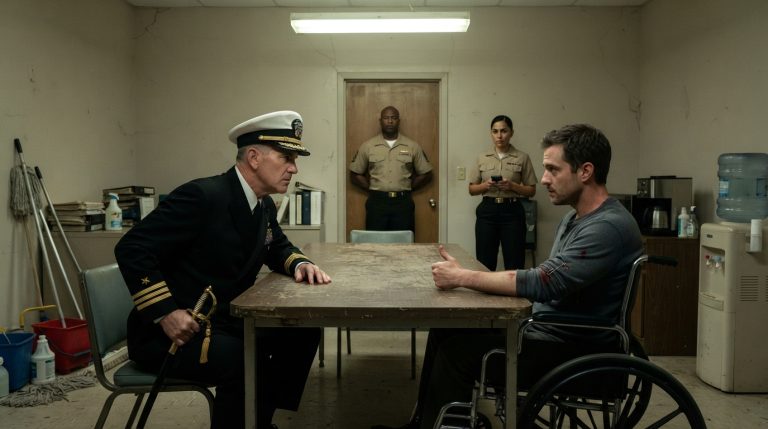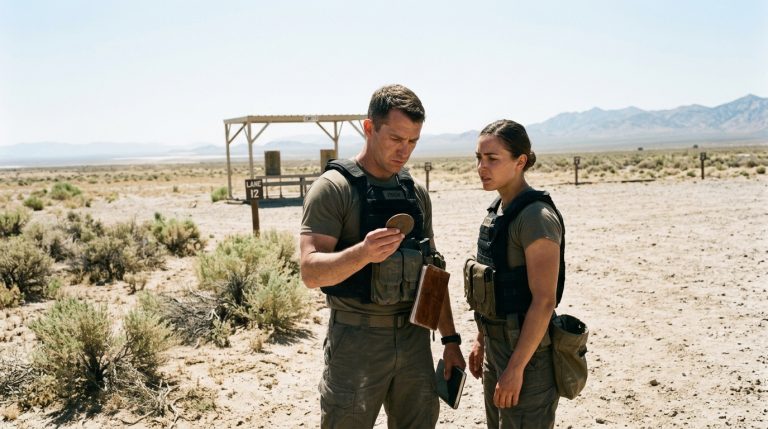
The Silent Keeper: A Legacy of Courage Carved in the Quiet Moments Between the Frontlines
CHAPTER 1: THE GATEKEEPER’S BLUNDER
The dust of the Coronado parade ground tasted like dry iron and disappointment. Daniel Harrison adjusted his grip on the folded flag, his fingers finding the familiar, frayed edge of the fabric—a tactile map of a life long since put to rest. He was here for one reason: to see the boy. That was the only variable that mattered in the equation of his day.
“Sir, stop right there. Active personnel only.”
The voice was thin, sharpened by the arrogance of someone who had never bled for a position of authority. Daniel looked up, his gaze steady, devoid of the defensive fire the young officer clearly expected. The officer stood with his chin tucked, his uniform so crisp it seemed to repel the very sunlight that had weathered Daniel’s skin into a mosaic of survival.
“I’m just here to watch my grandson,” Daniel said, his voice a low gravel, unbothered by the sharp edge in the boy’s tone.
“Rules are rules, Grandpa. And this area is for those who earned the right to stand here.” A few trainees behind the officer snickered. It was a practiced sound—dismissive, brittle, and entirely hollow.
Daniel didn’t look at the trainees. He looked at the officer’s boots, caked in the pristine, manufactured dust of a training exercise. He felt a sudden, sharp pang of pity for them. They were hunting for glory in a place where only duty existed. He moved back, his movements slow, deliberate, the quiet rhythm of a man who knew exactly how much energy to spend on a losing argument.
He found a seat in the back row, a solitary island of worn wool in a sea of starched camouflage. He set the flag on his lap, smoothing it with palms that carried the faint, white webbing of old scars.
The loudspeaker crackled to life, a booming, artificial sound that sent a shiver through the air. Daniel’s breath hitched. For a fleeting second, the heat of the California sun didn’t reach him; he was back in the burning haze of a highway in 2006, the air thick with the copper tang of cordite and the desperate, rhythmic screams of men who believed they were dying. He felt the phantom weight of a tourniquet in his hands, the frantic, wet slip of a bandage against his skin.
He blinked, pulling the present back into focus. The ceremony was a blur of movement, of young men standing tall, of parents weeping in the heat. And then, he saw him—Tyler. His grandson, standing in the second row, his face a mask of focus, the trident he had just earned gleaming with a cold, sharp light.
Daniel’s chest tightened, a familiar pressure that felt like grief and triumph colliding. He reached to wipe his brow, and his sleeve slid back. The tattoo—the FMF07 code, the faded wings—caught a shard of reflected light from the podium.
On the stage, the speech mid-sentence died. Commander Rodriguez didn’t just stop talking; he froze, his body going rigid as if he’d been struck. His eyes weren’t on the crowd anymore. They were locked on that patch of weathered skin in the back row.
Daniel’s pulse quickened. The air shifted. A single, heavy question hung in the silence between them, unasked but deafening: How did you survive?
CHAPTER 2: THE RECOGNITION
The silence was not empty; it was pressurized. It settled over the concrete of the Coronado parade ground like a thick, humid fog that refused to disperse. Daniel Harrison stood his ground, his boots heavy, his hands resting on his knees. He didn’t look for an exit. He didn’t look for a place to hide. He simply breathed—long, shallow inhalations that tasted of dry dust and the faint, lingering scent of ozone, an olfactory echo of the explosion that had defined his life nearly two decades ago.
Commander Rodriguez did not blink. He stood six feet away, a bridge between two worlds. The young, starched officers in the rows behind the commander shifted their weight, their confusion manifesting as restless, rhythmic tapping of heels against concrete. They were waiting for a command, a directive, some signal that would explain why a decorated leader was staring at a frayed-sleeve old man with the intensity of a man finding a long-lost compass.
Daniel’s mind flickered. The bright, sterile sunlight of the present moment began to fray at the edges, revealing the dark, jagged landscape of Ramadi 2006. He saw the highway—a ribbon of heat-cracked asphalt—and the way the light had bounced off the hood of the lead vehicle just before the world inverted. He felt the phantom vibration of the blast against his ribs, a sensation that made his lungs ache for air that wasn’t choked with pulverized stone. In his memory, he was kneeling in the dirt, his hands slick with a warmth that wasn’t his own, trying to hold a man’s life inside his chest.
The ghost of that sensation prickled at his palms now. He looked down at his own fingers. They were steady, a testament to years of forced composure, but the tremor was lurking beneath the surface, waiting for the right frequency to vibrate.
Rodriguez took a half-step forward. The movement was slow, deliberate, as if he were treading on glass. “The insignia,” the commander whispered, the words barely clearing his throat. His voice lacked the booming authority of the podium; it was raw, stripped of the polish of a high-ranking officer. “I haven’t seen that since the smoke cleared in the valley.”
Daniel didn’t answer with words. He knew the cost of naming the past. Instead, he simply shifted his sleeve an inch higher, revealing the FMF07 code—the ink faded to a dull, bruised blue. It was the only artifact he had left from the unit that no longer officially existed, the ghost-unit that lived in the quiet corners of history books.
The commander’s eyes widened, then darkened with a flicker of something far deeper than professional recognition. It was a shared grief, a recognition of the nights spent awake staring at ceilings, replaying the exact moment the radio static had cut off. The surrounding world—the graduation, the proud parents, the young SEALs with their pristine tridents—began to slide into the background. For a few, suspended seconds, there were only two men standing on a highway in the middle of a war zone.
“Doc,” Rodriguez said. It wasn’t a rank. It was a plea.
A ripple of unease passed through the trainees nearby. The young officer who had mocked Daniel earlier took a hesitant, clumsy step toward them, his face a palette of shifting expressions—from annoyance to bewilderment to the dawning terror of realizing he had stepped into a history he was too young to understand. He opened his mouth, perhaps to demand order, perhaps to ask a question, but the look Rodriguez shot him—a jagged, cold glare—froze the words in his throat.
Daniel felt the hum of the crowd begin to return. The distant murmur of the loudspeakers, the restless shifting of the parents, the wind picking up a discarded program and tumbling it across the steps—it all rushed back, drowning out the silence. He stood up slowly. His joints protested, a soft clicking in his knees that grounded him firmly in the present. He adjusted the folded flag in his hand, his thumb tracing the blue edging of the material.
“I’m just here for the graduation, Commander,” Daniel said, his voice quiet but carrying with the resonant authority of someone who had commanded life and death in a kill zone. “There’s no need to stop the ceremony.”
Rodriguez didn’t retreat. He looked at the flag, then back to Daniel’s eyes, searching for the man who had pulled him from the fire. The tension was no longer just between them; it was leaking into the air, infecting the entire assembly. The atmosphere shifted from one of joyous celebration to something far more somber, something that felt like a funeral being held in the middle of a parade.
“A man who saves his brothers,” Rodriguez replied, his voice gaining a hard, ringing edge, “doesn’t get to sit in the back row when the debt is still outstanding.”
Daniel looked past the commander, toward the formation of new seals. He saw Tyler. His grandson was staring at him, his face pale, his eyes wide with a mixture of shock and a dawning, terrible awe. The boy wasn’t looking at him as a grandfather anymore. He was looking at him as a legend.
Daniel felt a heavy, sinking sensation in his chest. He had spent years, decades, building a wall of silence between his life and the ones he loved, specifically to protect them from this precise moment. He wanted his grandson to be a man, not a shadow. He wanted the trident on Tyler’s chest to be earned in the light of his own deeds, not in the long, dark shadow of a ghost.
But the truth had a way of bleeding through, no matter how tightly one folded the flag. The silence he had cultivated, the very armor of his existence, was starting to crack. And as the wind whipped around them, carrying the scent of salt and the mechanical grind of a helicopter circling in the distance, Daniel knew that the quiet, ordinary life he had spent years crafting was about to be reclaimed by the war he thought he’d left behind.
He looked at Rodriguez, his gaze unflinching. He knew what was coming next—the recognition, the citations, the unwanted glare of the spotlight—and he felt a cold, familiar dread. He had been a guardian of secrets for too long to let them be spilled now, but looking into the eyes of the man he had once saved, he realized he might have run out of time.
CHAPTER 3: THE DESCENT
The air felt thinner now, stripped of the casual hum of a typical graduation. Commander Rodriguez remained rooted to the spot, his posture radiating a rigid, desperate need for closure that seemed to bleed into the surrounding environment. He didn’t just stand there; he anchored the space, forcing the rest of the world—the rows of new SEALs, the whispering families, the jittery young trainees—to recalibrate around his singular, fixed attention on Daniel.
Daniel felt the gaze of hundreds of people pressing against him like a physical weight. He kept his hands folded over the flag, his knuckles white. He could feel the pulse in his own throat, a steady, rhythmic thrumming that threatened to betray the calm facade he’d constructed over decades. He looked at Rodriguez—really looked at him—and saw the map of the man’s life written in the fine, pale lines around his eyes and the small, jagged scar tracing the line of his temple. This was no longer just the young soldier he had dragged through the sand; this was a man who had carried the memory of that day as his own moral compass.
“I didn’t come here for a tribute, Nathan,” Daniel said, his voice dropping low, pitched so that only the commander could hear the gravelly vibration beneath the words. “I came for my grandson. Let the ceremony finish. Let them have their moment.”
Rodriguez’s jaw tightened. A muscle pulsed at his temple. “They aren’t having a moment, Doc. They’re watching a history lesson.” He gestured toward the formation of new seals, then back at Daniel. “You think you can just sit here, hidden in the back, and let them think the standard for this unit is just about the training? It’s about what’s in the marrow. It’s about the silence you held.”
Before Daniel could respond, a ripple of movement cut through the crowd. A group of parents in the row ahead turned fully around, their curiosity overriding their decorum. Behind them, the young officer who had mocked Daniel earlier stood stiffly, his face drained of color, his eyes darting between the commander and the old man. The audacity of his previous remarks seemed to have evaporated, replaced by a nervous, twitchy energy.
The wind shifted, catching the corner of Daniel’s frayed sleeve and pulling it taut against his wrist. For a split second, the tattoo—the faded ink of a service that predated half the people on the field—was laid bare. It wasn’t just ink; it was a confession.
“You’re making this into something it isn’t,” Daniel said, his voice retaining its quiet, tectonic stability. He stood up fully, his height surprisingly imposing despite his thin frame. “I did what I was told to do. I did what was necessary. The medal, the citation—that’s just paper. It doesn’t fill the holes in the ground where the others are sleeping.”
The words hit Rodriguez like a physical blow. He staggered back an inch, his hand dropping from the air to his side. The atmosphere on the field warped. The distant, steady beat of the marching band, which had been preparing to resume, seemed to stutter, then stop entirely. The silence became absolute, a vacuum that pulled every eye, every ear, every unspoken question toward the old man in the frayed jacket.
“You’re wrong,” Rodriguez whispered, though the intensity of his tone carried across the field. “It was never just paper. It was the only reason I’m standing here.”
He turned away, not toward the stage, but toward the rows of new SEALs. His movement was abrupt, a forced pivot that caused the gathered crowd to shuffle back as if the ground itself had tilted. He walked toward the microphone at the base of the podium, his steps heavy, deliberate, echoing across the concrete like rifle fire. Daniel remained where he was, feeling the cold, creeping dread that his carefully managed anonymity was finally, irrevocably dead.
Tyler, standing in the second row, was staring at him. Their eyes locked for a fleeting second—a collision of two generations. The boy’s face was unreadable, a blend of shock, pride, and the kind of existential vertigo that comes when one realizes their foundation was built on a story they were never told. Daniel felt a lump form in his throat, a sharp, bitter thing he couldn’t swallow. He hadn’t wanted this. He had wanted the boy to forge his own steel in the forge of the world, not to be handed a relic he hadn’t yet learned to carry.
As Rodriguez gripped the podium, the microphone screeched a high-pitched feedback loop, a sound that sliced through the stillness like a jagged blade. The Commander didn’t adjust it. He leaned in, his eyes still fixed on the back row, on the man who had pulled him back from the threshold of nothingness.
“Ladies and gentlemen,” Rodriguez began, his voice echoing, stripped of all artifice, “we are going to pause. Because today, we aren’t just celebrating a new class of warriors. We are acknowledging the cost of the ground they stand on.”
Daniel looked down at his shoes, at the dust he had walked through to be here, and realized there was no path back. The silence had been broken, and now, the weight of everything he had kept locked away—the faces of the fallen, the desperate prayers in the heat of a burning highway, the long, lonely years of forgetting—was about to be laid out in the light for everyone to see. He stood, his back straight, preparing for the exposure, feeling the frayed flag in his hand turn from a memento into a burden he could no longer carry alone.
CHAPTER 4: THE PUBLIC WEIGHT
The silence that followed the feedback loop was not merely quiet; it was a physical weight, pressing against the chest of everyone on the parade ground. Daniel didn’t move. He kept his eyes locked on the rough, uneven concrete near his worn shoes, refusing to offer the crowd a view of his face. He felt the ripple of the Commander’s words moving through the formation of graduates like a sudden chill.
“Ladies and gentlemen,” Rodriguez’s voice continued, stripped of its usual professional cadence. It was raw, urgent, and lacked the performative polish that usually governed such ceremonies. “We are going to pause. Because today, we aren’t just celebrating a new class of warriors. We are acknowledging the cost of the ground they stand on.”
A sudden, sharp movement to Daniel’s left caught his attention. It was a man, older than the trainees, dressed in a crisp suit that stood out against the tactical camouflage of the base. He moved with a subtle, predatory grace, his eyes darting across the formation before settling, with jarring precision, on Daniel. There was a flicker of recognition in the man’s eyes—not of the man himself, but of the history he represented. This was someone who didn’t just understand the ceremony; he understood the classified, blood-soaked ledger behind it.
“He’s reading the citation,” the man whispered to an aide standing nearby, though the sound carried clearly in the unnatural stillness. The aide’s face went pale. They didn’t look like they were watching a graduation; they looked like they were witnessing an audit.
Daniel felt the first tremor of the “public weight” begin to manifest. It wasn’t the sound of the citation being read that bothered him—he had lived that afternoon in his own head a thousand times. It was the way the Commander described the four hours of carnage in the Ramadi valley. Each detail Rodriguez plucked from the archives was like a shard of glass being pulled from a wound that had never truly closed.
“He crawled,” Rodriguez said, his voice cracking as he recounted the tactical reality of the 2006 ambush. “Under heavy fire, with shrapnel in his own shoulder, he dragged eight of us to the extraction point. He didn’t ask for cover. He didn’t wait for instructions. He just acted.”
The audience—parents, siblings, and the newly pinned SEALs—were leaning forward, a collective, involuntary motion. The light seemed to change, the harsh midday sun softening into a hazy, dream-like quality. Daniel felt the phantom weight of his medical bag against his back, the strap biting into his skin, the smell of burnt rubber and wet sand returning with a ferocity that made him squeeze his eyes shut.
He felt a sudden, small hand press against his arm. It was Tyler. The boy had broken formation. He stood beside his grandfather, his uniform pristine, his eyes brimming with a chaotic mix of awe and burgeoning horror.
“Grandpa,” Tyler murmured, the word barely audible. “You never said it was like this. You never said…”
“It’s not for the telling, Tyler,” Daniel said, his voice a low, steady rumble that only his grandson could hear. He didn’t look at him. He couldn’t. To look at Tyler was to see the reflection of his own past, a mirror he had spent eighteen years trying to shatter. “It’s for the doing. You don’t take a badge and make it a shout. You take it and make it a promise.”
The man in the suit began to approach. He moved through the crowd with an easy, practiced authority, but he stopped short of the row where Daniel sat, as if recognizing that the air around the old veteran was somehow radioactive, charged with a reality that didn’t fit into the polite, choreographed narrative of the ceremony.
Rodriguez reached the conclusion of the citation. The final words hung in the air: For extraordinary heroism and disregard for his own life in the face of enemy fire.
The silence held for ten long, agonizing seconds. Then, the first person stood. It was an older man, a retired veteran in the third row, his hand rising to his chest. Then another. Then the entire formation of new SEALs, the movement liquid and simultaneous. The sound of hundreds of people rising at once was like the rustle of a giant, ancient forest.
Daniel remained seated. He wasn’t resisting; he was simply anchored to the earth by the weight of the names he had been whispering in the dark for nearly two decades. The faces of the eight men he had pulled from the fire—and the two he hadn’t—flashed through his mind. He wasn’t hearing the applause, if there was any. He wasn’t hearing the cheering. He was hearing the radio static, the guttural, choking sound of a life slipping away, and the desperate, rhythmic pulse of a heart he was trying to keep beating.
The Commander looked down from the podium, his expression a mixture of profound relief and a lingering, haunting sorrow. He had fulfilled his duty, but he had also broken the seal on a life that was never meant to be opened. Daniel looked up, his eyes meeting Rodriguez’s. For a moment, they were just two ghosts in a room full of the living, connected by a thread of memory that was thicker than blood.
The man in the suit finally made his move, stepping into the row and offering a stiff, professional nod toward Daniel. “A pleasure, Corpsman,” he said, the words smooth and empty. “The Bureau has kept a file on your actions for a very long time. It’s an honor to finally see the man behind the entry.”
Daniel didn’t respond. He simply looked at the man, his eyes steady and cold, and felt the first true prickle of alarm. This wasn’t about honor. The presence of someone from the Bureau suggested that the “truth” being told today was only a fragment, a carefully curated version of history that served a purpose far larger than a simple graduation. As the applause finally erupted—a tidal wave of sound that threatened to wash away the quiet, dignified life he had built—Daniel realized that the most dangerous part of his past wasn’t what he had done in the fire; it was the secret he had brought out of it.
CHAPTER 5: THE PRIVATE CONVERSATION
Daniel didn’t look at the man from the Bureau again. He kept his focus on Tyler, who was still standing at his side, looking as though the earth had tilted beneath his feet. The crowd was beginning to disperse, but the atmosphere remained thick, the jubilant noise of the graduation replaced by a cautious, inquisitive silence.
“Tyler,” Daniel said, his voice dropping into that low, gravelly register that left no room for debate. “Go finish your duties. Dismiss yourself from the formation properly. Don’t let this change the way you stand.”
Tyler hesitated, his gaze flickering from his grandfather to the suited man, then back to the tridents pinned to his own chest. He looked lost, caught in the friction between the man he had known his entire life—the quiet gardener—and the legend currently standing in the center of the parade ground. “Grandpa, I… I need to know. Why didn’t you ever say anything?”
“There’s a time for telling, and a time for living,” Daniel replied, reaching out to straighten the collar of his grandson’s uniform. His fingers were steady, but the rough, callus-worn pads of his thumbs felt the crisp, synthetic fabric of the military issue, a texture that stood in sharp contrast to the lived-in reality of his own jacket. “Right now, you’re living. Go.”
Tyler gave a jerky, confused nod and turned to rejoin the unit. As he walked away, his gait seemed heavier, burdened by the realization that he was walking into a story that was already written, a path carved in blood before he was even born.
Daniel turned to leave, his boots clicking against the concrete, but a hand—cool, firm, and entirely professional—settled on his elbow. It was the man from the Bureau.
“We have some concerns, Mr. Harrison,” the man said, his voice dropping to a conversational murmur that somehow managed to vibrate with the threat of a locked door. “The citation read today… it’s a public document, of course. But the internal logs from the 2006 Ramadi incident have been… inconsistent. There are names missing from the official record. Names that, according to the files, shouldn’t exist.”
Daniel stopped. He didn’t turn around immediately. He looked at the vast, open horizon of the Coronado base, where the sky was beginning to bruise with the first purple streaks of the coming evening. “Names don’t disappear, son. People do.”
“Exactly,” the man said, sliding a small, nondescript card into Daniel’s coat pocket. “And we’d like to understand how you managed to ‘save’ eight men when the tactical summary suggests the entire unit was wiped out in the initial blast. You see, the math doesn’t quite work. We’re interested in the phantom variables.”
Daniel finally turned. The man was younger than he appeared at first glance, his face unlined by the sun, his eyes devoid of the weight that marked everyone who had actually walked through the fire. He was an auditor, a man who believed that everything in the world could be explained by a ledger, provided you looked at the numbers long enough.
“You’re looking for an equation,” Daniel said, his eyes narrowing. The metallic taste of iron bloomed in his mouth—the smell of the desert, the feeling of his own blood mixing with the dust. “But a battlefield isn’t a classroom. You don’t add and subtract lives like items on a shelf. Some of them… some of them chose to stay behind. They weren’t in the reports because they were never meant to be found.”
The man’s expression didn’t flicker. “That’s a dangerous narrative, Corpsman. Especially for a man who is supposed to be the model of integrity.”
“I am the model of integrity,” Daniel said, his voice rising, carrying the sharp, cutting edge of a command. The nearby trainees who had been lingering at the edge of the field froze. “Because I never told you their names. I took that silence to my grave eighteen years ago, and I have no intention of digging it up for the sake of your filing cabinets.”
He walked away, his pace steady, his resolve hardening like cooling metal. He could feel the Bureau agent’s eyes boring into his back, a persistent, uncomfortable pressure that felt like the crosshairs of a rifle. He reached the gate, where his old truck was parked. The paint was peeling, the hood rusted in streaks of dark, oxidizing orange—a testament to years of neglect and quiet endurance.
As he reached for the door handle, he looked back at the field. The sunset was casting long, distorted shadows across the parade ground. He saw the empty podium, the discarded programs tumbling in the breeze, and for a fleeting, terrifying moment, he didn’t see the base at all. He saw the desert floor, endless and shifting, and the faces of the men he had failed to bring home. He realized then that the man in the suit wasn’t the only one looking for the “missing variables.” The past was no longer content to stay buried in his own mind. It was rising to meet him, and he was, for the first time in eighteen years, entirely unprepared to hold the line.
CHAPTER 6: THE DEPARTURE
Daniel’s hand gripped the rusted handle, the metal flaking away under his pressure like dried skin. He pulled, and the door groaned—a slow, tortured sound that echoed in the vast, empty parking lot. He didn’t look back at the agent. He didn’t need to. He could feel the man’s eyes on him, a steady, calculated appraisal that felt like being measured for a suit he had no intention of wearing.
He climbed into the cab, the seat springs popping beneath him, the scent of old leather and stale coffee filling his senses. It was a familiar space, a sanctuary of sorts where the ghosts didn’t usually follow. But today, the air in the cab was thick with something else—the scent of the desert, the ozone of an explosion, and the metallic tang of blood. He rested his forehead against the steering wheel, his eyes closed. The silence of the base, usually a source of comfort, was now a vacuum that pulled every suppressed memory to the surface.
He heard the crunch of gravel. The agent was walking closer, his steps rhythmic and precise.
“Mr. Harrison,” the man’s voice came through the open window, sounding unnervingly clear in the evening air. “You seem to be under the impression that this is an optional conversation. The Department of Defense has records that don’t match your story. If you drive away now, we will simply be forced to pursue this through more… formal channels.”
Daniel started the engine. The old engine sputtered, coughed, and finally roared to life, a rough, guttural sound that rattled the dashboard. He didn’t look at the agent. He put the truck into gear, his movements mechanical, his mind miles away in the heat of a burning highway. He pulled out of the parking space, the tires kicking up a spray of loose rocks. He didn’t speed. He drove with a deliberate, haunting slowness, watching the agent shrink in the rearview mirror until he was nothing more than a dark, rigid silhouette against the fading sunset.
As he drove off the base, the landscape began to blur—not just into the familiar scenery of the California coast, but into the shifting, golden-brown landscape of the Ramadi valley. He saw the highway markers, but his mind painted them as charred remains of vehicles. He saw the streetlights, but they flickered like the dying flares of a mortar round. He wasn’t navigating a road; he was navigating a ghost story.
He stopped at a red light, his hands trembling on the wheel. He looked down at the silver ring on his finger—the seal of his old team. He traced the engraving, the metal feeling unnaturally cold. The weight of the names he had been carrying—the men he had left behind because he couldn’t reach them, the men he had pulled out and who now had lives they would never have lived otherwise—suddenly felt like a crushing burden. He had always believed that his silence was his service, that by keeping the truth buried, he was shielding the world from the brutal, ugly realities of what it cost to “bring them home.” But now, the Bureau wanted to open that grave.
A sharp gust of wind rattled the truck, and for a heart-stopping moment, he heard it—the faint, distant sound of a helicopter rotor, its rhythmic wop-wop-wop echoing in the air. He flinched, his heart hammering against his ribs. The world tilted. He wasn’t in his truck; he was kneeling in the sand, the desert heat pressing down on him, the radio static screaming in his ears, and the desperate, pleading cries of his teammates echoing through the smoke.
“Doc, I can’t… I can’t see anything,” a voice whispered in his memory—a voice he hadn’t spoken to in eighteen years.
He gasped, his eyes flying open. He was still at the light. A car horn blared behind him. The light was green. He blinked, the desert heat receding, leaving him shivering in the cool, evening air. He pulled his truck forward, his breath coming in ragged, uneven gasps. He needed to get home. He needed to see Tyler. He needed to confirm that the boy was safe, that the legacy he had tried so hard to build—a legacy of quiet dignity, of humble service—wasn’t just an illusion he had spun to hide his own guilt.
As he turned onto the highway, he glanced at the passenger seat. There, tucked against the dash, was the folded flag. It seemed to pulse with a life of its own, a silent, colorful testament to everything he had lost. He knew then that the Bureau wouldn’t stop. They didn’t want the truth; they wanted a narrative, a controlled history that fit their internal, sterile logic. And if he kept silent, he wouldn’t just be protecting his own secrets—he would be betraying the men who had given their lives for a truth that was far too large to be contained in a classified file. He had to prepare. He had to ensure that when the time came, the truth wouldn’t be told by the Bureau—it would be told by the ones who had lived it.
CHAPTER 7: THE ECHOES OF RAMADI
The interior of the truck was a tomb of silence. Daniel drove with a mechanical rigidity, his eyes tracking the white lines of the highway as they flickered past like a countdown. The air inside the cab felt increasingly heavy, saturated with the phantom smells of burnt cordite and the dry, acrid dust of a desert that existed only in his mind. He wasn’t driving home to his quiet garden; he was driving deeper into a confrontation with a past he had believed was safely behind a vault door of his own making.
The radio was off, but the static in his ears was constant—a high-pitched whine that rose and fell with his own heartbeat. He kept his right hand hovering near the gear shift, his fingers drumming a nervous, irregular rhythm. Every time a headlight caught the rearview mirror, he felt a jolt of primal adrenaline, a reflex born in the kill zones where the only difference between existence and oblivion was the fraction of a second you took to look back.
He pulled into his driveway, the gravel crunching under his tires with a sound that seemed abnormally loud in the quiet suburban street. His house sat in the dark, a modest, single-story structure with a small porch and a garden that had been his pride for years. But as he killed the engine, the house looked wrong. The shadows were too long, too jagged. They didn’t fall like the shadows of trees or eaves; they draped over the siding like the camouflage netting of a forward operating base.
He sat for a moment, his hands gripping the wheel until his knuckles ached. He was home, but the “home” he had cultivated—the safe, sterile, un-remembered life—felt like a facade that was beginning to peel. He had spent eighteen years pruning back the memories, cutting away the dead weight of the things he couldn’t fix, but today’s ceremony had acted like a summer rain on a long-dormant field. Everything was growing back all at once.
He stepped out of the truck, his legs stiff. The air outside was cool, smelling of damp earth and distant lawn sprinklers, but he couldn’t shake the sensation of heat—the relentless, oppressive heat of the Middle East. He walked to the front door, his key trembling in his hand. As he unlocked it, he glanced over his shoulder. The street was empty, a row of silent, sleeping houses, but he felt watched. It wasn’t just the Bureau; it was the weight of the men who had died in that valley, men whose names he had never dared to say aloud, men whose stories were now being commodified by suits who wouldn’t know a tourniquet from a necktie.
Once inside, he didn’t turn on the lights. He moved through the darkness with a practiced, light-footed ease, his body remembering the geometry of his own home as if it were a tactical grid. He went to the kitchen and sat at the small, laminate table. His hands reached for a box on the top shelf, a box he hadn’t opened since he’d first moved into this place.
Inside was a thin, leather-bound notebook. It was frayed, the pages stained by oil and what looked like old, dried water marks. He opened it. The handwriting was his own, though it looked like the script of a stranger—cramped, desperate, and frantic. It wasn’t a diary. It was a list. Eight names, neatly crossed out. And then, at the very bottom, in a hand that shook so violently the ink had bled into the paper, were four names that were not crossed out.
Those were the names that didn’t appear in the official records. Those were the men he had been forced to leave because the medevac couldn’t take everyone, because the fire was too heavy, because the math of war had demanded a sacrifice he still couldn’t compute.
He heard a soft click—the sound of the back door latching. It wasn’t his doing.
He didn’t jump. He didn’t scream. He simply went still, his body sinking into the posture of a man who had long expected the shadows to finally come calling. He knew it was the Bureau, or perhaps someone even more interested in the “missing variables.” He sat in the dark, the notebook open before him, his heart rate steadying into the lethal, calm rhythm of a combat medic who has realized there is no one left to save but himself.
He didn’t grab a weapon. He didn’t look for a way out. He simply looked at the list of the four men—the real, hidden history of that highway—and felt a strange, chilling peace. For eighteen years, he had lived as a coward, hiding from the truth to keep his own life intact. But as the floorboards in the hallway creaked under an intruder’s weight, he realized that if he was going to die, he would die telling the truth about who he had actually pulled out of that fire, and who he had been forced to leave behind. He closed the book and waited for the light to hit the room, ready to break his silence, even if it cost him everything.
CHAPTER 8: THE HORIZON LINE
The light in the kitchen flared, a harsh, electric intrusion that forced Daniel to squint. Standing in the doorway was the agent from the Bureau, his suit jacket open, revealing the dull, heavy outline of a service pistol holstered at his side. He didn’t look like an auditor anymore. The polite veneer had vanished, replaced by the tired, sharp-eyed exhaustion of a man who had spent his entire career cleaning up the messes left by people like Daniel.
“Mr. Harrison,” the agent said, his voice devoid of any pretense of friendliness. “We’re done with the games. The four names in that book. They weren’t just soldiers left behind. They were the key witnesses to the command oversight that caused that entire convoy to burn. You didn’t leave them because you couldn’t reach them. You left them because they were ready to testify.”
The revelation hung in the air like a poisoned gas. Daniel felt his heart skip—not in fear, but in the sharp, crystalline clarity of a long-hidden truth finally being dragged into the light. He looked at the notebook, the ink of those four names mocking him from the page. He hadn’t just been a medic; he had been a carrier of a secret that could collapse the entire command structure of his unit. He had kept his mouth shut, choosing to live as a ghost to protect the honor of the uniform, while the very people who had sacrificed those men were building careers on the “official” version of the events.
“You think you’re protecting honor?” the agent continued, moving slowly into the room, his hand hovering near his hip. “You’ve been protecting the people who abandoned your team. We don’t want to jail you, Daniel. We want the evidence you’ve been hoarding. Give us the log, and you can go back to your garden.”
Daniel looked at the notebook, then at the agent. He felt a sudden, profound sense of fatigue—the weight of eighteen years of holding his tongue, of pruning back the truth so it wouldn’t hurt the people he loved. He thought of Tyler. He thought of his grandson, heading out into a world that would inevitably test him in the same way, and he realized that the greatest disservice he had done the boy wasn’t keeping the secret; it was letting him believe that the system was worth the silence.
“You want the evidence?” Daniel asked, his voice steady, carrying the weight of a final, irrevocable decision.
He stood up, his movements slow and fluid. He didn’t go for the notebook. He went to the stove, where a small, decorative metal tin sat on the counter. He reached inside, his fingers closing around a heavy, tarnished silver lighter—the same one he had carried through the desert, the one that had clicked into life a thousand times in the dark.
“The evidence wasn’t the log,” Daniel said. He flipped the lighter open. The flame jumped to life, casting long, wavering shadows across the walls. He touched the flame to the corner of the notebook. The paper, dry and brittle with age, caught instantly. “The evidence was the men. And you’re too late to save them.”
The agent lunged forward, his hand snapping to his weapon, but he stopped short as the notebook flared into a brilliant, consuming ball of fire. Daniel held it over the sink, watching the names—the official ones, the hidden ones, the story that had haunted his life—curl into black, drifting ash.
“You’re a fool,” the agent hissed, his face twisted in frustration. “You think you’re erasing the past? You’re just erasing your only leverage.”
“I’m erasing the temptation,” Daniel replied, watching the last of the paper vanish into char. He turned, his gaze meeting the agent’s with a clarity that seemed to stun the younger man. “The truth isn’t on a page. It’s in the men I saved. And my grandson knows exactly who he is, and whose shoulders he stands on. That’s enough.”
The agent hovered for a long moment, the threat of force lingering in the room, but he eventually pulled his hand away from his weapon. He knew, with the cold, pragmatic certainty of a professional, that there was nothing left to salvage. The leverage was gone. Daniel Harrison was no longer a ghost; he was a man who had finally put his past to rest.
“You’ll never be at peace,” the agent said, turning toward the door. “You’ve burned your only bridge to the truth.”
“I didn’t burn it,” Daniel said, his voice quiet as the flame on the lighter died. “I just stopped needing it.”
The house settled into a deep, heavy silence. Daniel went to the back door and pushed it open, stepping out into the garden. The air was cool, smelling of night-blooming jasmine and damp earth. He looked up at the stars—bright, distant, and indifferent—and for the first time in eighteen years, he didn’t see the desert. He didn’t hear the rotors. He didn’t feel the phantom weight of the medevac bag. He simply felt the cool night air on his face.
He walked to the corner of the yard, where a small, neglected rose bush was fighting to push through the weeds. He knelt down, his aged knees cracking, and began to pull the tangles away, his hands moving with the steady, practiced grace of a man who had finally decided to live in the present. In the distance, the first light of dawn was beginning to bleed over the horizon, painting the world in shades of soft, hopeful gold. The secret was gone, the past was ash, and for the first time, the future belonged only to the living.