The Line in the Dirt: A Veteran’s Cold Campaign of Suburbia, Sabotage, and Retribution
CHAPTER 1: THE FOAM ON THE BARK
The white foam didn’t belong in the grass.
It oozed from the base of the Gravenstein apple tree, thick as shaving cream, bubbling lazily against the damp turf. The sharp, sweet stench of industrial solvent hit my nose before I even reached the trunk.
Fifteen feet inside my property line. Not fourteen. Not fourteen and a half. Exactly fifteen feet from the iron survey stake buried at the property corner.
“Those aren’t your trees, Sergeant.”
Karen stood on the manicured slope of the common area, arms crossed over her pink tracksuit. Her sneakers didn’t cross the boundary. Her eyes did.
“They’re community property,” she said, her voice dripping with artificial regret. “And frankly, they’re an eyesore.”
I didn’t answer. I rolled my brass Zippo lighter across the knuckles of my left hand. Click-clack. Click-clack. The heavy metal thump against my fingers kept my pulse at a steady sixty beats per minute.
“I asked you a question, Karen,” I said. My voice barely carried across the grass.
“I didn’t hear a question.” She scoffed, taking a tiny step forward, her chest puffing up. “I did what the board empowered me to do. They overhang the buffer zone. They draw vermin. They breach aesthetic harmony.”
“What was in the sprayer?”
Her face tightened. The mask of suburban concern slipped just enough to show the jagged teeth underneath. “That is confidential HOA business. I am the president of this subdivision. I don’t answer to you.”
“The buffer zone ends ten feet past my stake,” I said, pointing the brass edge of the lighter toward the grass. “You crossed the line.”
“I serviced a nuisance.” She turned her back on me, her rubber soles squeaking against her pristine driveway. “Have a nice day, Mr. Davidson. Don’t forget your lawn needs edging.”
I watched her front door slam.
I knelt by the Gravenstein. The bark was warm. The foam had already eaten through the outer layer, turning the dark wood beneath into mush. Green leaves, vibrant forty-eight hours ago, were curling at the tips, veins turning yellow under the morning sun.
Seven trees. Seven heritage cultivars I had planted after coming back from Helmand.
I pulled my phone from my pocket and dialed.
“Jack?” Sarah’s voice was tight. “Did you find out why the leaves are dropping?”
“Call Arthur Henderson,” I said, staring at the white foam. “Tell him I need a chemical assay and a certified appraisal. Today.”
“Jack… what did she do?”
“She stepped over the line,” I said, closing the lighter with a sharp clack. “Start a new folder on the desktop. Label it ‘Karen’.”
I didn’t go back inside. I walked the fence line with a tape measure and a camera, taking eighty pictures before the sun hit the roofline. Every angle. Every drop of chemical residue. Every property marker.
This wasn’t a feud over lawn care. It was an insertion into controlled territory.
And she had no idea who was waiting in the tree line.
CHAPTER 2: THE MONETARY SPECIES
The floorboards under my boots vibrated three seconds before I heard the engine.
Arthur Henderson’s 1998 Ford F-250 turned into the driveway, its rusted muffler coughing a blue cloud into the humid morning air. I slid the freshly printed plat survey into a manila folder, picked up my camera, and walked out to meet him.
The old man didn’t get out right away. He sat behind the wheel, engine idling, staring through the bug-spotted windshield at the seven apple trees. His jaw worked on a wad of tobacco. When he finally opened the door, the hinges shrieked like a dry saw blade.
“Son,” Arthur said, his voice sounding like two bricks grinding together. “What in the hell am I looking at?”
“Chemical attack,” I said, stepping past the truck’s rear tailgate. A rusted toolbox sat in the bed alongside a faded yellow binder stamped with Docket 409 across the spine, half-buried under grease-stained rags. “Sometime between two and four this morning.”
Arthur didn’t ask questions. He reached into his truck bed, hauled out a heavy steel case, and walked toward the line. He didn’t touch the white foam. He pulled a brass probe from his kit and pushed it eight inches into the soil at the base of the Gravenstein.
When he pulled it up, the tip came out coated in gray sludge. He brought it to his nose, took a tiny sip of the air, and immediately spat into the grass.
“That ain’t Roundup, Jack,” Arthur growled, his face darkening. “That’s industrial-grade sterilant. Triazine base, highly concentrated. Probably a custom blend—something like Chemical Vector Bravo or a pipeline clearing agent. Nothing you buy at a box store. You need a commercial license just to sign the manifest.”
“It’s restricted?”
“It’s nuclear,” Arthur said flatly. He pulled out a glass vial, scraped a sample of the foam, and sealed it with a black rubber stopper. “This stuff doesn’t just kill the root. It sterilizes the dirt. You won’t grow a dandelion here for six years unless you excavate the top five feet of earth.”
I rolled the brass Zippo across my knuckles. Click-clack. “Can you prove it in court?”
“I’ve been doing court appraisals for thirty years,” Arthur said. He pulled a folding wooden rule from his back pocket and measured the trunk diameter at breast height. “I don’t guess. I calculate.”
For the next two hours, Arthur worked like a crime scene tech. He took core borings from the bark. He snapped fifty macro photos of the curling leaf veins. He measured the canopy drip line, mapping the exact boundary where my lawn met the HOA’s pathetic five-foot common strip.
Every measurement proved the same thing: the root systems were entirely on my side of the iron survey pin.
“These aren’t cheap nursery whips, Jack,” Arthur muttered, writing numbers in a grease-stained ledger. “This Gravenstein is forty years old. The Black Oxford beside it—that’s a nineteenth-century Maine cultivar. You can’t buy these off a rack.”
“What are they worth?” I asked.
Arthur stopped writing. He looked at the dying canopy, then down at his ledger. His thumb rubbed the worn corner of his pen, a subtle micro-flick of hesitation that contradicted his stony face.
“Under the Council of Tree and Landscape Appraisers trunk formula,” Arthur said slowly, “value isn’t based on what you paid at a garden center. It’s based on replacement cost, species rarity, location, and condition prior to casualty.”
He tapped the page with his pen tip.
“A mature, functional heritage tree of this size, in a residential zone, carries a baseline structural value between fifty and seventy grand. Multiply that by seven.”
The math hit the air like a lead weight.
“Over four hundred thousand dollars,” I said, my voice dropping an octave.
“Easily,” Arthur said. “Once I factor in the soil remediation and total loss of specimen value, you’re looking at a four-hundred-and-twenty-thousand-dollar crime scene.”
A door clicked open across the street.
I turned my head slowly. Karen stood on her front porch, holding a ceramic coffee mug with both hands. She was wearing sunglasses despite the overcast sky. She didn’t come down the steps. She just stood there, watching us work, taking a slow sip from her cup.
Her posture was rigid, projecting absolute ownership of the street. But as I held her gaze, her left index finger twitched twice against the handle of her mug—a tiny, involuntary leak of static in her composure.
She thought she was watching a neighbor mourn his garden. She didn’t know Arthur was writing down a felony dollar amount.
“I’ll have the certified report to your lawyer by tomorrow morning,” Arthur said, closing his steel case with a heavy metallic latch. “Including the lab toxicology.”
“Send it directly to David Chen,” I said.
“Chen?” Arthur let out a low, dry chuckle. “You aren’t going to the board with this?”
“No,” I said, watching Karen turn and walk back inside her house. “I’m going to her throat.”
CHAPTER 3: THE EMBEDDED DEMAND
The leather of David Chen’s visitor chair didn’t yield an inch.
It was stiff, black, and smelled of mink oil. David sat behind a slab of polished mahogany, his hands folded over Arthur Henderson’s twenty-page valuation report. The lab sheets rested beside it, the red stamp from the state chemical registry glowing under his desk lamp like an open wound.
“Four hundred twenty thousand,” David said softly. He didn’t look up. His thumb ran over the embossed seal on the arborist’s cover page. “Plus fifty thousand for soil excavation down to the bed clay. That’s almost half a million dollars for seven trees, Jack.”
“Seven heritage cultivars,” I said, my brass lighter resting motionless against my knee. “Four decades of root growth. You wanted a leverage point.”
David tilted his head, his dark eyes sharp behind rimless glasses. “This isn’t a leverage point. This is an artillery barrage. If we sue the Lakeside Meadows corporate entity, their insurance carrier drags this through discovery for three years. They have a thirty-thousand-dollar annual litigation retainer just to starve people out.”
“Then don’t sue the entity,” I said.
David’s mouth twitched into a thin, predator’s smile. “We aren’t going to. Gross negligence and intentional torts fall outside director protection clauses. We name Karen Miller individually. We name the four other board members by name at their residential addresses for failure of oversight.”
He opened a manila folder on his blotter. Inside lay a single printed sheet stamped with a corporate registry code—Project Vanguard—listed under a commercial supplier’s account index.
“She bought the sterilant under a fake maintenance corporate profile,” David said, tapping the paper. “Told the chemical supply depot in Greenfield she was clearing a commercial railway spur. That’s fraud to obtain a restricted substance.”
“Send the demand letter,” I said. “Thirty days.”
“I’ll give them fourteen,” David replied, pulling a Montblanc pen from his breast pocket. “And I’ll deliver it by special process server during her Tuesday bridge club.”
The community clubhouse smelled of lukewarm coffee and carpet cleaner.
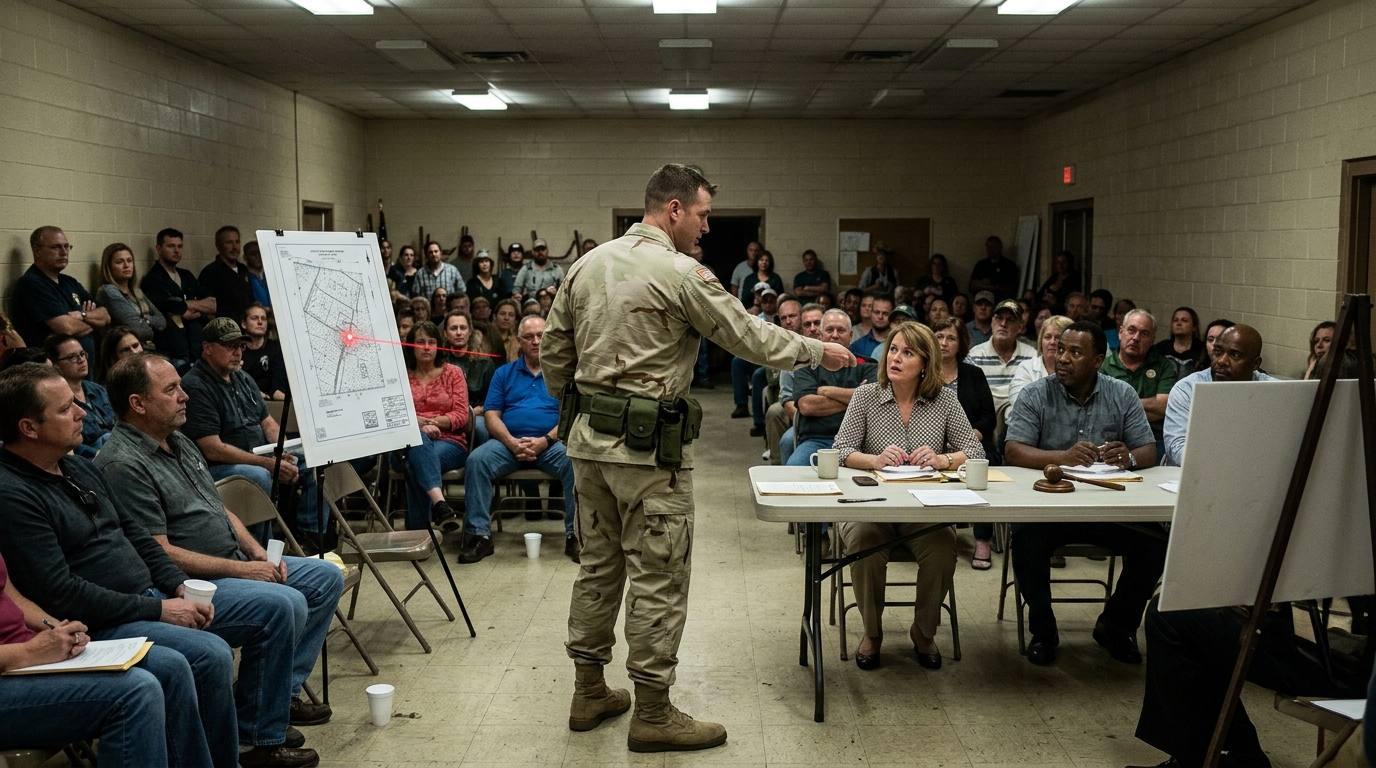
Seventy residents sat in metal folding chairs under flickering fluorescent tubes. At the front of the room, behind a long folding table, sat Karen Miller and her four board members. A microphone hissed on a chrome stand in front of her.
“This emergency meeting is called to order,” Karen said. She slammed a wooden gavel down. The sharp thud echoed off the cinderblock walls. Her eyes swept the crowd, landing on me near the back row. “We are here to address an unprecedented campaign of financial terrorism directed against this neighborhood by a single rogue homeowner.”
A low murmur ran through the rows. Sarah sat beside me, her knuckles white where she gripped her handbag.
“Mr. Davidson has served this board with a frivolous, extortionate demand letter,” Karen continued, her voice rising with practiced indignation. She held up David Chen’s notice, waving it like a battle flag. “He is demanding nearly half a million dollars from our shared reserve fund! He wants to bankrupt our community, freeze our property values, and force a special assessment on every family in this room—all over a few overgrown, unapproved fruit trees that were encroaching on common ground!”
People turned in their seats, staring at me. A man two rows ahead shook his head, muttering under his breath.
I didn’t argue. I didn’t shout. I stood up smoothly, picking up a four-foot poster board I had kept propped against my chair leg. I walked down the center aisle, my boots heavy against the linoleum.
“Mr. Davidson, you are out of order!” Karen barked, slamming her gavel twice. “Sit down or I will have security remove you!”
“We don’t have security, Karen,” I said calmly. “We have a county sheriff who enforces legal boundaries.”
I set the poster board on an easel near the podium. It was a high-resolution print of the county clerk’s sealed plat survey, scaled to three inches per foot. I pulled a red laser pointer from my shirt pocket and clicked it on. A crimson dot appeared on the paper.
“This is the official survey on file at the county courthouse,” I said, speaking over her rising protest. “The thick black line represents my property boundary. This red dot is the iron pin set by a licensed surveyor in 2014.”
I moved the red dot six inches to the left.
“These seven X’s mark the exact trunks of the Gravenstein, the Black Oxford, and the five other heritage trees. As every person in this room can clearly see, those trunks are fifteen feet inside my boundary line.”
The room went dead silent. A woman in the third row leaned forward, putting on her reading glasses.
“That document is a fabrication!” Karen shouted, her voice cracking into a shrill register. Her hand reached for her glass of water, but her fingers misjudged the distance, rattling the rim against the wood before she clamped down on it.
“It’s a certified public record,” I said quietly. “And the demand letter isn’t addressed to the HOA reserves, Karen. It’s addressed to you personally. For four hundred and twenty thousand dollars in intentional property destruction.”
I turned my back on the board and faced my neighbors.
“She used a restricted industrial chemical,” I told them. “If it leaches another ten feet, the environmental protection division will condemn the drainage basin behind all our fences. Check your bylaws. The HOA doesn’t cover intentional criminal acts by board members. You aren’t paying for her mistake. She is.”
I clicked off the laser pointer, dropped it into my pocket, and walked out the double doors into the cool night air, leaving the room to explode into chaos behind me.
CHAPTER 4: THE INFRARED PROOF
The glass doors bounced once in their aluminum frame, sealing the shouting inside.
I didn’t pause on the clubhouse porch. I walked straight down the asphalt path, my shadow stretching out long under the sodium vapor lights. Sarah caught up three paces later, her hand sliding into mine. Her palm was damp, her thumb tracing my knuckles over the brass lighter in my pocket.
“They’re going to tear her apart in there, Jack,” she whispered.
“They’re going to try,” I said. “Then she’ll start issuing retaliation fines to buy time.”
By Thursday morning, the retaliation arrived.
Four yellow envelopes stuffed into my mailbox before eight o’clock. A fifty-dollar fine for grass length measuring three point one inches. A hundred-dollar fine for trash containers left out forty minutes past the morning window. A notice to remove my flowerbed stone border—a border installed six years ago under the previous owner.
I didn’t tear them up. I opened my flatbed scanner, digitized every notice, and saved the files into the desktop folder alongside the surveyor’s plat. Every fine was a line of code in her paper trail, proving targeted malice.
At nine fifteen, my doorbell rang.
Frank, the retired mechanic from three doors down, stood on the porch step. He held a grease-stained folder tucked under his arm. His knuckles were raw, his jaw set in a tight, awkward line that twitched as he met my eyes.
“Jack,” he said, his voice scratchy. “You got a minute?”
I stepped back, opening the door wider. “Coffee’s hot, Frank.”
“Don’t need coffee,” he muttered, stepping into the entry hall. He set the folder on the mail table. “She hit me two years ago. Said my grandson’s play set breached the setback rule. Threatened a lien unless I tore it down in forty-eight hours. My daughter was going through a divorce, Jack. Kid was three. I didn’t have the stomach to fight her.”
He opened the folder. Inside were receipts, certified letters, and three photographs of a wooden swing set being unbolted in the rain.
“I signed an affidavit,” Frank said. “Notarized it down at the bank this morning. Put it on the pile.”
By noon, Maria from across the cul-de-sac came by with a neighbor named Susan. Susan brought an invoice for six thousand dollars—the cost Karen had forced her to pay to repaint her house because the approved shade of beige was “a half-shade off the architectural palette.”
Story by story, the neighborhood’s silent history spilled into my entry hall. The wives who had wept quietly over dead garden beds. The widow who had been forced to remove a wooden bench dedicated to her late husband. I wrote out simple, one-page statements, watched them sign, and applied my notary seal to every sheet.
Then Ben called.
Ben lived directly across the street in a two-story gray colonial. He was twenty-eight, ran a network security firm from his basement, and rarely came out during daylight.
“Jack,” his voice came through the phone speaker, thin and nervous. “You need to bring a flash drive over. Right now.”
Five minutes later, I sat in Ben’s basement office. Three monitors glowed in the dark room, illuminating rack-mounted servers humming against the wall. Ben moved his mouse, clicking open a media player.
“My front arch camera records in four K infrared,” Ben said, tapping the screen with a pen. “I set it up to monitor my server delivery packages. Look at the timestamp.”
The monitor displayed my driveway in high-contrast black and white. 02:17:04 AM.
A figure walked into the frame from the right side of the screen. A heavy frame draped in a plush bathrobe, feet shoved into rubber-soled slippers. In her right hand, she carried a three-gallon tank sprayer with a brass wand.
She crossed the asphalt line, walked directly onto my lawn, and unclipped the wand nozzle. For four minutes, the white heat signature of the spray misted over the base of the Gravenstein and the six heritage trees beside it.
“She didn’t even look around,” Ben said, pulling a printout from under his desk blotter—a still frame tagged with a file code linked to Chemical Vector Bravo. “She thought nobody was watching.”
I watched the screen as the figure turned, walked back across the street, and stepped back onto her porch.
“Can you export the raw video file with the cryptographic timestamp intact?” I asked, my voice dropping into a flat, calm register.
“Already done,” Ben said, pushing a metallic USB drive across his mousepad. “It’s hashed and verified. She can’t claim it’s a deepfake.”
I took the drive and felt its cool metal edge against my thumb.
The physical chain was locked. The motive was on paper in her yellow violation envelopes. The method was in Arthur’s lab report. And the act itself was captured in four K resolution.
“I’m calling Sharon Price at Channel Six,” I said.
Ben blinked, his eyes wide behind his glasses. “The investigative reporter?”
“The one who handles public abuses,” I said, closing my hand around the drive. “It’s time to take Karen’s private kingdom and put it on the six o’clock news.”
CHAPTER 5: THE POLICY EXCLUSION
The metallic click of the flash drive sliding into my pocket felt like loading a magazine.
Sharon Price didn’t waste air when she arrived at my kitchen table two days later. Her broadcast crew set up two softbox lights in three minutes flat, their matte-black aluminum stands clicking into place on my hardwood floor.
“We air at six,” Sharon said, her voice clipped, professional, and razor-sharp. She looked over the stack of notarized affidavits, Arthur’s appraisal report, and the raw infrared file Ben had exported. “The video is clear enough to identify her gate and bathrobe pattern. We blur the face slightly for legal clearance, but the community will know.”
“Make sure the four-hundred-and-twenty-thousand-dollar figure gets full screen time,” I said, my Zippo resting cold on the table.
“It’s our chyron line,” Sharon replied.
When the six o’clock news segment hit the air, the broadcast exploded across local social media channels within twenty minutes. By eight, the clip had been mirrored onto regional news aggregators. Karen’s image—blurred but unmistakable, creeping across my yard with a chemical sprayer under the infrared lens—became an overnight viral symbol of suburban tyranny.
The immediate fallout was not a lawsuit from Karen. It was a black Chrysler sedan parking in front of the HOA clubhouse forty-eight hours later.
Two adjusters from Omni National Assurance’s Special Investigations Unit stepped out of the vehicle, carrying slim leather briefcases. They didn’t call Karen to schedule an interview. They summoned her and the remaining four board members to an emergency executive session behind closed doors.
George, the board treasurer, called my landline at seven forty-five that evening. His voice was trembling so badly I could hear the receiver rattling against his ear.
“Jack,” George gasped, his breathing shallow. “They… they brought forensic audit papers.”
“Who did?”
“Omni National,” George said. “The lead investigator—a woman named Vance—pulled out a copy of your lawyer’s demand letter, Arthur’s lab report, and a purchase ledger from Greenfield Depot. Jack, she had a subpoenaed invoice under Project Vanguard.”
I adjusted my grip on the phone. “And?”
“Karen lied to the agricultural vendor,” George whispered. “She used an expired commercial registration number from a defunct drainage project—Docket 409—to purchase the sterilant under the table. And then… God, Jack, it gets worse.”
“Speak clearly, George.”
“Vance handed us a Reservation of Rights notice,” George said, his voice breaking. “Paragraph four, section B. Intentional torts, fraud, and illegal acts are excluded from coverage. Omni National is refusing to defend Karen personally. They’re dropping her policy shield.”
“And the board?” I asked flatly.
“They warned the rest of us that if we used HOA reserve funds to cover her personal legal bills or pay off the environmental damage, we’d be personally liable for civil embezzlement. They found two missing entries in the reserve ledger from last quarter—she’d been routing maintenance funds to cover illegal chemical disposal from Chemical Vector Bravo dumping in the rear culverts!”
The decoy fell away. It wasn’t just a petty property feud. Karen had been skimming the HOA reserve account to mask unapproved chemical dumping along the common drainage line, using her position as president to cover up systemic violations.
“George,” I said, my voice dropping into a hard, rhythmic beat. “Call a special board removal meeting for tomorrow night. State section nine of your bylaws.”
“She’ll fight it, Jack. She’s crazy.”
“She has no insurance, no corporate indemnity, and no allies,” I said. “Present the facts. I’ll be in the back of the room.”
CHAPTER 6: THE REMEDIATED GROUND
The dial tone hummed in my ear for three seconds before I set the landline back on its wall cradle.
Twenty-four hours later, the community clubhouse was dead quiet. No murmurs. No whispering. Sixty neighbors sat in straight metal rows, their eyes locked on the front table where George stood alone behind the podium.
Karen sat in the front row, isolated by four empty folding chairs on either side. She wore a dark gray trench coat, her hands clamped around a leather handbag so tightly the vinyl seam was cracking under her thumbs.
“By vote of the remaining board members,” George announced, his voice flat and unyielding, “and in accordance with Section Nine of the Lakeside Meadows covenants, we are voting on the immediate removal of Karen Miller for gross breach of fiduciary duty.”
Karen stood up fast, her chair scraping sharply against the linoleum. “You don’t have the authority! I signed the vendor permits under Project Vanguard for drainage maintenance! The board approved those allocations three years ago under Docket 409!”
“You routed reserve checks to cover illegal chemical disposal,” George said, holding up a certified bank audit sheet. “You used Chemical Vector Bravo to sterilize the runoff culverts because you let the retention pond silt over, then tried to pin the environmental damage on Jack’s trees when the state inspectors started asking questions.”
The room stayed frozen. Nobody gasped. Nobody raised a hand to defend her.
“The vote is unanimous,” George said. “You are removed from the presidency and the board effective immediately. The civil indemnification waiver is signed. You are personally liable.”
Karen turned around slowly. Her eyes scanned the sixty faces staring back at her. Her lower lip quivered once—a sudden, desperate break in her composure—before her jaw snapped shut into a crooked mask of contempt.
She didn’t speak. She grabbed her handbag, shoved past Frank in the aisle, and walked out into the rain. The heavy exterior door slammed behind her, the latch catching with a hollow iron thunk.
The settlement was signed four weeks later in David Chen’s downtown office.
The HOA insurance carrier contributed seventy thousand dollars from their baseline administrative settlement pool to release the entity from future drainage claims. The remaining three hundred and fifty thousand dollars came directly from the forced liquidation of Karen’s house, ordered by the circuit court to satisfy the personal property judgment and soil remediation lien.
Six weeks after the papers cleared, an environmental restoration crew arrived in two flatbed trucks.
They cordoned off my backyard with yellow caution tape. Heavy diesel excavators scraped away ten feet of contaminated topsoil down to the blue clay, hauling the poisoned earth away in sealed steel containers. For five days, my fence line looked like a trench from a forgotten war.
Then came the replacement earth. Ton after ton of dark, sweet loam poured into the trench, packed down firmly by yellow compaction rollers until the ground was level and clean again.
Instead of replanting the seven heritage trees, Sarah, Lily, and I walked down to the new boundary line on a bright Saturday morning. Frank was there with his shovel. Maria brought a wooden bench. Ben brought a roll of drip-irrigation hose.
We built a six-bed community garden across the former buffer zone, laying a crushed gravel path right along the surveyed property line. At the entrance, mounted to a cedar post anchored six inches inside my iron pin, I screwed in a small bronze plaque.
It didn’t bear Karen’s name. It didn’t mention the lawsuit or the news segment. It read simply: Good Fences. Clear Boundaries.
A moving van pulled up across the street at noon. Two workers in gray overalls loaded the last of Karen’s furniture into the back doors. Karen stepped out onto her porch for the last time, carrying a small cardboard box.
She looked across the street. I was kneeling in the fresh soil with Lily, holding a six-inch Honeycrisp sapling while my daughter packed dirt around its roots.
Karen met my eyes for two seconds. Her shoulders were stooped, her pink tracksuit replaced by a faded raincoat. I didn’t smile. I didn’t raise a hand in triumph. I just held her gaze, calm and steady, until she turned, got into the passenger seat of an old sedan, and drove away from Lakeside Meadows forever.
I picked up my brass Zippo from the edge of the wooden garden bed, slid it into my pocket without clicking it, and wiped the black earth from my palms.
The line held.