The Fence Line War: How One Texas Rancher Engineered the Perfect Downfall of a Suburban Tyrant
CHAPTER 1: THE TASTE OF BITTER COFFEE
The screech of Brenda Hartwick’s voice didn’t just break the morning; it sliced through it. I stood by the water trough, the condensation on the metal biting into my palms, listening to her shout orders at a contractor who looked like he’d rather be anywhere else in Texas. My morning coffee, usually a quiet companion, tasted suddenly like ash.
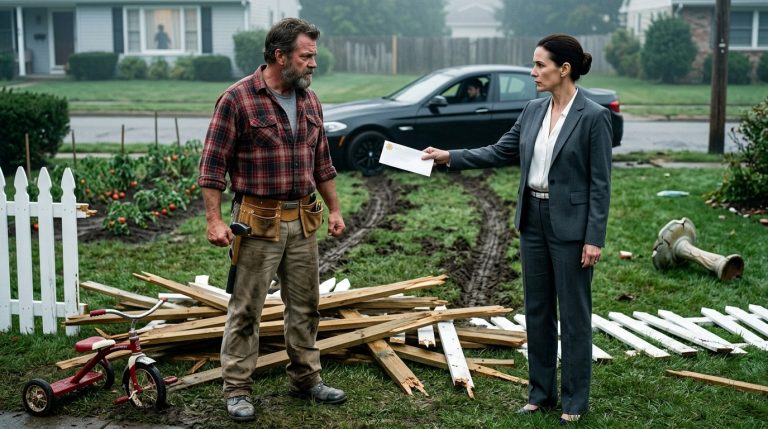
Brenda looked like a mirage of suburban perfection—white power suit, hair sprayed into a blonde helmet that refused to acknowledge the wind, and those heels. She was standing three feet inside my perimeter, pointing at a cedar post my daddy had hammered into the dirt in 1982.
“It’s an encroachment, Jake!” she yelled over the whine of a chainsaw. “Your cattle are a hazard. We’re reclaiming the trail easement as per the HOA’s development mandate.”
I didn’t move. I watched the contractor hesitate. He was young, nervous, and clearly didn’t know the weight of the land he was standing on. My pulse was a slow, steady drum in my ears. I’d spent two weeks in the courthouse basement, inhaling the smell of rotted paper and ancient ink, uncovering truths that Brenda hadn’t even bothered to look for. She was playing a game of checkers, and she thought I was still trying to learn the rules of the board.
“You touch that post,” I said, my voice low enough that she had to stop her screeching to hear it, “and you’re not just violating a survey. You’re violating a federal property protection act that hasn’t been tested in this county for forty years.”
She laughed, a sharp, brittle sound that made the birds in the nearby oaks go quiet. She held up her folder—her weapon of choice—and waved it like a white flag of surrender. “Threats? Really? I have the county code enforcement on speed dial. You want to see how fast they can turn this ranch into a parking lot?”
I took a step forward, the gravel crunching under my boots. I wasn’t angry; the rage had passed days ago, replaced by a cold, surgical clarity. I thought about the twelve prize bulls in the north pasture, the way they moved like a single, heavy shadow in the dark. I thought about the hidden cameras I’d mounted, each lens watching her now, recording every second of this trespass.
She didn’t know that the contractor’s chainsaw was currently cutting through a fence that wasn’t just wood and wire—it was the legal tripwire for her entire existence.
“Move the equipment, Brenda,” I said, my gaze shifting to the contractor. “Or don’t. But you should know, the sheriff is already on the road. And he’s not coming to help you survey.”
The silence that followed was total. She froze, her red nails digging into the folder, her eyes darting toward the horizon as if she expected flashing lights to burst from the brush. For the first time, her confidence flickered, a tiny crack in the designer armor. She didn’t know yet that the real trap wasn’t the law—it was the fact that she was standing on land that had never belonged to her.
CHAPTER 2: THE PAPER GHOSTS
The courthouse was a place where time didn’t move; it just settled in layers of dust over the records of lives that had long since stopped mattering to anyone but the archivists. The air inside the basement archive tasted of dry rot and neglect. I moved a stack of property surveys from the early seventies, my fingers tracing the frayed edges of the blue-print paper. The texture was rough, like dried skin.
Old Hank Morrison sat at the adjacent table, his glasses perched precariously on the end of his nose. He’d been the one to tip me off. He wasn’t a man of many words, but when he spoke about local history, it was like listening to a confession.
“You’re looking for the wrong document, Jake,” he said without looking up from his ledger. His voice was like grinding stones. “You’re looking for a boundary. You should be looking for a charter.”
I stopped. The silence in the room suddenly felt heavy, pressing against my eardrums. I had come here to prove the fifty-foot encroachment of the nature trail, to show the law that my land was being swallowed by the arrogance of a subdivision that didn’t know the difference between a fence and a property line. But Hank’s words were a warning.
I set the survey aside and began digging deeper. I pulled files marked ‘Sunset Meadows Development – 1972.’ My heart was a steady, rhythmic thrum in my chest. The documents were brittle, yellowed, and smelled of decades of stagnation. I found the incorporation papers, the original agreements signed by my father and the lead developers.
It took me twenty minutes to find the discrepancy. It wasn’t in the maps. It was in the boilerplate language of the HOA’s foundation.
There, in ink that had faded to the color of a bruise, was an agricultural preservation clause. It was ironclad. The developers had promised—in writing, recorded with the county—that the ranching operations would be preserved in perpetuity. It wasn’t just a preference; it was a condition of the land usage. If the HOA interfered with the ranch’s operation, the very charter that allowed them to collect dues and manage the neighborhood would be legally nullified.
My eyes scanned the signature line. The seal of the State of Texas was embossed there, but something felt wrong. I held the page up to the dim overhead light. The indentation of the seal was present, but it was offset. It looked like an afterthought, pressed by someone who didn’t know where the original matrix had been.
“Hank,” I said, my voice sounding foreign in the quiet room. “This seal. It’s off-center.”
Hank finally looked up. He squinted at the paper, then grunted. “That’s not just off-center, boy. That’s a forgery. That’s the stamp they used when they wanted to bypass the state filing fees back in the day. The whole development was built on a legal fiction.”
I felt the blood drain from my face. Brenda wasn’t just a bully; she was the current steward of a fraudulent kingdom. She had been operating for years, enforcing rules that had no teeth, collecting dues for an entity that existed only on paper. The sheer, audacious scope of the lie was breathtaking. She had built her power on a ghost.
My mind raced. If the HOA didn’t legally exist, then every fine she’d levied, every threat she’d made regarding ‘property standards,’ and every attempt to seize my land was not just harassment—it was a series of criminal frauds.
I looked at the document again. The paper felt cold, a dead thing that held a live explosive. Brenda Hartwick didn’t just want my land; she needed it to retroactively legitimize the disaster she was running. If she could absorb my ranch into a ‘community park,’ she could paper over the gaps in her charter, using the value of my acreage to secure the legitimacy she lacked.
I stood up, the chair scraping sharply against the concrete floor. The micro-mystery wasn’t just the missing legal standing; it was the realization that someone had been updating these records. The forgery wasn’t forty years old. The ink on the secondary filings, the ones Brenda had cited in her recent ‘code enforcement’ letters, was fresh. Someone was maintaining the lie.
I looked at Hank, who was watching me with eyes that seemed to know exactly what I was thinking.
“She doesn’t know you found this,” Hank muttered. “But if you go after her, you aren’t just fighting a neighbor. You’re fighting a criminal enterprise.”
I nodded, sliding the copies into my bag. I didn’t need to say anything. I had the ammunition. Now I just needed to make sure she walked into the line of fire. I left the archive, the sunlight outside feeling blinding, almost aggressive. The world had shifted. The ranch wasn’t just a place of work anymore; it was the epicenter of a collapse.
I didn’t head home. I drove toward the edge of the HOA, toward the pristine, beige-mailbox wasteland that Brenda called home. I needed to see it for what it was now: a house of cards waiting for the first stiff breeze.
CHAPTER 3: THE CHILLING OF THE SUBURBS
“I’m telling you, Jake, she’s got us all looking over our shoulders, but the moment I saw those orange flags, I stopped feeling like a resident and started feeling like a mark.”
Pete Kowalsski leaned against the hood of my truck, his hands calloused from years of working construction, much like my own. We were parked at the edge of the property, the line clearly marked by the vibrant, synthetic orange of the survey flags I’d hammered in that morning. The wind whistled through the high grass, carrying the scent of dry earth and impending rain.
“She’s been telling us the ‘natural trail’ is for the kids, for the community, but since when does a community nature trail require a security detail in tactical vests?” Pete spat on the dirt. “My wife’s been getting notices about ‘unsightly landscaping’ because we didn’t use the approved mulch from her brother-in-law’s supply company. It’s a racket, Jake. Everyone knows it, but everyone’s afraid to say it.”
I kept my eyes on the horizon, watching the silhouettes of the houses in Sunset Meadows. They looked like oversized monopoly pieces, sterile and demanding. “It’s not just a racket, Pete. It’s an illusion. And once you see the seams, the whole thing stops looking like a neighborhood and starts looking like a cage.”
I pulled a small, ruggedized camera from my jacket pocket—the first of six. “I need you to do something for me. I’m placing these along the true property line. If Brenda or her ‘security’ teams cross into this zone, I need a witness. Not to fight them, not to engage—just to record. Let them believe they’re still in charge.”
Pete looked at the camera, then back at me. A slow, grim smile spread across his face. “You’ve got a plan, haven’t you? A real one.”
“I’ve got a map,” I corrected him.
After Pete left, I spent the afternoon in the sun, my hands working the familiar rhythm of the fence. Drive the post, set the wire, tension the line. Every snap of the metal fastener was a reminder of what was at stake. While I worked, I kept the property boundaries clear in my mind—not the ones the HOA claimed, but the ones recorded in the original 1972 survey.
I’d spent the last few days quietly ‘educating’ the neighbors. It was simple, really. A chat over a fence, a shared cup of coffee, a subtle mention of the agricultural protection clause I’d unearthed. I didn’t need to be aggressive; I just needed to plant the seed of doubt. The HOA was a house of cards, and Brenda was the one who’d built it on top of a sinkhole.
As the sun began to dip, casting long, sharp shadows across the pasture, I made my way toward the back perimeter of the Sunset Meadows development, near Brenda’s own property. I needed to see if she was as meticulous at home as she was in the office.
Her trash bins were lined up neatly at the curb, an army of black plastic soldiers. I moved with the stealth of someone who’d spent a lifetime avoiding spooking cattle. I nudged the lid open. It wasn’t the garbage of a woman confident in her position. Among the standard waste were shredded documents—thick, heavy stock—and a series of high-resolution, aerial photographs of my ranch.
I pulled one out. It was a recent shot, taken from a drone, showing my water troughs, my gates, and the exact positioning of my bull pens. Why would an HOA president need tactical drone surveillance of a neighbor’s livestock?
My breath hitched. This wasn’t about property values or nature trails. This was about mapping my defenses. She wasn’t just planning to annex my land; she was planning to dismantle my operation, piece by piece, under the guise of ‘code enforcement.’
I took the photo, my knuckles white as I gripped the glossy paper. The sun was gone now, replaced by a cold, gray twilight. I looked at the house—her house—and saw the flicker of a light in her upstairs office. She was watching. She had to be.
The air felt thinner, sharper. I felt like a bull sensing the approach of a wolf, a primal recognition of danger that had nothing to do with contracts or surveys. She wasn’t just fighting for commission checks anymore. She was playing a much deeper, much nastier game.
I turned and walked back toward my truck, my boots silent on the asphalt. The stakes had just fundamentally changed. The decoy secret—the expired incorporation—was still our best weapon, but I realized now it was only the shield. The sword was something else entirely, something Brenda was keeping hidden in her own files. I had to know what those shredded documents were. I had to know how far the rot went.
As I started the engine, I saw a movement in the window—a curtain pulled back, then dropped. Brenda was watching, and for the first time, I felt the cold, electric thrill of the hunt. She wanted to play the game of borders? Fine. We’d see whose foundation held up first when the ground started shifting.
CHAPTER 4: THE INSPECTION OF LIES
“Mr. Thornton, I’m just here to do my job. If you’d please step aside, I have a mandate from the county to evaluate these structures.”
The inspector was a man named Miller, his uniform stiff and smelling of antiseptic. He had a clipboard held up like a shield, and behind him, hovering like a carrion bird, was Brenda. She didn’t say a word, but her smile was a thin, predatory line of triumph. She knew exactly what was in those papers. She knew the ’emergency’ code violations would trigger a mandatory shutdown of my grazing operation.
“The mandate is one thing, Miller,” I said, my voice steady, though my blood was boiling. “But the paperwork you’re holding? That’s something else.”
I walked toward the lead structure—the main calving barn—my boots crunching on the dry, hard-packed earth. The air was heavy, the heat rising in waves off the pasture. I reached out and tapped the clipboard. “You ever read the fine print on these? The ones signed by the assistant director, Rick Hartwick?”
Miller blinked. He glanced back at Brenda. She shifted, her eyes narrowing.
“I don’t discuss administrative signatures, Mr. Thornton,” Miller said, his voice tightening. “I’m here to document code violations regarding unsanitary livestock runoff. Now, move or I report you for obstruction.”
“Document away,” I said, stepping aside, but I wasn’t backing down. “But before you put that pen to the paper, you might want to look at the water samples I took from the creek this morning. You’re looking for contamination from my herd, right? It’s funny. The runoff from the Sunset Meadows development upstream has been testing with E. coli levels that would turn a stomach inside out.”
Brenda let out a short, sharp laugh. “Don’t listen to him, Miller. He’s obsessed with conspiracies. He’s trying to deflect because he knows he’s in violation of basic sanitation codes.”
Miller stepped into the barn. The darkness was cool, filled with the low, rhythmic breathing of my bulls. He walked to the center, his flashlight cutting a stark beam through the dust-mote-filled air. He crouched near the trench I’d dug for the runoff management, the one that filtered water through natural stone and native vegetation.
He stayed there for a long time.
I watched his shoulders. They were stiff. He reached down, took a soil sample, then paused. His hand hovered over the sample bag. He didn’t look back at Brenda. He looked at the floorboards, his expression unreadable.
“Miller?” Brenda prompted, her voice losing its edge of absolute certainty. “What are you doing? Just tag the violation.”
Miller didn’t answer. He stood up, but he didn’t close his clipboard. He walked over to the back wall, where I’d mounted the latest security camera, and stared at it. His face was pale.
“Mr. Thornton,” he said, his voice dropping, “I think we need to step outside.”
My heart hammered against my ribs. Something was wrong. He wasn’t the man who had driven up here with the intent to shut me down. He looked like a man who had just realized he was walking into a trap, and it wasn’t the one he’d been told about.
We stepped back into the blinding glare of the sun. Brenda was waiting, her arms crossed, the picture of composed authority. “Well? Is it tagged?”
Miller turned to her, his face flushed. “Ms. Hartwick, there’s a discrepancy. A significant one. The runoff in the drainage trench… it isn’t livestock waste.”
Brenda’s smile didn’t falter, but her eyes went cold. “Of course it is. What else would it be?”
“Chemicals,” Miller said. “Heavy, industrial-grade pesticides and fertilizers. The kind they use on suburban lawns.” He looked at Brenda, his gaze hard. “And there’s more. The septic discharge from the community development is bypassing the main treatment plant. It’s flowing directly into the creek system. If I sign this violation report, I’m signing off on the fact that I ignored a federal environmental health hazard.”
The silence was deafening. I felt a surge of adrenaline, sharp and cold. I hadn’t expected him to find the truth, only to be forced to document it.
“That’s impossible,” Brenda hissed. “You’re clearly mistaken. You’re obviously incompetent, and I’ll be speaking to the director about your—”
“Actually,” I cut in, my voice booming in the quiet pasture, “I think Mr. Miller has been very thorough.” I held up my phone, the screen showing the data logs from my own testing. “I’ve been tracking the runoff for months, Brenda. I knew about the septic failures. I just needed someone official to confirm the source.”
Brenda’s composure shattered. She turned on her heel, her face a mask of incandescent rage, and marched toward her Escalade. She didn’t look back at the inspector, and she didn’t look at me. She was already on her phone, likely screaming at someone who couldn’t help her anymore.
But as she drove away, kicking up a cloud of choking dust, Miller didn’t sign the report. He tucked it into his jacket and looked at me. “I’m not reporting you, Jake. But this isn’t over. You just brought the EPA into our county. Do you have any idea what that’s going to do to the local infrastructure?”
“I know exactly what it’s going to do,” I said, watching Brenda’s car vanish around the bend. “It’s going to clear the field.”
He walked back to his truck without another word. I stood in the silence, the weight of the moment pressing down on me. I had won the battle, but I had opened a door I couldn’t close. The HOA was reeling, but Brenda? Brenda was a cornered animal now. And the thing about cornered animals is that they don’t play by the rules anymore.
The micro-mystery of the missing seal on the 1972 contract lingered in the back of my mind. Why had she kept the original charter? Why hadn’t she destroyed the evidence of the forgery when she had the chance?
I walked back to the barn. The air was still, save for the low snorting of the bulls. I knew it wasn’t over. The escalation had started, and the endgame was just beginning. I just hoped I had enough ammunition left to survive the fallout.
CHAPTER 5: THE CALM BEFORE THE STAMPEDE
The air at 5:00 a.m. tasted like cold iron and impending disaster. I stood on the porch of the old ranch house, the floorboards creaking under my weight, watching the headlights of a hundred different cars snake their way toward my pasture gates. They were coming for the ‘Sunrise Festival,’ lured by the glossy brochures Brenda had plastered across the county. They were coming with coolers, camping chairs, and an absolute, unshakable belief that they were guests on public land.
I checked the watch on my wrist. The gate to the main enclosure was latched with a heavy-duty, spring-loaded mechanism I’d installed myself. It would take less than a second to open.
“They really believe her, don’t they?” Sarah’s voice was quiet from the doorway. She didn’t come out onto the porch; she knew what was coming. She knew the cost of what we were about to do.
“They believe what they’ve been sold,” I said, my gaze locked on the lead vehicle—a massive, luxury RV that was currently navigating the narrow gap near the main gate. “Brenda sold them a dream of community. She just didn’t mention that the foundation was built on stolen land.”
The noise grew as the sun began to bleed over the horizon—a jagged, bloody line of light. Laughter, the hiss of propane stoves, the rattle of tent poles being assembled in the tall, dew-soaked grass of my north pasture. To them, this was a weekend getaway. To me, it was a crime scene in the making.
I grabbed my coat and headed toward the gate. I didn’t need to shout. I didn’t need to argue. I just needed to be visible. As I walked into the field, people stopped what they were doing, glancing at me with a mixture of confusion and mild annoyance. I was the rancher, the guy they’d been told was ‘grumpy’ and ‘uncooperative.’
“Excuse me,” a woman said, her voice bright with suburban cheer. “Are we in the right spot for the festival check-in?”
I looked at the permit she held out—a crisp, high-gloss card with a fake county seal. It was a beautiful piece of forger’s art. “You’re in the right spot for what you paid for,” I said, my voice neutral. “But you might want to consider how you’re going to get your gear out when the sun goes down.”
She frowned, but before she could answer, a black SUV roared past us, kicking up a spray of gravel. Brenda stepped out. She was wearing a white linen pantsuit that looked utterly ridiculous against the backdrop of cow dung and dust. She looked manic, her eyes darting between the arriving crowds and the stage she’d ordered her contractors to build.
“Thornton!” she shrieked, ignoring the fact that half the festival-goers were looking at her. “Get out of the way. This is a licensed community event. If you interfere, I’m calling the police to have you arrested for inciting a disturbance.”
I didn’t move. I leaned against the gate, the cold metal biting into my spine. “You want to talk about police, Brenda? I’d be happy to. I’ve been waiting for them all morning.”
“You’re a paranoid, petty, washed-up rancher,” she snapped, stepping into my personal space. The scent of her expensive, cloying perfume was suffocating. “Nobody cares about your ‘agricultural heritage.’ This land belongs to the people now. I’ve already processed forty-five thousand dollars in fees. The deal is done.”
“Forty-five thousand,” I repeated, tasting the bitterness of the number. “Tell me, Brenda, which account did that money go into? Because it certainly didn’t go to the county. And it definitely didn’t go to the HOA fund.”
Her face went deathly pale, then a mottled, angry red. For a split second, she looked like she might swing at me, but she held back, turning to bark at her security detail. “Remove him! Now!”
The guards hesitated. They looked at the crowd, then at me, then at the sheer absurdity of the situation—a man in work clothes, a woman in a white suit, and a thousand people trying to set up camp in the middle of a working cattle ranch.
“Go ahead,” I said to the guard, my hand hovering near the gate latch. “But before you put your hands on me, you might want to ask Ms. Hartwick why her ‘consulting fees’ are being routed through a shell company in Dallas. Ask her why the HOA’s incorporation papers have been expired since 2022. Ask her if she’s prepared to explain to the IRS why these permit deposits aren’t being reported as taxable income.”
The guards didn’t move. The silence that fell over the group was absolute. Brenda stood frozen, her mouth working but no sound coming out. The lie was so big, so pervasive, that it had finally hit the wall of reality.
I looked at the gate, then at the horizon, where the dust of the Sheriff’s cruisers was beginning to rise. The trap wasn’t just set; it was closing. I reached for the latch.
“I think the festival is over, Brenda,” I whispered. “I think the bulls are ready.”
The click of the latch was the loudest sound in the world. I threw the gate wide open. Behind me, the low, guttural roar of twelve agitated Angus bulls—a sound of raw, primitive power—ripped through the air. The crowd didn’t just move; they surged, a wave of confusion and panic as the ground began to tremble beneath their feet.
I didn’t run. I stayed exactly where I was, watching the destruction of the illusion I’d spent months dismantling. The stampede wasn’t about violence; it was about the simple, undeniable truth of who owned the dirt, and who was just pretending.
CHAPTER 6: THE WEIGHT OF THE GAVEL
“Brenda Hartwick! Put your hands behind your back! Now!”
The voice was Sheriff Martinez’s, but it sounded distant, muffled by the chaotic roar of the stampede. The bulls were an ocean of muscle and fury, a tidal wave of hide and hoof that had shattered the festival campsite into a million pieces of debris. Tents were flattened, tables were splintered, and the screams of the “festival-goers” were a frantic, high-pitched backdrop to the scene.
Brenda stood in the center of the madness, her white suit now splattered with mud and manure. Her hands were trembling, not with fear, but with a blind, unadulterated rage that distorted her face. She was clutching a cash-box to her chest, her knuckles white, refusing to let go even as the Sheriff closed the distance.
“This is all a mistake!” she shrieked, her voice cracking. “This land is a public space! He did this! He unleashed them! You should be arresting him!”
I walked through the chaos, my boots heavy on the earth. I didn’t rush. I didn’t need to. The scene was already written. Behind me, Tommy, my attorney, was already speaking with the lead federal agent who had arrived moments after the bulls. He was holding a stack of documents—the bank records, the forged charter, and the proof of the embezzlement that spanned eight long years.
“Brenda,” I said, my voice cutting through the panic. “The bulls don’t care about your permits. And they certainly don’t care about your shell companies.”
She spun around, her eyes wild, looking for an exit, but there were only bulls and badges in every direction. She looked at the Sheriff, then at the federal agents, and finally, her eyes landed on me. For the first time, she looked small. She looked like a woman who had spent so long building a house of cards that she’d forgotten what it felt like to stand on solid ground.
“You think you’ve won?” she hissed, her voice a jagged whisper. “The subdivision will eat you alive. They’ll sue you for every penny you have. They’ll—”
“They’re already filing for a class-action lawsuit against you, Brenda,” Tommy said, stepping up beside me. He held up a smartphone, the screen flashing with a news feed—a live report from the HOA board meeting happening just two miles away. “The board dissolved twenty minutes ago. Your brother-in-law is already in custody. The embezzlement trail is as clear as day.”
The Sheriff gripped her arms, the metallic click of the handcuffs echoing like a final gavel strike. She didn’t fight back; she went limp, a sudden, jarring change from the fury that had possessed her just seconds before. The cash-box fell from her grip, hitting the dirt and spilling thousands of dollars in stolen permit fees—fives, tens, and twenties—across the trampled grass.
The bulls, their territorial rage spent, began to drift back toward the watering hole, lowing softly. The campers were still in shock, staring at the scene in a daze, their planned weekend of “community” now a forensic investigation site.
I watched as they led her toward the back of the cruiser. She didn’t look at me again. She didn’t look at the ruin of her festival. She looked at the horizon, toward the subdivision, as if she could still salvage the lie from a distance. But there was nothing left to save.
The weight in my chest, a heaviness I’d carried for years, suddenly vanished. It felt like the air had cleared after a storm. I looked at Sarah, who was standing by the fence line, her eyes wet with relief. We had survived. The ranch was still ours. The boundary lines were etched into the legal record now, and the era of the ‘suburban tyrant’ had ended with the sound of a closing cruiser door.
The federal agents were already setting up markers around the cash-box. Tommy walked over, clapping a hand on my shoulder. “It’s over, Jake. Not just the festival. Everything.”
“Is it?” I asked, looking at the land—the dirt, the grass, the creek. It looked the same as it had yesterday, yet it felt entirely different. It was no longer a disputed territory. It was just home.
“Everything,” he confirmed. “The courts will handle the restitution. The HOA is going to be in receivership for years. But you? You’re the hero of the Milbrook County Gazette tomorrow morning.”
I chuckled, a sound that felt rusty. “I don’t want to be a hero, Tommy. I just wanted my fence back.”
As the sun fully cleared the horizon, bathing the ranch in a warm, golden light, I watched the last of the intruders gather their bags and head toward their cars. They looked humbled, their suburban entitlement shaken by the raw reality of the cattle they’d ignored.
The silence returned to the ranch, broken only by the chirping of crickets and the low, steady breathing of the herd. I walked to the gate and latched it, the iron clicking into place with a definitive, satisfying finality. It was done. The land was safe, the truth was out, and for the first time in years, the future felt as wide and open as the Texas sky.