The Golden Thread of Willowbrook Heights: A Symphony of Fractured Lives and Found Grace
CHAPTER 1: THE SHATTERED WOOD
The sound wasn’t a mechanical failure; it was the wet, heavy splintering of treated pine that I had leveled by hand just seven days ago. Through the low morning haze of Pinewood Circle, the silhouette of a blacked-out BMW sat embedded in my front lawn, its engine hissing like a dying animal. The air smelled immediately of scorched rubber and the sharp, cheap sweetness of sour mash whiskey.
I stepped onto the porch, the cold October gravel biting through the thin soles of my slippers. Bryce Thornfield was still slumped against the steering wheel, the blue light of his dashboard illuminating a face that had never known a hard day’s labor. Before I could reach the driver’s side door, the silent hum of a white Tesla cut through the damp fog.
Patricia Thornfield didn’t exit her vehicle; she arrived. Her heels clicked against the asphalt with the rhythmic finality of a metronome. She didn’t look at the ruined earth, nor the tire tracks that had torn through my military-straight rows of tomato plants. She looked directly at me, her eyes carrying the faded texture of old porcelain—smooth, cold, and entirely hollowed out by the necessity of control.
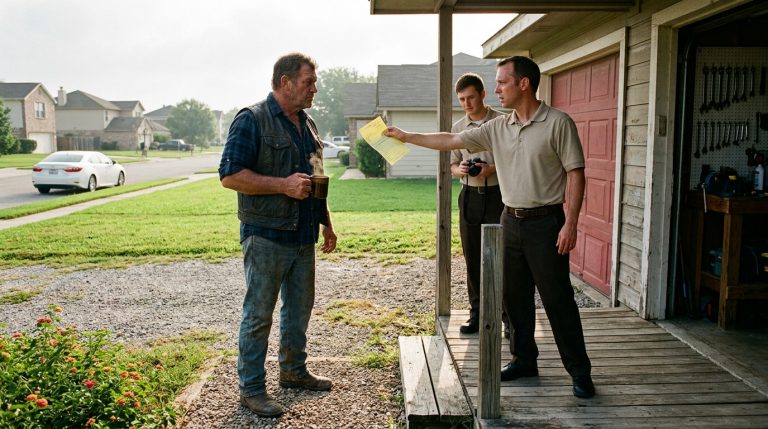
“This will be handled through the proper channels, Mr. Holloway,” she said, her voice dropping into the quiet space between us like a weighted stone. She held a crisp, white envelope in her manicured hand, the gold leaf of the HOA letterhead catching the first pale ray of dawn. “Your structure was clear of the setback line by less than the required tolerance. My son’s vehicle suffered significant front-end damage due to an unapproved obstacle.”
I looked down at the shattered white wood littering the grass. Three weekends of work. My hands, calloused from thirty years of pulling wire through frozen conduits, began to tighten at my sides. “He’s drunk, Patricia. The street is dry.”
“The report will reflect the atmospheric conditions at seven a.m.,” she replied softly, her expression remaining completely undisturbed, like a pond frozen over to protect the dark water beneath. “A heavy mist. Limited visibility. You’ll receive the assessment for the street cleanup by Tuesday.”
Behind her, the passenger window of the BMW rolled down an inch. Bryce didn’t speak; he simply let out a low, humorless laugh that ended in a cough. But as Patricia turned back toward her car, I noticed something else—a small, silver Ring doorbell casing lying crushed in the gutter two houses down, its lens pointing directly at the trajectory of the crash.
Across the street, a curtain fluttered in Mrs. Monroe’s window. A single, warm light was on in her kitchen, casting a long shadow across the pavement. Patricia didn’t see it, or perhaps she chose not to notice the small fraying edges of the neighborhood she thought she had perfectly tailored. She slipped back into her car, leaving the mechanical hiss of the wreck to fill the silence between my boots and the ruined wood.
CHAPTER 2: THE CRYPT OF THE FOUNDERS
“The county doesn’t keep mistakes for fifty years, Mr. Holloway. They just let them settle until they look like the truth.”
The clerk’s voice was as dry as the crumbling parchment she was paid to protect. She didn’t look up from her knitting, the rhythmic click-clack of her plastic needles a steady counterpoint to the low, electric hum of the failing fluorescent tubes overhead. The basement of the county courthouse smelled intensely of lime-washed stone, stagnant humidity, and the sweet, slightly sickening rot of leather bindings that had survived three historic floods.
I pulled my fingers away from the spine of a municipal ledger marked Willowbrook Development Corp: 1970–1975. A fine layer of grey slate dust clung to my callouses, filling the deep lines of my palms like chalk. “A variance isn’t an act of God, Clara. Someone had to sign off on where that property line sat before the concrete poured.”
“Patricia’s father was the registrar in seventy-four,” she murmured, her needles never missing a beat. The yarn she pulled from her wicker basket was a faded, sun-bleached blue, its fibers fraying under the friction of her thumb. “If you’re looking for clean borders, Garrett, you came down the wrong stairwell.”
I turned my back to the counter, stepping deeper into the narrow aisle where the shadows grew long and cold. My work boots crunched softly against the salt-crusted concrete floor. The air down here carried a heavy, physical stillness that made my chest tighten—the weight of three thousand properties reduced to ink and dead signatures. I reached into my pocket, my thumb tracing the edge of the scratched steel tape measure clipped to my belt, seeking the comfort of calibrated reality.
My hand brushed against a small, metal cylinder I’d pulled from the bottom of the unindexed third box. It wasn’t an official record. It was an old tobacco tin, its lid rusted shut with a thick, orange crust that flaked off under my fingernail. Inside, wrapped in a scrap of grease-stained wool, sat a heavy brass surveyor’s token stamped with the year 1974.
The brass was cold, but it carried a strange, oily residue that smelled faintly of old machine grease and iron filings. On its reverse face, a single phrase had been crudely scratched with a hardened awl: Property Fund 47B—Held in Trust.
I pulled a pair of reading glasses from my flannel shirt pocket, letting the frame rest low on my nose as I leaned over the open ledger box. The paper beneath my fingers felt like dry leaf mulch, so brittle that the simple act of turning a page caused the edges to dissolve into tiny, grey flakes. My eyes scanned the columns of copperplate handwriting—the original incorporation roster for Willowbrook Heights.
There were names I knew from the old days, names belonging to the retired teachers and machinists who still lived along Pinewood Circle, waving from their porches at five in the morning while the world was still dark. But beneath each of those familiar names, written in a different, sharper ink, was a pencil notation that made my electrical-engineering brain start calculating logic gates.
Notice of Aesthetic Non-Compliance. Infrastructure Levy Pending. Title Reversion Clause Active.
The dates on the notations weren’t from forty years ago. They were fresh. Some were stamped within the last eighteen months, all of them bearing the neat, microscopic initials of Patricia’s personal property management firm.
“She isn’t just looking for a fence violation, Clara,” I said, my voice sounding thin and hollow against the low clearance of the concrete ceiling. “She’s mapping the foundations.”
“Patricia doesn’t do anything without a blueprint, Garrett,” Clara replied, her voice drifting down the dark aisle like dust settling on an old trunk. “Her family spent forty years turning this valley into something they could sell. You think a man with a tool belt is going to change the grade of the hill?”
I didn’t answer. I pulled the master utility grid blueprint from the bottom of the stack, the heavy blueprint paper stiff and cold against my fingertips. As I unrolled the sheet across the damp wooden table, the smell of ammonia and stale vinegar filled the small space. My eyes tracked the main water and electrical lines feeding into my corner of Maple Court.
Something was wrong with the orientation. The original lines didn’t match the modern right-of-way maps Patricia had attached to her violation notice. On this historic layout, my white picket fence didn’t just sit eighteen inches inside the property line—it sat squarely on top of an unrecorded, capped municipal conduit that didn’t appear on any modern public ledger.
The blueprint had been altered. Not with a digital overlay, but old-fashioned: a fine, careful scraping of the original ink with a razor blade, leaving a faint, translucent scar where the boundary line used to be.
A draft moved through the basement, carrying the scent of wet asphalt from the street above. The edges of the blueprint curled slightly, the worn paper resisting the weight of my hands. I reached into my pocket, pulling out the small brass token, and set it directly over the scraped portion of the map. It fit the missing radius perfectly, a heavy piece of dead metal marking the exact center of a lie that had been buried before Bryce Thornfield was even born.
“Clara,” I called out, my eyes never moving from the translucent scar on the paper. “Who authorized the structural inspection for the western grid back in February?”
The clicking of the needles stopped. The silence that followed was heavy, broken only by the distant, mechanical throb of the building’s drainage pump two levels down.
“There wasn’t an inspection, Garrett,” she said, her voice dropping until it was barely a whisper against the hum of the lights. “The board just filed an emergency declaration. They said the earth was shifting under the road.”
I looked down at my hands, at the grey slate dust that had worked its way beneath my fingernails. The earth wasn’t shifting. Someone was digging it up from the inside, using the rules like a shovel, and I had just found the spot where they buried the iron.
CHAPTER 3: THE GATHERING OF SHADOWS
The steam rising from Mrs. Monroe’s porcelain teapot smelled faintly of dried jasmine and old wood smoke, a fragile barrier against the chill leaking through the window frames. Outside, the evening rain drummed a steady, relentless rhythm against the glass, blurring the streetlamps of Pinewood Circle into smeared gold halos.
“Patricia thinks we forgot how to look each other in the eye,” Mrs. Monroe said softly. Her fingers, spotted with age and slightly crooked from arthritis, adjusted the fraying hem of her beige cardigan. She poured the amber liquid into a cup that carried a hairline fracture along its rim—a delicate scar from some forgotten kitchen accident decades ago. “She thinks if she keeps the fines high enough, everyone will just look at their own shoes.”
I reached out, my fingers wrapping around the warm ceramic of the mug. The heat soaked into the stiff joints of my hands, a welcome relief from the damp cold of the courthouse basement that still clung to the marrow of my bones. Beside me, Mr. Kowalsski sat in a low armchair, his frame swallowed by the faded floral upholstery. He didn’t touch his tea. His eyes, sharp and watery behind thick, round lenses, were fixed on the scratched surveyor’s token I had placed on the lace tablecloth between us.
“That token shouldn’t exist, Garrett,” Kowalsski murmured, his voice carrying the dry, methodical cadence of a man who spent twenty-seven years looking for missing decimals for the IRS. He leaned forward, the old springs of the chair groaning under his weight. He touched the brass disk with the tip of a yellowed finger, spinning it slowly. “The seventy-four fund was supposed to be absorbed when the township restructured the water district in ninety-two. If it’s still being logged under forty-seven-B, it means the interest isn’t going into the county ledger. It’s staying local.”
“It’s staying behind her letterhead,” I said. I pulled the photocopied ledger sheets from my canvas work bag, the crisp paper crinkling in the quiet room. The smell of fresh toner mixed uncomfortably with the sweet scent of the jasmine tea. “Every name with a pending violation on this list belongs to someone who bought their home before the nineties. Mrs. Monroe, your mailbox fine from two years ago—what did the notice say exactly?”
Mrs. Monroe paused, her hand hovering over the sugar bowl. The porcelain tongs trembled slightly, a tiny mechanical rattle that seemed incredibly loud in the small kitchen. “It said ‘Structural Revision Deterioration.’ It claimed the base of the post was encroaching on the easement. I paid the four hundred dollars because Bryce… well, Bryce had already taken the mirror off my car that weekend, and I didn’t want Patricia looking too closely at my back porch.”
She looked down, her eyes tracking the intricate, faded pattern of the lace tablecloth. It was the look I had seen in the mirror every morning since the divorce—the quiet, exhausting calculation of a person trying to figure out exactly how much ground they could lose before they had nowhere left to stand.
“You didn’t lose the easement, Evelyn,” I said gently, leaning across the table until the metal clip of my tape measure nudged against the sugar bowl. “The easement moved on paper because someone scraped the ink off the old county maps. Look under the tray.”
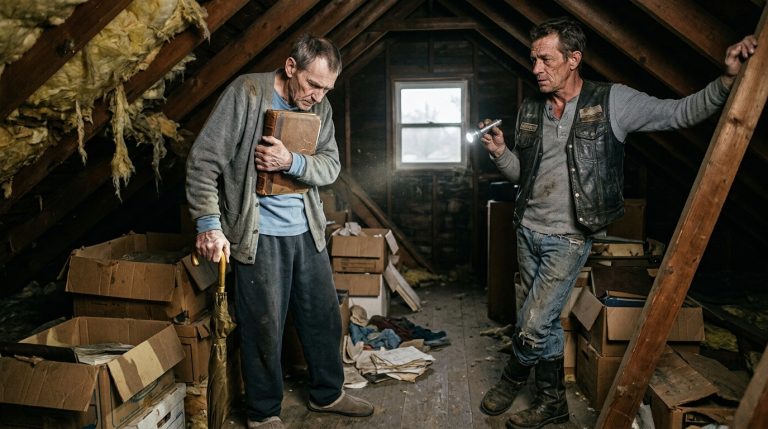
Kowalsski frowned, his hand moving automatically to lift the heavy silver tea tray. Beneath it, taped securely to the polished mahogany of the table, was a yellowed, hand-drawn property layout from 1978. It was a duplicate of the map I had found in the courthouse crypt, but this one carried an additional red boundary line drawn with a steady, archival pen.
“Evelyn’s daughter found it in the attic last winter,” Kowalsski whispered, his breath whistling slightly through his teeth. “The original developer didn’t just give us the land, Garrett. He gave the neighborhood a shared equity bond to ensure the blue-collar families could afford the rising assessment taxes. If Patricia can manufacture enough non-compliance violations, the association rules state she can force a judicial sale of the title.”
“A targeted foreclosure,” I muttered, the pieces clicking together with the cold, heavy precision of an electrical circuit snapping shut. The metallic taste of old injustice coated my tongue. “She isn’t trying to clean up the street. She’s clearing out the people who hold the original covenants.”
“But she needs a trigger,” Kowalsski added, his finger tapping the red line on the map. “A major structural failure. Something that allows the HOA to condemn the sub-grade utilities and pass the entire repair bill onto the individual homeowners.”
The rain outside suddenly shifted, a heavy gust of wind rattling the loose panes of the kitchen window. Down the street, the distant, unmistakable rumble of an un-muffled engine broke the quiet—the low, wet throb of Bryce’s BMW cruising the dark edges of Maple Court.
I stood up, the chair scraping sharply against the linoleum floor. I reached down and picked up the surveyor’s token, its cold weight settling into the palm of my hand like a loaded die.
“She’s not waiting for a failure,” I said, looking out through the wet glass at the dark silhouette of the Thornfield mansion rising against the ridge line. “She’s building one.”