The Frozen Ridge: How Eighteen Forgotten Riflemen Stood Against an Entire German Army
CHAPTER 1: FROZEN GROUND STEEL
The dirt inside the foxhole had frozen into gray concrete during the night.
Lieutenant Lyall Bou scraped his thumbnail across the face of his brass pocket watch, wiping away a thin skin of ice to read the hands. 5:30 AM.
The air didn’t just smell like pine needles and pine resin anymore; it smelled like sulfur, raw earth, and the sharp, metallic tang of cold iron. Ninety minutes earlier, sixteen hundred German guns had turned the horizon behind Lanzerath Ridge into a solid wall of orange fire. The shockwaves had shaken the pine needles off the trees and filled the bottom of Bou’s trench with a two-inch layer of dry, powdery frost.
He reached down, picked up his M1 Garand, and pulled the operating rod back a fraction of an inch to verify the chambered round. The steel felt cold enough to tear the skin off his palm.
“Sir,” Sergeant Slate whispered from the adjacent hole, his voice barely carrying over the crunch of freezing snow. “Telephone wire is dead. Cut clean through somewhere back near the intersection.”
“Keep the radio battery against your chest under your wool coat,” Bou said, his voice flat and steady. “If that battery freezes, we don’t even have a ghost to talk to.”
He pulled a wooden crate of eight-round en-bloc clips closer to his boots, checking the brass cases for corrosion. Eighteen men. That was the whole line. Eighteen riflemen scattered across nine shallow holes dug into the crest of the hill, tasked with holding a five-mile gap where a full infantry battalion ought to have been dug in.
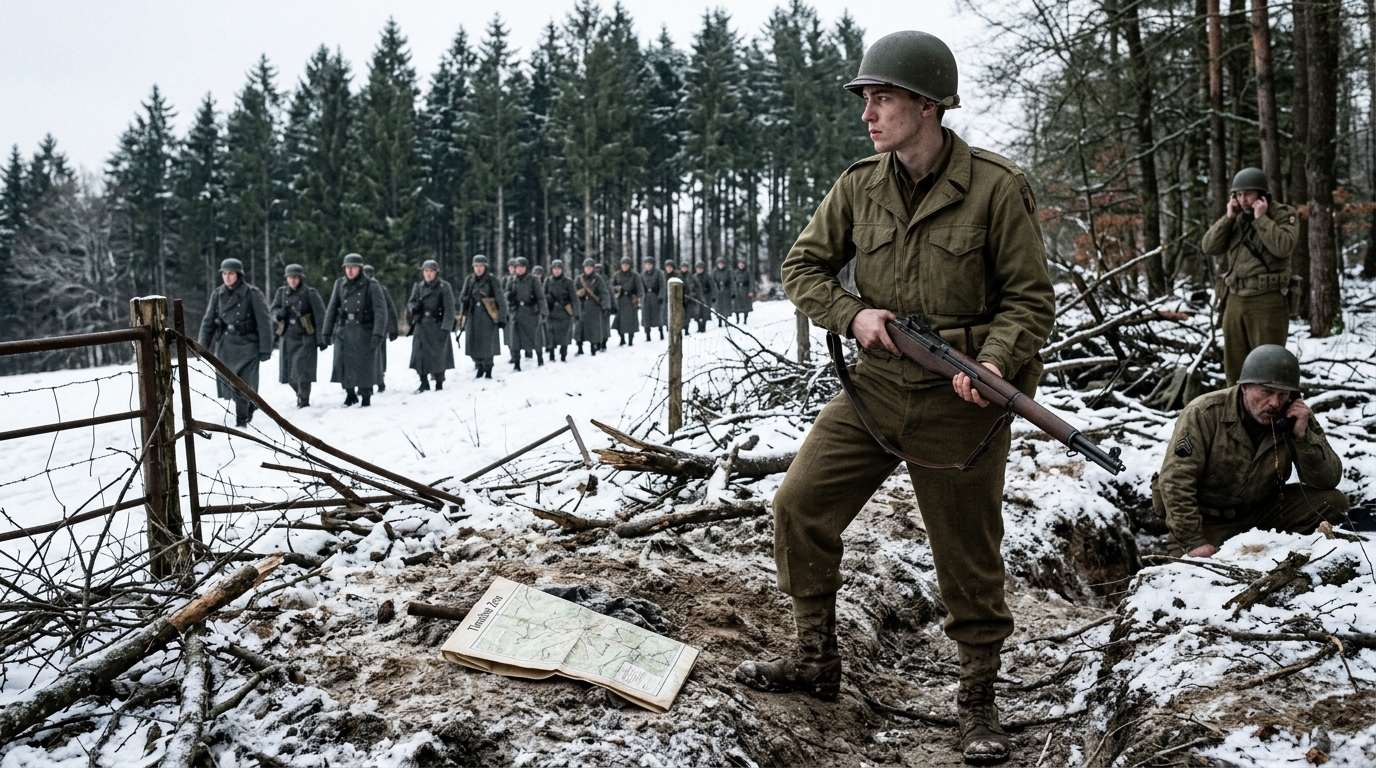
Across the snowfield below, the dense black pine forest went deathly quiet.
Then the branches groaned under the weight of movement.
Bou raised his field glasses. Through the early morning mist, dark gray wool coats began spilling out from between the trunks. Dozens of them. Then hundreds. German paratroopers from the 9th Fallschirmjäger Regiment, stepping into the knee-deep snow in tight, confident column formations.
“Look at ’em,” Slate muttered, clearing his throat and spitting a dark streak of tobacco onto the snow. “They think they’re taking a Sunday walk to the supply depot.”
Bou didn’t answer. He carefully thumbed open the front lid of his pocket watch, feeling the rhythmic, mechanical tick against his thumb. He closed it with a soft click.
“Pass the word down the line,” Bou said, leaning his rifle against the log parapet. “Nobody pulls a trigger until the lead boots hit that rusty cattle fence seventy-five yards down. Not a single shot.”
CHAPTER 2: THE GEOMETRY OF FIRE
“Now,” Bou said.
He didn’t scream it. He didn’t have to.
Sergeant Slate, crouched three yards to his left in the freezing mud, squeezed the trigger of his M1 Garand. The sharp, metallic crack of the eight-round semi-automatic shattered the silence of the valley, and thirty yards down the slope, the lead German paratrooper buckled into the snow.
Before the casing even hit the frost inside the foxhole, the rest of the platoon opened fire.
Without the heavy roar of a machine gun to suppress the open field, the eighteen riflemen had to rely on pure discipline. Every man had chosen a target before the first shot was called. They didn’t dump their clips blindly into the treeline. They picked off the officers, the men carrying wire cutters, and the soldiers attempting to deploy light mortars at the edge of the forest.
The lead German squad collapsed into the knee-deep drifts beneath the cattle fence.
“Keep your rhythm!” Bou yelled, working the trigger of his own rifle, picking out a spotter behind a pine trunk. “Two shots per target! Don’t let them cluster at the wire!”
The German line shuddered, thrown into momentary chaos by the sheer precision of the fire. They had expected an empty road or a panicked surrender from green troops. Instead, every time a grey wool coat rose out of the snow, a three-inch Garand slug knocked it flat.
“They’re falling back!” Slate called out, his breathing ragged, a thin trail of steam rising from his mouth. “First wave is pulling into the treeline!”
Bou didn’t cheer. He pulled his rifle back into the trench, popped the empty brass clip out, and shoved a fresh eight-round en-bloc into the receiver with a heavy, metallic click.
Below the hill, twenty-three German bodies lay motionless against the white expanse of the snowfield.
“Check your bands,” Bou said, his voice dropping into a cold, pragmatic cadence. “Count your clips. They aren’t going away—they’re just figuring out that we’re actually standing here.”
CHAPTER 3: THE COLD MATH OF AMMUNITION
The sound wasn’t like an American gun. It sounded like ripping canvas—twelve hundred rounds a minute chewing through the pine branches above their heads, showering the foxhole with wood splinters and ice.
“Keep down!” Bou yelled, pressing his shoulder into the frozen earth as a stream of tracer fire snapped six inches over the parapet. “Don’t burn through your clips covering blind ground!”
Sergeant Slate scrambled sideways, sliding down into the pit next to Bou with his back pressed hard against the dirt. He held up a canvas bandolier, his fingers shaking as he counted the remaining pockets.
“Two clips left for me, Lieutenant,” Slate said, his breath hitching. “James is down to his last twelve rounds on the right flank. At this rate, we’re dry before the sun hits the top of the trees.”
“Springer!” Bou called out, turning toward the forward artillery observer crouched behind the radio. “Get regimental headquarters on the horn. Tell them the whole ninth regiment is sitting on our toes and we need fire support on these grid coordinates right now.”
Springer pressed the headset to his ear, his thumb white against the side of the receiver. He shouted into the mic over the deafening chatter of the enemy guns, waited three seconds, and slowly lowered his hand.
“The line is clear, but they’re turning us down, sir,” Springer said, his eyes hollow. “Regiment says every battery in the sector is locked down supporting the division main line. No shells coming to Lanzerath.”
Bou reached down to his web belt, feeling the weight of his own canteen and the small, leather-bound notebook where he kept the platoon count. He didn’t curse. He didn’t punch the dirt.
“Did they say anything about the third battalion?” Bou asked, his voice dead level. “The relief team?”
“They said hold,” Springer muttered. “Said they’re on the way.”
Bou reached out with his left hand and picked up a folded piece of oilskin paper dropped by a German scout during the second wave—an operational map stamped with a red circular mark directly over their road intersection. Beneath the stamp was a single hand-written German phrase: Timeline Zero.
They weren’t waiting for a delayed convoy. The main German thrust was built around this single stretch of dirt, and regimental command knew it. The promised reinforcements were a ghost story meant to keep eighteen men in their holes.
“Slate,” Bou said softly, putting his watch back into his pocket. “Gather every loose round from the bandoliers in the rear trench. We aren’t getting help, and we aren’t getting resupplied.”
CHAPTER 4: THE FINAL MAGAZINE
“Fire at your maximum rate,” Bou said, his voice terrifyingly calm against the roar of incoming mortar impacts.
Sergeant Slate stared at him from three feet away, his hand frozen mid-reach above his web belt.
“Sir?” Slate rasped, a streak of black soot cutting through the frost on his cheek. “We’ve got four rounds per man. If we burn them now—”
“If they think we’re low, they rush this hole in forty seconds,” Bou interrupted, raising his M1 Garand to his cheek and dropping a paratrooper attempting to set up a mortar plate at seventy yards. “If we pour it on, they think a fresh company just stepped into the line. Shoot fast. Make every copper jacket count.”
The men didn’t question him twice. Across the nine frozen pits, sixteen Garands went into full semi-automatic cadence.
The sharp, rhythmic crack-crack-crack echoed off the tree line in a continuous wall of sound. To the German officers organizing the assault from the edge of the woods, it didn’t sound like eighteen half-frozen boys clinging to their last belt of clips. It sounded like an entrenched battalion receiving fresh ammunition crates.
Fifty yards down the slope, the lead German squad hit the snow, hugging the drifts as bullets bit into the white crust inches from their helmets. Their forward momentum stalled, frozen in place by the illusion of overwhelming defensive force.
“Hold fire!” Bou shouted, checking his receiver as his final clip ejected with a hollow, metallic ping.
Silence slammed down over the ridge like a heavy iron door.
Bou pulled his brass pocket watch from his pocket, flipping the dented cover open with a thumb that had lost all feeling two hours ago. 11:30 AM. They had held the crossroads for six full hours on grit, snow, and empty promises from command.
In his right hand, he held his last three loose .30-06 cartridges.
“Slate,” Bou called out, his eyes locked on the German line slowly organizing for an all-out bayonet charge across the wire. “Count ’em up. Every man.”
Slate moved down the trench, crawling low beneath the dirt parapet, checking each soldier’s bandolier. When he slid back into the command hole, his jaw was tight, his lips bloodless.
“Seventy-three rounds left, sir,” Slate whispered. “For the whole platoon.”
Bou nodded slowly, slipping his watch back into his wool coat and sliding his thumb down the steel edge of his fixed bayonet.
“Fix steel,” Bou said.
CHAPTER 5: THE UNSPOKEN YIELD
The wave hit the trench line with the force of a falling pine trunk.
There were no more rifle cracks. The air dissolved into the heavy, suffocating scrape of steel against wool, the wet thud of entrenching tools biting into frozen earth, and the raw, breathless strain of men grappling in knee-deep mud.
Bou ducked a wide rifle butt sweep on the lip of his pit, drove his weight forward, and slammed his shoulder straight into a paratrooper’s chest. They both tumbled back into the dirt wall of the trench. The German scrambled up, reaching for his bayonet sheath, but Bou grabbed the collar of the heavy gray coat, using the man’s momentum to pin him hard against the wooden shoring logs.
Two yards to the right, Sergeant Slate wrestled over a dropped rifle, his knuckles bleeding against the ice, forcing an attacker backwards until three more paratroopers dropped into the hole from above.
It wasn’t a tactical defense anymore. It was eighteen exhausted farm boys fighting with bare hands and blunt shovels against a battalion that had paid ninety-two casualties just to cross seventy yards of open snow.
A young German lieutenant dropped into Bou’s hole, his Luger raised and thumb bracing the hammer back. He stopped, his breathing harsh and ragged in the freezing air, his eyes darting frantically from Bou to the empty floor of the foxhole.
“No bullets,” the German lieutenant rasped in broken English, his jaw tight with adrenaline and shock. “Where… where is your machine gun battery?”
Bou wiped a smear of frozen mud from his cheek with the back of his hand. He didn’t drop his stance, but he slowly let the butt of his empty Garand rest against his boot.
“Cease fire!” Bou called out, his voice cutting through the localized scuffles across the trench line. “Platoon, hold! Stand down!”
Slate froze, his arm locked around an enemy officer’s sleeve. Slowly, one by one, the surviving riflemen backed against the dirt walls, their breathing ragged, hands raw and numb, their weapons stripped of every single round.
The German battalion commander slid down into the trench five minutes later, his face pale as he surveyed the nine shallow holes. He walked past Bou, stepped over a pile of empty brass clips, and peered into the rear staging trench, expecting to see underground bunkers or heavy belt-fed positions.
There was nothing back there except empty wooden crates and trampled snow.
“Where are the rest of you?” the German commander demanded, turning back to Bou, his voice tight with disbelief. “Where is the company?”
Bou pulled his dented brass pocket watch from his coat one last time, clicking the cover open with a quiet snap.
“You’re looking at them,” Bou said. “Eighteen riflemen.”
The German commander stared at him in stunned silence, his hand trembling slightly against his holster strap as he looked back down the snowfield at the ninety-two fallen paratroopers dotting the slope.
CHAPTER 6: THE LONG ROAD HOME
The German officer’s jaw stayed locked in rigid denial, his fingers twitching against his leather belt as he refused to accept that a full paratrooper regiment had been stalled for seven hours by a single understrength reconnaissance squad.
He turned on his heel without another word, shouting frantic orders to clear the road—unaware that the sixteen-hour delay had already crippled the entire SS Panzer timetable at the opening hour of the offensive.
Thirty-seven years later, the friction was no longer freezing mud and mortar fragments, but cold, gray bureaucracy.
Lyall Bou sat at a worn wooden kitchen table, his hands weathered and spotted with age, carefully smoothing down a stack of official Army denial letters. Across from him, William James—his former squad leader, bearing thirty-seven surgical scars from that frozen ridge—set down a heavy manila folder packed with archived field logs and handwritten affidavits.
Military archivists and official historians had spent decades downplaying Lanzerath Ridge, writing it off in official records as a minor skirmish involving an entire reinforced American company to avoid correcting thirty years of printed books.
“They keep telling us the records are lost, Lyall,” James said, his voice gravelly, tapping his knuckle against the desk. “They say eighteen men couldn’t have held up a regiment without armored fire support.”
“They don’t want to rewrite the books,” Bou said quietly.
He reached into his pocket, pulled out the brass watch with the dented cover, and laid it gently on top of the military brass’s rejection letters. He didn’t raise his voice. He didn’t demand personal glory. He simply mailed every congressman, historian, and Army board member the exact timeline, matching German war logs against the names of his eighteen men.
The institutional denial held out for fifteen long years, deflecting, delaying, and making excuses—until the sheer weight of undeniable historical facts forced the Pentagon to capitulate.
On a bright October afternoon, the surviving men of the Intelligence and Reconnaissance Platoon stood together on a manicured lawn, their coats neat, their backs straight despite the weight of their years.
The official military citation was read aloud, establishing the eighteen men of Lanzerath Ridge as the most decorated American small unit for a single engagement in the entire history of World War II. Presidential Unit Citations, Distinguished Service Crosses, and Silver Stars were pinned to their lapels—not for calling in massive strikes or relying on heavy armor, but for pure, unyielding grit when everyone else had written them off.
Bou didn’t look at the medals.
He reached into his vest pocket, felt the smooth, dented casing of his brass watch, and wound the stem until it clicked into place. He closed the cover, resting his hand over his chest as the silent crowd began to applaud.