The Weight of Silence: How Fifteen Thousand Tons of Secret Treasury Silver Forged the Atomic Age
CHAPTER 1: THE TREASURY LEDGER
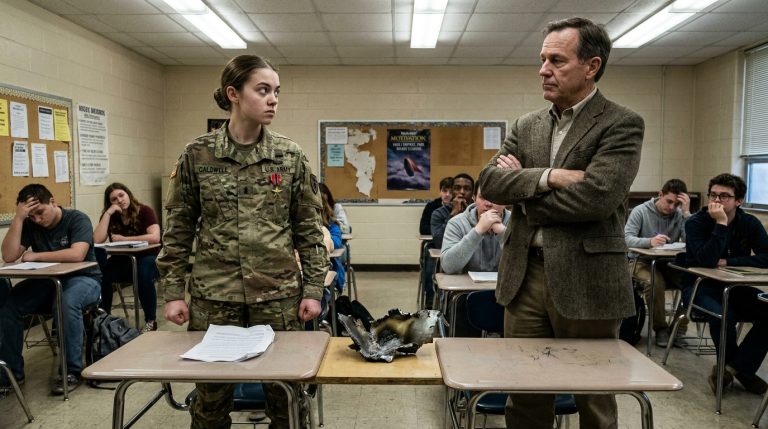
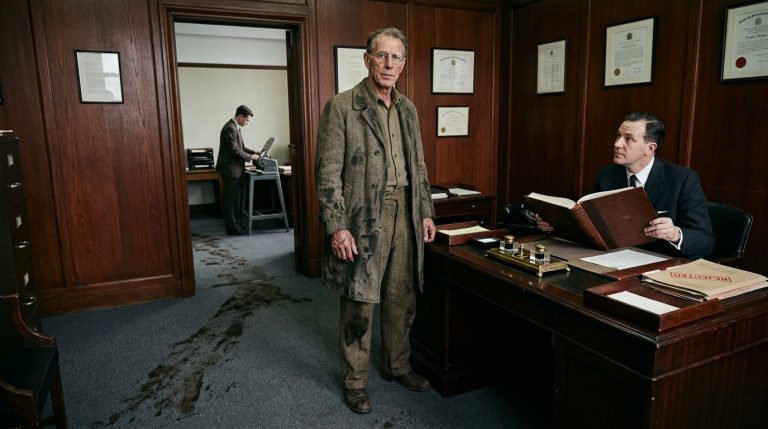
The ledger slammed onto the mahogany desk with a dull, flat thud.
Belle did not look up immediately. He kept his pen moving across the column of figures, his hand steady against the dry parchment.
Nichols stood on the other side of the partition. His boots were gray with dust from the rail yards, and his uniform jacket was buttoned tight to the throat despite the stale heat of the room.
Six thousand tons. The number sat between them like an unexploded shell.
Belle stopped writing. He raised his chin, his eyes settling on the younger officer with a cold, flat skepticism.
The Treasury operates in troy ounces, Nichols. Every bar is accounted for down to the grain. You are asking for a number that does not exist in our books.
Nichols did not shift his weight. He kept his fingers flat against the edge of the polished wood, feeling the cold grain beneath his palms.
We are not asking to borrow reserves for a ledger adjustment, Sir. The project requires mass, and it requires it immediately.
Belle leaned back, the leather chair groaning under the sudden shift in weight. He reached for a cold glass of water on the side table, his fingers wrapping around the condensation.
You talk about war scale as if the vault is an open quarry. That silver backs the currency of this nation. It does not sit around waiting to be hauled off to some nameless valley in Tennessee.
The silence stretched, thick and unyielding, broken only by the distant clatter of a typewriter down the hall.
Nichols let out a slow, controlled breath, keeping his gaze locked on the older man’s face.
If we don’t secure the metal, Belle, the conversation won’t be about currency. There won’t be an economy left to balance.
CHAPTER 2: HEAT IN THE VALLEY
The foundation trenches cut through the Tennessee clay like open wounds.
Heavy wooden shoring groaned under the weight of the rain-soaked banks, threatening to slide back into the mud before the pour could set.
Nichols stepped off the running board of the command car, his boots sinking two inches into the red muck.
The procurement manifest was soaked through at the edges where the rain had caught it.
We don’t have the copper for the auxiliary windings, Major, the site engineer muttered, wiping a streak of black grease across his forehead with the back of a cracked hand. The last shipment from the railhead was re-routed to the shipyards in Philly.
Nichols did not blink. He stared past the man at the sprawling skeletal frame of the first primary building rising from the valley floor.
Then we stop waiting for copper, Nichols said, his voice flat and hard against the drone of the diesel generators. We use what is sitting in the vault.
The engineer let out a dry, humorless bark of laughter that didn’t reach his eyes.
You want to wind multi-ton electromagnets out of coinage silver? The supply chain will have a fit before the first billet even clears the furnace.
Let them scream at the paperwork later, Nichols said, snapping the scarred clipboard against his thigh with a sharp crack. Right now, the magnets need to be built before the winter freeze locks this valley solid.
He turned away from the muddy track, his gaze fixing on a peculiar, iridescent oily film pooling beneath the seals of a test vacuum tank sitting in the staging yard.
It shimmered with a sickly rainbow sheen under the pale gray light, refusing to mix with the water pooling around its base.
Nichols crouched down, his fingers hovering just above the oily sludge without touching it.
What is leaking from the gasket, Sergeant?
The mechanic stepped closer, squinting through the damp air and shaking his head.
Condensation mixing with the seal-coating, sir. It gums up the intake lines every time we bring the pressure down.
Nichols rose slowly, his knees popping in the cold air as he stared down at the dark metal cylinder.
Clean it out and seal it again, Nichols muttered, his jaw tightening as the reality of the machine’s fragility pressed down on him. We don’t have time for leaks.
CHAPTER 3: THE COLD IRON SHIFT
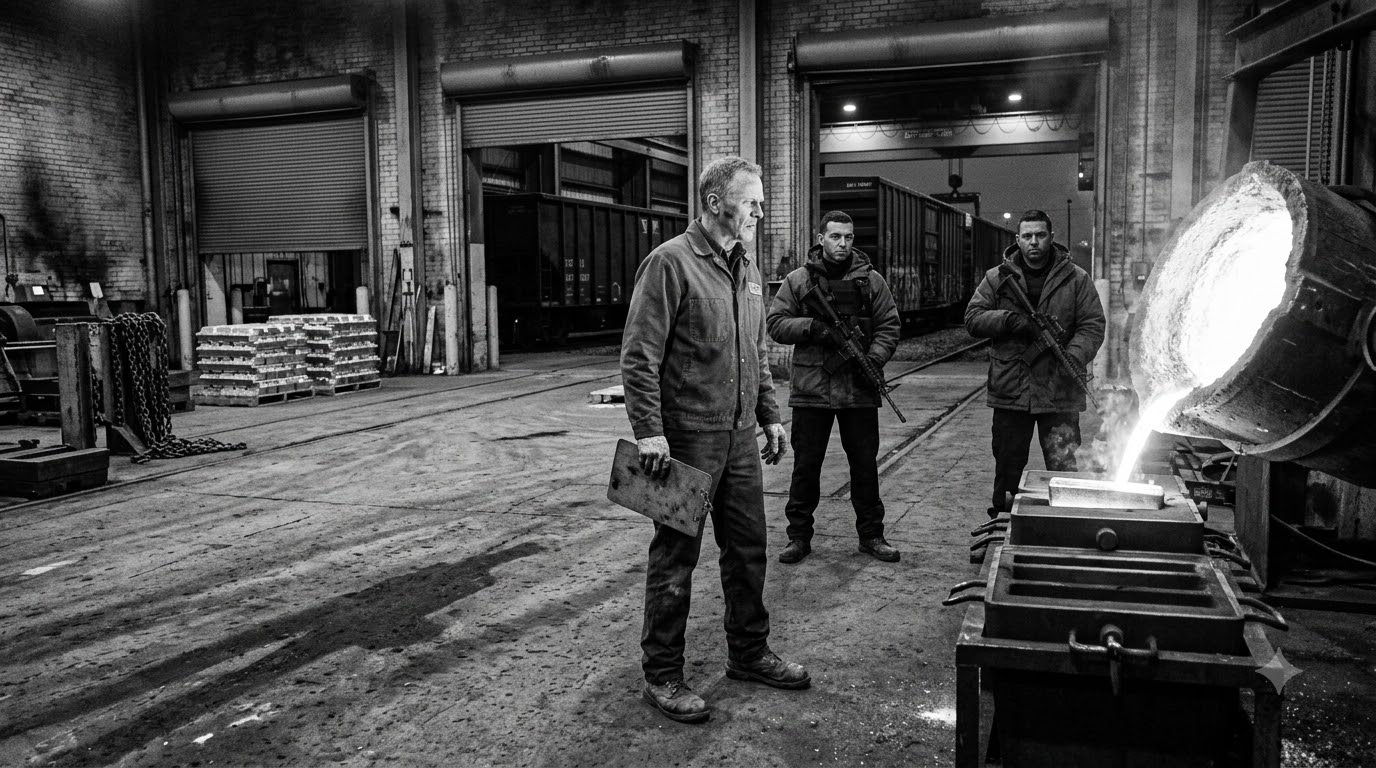
The crane shrieked as iron chains bit into the corners of the uniform bullion crates.
Guards stood shoulder-to-shoulder along the perimeter of the foundry floor, their rifles held at a low, heavy ready.
Each bar of silver slid from its wooden housing with a dry, metallic rattle that echoed off the soot-stained brick walls.
This isn’t warehouse stock anymore, Colonel, the shift foreman muttered, his eyes darting nervously toward the open loading bays.
Nichols didn’t answer right away. He kept his gaze locked on the stack of metal as the massive induction furnace roared to life behind them, casting long, writhing shadows across the concrete floor.
It never was, Nichols said, his voice dropping low beneath the rising whine of the generators. Feed it into the crucible.
The first thousand-ounce bar slipped over the lip of the firebrick lining and vanished into the blinding orange interior.
The metal didn’t spark; it simply collapsed, melting down into a heavy, swirling pool of liquid wealth that seemed to absorb the ambient light of the room.
A sharp, metallic tang filled the air, sticking to the back of the throat like dry copper dust.
They weren’t just melting bars; they were erasing the visible history of the nation’s currency to feed a machine that didn’t have a name yet.
Every ladle had to be accounted for down to the last decimal grain before it was poured into the extrusion molds.
The foreman wiped a soot-stained hand across his jaw, leaving a dark smudge that cut across his pale skin.
If a single ounce sticks to the ladle lining during the pour, Washington will have our badges before the month is out.
Nichols stepped closer to the edge of the pit, feeling the radiant heat bake straight through his uniform tunic.
Then we scrape the linings twice, Nichols said, his jaw tightening as he watched the molten stream pour into the long steel dies. We don’t leave anything behind for them to audit.
CHAPTER 4: THE DUST AND THE DIAL
The control room hummed with a low, oppressive frequency that vibrated straight through the floorboards.
Outside the heavy quartz glass, the vacuum tanks shifted three inches out of alignment under the brutal surge of the magnetic coils.
A sharp warning buzzer cut through the air, shrill and demanding.
The main vacuum seal is dropping pressure again, the young shift operator called out, her fingers hovering over the toggle switches without touching them.
Nichols stepped up behind the console, his eyes fixed on the flickering green trace of the ion beam.
Hold the voltage steady, Nichols said, leaning in close enough to feel the dry heat radiating off the instrument panel. Do not touch the rheostat.
The operator swallowed hard, her jaw tightening as a greasy residue began to crust along the edges of the viewing slit.
If that residue blocks the collector slit completely, we lose the entire day’s run.
Let it clog, Nichols muttered, his fingers gripping the edge of the metal console until his knuckles went white. We scrape it clean by hand before we let the alignment drift another millimeter.
He reached down, grabbing a long-handled wiper tool from the maintenance rack and shoving it into the airlock chamber.
The machine bucked against the floor, vibrating with the stubborn, brute-force resistance of bad physics and worn tolerances.
Keep your eyes on the green zone, Nichols warned, jaw clenched as he forced the wiper through the gunk-choked seal. The machine doesn’t care about our schedules.
CHAPTER 5: THE FINAL ARC
The indicator needles on the central control bank swung hard into the green zone, trembling under the massive electrical load.
Across the sprawling concrete floor, hundreds of young operators stood shoulder-to-shoulder, their eyes locked on the endless rows of dials.
They didn’t understand the physics of isotope separation, and they didn’t need to.
They followed the strict discipline of the dials, correcting drift instantly without hesitation or academic theorizing.
A shift supervisor hurried over, his boots clicking sharply against the concrete as he wiped sweat from his brow.
The output logs from the beta racetrack just crossed the threshold, sir. We’re hitting enrichment targets ahead of schedule.
Nichols did not drop his wrench. He stared through the reinforced glass at the humming vacuum chambers vibrating with raw, unyielding power.
Tell the crews to keep their hands on the toggles, Nichols said, his voice flat and cutting through the ambient hum of the generators. One second of hesitation and the whole alignment drifts.
The supervisor nodded, turning back to the rows of operators whose steady hands kept the beam focused through every microscopic wobble and grease-clogged slit.
The academic scientists from Berkeley had argued for weeks over theoretical anomalies and molecular curves.
The operators ignored the theory and simply executed the mechanical routine with ruthless consistency.
A faint, pale smear of material settled into the collector cups on the far side of the massive magnetic coil, marking the boundary where desperation finally met hard-earned results.
Nichols watched the collection gauge stabilize, his grip finally easing just a fraction against the cold steel handle.
We keep feeding the line until the core is full, Nichols said, his eyes narrowing as he calculated the weight of the silver coils humming in the dark. We don’t stop for anything.