The Quiet Dust of Texas Stretched Beyond the Horizon, Where a Broken German Radio Operator Found an Unlikely Sanctuary Among Former Enemies
CHAPTER 1: THE IRON TRUCK GATES
The iron latch of the truck gate dropped with a hollow clatter that scraped against the wide, empty silence of the Texas morning.
Leona Mannheim blinked against the harsh glare, her fingers tightening around the canvas strap of her faded uniform bag.
The air smelled of dry dust, sun-baked earth, and something sweet and green drifting from the distant mesquite trees.
She stood frozen beside the rusted bumper, waiting for the anticipated barked orders and the heavy thud of rifle butts against dirt.
Instead, a boot crunched lazily on gravel.
A tall man in a dust-stained denim shirt and a wide-brimmed hat stepped into her field of vision, holding out a tin cup of water without a word of warning.
His face was mapped with deep sun lines, his eyes crinkling at the corners as he tilted the cup toward her gloved hand.
Drink it down, ma’am, he said, his voice slow and heavy like gravel rolling in a dry creek bed. Long ride from the railhead.
Leona stared at the chipped metal rim, her throat burning with salt and fatigue, yet every instinct warned her of a trap.
Behind him, the open plains stretched out toward an endless blue sky that felt entirely too vast for a prisoner of war.
She took the cup with a trembling hand, her fingers brushing his calloused knuckles as she swallowed the cold, clear water in a single breath.
CHAPTER 2: COFFEE AND CORRALS
Frank Callahan lowered the heavy galvanized bucket with a dull thud, his boots sinking an inch into the packed corral dirt.
He didn’t offer a smile, nor did he bark an order.
He simply watched her finish the water, his eyes tracking the fade of tension in her shoulders.
Over by the main barn, two other ranch hands were unlatching wooden gates, letting a dozen restless horses spill into the open morning air.
The air smelled sharp—a mix of dry dung, leather oil, and the dry, sweet scent of crushed buffalo grass beneath heavy hooves.
Leona set the cup down on a weathered fence post, where a dark circle of moisture was already evaporating under the steep climb of the Texas sun.
You’re Leona, aren’t you? Frank asked, pulling a rolled cigarette from his shirt pocket without lighting it.
I am, she said, her voice tighter than she intended, clinging to the remnants of her military bearing.
Well, Leona, the horses don’t care about uniforms or what happened across the Atlantic, Frank said, gesturing toward a chestnut mare standing quietly by the water trough. Saddle’s in the tack room. If you want breakfast, you earn the grease on the skillet.
He turned his back before she could formulate a response, walking toward the corral fence with a slow, deliberate stride that lacked any hint of military crispness.
The other women were moving now, hesitatingly nudged forward by the quiet curiosity of the ranch hands rather than the crack of a whip.
Leona looked down at her polished leather boots—ruined by weeks of mud and cargo holds—and felt a strange, hollow quiet settle in her chest.
She walked toward the tack room, her fingers brushing the rough pine of the wall as a sudden, sharp gust of wind rattled the corrugated tin roof above.
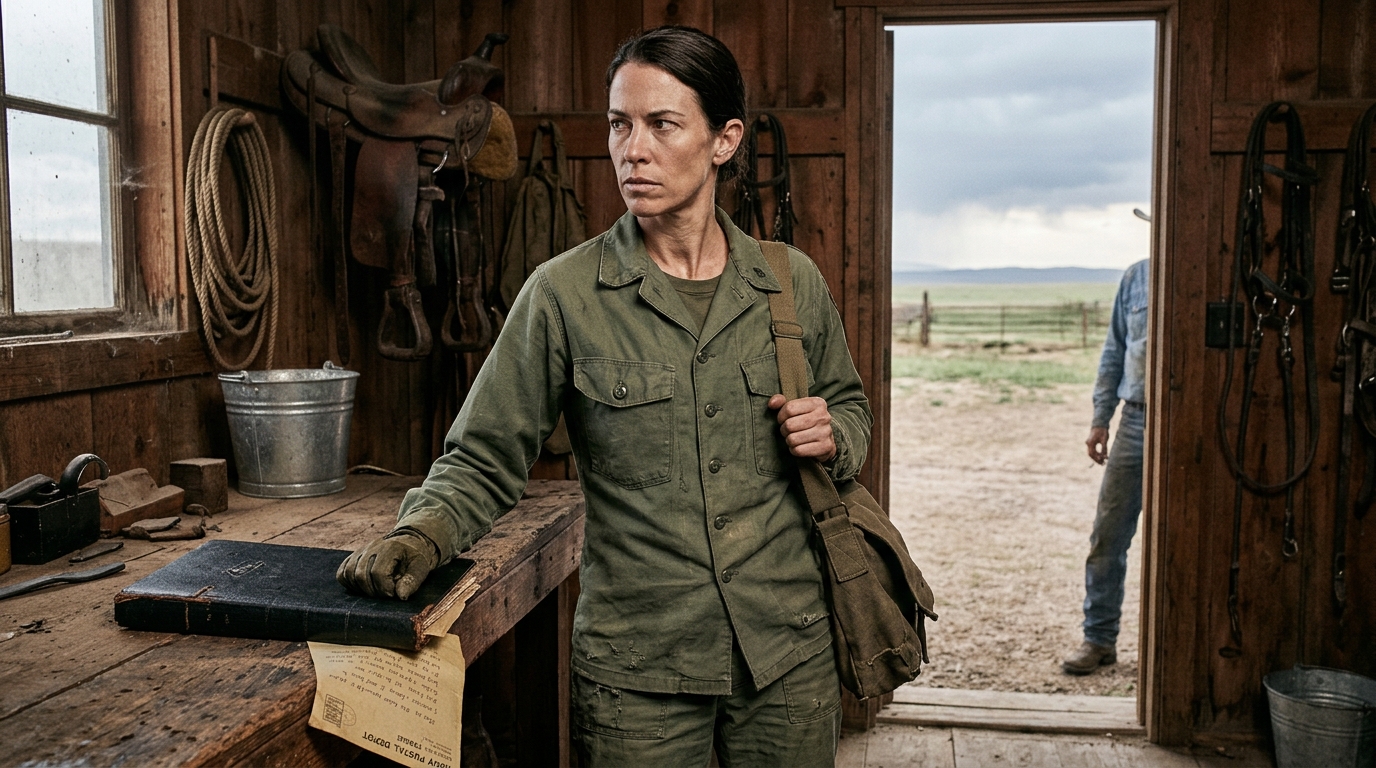
Inside the dim shed, shafts of golden light cut through the dust motes, illuminating rows of heavy leather saddles and oiled bridles hanging from wooden pegs.
Near the back corner, resting on a low workbench beside a tin of axle grease, lay an open ledger bound in cracked black leather.
A single sheet of paper protruded from the middle of the book, its edges yellowed and covered in tight, sloping handwriting that wasn’t Frank’s.
Leona paused, her hand hovering inches from the leather binding as she caught the distinct, unintended glimpse of a folded return address marked from an army postal depot in France.
The front page of the ledger listed feed counts and cattle tallies, but the loose paper bore no inventory numbers—only a sharp, unfinished sentence addressed to a boy who would never ride this fence again.
CHAPTER 3: THE GATHERING STORM
The single shaft of light across the workbench flickered as a heavy roll of gray clouds slammed over the ridge of the roof.
Outside, the cicadas stopped their dry hum instantly, replaced by a deep, hollow pressure dropping across the open Texas plains.
Leona folded her palms against the rough denim of her trousers, wiping away the faint smudge of old ink she had barely brushed.
The words on that hidden paper weren’t meant for a prisoner’s eyes, yet they hung in the dim tack room air like an unexploded shell.
A heavy boot scraped gravel outside the open doorway, and Frank Callahan stepped into the dim interior, ducking his head beneath the low lintel.
You finding what you need in here, Leona? Or are you just hiding from the wind?
She didn’t flinch, keeping her posture rigid despite the sudden tightening in her chest.
I was looking for a bridle, Mr. Callahan, she said evenly, her voice steady against the rising whistle of the wind through the eaves.
Frank looked past her shoulder toward the workbench, his gaze lingering on the closed ledger for a fraction of a second too long before his eyes flicked back to her face.
The wind’s coming around hard from the west, he said, turning back toward the sunlight fading at the threshold. Get those corral gates bolted down before the rain turns this dust into a trap.
He didn’t ask if she saw the paper, and she didn’t mention it, but the silent weight between them shifted like shifting soil beneath a heavy load.
Outside, the sky turned the color of bruised slate as the first heavy drops of rain began to pit-pat against the sun-baked ground.
The other women were already running from the stables, clutching their straw hats as the tempest broke with sudden, blinding fury across the plains.
Leona grabbed a heavy iron chain from the corner of the shed, her teeth gritted against the rising roar of the storm.
CHAPTER 4: THE LEDGER SECRET
The padlock clicked into place with a sharp, metallic bite that barely cut through the wet roar of the wind outside.
Leona pressed her back against the rough pine wall, her chest heaving as she listened to the rain hammer the corrugated tin overhead.
Inside the dim shed, the air smelled of stale canvas, damp horse blankets, and old paper left too long in the dark.
She reached into her coat pocket, her fingers brushing the crisp, folded edge of the unmailed V-Mail she had slipped away from the ledger.
It wasn’t an act of espionage; it was an anchor in a world that had suddenly turned upside down.
She unfolded the thin paper by the faint, gray light filtering through the high window, her eyes scanning the ink written by a hand that would never hold a reins again.
—He’s not coming back to the south pasture, Frank— the cramped handwriting whispered off the page, detailing a casualty report from the hedgerows of Normandy.
The heavy silence of the shed pressed down on her, replacing the noise of the storm with a much heavier, localized grief.
Frank Callahan wasn’t running a prison camp out of kindness or corporate policy; he was preserving the ghost of a boy who had loved these wide-open horizons.
A boot heel ground against the gravel outside the threshold, followed by the slow, heavy creak of the outer gate swinging loose in the wind.
Leona shoved the paper back into the ledger, her knuckles rapping sharply against the cracked leather binding as a shadow darkened the doorway.
CHAPTER 5: THE TOWNS SHADOW
The silhouette filled the frame, broad-shouldered and wearing a clean wool coat that smelled of wet town dust rather than barn straw.
Sheriff Vance didn’t knock on the open jamb; he stepped straight across the threshold, his heavy boots grinding grit into the wooden floor.
You’ve got outsiders running loose in the main pens, Callahan, Vance said, his voice flat and hard as a limestone slab. The county council didn’t approve labor details just to watch them mingle with the livestock like they own the place.
Frank stepped out from the shadow of the feed bins, his jaw tight, his hands resting loose and empty at his sides.
They’re doing the work we hired them for, Vance, Frank said, the low rumble of his voice carrying no room for argument.
That isn’t your call to make alone anymore, the sheriff muttered, stepping closer while his gaze flicked suspiciously toward the workbench where the ledger lay half-open. People in town are talking about what happened across the sea, and they don’t want the enemy walking free down our main roads.
Leona stood motionless beside the back shelf, her hand slipping down to grip the cold edge of a spare horseshoe.
Vance shifted his weight, his eyes locking onto Leona with a sharp, accusatory glare that treated her less like a worker and more like stolen property.
You’re harboring more than just farm help in this old barn, Callahan, and the committee’s coming out here tomorrow morning to clear these pens out for good.
CHAPTER 6: THE DIVIDED HORIZON
The heavy double doors of the barn remained wide open, letting the cool morning breeze sweep away the lingering tension of the previous night.
Sheriff Vance’s truck sputtered to life by the main gate, its exhaust rattling against the empty gravel road before disappearing over the ridge.
Frank Callahan didn’t watch him leave, instead turning his attention back toward the feed bins where Leona stood holding her ground.
The ledger lay closed on the workbench, the unmailed V-Mail letter safely tucked inside its cracked leather spine where grief and duty finally met.
You don’t have to carry that weight alone, Leona said quietly, setting the heavy iron piece back onto the wooden shelf with a soft thud.
Frank looked out across the sunlit pastures where the cattle grazed undisturbed beneath the vast, unobstructed Texas sky.
The work still needs doing, ma’am, and the fence lines won’t mend themselves while we argue about who we used to be, he replied, a faint, weary understanding softening the hard lines of his face.
The other women were already stepping out into the sunlight, carrying buckets and tack with the steady, quiet rhythm of people who had found an anchor in the storm.
There were no grand speeches, no sudden declarations of victory, only the honest friction of common sense prevailing over bitterness and fear.
Leona reached up, adjusting the wide brim of her hat as she stepped out into the bright morning air to finish what they had started together.