The Bridge at Nijmegen: How One Man’s Final Stand Wrote Six Hundred Names Into Eternity
CHAPTER 1: THE VOLUNTEER
The bridge timbers shuddered beneath the heavy boots of six hundred men moving in disciplined, unbroken rhythm toward the southern bank.
Sergeant John Mercer stood motionless fifty yards from the northern abutment, his fingers clamped around the warm wooden stock of his M1 Garand.
His platoon sergeant stopped three paces short, his face smeared with grease and gray canal silt, staring hard through the autumn haze.
“You know what this is, Mercer,” the sergeant said, his voice dropping into a harsh rasp against the wind. “You got a girl back in Pennsylvania. You got three years of life waiting.”
Mercer did not look back at the retreating column, keeping his eyes locked on the tree line two hundred yards up the road where the first German scouts were beginning to spill out of the brush.
“Every man in that column has someone waiting,” Mercer said, his thumb resting lightly on the safety catch. “That’s why I’m standing right here.”
The sergeant stared at him for one long, unblinking second, slapped a heavy canvas bandolier of ammunition onto the concrete beside Mercer’s boot, and turned back toward the south.
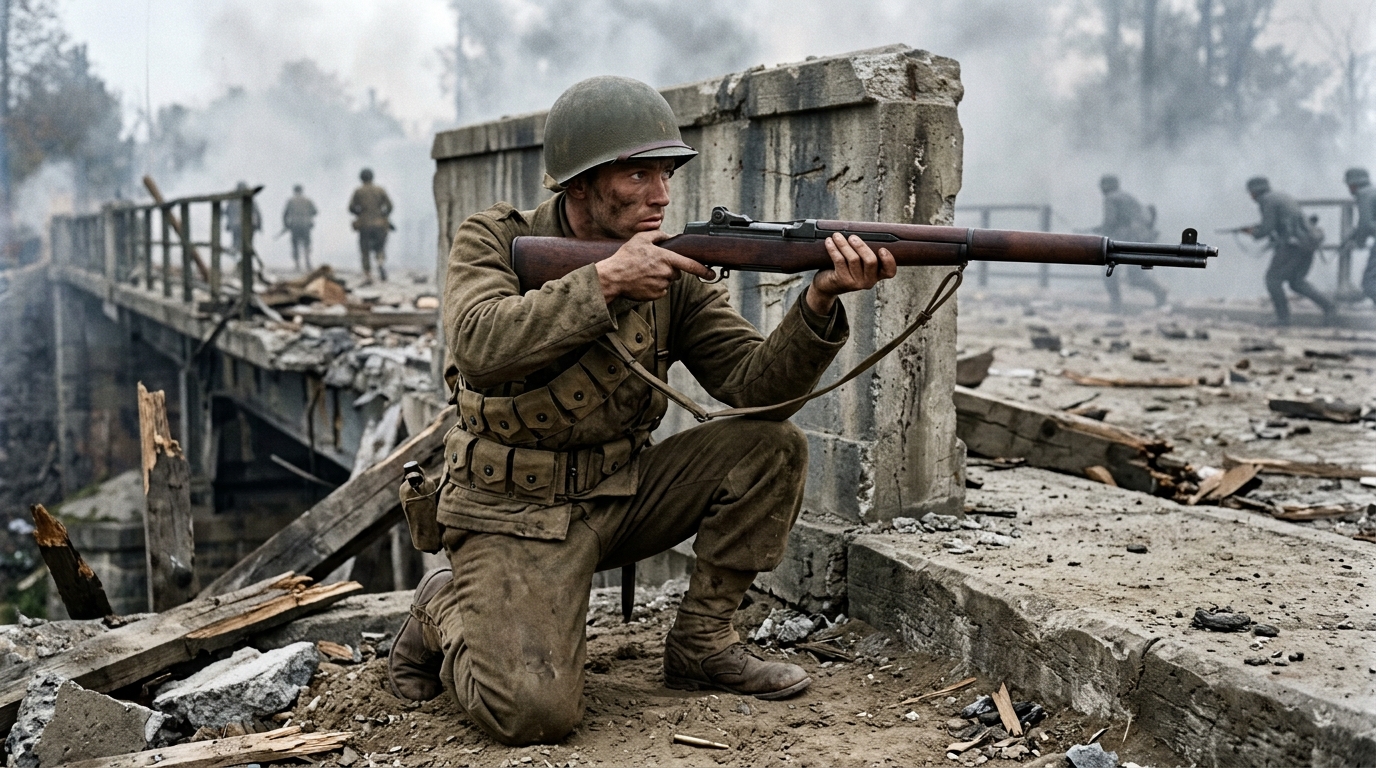
Mercer dropped to one knee, pulled the oil-stained cotton handkerchief from his breast pocket to wipe a streak of sweat from his receiver, and chambered the first round.
CHAPTER 2: FIRST CONTACT AT DUSK
The first gray shapes detached themselves from the smoke hanging over the northern road, moving low with disciplined, rhythmic strides.
Mercer did not blink. He tightened his grip on the walnut stock, feeling the rough grain bite into his palm as the lead scout stepped past the two-hundred-yard marker.
The silence hung heavy, broken only by the steady hiss of the wind off the grey water below.
Mercer centered the front sight blade on the center of mass, squeezed the trigger back until the metal wall broke clean, and watched the lead silhouette drop without a sound.
The bolt slammed home with a sharp metallic clack, throwing a spent brass casing that bounced off the stone and rolled toward a solitary unspent cartridge lying half-buried in the mortar dust.
A sharp spray of ricocheting lead chewed the sandbag directly beside Mercer’s left shoulder, sending a stinging shower of grit across his cheek.
“Keep your heads down,” Mercer muttered to the empty air, shifting three feet to his left as a burst of automatic fire stitched the concrete where he had knelt a second before.
The figures across the asphalt scattered into the ditches, returning sporadic rifle fire that chipped the bridge parapet into powdery white dust.
Mercer worked the bolt again, his thumb catching the edge of the clip with mechanical precision while his eyes scanned the drainage ditch for the next movement.
CHAPTER 3: THE IRON THRESHOLD
Gray smoke rolls thick across the fractured asphalt, carrying the sharp, stinging scent of scorched earth and pulverized mortar.
Mercer drags his bruised knee across the abrasive deck of the bridge, sliding thirty feet west behind a massive iron girder before the next concussive wave hits the stonework.
The air grows heavy with heat and sulfur, burning the back of his throat with every ragged breath he draws in the confined shadow of the span.
“Keep moving back,” Mercer mutters to himself, his fingers sliding into his breast pocket to check the frayed cotton handkerchief that stays damp with cold sweat.
A fresh wave of rifle fire pings against the vertical steel beams above his head, showering his woolen cap with tiny iron flakes and gray chips of paint.
Mercer drops his magazine follower, checks his remaining clips by touch alone, and counts the dead weight of the brass ticking down inside his canvas pouch.
CHAPTER 4: THE IRON MONSTER
The low metallic rumble shakes loose flakes of rust from the underside of the stone arches, raining a fine orange dust onto Mercer’s woolen cap.
He presses his back flatter against the curved steel plate of the girder, feeling the sheer bulk of the approaching tank vibrate straight through his joints.
There are no anti-tank weapons in his pouch, no hidden surprises, only the walnut stock of his rifle and the stubborn refusal to budge an inch.
“Keep rolling,” Mercer mutters under his breath, watching the long seventy-five-millimeter barrel traverse slowly toward the center of the span.
The hatch on the turret cranks open with a sharp screech, and a gray-uniformed commander emerges halfway to scan the deserted approach with field glasses.
Mercer sights on the gap beneath the turret ring, his finger feathering the trigger as the distance closes down to three hundred yards.
CHAPTER 5: THE FINAL CROSSING
The last heavy boots pound across the limestone planks, fading into the rhythmic murmur of the main column regrouping on the southern bank.
Mercer stays pinned behind the stone abutment, his left arm hanging limp while warm blood seeps through the coarse wool of his field jacket.
Across the fractured road, the enemy infantry surges forward to occupy his abandoned rifle pit, their shouting voices echoing off the steel trusses above.
“Time’s up,” Mercer whispers, his fingers hooking into the final two clips of ammunition left in his canvas pouch.
He risks a glance over the low stone parapet, watching the vanguard close the gap down to thirty paces with rifles raised and ready.
There is no friendly artillery coming down the line, no voice on a radio to call an easy retreat, only the hard cold weight of his own breathing.
CHAPTER 6: THE LONG ECHO
Steel tracks crush the limestone rubble of the bridgehead as heavy armor rolls across the span, sweeping the enemy line back into the northern mist.
Mercer pulls himself up against the stone parapet, his left shoulder burning with a dull, throbbing weight while relief infantry fan out past his position.
Colonel Hayes steps down from the lead vehicle, his eyes scanning the empty shells scattered across the concrete before stopping squarely on Mercer’s blood-stained jacket.
“You held them,” Hayes says, his voice flat with raw disbelief as he checks his watch against the fading daylight.
“Four hours and twenty-innitus,” Mercer breathes, letting the rifle slide against his thigh with a dull metallic thud.
The promise made months ago in Millbrook settles deep into his chest, transforming the cold Pennsylvania memories into a quiet, enduring reality where six hundred men are finally safe.
Years later, the town of Millbrook stands unchanged except for the iron street signs bearing six hundred names—with Mercer walking home each evening down Private Anthony Russo Street, surrounded by the quiet echoes of the lives he bought.