Forging Steel from Scrap: The Dusty Gray Struggle to Build the Navy’s Unsung Floating Runways
CHAPTER 1: THE RUSTED HULL
Arthur wiped a smear of heavy engine grease across his forehead and stared up at the towering, grime-streaked side of the condemned freighter.
The port authority had condemned the old merchant hull three weeks ago, citing dry-rot and obsolete framing that made it useless for the war effort.
Arthur adjusted the worn brass caliper in his coat pocket, his thumb rubbing instinctively over its scarred hinge as he listened to the rhythmic pounding of rain against the rusted iron plates.
“You’re wasting your time, Arthur,” muttered Miller, pulling his wool collar tight against the freezing wind sweeping off the gray North Atlantic. “The admiralty signed off on her scrap value yesterday. You can’t turn a floating oil-can into a flight deck.”
Arthur didn’t look up from the warped plating.
The bureaucrats in London wanted pristine blueprints and endless committee meetings while the Atlantic convoys burned under long-range raiders.
“They looked at the ledger and saw a liability,” Arthur said, his voice grating like dry gravel. “I looked at the hull and saw twelve hundred feet of flat steel that doesn’t care about their treaty limits.”
A sudden shout echoed from the harbor gates, breaking the steady roar of the surf.
Two men in crisp, dry naval overcoats were picking their way through the mud toward the dry-dock, their polished boots entirely unsuited for the grime of a working civilian yard.
Arthur tightened his grip on the grease gun, his jaw tightening as he recognized the sharp, self-satisfied stride of Port Inspector Vance.
“Looks like our paperwork just caught up with us,” Miller muttered, stepping back into the shadow of the rusted winch house.
Arthur didn’t move an inch, his eyes locked on Vance’s approach.
“Let them try to stop us,” Arthur whispered, turning back to the cold iron of the hull.
CHAPTER 2: STRIPPED MACHINERY
The rusted hinges of the storage locker groaned under Miller’s weight as he hauled the iron door back.
The interior was pitch black, smelling of stagnant bilge water and old grease.
Arthur reached past him, his fingers brushing against empty wooden brackets where the pneumatic riveting tools should have been bolted down.
“They’re gone,” Miller breathed, his voice dropping an octave as the biting wind howled through the skeletal ribs of the old freighter. “Every last compressor and pneumatic gun. Cleaned out before dawn.”
Arthur didn’t panic, though a cold knot tightened in his stomach.
The harbor records showed the tools had been signed over to the maintenance depot yesterday, but the fresh tire tracks in the mud outside told a different story.
Someone wanted this dry-dock dead before the first plate could be welded.
“They thought we’d pack up and leave the moment we saw empty shelves,” Arthur said, his hand sliding into his pocket to grip the cold, scarred metal of his brass caliper.
A sharp metallic clatter echoed from the lower hold—a sound that didn’t belong to the dripping rain or the shifting tides.
Arthur signaled with a quick jerk of his chin, moving silently across the damp steel deck toward the companionway stairs.
The darkness below smelled faintly of burnt oil and fresh wood shavings, completely at odds with the derelict state of the rest of the ship.
Arthur ducked beneath a low overhead beam, his boots crunching quietly on something unexpected scattered across the rusted floorboards.
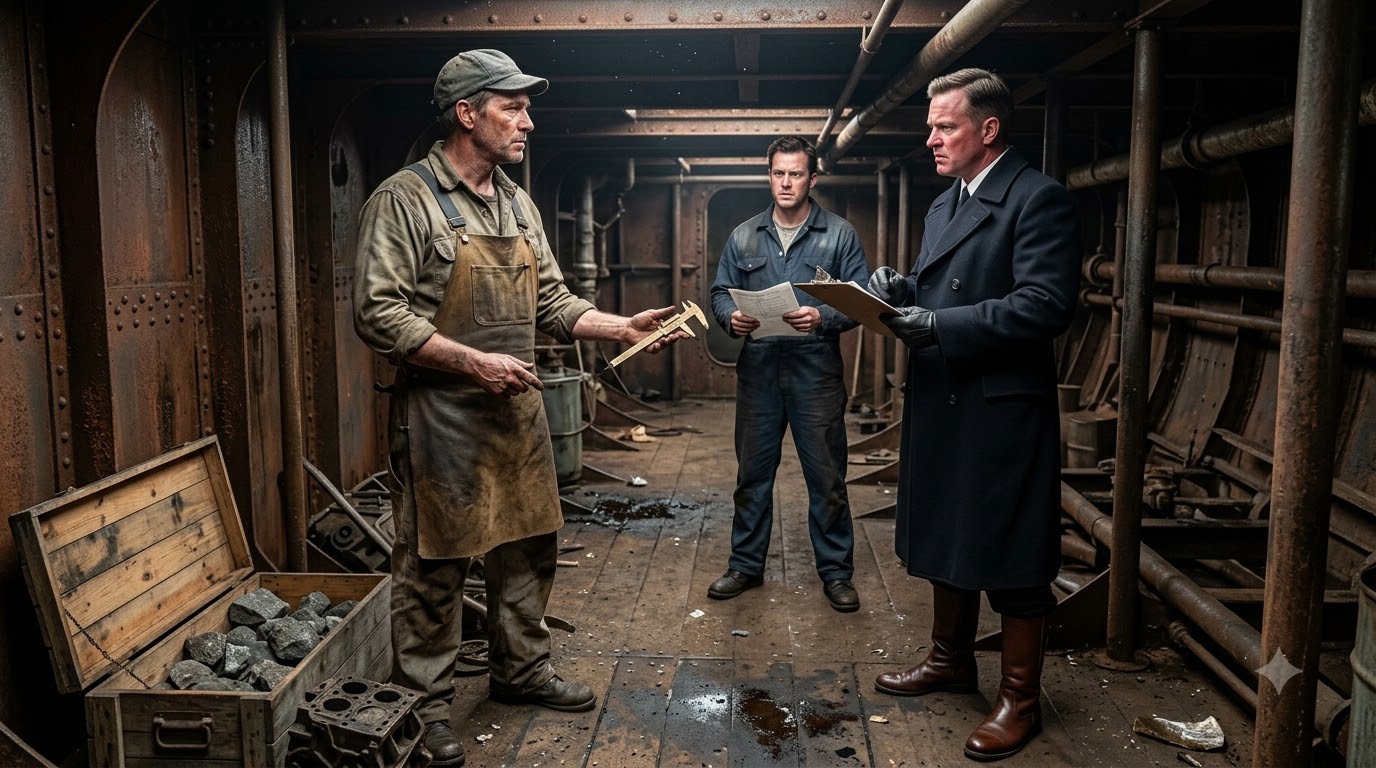
He crouched, scraping his fingers through the dust to pull up a heavy, steel-strapped shipping manifest dropped beside a row of sealed crates.
The stamp on the paper bore the seal of the naval supply board, officially listing the contents as heavy-duty aviation fuel pumps desperately needed for the flight deck conversion.
Arthur pried open the nearest crate with the flat edge of his caliper, his eyes narrowing in the dim light.
There were no pumps inside.
The heavy wooden box was packed entirely to the brim with jagged basalt ballast rocks and chunks of cracked engine blocks.
Miller stepped up behind him, his breath fogging in the freezing air as he stared down at the deception.
“They aren’t just starving us of tools,” Miller whispered, his voice tightening with sudden realization. “They’re burying the whole project under a mountain of paper fraud.”
Arthur stood up slowly, the weight of the forged manifest heavy in his palm.
“No,” Arthur said, his voice dropping into a hard, flat register as heavy footsteps began descending the steel stairs behind them. “They just gave us the exact leverage we need.”
CHAPTER 3: THE BUREAUCRATIC WALL
Vance planted a polished leather boot on the bottom rung of the companionway, blocking the only way out of the lower hold.
He didn’t look at the basalt crates or the open manifests scattered across the floorboards.
“You’re trespassing on condemned government property, Arthur,” Vance said, his voice echoing flatly against the damp iron bulkheads. “The ministry issued a stop-work order on this hulk four days ago, and yet I hear hammers ringing on steel before dawn.”
Arthur kept his weight balanced on his heels, his thumb sliding rhythmically over the scarred brass caliper inside his coat pocket.
“The ministry signed off on scrap because they didn’t want to admit their treaty math left the convoys naked,” Arthur said, his tone flat and unyielding.
Vance’s mouth tightened into a hard, bloodless line as he stepped closer, using his height and his pristine uniform to crowd the narrow aisle.
“You don’t write the naval budget, old man,” Vance snapped, tapping a leather-gloved finger against the forged manifest still clutched in Miller’s hand. “You take what the board allocates, or you pack up your tools and get off the pier.”
“We would take what’s allocated,” Arthur replied, his eyes narrowing as he gestured toward the open crate of ballast stones behind the inspector. “Except your supply board seems to think merchant freighters run on heavy rocks instead of fuel pumps.”
Vance glanced sideways at the crate, his expression not showing surprise, only a cold, practiced irritation.
“Administrative delays happen in wartime,” Vance said smoothly, refusing to blink. “A clerical error on the requisition forms doesn’t give a civilian contractor the right to tear down bulkheads without a signed warrant from London.”
“That error cost three ships in the channel last Tuesday,” Miller muttered, stepping forward from the shadows before Arthur could check him.
“Keep your mouth shut, mechanic,” Vance snarled, his face flushing a dull, angry red as he turned his full fury onto Miller. “You’re operating outside the rules, and I can have this entire dry-dock cleared and padlocked by noon under emergency shipping laws.”
Arthur stepped between them, his boots grinding sharply against the metal deck to break the line of sight.
“You can try,” Arthur said quietly, pulling the scarred brass caliper entirely out of his pocket and letting it rest openly in his palm. “But if you padlock this pier today, I hand these shipping manifests to the coastal patrol commander before the evening tide.”
CHAPTER 4: THE PHANTOM SHIPMENT
Vance’s eyes dropped from Arthur’s face to the open shipping manifest resting on top of the basalt crates.
The silence in the lower hold stretched thin, broken only by the steady drip of rainwater through the rusted seams overhead.
“You’re holding a forged document for requisitioned military stores,” Vance said, his voice dropping into a harsh, tight whisper as he tried to regain his footing. “That’s a federal offense, Arthur. I can have you and every man in this yard thrown in a military prison by nightfall.”
Arthur didn’t flinch, his thumb maintaining a slow, rhythmic circle against the hinge of the brass tool in his coat.
“It would be a federal offense if I forged it,” Arthur replied, his voice flat and steady. “But it bears the ink stamp of the district supply depot, signed by your own junior clerk three days before the delivery run.”
Vance stepped forward, reaching out a gloved hand to snatch the paper from Miller’s grip.
Arthur moved faster, snapping the caliper shut with a sharp click that echoed like a pistol shot in the confined space.
“Don’t touch it,” Arthur said, his eyes locking onto the inspector’s panic-stricken expression. “The coastal patrol commander isn’t interested in paperwork memos, Vance. He wants to know why convoy escorts are waiting on fuel pumps while cargo holds are stuffed with roadside gravel.”
The color drained entirely from Vance’s face, leaving his skin the gray, sickly shade of wet cement.
“You don’t understand how the funding works,” Vance stammered, his professional composure finally cracking as he took an involuntary half-step back. “The dreadnought refit at the main naval yard ran three million over budget. If these auxiliary conversions take priority, the capital ship contracts get canceled.”
“So you buried the fuel pumps, falsified the delivery logs, and stripped the local dry-docks to protect a fleet of floating targets that can’t even catch a raider,” Miller said, his jaw tightening as he stepped up beside Arthur.
Vance’s breathing turned shallow and ragged, his eyes darting frantically toward the narrow steel stairs leading back up to daylight.
“You can’t publish this,” Vance hissed, his voice cracking with sudden desperation. “If the admiralty sees those manifests, the whole department goes down.”
“Then you’ll clear our permits by sundown,” Arthur said, his voice dropping to an absolute, unmovable wall. “And every missing riveting tool goes back onto this pier before the tide turns.”
CHAPTER 5: THE CORNERED DOCK
The sharp recoil of the door echoing through the hangar reminded Arthur of the freezing hangar decks at Scapa Flow where common-sense logistics were traded for polished mahogany desks in London.
He slid the brass caliper back into his coat pocket, his fingers wrapping around its cold hinge as he climbed the iron stairs out of the bilge.
Vance was waiting by the main loading platform, his face flushed and distorted by a sudden, frantic surge of desperation.
“You think a handwritten manifest stops an official ministry directive?” Vance shouted, his voice cracking against the wind as he tried to block the exit with his own body. “I’ll have the gate guards lock you out of this yard within the hour under national security protocols.”
Arthur didn’t slow his stride, his heavy boots crunching steadily across the gravel path toward the main gate.
“You can try calling the guardhouse,” Arthur said, his voice dropping into a flat, level register that cut through the noise of the surf. “But the patrol commander is already reviewing the discrepancy between your fuel requisitions and these stone crates.”
Vance lunged forward, grabbing the sleeve of Arthur’s canvas jacket with shaking fingers.
“Listen to me, you stubborn old fool—if the audit hits the desk of the naval board, every capital ship contract gets frozen for six months,” Vance hissed, spittle flecking his dry lips as his eyes darted wildly toward the open street. “We lose the war in the Atlantic before the year is out just to save a few floating barges!”
Arthur yanked his arm free with a dry, leathery snap of fabric, staring down at the inspector with cold, exhausted contempt.
“You didn’t sink those ships with grand strategy, Vance,” Arthur said, stepping directly into the inspector’s path and forcing him back a full pace. “You did it by stealing the tools off working men to cover up a budget shortfall for ships that can’t even fit through the locks.”
Vance’s face twisted into an ugly, mask-like grimace as he realized every escape route had rusted shut.
“You won’t get this ship past the breakwater,” Vance spat, his voice dropping to a venomous whisper as he scrambled for a final piece of leverage. “The harbor master won’t issue clearance without my signature, and I’ll burn my own desk before I sign off on a floating coffin.”
Arthur turned his back on him without a word, walking straight toward the towering grey hull of the converted freighter where Miller was already lowering the loading ramp.
CHAPTER 6: IRON AND SALT
The old freighter shuddered from stem to stern as the auxiliary diesel engines caught, coughing a cloud of dense black smoke into the biting North Atlantic wind.
Arthur stood on the newly welded flight deck, his boots planted firmly against the vibrating steel plates while the dock lights slowly receded into the mist.
Miller leaned against the housing of the forward windbreak, wiping a final streak of grease from his forearm as the open sea stretched out before them.
“Vance is already on the telephone to district headquarters,” Miller said, his voice carrying easily over the roar of the exhaust. “By morning, they’ll have every harbor master between here and Scapa Flow looking for our heads.”
Arthur pulled the scarred brass caliper from his pocket, opening it to measure the gap on the guide rail before snapping it shut with a crisp, final click.
“Let them look,” Arthur said, his eyes fixed on the gray horizon where the Atlantic convoys fought their daily war in silence. “The admiralty wanted paperwork and polished desks while the channel burned.”
He ran a calloused hand across the cold, flat iron of the deck that common sense and stubborn endurance had built out of a condemned hull.
“We didn’t need their dry-docks or their blueprints,” Arthur muttered, turning his back to the wind as the first swell caught the bow. “We just needed a flat sheet of steel that didn’t care about their treaty rules.”
The ship cut steadily through the heavy grey waves, leaving the politics and the paper fraud far behind in the freezing salt spray.