The Daughter They Cast Out Returned to Hand Them Their Legacy in Ruins
CHAPTER 1: THE COLD THRESHOLD
The rain didn’t fall; it hammered the porch roof like gravel dumped from a truck.
Dad’s hand gripped the brass knob of the front door, his knuckles white against the dark oak finish. Behind him, standing on the polished hardwood of the entryway, my mother held a trembling twelve-year-old Madison against her hip. Madison’s face was buried in Mom’s cardigan, but her right eye was clear, dry, and fixed directly on me.
“You don’t get to stay under this roof and poison it,” Dad said. His voice wasn’t raised. It had that flat, dead density he used when a shipment arrived damaged at his hardware shop.
I rolled the tarnished brass house key between my thumb and forefinger in my coat pocket. The metal was cold, biting into my skin. “I didn’t touch her arm, Dad. Look at the shape of that bruise. It’s from her own grip.”
“She’s twelve, Olivia!” Mom snapped, her voice cracking across the narrow foyer. “She has your texts on her phone! She has the bruised arm! Are you going to tell me she forged an entire conversation with that boy from your chemistry class?”
“I don’t even have my phone,” I said, pointing to the kitchen counter where Dad had slammed it an hour ago. “Check the timestamp. Check the router logs.”
Dad didn’t look at the counter. He didn’t look at my face either. He looked at the wet doormat between us. “I’m not playing detective in my own home. You’ve been a dark cloud in this house since the day you decided your sister needed less than you. Take the slicker and get out.”
He shoved a yellow vinyl raincoat into my chest. It smelled of stale engine oil and mildew from the garage.
“It’s thirty-eight degrees outside,” I said. “The bus stopped running at seven.”
“Then you walk to the shelter on Fourth Street,” Dad said. He reached down, caught my shoulder with a grip that left no room for negotiation, and propelled me backward onto the porch.
The door clicked shut. The deadbolt slid into place with a sharp, heavy thunk.
I stood on the wet composite decking as the sky opened up in earnest. The wind caught the brim of the vinyl coat, whipping it against my jaw. Inside, through the frosted glass panel beside the door, three shadows moved away from the foyer and turned toward the living room fireplace.
I didn’t knock. I didn’t scream. I pulled the tarnished brass key from my pocket, slipped it onto the worn leather strap around my neck, and turned toward the street.
The storm turned the asphalt into a black river. Every passing headlights washed over me like a spotlight, but no cars slowed down. By the time I reached the corner of Elm and Eighth, my sneakers were logged with freezing runoff, water squelching inside the canvas with every step. My fingers were too stiff to pull the zipper of the vinyl slicker all the way to my chin.
At nine o’clock, I sat on the concrete bench inside the glass bus shelter near the closed public library. The glass panel behind me was shattered in the corner, allowing a steady draft of wind to spray fine mist across my neck.
I reached into my pocket and pulled out my wet notebook—the small, black spiral one I used for tracking my chemistry formulas. The ink on the front page had run into dark blue rivers, but the numbers remained legible.
Two years until I turned eighteen. Seven hundred and thirty days.
I didn’t have a benefactor coming down the street in a sedan. I didn’t have a professor waiting at the hospital with a blanket and a scholarship application. I had three dollars and forty cents in quarters jammed into the lining of my coat, a soaked pair of canvas shoes, and a brass key that no longer opened a single door in town.
I curled my toes inside my wet socks, leaned my head against the cold aluminum frame of the bus stop, and waited for the library to open at dawn.
CHAPTER 2: THE WARD OF THE STATE
The linoleum floor of the county social services lobby smelled of floor wax and stale cigarette smoke carried in on winter coats.
A clerk behind a scratched Plexiglas window slid a blue intake folder across the stainless-steel counter. She didn’t look up from her monitor. “You’re seventeen now, Olivia. The state doesn’t place seventeen-year-olds in foster homes unless there’s active physical battery documented by a doctor. Your dad signed the emancipation waiver.”
I reached into my pocket, my fingers brushing the cold, tarnished brass house key on its leather strap, before pulling out my temporary state ID. “I don’t want a placement. I need an adult education waiver so I can work thirty hours a week and take night classes at the community college.”
“You need an adult signature for the waiver,” the clerk said, tapping a red box on the bottom of page three. “Parent or legal guardian.”
“My father told the police I stole fifty dollars and left voluntarily,” I said, keeping my voice flat, level, and entirely devoid of the shaking that wanted to start in my chest. “He won’t sign a waiver. He wants me in a juvenile facility so he doesn’t have to explain to the school board why his eldest daughter isn’t living at home.”
The clerk paused, her finger hovering over the keyboard. She looked up, taking in the frayed cuffs of my jacket, my neat, hand-washed collar, and the black spiral notebook resting under my arm. “The director’s office is down hall B. Room 104. Tell her Dennis sent you.”
Room 104 belonged to Mrs. Vance, a woman whose desk was stacked with mountain ranges of case files. She didn’t offer me tea. She didn’t ask how I felt. She pulled a single printed sheet from a drawer and laid it between us.
“Your father called this office twice last week,” Mrs. Vance said, resting her chin on her laced fingers. “He asked if we could process a runaway petition. He said you were disruptive, unstable, and making false accusations against your younger sister.”
“My sister forged messages on a prepaid phone she bought with cash from his hardware shop,” I said, my voice steady. “And he knows it. But if he admits she lied, he has to explain why he called the police on his own child to cover up a broken vase and fifty missing dollars.”
Mrs. Vance stared at me for five long seconds. The silence in the office was heavy, broken only by the hum of an old radiator clanking against the baseboard.
“I’m approving the independent minor status under the educational hardship clause,” she said, pulling a heavy red rubber stamp from her drawer. “You get a bed at the transitional youth lodge for ninety days. After that, you’re on your own. No state stipend. No food assistance once you hit eighteen.”
The stamp came down with a sharp thwack.
“I don’t need a stipend,” I said, taking the stamped paper. “I just need the night-class clearance.”
For the next eight months, my life was measured in sixteen-hour cycles. From six in the morning until two in the afternoon, I stocked shelves at a commercial medical supply warehouse, lifting fifty-pound boxes of saline solution until my shoulders burned with a dull, constant ache. From four to nine, I sat in the back row of the community college annex, taking notes on educational administration and public finance.
I didn’t buy new clothes. I didn’t go to diners. Every spare cent went into a passbook savings account at the credit union on Main Street—an account my father’s name was nowhere near.
On a Tuesday in late May, while working the front counter at the warehouse, a familiar blue station wagon pulled into the loading bay.
Dad got out of the driver’s side, carrying a clipboard. He looked older than he had in October; the gray at his temples was thicker, and his posture had a stiff, rigid set to it. He walked toward the desk, his eyes scanning the shelving units before landing on me.
He stopped ten feet away. His jaw tightened, his hand gripping the edge of his clipboard so hard the metal clip rattled.
“Olivia,” he said. His voice lacked the thunder it had on the porch. It sounded thin, forced through tight teeth.
“Mr. Sterling,” I said, keeping my hands resting flat on the counter. “Are you picking up the order for Sterling Hardware?”
He looked around at the warehouse floor, at the heavy forklift parked near the bay, and then down at the crisp, clean uniform shirt I wore with my name embroidered on the pocket. “Your mother hasn’t slept in six months. She thinks you’re living in a car.”
“I have an apartment on Oak Street,” I said. “And my shift ends in twenty minutes.”
“You need to come home,” he said, stepping closer to the counter, lowering his voice to a harsh whisper. “Madison is failing two classes. She tells the counselors at school that she misses you, that the stress of you leaving is why her grades dropped. The principal called me into his office yesterday.”
I picked up the order manifest, checking the line items one by one with a black pen. “Tell the principal that Madison can hire a tutor. I’m not available.”
“She’s your sister!” Dad’s fist came down on the counter, rattling the cup of pens. A warehouse worker near the loading dock turned to look. “You’re making this family look like a parade of monsters in this town! People ask why you aren’t at Sunday service. They ask why you aren’t enrolled at the high school!”
I looked him dead in the eye, my pulse slow, steady, and cold. “You told the neighbors I was sick, Dad. You told them I needed help you couldn’t give me. Keep using that story. It works.”
He stared at me, his mouth opening slightly, but no words came out. The audacity that had sustained him on the night of the storm seemed to hit an invisible wall—the wall of a seventeen-year-old girl who didn’t need his roof, didn’t ask for his money, and wasn’t afraid of his voice.
“Order forty-two is in bay three,” I said, pushing the signed receipt toward him. “Have a safe drive home.”
He didn’t take the paper right away. He stood there, his chest heaving under his flannel shirt, before snatching the receipt and walking back to his wagon without another word.
I watched the red taillights of his car disappear down the driveway, then pulled the tarnished brass key from under my collar, holding the cold metal against my palm until the shaking in my hands completely stopped.
CHAPTER 3: THE SHADOW ON THE LEDGER
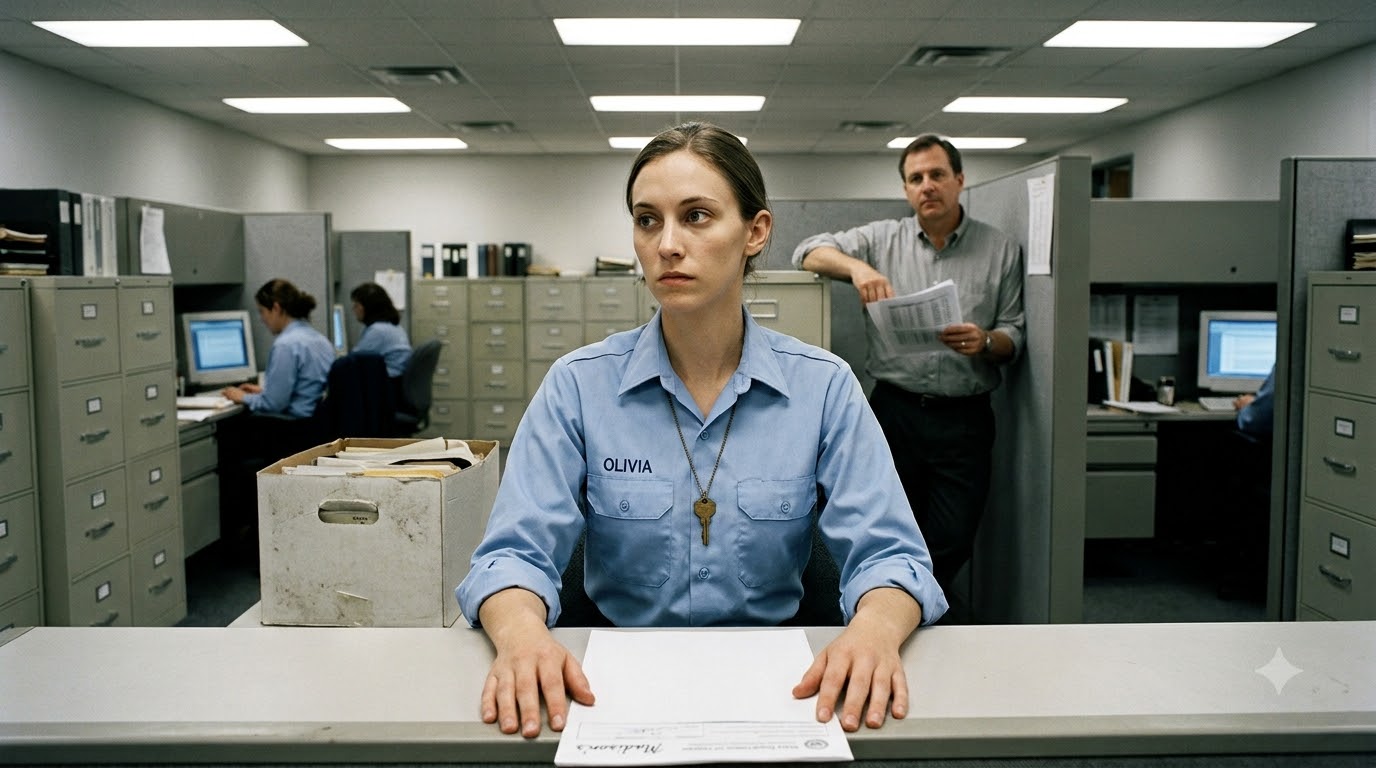
As an associate compliance officer for the State Department of Higher Education, my office smelled of powdered toner, old cardstock, and lukewarm coffee.
I was cross-referencing regional grant allocations for Riverside State University when a discrepancy flagged in the auxiliary student emergency fund. Twelve thousand dollars had been disbursed across three semesters to a single social security number—a number that matched my own down to the last four digits.
I pulled the physical archive box from the low metal shelf behind my desk, setting it down with a dull, heavy thump that kicked up a faint cloud of grey dust.
Inside lay the paper applications. On the top sheet, printed in clear, sloping cursive, was my name: Olivia Sterling. But the contact address listed on the tax schedule wasn’t my apartment on Oak Street. It was 1422 Elm Lane—my father’s house.
I pulled the tarnished brass key from under my collar, rolling the cool, notched edges across my knuckles while my eyes scanned the attached documentation.
Attached to the back of the third form was a yellowed bank collections notice addressed to me, postmarked three years after Dad had locked the deadbolt on the porch. Someone had opened three store credit lines in my name using my birth date, then routed the default notices directly to my father’s business ledger address.
The signature at the bottom of the state grant affidavit wasn’t mine. It was Madison’s handwriting, styled with the exact rounded loops she had practiced in her bedroom diary when we were kids.
David Brooks, my senior department head, leaned against my doorframe holding two printed budget sheets. “Olivia, President Walsh from Riverside State is on line two. He wants to know if the keynote speaker bio for their spring commencement needs board approval.”
I laid a blank sheet of paper over the forged grant application, keeping my voice steady and level. “Tell him the speaker bio is cleared. I’m submitting the final draft myself this afternoon.”
“You look like you’re staring down a tax audit,” David said, crossing his arms and squinting at the archive box. “Anything wrong with the Riverside regional ledger?”
“Just a clerical anomaly in the emergency hardship disbursements,” I said, sliding the box shut and securing the string latch with a tight double knot. “An old debt that was never properly closed.”
“Well, clear it fast,” David said, tapping his papers against his elbow. “Walsh is nervous about the ceremony. Apparently, one of their top communications majors tried to file a late petition for an academic honors waiver, and the system flagged her for outstanding administrative holds.”
“What’s the student’s name?” I asked.
“Madison Sterling,” David said. “Related?”
I picked up my black pen, uncapping it with a quiet click. “Not on paper.”
That evening, I didn’t go home to my apartment. I drove to the public records office in the county basement, pulling the historical filing ledgers for Sterling Hardware.
Under the business’s corporate structure, my father had listed two secondary credit guarantors. One was my mother. The second was an active line of credit established under my identity when I was sixteen years old—opened four months before the night of the storm, with a forged parental consent form bearing my father’s distinct, blocky signature.
He hadn’t just thrown me out because Madison cried over a chemistry student. He had built a financial buffer out of my name to cover his shop’s failing inventory, using Madison’s lies as the convenient cover story to declare me a runaway and keep me from ever checking my credit history.
I closed the ledger, the heavy leather cover snapping shut in the silent basement room, and slipped my black spiral notebook back into my bag.
They thought I was a ghost who had vanished into the state system. They were about to find out that ghosts keep carbon copies.
CHAPTER 4: THE UNINVITED SPEAKER
David Brooks double-checked his headset, adjusting the clip on his lapel. “President Walsh is giving the opening remarks now, Olivia. Two minutes until your cue.”
I stepped back half an inch from the velvet curtain split. In row three, centered among the graduates in blue caps and gowns, sat Madison. Her honor cords hung straight over her shoulders, and she was turning around, laughing with a classmate while snapping a photo with her phone.
Five rows behind her sat my parents. Dad was leaning forward, his hands resting on his knees, adjusting his wire-rimmed glasses to scan the stage program. Mom sat next to him, smoothing the lap of her floral dress with small, rhythmic sweeps of her palm.
“Please welcome the Senior Director of State Educational Equity, Ms. Olivia Sterling,” President Walsh’s voice boomed over the house audio system.
The applause surged—polite, widespread, and rhythmic.
I walked onto the wooden stage, my heels making a crisp, even cadence against the polished oak floorboards. The overhead floodlights hit my face, warm and blinding, casting long shadows behind me toward the back podium.
When I reached the center microphone, Madison’s hands froze mid-clap.
Her smile collapsed. The phone in her hand slipped an inch before her fingers clamped tight around the case. Her throat moved in a hard, visible swallow as her eyes locked onto mine.
Behind her, in row eight, my father squinted through his glasses. I saw the exact second his memory caught up with the present—his shoulders went rigid, his jaw dropping open just enough for his teeth to part. Beside him, Mom’s palm stopped dead on her dress.
“Good morning,” I said into the microphone. My voice echoed across the steel rafters, flat, calm, and clear. “When I was fifteen years old, my father stood on our front porch in an October storm, locked the deadbolt, and told me I was too sick to live under his roof.”
A ripple of uneasy shifting rustled through the front rows of graduates.
“I didn’t have a car,” I continued, holding the edges of the wooden lectern with both hands. “I didn’t have a place to sleep. I had three dollars in quarters, a wet notebook, and a house key that no longer opened a single lock in town.”
In row three, Madison turned her head sharply, looking down at her lap as the two graduates sitting on either side of her began whispering behind their programs.
“For thirteen years, the people who threw me out told their friends and neighbors that I was an unstable runaway,” I said, looking straight at row eight where Dad sat frozen, his face flushed a dark, blotchy red. “They used my identity to secure business credit. They forged grant affidavits in my name to cover up administrative holds.”
Mom covered her mouth with her program sheet, her head dropping forward.
“I am not standing here today as a victim,” I said, pulling the leather presentation folder open and laying the state grant audit sheets flat over the lectern. “I am standing here as the officer who authorized the compliance review for this university. Resilience isn’t about forgiving the people who locked the door. It’s about making sure they never have the leverage to lock it again.”
The auditorium fell into a dead, absolute silence.
I didn’t look at Madison when the faculty members behind me slowly began to stand. I didn’t look at my father when President Walsh stepped back toward the podium, his face pale and unreadable.
I picked up my leather folder, turned on my heel, and walked off the stage into the wings, where the heavy curtain fell shut behind me.
CHAPTER 5: THE GLASS HOUSE SHATTERS
Dad came down the narrow concrete hallway first, his gray suit jacket unbuttoned and trailing behind him like a loose sail.
Mom followed two steps behind, her hand clamped tight around Madison’s elbow as she dragged her down the hall. Madison had pulled off her velvet graduation cap; her face was blotched red, her lipstick smeared near the corner of her mouth where she had wiped at tears.
“Olivia! Wait!” Dad stopped six feet away, his breathing ragged, his eyes darting toward David Brooks, who stood near the green exit sign. “David, give us a minute. This is a private family matter.”
David didn’t move. He looked at me, his fingers resting on the strap of his shoulder bag. “Do you need security, Olivia?”
“No,” I said, stepping forward until the soles of my shoes clicked against the bare concrete. “David, wait by the loading bay. Five minutes.”
David nodded once, shot my father a hard glance, and walked through the heavy fire doors at the end of the hall.
“What was that speech?” Dad’s voice cracked across the corridor, echoing off the cinderblock walls. He took two steps closer, pointing a trembling finger at my chest. “You stood up on that stage in front of twelve hundred people—in front of Madison’s professors, her peers, our friends—and you humiliated this family!”
“You humiliated yourself the day you signed a forged grant affidavit,” I said.
I pulled the audit sheets from my folder and held them out. I didn’t hand them over. I held them at eye level where the state crest was visible in dark red ink.
“That’s a regional educational hardship grant,” I said, my voice dropping into a flat, quiet register. “Twelve thousand dollars. Applied for three years after you threw me out in the rain. Signed with my name, but routed to the PO box registered under Sterling Hardware.”
Mom’s grip on Madison’s arm loosened. She looked from the paper to Dad’s face, her brow furrowing. “Richard… what is she talking about?”
“She’s lying!” Madison yelled, her voice echoing down the hall as she tried to pull her arm free. “She’s making things up because she hates me! She’s always hated me! Dad, tell her!”
“Shut up, Madison!” Dad snapped, his face turning an unhealthy, mottled purple. He stepped directly into my space, his chest heaving under his white shirt. “You think you’re smart, Olivia? You think because you got a state title you can come back here and play judge? You were a difficult, spiteful child! We did what we had to do to protect this family’s reputation!”
“You used my social security number to open a secondary credit line for your shop,” I said, not flinching as he leaned closer. “I pulled the county clerk ledgers yesterday morning. You declared me a runaway so I wouldn’t receive the collection notices at my apartment.”
Mom let go of Madison entirely. She took a step back, her back hitting the concrete wall. “Richard… tell me you didn’t do that. Tell me you didn’t put debt in her name.”
Dad didn’t look at Mom. He glared at me, his hands clenching into fists at his sides. “I kept the business afloat! The shop paid for the roof over your head for fifteen years! You owed this family!”
“I owe this family nothing,” I said.
I pulled the tarnished brass house key from under my collar, unhooked the leather strap from my neck, and dropped the key onto the concrete floor between his shoes. It hit with a small, flat metallic clatter.
“That key hasn’t opened a door in thirteen years,” I said. “And as of nine o’clock tomorrow morning, the State Attorney General’s office receives the audit packet for the hardship grant.”
Madison let out a sharp, choked gasp, dropping her graduation cap onto the floor. “Dad… if they audit the grant, my degree… my job offer at the agency…”
“Fix this, Olivia!” Dad lunged forward, his hands reaching for the edge of my presenter folder. “You pull that file right now! You’re my daughter—you don’t get to ruin your sister’s life over a grudge!”
I took one precise step backward, keeping my hands folded over the folder as David opened the heavy exit door behind me, two university security officers standing right at his shoulder.
“I’m not ruining her life,” I said, holding his glare until his hands dropped back to his sides. “I’m just letting the paper trail catch up to her.”
CHAPTER 6: THE QUIET KEY
David Brooks walked beside me toward the state car parked near the fountain, his laptop bag slung over one shoulder. He didn’t ask questions about the corridor. He didn’t ask about the key on the floor.
He pulled a thin manila folder from his briefcase and laid it over the hood of the sedan. “The university legal team reviewed the hardship grant audit before we left the building. President Walsh signed the formal referral to the county prosecutor. They’re freezing the distribution accounts.”
“Thank you, David,” I said, leaning against the warm metal of the passenger door.
Across the lawn, near the main archway, I saw Dad walking toward the parking lot alone. His shoulders were rounded, his hands shoved deep into his coat pockets, ignoring Mom and Madison as they trailed twenty feet behind him, arguing in low, sharp bursts.
Mom kept pointing at Madison’s phone; Madison kept shaking her head, wiping at her eyes while turning away. There was no tearful scene. No dramatic arrest on the grass. Just three people discovering that when a house built on lies collapses, everyone inside has to clean up their own trash.
I opened my bag, pulled out my black spiral notebook, and flipped past the rain-warped pages from thirteen years ago to the fresh, blank grid at the back.
Using my pen, I drew a single, precise line through the entry labeled Sterling Hardware Audit – Clearance Pending.
I sat down in the driver’s seat of my office, adjusted the rear-view mirror until the courtyard disappeared from view, and turned the key in the ignition.
The brass door key was gone from my neck. The fake debts were erased from my credit file. The state program I built was operating across fourteen districts without a single cent owed to anyone named Sterling.
I reached into my glove compartment, pulled out a small desk key, and unlocked my lower supply drawer. Inside lay a fresh set of grant applications for the upcoming fall semester—sixty-four kids who needed an independent waiver, sixty-four kids who needed someone to sign their paperwork without asking them to shrink first.
I clicked my black pen, took the first application off the stack, and began to read.