The Cold Oath of Dr. Irene Wulette: A Story of Betrayal, Survival, and Absolute Vindication
CHAPTER 1: THE COLD CALL
The sharp, rhythmic buzz of the pager on my nightstand didn’t just wake me; it cut straight through four hours of heavy, restless sleep.
I sat up instantly, swinging my legs over the edge of the mattress. Cold air hit my bare ankles, instantly clearing the fog from my brain. Beside me, Nathan stirred, his voice a low hum against the dark room.
“Trauma?” he muttered.
“Level one,” I said, already pulling my scrub pants on. “Single vehicle. Unstable.”
I didn’t waste seconds on lighting lamps or making coffee. My thumb found the familiar brass casing of my fountain pen on the dresser, clicking the cap onto the barrel once, twice—a steadying, mechanical beat before I jammed it into my breast pocket. On the floor, Hippo lifted his heavy golden head, thumped his tail twice against the rug, and went back to sleep.
The drive to Mercyrest Medical Center took six minutes along wet, empty blacktop. January in Connecticut meant the pavement held a greasy sheen under the yellow streetlights, the temperature hovering right at freezing. I kept both hands at ten and two, letting my mind run through the standard checklist.
Blunt abdominal trauma. Likely internal hemorrhage. Prepare two units of O-negative on arrival. Call anesthesia for standby.
I badged through the ambulance bay doors at 3:17 a.m. The air inside smelled of harsh industrial floor cleaner, iodine, and cold rain tracked in on boots.
Linda, the night charge nurse, was standing at the central desk, two fingers resting on a glowing iPad screen. She didn’t look up until my soles squeaked on the linoleum beside her.
“Bay two is set,” Linda said, her voice flat with three-a.m. exhaustion. “EMS is two minutes out. Vitals are crashing.”
She turned the screen toward me. I reached out, my thumb catching a tiny streak of black ink from my leaking fountain pen as I took the frame.
I looked down at the patient profile.
Patient: Monica Wulette. DOB: 03/14/1990. Emergency Contact: Gerald Wulette, Father.
The ambient noise of the ER—the distant chime of telemetry monitors, the hum of the ice machine, the low rumble of an incoming diesel engine—didn’t fade. It sharpened into a single, needle-thin point of reality.
Five years of blocked calls. Five years of returned letters. Five years of being dead to the people who raised me because the woman in that ambulance told them I was a disgraced dropout.
“Dr. Wulette?” Linda asked, her eyes narrowing as she noticed my hands freeze over the screen. “You need Patel to take this?”
I clicked the cap of my fountain pen in my pocket with my left hand. One sharp, metallic snap.
“No,” I said, setting the iPad down on the counter with a quiet click. “I’m taking the case.”
CHAPTER 2: GLASS PARTITION
I stared into the distorted reflection of the mirror above the basin. My face looked pale under the brutal fluorescent tubes, my scrub cap pulled low over my forehead.
Behind me, the double doors to the trauma bay rattled. Dr. Patel stepped into the scrub room, his hands already hovering near the automated soap dispenser.
“She’s losing pressure, Irene,” Patel said, his voice clipped, professional. “Systolic is down to seventy. Spleen is a disaster, and there’s a heavy bleed behind the liver.”
“I know,” I said. I turned off the tap with my elbow, the water shutting off with a sharp metallic clunk.
I picked up a sterile towel, drying my palms with deliberate, forceful pressure. Through the reinforced glass partition separating the scrub room from the hallway, I could see them.
My mother was doubled over on a vinyl waiting room chair, her bathrobe pooled around her slippers like dirty snow. My father stood over her, his hands jammed deep into his flannel pockets, his jaw working as he paced the three-foot strip of linoleum in front of the intake desk. Five years had put silver in his hair and bent his shoulders, but the posture was the same. The posture of a man who believed the world owed him an explanation.
She’s all we have, his voice echoed through my mind. The words he’d shouted to the triage nurse just minutes ago.
I clicked my fountain pen once inside my scrub pocket through the thin fabric. The brass cap gave a muted thwack.
“Patel,” I said, my voice dropping an octave, completely level. “The patient is my sister. We haven’t spoken in five years.”
Patel froze, a thick glob of iodine soap dripping from his palm into the basin. He looked at me, then turned his head slowly to look through the glass at the two panicked people in the hallway.
“I’m documenting the conflict of interest in the chart right now,” I continued, stepping toward the foot pedal of the OR doors. “You are my second. If my hands shake for one microsecond, if I make a single call that isn’t by the book, you take the tray from me. Understood?”
Patel swallowed hard, his eyes scanning my face for any crack in the armor. He found none.
“Understood, Chief,” he said quietly.
“Good. Let’s go save her life.”
I backed through the swinging doors into Operating Room 2. The air was frigid, smelling of ozone, sterile draping, and the heavy, metallic tang of pool blood.
Monica lay under the harsh surgical lamps, her face pale, bruised, and unrecognizable beneath the plastic anesthesia mask. The monitors were chirping in a frantic, rising rhythm—a hundred and thirty beats a minute.
“Suction,” I said, extending my gloved hand. The scrub tech slapped the Yankauer handle into my palm.
I didn’t see the sister who had told my parents I was a failure. I didn’t see the girl who had watched me pack my life into cardboard boxes while she smiled into her coffee cup. I saw a Grade III liver laceration and a shattered spleen.
For three hours and forty minutes, the world narrowed to the blue field of the surgical drapes. Clamps, ties, lap pads, electrocautery.
We took the spleen. It was unsalvageable. I spent an hour painstakingly suturing the liver tissue, my stitches tight, even, and ruthless. Every time my fingers tightened a knot, I felt the physical strain in my forearms, the cold sweat pooling at the small of my back.
“Bleeding controlled,” Patel breathed, exhaling a long, ragged breath from behind his mask as the suction tip finally came up clear. “Vitals stabilizing. BP ninety-eight over sixty.”
“Layered closure,” I ordered, my voice cutting through the hum of the ventilator. “Patel, finish the skin staples.”
I stepped back from the table, peeling my gloves off with a sharp snap that echoed against the tiled walls. I threw them into the biohazard bin, my hands cold and completely steady.
As I walked toward the scrub room to wash up, my eye caught the stainless-steel tray holding Monica’s personal belongings, sealed in a clear plastic bag by the trauma team.
Cut clothing. A broken silver necklace. A heavy ring of keys.
Among the house keys and car fob sat a single, heavily scuffed brass key. It had no branding, no head cover, just a tiny stamped tag clipped to the ring with three worn numbers: 402. It was the kind of key that belonged to a private safe-deposit box, completely out of place for a mid-level medical sales rep living in a rented Stamford apartment.
I stared at it for two seconds through the plastic.
“Dr. Wulette?” Linda called from the doorway, her clipboard tucked under her arm. “Family is still in the main waiting area. They’re refusing to sit down.”
I turned away from the tray, pulling my surgical mask down around my neck.
“I’m heading out now,” I said.
CHAPTER 3: THE SURGICAL RECKONING
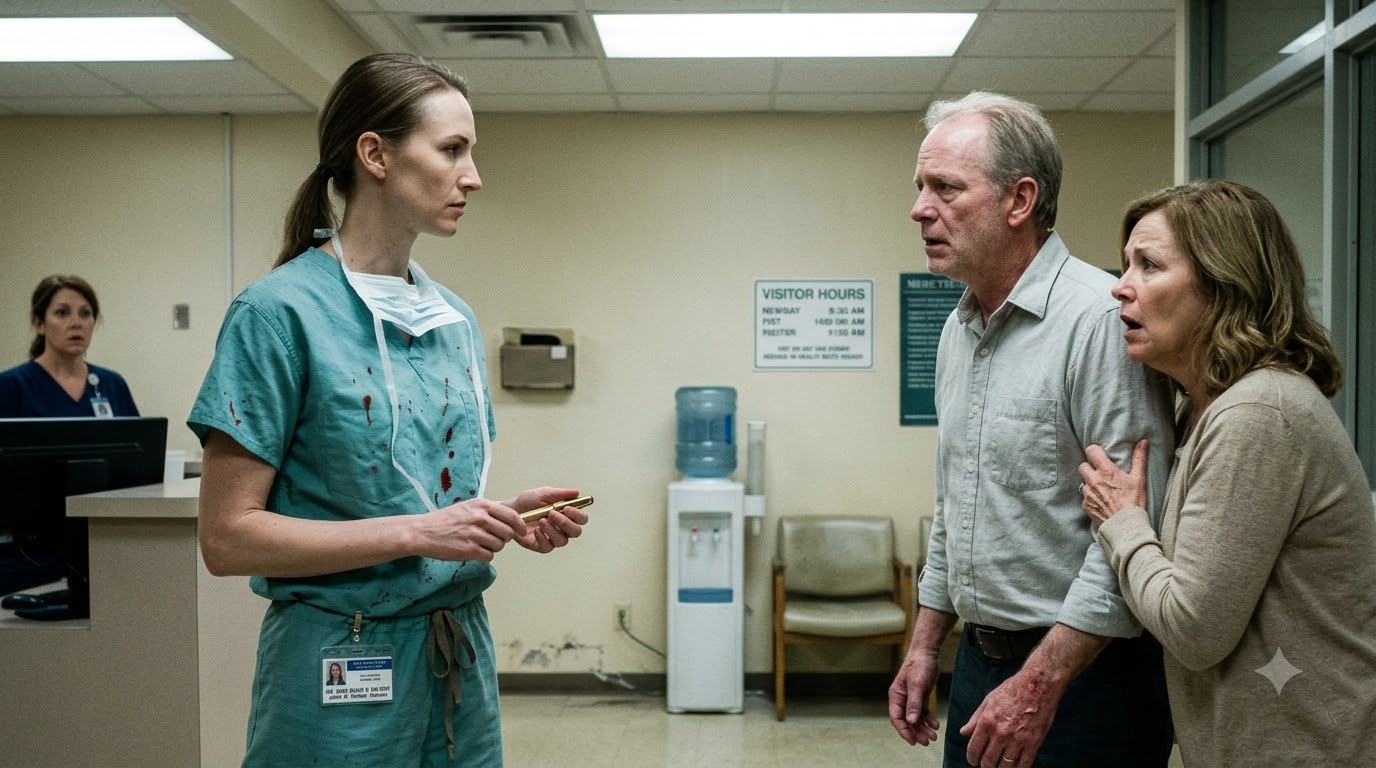
I stepped into the center of the room, my scrub top still showing the faint, damp shadow where blood had soaked through the outer layer. My surgical mask hung loose around my neck, and my ID badge swung gently at chest level: Dr. Irene Wulette, MD, FACS, Chief of Trauma Surgery.
My father bolted up from his chair instantly. His knuckles were raw, his face pale as paper.
“Doctor—” he began, his voice raspy with panic. “How is she? Where is the chief? They said the chief was handling it—”
His words cut off mid-sentence. His eyes dropped from my face to the white block letters on my badge, then darted back to my eyes. A visible tremor started at his chin and worked its way down his throat.
My mother rose half a second later, her hand shooting out to grab Dad’s forearm. Her fingers dug into his flannel sleeve so hard her knuckles turned translucent white.
“Irene?” her voice was a thin, broken whisper. “Oh God… Irene?”
She took a fast step forward, her arms rising instinctively for a hug, tears brimming over her lower lids.
I took half a step backward. It was a precise, clinical movement. My feet stayed flat on the linoleum, my posture straight as a rod.
She froze mid-motion. Her hands hovered in the empty air between us before dropping limply to her sides like dead weight.
“Mr. and Mrs. Wulette,” I said, my tone as measured as if I were reading a lab result to a room full of medical students. “I am Dr. Wulette, Chief of Trauma. Your daughter Monica sustained a ruptured spleen and a Grade III liver laceration. I operated on her over the last four hours. Surgery was successful. She is stable and in the ICU.”
Dad opened his mouth, but no sound came out. He swallowed hard, his throat clicking in the quiet room.
“Mr. and Mrs. Wulette,” I repeated, letting the formal title hang in the air like a wall of ice.
“Irene, please,” Mom sobbed, covering her mouth with a trembling palm. “We thought… Monica told us you dropped out. She said you were living with some man, that you refused to talk to us…”
“None of that happened,” I said, keeping my voice utterly flat. “I never dropped out. I finished my residency. I built a life.”
“Where are the emails?” Dad rasped, his eyes bloodshot, his voice cracking with a sudden, desperate rage directed nowhere. “The letters? Why didn’t you write?”
“I wrote two emails,” I said, pulling my fountain pen from my pocket and tapping the brass cap against my palm with a dull clack. “I sent a priority letter. You returned it unopened. I called fourteen times in five days. You blocked my number.”
Behind the glass partition, Linda stood motionless, her eyes wide as she watched the exchange.
Dad stared at me, his chest heaving, his authority entirely stripped away by the plain, unadorned facts of his own choices. He couldn’t yell. He couldn’t decree. There was no paper trail to argue over, no excuses left—only his daughter standing before him in surgical scrubs, holding his other daughter’s life in her hands.
“She’s in Room 4,” I said, turning toward the hallway. “You can see her in an hour.”
CHAPTER 4: ICU CHECKMATE
Monica’s eyes flickered open, heavy and glassy from the lingering weight of the propofol. She blinked slowly against the dim morning light filtering through the blinds, her gaze tracking sideways until it locked onto me.
The color drained from her face—not the slow pale of blood loss, but the instantaneous grey of absolute, blinding panic.
She squinted, her vision refocusing on the blue scrubs, the stethoscope slung over my shoulder, and the silver lettering pinned to my chest.
“Irene…?” Her voice sounded like crushed gravel.
“Don’t try to sit up,” I said, stepping up to the side of the bed. My hand reached for the IV pole, my fingers adjusting the drip chamber with practiced, automatic precision. “You have thirty-two staples holding your abdominal wall together. I excised your spleen three hours ago.”
“You…” She swallowed hard, her tongue thick. “You’re… here?”
“I’m your attending surgeon,” I said. “I’m the Chief of Trauma.”
A tight, shuddering breath escaped her lips. I saw the exact second her brain shifted gears—the panic subsiding just enough for the old, familiar machinery to kick back on. Her eyes darted toward the glass wall, where Dad and Mom were standing in the corridor, shadows frozen against the bright hallway lights.
“Irene, listen to me,” Monica whispered, her hand twitching against the bedsheet, trying to reach for my wrist. “It wasn’t… I was trying to protect them. You don’t know how bad Dad got after you left. I had to tell them something—”
“Save it, Monica,” I cut in softly. I didn’t raise my voice. I didn’t need to. “I didn’t operate on you so I could listen to another script.”
I reached into my pocket, my fingers brushing past my fountain pen, and pulled out the clear plastic belongings bag the trauma team had sealed during intake. I laid it on the bedside tray right next to her hand.
Through the clear vinyl, the heavy brass key stamped with 402 caught the light.
Monica’s eyes dropped to the tray. Her chest hitched, the telemetry monitor jumping from eighty beats a minute to a sharp, insistent one-hundred-and-ten.
“A safety deposit box in Hartford,” I said, leaning down slightly so my voice stayed strictly between the two of us. “You didn’t just lie about my leave of absence to keep Mom and Dad’s attention. You’ve been siphoning Dad’s manufacturing pension into an unlisted account for three years, haven’t you?”
“You can’t prove that,” she hissed, her voice suddenly dropping the raspy weakness, her eyes narrowing into cold, desperate slits. “You have nothing. You’re just a bitter bitch who walked away—”
“I don’t need to prove it,” I said, tapping the glass pane behind me with the brass cap of my pen. Tap. Tap.
Outside, my father saw the gesture. He pushed open the sliding door, Mom right behind him, both of them stepping into the sterile room with raw, hollow expressions.
“Monica,” Dad said, his voice flat, broken, and dangerously quiet. “What is that key?”
CHAPTER 5: THE COLLAPSE OF AUDACITY
“What key, Monica?” Dad repeated. His voice lacked its usual booming decree; it was raspy, thin, and brittle as dried leaves.
Monica clawed at the bedsheet with her left hand, her knuckles turning yellow under the strain. She forced a sudden, ragged sob from her throat, her chest heaving against the cardiac leads.
“Dad, don’t listen to her!” Monica gasped, her eyes wide, flooding with frantic tears as she tried to pull the blanket higher over her abdominal bandage. “She’s trying to ruin everything! She put that key there! She brought it from outside—she’s trying to make you hate me because she knows I took care of you!”
Mom stepped up beside Dad, her hands trembling as she looked from the brass key on the tray to Monica’s hyperventilating face.
“Irene…” Mom whispered, her eyes pleading, looking for an easy escape. “Did you… is that yours?”
I didn’t answer with words. I unclipped my fountain pen from my pocket, turned the brass cap once until it clicked, and tapped the metal tip lightly against the clear plastic bag holding the key.
“The trauma team cut her clothes off in Bay Two,” I said softly, looking straight at my mother. “Nurse Carla bagged those items before I ever set foot in the OR. Check the intake seal if you want. It’s time-stamped 3:12 a.m.”
Dad reached out. His thick, calloused fingers hesitated above the plastic before he grabbed the bag. He pulled the brass key out, turning the small stamped tag over in his palm.
402.
“This is the safe-deposit box key from the First National on Main,” Dad said, his voice dropping to a whisper that carried more weight than a shout. “The one where I kept the plant’s secondary reserve account. The account that went empty six months ago.”
“Dad, no! Listen to me!” Monica shrieked, wincing violently as the strain pulled at her surgical staples. The heart monitor beeped in a frantic, irregular rhythm. “I transferred it to protect it! I thought you were losing your mind—you were forgetting things! I did it for the family! Just like I had to handle Irene when she lost her scholarship!”
She turned her face toward me, her eyes burning with pure, unadulterated venom. The mask of the grieving, dutiful sister didn’t just slip—it shattered onto the linoleum.
“You think you won?” Monica spat, her voice dropping into a harsh, vicious growl despite the oxygen tube in her nose. “You think because you put on a white coat you’re better than us? You abandoned them! You left me to manage them for five years! I earned every single cent in that box!”
Dad stared at her. It was as if he were looking at a complete stranger occupying his daughter’s body.
“You lied,” Dad said. The four words came out like stones dropping into a deep well. “About the school. About the letters. About the money.”
“She didn’t write any letters!” Monica screamed, her voice cracking as she doubled down, fighting dirty to the absolute end. “She’s lying! She forged everything! Dad, call the police—she abused her position as a doctor to search my things!”
“I am the Chief of Trauma,” I said, stepping backward toward the door with absolute, unyielding calm. “I saved your life today because it was my job. But your medical care is transferred to Dr. Patel as of this moment.”
I turned to my parents. Dad was leaning heavily against the footboard of the bed, his head bowed, his shoulders shaking in silence. Mom had collapsed into the visitor’s chair, her face buried in her hands, sobbing so hard her entire frame shuddered.
“I will be in my office,” I said quietly. “When you’re ready to speak to me as adults, you know where to find me.”
CHAPTER 6: FOUR PLATES AT THE TABLE
A soft knock rattled the frosted glass panel of my door.
Dad pushed it open slowly, his knuckles wrapping twice around the wooden frame before he stepped inside. He wore a dark tie he clearly hated, his neck stiff, his eyes bloodshot and heavy with exhaustion. Mom stood half a step behind him, her hands clasped around a small tin of homemade shortbread.
“Irene,” Dad said. He didn’t sit down. He stood straight, clearing his throat against the quiet room. “The bank confirmed the safe-deposit box. Everything Monica said… it was all in there. The transfer records. The fake emails she generated from a spoof account.”
I picked up my fountain pen from the desk, resting the brass barrel against my palm. I didn’t unscrew the cap. I didn’t need to.
“I know,” I said softly.
Mom took a shuddering step forward, setting the tin on the corner of my desk like an offering. “We… Dr. Rena said we need to be the ones to say it. Not to ask for a pass. Just to say it.”
“We failed you,” Dad said, his voice dropping into a low, rugged hum. “I let my pride decide what was real because it was easier than admitting I was wrong about my own family. I was blind, Irene. And I let that girl ruin five years of your life.”
I stared at the two of them—two people who had seemed impossibly large, untouchable, and absolute when I was eighteen years old. Standing in my office under the glare of my diplomas, they looked small. Human. Fractured by the weight of their own arrogance.
“Apologies don’t rewrite the past,” I said, setting the pen down with a quiet, solid click. “They don’t put you at my wedding. They don’t give me back the five years I spent as nobody’s daughter.”
Mom wiped a tear from her cheek with the back of her wrist, her shoulders slumping. “We know.”
“But I am not closing the door,” I continued, leaning forward against the blotter. “If you want to be part of my life now, it happens on my terms. No performance. No excuses. Real, consistent time.”
Dad gave a single, firm nod—a quiet, devastated acceptance of the boundaries I had built with my own hands.
The doorbell rang at eight in the morning.
Light snow was falling outside the kitchen window, dusting the porch railings in clean, quiet white. Nathan was at the counter grinding coffee beans, his voice off-key as he hummed along to the radio. Under the table, Hippo’s tail thumped twice against the floorboard.
I wiped my palms on a dish towel and opened the front door.
Dad stood on the mat in his heavy winter coat, holding a glass bottle of orange juice in his gloved hands like he wasn’t sure where to place it. Mom stood next to him, her cheeks red from the cold air, holding a freshly baked tray of French toast toppings.
“Hi,” Mom said, hopeful, her breath clouding in the cold air.
“Come in,” I said, stepping back to hold the door wide. “Coffee’s almost ready.”
Dad walked inside, wiping his boots carefully on the mat. He looked around the kitchen—taking in the warm sunlight, the framed photos on the hallway wall, the life I had constructed entirely without his permission.
He cleared his throat, holding the juice out slightly. “Can I help with anything?”
I pointed toward the corner cabinet. “You can set the table, Dad.”
He nodded, walked to the glass doors, and pulled down four white porcelain plates. He walked to the wooden table, setting them down one by one, carefully—as if he were afraid the ceramic might break if he wasn’t gentle.
Four plates. One for Nathan. One for me. Two for the parents who were finally learning how to look at their daughter.
It wasn’t a dramatic reconciliation. It wasn’t a movie ending. It was just a quiet Sunday morning, built on hard-earned truth and unbreakable architecture.