The Architect’s Last Measure: How a Mother Built the Ultimate Trap for Her Entitled Son
CHAPTER 1: THE COLD MEASURE
The amber light from the converted library’s high vaults filtered softly through my glass of cabernet, casting long, blurred shadows across the white linen.
“Mom, you’re squinting again,” Nathan said, his voice dripping with smooth, practiced sympathy as he reached across the table to pat my hand. “You’ve spent thirty-five years carrying the weight of every old stone building in this city, but you have to accept when the foundation gives out.”
Brooke took a delicate sip of water, her diamond ring catching the dim light. “He’s only saying it because we love you, Eleanor. The council meetings, the site inspections—it’s just too much when your eyes are failing like this.”
I didn’t answer right away. I rolled my heavy brass architectural scale ruler between my fingers beneath the tablecloth, feeling the cool, sharp edges of the triangular metal. For months, the edges of blueprints had blurred into gray smears, and my depth perception had turned stairs into hazards. I had trusted them when they said it was stress, age, and overwork.
“I still have two historical surveys to finalize before the winter freeze,” I said quietly, keeping my voice level despite the cold knot tightening in my stomach.
“We can handle the paperwork for the transition, Mom,” Nathan insisted, leaning in with a warm, reassuring smile that used to make me feel safe. “Just sign the authority transfer on Thursday. Let us take care of you.”
When the waiter brought the check, I gathered my coat and stepped toward the ladies’ room to clear my head, leaving my leather handbag slung over the back of my chair. The hallway was quiet, smelling of floor wax and old paper. Washroom mirrors usually lied gently, but the reflection staring back at me looked hollowed out—a woman fighting a shadow she couldn’t name.
I turned back down the narrow corridor toward our alcove, my soft-soled shoes making no sound against the thick carpet.
As I rounded the corner near the service station, Nathan’s voice cut through the quiet dining room—stripped clean of every drop of warmth.
“—won’t notice a thing before Thursday,” he was saying, followed by the dry clink of a glass. “She actually thinks her body is just giving up.”
I froze in the shadow of the mahogany archway. My fingers instinctively clamped down on the brass ruler in my pocket, the metal digging hard into my palm.
“How much of the compound is left in the bottle?” Brooke asked, her tone flat, bored, and completely devoid of the sweetness she had displayed moments ago.
“Enough for two more doses in her morning tea,” Nathan replied with a soft, amused chuckle. “By the time the council convenes, she won’t even be able to read the headline on the document, let alone the fine print. She’ll sign whatever I put in front of her just to make the headache stop.”
Brooke laughed softly—a sharp, rattling sound that felt like ice water dumped down my spine. “Her precious historical sites… if she only knew who’s buying them.”
My breath hitched in my throat, but years of field inspections kept my body dead still. The floor beneath me didn’t tilt from failing eyes; it tilted because the world I had built around my family had just shattered into jagged pieces.
I didn’t push past the curtain. I didn’t scream. I backed away step by step into the dim hallway, my spine rigid, the brass ruler biting deep into the meat of my hand until the physical pain grounded the panic surging in my chest.
They thought my eyes were failing. They thought I was a fragile old woman ready to be swept out of the way. But as I reached the front entrance and pushed into the cold night air, the blur in my vision didn’t matter anymore—I had never seen my son more clearly in my entire life.
CHAPTER 2: THE FORENSIC AUDIT
The rain had cooled into a fine, bitter mist by the time I let myself into the quiet dark of my backyard studio. The smell of cedar, dried paper, and cold stone greeted me—a smell that had meant safety for thirty years.
I didn’t turn on the overhead lights. Instead, I clicked on the small halogen lamp above my drafting table, isolating a circle of stark white light against the shadows.
My hands were shaking, not with the weakness Nathan mocked, but with a cold, vibrating rage. I pulled the brass scale ruler from my pocket and set it down beside a portable optic analyzer—an old diagnostic tool I used to test mortar degradation and chemical sealant decay.
From my handbag, I retrieved the wine glass coaster I had slipped off the restaurant table, its edge marked with a faint, dark ring where the cabernet had sweated.
I took a sterile glass slide and scraped a microscopic layer of the dried residue into a solvent droplet. My vision blurred slightly around the edges, a dull pressure throbbing behind my eyes. I pressed my thumb against the bridge of my nose, forced three slow breaths, and leaned over the lens.
The crystalline pattern beneath the light wasn’t the jagged, organic structure of aged wine.
It was geometric, synthetic, and uniform. A controlled chemical suppressant—a compound designed to disrupt optic nerve transmission without leaving permanent tissue damage. It was engineered to mimic gradual macular degeneration, precisely timed to worsen after ingestion and clear during periods of rest.
I sat back, the wood of my chair creaking in the silence.
Age hadn’t stolen my vision. My own son was feeding it to me.
I pulled open the lower drawer of the drafting table and brought out a small cardboard box Nathan had dropped off two weeks ago—a set of imported eye supplements he insisted would “help with the strain.”
I picked up the bottle and turned it under the halogen bulb. The branded label looked professional, but as I ran the sharp edge of my brass ruler under the adhesive seam, the top layer peeled away too easily.
Beneath it sat an off-spec corporate seal embossed directly onto the inner lining—a stylized, geometric ‘M’ stamped over a serial code. Meridian Developments.
They weren’t just paying him to buy out my preservation firm. They were supplying the precise chemical tools to break my independence, using an indemnity waiver clause to erase decades of heritage protections the moment I signed over my authority.
My phone buzzed on the blotter, vibrating against the hardwood. Nathan’s name lit up the screen.
I let it ring three times, controlling the rhythm of my breath until my voice felt as hollow and fragile as he expected it to be.
“Nathan?” I whispered, letting a slight tremor bleed into the word.
“Mom? You sounded so quiet when you left the restaurant,” his voice came through smooth, laced with that toxic, rehearsed concern. “I just wanted to make sure you got home okay. Your eyes aren’t acting up again, are they?”
“It’s… everything is very dark tonight, Nathan,” I said, squinting into the shadow beyond the lamp. “I could barely find the front door key.”
A short, almost imperceptible pause hung on the line—the quiet satisfaction of a predator confirming a hit.
“I’m so sorry, Mom,” he said softly. “Look, don’t strain yourself. Brooke and I will come by tomorrow afternoon with the revised transition papers. You don’t need to fight this anymore. Just sign them, and let us carry the load.”
“Tomorrow,” I repeated, letting my chin sink toward my chest. “Yes. Maybe… maybe it’s time.”
“Rest now, Mom. We’ll handle everything.”
I ended the call and laid the phone flat on the blotter beside the glass slide.
Nathan thought he was guiding a blind woman to the edge of a cliff. He had no idea he was delivering the final piece of evidence straight into my hands.
CHAPTER 3: THE BROKEN GLASS
The car door slammed shut with a sharp metallic crack that echoed across the quiet front yard.
Nathan walked toward the porch with quick, aggressive strides, a thick leather folder tucked under his arm. Brooke followed half a step behind, her high heels clicking rhythmically against the stone steps, carrying a bakery box tied with a satin ribbon.
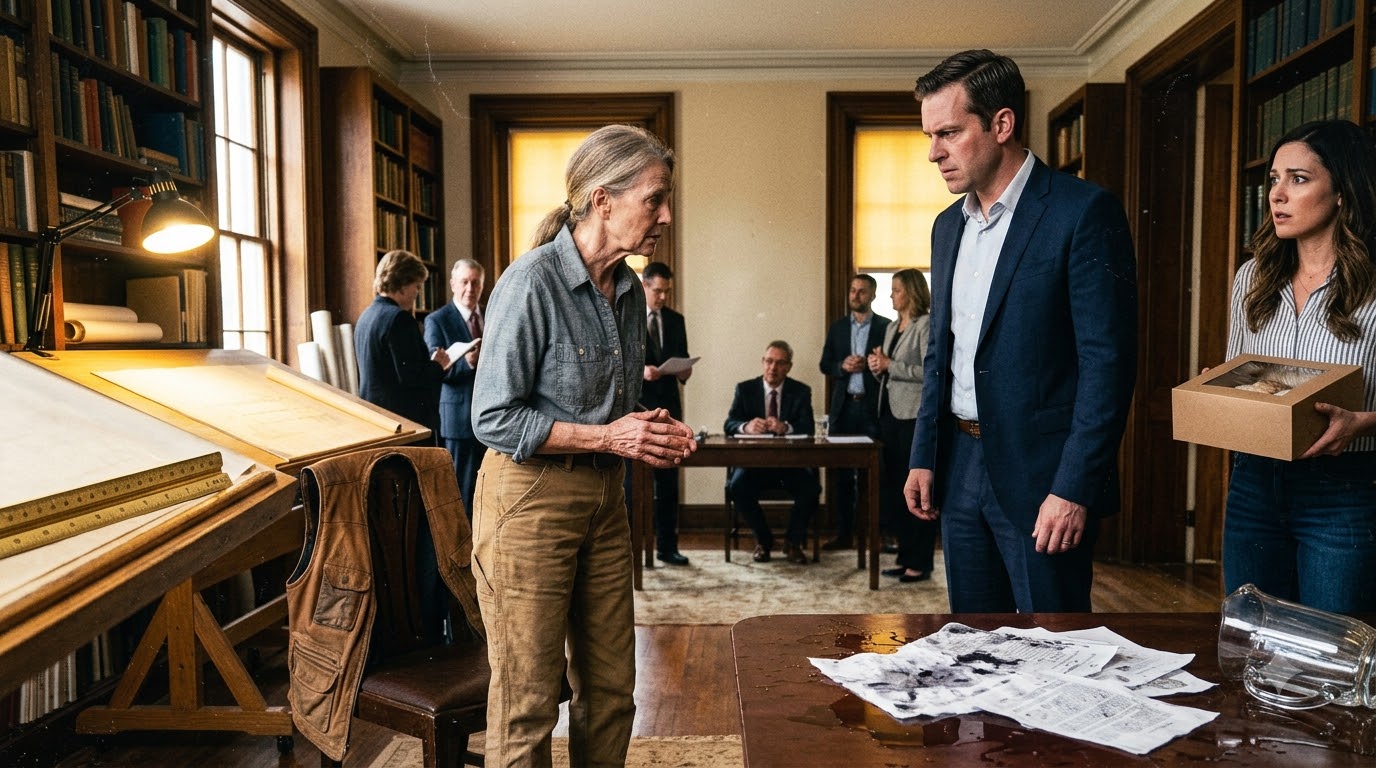
I pulled the shawl tighter over my shoulders, let my posture sag, and took my seat at the end of the mahogany dining table. Beside my elbow sat a heavy glass pitcher, filled to the brim with cold water.
“Mom!” Nathan called out, pushing through the front door without knocking. “We brought coffee and cake to celebrate.”
“Over here, Nathan,” I called back, my voice dry and thin. “In the dining room.”
Brooke walked in first, setting the box down on the polished wood. “You look tired, Eleanor. Did you sleep at all?”
“The shadows wouldn’t sit still last night,” I said, squinting up at her and letting my gaze wander slightly to the left of her face. “Everything feels… fuzzy.”
Nathan laid the leather folder flat between us, unzipping it with a loud, decisive slide. He pulled out three crisp stacks of legal paper, fresh from a laser printer.
“That’s why we’re here,” Nathan said, clicking a heavy silver pen and resting it directly on top of the documents. “The preservation board needs the authorization transfer filed before their Friday session. If you sign now, Brooke and I can handle the rest, and you can finally just rest.”
“Where do I…” I reached out, letting my hand wobble dramatically in mid-air. My fingers brushed the side of the silver pen, missing it by two inches. “I can’t quite read the line, Nathan. Is it the bottom one?”
“Right here, Mom,” he said, taking my hand and guiding it firmly toward the paper. “Just your full signature. Don’t worry about reading every page. It’s identical to what we discussed.”
I took the pen. I let my fingers tremble violently, the metal tip vibrating against the pristine white paper.
“Oh dear,” I gasped, jerking my arm backward as if my hand had suffered a sudden muscle spasm.
My forearm struck the side of the heavy glass pitcher.
The pitcher tipped sideways with a hollow thud. A wall of cold water surged across the mahogany table, engulfing the three stacks of legal transfer documents in a dark, soaking wave. Ink bled instantly across the title blocks, warping the thick stock into wet, useless pulp.
“What are you doing?!” Nathan roared, jumping back as water spilled off the edge of the table and splashed onto his leather shoes.
Brooke shrieked, snatching her bakery box out of the flood. “Eleanor! Look at what you did!”
“I’m so sorry!” I cried out, standing up so fast my chair rattled against the floorboards. I wrung my hands together, staring blankly at the wet mess. “My hand just… it gave out! I can’t control the tremor when my eyes strain like this!”
Nathan stared at the soaked papers, his face turning a dark, blotchy red. For two seconds, the smooth, caring persona vanished entirely, revealing the cold, furious predator beneath.
“These were original notary prints,” he snapped through clenched teeth, his voice dangerously tight.
“We can reprint them, Nathan,” Brooke interjected quickly, catching his arm and giving him a sharp warning look. “The notary office downtown closes in twenty minutes, but we can print a new set tomorrow morning.”
I pressed a trembling hand against my chest and looked up at them with wide, apologetic eyes. “The council meets on Thursday afternoon in the public chambers, doesn’t it? I could sign the new set right there in front of the board. That way… that way no one can ever say you forced me.”
Nathan narrowed his eyes, analyzing me. The silence in the dining room grew heavy, broken only by the steady drip of water falling onto the rug.
“Public is fine,” Nathan said slowly, the tightness leaving his jaw as he calculated the optics. “Signing in front of the council actually makes it official faster. They won’t be able to question my authority once it’s on their record.”
“Yes,” I whispered, meeting his gaze with total, unflinching clarity hidden behind my dim eyes. “It will all be on the record.”
CHAPTER 4: THE SILENT ARCHIVE
Daniel Mercer didn’t say a word as he unlocked the heavy oak door. He just pulled it open, his weathered face lined with forty years of shared site surveys, restoration battles, and cold coffee over blueprint drafts.
The air inside smelled of dust, lime mortar, and dry paper—the quiet scent of preserved history.
“You look like hell, Eleanor,” Daniel said bluntly, relocking the door behind us with a sharp click of the key. “And your eyes are bloodshot.”
“I haven’t slept in thirty-six hours,” I said, setting my briefcase on the intake desk. “And my son is poisoning my tea.”
Daniel stopped dead in his tracks. His jaw tightened, but he didn’t laugh or offer empty platitudes. He knew me too well to mistake my words for paranoia.
“Show me,” he said flatly.
I pulled out the glass slide wrapped in paper, the altered eye supplement bottle with the Meridian seal beneath the label, and the material lab report I had printed in my studio. Daniel leaned over the counter, adjusting his wire-rimmed glasses as he read through the chemical breakdown.
“Synthetic optic suppressant,” Daniel muttered, his finger tracing the chemical structure line. “Designed to trigger transient blurring… Jesus, Eleanor. It’s an engineered medical decline.”
“Nathan needs me declared unfit or willing to sign over firm authority before Thursday’s council session,” I explained, pulling my brass scale ruler from my pocket and tapping its edge against the wooden counter. “Meridian Developments is behind it. They don’t just want the historic sites; they’re trying to force an indemnity waiver to clear their past illegal demolitions.”
“They think you’re alone,” Daniel said, looking up from the papers, his eyes hard. “They think the board will just accept your resignation.”
“They think I forgot how we built the firm,” I replied quietly. “Follow me.”
We moved down two flights of concrete stairs into the sub-basement, past rows of decommissioned municipal records and rusted plan drawers. At the far end of the vault room, behind a heavy steel fire door, I unlocked a grey filing cabinet that hadn’t been opened in fifteen years.
I pulled out three thick leather-bound binders stamped with gold foil.
“The master preservation covenants,” Daniel breathed, recognizing the crest immediately.
“Every site my firm protected over thirty-five years wasn’t just tied to company authority,” I said, laying the covenants out under the bare hanging bulb. “I embedded secondary reversionary clauses into the land deeds themselves. If my authority is transferred under duress, illness, or fraud, all development rights freeze instantly and revert to a private, non-profit trust.”
Daniel flipped through the pages, a slow, grim smile spreading across his face. “A land trust they can’t buy, coerce, or dissolve.”
“Nathan thinks he’s walking into the council chambers to claim a corpse,” I said, my voice steady and cold. “He has no idea he’s stepping into a cement box.”
Daniel looked at me, taking a heavy breath. “He’s your son, Eleanor. Once we drop these covenants on the board record, there’s no coming back from it. It’s criminal.”
I picked up the brass ruler and slipped it back into my coat pocket, feeling its heavy, unyielding weight against my ribs.
“He stopped being my son the moment he poured poison into my wine,” I said.
CHAPTER 5: THE MASTER STRUCTURE
Nathan adjusted the microphone, his posture radiating unearned authority as he smiled smoothly at the seven board members seated above us.
“Members of the council,” Nathan began, his voice echoing in the crowded chamber. “My mother, Eleanor Whitfield, has dedicated thirty-five years to preserving this city’s heritage. But as her family, we must confront the painful reality of her failing health. Today, she is officially transferring her signing authority to me so we can proceed with site modernizations.”
He motioned toward me with a practiced, solemn nod. Brooke sat two rows back, clutching her designer purse, her face tight with anticipation.
I didn’t squint. I didn’t reach for help. I stood up smoothly, picking up my leather briefcase, and stepped into the center aisle.
“I am afraid my son is mistaken,” I said, my voice cutting cleanly through the hum of the gallery.
Nathan’s smile faltered. His eyes narrowed as I walked up to the clerk’s desk with a firm, unhurried stride.
“Mom, sit down,” Nathan muttered under his breath, stepping away from the podium to intercept me. “You’re confused. You can barely see the floor.”
“My vision is perfectly clear, Nathan,” I said aloud, laying three thick folders flat onto the clerk’s desk. “And so is my understanding of what you’ve been putting in my morning tea.”
A sharp murmur rippled through the gallery. The council chair leaned forward, rapping his gavel. “Mrs. Whitfield, what is the meaning of this interruption?”
“This folder contains a certified material lab report,” I announced, turning to face the board. “It documents a synthetic optic suppressant extracted from residue in my home—a compound administered to me over two months to simulate macular degeneration. The second folder contains the bottle supplied by my son, complete with Meridian Developments’ hidden corporate seal underneath the consumer label.”
Nathan’s face turned gray. He lunged forward, grabbing the edge of the clerk’s podium. “She’s lying! She’s paranoid! Her mind is deteriorating—ask anyone who was at dinner with us!”
Brooke stood up in the audience, her voice shrill. “She’s confused! She had a medical episode at home yesterday and broke a pitcher!”
“And this third binder,” I continued calmly, ignoring their shouting as Daniel stepped up beside me, holding the gold-stamped covenants high, “contains the irrevocable land trust covenants filed twenty years ago. Any attempted transfer of my authority under fraud or duress immediately strips all commercial rights and freezes every protected historical site in perpetuity.”
Nathan grabbed my arm, his fingers digging into my coat sleeve with desperate, white-knuckled force. “You ruinous old fool! Do you have any idea what you’ve done? Meridian will pull the funding! They’ll sue us into the ground!”
“They can sue the trust,” I said, leaning in close so only he could hear my quiet, steady words. “Because you won’t have a dime left to pay them.”
Two uniformed bailiffs moved quickly down the side aisle, stepping between Nathan and the podium as the council chair signaled for immediate security intervention. Nathan backed away, stammering, pointing a trembling finger at me while Brooke frantically tried to gather her things and slip toward the rear exit, only to be stopped by officers at the doors.
I didn’t watch them get escorted out. I didn’t need to see the collapse of a structure built on sand.
An hour later, the sun broke through the clouds outside the municipal building. The air was crisp, smelling faintly of damp autumn leaves and wet stone.
I sat down on the stone bench outside the archives, pulling my brass scale ruler from my pocket. I ran my thumb over its smooth, triangular edges—feeling every precise notch, every hard line, completely unyielding under my touch.
My hands were steady. My eyes were focused. And the foundation stood intact.