The Midnight Ride That Uncovered a Decades-Old Betrayal and Saved My Life
CHAPTER 1: THE MISSED EXIT
The windshield wipers beat a lazy, ragged rhythm against the glass, smearing the yellow halo of every streetlamp into a long streak of grease.
It was 11:58 p.m.
The dark sedan carried the sharp, familiar scent of stale chamomile and damp wool. I sat in the back, my thumb tracing the cold dent near the rim of my stainless-steel travel mug.
“Aaron,” I said, keeping my voice level. “Cedar was two blocks back.”
Aaron didn’t look at the rearview mirror. His broad hands stayed locked at ten and two on the steering wheel, his knuckles white against the dark leather wrap. He didn’t hit the turn signal. He didn’t slow down.
He merged straight onto the commercial bypass heading toward the empty industrial park by the river.
“I need you to keep your hands on that cup, Lydia,” Aaron said. His voice was too quiet, pulled tight like a wire under strain. “And I need you to stay in this seat.”
“My gate is unlatched,” I said, the words spilling out before my brain could stop them. “I need to get home.”
“Your gate is unlatched because a man in a gray sedan walked up your driveway twenty minutes ago,” Aaron replied. He took a hard right into an unlit parking lot behind an abandoned plumbing supply warehouse and killed the headlights. “He tried the side door under the carport. Then he sat back in his car across the street to wait for you.”
The engine cut out. The sudden silence pressed hard against my eardrums, broken only by the steady tap-tap-tap of cold rain on the roof.
“Who?” My throat felt like dry paper.
“His name is Victor Hail,” Aaron said. He turned around in his seat, his tired eyes catching the faint red glow of a distant billboard. He pulled a black smartphone from the center console and tapped the screen with a calloused thumb. “He drives night shifts. He gets in my back seat three, four times a week. Always smelling like cheap whiskey. Always talking on a speakerphone like the rest of the world is deaf.”
Aaron angled the phone toward me. A jagged audio waveform sat paused on the screen.
“Listen,” Aaron whispered.
He pressed play.
The audio speaker hissed with road noise, then a rough, raspy voice cut through the static.
“She’s the only one auditing the 2012 civil logs,” the voice growled, slurring the edges of the words. “She stays until midnight on Tuesdays. The bungalow is wide open. If Daniel left those original paper affidavits anywhere, they’re in that front room.”
My heart didn’t race; it felt like it dropped through the floorboards of the car.
“Daniel?” My voice cracked. “My husband has been dead six months.”
“This man knows that,” Aaron said, his fingers tightening around the phone. “And he’s not looking for grocery lists, Lydia. He’s looking for whatever you’re pulling out of those archive boxes.”
CHAPTER 2: THE COLD AUDIT
The interior of the sedan felt smaller with the engine off. Aaron didn’t turn on the dome light. He unclipped a thin penlight from his sun visor, keeping the beam angled strictly down at the center console.
“Show me what you flagged,” Aaron said quietly.
I unzipped my canvas tote bag, my fingers stiff against the teeth of the zipper. I pulled out my legal pad—not the missing one from home, but the backup grid-notebook I kept stuffed in the bottom lining.
“The civil files,” I said, flattening the page against my knee. “Settlements from 2012 to 2018. Elder care facilities, disability payouts, municipal worker claims. Small cases. The kind where the check goes into a court-ordered trust and nobody checks the sub-ledgers for ten years.”
“How much?” Aaron asked. His eyes were reflected in the glass of his phone, pale and motionless.
“Three percent here. Five percent there,” I whispered, pointing my pen at the handwritten columns. “Redirection codes. Instead of the money moving to the county trustee, a small slice gets rerouted to a third-party management entity called Apex Custodial Services.”
Aaron leaned closer. The faint smell of copper and wet canvas rose off his jacket.
“Victor Hail isn’t smart enough to set up shell entities,” Aaron noted. “He’s muscle. He’s the guy who opens doors.”
“He’s the security guard,” I agreed. “He has the master keys to the sub-basement vault in the archive. He’s not writing the code, Aaron. He’s removing the physical paper back-sheets—the original notarized release forms—so when the state auditors scan the digital files, there’s no paper trail to dispute the altered numbers.”
I flipped the page. My own handwriting looked jagged, written under the flickering fluorescent tubes of the records room.
“I found three physical files missing their paper backing last Tuesday,” I said. “I logged the discrepancy on the internal master server. Ten minutes later, my supervisor told me to stop cross-referencing paper logs and focus strictly on digital indexing.”
“Because your supervisor is in on it,” Aaron said simply.
“Or terrified,” I replied. “Either way, Victor Hail was parked outside my bungalow because he knows I noticed the gap. He thinks I took the physical paper originals home before they could be shredded.”
Aaron shifted his grip on the steering wheel, his jaw working silently. He looked out the side window toward the dark silhouette of the warehouse.
“Did you?” he asked.
“Never,” I said flatly. “I follow protocol. I’ve worked legal records for thirty years. Files do not leave the facility.”
“Then he’s going to tear your house apart looking for something that isn’t there,” Aaron said. He looked down at his phone, his thumb hovering over the recorded audio file. “And when he realizes he came up empty, he won’t just walk away. A man like that double-downs on a break-in.”
“We can’t just sit here,” I said, my voice tightening. “If he’s at my house right now, he’s destroying what’s left of my life.”
Aaron clicked off the penlight, plunging the car back into heavy darkness.
“He’s not at your house to destroy it, Lydia,” Aaron said softly. “He’s at your house because he thinks you’re weak, alone, and frightened. We aren’t going to call for help and wait two hours for a report to be filed. We’re going to see what he’s actually doing.”
He restarted the engine, the low hum vibrating through the floorboards, and pulled slowly out of the lot without turning on the headlights until we hit the main strip.
CHAPTER 3: THE BROKEN LATCH
My house stood at the end of the block, dark except for the erratic, pale flicker of the porch light Daniel had promised to rewire ten years ago.
across the street sat a gray, older-model sedan. Its tailpipes gave off no exhaust, but the tires were caked in fresh mud.
“Stay down,” Aaron said, his arm extending across the passenger seat to block my shoulder.
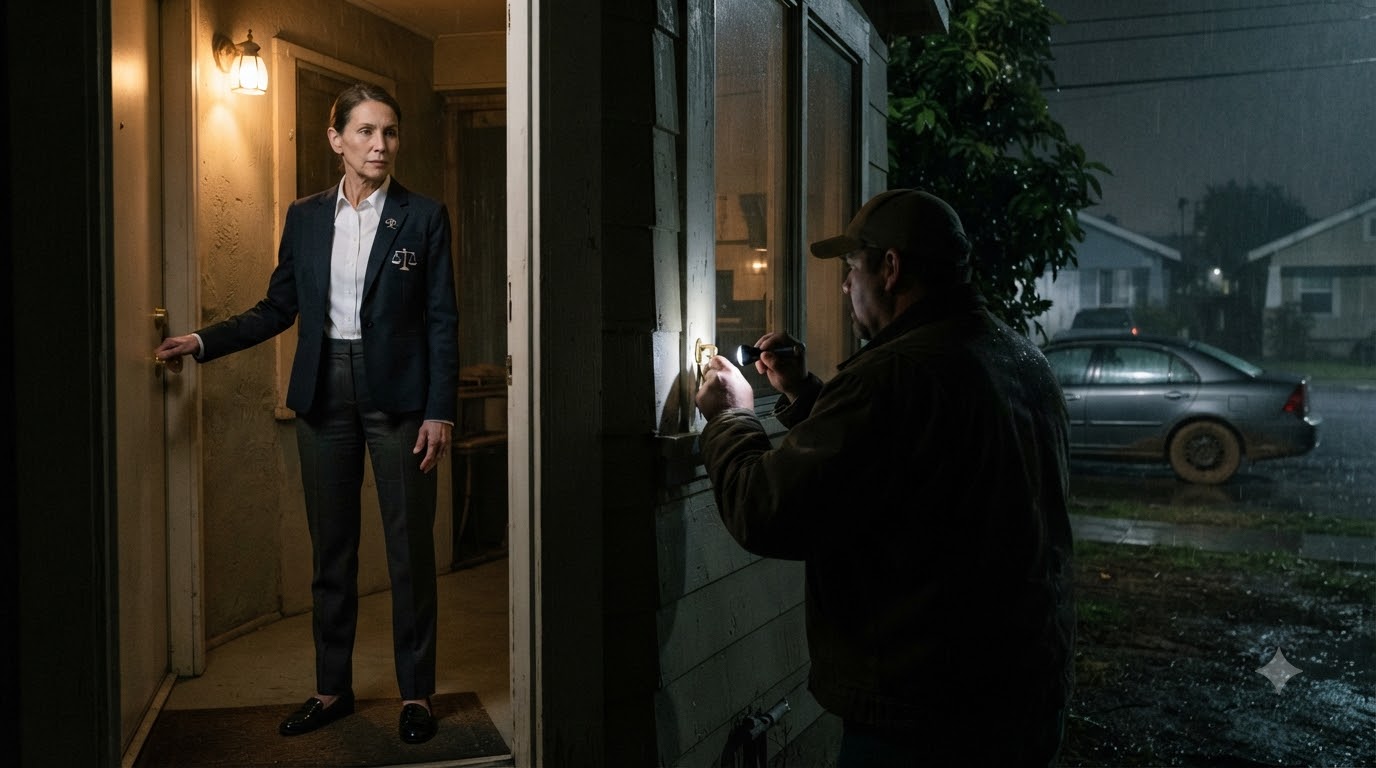
Through the rain-streaked side glass, a broad figure moved along my chain-link fence. The man wore a dark canvas jacket and a baseball cap pulled down past his brow. He didn’t rush. He moved with the heavy, practiced authority of a guard checking an empty warehouse, his flashlight beam clipped to his belt and pointed down at his boots.
He reached the side gate, hooked his boot under the bottom bar, and kicked it inward. The rusted latch snapped with a dry, metallic pop.
“He’s going around back,” I whispered, tightening my fingers around the strap of my tote bag until the canvas dug into my skin. “There’s nothing in that house, Aaron. Nothing.”
“He doesn’t know that,” Aaron replied, his voice dropping into a flat, dangerous register. “And he’s not going to leave until he proves it to himself.”
Aaron shifted the car into drive, letting the sedan coast forward in the dark without hitting the accelerator. We glided past the gray sedan, stopping four houses down where the shadow of an overgrown avocado tree spilled into the street.
“What are you doing?” I asked.
“He thinks he’s the only one who knows this block,” Aaron said, setting the parking brake with a quiet click. “He thinks because you’re sixty-one and live alone, nobody is checking the clock.”
Aaron unlatched his door. The interior light didn’t turn on—he had pulled the fuse three weeks ago.
“Aaron, wait—”
“Keep the doors locked from the inside,” he said, turning back to me. His tired eyes caught the faint streetlamp glare. “If he comes back to his car, honk twice. If he goes inside your kitchen, you sit tight.”
He slipped out into the rain, shutting the door until the latch barely caught.
I watched his dark silhouette move along the hedge line, fluid and silent despite the crushed vertebrae that made him wince whenever he got out of the car. He didn’t head for my driveway. He headed straight for the rear alleyway that ran behind the garages.
Through the gap between my house and the neighbor’s fence, a narrow beam of light flickered against my kitchen window.
Victor Hail was at the glass. He wasn’t prying it open with a crowbar; he was using a heavy set of brass commercial keys—the kind issued only to facilities management—testing the lock cylinders one by one.
He belonged in the building downtown, but standing in my muddy flowerbeds, he looked like a shadow that had finally stepped out of the files.
CHAPTER 4: THE VAULT CONFRONTATION
The sub-basement smelled of damp paper, ozone, and decades of stagnant air.
Victor Hail stood over the open metal archive drawer, a heavy steel flashlight tucked under his arm. His thick fingers shoved aside rows of red-pressboard folders, sending paperclips skittering across the floor.
“You’re looking in the wrong box, Victor,” I said, my voice flat, ringing off the unpainted concrete walls.
He snapped around so fast his hip caught the sharp corner of the steel sorting table. The heavy flashlight beam whipped across my face, blinding me for a split second before dropping to the floor.
“Lydia,” he grunted. His face was flushed red, his breath heavy with the sour stench of whiskey. He didn’t look like a criminal mastermind; he looked like a bitter, exhausted man clinging to a grudging vendetta. “You shouldn’t be here. You’re supposed to be at home.”
“Waiting for you to kick my side gate in?” I stepped past the threshold, keeping my feet planted wide on the slick concrete. “My husband testified against you thirty years ago, Victor. Daniel did his job. Just like I do mine.”
“Daniel ruined me!” Victor spat, his voice echoing up the elevator shaft. He slammed his palm onto the metal filing cabinet. “One deposition! One statement about forged sign-offs on the 1994 municipal contract, and my contractor license went into the trash! I spent thirty years working graveyard security shifts while he played history teacher!”
“So you took this job,” I said, taking half a step forward, my hand hovering over my tote bag. “You found the Apex Custodial accounts. You started cutting out the paper release forms from elder care settlements because you realized nobody cross-referenced the physical files.”
“They’re old people!” Victor yelled, his jaw trembling with erratic fury. “They don’t even know what the court awarded them! The lawyers take their cut, the state takes its cut, and I take what Daniel stole from me!”
He reached into his jacket pocket, pulling out a heavy, yellowed paper back-sheet—the physical affidavit from a 2014 disability trust file.
“I’m burning every original paper back-sheet in this vault tonight,” Victor growled, taking a heavy step toward me. “And if you’re standing in front of that exit door, Lydia, I’ll push right through you.”
Behind him, the shadow of the steel vault door began to move, swinging inward on its heavy grease hinges without making a sound.
CHAPTER 5: THE COLLAPSE OF LEVERAGE
Victor lunged forward, his heavy shoulder slamming against the steel door to keep it from latching.
“Get out of the way, old woman!” he bellowed, his voice straining as he shoved against the weight.
Aaron stepped into the frame from the outside corridor. He didn’t raise a fist; he simply wedged his heavy steel-toed work boot into the floor gap, placing his entire body weight against the exterior latch arm.
“The seal locks automatically from the outside once the pin drops, Victor,” Aaron said, his voice dangerously level. “And the master key ring hanging off your belt doesn’t have the override brass for this specific vault door.”
Victor froze, his chest heaving, sweat ruining his thin gray hair. He reached down to scramble through his key ring with trembling hands, his eyes darting frantically between the heavy lock face and the two of us.
“You think you’re clever?” Victor sneered, his breath hitching as he tried to force a confident grin. “You think locking me in a room proves anything? I’m contract security! I have a right to be in this basement! You two are trespassing on private archive property!”
“I have my clerk badge in my pocket, Victor,” I said, pulling out my backup grid-notebook and holding it up where the dim overhead bulb caught the ink. “And on page fourteen, I logged the exact serial numbers of the missing release back-sheets you stuffed into your jacket.”
Victor’s face went pale. He snatched the paper affidavit out of his pocket and tried to tear it across the middle, but the heavy, cotton-bound legal stock resisted his grip, digging deep red cuts into his thumbs.
“It doesn’t matter!” Victor yelled, tossing the crumpled paper onto the concrete floor. “You don’t have the authority to hold me! Nobody is going to listen to a night auditor and a rideshare driver over a bonded guard! I’ll tell management you broke into the vault to tamper with evidence!”
“You can tell them whatever you want,” Aaron said, his arm holding the heavy door steady against Victor’s frantic shoves. “But every word you said in my sedan for the last six weeks was recorded on a multi-directional cabin mic. The audio files are already uploaded to a secure cloud drive, tagged with timestamps and GPS routes.”
Victor stopped pushing. His mouth opened, but no sound came out. The arrogant entitlement that had carried him through thirty years of holding a grudge suddenly drained from his eyes, leaving only the raw, messy panic of a man who realized his own leverage had turned into a trap.
He backed away slowly until his spine hit the cold metal filing cabinets, sliding down two inches as his knees buckled.
“Daniel was a fool,” Victor whispered, his voice trembling as he looked up at me. “He thought the world was fair.”
“Daniel knew the world wasn’t fair,” I replied, stepping back into the hall as Aaron let the heavy vault door click shut, locking the bolt into place from the outside. “That’s why he wrote everything down.”
CHAPTER 6: THE QUIET NORMAL
The rain had stopped, leaving only the slow drip of water from the building’s overhang onto the hood of the car.
Aaron rested his hands on the steering wheel, his shoulders dropping two inches as he let out a breath he seemed to have held for weeks. He took one of the stainless-steel cups from my hands, his thumb tracing the dented rim before taking a small sip.
“He’s not getting out of that sub-basement until the morning facilities manager turns the master key,” Aaron said softly. “And when they open that door, the physical logs in his jacket pocket will answer every question the state auditors have.”
“I know,” I said.
I looked down at my own cup, watching the steam rise against the dark dashboard. For six months, the silence inside my bungalow had felt heavy, like an unfinished sentence left behind after Daniel passed away. But sitting here in the quiet of a dark sedan with a man who simply chose to pay attention, the silence felt light.
“He tried to turn my husband’s legacy into a weapon,” I whispered, my thumb scraping a speck of dried tea off the lid. “He thought because Daniel was gone and I was working night shifts alone, nobody would notice if he stepped into our lives and took what he wanted.”
“People like Victor count on everyone else minding their own business,” Aaron said. He turned his head, meeting my eyes with a calm, steady gaze. “They depend on people looking down, staying quiet, and treating strangers like background noise.”
“You didn’t look away,” I said.
“Neither did you,” he replied gently. “You brought me tea when your own hands were shaking.”
A soft chime sounded from his phone mounted on the dashboard. An incoming text flashed on the screen—a short message from an unlisted local number: Dad, saw the news clips. Call me when you get a minute.
Aaron stared at the screen for a long moment. His jaw worked silently, a single tear cutting a pale track through the dark rain-dust on his cheek before he wiped it away with the back of his hand.
“He’s moving back to Los Angeles,” Aaron said, his voice cracking slightly before settling back into its familiar, dry tone. “Slowly. But he’s coming back.”
I smiled, setting my travel mug into the center cup holder next to his.
“It’s nearly two in the morning, Aaron,” I said, leaning back against the headrest. “Take me home.”
He nodded, shifted the sedan into drive, and turned the wheel toward Cedar Street.