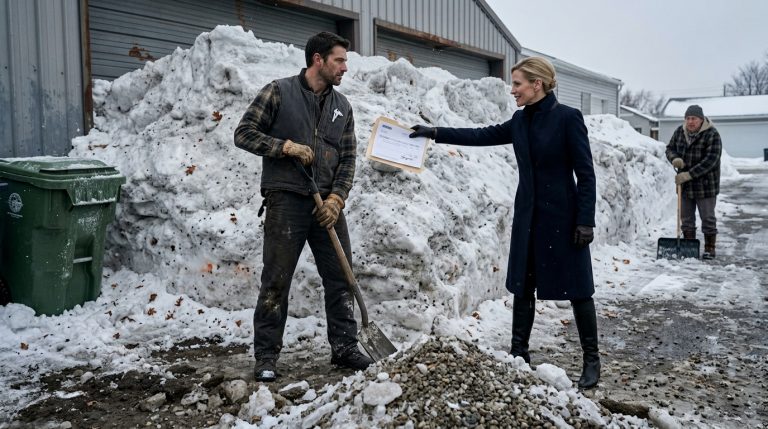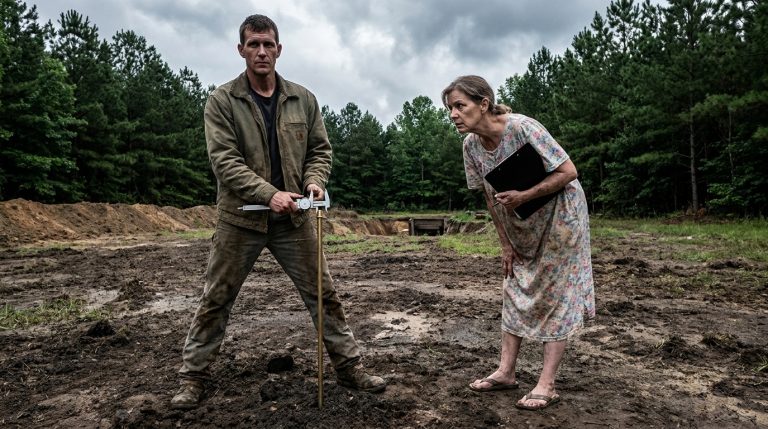
The Ledger of Harlow Creek: How a Quiet Electrician Dismantled a Hostile Bureaucratic Takeover
CHAPTER 1: THE FIRST CIRCUIT
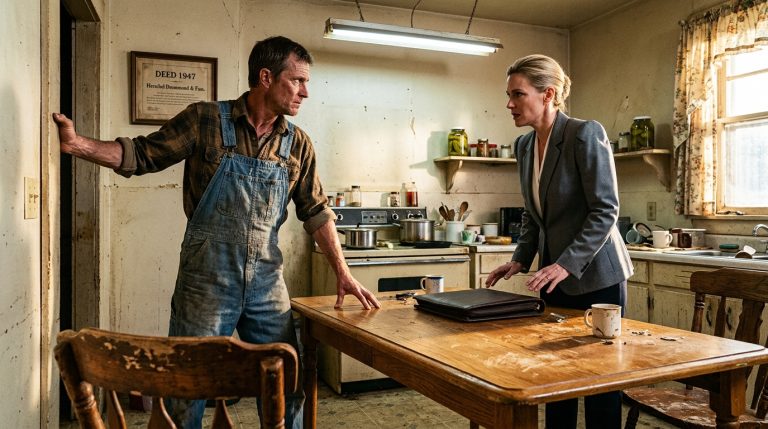
The air in the workshop was thick with the smell of ozone and machine oil—the scent of a system running perfectly. My workbench was a landscape of precision: calipers, copper wire stripped to the strand, and the labeled binders that held every invoice, permit, and property document I’d collected since buying these five acres. I was a man who knew the value of a closed circuit. When everything was connected correctly, there was no hum, no heat, just the clean flow of power.
Then came the letter.
I stared at the document under the harsh white light. “Harlow Creek Homeowners Association, LLC.” It was a string of words that didn’t belong in this valley. I turned the page, my eyes tracking the legalese. It spoke of ‘retroactive dues,’ ‘architectural review committees,’ and, in a paragraph buried near the bottom, the threat of a lien.
My pulse didn’t spike. I didn’t feel the heat of anger; instead, I felt the cold, sharp focus of an inspector finding a short.
I reached for my coffee, but stopped halfway. The letter sat flat on the scarred oak of my workbench, a foreign object disrupting the geometry of the room. Renata Stovall. She’d moved here four years ago, brought her beige carpet and her sharp-edged posture, and apparently decided that Harlow Creek was an unfinished project waiting for her oversight.
I opened the binder labeled HOA. It was empty, a placeholder waiting for data. I pulled out a fresh sheet of paper and wrote the date, the time, and the verbatim demand: $4,200.
I knew how to trace a fault. I knew that if you follow the voltage, you find the break. I didn’t reach for the phone to call a neighbor. I reached for my records. I wanted to see if anyone else had been flagged, but more importantly, I wanted to see if the paper trail—the actual recorded deed to my land—supported a single word of the threats Renata had mailed out.
The silence of the valley outside was absolute, but inside the shop, the gears were turning. I wasn’t just a retired electrician looking at a bill; I was a man looking at a breach in the perimeter. And as I looked at the letterhead—the little house inside the circle, the font that smelled of corporate arrogance—I realized she had made one critical miscalculation.
She thought we were people who couldn’t read the fine print. She didn’t know that I had spent eighteen years building this house with my own hands, and I knew exactly where the foundation was buried.
I heard the crunch of gravel outside—someone pulling up to the bait shop, maybe, or just someone driving too fast up the county road. I left the letter on the bench and walked to the door, peering through the gap in the siding. The twilight was turning the ridge a bruised, rusted purple.
I saw a car slow down near my mailbox. It was the white Volvo. It didn’t stop, but it lingered, a slow, deliberate crawl that felt like a predator marking its territory. It turned, the gravel spraying, and headed back toward the spec house on the flat parcel.
My phone vibrated. A text from Ted Marsh.
Desmond, did you get one of those letters?
I picked up the phone, my thumb hovering over the screen. I didn’t type a comforting lie. I typed the truth.
I have it. Don’t pay. Don’t sign. Meet me at the bait shop in an hour.
I set the phone down. The circuit was live. I just needed to see who else was going to get shocked.
CHAPTER 2: THE BAIT SHOP COUNTER
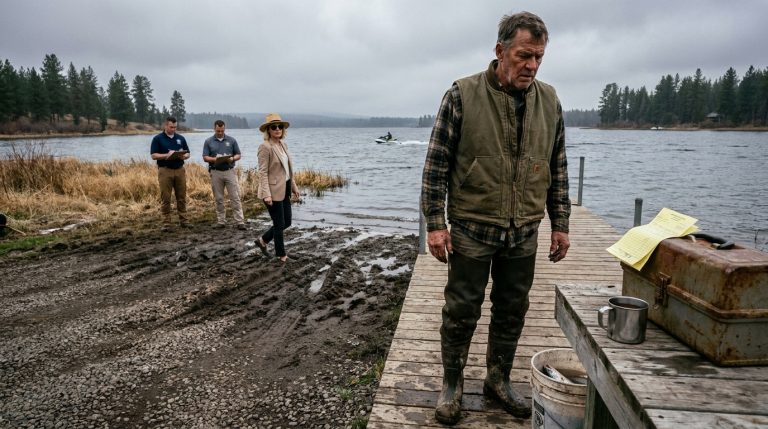
The air in Grover’s bait shop smelled of stagnant creek water and old, treated timber—the scent of things left too long in the dark. I pushed the door open, the bell above it giving a dull, rusted clack.
Grover was behind the counter, his hands deep in a tub of nightcrawlers, looking like he hadn’t moved since the Reagan administration. Ted Marsh was already there, leaning against the glass display case that housed the crankbait lures. He looked like a man who hadn’t slept in forty-eight hours.
“Desmond,” Ted said, his voice tight. “You’re late.”
“I was reading,” I replied. I didn’t say what I was reading. I just stepped up to the counter and laid my own letter on the laminate, right next to his. Two sheets of identical, sterile paper. They looked like infected tissue samples on an otherwise clean surface.
Before I could speak, the door opened again. The bell clacked.
Renata Stovall stepped inside. She didn’t look like a woman who belonged in a shop where the floor was stained with bait-bucket drippings. She wore a coat that cost more than a month of my social security and carried herself with the terrifying confidence of someone who has never been told ‘no’ in a room she didn’t own.
She paused, spotting us. For a second, the mask of the neighbor slipped. She didn’t look surprised; she looked annoyed, the way one might look at an obstruction in a hallway.
“Mr. Kraus. Mr. Marsh,” she said, her voice measured, rhythmic. “I didn’t realize there was a scheduled meeting today.”
“It’s not a meeting, Renata,” I said, keeping my tone flat. “It’s a review.”
I didn’t turn around to look at her. I kept my eyes on Grover, who had stopped digging through the worms and was now watching us with the detached interest of a man watching a storm build on the horizon.
“I’m sure you’ve had a chance to digest the documentation,” Renata continued, stepping closer. The scent of her—something floral, something that didn’t belong in a bait shop—hit me like a chemical weapon. “It’s a significant step forward for the community. I know change is difficult for those accustomed to… less rigorous standards.”
“Rigorous standards,” Ted repeated, his voice shaking. “Renata, I’ve lived on my parcel for thirty years. I don’t owe anyone a dime for the privilege of keeping my own fence.”
“It’s not a privilege, Theodore. It’s an obligation,” she countered, her cadence smooth, rehearsed. “The Homeowners Association acts in the interest of every resident. Once the covenants are fully processed, the property values will reflect that.”
I finally turned to look at her. I didn’t smile. I studied her face the way I’d study a wiring diagram, looking for the bypass, the flaw, the point where the connection was forced. She wasn’t just a neighbor. She was a tactical operator who believed we were the simpletons in her game.
“Renata,” I said, my voice quiet. “I called the register of deeds. I checked the Secretary of State portal. I looked for the recorded covenants that grant you this authority.”
She didn’t blink. She held my gaze with a cool, detached clinicality. “Administrative procedures take time, Desmond. Surely, as a man who values precision, you understand that these things are built in layers.”
“Layers,” I agreed. “That’s exactly what they are.”
I reached into my jacket pocket and pulled out a small notepad. I didn’t show her the contents. I just tapped it against the glass.
“There’s a small discrepancy in your LLC filing,” I said. “The registered agent. I noticed the name attached to the filing is a paralegal service in Charleston, one that processes hundreds of these every month. It’s a very efficient system. Almost industrial.”
The air in the shop felt thinner. Grover went completely still. Renata’s smile remained, but it had thinned, turning into a blade.
“I think you’ve spent too much time in your workshop,” she said.
“Maybe,” I replied. “Or maybe I just know that when you find a break in the circuit, you don’t just patch it. You trace it back to the source.”
She stepped away from the counter, her posture perfect, her coat rustling against the shelves of plastic lures. She didn’t look back as she headed for the door.
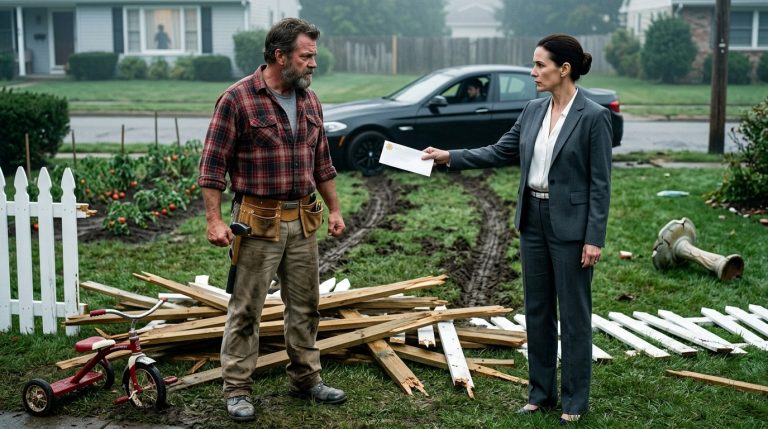
“The deadline is still in effect,” she said, her voice light, like she was talking about the weather. “I’d suggest focusing on your compliance, Desmond. It would be a shame to lose your workshop to a lien simply because you couldn’t keep up with the neighborhood’s growth.”
The door closed. The bell clacked.
Ted let out a long, ragged breath, his hands trembling against the glass. “Desmond, what did she mean about the workshop?”
I didn’t answer him immediately. I looked at the spot where she had been standing, then down at the dust on the floor.
“She’s already looking for a weakness,” I said, my voice low. “She doesn’t want our money. She wants our compliance. And the moment she realizes we won’t give it, she’s going to start pulling at the threads.”
I walked to the door and looked out at the gravel lot. Her Volvo was gone. In its place, the late afternoon sun was hitting the ridgeline, turning the valley into a jagged, rusted shadow. I had the start of my binder, and I had a target.
But I also knew something else. She hadn’t been bluffing about the inspection. She had been scouting.
“Ted,” I said, not turning back to him. “Go home. Check every inch of your property line. If you have anything that isn’t up to code—anything at all—fix it tonight. She isn’t just sending letters anymore. She’s building a case.”
I walked back to my truck, the weight of the binder in my pocket feeling like lead. I had just poked the bear, and the bear had just confirmed that she had a list of targets. I needed to see what she was filing with the county. I needed to know what else she had hidden under that corporate seal.
The circuit was live, and I was holding the switch.
CHAPTER 3: THE HOLLOW INSTRUMENT
The county register of deeds was a place where sound went to die. It was all fluorescent hums, heavy stacks of paper that smelled like decades of bureaucracy, and the sound of heavy metal drawers sliding shut. Patricia, the clerk who had manned this desk since the days of rotary phones, looked up as I approached.
“Desmond,” she said, her voice dry as parchment. “Back again?”
“Just one more verification, Patricia. I need to pull the instrument number from this document.” I slid a copy of Renata’s latest ‘Notice of Lien’ across the counter.
She adjusted her glasses, peering at the string of digits typed in the bottom corner of the page. She didn’t type it into a computer; she walked over to a massive, ledger-style filing system, her fingers moving with the rhythmic familiarity of a master locksmith.
I waited, my hands resting on the counter. The metal edge was cold, biting into my skin. I could feel the tension in the room—not just from the legal weight of what I was doing, but from the quiet realization that if this number didn’t check out, the entire ‘HOA’ was nothing more than a ghost story.
“That’s funny,” Patricia muttered, her brow furrowing. She flipped back a few pages in the manual register. “This instrument number… it’s misaligned, Desmond. The formatting isn’t ours.”
“What do you mean?”
“This number belongs to a commercial property filing from 2012. It’s an empty lot out near the county line, not a residential lien.” She looked up, her expression turning from boredom to concern. “Where did you get this document?”
“A neighbor,” I said. “Trying to establish authority.”
“Well, they didn’t get this from our office. This is a fabrication.”
I didn’t need to hear anything else. I thanked her, took the original document back, and stepped out into the crisp, biting air of the parking lot. The sun was dipping below the ridgeline, turning the world into a series of jagged, high-contrast silhouettes. The gravel crunched under my boots—that same, settling sound of the earth preparing for something harsh.
I didn’t go home. I sat in my truck and opened my laptop, pulling up the state’s business portal. The search took three minutes. I ran the name of the LLC, then the registered agent, then the Morgantown PO Box.
The screen glowed, illuminating my face in the dim cabin of the truck.
It wasn’t just Renata. The address—the PO Box in Morgantown—wasn’t just for Harlow Creek. It was linked to four other entities. Four different states. Four different ‘Homeowners Associations’ that had appeared, demanded money, and then dissolved into the ether, leaving behind empty bank accounts and a trail of devastated homeowners who didn’t know how to file a motion in circuit court.
This wasn’t a project. This was a process.
Renata wasn’t a neighbor who had lost her way; she was a seasonal scavenger, moving from valley to valley, picking off the residents who were too isolated or too afraid to fight back. She had the playbook down to a science—the threatening font, the manufactured lien numbers, the psychological pressure on the elderly.
I leaned my head back against the seat. The cold was seeping through the metal of the truck, but I didn’t feel it. I felt a sudden, sharp clarity. The ‘HOA’ didn’t exist. There were no covenants, no architectural review committees, no legal authority. It was all a digital phantom, a bluff built on the assumption that nobody would bother to look at the paperwork.
She had played the percentages. She had calculated that in a town like Harlow Creek, the cost of fighting her—both in time and stress—was higher than the $4,200 she was demanding. She had bet on our apathy.
I looked down at the binder in the passenger seat. It was growing, the tabs thick with evidence, receipts, and the names of people who had been hurt. I wasn’t just fighting for my property anymore. I was holding a light to a predator that relied entirely on the darkness of our own ignorance.
I pulled out my phone and dialed Fitzgerald Okafor’s number. He answered on the first ring, his voice low, sharp, and entirely focused.
“I have the proof, Fitzgerald,” I said. “It’s not just a civil dispute. It’s a systemic fraud.”
“I’m listening, Desmond.”
“I have the instrument numbers. I have the multi-state LLC links. This isn’t a neighbor. This is a serial operator.”
There was a long silence on the other end, followed by the faint sound of a pen scratching against paper.
“If that’s true,” Fitzgerald said, his voice dropping into a register that made the hair on my arms stand up, “then this isn’t just a motion for declaratory judgment anymore. We aren’t just protecting the land. We’re looking at federal mail fraud and potential bank fraud.”
“When can we file?”
“I’ll have the emergency motion drafted by morning. But Desmond… be careful. If she realizes you’ve traced the shell companies, she’s going to stop sending letters and start looking for a way to discredit the evidence. Or the man holding it.”
I looked out the windshield at the darkening valley. Somewhere in the distance, I could see the light from the spec house—the only one that wasn’t included on her ‘boundary map.’ She was sitting in there right now, comfortable in her beige living room, probably drafting the next wave of threats, completely unaware that the man she’d chosen as an ‘easy target’ was currently dismantling her entire operation, wire by wire.
“Let her come,” I said. “I’ve spent my whole life wiring houses. I know exactly how to ground a live current.”
I hung up the phone and started the engine. The sound of it echoed through the quiet valley, a steady, low-frequency hum. I drove home, the headlights carving a path through the mist. I had the truth, and for the first time since the first letter had arrived, I knew exactly how this circuit was going to end. It wasn’t going to be a debate. It was going to be a total, irreversible collapse.
But as I pulled into my driveway, I saw something that made me cut the engine immediately.
There was a light on in my workshop.
The door was slightly ajar, just enough for a sliver of light to bleed out onto the damp grass. I hadn’t left it open. I was a man of patterns, and my pattern was to lock the workshop when I left.
I didn’t grab a weapon—I didn’t need one. I reached into the bed of my truck and pulled out a heavy-duty flashlight and a pair of bolt cutters. I moved with the silent, practiced gait of a man who knew every inch of his own land. I didn’t approach the door; I moved to the side, staying in the shadows of the porch, listening.
Inside, the sound of paper—the crisp, rhythmic rustle of binder rings—drifted out into the night air. Someone was going through my research. Someone was looking for the evidence.
The circuit had just been tripped.
CHAPTER 4: THE THREADS OF THE WEB
I didn’t rush. I didn’t shout. I stood in the deep shadow of the workshop’s exterior wall, my breath hitching only once before I forced it into the steady, measured rhythm of a man doing a job. The intruder inside was quiet, far too quiet for a common thief. There was no clatter of tools being swept into a bag, no heavy footsteps of someone panicked. There was only the precise, rhythmic sound of paper being turned.
I kicked the door wide. It slammed against the interior workbench with a hollow, ringing crack.
“Step away from the table,” I said. My voice was a low growl, stripped of all neighborly veneer.
The figure spun around, a silhouette against the harsh light of my task lamp. It wasn’t Renata. It was a man in a nondescript work jacket, holding a camera phone. He looked at me, then at the open binder, and his face went blank—not surprised, but calculated. He was measuring the distance to the door, measuring the threat.
“You’re out of your depth, Kraus,” the man said. His voice was flat, devoid of regional cadence. A professional.
“And you’re trespassing,” I replied, taking a step inside. The workshop smelled of sawdust and the metallic tang of fear. I didn’t care about the man; I cared about the binder. My life’s work—the receipts, the deeds, the proof of a serial fraud—was spread out across the oak surface, exposed.
He didn’t fight. He moved with a practiced, fluid motion toward the side exit, ducking under the shelving. I lunged, my hand catching the sleeve of his jacket, but he twisted, the fabric tearing with a sound like a dry branch snapping. He was out the door and into the darkness before I could recover my balance.
I didn’t chase him. I stood in the middle of the shop, my chest heaving, listening to the crunch of gravel under receding tires. A white sedan—not the Volvo—roared to life down the road and vanished into the night.
I walked back to the workbench and looked at the binder. My heart was hammering against my ribs, a frantic, uneven rhythm that betrayed my control. He hadn’t taken the documents. He had been photographing them. They weren’t trying to stop the investigation anymore; they were mapping it.
I spent the next three hours in a state of hyper-vigilance, my senses tuned to the slightest shift in the valley’s silence. The wind through the ridge trees sounded less like a natural phenomenon and more like a warning. I reorganized the binder, every page, every sticky note, until the geometry of the evidence was restored. But the comfort of the order was gone.
The next morning, the fallout began.
I walked out to my mailbox to find three of my neighbors—The Hendersons, Carlton Webb, and Ted Marsh—waiting for me. They looked like people who had been hollowed out.
“They called the bank, Desmond,” Carlton said, his voice barely a whisper. “My lender. They told them there was a ‘title encumbrance’ on the property. My refinance… it’s been flagged for review. They told me it could take months.”
Ted held up his phone. A photo of a letter—the same sterile, corporate letterhead, but this one addressed to his mortgage holder. “They’re not just attacking our pockets, Desmond. They’re attacking the house itself. If I can’t refinance, I can’t pay the medical bills. I lose the place.”
I felt the weight of it then, heavy and cold. Renata had shifted her focus. She had realized that the legal case would eventually catch her, so she was scorching the earth behind her, targeting the one thing that mattered most to a man in this valley: his title.
“We go to the courthouse,” I said, my voice hard. “We go to the judge, and we show him that this isn’t just harassment. This is an attempt to destabilize the property values of the entire community through fraudulent claims.”
“They’ll just delay,” Ted said, despair finally cracking through his resolve. “Renata told me at the fire station that she’d have the lawyers tied up in motions until the next decade.”
“Let her try,” I said. But as I looked at them—the Hendersons, aged ten years in a week; Carlton, staring at the ground—I realized that Renata was winning the war of attrition. She had the professional backing, the shell companies, and the sociopathic patience to wait us out.
I went back inside and called Fitzgerald. I didn’t bother with pleasantries.
“They’re attacking the mortgages, Fitzgerald. They’ve found a way to weaponize the system.”
“I know,” he said, his voice weary. “I just got a call from the AG’s office. They’re running into a brick wall. Renata has filed for a stay of proceedings, claiming the community is engaged in a ‘coordinated defamation campaign.’ They’ve managed to turn the victim into the villain in the court’s eyes.”
I looked at the workshop, at the tools that had built this house, at the binders that were supposed to hold the truth. I had documented everything, but it felt like I was trying to hold back a flood with a handful of sand.
“So we’re losing?” I asked.
“Not yet,” Fitzgerald said. “But the rules have changed. If we want to break this, we don’t just need to prove she’s lying. We need to prove she’s a criminal.”
I hung up. The sun was rising, casting long, cruel shadows across the floorboards. I grabbed my coat and my truck keys. I had one more lead—the Ohio judgment, Marguerite Holloway. I hadn’t followed up on the specific details of how she lost her home. I had focused on the law, but I had ignored the history.
If Renata was a machine, every machine had a master switch. I wasn’t just going to fight her in the courts anymore. I was going to find the one thing she was afraid of, the one secret she hadn’t been able to bury in a shell company, and I was going to pull it into the light.
The rust on the workbench seemed to glow in the morning light, a reminder that everything, no matter how solid, eventually succumbed to the friction of time. I was going to make sure she was the one who broke first.
CHAPTER 5: THE BONFIRE OF VANITIES
The field behind the fire station was a sea of flannel and hushed, nervous energy. The bonfire was already roaring, a towering, crackling monument of timber that Grover had spent the better part of the afternoon nursing into a masterpiece. Two hundred and twenty people were huddled in the cold, the smell of wood smoke and grease from the corn-dog trailer hanging thick in the damp, stagnant air.
I stood near the fire station’s back door, my knuckles white as I gripped the binder. It felt heavy—a physical weight of every fraudulent letter, every recorded phone call, every piece of evidence that proved we were being hunted by a ghost. The television crew from Charleston was set up near the edge of the crowd, their camera light a dull, unblinking eye that seemed to be watching for a collapse.
Beaumont Strick walked up to me, his face grim. “The crowd is getting restless, Desmond. People want to know why you asked for the time. They’re hearing rumors about the bank flags.”
“I’ll give them the facts, Beaumont. That’s all they need.”
I walked toward the makeshift stage—a few plywood sheets laid over cinderblocks. The crowd parted, a silent wake behind me. I saw Renata near the back, standing by the pie table. She looked untouchable, wrapped in a cashmere coat, her expression one of polite, slightly bored curiosity. She didn’t look like a scavenger. She looked like the queen of a domain that wasn’t hers.
I stepped onto the plywood. It groaned under my weight. The microphone screeched as I adjusted it, the feedback a sharp, jarring noise that silenced the entire field.
“Good evening,” I said, my voice steady, amplified by the speakers. “Most of you know me. You know I’m a man who likes to keep his records straight. And for the last six weeks, I’ve been keeping records on something that’s been happening to our homes.”
I didn’t start with the anger. I started with the numbers. I read the date of the first letter. The name of the LLC. The registered agent in Charleston. As I spoke, I watched the crowd. The confusion on their faces slowly solidified into something harder—a realization that they hadn’t just been bothered by a nosy neighbor; they had been targeted by a business model.
When I reached the part about the fabricated county instrument numbers, a murmur rolled through the field, low and dangerous.
“They didn’t just want your money,” I said, my voice rising just enough to cut through the crackle of the fire. “They wanted your title. They wanted to make it so expensive to be here that you’d just hand over the keys and move on.”
Renata was still standing by the table, but the smile had vanished. She was staring at me, her eyes narrow, calculating. I saw her hand reach for her phone. She was calling someone—another lawyer, another shell company, another way to pull the strings.
“I have the documentation here,” I said, lifting the binder high. “Every letter, every false lien, and the proof that this same organization has operated in three other states, under three different names, before leaving a trail of empty accounts and broken homes.”
Then, I delivered the blow I’d been saving.
“I also have the results of the investigation currently being conducted by the Attorney General’s office. They aren’t just looking at the letters. They’re looking at the patterns of coercion.”
The field exploded into a chaotic roar. People were shouting, pointing, turning to their neighbors to verify what they’d just heard. The tension that had been building since October, the fear of the liens, the stress of the mortgage flags, all of it seemed to manifest in a single, kinetic surge of outrage.
Renata didn’t wait. She turned, her coat fluttering, and disappeared into the shadows near the parking area. I didn’t try to stop her. She was already finished.
But as I stepped down from the plywood, I saw something that chilled me worse than the winter air.
Ted Marsh was standing at the edge of the crowd, his phone held to his ear. He looked at me, his face pale as death.
“Desmond,” he mouthed. He didn’t speak into the phone. He held it out. “It’s my bank. They just foreclosed.”
My blood ran cold. I pushed through the crowd, my mind racing. She hadn’t been defeated by the speech. She had used the time while I was on stage to execute the final, terminal strike against the most vulnerable among us. She had bypassed the courts, bypassed the law, and leveraged a back-channel deal to lock the titles while we were distracted by the bonfire.
The “victory” of the speech was a shroud. While I was talking about the past, she was finalizing the future.
The wind shifted, the smoke from the bonfire blowing into my face, blinding me for a second. I looked for Renata, but the field was empty where she had been. She had left us with a spectacle, a moment of public vindication, while she systematically dismantled the foundation we were standing on.
I looked down at the binder in my hands. It was full of papers, dates, and names. But suddenly, it felt like nothing more than a collection of historical artifacts. The foreclosure had happened. The titles were moving. The system was eating our homes, and we were standing in a field listening to a speech about it.
I had the truth, but the truth didn’t stop a foreclosure. I had miscalculated. I had assumed the law was a circuit that could be fixed with evidence. I hadn’t realized that for someone like Renata, the law was just another tool to be broken and rebuilt to suit the design.
I looked at Ted. “We go to the bank, Ted. Tonight.”
“It’s Friday night, Desmond. They’re closed until Monday.”
“Then we find someone who’s open.”
I turned back to the bonfire. It was still burning, but the heat didn’t feel like warmth anymore. It felt like a funeral pyre. The investigation was moving, but it was too slow. Renata had sprinted while we were walking, and now, we were going to find out if there was anything left to save.
CHAPTER 6: THE CIRCUIT BREAKER
The ride to the bank was a blur of rain-streaked asphalt and the steady, rhythmic drumming of wipers against glass. Ted sat in the passenger seat, staring out into the dark, his hands clenched so tight in his lap that his knuckles looked like white bone. I didn’t speak. I didn’t need to. I was tracing the circuit, identifying the final point of resistance.
Renata had played the system’s own velocity against us. She had anticipated the lag in the legal process and used it to trigger the foreclosure notifications, banking on the fact that no bank would stop a standard automated process for a bunch of rural homeowners with no formal legal standing. But she had made one mistake: she had relied on an automated system, and automated systems require data. And data, unlike human resolve, can be corrupted.
We reached the bank—a local branch, not the massive headquarters—by the time the night manager was heading to his car. I didn’t wait for him to open the door. I stepped into his path, my binder in hand, my face as weathered and hard as the ridge line in winter.
“I’m Desmond Kraus,” I said. “And if you foreclose on these properties based on the documents provided by Covenant Compliance Solutions, you are not just executing a contract. You are knowingly facilitating a multi-state federal mail fraud scheme.”
The manager looked at me, his eyes flickering with the uncertainty of a man caught between corporate procedure and a very real, very imminent liability. “Mr. Kraus, I have my orders—”
“You have orders based on a lie,” I said, opening the binder. I didn’t show him the legal threats. I showed him the one piece of paper that couldn’t be faked: the certified report from the state’s portal confirming the LLC’s dissolution had been initiated weeks prior due to investigation. I showed him the email from the AG’s office. I showed him the Ohio judgment.
“If you process those foreclosures,” I said, my voice dropping into a low, steady hum, “you aren’t just processing paperwork. You’re becoming a co-conspirator. Do you want to explain to your board why your branch is the one that got caught ignoring a multi-state investigation?”
He looked at the papers. The fluorescent light of the parking lot reflected off the plastic sleeves, blinding, clinical. He stared at the documents, his face draining of color. He saw the official seals. He saw the signatures. He saw the liability.
He reached out, his hand hovering, then snatched the papers from the binder. He retreated into the bank, the door locking behind him.
Ted and I waited in the cold. Five minutes passed. Ten. Twenty. The rain turned into a freezing drizzle, coating the truck in a sheen of ice. Then, the door opened. The manager walked back out, his face etched with a mix of relief and terror.
“I’ve flagged the files,” he whispered. “The foreclosure orders are suspended, pending a legal review. But you need to get the court order to us by Monday, or the system will reset automatically.”
I nodded once. “Monday. It’ll be there.”
When we drove away, the silence in the truck wasn’t empty anymore; it was heavy with the weight of what we had done. We had broken the cycle.
The following months were a slow, grinding process of legal surgery. Fitzgerald worked the court filings, shredding the LLC’s claims layer by layer, exposing the shell companies, the false lien numbers, and the deliberate deception. We watched, session by session, as the courts systematically dismantled everything Renata had built.
She didn’t show up for the final judgment. She had vanished before the investigators could serve the final subpoenas, a ghost in a machine that had finally run out of power. The LLC was dissolved, the assets—what little was left after her fees—were frozen, and the residents of Harlow Creek were finally free of the phantom governance that had threatened their peace.
We established the Harlow Creek Property Rights Fund, a small but sturdy line of defense built from the restitution checks we received. It wasn’t about the money. It was about the principle. We had proven that a community, no matter how isolated, could hold its ground if it was willing to keep the records, trace the source, and refuse to blink.
I was back in my workshop the day the final court order arrived. The sun was streaming through the windows, hitting the dust motes as they danced in the air. I looked at the binder sitting on the bench. I pulled the last of the documents—the final judgment—and slid it into the back.
I locked the binder and placed it on the shelf, right next to the tools I used to maintain the house. It was part of the infrastructure now. The shop was quiet, the circuit stable, the power flowing clean.
I walked to the door and looked out over the valley. The creek was running, clear and steady, deep in the trench it had carved over the centuries. I knew that other threats would come. Other people with other lists, other schemes, and other ways to try and squeeze the life out of a place that just wanted to be left alone.
But I also knew this: the next time, we wouldn’t be caught by surprise. We were a wired house now. We were connected. We were watching. And that, I realized, was the only defense that ever really mattered.
I turned the light off, the room falling into a peaceful, functional darkness. The work was done.