Shadows Over the Subdivision: A Calculated Dismantling of Unchecked Authority Under the Oklahoma Sky
CHAPTER 1: THE WEIGHT OF GALVANIZED STEEL
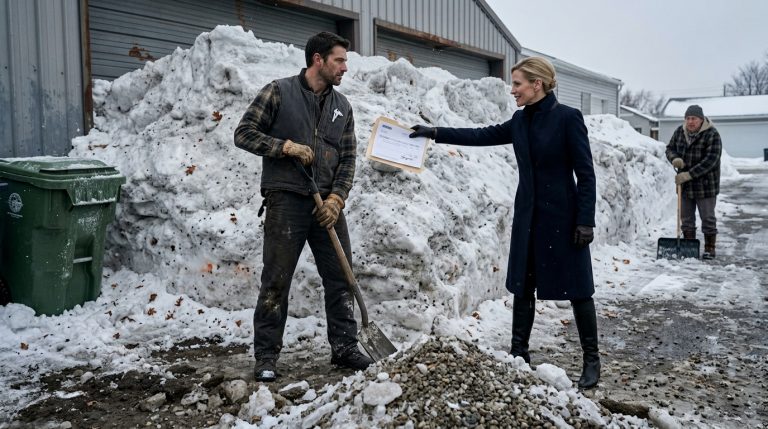
The sound of the padlock settling into the hasp was louder than it had any right to be. It was a sharp, final clack that cut through the low hum of the wind sweeping across the flat Oklahoma plains. I sat in the driver’s seat of my truck, the engine ticking as it cooled, and watched the sunlight crawl across the galvanized steel links of the chain Tammy Cresswell had draped over the storm shelter doors.
It was a storage unit aesthetic for a structure built to save lives.
I didn’t reach for the door handle. I didn’t shout. I simply reached into the passenger seat, pulled my notebook from the center console, and wrote down the time: 16:12. I noted the brand of the lock—a heavy-duty Master—and the tension on the chain, which looked tight enough to resist a crowbar but loose enough to rattle when the gusts hit.
Behind me, the neighborhood of Cedar Ridge looked perfectly manicured, a sprawling grid of pastel homes and aggressive lawns. It looked like peace. It looked like control. It looked like a setup.
“You aren’t just locking a door, Tammy,” I whispered to the empty cab. “You’re signing a federal confession.”
My phone vibrated against the seat. A notification from my weather station: Pressure had dipped another point-zero-two. The atmosphere was thinning, stretching tight like a drumhead. I glanced at the chain one last time, the way it bit into the painted concrete handles, then put the truck in gear. I wasn’t going to fight her for the key. I was going to wait for the storm to prove she didn’t own the house she was trying to burn down.
As I pulled away, my rearview mirror caught a flash of yellow—Tammy’s polo, tucked into her white capris, as she walked toward her own front door with that familiar, swinging gait. She hadn’t even looked back. She assumed the barrier was absolute.
She had no idea that the very thing she was counting on to keep people out was the anchor I was about to use to pull her entire world down.
CHAPTER 2: THE VOID IN THE BYLAWS
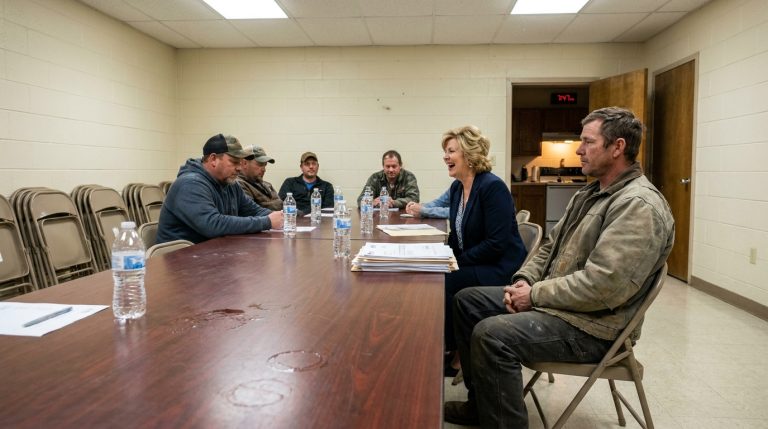
The community clubhouse smelled of industrial floor polish and the damp, lingering ghost of rain that had been tracked in on thirty pairs of shoes. I sat in one of the folding metal chairs, the kind that pinched the skin if you shifted your weight too quickly. Across the room, Tammy Cresswell presided over the front table as if she were holding court in a kingdom that existed solely within the property lines of Cedar Ridge.
She adjusted her glasses, the movement practiced and precise, and tapped a pen against the edge of her clipboard. To her left, Connie Pratt looked down at her own notes, her expression carefully neutral. To the right, Boyd Thatcher stared at the wall, his posture slumping in a way that suggested he was only present because he’d been told his attendance was mandatory.
“The matter of the storm shelter is settled,” Tammy said, her voice smooth and devoid of any real negotiation. “The resolution for safety infrastructure management has been filed. Access cards will be distributed to compliant residents starting Monday.”
The air in the room felt stagnant. Around me, the neighbors were quiet, a mix of genuine concern and a pervasive, low-level anxiety. They were looking at their feet, at their phones, anywhere but at the clipboard in Tammy’s hand.
I stood up. The metal chair gave a sharp, protesting screech against the linoleum. Every head in the room swiveled toward me. Tammy’s eyes narrowed, a flicker of irritation crossing her features before she smoothed it over with a practiced, thin-lipped smile.
“Mr. Maddox,” she said, her tone dripping with mock patience. “We are in the middle of a motion. You are not a board member. You have no standing to debate agenda items.”
“I have standing as a homeowner,” I replied, my voice steady, cutting through the stale silence. “And I have standing as the designer of that shelter.”
Tammy sighed, a sound of heavy, performative exhaustion. “The board has already voted. The resolution passed. We are concerned with liability management, Garrett. Not with your personal projects.”
I walked toward the front of the room. I didn’t rush. I wanted the silence to stretch, to let the tension in the room thicken until it felt like a physical weight against the chest. I reached into my bag and pulled out a single, heavily highlighted document—the subdivision’s CC&Rs.
“Section 12.1,” I said, my voice quiet, conversational. “It’s a standard amendment clause, Tammy. Maybe you missed it when you were drafting your safety resolution. It states that any change to the access policy for shared infrastructure—and that includes the pool, the clubhouse, and the storm shelter—requires a full membership vote. Sixty percent approval from all homeowners.”
I placed the document on the table in front of her. The paper looked bright, almost blinding under the harsh overhead fluorescent lights.
“You had three votes,” I continued, glancing at Connie and Boyd, who remained frozen. “In a room of thirty people. This resolution isn’t a policy. It’s an unauthorized act. It has no legal force.”
Tammy didn’t look down at the paper. She stared straight at me, her smile tightening, the skin around her eyes turning brittle. “You’re disrupting the meeting, Garrett. If you continue, I will have you removed.”
“By who?” I asked, looking around the room. “The neighbors? Or the people you’ve been fining for having a weather station that’s perfectly compliant with county regulations?”
I watched her hand tighten on the clipboard. For a split second, the mask slipped. I saw the fear beneath the arrogance, the sudden, sharp realization that the ground she was standing on wasn’t nearly as solid as she’d been telling everyone for six years. But then, she blinked, and the professional facade snapped back into place.
“This meeting is adjourned,” she announced, her voice rising to drown out the murmurs beginning to ripple through the chairs. “We will discuss this in private session. Mr. Maddox, you’re done here.”
She gathered her papers, her movements abrupt. As she pushed past me to leave, she didn’t look at me, but she didn’t have to. The way she held that clipboard, as if it were a shield, told me everything I needed to know. She knew I was right. But she also knew she wasn’t going to back down. She was going to fight me not with law, but with the institutional inertia she had built around herself.
I stayed where I was, watching her go. I noticed, for the first time, a small, missing entry in the maintenance log sitting on the corner of the table—the record of the last inspection. It wasn’t just incomplete; the pages for the month before the shelter opened had been cleanly, surgically removed.
The room began to clear, the neighbors whispering as they filed out. I walked over to the table and stared at the empty space in the binder. The mystery of the missing log wasn’t just a clerical error. It was a thread. And as I turned to leave the clubhouse, I realized it was the only thread I needed to pull to begin unraveling the entire, brittle structure of her authority.
The storm was still hours away, but the wind outside was already beginning to scream.
CHAPTER 3: THE OVERRIDE ARCHITECTURE
The late afternoon sun was beginning to dip, casting long, distorted shadows across the concrete pad of the storm shelter. The air had taken on that familiar, heavy quality that precedes a severe weather event—a pressurized stillness that made the fine hairs on my arms stand up. I pulled my truck up to the south exterior wall, the tires crunching over the loose gravel with a sound like grinding teeth.
Tammy was gone, but the chain remained. It hung from the handles of the primary doors, a thick, rusted snake of galvanized steel that seemed to mock the purpose of the structure itself.
I didn’t waste time looking at the chain. I stepped out of the truck, the wind pulling at my jacket, and moved toward the utility access point on the south wall. It was a flush-mounted steel plate, painted the same dull grey as the concrete, a detail I had insisted on so it wouldn’t draw the eyes of anyone looking for a way inside.
I knelt, the gravel pressing into my knees, and withdrew the hex key from my pocket. It was small, unremarkable, but it was the only thing standing between the residents of Cedar Ridge and a complete lack of agency when the sky finally turned.
The four bolts held tight, resisting the first turn with a sharp, metallic screech. My hands felt steady, a stark contrast to the thrumming in my blood. Every turn of the wrench was a calculation, a move on a board Tammy hadn’t even realized she was playing on. As the final bolt gave way, the panel popped outward, revealing the dark, recessed cavity beneath.
There it was. The override keypad. It sat nestled in the concrete, a clean, high-precision instrument that had been completely ignored by the locksmiths and the HOA board. It had never been opened, never been touched, and certainly never been read into the minutes of the board meetings.
I leaned in, the smell of damp concrete and metallic dust filling my nose. I entered the six-digit sequence, the keys depressing with a satisfying, soft click.
A muffled, internal thrum vibrated through the wall, followed by the definitive, heavy thud of the electromagnetic lock releasing. I didn’t open the door—not yet. I simply pushed the panel back into place and replaced the hex bolts, tightening them until they were flush with the surface once more.
When I stood up, I looked at the padlock on the main door. It felt entirely different now. It was no longer a symbol of absolute authority; it was a cosmetic distraction, a false bottom in a magic trick that was about to be exposed.
I looked back toward the neighborhood. My weather station sat near my fence line, its sensors spinning in the strengthening breeze. Every gust carried the scent of coming rain, a sharp, metallic tang that tasted like an approaching deadline.
I wasn’t just planning for a storm. I was planning for the moment Tammy would realize she had been playing with a house of cards. I had the override, I had the FEMA designation, and I had the proof of the missing maintenance logs. I had everything I needed to wait, to watch, and to let her own hubris provide the final, devastating blow.
As I walked back to my truck, a movement in the distance caught my eye. A dark sedan was parked two streets over, watching. It was a detail I hadn’t accounted for, a variable in an equation that had been perfectly balanced until now. I paused, my hand on the driver’s side door, and watched the car. It didn’t pull away. It just sat there, anchored in the growing twilight.
I climbed inside and started the engine. The radio crackled to life with a weather alert, the voice of the NWS meteorologist clipped and urgent. A new hook echo had developed, spinning faster, tighter. The timeline was compressing.
I glanced at the passenger seat where the manila folder lay, the edges of the papers sharp against the dark upholstery. If Tammy thought she could control the wind, she was about to be proven wrong. But the dark sedan—the new variable—suggested that she might have found someone else who played by the same, dirty rules.
I drove toward home, the road stretching out ahead of me like a fuse. The game was no longer just about a padlock; it was about the shadow in the distance, and the realization that while I had been busy checking the locks, someone else had been busy watching my hands.
CHAPTER 4: THE CONVERGENCE OF CONSEQUENCES
The kitchen table was no longer a place for meals; it was a command center. I had the FEMA grant agreement, the fire marshal’s contact details, and the timestamped photos of the padlock spread out like a hand of cards in a high-stakes game. The air in the house felt thin, vibrating with the low-frequency hum of a storm that was no longer distant.
My phone screen flickered to life. A message from Captain Eastman: Inspection team ready. 30-day window now active. Keep your head down, Maddox.
I looked up from the table. Outside, the sky had bruised into a deep, sickly shade of violet. The streetlights of Cedar Ridge flickered, a rhythmic, strobe-like warning that signaled the power grid was beginning to buckle under the strain of the front.
The dark sedan from the previous evening was back. It was parked at the far end of the street, its silhouette a stark, unmoving blot against the suburban perfection. It wasn’t HOA business. It wasn’t Tammy. The HOA didn’t have the budget or the sophistication to hire surveillance, and they certainly didn’t have the patience to sit in a car for twelve hours at a stretch.
I stood up, moving to the window, and pulled the curtain back just an inch. The sedan was an older model, nondescript, the kind of vehicle that blended into the background of a strip mall or a parking garage. I watched the driver’s side window roll down. A hand, gloved and steady, flicked a cigarette butt into the street.
The realization hit me with the weight of a physical blow: Tammy was a pawn. She had been operating with the belief that she was the architect of her own little fiefdom, but the level of observation suggested something else entirely. The “safety infrastructure management” resolution hadn’t been about her ego. It had been a test of control, a trial run for something larger.
I turned back to the kitchen and grabbed my laptop. I pulled up the HOA’s financial records from the past two years, searching for any hint of external investment or development partnerships. I had been looking for the missing maintenance logs, but I had ignored the revenue streams.
My fingers flew across the keyboard. Every transaction, every vendor payment, every “special assessment” fee—it was all there, recorded in cold, impersonal figures. I found it in the budget for the previous year: an anonymous line item titled Infrastructure Compliance & Advisory Services. The amount was substantial—more than the entire maintenance budget for the subdivision. The recipient was a holding company registered in a different state.
I leaned back, the chair groaning under the weight. The decoy secret was becoming clear. Tammy wasn’t just hoarding power; she was facilitating a shell game that served interests far outside the boundaries of Cedar Ridge Estates. She was the face of a land-grab masquerading as a homeowners’ association, and I had just walked straight into the middle of the negotiation.
A sudden, violent crack of thunder shook the house, the sound so loud it felt as if the walls themselves were buckling. The power cut out instantly, plunging the room into darkness. My emergency flashlight sat on the table, its beam cutting through the shadows.
I heard a soft, rhythmic tapping on my front door. It wasn’t the tentative knock of a neighbor. It was deliberate, steady, and entirely devoid of hesitation.
I walked toward the foyer, my heart hammering a cadence that rivaled the storm outside. I didn’t reach for my keys or look through the peephole. I stood behind the door, listening.
“Mr. Maddox?” The voice was low, smooth, and utterly professional. It didn’t belong to a resident, a board member, or anyone who lived in Cedar Ridge. “I believe we have some paperwork to discuss regarding the storm shelter. It would be in your best interest to open the door.”
I didn’t answer. I looked at the shadow cast by the porch light, the way it stretched across the floor, long and distorted. I realized then that the fight for the shelter was already over, replaced by a much darker, much more dangerous game. The failure here wasn’t in my planning; it was in my assumption that I was fighting a person rather than an institution.
The tapping started again, louder this time, less of a request and more of a demand. I realized with a sick, sinking feeling that the shelter, the one I had built as a refuge, was exactly what they were trying to claim. They weren’t interested in safety; they were interested in the land underneath the concrete.
And as the wind began to howl, tearing at the shingles of my roof, I understood that I had underestimated the predator in the room. I had been planning for a storm, but a hurricane had already made landfall.
CHAPTER 5: THE FUNNELS EMBRACE
The sirens didn’t just wail; they tore through the night like a physical force. The low, guttural moan of the alert system signaled that the supercell had finally arrived, a massive, rotating wall of black cloud that swallowed the horizon whole.
I didn’t answer the door. I didn’t engage the man on the porch. Instead, I retreated through the dark kitchen, the floorboards groaning under my boots, and slipped out the back sliding door into the yard. The wind was already insane, a chaotic, thrashing violence that whipped the rain into stinging needles against my skin. The air tasted like iron and ozone—the scent of a storm that had reached its zenith.
I reached the backyard fence and vaulted over it, landing hard on the slick, mud-drenched grass of the neighboring lot. Behind me, the house—the command center, the folder, the evidence—was already receding into the dark. I wasn’t running away; I was moving toward the only point of certainty left in a world that had suddenly turned predatory.
The shelter was two blocks away. Through the driving rain, I could see the parking lot lights flickering, a dying amber pulse against the black. I saw the shapes of the neighbors, huddled and frantic, and there, as clear as a strobe light, was the flash of Tammy’s yellow jacket. She was still holding that clipboard, still trying to enforce her invisible rules while the sky screamed.
I didn’t head for the front. I sprinted toward the south wall, my lungs burning, the mud pulling at my legs like a living thing. The utility panel was a faint, matte-grey square in the concrete. I threw myself against it, my hands fumbling for the hex key I still carried, the cold metal biting into my skin as the wind fought me for every movement.
Behind the shelter, the roar of the tornado began—a sound that defies simple description. It wasn’t just wind; it was the sound of the earth itself coming apart, a low, tectonic grinding that vibrated through the very marrow of my bones.
I got the key in. I twisted. The bolts broke free just as a piece of debris—a chunk of roofing or a piece of fencing—slammed into the concrete wall above my head, sending a spray of gravel into my eyes. I didn’t flinch. I yanked the panel open, punched in the override, and felt the familiar, heavy clunk of the electromagnetic seal popping open.
The main door, chained and padlocked as it was, swung inward as if it had been hit by a wrecking ball.
The neighbors inside didn’t wait. They surged into the darkness of the shelter, a frantic, desperate tumble of bodies seeking the only concrete reality left in a world that had gone insane. Mrs. Perkins was there, her walker clattering against the concrete threshold, her face a mask of terror that mirrored my own.
I caught her arm, steadying her as the wind threatened to pull her back out into the maelstrom. “Go,” I shouted, the sound swallowed instantly by the roar. “Get inside! Down the ramp!”
I turned back to the parking lot. Tammy was still standing there, her eyes wide, the clipboard having long since vanished into the dark. She was looking not at the storm, but at the door I had just opened—the door that had defied her, the door that rendered her authority into a pathetic, discarded relic.
A flash of lightning illuminated the field. The funnel was visible now, a massive, jagged finger of shadow descending from the clouds, tearing a path through the trees behind the subdivision. The pressure was so intense my ears popped, a sharp, physical pain that mirrored the sudden, agonizing memory of Elaine’s last hours—the same clinical, cold, inevitable pressure of a terminal diagnosis.
I hadn’t been able to save her. I had watched her fade in a room that smelled of antiseptic and silence, unable to bridge the gap between my expertise and her reality. That helplessness was the grit in my gears, the reason I had built this shelter with such fanatical, rigid precision.
“Get in!” I screamed at Tammy, my voice raw.
She didn’t move. The realization of her own obsolescence had paralyzed her. I didn’t wait for her to decide. I grabbed her by the shoulder of her yellow jacket and shoved her toward the opening. She stumbled, fell hard onto the concrete, and scrambled inside, her movements animalistic and panicked.
I followed, the roar outside rising to a deafening, final crescendo as the tornado struck the subdivision perimeter. The sound of splintering wood, shattering glass, and the groan of metal twisting like paper filled the air. I reached the threshold and threw my weight against the heavy concrete door, forcing it shut just as the wall of wind hit.
Inside, the silence was absolute—a crushing, suffocating stillness that was somehow more terrifying than the roar outside. We were alone, forty-odd people in the dark, and as I clicked the bolt into place, I realized that the threat I had been running from wasn’t the tornado. It was the fact that even here, in the dark, I was still the one responsible for everyone else’s survival. And the weight of that, the sudden, terrible realization of how much I had at stake, pressed down on me harder than the storm above.
CHAPTER 6: THE SILENCE AFTER THE GRIND
Inside the shelter, the roar didn’t just end; it collapsed into a high-pitched, ringing vacuum. For a long minute, forty-three people sat in a darkness so dense it felt like being buried alive. No one spoke. No one moved. The only sound was the jagged, uneven breathing of the children and the soft, rhythmic scrape of Mrs. Perkins’s hand against the concrete wall, as if she were tracing the geometry of the room to prove she was still anchored to the earth.
I sat near the door, my fingers still locked around the manual override hex key. My pulse was a slow, heavy thud in my ears, echoing the vibration that had just passed through the shelter’s reinforced concrete shell. My skin felt coated in a layer of fine, grit-like dust, and the air smelled exclusively of wet concrete and stagnant anxiety.
When the emergency lights flickered on—a dim, yellowish glow that barely reached the corners of the room—the transformation was jarring. Forty-three faces, pale and drawn, looked toward the door. I saw the Coopers clutching their children, Dolores Vance staring at the ceiling as if checking for cracks, and near the back, slumped against a support pillar, Tammy Cresswell.
She wasn’t the HOA president anymore. She was just a woman in a mud-streaked yellow jacket, her hair matted with concrete dust, staring at the floor. The clipboard was gone. The authority was gone. And in the sudden, clinical light, she looked smaller than I had ever imagined possible.
I stood up, my knees popping, and walked to the door. I didn’t open it. I pressed my ear against the steel, listening. Outside, the world was silent, save for the distant, rhythmic drip of water. The tornado had passed, but it had taken Cedar Ridge with it.
“Is everyone okay?” I asked. My voice sounded foreign, brittle and thin.
A murmur of confirmation rippled through the room. No one was hurt. The structure had held; the engineering I had fought to protect had done exactly what it was designed to do.
I turned back to the room, my gaze landing on Tammy. She didn’t meet my eyes. She knew what I had. She knew about the missing maintenance logs, the procedural void of the resolutions, the federal grant violations, and the holding company that had been pulling her strings. The storm had stripped away her mask, and all that remained was the pathetic skeleton of her corruption.
But as I looked at her, I felt a hollow, cold indifference. I had spent months obsessing over her, treating her like a chess opponent, as if dismantling her were the key to regaining the balance I had lost when Elaine died. But now, in the quiet aftermath, I realized the truth. My crusade against the HOA hadn’t been about safety; it had been an attempt to fill the void Elaine left behind—a desperate, rigid struggle for control in a world that had proven, in the most final way possible, that control is an illusion.
I had saved these people. I had defeated Tammy. But the shadow that had been watching me from the dark sedan remained. The financial records, the shell company, the “advisory services”—they were still out there, and they wouldn’t be stopped by a tornado or a fire marshal’s citation.
I pushed the door open. The air that rushed in was cool, heavy with the scent of pine needles, shredded insulation, and wet earth. Cedar Ridge was gone. The subdivision where the lawns all looked the same was now a chaotic tangle of splintered wood and debris.
As I stepped out, Captain Eastman’s red lights were already pulsing in the distance, cutting through the dark like a heartbeat. Ashley Montoya’s news crew was moving through the rubble, the lights of their cameras flashing as they documented the ruin.
I held the hex key in my hand, its edges sharp against my palm. I had won this round, but the battle for the truth was only beginning. The decoy secret—the financial greed of the HOA—had been shattered. Beneath it lay the core truth: I was no longer the man I had been before I moved here. The military engineer who believed in structures and chains of command was gone, replaced by someone who understood that the real danger never comes from the sky. It comes from the people who think they can lock the doors while the rest of us are left to figure it out on our own.
I stepped into the wreckage of the life I had tried to build, looking toward the dark horizon. I was ready.