The Weight of 1987: A Chronicles of Iron, Deeds, and the Long Memory of the North Shore
CHAPTER 1: THE VIBRATION OF THE CAB
The diesel idles at a low, guttural thrum that I usually feel in the marrow of my teeth. It’s a productive sound. It’s the sound of twelve tons of iron ready to move earth. But this morning, the vibration feels different—sharper, like a wire being pulled taut across the cabin.
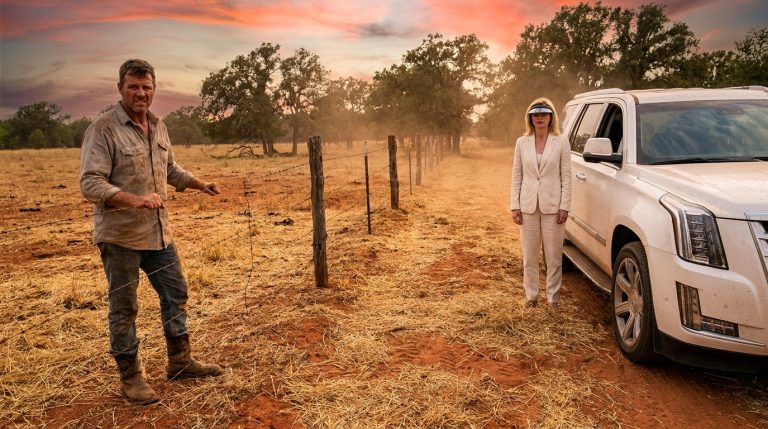
Through the frost-cracked windshield, the headlights of my rig cut two blinding tunnels into the 6:00 a.m. gloom. At the very end of those tunnels, right where my gravel apron meets the county asphalt, sits a pearl-white Cadillac Escalade. It’s parked dead-center, perpendicular, a $90,000 barricade of arrogance.
Then she steps into the light.
Deirdre Fulton Marsh is wearing a quilted navy vest over a crisp white turtleneck. She looks like she’s stepped out of a catalog for “Aspen Living,” not a lake lot in central Wisconsin where the mercury is struggling to hit eleven degrees. She isn’t shouting. She isn’t waving her arms. She’s just standing there by her driver-side door, arms crossed, smiling. It’s a thin, brittle smile—the kind of look a high school principal gives a student they’ve finally caught behind the gym.
I don’t roll down the window. I don’t kill the engine. I just sit in the air-ride seat, my hands resting steady on the wheel. The smell of clean-burning petroleum fills the cab, a scent that usually means progress, but today it smells like a dare.
My phone buzzes in the cup holder. I don’t have to look to know what it is.
“Board passed a resolution last night, Garrett,” she’d said through a text five minutes ago. “You’re not going anywhere.”
I look at the clock on the dash: 6:47 a.m. I have a permitted load. I have a crew waiting forty miles north. I have a contract that doesn’t care about HOA board meetings held in secret. Most importantly, I have eleven years of sweat buried in this driveway. I poured this concrete. I crushed the limestone under her tires.
Deirdre has been here three years. To her, this neighborhood is a project to be managed, a set of aesthetics to be enforced. To me, it’s a deed. It’s a boundary.
She shifts her weight, her boots crunching on my gravel. She thinks she’s winning because I haven’t moved. She thinks the silence of the cab is a sign of hesitation. She doesn’t realize that I’m not deciding whether to move the machine. I’m just calculating the exact weight of the bucket.
I pick up the phone, not to call her, but to check the time on the county sheriff’s non-emergency dispatch.
“Deputy Schoenfeld?” I say when the line picks up. I keep my voice as level as a laser-graded pad. “It’s Garrett Hollowell. I’ve got a trespasser on my apron. Bring a ticket book.”
I look back through the windshield. Deirdre’s smile hasn’t faltered, but she’s adjusted her vest. She’s checking her own phone now, probably drafting a victory post for the Facebook group.
She doesn’t know about the cardboard box in Walt’s barn. She doesn’t know about the 1987 plat map sitting on my kitchen table. She thinks this is a fight about a parked car. She doesn’t realize I’ve already started reading the fine print.
The diesel continues to hum. The wire pulls tighter.
CHAPTER 2: THE POWDERCOATED CAGE
“You’re making a very expensive mistake, Garrett,” Deirdre said, her voice carrying easily over the low, rhythmic throb of my engine. She didn’t move from the apron. She stood there like a sovereign, her Escalade acting as a white steel border wall.
I didn’t answer. I reached out and flicked the toggle for the work lights. A bank of LEDs on the cab roof erupted, bathing the Escalade and Deirdre in a harsh, clinical white glare. I watched her squint, her hand rising to shield her eyes, the professional mask of her smile finally twitching. I wasn’t looking at her face, though. I was looking at the way her tires were pinched against the limestone gravel I’d spread three years ago.
I put the rig in park, pulled the air brake—a sharp hiss-crack that made her flinch—and climbed down. The air hit me like a slap, sharp and dry, tasting of woodsmoke and the coming snow. My boots hit the ground with that solid, frozen crunch that only happens when the moisture in the earth turns to iron.
“The board passed Resolution 2023-14,” she continued, recovering her stride as I walked toward the front of my rig. She held up her phone, the screen glowing. “Temporary parking restrictions for heavy equipment transit. It’s for the safety of the children, Garrett. And the ‘aesthetic integrity’ of the lakefront. You were notified.”
“I was notified at midnight via an automated email,” I said. I stopped six feet from her. I could see the fine mesh of the Escalade’s grille, the polished chrome reflecting the LEDs. Everything about her world was shiny, new, and remarkably thin. “The county road begins ten feet past your rear bumper, Deirdre. This gravel? This is mine. You’re idling on private property.”
“The HOA has an easement for ‘community character’ management,” she countered. She had that tone—the one she used in the newsletters. It was the sound of someone who had spent her life winning arguments by being the most exhausting person in the room. “We’ve expanded the definitions. My brother-in-law vetted the language. If you move this rig, you’re in violation. Fifty dollars a day, backdated to the moment you keyed the ignition.”
I looked past her, toward the lake. Pinecrest Lake Estates wasn’t always this. When I bought my three acres eleven years ago, it was a place for people who liked the silence of the North Shore. It was a 1970s ranch house with a busted dock and a lot of potential. It was a place where you fixed your own shingles and watched the eagles.
Then came the “Estates” rebrand. Then came the Marshes.
Deirdre had bought the corner lot three years ago and immediately realized that the HOA was a sleeping giant. It was a paper tiger that had been dormant since 1987, run by retirees who just wanted the boat launch mowed. She didn’t just join the board; she consumed it. Within eight months, she was President. Within a year, she’d rewritten the bylaws using a template she’d found online, turning a neighborly pact into a weaponized bureaucracy.
The first time she’d come for me, it was my mailbox. Galvanized steel, she said, was “industrial” and “inconsistent with the rustic-modern aesthetic.” I’d replaced it with a black powder-coated box because I was a reasonable man and I had a business to run. Then came the flagpole. Then the “noise complaints” for a excavator idling at 10:00 a.m. on a Tuesday.
I watched her now, standing on my land, telling me I couldn’t leave to do my job. She felt powerful because she had a “Resolution.” She felt protected by the “Community Character.”
“I called the Sheriff, Deirdre,” I said quietly.
Her eyebrows arched. “Good. Let them see the heavy machinery blocking the view of the lake. I’m sure Deputy Schoenfeld will be fascinated by your lack of compliance.”
She didn’t get it. Most people like Deirdre don’t. They think power is something you broadcast. They think it’s the person who speaks first and loudest. In my business, power is the frost line. It’s the thing you can’t see until you start digging, and if you don’t respect it, it’ll crack your foundation and leave you in the mud.
I walked back to my cab, ignoring her follow-up remark about “legal consequences.” I climbed inside, the warmth of the heater core finally fighting back the Wisconsin chill. I didn’t look at her again. Instead, I reached into the glove box and pulled out a yellow legal pad.
I started a list.
Escalade Position (Geotagged).
Resolution 2023-14 (Timestamp check).
Deed Search (Easement verification).
I could see her in the side mirror, pacing back and forth in front of my rig. She looked like a predator patrolling a cage. But as I watched the way her Escalade sat—heavy and arrogant across my apron—I remembered something my father told me when I took over the iron. Never move the machine until you know exactly where the bucket is going to land.
I looked at the driveway. I looked at the property line. I realized then that I had been playing her game—the game of “Reasonable Man.” I’d been replacing mailboxes and lowering flags. I’d been letting her define the borders of my life.
I picked up my coffee, the liquid bitter and lukewarm, and watched the headlights of a squad car turn onto Lakeshore Drive in the distance.
Deirdre straightened her vest. She thought her backup had arrived. She thought the law was a tool she’d rented along with her corner lot.
She was wrong. The law wasn’t a tool; it was a map. And I was about to spend the next six weeks becoming the best damn cartographer Pinecrest Lake had ever seen. I looked at the rusted hinge of my gate, the metal scarred but holding.
I wasn’t just going to move the car. I was going to move the world she’d built around it.
CHAPTER 3: THE WEIGHT OF THE PERMIT
The red and blue strobes of the cruiser bounced off the pearl-white paint of Deirdre’s Escalade, turning the North Shore gloom into a rhythmic, nauseating disco. I stayed in the cab, watching through the side-mirror as Deputy Tara Schoenfeld stepped out of her SUV. She didn’t rush. In this part of Wisconsin, nobody rushes at seven in the morning unless there’s a fire or a deer through a windshield.
Tara looked at the Escalade. She looked at my rig—the D6 dozer chained down tight, the tracks still holding a dusting of frozen shop floor grit. Finally, she looked at Deirdre, who was already marching toward her with her phone held out like a holy relic.
I cracked the door. The sound of the diesel engine, that low, dependable thrum, spilled out into the cold air.
“Deputy, thank God,” Deirdre’s voice was sharp, a weaponized soprano. “I’ve been trying to explain to Mr. Hollowell that he is in direct violation of a safety resolution passed by the board. This vehicle,” she gestured vaguely at my twelve-ton rig, “is a public nuisance and a hazard to the children of Pinecrest.”
Tara didn’t look at the phone. She adjusted her belt, the leather creaking in the frost. “Morning, Deirdre. Garrett.” She turned her gaze to the Escalade’s rear tires, which were buried four inches deep into the limestone of my apron. “Deirdre, you want to tell me why your car is parked on Garrett’s driveway?”
“It’s an official HOA enforcement action,” Deirdre snapped. “Resolution 2023-14. We have the right to restrict access for non-compliant commercial traffic.”
“An HOA,” Tara said, her voice dry enough to catch fire, “is a private corporation. A private corporation doesn’t have the authority to kidnap a man’s property or block his access to a county road. Especially not while standing on the man’s own deeded dirt.”
I stepped down from the cab then, my boots finding the familiar, uneven bite of the frozen ground. I didn’t look at Deirdre. I looked at my watch. 7:14 a.m. The window for the scale house was closing. Every minute we stood here was a minute of fuel burned, a minute of labor lost, a minute of my reputation with the logistics company in Wausau fraying at the edges.
“She’s been there since 6:00, Tara,” I said. I pulled the yellow legal pad from my pocket. “I’ve got the timestamps. I’ve got the text where she admits it’s a deliberate block. I need to move this load. Now.”
Deirdre’s face went a shade of red that matched the cruiser’s lights. “This is a residential community, not a staging ground for a construction site! The bylaws—”
“The bylaws don’t override the state statutes on obstructing a private drive,” Tara interrupted. She pulled a ticket book from her jacket. The sound of the carbon paper being tucked into place was the most satisfying thing I’d heard all morning. “Move the car, Deirdre. Now. Or I’m calling a tow, and you can explain to your husband why the Escalade is in the county impound lot.”
Deirdre froze. For a second, I saw the calculation in her eyes—the moment where the “Queen of the HOA” realized that the badge in front of her didn’t care about her powder-coated mailbox or her “aesthetic integrity.” She snatched her keys from her vest pocket, the metal jingling like a warning.
“This isn’t over,” she hissed, looking directly at me. “You think you can just bully this neighborhood into being your personal junkyard? Wait until the annual meeting. You’ll be lucky if you’re allowed to park a bicycle on this lot by February.”
She climbed into the Escalade and slammed the door. The engine roared to life, and she backed out with a violent spray of my limestone, her tires screaming against the asphalt as she sped toward her corner lot 300 yards away.
Tara watched her go, then sighed, a puff of white steam vanishing into the air. She turned to me, leaning against her cruiser. “She’s going to make your life hell for this, Garrett. You know that, right?”
“She’s been trying for two years,” I said, leaning back against the cold, rusted steel of my trailer. I felt the vibration of the idling rig through my spine. It felt like a ticking clock. “But she just did something she hasn’t done before.”
“What’s that?”
“She left her signature on the trespass,” I said, tapping the legal pad. “She’s counting on me being too busy to read the fine print. She thinks I’m just a guy with a backhoe.”
Tara looked at me for a long moment. She’d known me since my father ran this company, back when Pinecrest was just a few fishing cabins and a gravel road. She knew I didn’t make threats. I made plans.
“Just keep it legal, Garrett,” she said, climbing back into her cruiser. “I don’t want to have to come back out here for a property line war.”
“It’s already a war, Tara,” I said quietly. “I’m just the only one who’s started digging the trenches.”
I climbed back into the cab. I hit the gear, the rig groaning as I eased it out onto Lakeshore Drive. I missed the scale house window by twelve minutes. The project manager in Wausau was cold on the phone, his silence a heavy weight on the other end of the line. It was a half-day lost. A thousand dollars in liquidated damages.
But as I drove, the heater humming against the Wisconsin frost, I didn’t feel the anger I expected. I felt a cold, sharp focus. I thought about the way Deirdre’s fence—that ornate, expensive privacy screen—ran right along the eastern edge of her property. I thought about the way the light hit the lake, and the way the original plat maps from 1987 were filed in the basement of the county building.
Deirdre was a student of the new bylaws. She loved the “Temporary Resolutions” and the “Emergency Sessions.” She operated in the shallow water of the present.
I was going to go deep.
That evening, I didn’t go to the bar. I didn’t watch the news. I sat at my kitchen table with a stack of property records I’d been collecting for months, a highlighter, and a cup of coffee that had long since gone cold. I looked at the original development agreement between Roland Pruitt and the county.
My finger stopped on a paragraph buried on page forty-one. Passive Recreational Easement.
I frowned, leaning closer to the faded ink. I looked at the map. Then I looked at the photos I’d taken of Deirdre’s lot during the summer.
The fence. The plantings. The stone patio she’d built for her outdoor kitchen.
If my math was right—and I’ve spent twenty years measuring grades to the quarter-inch—Deirdre’s castle wasn’t just built on a foundation of ego.
It was built on land that didn’t belong to her.
I picked up the phone and dialed a number I hadn’t called in three years.
“Mel?” I said when the voice on the other end picked up. “It’s Garrett Hollowell. I need a boundary survey. And I need you to bring the 1987 plat records. All of them.”
Outside, the wind off the lake rattled the windowpane, a low, rusted sound that felt like an ending. Or a beginning.
CHAPTER 4: THE ARCHITECTURE OF A LIE
The kitchen table was a battlefield of paper. Under the harsh buzz of the overhead fluorescent, the original CC&Rs from 1987 looked less like governing documents and more like an ancient, forgotten map of a country that no longer existed. I sat with a yellow highlighter in one hand and a mug of black coffee in the other, the steam rising to meet the dry, cold air of the house.
I’m a man of grades and compaction. I understand how things settle over time. If a foundation is poured on bad soil, the cracks don’t show up in the first year; they wait. They wait for the house to get heavy. They wait for the frost to heave. Pinecrest Lake Estates was getting heavy, and the frost was finally setting in.
I ran the highlighter over Section 4, Paragraph 12 for the third time. “…commercial use restrictions shall apply to permanent structures and signage, but shall not impede the lawful transit of equipment required for the maintenance of deeded parcels or grandfathered business activity.”
Deirdre’s “Resolution 2023-14” wasn’t just a nuisance. It was a direct violation of the foundation. She had built a mezzanine of rules on top of a structure that couldn’t support them, banking on the fact that no one in this neighborhood remembered what the ground looked like before the concrete was poured.
“You’re digging again, aren’t you?”
I looked up. My daughter, Chloe, was standing in the doorway, her hoodie pulled up against the draft. She had her mother’s eyes—the kind that could spot a lie from three counties away. She walked over and looked at the mess of plat maps and high-resolution scans Mel Fitch had sent over an hour ago.
“I’m checking the footings,” I said, my voice sounding gravelly even to my own ears.
“The lady in the white car called the school,” Chloe said, sliding into the chair opposite me. She didn’t sound upset; she sounded curious, the way she did when she was taking apart a broken toaster. “She asked the principal if ‘industrial vehicle traffic’ in the neighborhood was a concern for the bus routes. She’s trying to make people think you’re dangerous, Dad.”
I felt a surge of that cold, quiet anger—the kind that makes you move slower, not faster. This was the social warfare. Deirdre wasn’t just blocking my driveway; she was trying to excavate the earth out from under my family’s name.
“What did the principal say?” I asked.
“He told her the bus has been running the same route for twenty years and the only hazard lately has been a white Escalade parked in the turn-around,” Chloe smirks. She tapped a finger on a document Mel had tagged with a red flag. “What’s this one?”
I pulled the sheet toward the center of the light. It was a copy of the 1987 development agreement. Mel had found a discrepancy. The county’s digital records showed Deirdre’s corner lot as a clean rectangle. But the original hard-copy plat, the one Roland Pruitt had filed before the ink was even dry on the subdivision, had a shaded strip along the eastern boundary.
“It’s a twelve-foot easement,” I whispered. “Passive recreational. It was supposed to be a walking path to the lake for the entire community. It was never deeded to the corner lot. It was common ground.”
I stood up and walked to the window, looking out toward the north shore. In the moonlight, I could see the silhouette of Deirdre’s privacy fence. It was an expensive thing—cedar, stained dark, topped with ornamental iron. It ran straight through that shaded strip. She hadn’t just landscaped it; she’d enclosed it. She’d claimed twelve feet of the community’s land as her own private fortress, then used that fortress to stand on while she lectured the rest of us about “aesthetic integrity.”
“She built her house on a lie,” Chloe said, echoing my thoughts.
“No,” I corrected, my eyes tracking the line of the fence in the dark. “She built her fence on a lie. The house is fine. The arrogance is what’s overhanging the boundary.”
I went back to the table and picked up the phone. I didn’t call the Sheriff. I didn’t call the HOA board. I called Dale Breneke. Dale was a farmer’s son who’d gone to law school and realized that the most powerful thing in the world wasn’t a gun or a badge—it was a quiet title action.
“Garrett,” Dale’s voice was thick with sleep, but sharp. “It’s late for a gravel man.”
“I found a void in the soil, Dale,” I said. I looked at the map, at the shaded strip of common area Deirdre had stolen. “I need you to look at the 1987 Pruitt filing. I’ve got a President who’s trespassing on public land and calling it a private yard. And I think she’s been using HOA funds to maintain it.”
There was a long silence on the other end. I could hear the rustle of Dale sitting up in bed, the sound of a man recognizing the scent of a long-overdue settlement.
“If she’s enclosed common area, she’s in breach of the fiduciary duty to the association,” Dale said, his voice gaining its courtroom resonance. “But Garrett, if you go after her fence, she’s going to go after your business. She’ll file every nuisance injunction in the book.”
“Let her,” I said. I looked at my daughter, who was tracing the property lines with a pencil. “I’ve already missed my scale window. The damage is done. Now we’re just talking about the cost of the repair.”
I hung up and looked at the legal pad.
Deirdre thought this was a fight about a parked car. She thought she could win by being the loudest voice in a room of sixty people. She didn’t realize that in the North Shore, the truth doesn’t care about voices. It only cares about the survey stakes.
I reached for my coffee. It was stone cold, but I drank it anyway. I had four hours before the sun came up, and I still hadn’t found the digital scan of the 1987 deed. It wasn’t in the county system. It was as if someone had deliberately forgotten to upload it.
I looked at the list on my pad.
Find the 1987 Deed (The Missing Scan).
“Dad,” Chloe said, pointing to the name at the bottom of the development agreement. Roland Pruitt. “Didn’t he used to give Walt Bremer those old boxes of files before he died?”
I froze. Walt. The man who’d lived here since the fishing cabins were the only things on the lake. The man who Deirdre had ignored because he wore overalls and drove a truck that smelled like wet dog.
The predator-prey logic shifted. I wasn’t the one being hunted anymore. I was the one tracking the scent back to the den.
“Get some sleep, Chloe,” I said, standing up and grabbing my keys.
“Where are you going? It’s two in the morning.”
“I’m going to see a man about a box,” I said.
The driveway was silent as I stepped outside. The wind had died down, leaving the lake a flat, black mirror. I looked toward Deirdre’s house. The lights were out, the Escalade parked safely behind her illegal fence. She was sleeping the sleep of the righteous, convinced of her own power.
I keyed the ignition of my truck. The engine turned over with a heavy, rusted growl. I didn’t put on my lights until I was at the end of the apron.
I knew exactly where the bucket was going to land.
CHAPTER 5: THE BURIED DEED
Walt Bremer’s barn didn’t just hold equipment; it held time. It was a cathedral of weathered oak and rusted iron, smelling of thirty Wisconsin winters and the sweet, lingering rot of old hay. My truck headlights swept across the sagging double doors as I pulled in, the beams catching the swirling dust motes that seemed to hang permanently in the stagnant air.
Walt was already waiting by the side door, a silhouette in a canvas chore coat, his hands shoved deep into pockets that had probably held more linchpins and fence staples than money. He didn’t say anything as I climbed out of the truck. He just jerked his chin toward the back of the structure, past the silent ghost of an old Allis-Chalmers tractor.
“You’re out late, Garrett,” Walt said, his voice a low rasp that sounded like gravel shifting in a bucket. “Or early. Depends on which side of the clock you’re looking at.”
“The clock stopped at 6:47 yesterday morning, Walt,” I replied, my boots crunching on the dry, dirt floor. The cold inside the barn was different than the cold outside; it was a heavy, still frost that settled into your joints. “I’m looking for the foundation. Chloe said you might have Roland’s old files.”
Walt led the way to a corner where the shadows were deepest. He reached up to a shelf cluttered with rusted coffee cans and coils of baling wire, moving a forgotten grease gun to reveal a cardboard box. It had Pruitt Lake Est. scrawled across the side in a marker that had faded to a ghostly purple.
“Roland was a man who didn’t trust anything with a battery,” Walt said, lifting the box with a grunt. He set it down on a workbench covered in iron filings. “He gave me this a year before he passed. Said the county was going digital and half the truth was going to end up in a recycle bin because some clerk didn’t want to type it out.”
I reached into the box. The paper was thick, old-stock bond—the kind that feels like it has weight even before you read the words. These were the original copies. The notarized ones. I flipped through the development agreements and the plat maps I’d already seen on my kitchen table, but then my hand hit something different.
A separate manila envelope was tucked into the back, sealed with a single piece of yellowed Scotch tape. I pulled it out.
“That’s the one he was worried about,” Walt whispered. He struck a match and lit a kerosene lantern on the bench, the orange flame blooming and throwing long, distorted shadows against the barn walls.
I slid the document out. It wasn’t a bylaw. It wasn’t a zoning map. It was a notarized Private Lake Access Agreement dated March 1987, signed by Roland Pruitt and the County Administrator. I read the first paragraph, and the air in my lungs suddenly felt too thin.
“Walt,” I said, my voice barely a whisper. “Do you know what this says?”
“I know what Roland told me,” Walt said, leaning against the bench. “He told me he made a deal. The county gave him the road infrastructure and the utility easements for free. In exchange, he had to guarantee that the lake—the whole 200 acres—would always belong to the property owners. Not just the ones on the board. All of them.”
I ran my finger under the critical line: …these rights of access and recreational use are perpetual and may not be restricted, suspended, or revoked by any Association action without a unanimous vote of all deeded property owners.
The room felt like it was tilting. For three years, Deirdre had used lake access like a billy club. She’d threatened boat slips, fishing rights, and dock privileges to keep people in line. She’d issued fines under the threat of “reviewing” lake status. It was her primary source of power—the leverage that kept the retirees and the weekenders from speaking up.
And it was a total fabrication.
“She doesn’t have the authority,” I muttered, the words tasting like iron. “She never did. This agreement is recorded in the register of deeds, but it predates the digital system by a decade. It’s not on the website. It’s not in the title searches.”
“But it’s here,” Walt said, tapping the notarized seal. “And it’s at the county building in a ledger somewhere, gathering dust.”
I looked at the seal. It was a physical piece of the past, a rusted truth that had been waiting for someone to dig deep enough to find it. Deirdre was playing a game of “Aesthetic Integrity” and “Community Character” while standing on a contract that made her entire enforcement regime a breach of county law.
“Why didn’t you say anything before, Walt?” I asked, looking up at him.
Walt took a slow breath, the scent of old diesel and cold hay swirling around us. “Because nobody asked. And because I’m seventy-four years old, Garrett. I didn’t want to be the one to start the fire. But I saw her Escalade in your lights yesterday. I saw the way you sat in that cab. I figured you were finally ready to handle the matches.”
I tucked the manila envelope under my arm. I felt the weight of it—the legal mass of a thirty-year-old promise. This wasn’t just a defense for my driveway anymore. This was a demolition charge.
“I need to get this to Dale,” I said.
“Wait,” Walt said, his hand catching my shoulder. His grip was like a pair of old pliers. “There’s one more thing in that box. A letter Roland wrote to the first board. He knew a Deirdre would come along eventually. He called them ‘The Quilted Dictators.'”
I reached back in and pulled out a smaller, hand-written note. It wasn’t a legal document, but it was a warning. The strength of the lake isn’t the water, it read. It’s the fact that nobody owns the view alone.
I walked out of the barn and back to my truck. The world looked different now. The dark lake wasn’t a private club run by a woman in a quilted vest; it was a public trust guarded by the dead.
As I pulled out of Walt’s driveway, my mind was already moving ahead, calculating the grade. I had the survey. I had the encroachment on the common area. And now, I had the ultimate reality: the Lake Access Agreement.
Deirdre thought she was a sovereign protector. She thought she was the one who decided who got to touch the water. She was going to find out that the foundation of her power was built on a void.
I didn’t go home. I drove straight to the county seat, waiting in the parking lot for the Register of Deeds to open. I sat there in the dark, the heater humming, watching the first light of dawn catch the frost on the trees.
The predator-prey logic was gone. This wasn’t about hunting. This was about maintenance. It was about clearing a blockage that had been choking this community for three years.
I checked my legal pad.
Record the Lake Access Agreement (Public record status).
I looked at the clock. 7:55 a.m.
In five minutes, the truth was going to become digital. And Deirdre Fulton Marsh was going to find out what happens when you try to block a man who knows how to move the earth.
CHAPTER 6: THE SIXWAY BLADE
The concrete doesn’t care about neighborhood politics. It only cares about the mix, the temperature, and the gravity that holds it in the earth. I stood in the pre-dawn shadow of my driveway, watching the soup-thick slurry slide down the chute and into the holes I’d bored four feet deep into the frost-hardened soil.
This was the quiet work. No diesel roaring, just the rhythmic scrape of my shovel and the wet slap of the mix hitting the bottom. I was installing two four-inch steel pipe bollards. I’d spray-painted them a flat, industrial gray—the color of a storm-tossed lake. They were set exactly eleven feet, six inches apart. Wide enough for a fuel truck, a fire engine, or a standard pickup.
Not wide enough for a pearl-white Escalade with an extended wheelbase.
I smoothed the top of the concrete around the first post, the trowel leaving a matte finish that would cure into iron by noon. This was the first physical border I’d drawn in three years that wasn’t dictated by a “powder-coated” bylaw. It was a sovereign act. I was reclaiming the apron Deirdre had treated as her personal parking lot.
“You’re making it permanent,” a voice said from the darkness.
I didn’t startle. I knew the cadence of Walt Bremer’s walk. He stepped into the pool of light cast by my shop lamps, a steaming thermos in one hand. He looked at the bollards, then at the survey stakes Mel Fitch had hammered into the ground yesterday—bright orange flags fluttering in the biting wind.
“I’m making it clear,” I said, not looking up from the wet concrete. “The survey confirmed the line, Walt. This apron is mine. If she wants to block the road, she can do it from her own dirt.”
Walt handed me a cup of coffee. “She saw Mel out here yesterday. She was standing on that patio of hers with a pair of binoculars. Ten minutes later, I saw her husband, Pierce, driving out toward Madison like his tail was on fire. They know you’re digging, Garrett.”
“Good,” I said, taking a sip of the coffee. It was hot enough to burn, which was exactly what I needed. “Let them dig back. I’ve got Dale filing the quiet title action today. By the time she realizes her fence is twelve feet into common ground, the concrete on these posts will be cured.”
I walked over to my Bobcat S850, the six-way blade reflecting the shop lights. I needed to move about three tons of road base gravel to finish the grade. I climbed into the cab, the familiar scent of hydraulic fluid and old grease wrapping around me like a second skin. I keyed the ignition. The machine didn’t just start; it woke up, the vibration a steady, purposeful thrum through the seat.
I spent the next two hours in a mechanical trance. The blade moved the gravel with surgical precision, carving out the path between the new bollards. I wasn’t just fixing a driveway; I was clearing the debris of three years of “reasonable” concessions. Every pass of the blade felt like a weight lifting.
But as the sun began to bleed a pale, watery light over the lake, the second wave of the siege began.
A silver Lexus I didn’t recognize pulled up to the edge of the county road. A man in a tailored topcoat stepped out—not Pierce, but someone sharper, carrying a leather attaché case. He didn’t approach me. He stood on the asphalt, taking photos of the bollards, the Bobcat, and the survey stakes.
I didn’t stop the machine. I kept the blade low, pushing the last of the limestone into place. I knew who he was. Deirdre had finally brought in the heavy hitters. The Madison attorney.
He waited until I killed the engine and stepped down from the cab.
“Mr. Hollowell?” he asked, his voice projecting with a practiced, mid-morning authority. “I’m Marcus Thorne. I represent the Pinecrest Lake Estates Homeowners Association and Mrs. Deirdre Fulton Marsh personally.”
“You’re on my apron, Mr. Thorne,” I said, wiping my hands on a shop rag. “You’re trespassing.”
Thorne didn’t flinch. He smiled—a cold, professional expression that didn’t reach his eyes. “Actually, I’m here to serve you with a formal cease-and-desist regarding these… obstructions. And a notice of a special board assessment. Mrs. Marsh has alleged that your recent actions have caused significant aesthetic damage to the community character, not to mention the potential liability of installing unapproved structures in a common thoroughfare.”
I took the envelope he held out. It was heavy. Thick with the kind of language designed to make a working man feel small.
“These aren’t in a common thoroughfare,” I said, gesturing to the orange flags. “They’re six inches inside my deeded boundary. Confirmed by a licensed surveyor and recorded at the county seat yesterday afternoon.”
Thorne’s smile faltered, just for a micro-second. “We’ll see what the court says about that. In the meantime, the board has authorized an emergency fine of five hundred dollars a day until these are removed. And I should inform you that Mrs. Marsh is pursuing a defamation claim regarding certain… documents… you’ve been circulating among the neighbors.”
“You mean the 1987 Lake Access Agreement?” I asked.
The silence that followed was the loudest thing I’d heard all morning. Thorne’s eyes shifted to the lake, then back to me. He knew. He’d seen the document, and he knew exactly how much damage it could do to Deirdre’s castle.
“That document is a relic, Mr. Hollowell. It’s unenforceable under current state statutes regarding HOA governance. If you continue to use it to incite the neighbors, we will seek an injunction.”
“I’m not inciting them, Thorne,” I said, stepping closer. I could smell his expensive cologne—something that didn’t belong in a Wisconsin winter. “I’m educating them. There’s a difference.”
Thorne turned to leave, but he stopped at his car door. “She won’t stop, Garrett. She’s already called the county zoning office about your equipment lot. She’s going to make sure Hollowell Excavation doesn’t have a square foot of dirt to park on by the time this is over.”
“She can try,” I said. “But tell her something for me. Concrete takes about twenty-eight days to reach full strength. I’ve got time. Does she?”
He drove off without another word. I stood there, the cold wind whipping the orange flags at my feet. I looked at the bollards. They were solid. Unmoving.
But Thorne’s threat wasn’t empty. Deirdre wasn’t just fighting for the lake anymore; she was fighting for her survival. If she lost the board, she lost everything. The “Quilted Dictator” was backed into a corner, and that’s when a predator is most dangerous.
I walked back to the Bobcat and pulled a small, black plastic box from the side pocket. The trail camera. I’d hidden it in the crook of an old oak tree overlooking the equipment lot two nights ago.
I pulled the SD card and slipped it into my pocket.
I didn’t have to wait for the annual meeting to see her next move. I had a feeling she’d already made it.
I went inside and woke Chloe. “I need you to look at something for me,” I said, handing her the card.
I sat at the table, the weight of Thorne’s envelope sitting between us like a landmine. I’d built the bollards. I’d found the deed. I’d secured the lines. But as I watched Chloe’s face go pale as she scrolled through the images on her laptop, I realized I hadn’t accounted for how far Deirdre was willing to go to protect a lie.
“Dad,” Chloe whispered, turning the screen toward me. “Is that… is she moving the stakes?”
The image was grainy, black and white infrared, but the quilted vest was unmistakable. There was Deirdre, a headlamp strapped to her forehead, physically pulling up Mel Fitch’s survey stakes and hammering them back into the frozen ground three feet closer to my rig.
She wasn’t just blocking the driveway anymore. She was stealing the dirt itself.
And she was doing it on camera.
CHAPTER 7: THE QUORUM AND THE QUILT
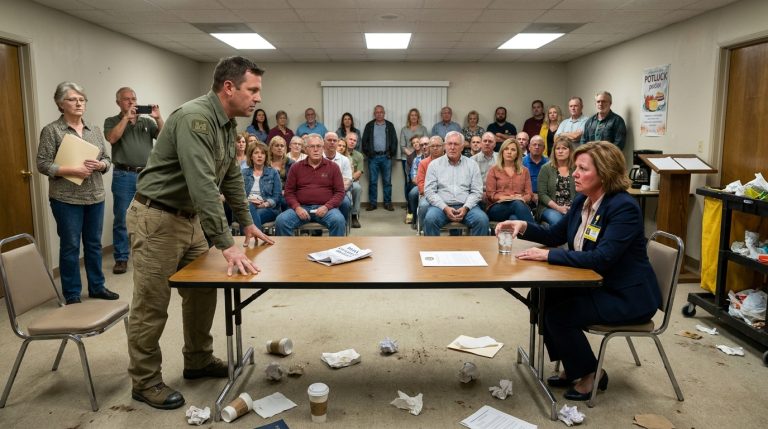
The Lakeside Pavilion smelled of ancient cedar, damp winter coats, and the kind of cheap, burnt coffee that only appears at civic functions where someone is about to lose their job. Outside, the temperature had plummeted to four degrees, turning the lake into a jagged, pewter landscape of frozen misery. Inside, the air was thick enough to choke a backhoe.
Thirty-four people. I counted them as I leaned against the back wall, my Carhartt jacket unzipped just enough to reach the manila folder tucked into my inner pocket. In the history of Pinecrest Lake Estates, twelve was a crowd. Thirty-four was an uprising.
Deirdre sat at the front behind a folding card table, flanked by her two handpicked board members—men who looked like they were attending a funeral they hadn’t been invited to. She was wearing a new quilted vest, navy blue this time, zipped to the chin. She was performing normalcy, greeting the weekenders with a warmth that didn’t reach her eyes, which kept darting to me, then to Walt, then to the stack of agendas in front of her.
“Quorum is established,” Deirdre announced, her voice ringing out with a brittle, rehearsed clarity. “We’ll move efficiently through the financial reports so we can address the New Business—specifically the amendments to Resolution 2023-14 regarding industrial vehicle safety.”
She didn’t look at me when she said it. She looked at Marcus Thorne, her attorney, who was standing by the projector screen like a polished gargoyle.
I felt the index card in my pocket. Robert’s Rules of Order, Section 11: Point of Order. Connie Dillard had highlighted it for me in her dog-eared copy. I’d spent forty-eight hours memorizing the language of small-town leverage. Deirdre had built her castle on the assumption that we were too tired or too ignorant to read the fine print. She’d weaponized the rules for three years. It was time to see how she liked the recoil.
“Move to approve the minutes,” one of the loyalists called out.
“Second,” another echoed.
It was a machine. A small, petty machine designed to grind us down by 11:00 AM so everyone could go home and pretend the neighborhood wasn’t rotting. Deirdre moved through the financial audit with a practiced speed, her laptop clicking through slides of “Harmonious Living” and “Landscape Enhancement Funds.”
“And now,” Deirdre said, her tone shifting to something mournful, “we must address the ongoing challenges to our community character. We have a proposal for a permanent bylaw amendment that will authorize the HOA to place physical barriers on any apron that interferes with the common thoroughfare, and a retroactive assessment for legal fees incurred by the association during recent… provocations.”
The room shifted. I heard the creak of thirty-four folding chairs.
“Point of order, Madam President.”
I didn’t shout. I didn’t have to. The silence that followed was absolute, the kind of silence you get in the woods right before a tree falls. I walked toward the front of the room, my boots heavy on the wood floor.
Deirdre’s hands gripped the edge of the table so hard the knuckles went white against the navy fabric of her vest. “Mr. Hollowell, you are out of order. There is a designated time for member comments at the end of the—”
“Point of order concerns the legality of the meeting itself,” I said, stepping into the light of the projector. I pulled the folder from my jacket. “Under the original 1987 CC&Rs, Section 4, and the notarized Lake Access Agreement recorded at the county seat three days ago, this board lacks the authority to propose amendments affecting property access without a unanimous vote of all sixty homeowners. Not a quorum. All of them.”
Thorne stepped forward, his leather briefcase clicking open. “That document is a private contract, Mr. Hollowell. It has no bearing on the—”
“It’s a recorded county covenant, Marcus,” I said, looking him dead in the eye. “I checked the digital scan myself. The one that was ‘missing’ until I brought the original to the Register of Deeds. And since this board has spent eighteen thousand dollars of HOA money on your personal retainer to fight a quiet title action on land the HOA actually owns… I believe that’s what we call a breach of fiduciary duty.”
I turned to the room. I didn’t look at Deirdre. I looked at Walt. I looked at Connie. I looked at the young couple, the Eklunds, who were holding their agendas like weapons.
“Every fine you’ve paid for a bird feeder,” I said, my voice carrying into the rafters. “Every threat she’s made about your boat slips or your docks. It was a lie. She legally cannot touch your lake access. She never could. Roland Pruitt made sure of that thirty years ago.”
I started handing out the copies. Thirty-four manila folders.
“Garrett, sit down!” Deirdre screamed. The mask was gone. Her face was a jagged mask of panicked fury. “You’re destroying this community! You’re bringing in lawyers and contractors and—”
“I’m bringing in the survey,” I said. I pulled out the 4K still from the trail camera. I set it on the table right over her agenda. “This is Deirdre at 11:14 PM last Tuesday. Moving a felony survey monument three feet onto my property. That’s not a bylaw violation, Deirdre. That’s a Class I felony in the state of Wisconsin.”
The room erupted. It wasn’t a roar; it was a hive of whispers that suddenly caught fire. People were standing up, reading the notarized agreement, looking at the photo of the HOA President in a headlamp tampering with a boundary stake.
“Move to table the new business,” Connie Dillard shouted, her schoolteacher voice cutting through the chaos.
“Second!” Walt boomed.
“I have a motion for a vote of no confidence,” Connie continued, her eyes locked on Deirdre. “Properly seconded. Under Robert’s Rules, this takes precedence over the agenda.”
Deirdre looked at Thorne. He wasn’t looking at her. He was looking at the photo of her moving the stakes, then back at his briefcase. He knew the grade was wrong. He knew the foundation was gone. He stepped back, away from the table, away from the sinking ship.
“You can’t do this,” Deirdre whispered, but the microphone caught it. It sounded small. It sounded like a child caught in a lie.
“We just did,” I said.
I looked at my watch. 10:42 AM. The annual meeting wasn’t over, but the reign of the Quilted Dictator was.
I walked back to my seat. I didn’t feel triumphant. I just felt the weight of the iron finally settling into the earth. The trenches were dug. The concrete was cured. And for the first time in three years, the North Shore felt like home again.
But as I sat down, I saw Deirdre reach for her phone, her thumb moving frantically across the screen. She wasn’t looking at the room. She was looking at the door.
And then the heavy oak doors of the Pavilion swung open.
CHAPTER 8: THE FOUNDATION SETTLES
“This meeting is adjourned,” Deirdre whispered, but no one was listening. The oak doors of the Pavilion hadn’t just opened; they had admitted the cold, hard reality of the county’s reach.
Deputy Tara Schoenfeld didn’t walk in with a flourish. She entered with the heavy, rhythmic gait of someone who had spent the morning reviewing 4K trail camera footage and talking to the District Attorney. She didn’t look at the crowd, and she didn’t look at me. Her eyes were locked on the woman behind the card table who was currently clutching a smartphone as if it could dial back time.
The room, which had been a hornet’s nest of voices just seconds ago, went graveyard quiet. It was the kind of silence that precedes a controlled demolition—the moment after the charges are set but before the dust rises. I leaned back against the cedar siding, feeling the rough texture through my jacket. The air in the Pavilion felt different now. The smell of burnt coffee was being replaced by the sharp, clean bite of the winter wind blowing through the open door.
“Deirdre Fulton Marsh?” Tara asked. It wasn’t a question; it was an identification.
Deirdre’s hand went to the throat of her navy quilted vest. “Deputy, this is a private community meeting. We are in the middle of a—”
“You’re in the middle of being served,” Tara interrupted. She stepped forward and laid a folded document on top of the manila folder I’d already placed there. “Criminal summons for tampering with survey monuments. Class I felony. There’s a detective division inquiry following up on the easement encroachment and the potential misuse of association funds for private property improvements.”
The sound that came out of Deirdre wasn’t a scream. It was a sharp, pathetic intake of breath, the sound of a lung hitting a vacuum. She looked at Marcus Thorne, her attorney, seeking a lifeline. Thorne was busy zipping his leather attaché case. He didn’t look up. He was already mentally halfway to Madison, distancing himself from the structural collapse of a client who had been caught moving the stakes.
“Garrett,” Walt Bremer’s voice was a low rumble beside me. He didn’t look triumphant either. He looked tired, the way a man looks after a long day of hauling stone. “Look at the numbers.”
I looked down at the ballot sheet on the table. Twenty-seven to five.
Twenty-seven neighbors who had been swallowing their pride for three years, watching their flagpoles and their mailboxes and their dignity being managed by a woman who didn’t understand that a community isn’t a project—it’s a pact. Five who were either too afraid to change or too invested in the lie.
The machine was broken. The “Quilted Dictator” was a woman in a folding chair, surrounded by evidence of her own trespasses.
“Adjourn the meeting, Connie,” I said quietly.
Connie Dillard, now the acting President by virtue of the no-confidence vote, rapped a wooden spoon against the table—the gavel Deirdre had forgotten to bring. “Meeting adjourned. Special session for board elections to be held in March. Documents on the Lake Access Agreement are available at the back for anyone who needs to verify their rights.”
The crowd began to filter out, but it wasn’t the usual rushed exit. They walked slow. They shook hands. They looked at the lake through the Pavilion windows, seeing the 200 acres of frozen white not as a restricted zone, but as common ground.
I waited until the room was nearly empty before I walked toward the front. Deirdre was still sitting there. Tara was standing a respectful distance away, waiting for her to gather her things.
Deirdre looked up at me. Her eyes were red-rimmed, the polished mask of the HOA President completely shattered. “You destroyed this, Garrett. We had order. We had value. You turned this place into a battlefield.”
I looked at the rusted hinge of the Pavilion door, then back at her. “I didn’t turn it into anything, Deirdre. I just dug down to the footings. If the house falls over because the foundation was rotten, that’s not the excavator’s fault.”
I walked out into the four-degree air. The sun was hitting the ice now, creating a glare so bright it made my eyes water. My rig was parked at the edge of the lot, the D6 dozer sitting heavy and silent on the lowboy.
I drove home slow. When I pulled into my driveway, I stopped at the apron. The two gray bollards stood four feet into the earth, the concrete now cured into a permanent gray stone. They were exactly eleven feet, six inches apart.
I sat in the cab for a long moment, the diesel idling at that familiar, rhythmic thrum. I thought about the three months of letters, the fines, the standoff in the headlights, and the box in Walt’s barn. I thought about the 1987 agreement that had been waiting thirty years for someone to remember it existed.
A community depends on the documents nobody looks at until they have to. It depends on the man who stays quiet until the lines are moved.
I looked at my house. Chloe was at the window, she gave a small, sharp nod before disappearing into the kitchen. I killed the engine. The silence that followed wasn’t the heavy, pressurized silence of the standoff. It was just the quiet of the North Shore.
The weight was gone. The grade was level. The borders were restored.
I stepped out of the truck, the frozen limestone crunching under my boots—a sound that only belongs to a man standing on his own land. I looked toward the lake one last time.
The 11′ 6″ gap was exactly where it needed to be.