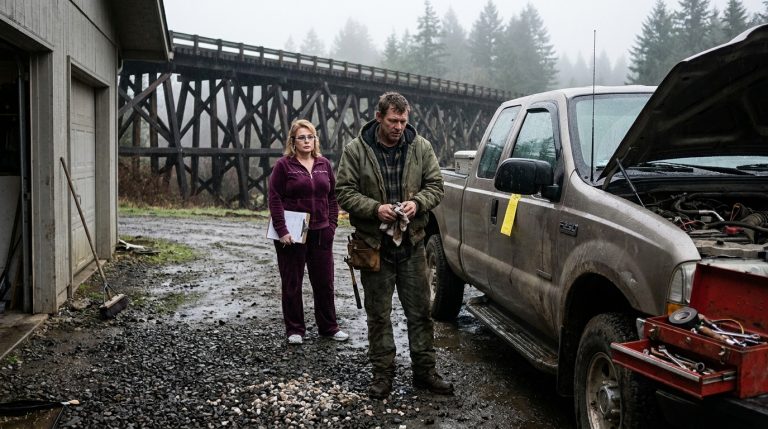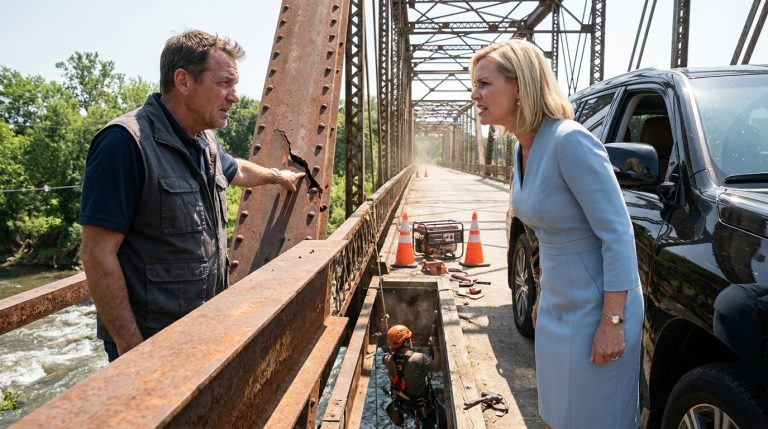
The Circuit of Inheritance: How One Federal Trace Grounded a Suburban Kingdom
CHAPTER 1: THE PREDAWN BREACH
The chainsaw engine didn’t idle; it screamed through the 3:47 a.m. mist like cold steel hitting stone, the sound traveling flat and heavy across sixty-five acres of black, unmoving water.
Bryce Kellerman didn’t wait to lace his boots. He kicked through the screen door of the log cabin, his bare heels striking the rough-sawn cedar of the porch before the cold, damp grit of the gravel trail bit into his skin. The air smelled of unburned two-stroke fuel and the sharp, chemical sting of synthetic sulfur—a smell that had no business mixing with the damp pine needles and the clean, iron-heavy scent of the lake earth.
At the end of the dock, the high-beam searchlight of a Washburn County sheriff’s cruiser cut a blinding white cylinder through the fog, pinning Bryce’s grandfather’s hand-carved cedar posts in its glare. The wood was worn butter-smooth by forty years of braided nylon fishing lines and calloused skin, but tonight it looked like a row of teeth under an executioner’s lamp.
“Step back, Kellerman!”
The voice belonged to Deputy Rick Vandenberg. He stood under the light, his hand resting on the heavy black polymer of his utility belt, his badge catching the high-beam reflection like a mirror shard. In his left hand, he held a phone, the red recording light glowing as he angled the lens down toward the water.
Beside him stood Tiffany Vandenberg. Her designer yoga pants were splattered with gray mud, her expensive French perfume cutting violently through the petrol exhaust. She didn’t look like an HOA president; she looked like a line superintendent executing a structural demo. She held a five-gallon industrial drum over the lip of the cedar planks, tilting it with a slow, deliberate tilt. A thick, milky polymer liquid sloshed out, hissing as it struck the pristine surface of the water, spreading out in an oily, iridescent skin that choked the surface mist.
“By police authority, your lake access is terminated,” Rick barked, his voice flat with the cheap confidence of a small-town badge. “You’ve got twenty-four hours to vacate the structures or you’re under arrest for criminal non-compliance.”
“You’re dumping commercial contaminants into a protected basin, Rick,” Bryce said, his voice dropping into the low, transactional register he used during hostile union contract disputes. He kept his hands open, palms out, counting the pacing of Rick’s boots on the wood. “That’s my waterline. That’s my grandfather’s dock.”
Tiffany let out a short, sharp laugh that sounded like dry plastic snapping. “Community standards have evolved, Bryce. Your antiquated grandfathered arrangement doesn’t dictate contemporary watershed protocols. This backwater aesthetic ends now.”
With a sudden, sharp thrust of her designer heel, she kicked out. Her shoe caught the heavy stone jar sitting at the edge of the final piling—the hand-thrown ceramic memorial urn Bryce had placed there three weeks ago.
The jar cracked against the iron cleat. The dark, coarse gray ash of an old union electrician spilled into the white chemical froth floating on the lake, disappearing into the poisonous soup before the ceramic fragments even touched the lake bottom.
“That’s what happens when you defy a lawful order,” Rick said, his face completely blank behind his mirrored sunglasses. “Pack your truck.”
Bryce didn’t move. He looked down at the empty space on the cedar plank where the stone had been. His heart didn’t hammer; it slowed down, settling into the steady, dangerous rhythm of a high-voltage circuit before the breaker throws. They thought the uniform and the corporate letterhead made them sovereign. They didn’t know about the single sheet of thick, federal paper sitting inside the safe under the cabin floorboards.
CHAPTER 2: THE WEIGHT OF PAPER
“Sign the acknowledgment, Bryce. Make it easy on yourself before the county sheriff returns with an transport van.”
The process server didn’t look like a man who enjoyed his work; he looked like an exhausted component in a heavy machine. He stood on the porch, his cheap polyester suit jacket damp with the gray lake fog, smelling of stale gas-station coffee and low-grade panic. The manila envelope he forced into my grip felt disproportionately heavy, thick as a residential breaker panel box. The crisp, geometric lines of the Whitman, Sheffield & Associates letterhead looked sterile against the hand-hewn cedar of the door frame. Thirty-two pages of high-gloss, premium bond paper. Eight-hundred-dollar-an-hour legal ink meant to simulate the weight of an iron hammer.
“Forty-eight hours,” I said, my thumb catching the rough, rusted latch of the screen door. The friction of the metal ground against my skin, leaving a faint orange smear of oxidation. “They’re giving me forty-eight hours to clear out of a basin my family paid taxes on before Tiffany Vandenberg’s suburban kingdom was even a blueprint.”
“I just deliver the paper, man,” the guy muttered, his eyes darting toward the gravel driveway where the deep, treaded ruts of Deputy Rick’s F-250 were still fresh in the gray mud. “But if Whitman’s firm signed off on a criminal trespassing notice, they think they own the dirt under your feet. In this county, what they think usually becomes reality by Tuesday morning.”
He turned and shuffled back to his sedan, his tires crunching over the river rock with a wet, heavy grinding sound.
I went inside, the cabin air catching in my throat. It smelled of old wood, dry moss, and the faint, bitter tang of the chemical residue drifting off the dock outside. Every step across the oak floorboards creaked with an ancient, structural stubbornness. My grandfather hadn’t built this place to be pretty; he’d built it like a commercial substation—over-engineered, square-pegged, and anchored into the granite bedrock with half-inch lag bolts.
I walked past the kitchen table, ignoring the cold coffee, and went straight to the pantry closet where the floorboards met the stone foundation of the central chimney.
The brass padlock on the hatch door was pitted with green corrosion, the iron shackle stiff and dry. I didn’t use oil. I liked the resistance. I liked the physical reminder of how much force it took to open things that were meant to stay shut. I swung the hatch back, the hinges screaming a brief, high-pitched metallic note that died instantly against the log walls.
The basement safe was an old, cast-iron firebox from a defunct paper mill in Green Bay. It didn’t have a digital keypad; it had a mechanical dial that required three full rotations to the left to clear the tumblers. As I spun the iron wheel, the internal steel dogs scraped against the casing with a heavy, ungreased friction that vibrated right through my forearm.
When the door swung wide, the scent hit me first—the sharp, unmistakable clean smell of WD-40, gun oil, and forty-year-old parchment preserved in a dark space.
Grandpa’s spidery blue ink marked every manila folder with the absolute precision of a man who spent forty years tracing three-phase electrical circuits. He’d treated his land records like a master schematic. Circuit 1: Shoreline Pier blocks. Circuit 2: Timber tax receipts, 1984. I pulled the thickest folder from the rear partition—the 1981 state deed. The paper was thick, fibrous, its edges yellowed like pine needles left in the sun, but the state seals were intact, pressed deep into the grain of the paper until the wax had flattened into the fiber.
“Exclusive ownership of lake bottom, water rights, and recreational usage in perpetuity,” I read aloud, my finger tracing the raised indentation of the notary seal. The words were clear, mechanical, free of the modern regulatory fluff Tiffany’s lawyers used to cloud titles. It was a absolute transfer of title.
But as I pulled the deed free, my knuckles struck something hard and unyielding at the back of the iron safe—a hidden lip behind the cedar lining my grandfather had installed to absorb moisture.
I reached in, my fingers scraping against the rough, unplaned reverse side of the wood until they caught on a small leather loop. I pulled. A secondary compartment, no wider than an electrical junction box, slid out with a dry, wooden hiss.
Inside lay a heavy brass key, thick-bit and stamped with three numbers—408—and an old, blue-backed booklet titled United States Environmental Protection Agency: Conservation Easement Registry, 1985.
The key felt cold, its weight unevenly distributed, the brass showing the dark brown patina of a tool that had spent decades in contact with iron dust. It didn’t match any lock in the cabin. It didn’t match the boat house, the tractor shed, or the padlock on the main gate. It was an alien piece of hardware, heavy and deliberate, hidden beneath the very foundation of the property.
I opened the blue booklet. My grandfather’s signature was on the final page, right next to a federal registration stamp that had been inked in a deep, permanent violet that hadn’t faded a fraction.
The phone on the kitchen counter rang, the electronic bell cutting through the silence of the cabin like a short circuit.
I didn’t rush. I left the safe open, the brass key resting on top of the 1981 deed like a weight to keep the past from blowing away. I walked across the room and picked up the receiver.
“Mr. Kellerman,” Tiffany’s voice was smooth, polished until it shone like the chrome on her Range Rover, but beneath the executive cadence, there was a hard, rhythmic tapping—the sound of her manicured nails striking her oak desk. “I assume the process server found your location. The forty-eight hours started at noon. My legal team suggests you use that time to secure a moving vehicle rather than consulting local mechanics.”
I looked out the window, past the rusted screen, down to where the oil slick from her chemicals was still clotting around my grandfather’s split pilings.
“Your lawyers write a lot of pages, Tiffany,” I said, my voice flat, my eyes fixed on the heavy brass key visible through the pantry doorway. “But they skipped a few chapters. A property dispute is just like a live circuit. You can run all the wire you want, but if you don’t check the ground source, you’re just waiting for the whole system to blow in your face.”
“There is no alternative circuit, Bryce,” she purrs, the condescension sharp enough to cut wood. “The HOA has managed this watershed for fifteen years. We define the modern parameters here. You’re an occupant of an obsolete structure. Nothing more.”
“We’ll see who owns the parameters when I get back from the courthouse tomorrow morning,” I said, and dropped the receiver back onto the cradle before she could finish her next syllable.
The silence returned, but it wasn’t peaceful anymore. It was the heavy, pressurized quiet that fills a room between the lightning flash and the thunderclap. I walked back to the safe, picked up the brass key, and slipped it into the pocket of my canvas vest. The weight of it pressed against my ribs, a solid, unyielding piece of iron truth waiting for the proper lock.
CHAPTER 3: THE BASEMENT VAULT
The basement records office of the Washburn County Courthouse smelled exactly like structural decay—a suffocating mixture of decomposing sulfur, yellowing wood pulp, and the oily graphite used to grease old industrial filing cabinets. Up on the street level, the modern world ran on high-speed servers and clean glass, but down here beneath the concrete foundation, everything was governed by friction, weight, and the slow accumulation of lime dust.
Above my head, a bank of outdated fluorescent tubes vibrated with a low, sixty-cycle hum that rattled right through the fillings in my teeth. It was the exact frequency of an overloaded transformer, a mechanical warning sign that most people ignored until the insulation caught fire.
“Kellerman,” Mrs. Henderson said, her voice sounding like dry gravel being scraped down a steel chute. She didn’t look up from her desk, which was a massive slab of dented green army surplus iron. Her fingers, twisted by decades of joint calcification but still moving with terrifying, automatic precision, sorted through a stack of unindexed land transfers. “Haven’t seen that name on a title pull since the winter of eighty-one. Your grandfather used to come down here with an electrician’s scale and a bottle of black ink. He didn’t trust the county survey maps. Said the county lines were drawn by men who drank their lunch.”
“He was right,” I said, leaning my forearms against the high laminate counter. The surface was pitted with cigarette burns from a generation of long-dead surveyors, the edges frayed down to the particleboard core. “I need the original tract filings for the Crystal Lake basin. Not the subdivision plats from ninety-eight. The state sovereign grant from before the developers cleared the timber.”
She paused, her right hand hovering over an iron card catalog box that had rusted a dark, dull mahogany along its welded seams. The metallic squeak of the drawer sliding open was sharp enough to make my shoulder muscles tighten. “The developers tried to bury those boxes back when the country club went up. Said the old state water registries were obsolete after the regional consolidation. But paper doesn’t dissolve just because an MBA wants to build a golf course.”
She rose from her chair with a slow, mechanical stiffness that mirrored the machinery around her, disappearing through a heavy steel fire door into the unconditioned stacks.
I waited, listening to the rhythmic, rhythmic thud of her orthopedic shoes against the bare concrete floorboards inside. Through the dirty glass panel of the door, I could see rows of industrial steel shelving units bending under the sheer tonnage of bound ledgers. The air venting from the room carried a cold, metallic draft that chilled the sweat on the back of my neck.
When she returned, she wasn’t carrying a standard leather-bound book. She was dragging a heavy, gray cardboard storage chest with reinforced brass corners, the sides stamped with a long-defunct state agency seal from the pre-merger era. She dropped it on the counter with a heavy, hollow thud that sent a cloud of fine, pulverized paper dust into the path of the fluorescent light.
“Fascinating case,” she whispered, her eyes tracking my hands as I reached for the top lid. The cardboard was rough, dry, and left a chalky residue on my fingers. “Between you, me, and the boiler room down the hall, that homeowner’s association has been running a cold bluff for fifteen years. They’ve been collecting two hundred and fifty dollars annually from forty-seven households for lake maintenance. That’s nearly two hundred thousand dollars over the duration.”
I pulled the first folder free, the zinc staples holding the binding together rusting into orange dust that stained the manila cover. The document inside was the official 1998 incorporation charter for Crystal Lake Estates. My finger traced down the boilerplate text, past the descriptions of the asphalt roads, the concrete curbs, and the uniform utility easements, until it hit the specific addendum hidden in the margins.
The print was smaller there, executed on an old dot-matrix printer with a fading ribbon.
Section 4-B: Exclusions. The text was unambiguous, written with the absolute, cold-blooded finality of an iron gate slamming shut. The charter explicitly excluded all pre-existing private water basins, submerged lands, and state-allocated water rights from the homeowners’ association’s regulatory jurisdiction. The founders of the development had literally written themselves out of any authority over the lake because they knew the state title was completely unyielding.
They had built an entire corporate empire on a foundation of empty air.
“They never owned a single inch of the water rights,” I murmured, the mechanical reality of the fraud clicking into place like a perfectly aligned conduit box. “Tiffany Vandenberg didn’t just misinterpret her grandfathered privileges. She’s been using her corporate letterhead to extort the community for fees she couldn’t legally process.”
“She’s not just facing a property dispute, honey,” Mrs. Henderson said, her thumb tapping against the iron edge of the file box with a slow, heavy rhythm. “When the residents realize they’ve been paying for an imaginary maintenance protocol, she’s facing organized fraud charges that will clear out her bank accounts before the first trial date.”
I pulled out my phone, the plastic casing cold against my skin, and began methodically photographing every page of the 1998 charter, ensuring the state notary stamps and the exclusion clauses were pinned under a clean, sharp focus. The camera lens caught the tiny, microscopic imperfections in the ink—the specific fractures in the type that proved the age of the record.
As I reached the bottom of the box to replace the folder, my fingers brushed against a secondary layer of paper—a single, unindexed sheet of blueprint paper from 1981, tucked away beneath the HOA filings like a stray wire left behind walls during a rushed remodel.
The white lines on the blue field showed the original geographic survey of the lake bottom, but across the main deep-water channel, someone had scrawled a series of hand-drawn coordinates in dark grease pencil, followed by a single, jagged mark that matched the exact three-digit sequence stamped into the brass key currently sitting in my vest pocket: 408.
Before I could unroll the blueprint further to trace the line to its ground source, the iron fire door behind the counter creaked open with a sudden, violent jolt.
The heavy, rubber-soled boots of a sheriff’s deputy echoed against the concrete floor before he even cleared the door frame. The air in the small room instantly changed, thick with the scent of wet leather, diesel exhaust, and the unmistakable, aggressive confidence of a man carrying a department-issued weapon.
Rick Vandenberg didn’t look at the files; his eyes fixed directly on my hands, his mirrored sunglasses catching the erratic blink of the dying fluorescent tube above.
“You’re done digging in the county archives, Kellerman,” he said, his voice dropping into that flat, transactional drone used by line officers before they throw a compliance lock. “This office is closing for an administrative audit. Pack your phone, leave the boxes on the counter, and step away from the records.”
I didn’t drop the phone. I kept my left hand flat on the 1998 exclusion clause, feeling the cold grit of the ancient paper under my palm. “The courthouse is open until five, Rick. And last time I checked the county charter, these files are public property paid for by the taxpayers.”
“The parameters changed ten minutes ago,” Rick said, his hand moving down to rest over the textured polymer grip of his sidearm, the leather of his utility belt creaking under the weight of his shift. “We’ve got a report of an unauthorized individual tampering with sensitive title registries. Move to the exit. Now.”
CHAPTER 4: THE UNIFORMED BLUFF
“You’re a long way from the county line to enforce a non-existent eviction, Rick.”
The heavy steel cabin door slammed behind me with a dull, iron clang that shook the rust loose from the frame’s mounting screws. The morning air had turned thick and heavy, a low-slung ceiling of gray fog pressing the diesel exhaust from three idling Ford Interceptors straight down into the coarse gravel of the driveway. They sat in a tight semicircle, their black push-bars angled toward my porch like teeth. The strobe lights weren’t active, but the raw, unwashed smell of state-issued grease and burning motor oil told the real story. This wasn’t an official tactical deployment; it was a personal shakeout.
Rick Vandenberg stood at the center of the gravel arc, his leather duty belt creaking under the shifting weight of his frame. He wore his tactical vest high, the nylon stiff and unblemished by actual labor, but his hand remained flat against the textured grip of his sidearm. Behind him, two junior deputies from the afternoon shift stood near their doors, their palms resting near their holsters, their eyes tracking the tree line rather than looking at me. They looked uncomfortable, like subcontractors who realized the primary blueprint didn’t match the foundation.
“This is a signed county eviction mandate for unauthorized occupancy of community resources, Kellerman,” Rick said. His voice carried that low, mechanical vibration common to line supervisors trying to push an unpermitted build past an inspector. He didn’t pull a document from his pocket. He just reached down, tapped his polished badge with a blunt index finger, and let the silence hang between us. “The homeowners’ association filed the structural encumbrance at nine this morning. You’re trespassing on property designated for municipal enhancement.”
I didn’t step off the porch. My boots were firmly planted on the rough-cut cedar boards my grandfather had anchored into the stone foundation with three-quarter-inch galvanized bolts. “The county records office closed its public terminals ten minutes before you arrived, Rick. And the nineteen-ninety-eight charter your sister-in-law signed explicitly states that the HOA has zero regulatory authority over this basin. You’re running a cold circuit.”
Rick’s jaw tightened, the skin above his collar flushing a dark, congested red that mirrored the raw iron ore in the bluffs behind the cabin. “The regional parameters changed when the code enforcement division flagged your septic system as an environmental risk. By order of the Washburn County Sheriff, you vacate the premises immediately or you’re transported.”
He took one step forward, the dry river gravel crunching under his heavy tread with a sound like bone fragments breaking in a mill.
I reached slowly into my canvas vest pocket. The two junior deputies flinched, their hips twisting toward their holsters, but I didn’t pull a weapon. I pulled my old field phone, the ruggedized plastic case scarred and pitted from years of being dropped into commercial electrical trenches. The display screen was cracked across the center, a jagged line dividing the incoming call signal.
“Wisconsin is a one-party consent state, Rick,” I said, my voice dropping into the flat, rhythm-less cadence of an electrician checking a breaker panel before throwing the main switch. “And this line isn’t just recording. It’s routed directly through the digital intake terminal at the Milwaukee Journal Sentinel. Sarah Adrian is on the other end of this circuit, and her recorder has been rolling since your tires hit my gravel.”
I flipped the toggle to speakerphone. The small, tinny speaker crackled with static, the high-frequency hum of a professional newsroom cutting through the damp lake mist.
“Deputy Vandenberg,” a sharp, precise voice came through the speaker, the words clipped and free of local accent. “This is Sarah Adrian, senior investigative reporter. I’m looking at the county land tract ledger pulled from the basement vault less than an hour ago. Could you verify the specific case file number for the eviction mandate you’re currently serving? Because the official court docket log shows a blank entry under today’s date.”
The silence that hit the driveway was absolute, heavy enough to drown out the idling roar of the interceptor engines.
Rick didn’t move. His mirrored sunglasses remained fixed on my face, but the skin around his mouth turned the exact color of dry cement. The two junior deputies behind him exchanged a quick, micro-second look—the universal signal of entry-level employees realizing their supervisor’s work order was completely unbacked by corporate insurance.
“We’re monitoring a potential environmental hazard at this location,” Rick muttered, his voice dropping an octave, losing its transactional weight. He didn’t look at the phone. He looked at the cedar post behind me, his eyes tracking the old, spidery blue ink markings my grandfather had carved into the wood decades ago. “An official notification will be processed through the proper legal channels within the standard twenty-four-hour window.”
“That’s not what you said when you told me to pack my truck, Deputy,” I said, keeping the phone angled toward his chest. “Authority without an active court docket is just a private uniform doing collections work for a pharmaceutical executive. The line is still live.”
Rick didn’t reply with a speech. He didn’t monologue. In the real world, when an illegal circuit gets shorted out by a solid ground wire, the current simply stops. He turned on his heel, his heavy boots kicking up a spray of dark, wet dirt as he reached for the handle of his cruiser door.
“We’ll be checking the property line standards by tomorrow morning, Kellerman,” he said through the open window as the power locks clicked into place with a sharp, synchronized pop. “Make sure your paperwork is as solid as your mouth.”
The three patrol cars backed out of the drive in unison, their tires spinning against the river rock before catching the asphalt of the main road. The gray diesel smoke lingered in the pines for a long time, turning the clean scent of the lake earth bitter and artificial.
I stood on the porch until the sound of the engines died out completely. When I looked down at my hand, the old field phone was cold against my palm, the plastic casing vibrating slightly from the residual tension in my grip. I hadn’t won the dispute; I had just forced them to shift their leverage to a more dangerous angle. I reached into my vest pocket, my fingers brushing against the heavy, cold brass of the hidden key stamped 408. The real connection hadn’t been traced yet, and the forty-eight-hour clock was still ticking down.