The Architect of Retribution: A Veteran’s Surgical Strike Against Suburban Tyranny
CHAPTER 1: THE TACTICAL PERIMETER
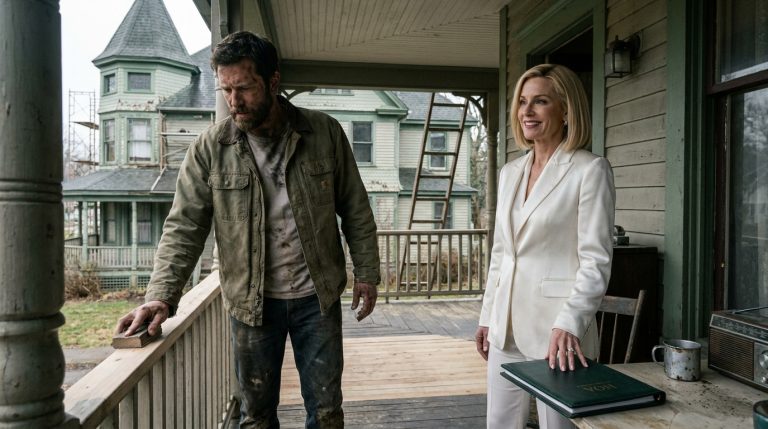
The smell of wet concrete is distinct. It’s chalky, chemical, and aggressive—a sharp contrast to the morning dampness of the grass. I stood at the edge of my porch, a steaming mug of black coffee in my fist, watching the sun crest over the roofs of Pinewood Springs.
Sixteen towers. Each one was a fridge-sized monolith of steel and industrial-grade paint, cemented deep into the earth where my garden had lived for three months. They formed a wall, a physical manifestation of an HOA board meeting gone nuclear.
Vivien was already there, her silver hair perfectly coiffed despite the early hour, her white Lexus idling like a predator in the driveway. She was checking her watch, her fingers tracing the screen of a clipboard as if she were tallying the cost of my spirit. She knew I was watching. She had set the bait, and she was waiting for me to step into the killing zone.
I didn’t yell. I didn’t reach for my tools. I didn’t give her the satisfaction of a reaction. Instead, I took a slow sip of the coffee, letting the heat burn away the initial spike of adrenaline. Twenty years in the Navy teaches you that panic is a luxury for the unprepared. Panic is a variable that leads to tactical failure.
I walked down the steps. My boots didn’t crunch on gravel; they sank slightly into the churned-up mud of my ruined flowerbed. The diesel scent from the nearby installation crew—who were already retreating into their trucks—hung heavy in the air.
“Community mail upgrade,” Vivien said, her voice carrying that practiced, melodic lilt she used for board meetings. “Isn’t it wonderful, Jake? We’ve been needing a consolidated point for years. The board felt your yard was the most… accessible.”
I looked at her. Really looked at her. I cataloged the tension in her jaw, the way her manicured nails tapped against the clipboard, the subtle shift in her posture that betrayed a predatory alertness. She wasn’t just managing mail. She was planting a stake. She was testing the strength of my resolve.
“Accessible,” I repeated, my voice steady, stripped of the rage that was currently vibrating in my marrow.
“The charter is very clear on common area easements,” she added, her smile sharpening. “I’d hate to see you accrue more fines, given your current… financial status.”
She turned, her heel pivoting with surgical precision on the asphalt, and walked toward her car. She didn’t look back. She didn’t need to. She expected me to pull out a hammer, to shout, to make a scene that she could record and report.
But she had made a fundamental error in her assessment. She had treated me like a resident. She hadn’t bothered to check the service records of the man she was trying to break.
As she slid into the Lexus, I didn’t look at the mailboxes. I looked at the ground, at the way the concrete met the soil, noting the structural weaknesses of her “perfect” installation. I noticed the way the power lines fed into the street, and how the runoff from the recent rain was already pooling near the base of the nearest unit.
She thought she had ended the war before it started. She didn’t realize that by planting those towers here, she had just handed me the keys to her own destruction. I stood there, watching her tail lights fade into the morning fog, and I felt the hum of a plan beginning to click into place—a plan that would require every ounce of my patience, every tool in my garage, and a cold, calculated precision she wouldn’t see coming until it was far too late.
The Zeigarnik effect gnawed at me. As I turned back toward my house, I noticed something glinting in the mud where the nearest tower had been forced into the ground. A small, brass object, partially obscured by the wet concrete, sitting just inches from the property line marker.
CHAPTER 2: THE PAPER TRAIL
The brass object wasn’t a coin. It was a fragment of a key, snapped off in the hardened grout at the base of the mailbox pillar. I pried it loose with the edge of my pocketknife, the metal cold and biting against my fingertips. It was jagged, stamped with a serial number that didn’t belong to any mailbox I’d ever seen installed for public use.
Vivien had been hurried. She’d cut corners, and in doing so, she’d left a signature in the mud.
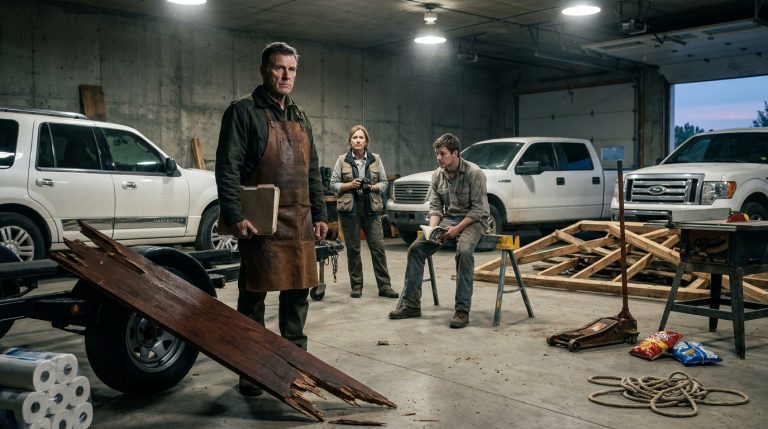
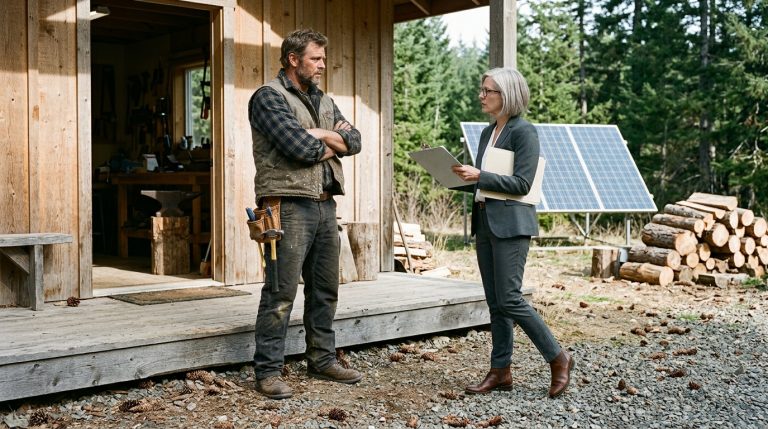
I stood up, wiping the wet clay from my jeans, and looked back at my workshop. The garage door was still open, the interior dark and smells like ozone and burnt oil. That was where I kept the real truth of Pinewood Springs. Not in the HOA charter, not in the sanitized newsletters, but in the physical reality of the neighborhood’s infrastructure.
I didn’t head for the kitchen to call a lawyer. Lawyers were for people who played by the rules. I was a mechanic. I knew that if you wanted to find the source of a leak, you didn’t look at the faucet; you traced the pipes back to the main.
The county courthouse was twenty minutes away, a building constructed in the 1960s with concrete that had held up better than the ethics of the people who worked inside. I knew the filing system there like I knew the hydraulic schematics of a Sikorsky SH-60. You don’t need a search warrant if you know how to file a public records request for “infrastructure development history” and “easement adjustments.”
I walked into the records room, the air thick with the smell of aging pulp and administrative indifference. The clerk at the desk looked at my work boots, then at the grease under my fingernails, and offered a dismissive, glassy stare.
“I need the 1994 original plat survey for Pinewood Springs,” I said, keeping my voice flat. “And every amendment filed since the tech corridor expansion three years ago.”
She sighed, a sound that held the weight of a thousand bureaucratic dead-ends. “You’re going to need to fill out form 4-C. It’s a forty-dollar fee. And it takes three days for the archivist to—”
“I don’t need the archivist,” I interrupted, dropping a crisp, folded twenty-dollar bill on the counter, perfectly aligned with the edge of her desk. “I need access to the terminal. I’ve got the file numbers.”
The money didn’t change her morals, but it certainly lubricated the wheels of her curiosity. She hesitated, her eyes flicking to the door, then back to the bill. “The terminals are for authorized personnel, Mr…?”
“Morrison. Jake. And I’m just a guy trying to understand why my front yard was rezoned into a UPS depot overnight.”
She pushed the keyboard toward me, the plastic clicking with a hollow, synthetic sound. “You have thirty minutes. If the supervisor walks in, you’re just a contractor checking on a drainage issue.”
I didn’t answer. I was already typing.
The digital map of Pinewood Springs pulled up on the screen, a web of colored lines representing property boundaries, easements, and infrastructure projects. I zoomed in on my house. The original survey from 1994 was a clean, straight line. But the “updated” survey Vivien had filed—the one she’d used to justify the concrete intrusion—was a jagged, ugly deviation. It shifted the property line by twelve feet, encroaching into my front yard.
I traced the signature on the digital document. Ashworth Development & Consulting. It was a shell company, one I hadn’t seen on any official HOA manifest. I followed the digital breadcrumbs, opening files that hadn’t been accessed in years.
There it was. A secondary plot. The “community mail upgrade” wasn’t just a nuisance; it was a physical barrier intended to facilitate a change in how the neighborhood’s central utility access was mapped. By pushing the mailboxes onto my property, she was forcing a modification to the utility easement that would, by default, give her company control over the maintenance access to the entire block.
It was a land grab, disguised as a neighborhood improvement.
My pulse spiked, but I forced it back down. I began printing the documents—the forged plat, the shell company registration, and the original, valid survey. As the printer groaned and spat out the sheets, I realized the full scope of her ambition. She wasn’t just keeping out people like me. She was preparing the ground to sell the entire subdivision out from under the residents to the highest bidder in the tech sector.
A shadow fell across the printer. I looked up, expecting the clerk, but saw instead the reflection of a man in a gray suit standing by the doorway, his eyes fixed on the printer’s output. He wasn’t county staff. He had the rigid, artificial posture of someone who spent their life protecting other people’s secrets.
He hadn’t seen my face yet, only the back of my head. I grabbed the stack of papers, the warm ink smearing slightly under my grip, and slipped them into my tool bag. I needed a way out that didn’t involve walking past him. I looked toward the side exit, a door marked Restricted Access, and felt the familiar, heavy weight of a choice that would define the next phase of this war.
I pushed the chair back, the screech of metal on linoleum sounding like a starter’s gun, and moved toward the shadows behind the microfilm stacks. The game had just escalated from property maintenance to corporate espionage, and for the first time, Vivien was going to realize she wasn’t just playing against a veteran—she was playing against a man who knew exactly how to dismantle a system from the inside.
CHAPTER 3: THE SOCIAL QUARANTINE
The drive home from the courthouse was a study in controlled aggression. I kept the legal documents in the passenger seat, the stack of paper feeling heavier than a crate of spare helicopter rotors. Every time I hit a red light, I looked over at the files, seeing not just maps and signatures, but the outline of a trap Vivien had been building for years. She thought she was the spider, but she’d just left her web wide open for me to snap the strands.
When I turned onto Maple Street, I felt the shift immediately. It was a subtle, atmospheric pressure change, the kind you feel before a high-altitude jump. The kids who usually played basketball in the street were gone. The cars that typically lined the curbs were tucked into garages, doors pulled shut like eyelids.
And then I saw it on the windshield of my truck.
A glossy, high-quality flyer, tucked neatly under the wiper blade. The paper was damp, curling slightly from the morning dew, and the ink was crisp, expensive. No name. Just a headline in bold, aggressive serif font: Concerned About Your Property Investment?
I pulled over and yanked the paper free. The headline was a lure, but the body text was a scalpel. It didn’t mention my name, but it used descriptors that hit the target with zero margin for error: Transient lifestyle choices, documented threats to neighborhood stability, unaccountable business practices. It was a masterpiece of suburban propaganda, designed to isolate me, to turn the very people I lived among into an informal security detail for her agenda.
“Jake.”
The voice came from the sidewalk. It was Eddie, my neighbor. He was standing by his mailbox, nursing a trowel, but his eyes were darting toward the end of the block where a black sedan was parked—a car I hadn’t seen in the neighborhood before.
I walked over, the paper crinkling in my fist. “You see this, Eddie?”
He didn’t take the paper. He didn’t even look at it. He just glanced at the black sedan, his face a map of weathered concern. “That’s her new toy. She’s not just using the HOA board anymore. She’s using the fear. She tells people if you stay near you, their property values drop like a rock. People here… they are teachers, nurses. They have mortgages that keep them up at night. They listen.”
“It’s a lie,” I said, my voice low.
“Truth don’t matter when people are scared for their homes,” Eddie muttered, stepping closer. “She’s talking about ‘background verification failures.’ She’s putting it on the Facebook group. You’re being blacklisted before you’ve even had a chance to work on a single faucet.”
I looked down the street. A neighbor I’d helped patch a leaky roof just last week was walking toward us, saw me, and abruptly turned around, heading into their house. The sting was sharp, colder than the morning air. It wasn’t just about the money; it was the isolation. Vivien was building a wall, and she was using the neighbors as the bricks.
“She thinks she can win by drowning me in social noise,” I said, mostly to myself.
“She’s winning,” Eddie replied. “She has the budget. She has the platform. And she has people who are terrified of what she’ll do next. She’s playing a long game, Jake. She isn’t just trying to move your mailbox. She’s trying to move you out of the zip code.”
I looked at the glossy flyer again. The ink was still vibrant, professional, and entirely detached from the reality of the people living here. I needed to know how she was funding this level of precision. If she was using community dues for this, I had the evidence to break her. But to get it, I had to stop looking at her as a neighbor and start seeing her as a military target.
“I’m going to need those meeting minutes, Eddie,” I said, my tone shifting into the rhythm of a briefing. “All of them. From the last three years. If she’s using the association’s legal fund for this social media blitz, she’s crossing into embezzlement territory.”
Eddie hesitated, then nodded. “I got them. I keep everything. But Jake, be careful. She’s watching everyone now. The HOA is just a mask. Behind it, she’s got people who don’t care about rules.”
I nodded and walked back to my truck. I didn’t head home. Instead, I drove to the edge of the subdivision, where the luxury homes gave way to the older, more grounded properties. I parked in the shadow of a warehouse, took a breath, and started mapping out the connections. Vivien had assumed I was an amateur—a handyman who would fold under the pressure of a few flyers and some icy glares.
She was right about one thing: I was a handyman. And I knew that when a foundation was built on rot, you didn’t need to knock the house down. You just needed to pull the right support beam, and the whole thing would come down under its own weight.
As I sat in the truck, the silence of the neighborhood felt heavy, suffocating. I caught a flash of movement in my side mirror—a silver Lexus slowing down at the intersection. She was checking the perimeter. She was checking to see if I was still there, or if the social pressure had finally done its job.
I leaned back, kept my face obscured by the shadow of the visor, and watched her pass. She was confident. She was in control. And she had no idea that I had the original plat, the forged survey, and the beginning of a plan that would turn her own meticulous web into her cage.
I didn’t move. I waited until her taillights disappeared, the red glow fading into the gray morning. Then, I pulled out my phone and called Maria. The nurse. The one person who knew that in Pinewood Springs, the sickness wasn’t in the houses—it was in the board. It was time to start the autopsy.
CHAPTER 4: THE TACTICAL PIVOT
The thunderstorm wasn’t just weather; it was a tactical advantage. By 8:00 p.m., the sky over Pinewood Springs had bruised to a deep, sickly purple, and the first sheets of rain were hammering against the garage roof with a rhythmic, percussive intensity that vibrated in my teeth. I sat at my workbench, the fluorescent lights humming overhead, surrounded by the guts of a circular saw and a heavy-duty hydraulic jack.
“It’s now or never,” I muttered.
The garage door was cracked just enough to let me monitor the street. Through the rain-streaked gap, I could see the mailbox clusters—sixteen steel pillars, standing like soldiers in the mud. They were the center of gravity for Vivien’s influence, but she’d made the classic mistake of the amateur commander: she’d overestimated the quality of the foundation. My reconnaissance from this morning, using a simple level and a pry bar, had confirmed my suspicion. The concrete was “Quick-Set”—cheap, brittle, and poured with zero rebar reinforcement. It was designed to look permanent, not to withstand a deliberate extraction.
Maria pulled her sedan into my driveway, the headlights cutting through the deluge like twin needles. She jumped out, clutching a waterproof bag to her chest, and sprinted for the garage. When she slipped inside, she was soaked, her scrubs clinging to her skin.
“The board meeting is already in session,” she said, her voice sharp, stripped of her usual calm. “Vivien didn’t wait for the quorum. She’s pushing the ‘nuisance’ motion right now. If she gets it passed, the sheriff comes for your tools tomorrow morning.”
“She’s counting on the weather to keep people home,” I said, sliding a heavy-duty wrench across the bench. “She thinks I’ll be sitting here, waiting for the paperwork to arrive. She doesn’t know I’ve already moved.”
I didn’t waste time on a pep talk. We moved with the economy of motion I’d mastered during long nights on carrier decks. Mike Kowalsski arrived five minutes later, his truck’s diesel engine idling with a throaty, rhythmic rumble that was swallowed whole by the thunder. He brought the magnetic signs—Emergency Infrastructure Services—and slapped them onto the side of his crane truck with a wet thwack.
“Storm’s peaking in twenty,” Mike yelled over the roar of the wind. “We hit the mailboxes, we pull, we load. If anyone stops us, we show them the code.”
We rolled out into the rain. The streets of Pinewood Springs were empty, the neighborhood surrendered to the elements. My boots squelched in the mud as we reached the first cluster. The rain was so thick I could barely see Mike’s crane operator, but the plan was muscle memory now.
I positioned the hydraulic jack, the cold steel slick with water. I pumped the handle, the pressure building, the ground groaning under the force. With a sharp crack that sounded like a gunshot—though it was instantly muffled by a thunderclap—the foundation fractured.
“Pull!” I signaled.
The crane arm groaned, cables tightening, and the entire cluster of four mailbox units lifted out of the earth like a tooth being extracted. It was clean. Professional.
But as the unit hung suspended in the air, its foundation swaying in the wind, I saw something that stopped me cold. Stuck into the underside of the concrete base, shielded from the rain by a plastic casing, was a small, sealed metal box.
I scrambled up the bed of the truck, the rain blinding me, and pried the box loose. My fingers were numb, but I managed to snap the lock. Inside weren’t HOA documents. They were keys—dozens of them—each labeled with a specific address in the neighborhood. And tucked behind the keys was a logbook.
I flipped through it, the pages protected by plastic sleeves. It was a ledger of mail interception. Every bank statement, every loan application, every piece of private correspondence sent to the most vulnerable residents on my block had been filtered through these boxes. Vivien wasn’t just managing mail; she was mining it for leverage.
“Jake! Get off the damn truck!” Mike shouted, his voice barely reaching me over the storm.
I shoved the box into my vest, the weight of it suddenly making the mission feel entirely different. This wasn’t just a relocation; this was a raid on a criminal enterprise.
“We’re moving!” I yelled back, jumping down into the mud.
As we navigated the crane truck toward Oakwood Drive, the windshield wipers struggling against the deluge, I realized Vivien’s “emergency” meeting was a distraction. She’d known I would come for the mailboxes. She’d set the installation as a trap, hoping I’d get caught in the act. But she’d made a mistake—she’d underestimated my ability to look beneath the surface.
We turned onto Oakwood. Her mansion sat dark, the circular driveway gleaming in the lightning like a stage waiting for an actor. We pulled in, the crane truck’s reverse lights casting an eerie, white glow on the pristine asphalt.
“Positioning,” I muttered, my heart hammering against my ribs.
We dropped the first cluster right in front of her garage door. It was a perfect fit, a barricade of steel that said more than a thousand legal notices ever could. But as I secured the bolts, I saw a light flicker in the second-floor window.
She was awake. She was watching. And for the first time, I felt the thrill of the hunt. She had the influence, the money, and the board. But I had the keys to her secrets, and I was about to drop them right on her doorstep.
“Let’s finish this,” I said to the rain.
The storm intensified, the wind howling around the steel pillars, as we began the installation of the second cluster. The foundation of her own suburban empire was about to be blocked, and she wasn’t going to have a single legal argument to move it.
CHAPTER 5: THE FRICTION POINT
The crane’s engine was a low, guttural growl that felt like a dying heartbeat against the drum of the storm. Rain slicked the cab windows, turning the world outside into a smeared palette of neon streetlights and dark, looming silhouettes. We had eight of the sixteen mailbox units installed in the circle of Vivien’s driveway, forming a jagged, steel fence that effectively bricked her Lexus into the garage. It was a beautiful piece of engineering: heavy, immovable, and entirely devoid of any legal argument.
“Last one, Jake!” Mike yelled, his voice sounding thin against the howling wind.
I was at the base of the crane, my hands wrapped around the guide cable, my muscles burning from the cold and the tension. The metal was slick, biting into my palms. I could see the upper floor window of the mansion. The curtains were parted, just a sliver, and I knew she was there—Vivien, watching her domain being dismantled by the very man she had tried to erase.
Then, the lights flared.
Not the house lights, but the sweeping, strobe-like blue and red of a patrol car turning the corner onto Oakwood Drive.
“Kill the engine,” I hissed, my voice sharp enough to cut through the rain.
Mike didn’t hesitate. He cut the power, and the sudden silence in the driveway was deafening, save for the relentless slap of rain on metal. The patrol car slowed, its headlights washing over the relocated mailboxes, illuminating the sixteen steel pillars as if they were a monument to some bizarre, suburban rebellion.
“Stay down,” I whispered, pulling the collar of my jacket up.
But it was too late. The driver’s side door opened, and Officer Martinez stepped out, his raincoat glistening. He didn’t look like he was here for a friendly check-in. He walked toward the driveway with his hand resting near his belt, his expression unreadable in the strobe light.
“Step away from the crane,” Martinez shouted, his voice amplified by the storm.
I stepped out from behind the crane, my hands held open—empty, but ready. “Officer, we’re just finishing up some emergency infrastructure maintenance. We have the municipal code documentation right here.”
Martinez didn’t care about the code. He walked past me, his eyes locked on the mailbox blockade. “Mr. Morrison. I recognize the truck. I recognize the uniform. But you aren’t a municipal contractor. You’re a resident with a grudge.”
“I’m a resident with a safety protocol,” I said, my voice steady, though my heart was hammering against my ribs like a trapped bird. “Check the paperwork, Officer. It’s all there.”
As Martinez moved to the crane to check the documents, a second car pulled up. This one wasn’t a patrol cruiser; it was a sleek, unmarked sedan. The man who stepped out wasn’t wearing a badge. He was wearing an expensive, tailored overcoat that looked entirely too dry for this weather. He walked toward the driveway with a deliberate, unhurried grace that told me everything I needed to know: Vivien’s reach was longer than I had calculated.
“He’s not supposed to be here,” the man said, his voice quiet, directed at Martinez but aimed at me. “The site is compromised.”
“This is private property, sir,” I interjected, stepping between them and the mailboxes. “I have authority under the emergency clause—”
“You have a pile of scrap metal and a trespassing charge,” the man replied, his eyes scanning me with the chilling detachment of a loan shark. He reached into his coat and pulled out a manila envelope. “Vivien didn’t call the police because of a mailbox, Mr. Morrison. She called them because you’re in possession of private property that doesn’t belong to you.”
He tossed the envelope into the mud at my feet. It popped open as it hit, the contents spilling out: photos of me, taken from a distance, documenting my movements at the courthouse, at the storage unit, and yes—the moment I’d pried the lock off the metal box I’d found earlier.
My stomach dropped. I hadn’t just found evidence; I had walked into a snare. The box hadn’t been buried there by accident. It had been planted. And the moment I’d opened it, I’d given them the legal grounds to declare this not a neighborhood protest, but a felony investigation.
“Mail tampering,” Martinez said, his tone shifting from casual annoyance to something far more dangerous. “Mr. Morrison, put your hands behind your back.”
The world seemed to tilt. I looked at Mike, who was standing frozen by the truck, and then back at the man in the overcoat. This wasn’t just a local dispute anymore. By playing their game, I’d moved into their territory, and they’d used my own tactical logic to pin me down.
“It’s not what you think,” I started, but Martinez was already closing the distance, his handcuffs glinting in the blue light.
The rain felt heavier now, as if the sky itself were pushing down on us. I’d failed. The decoy secret—the idea that I could expose her through documentation—had been turned into a weapon against me. And as the cold steel of the handcuffs bit into my wrists, I realized that I hadn’t even scratched the surface of what Vivien was hiding. This wasn’t just about mailboxes or embezzled funds.
The man in the overcoat stepped closer, his voice dropping to a whisper. “You’re a clever man, Jake. But you’re playing in the wrong league.”
As he walked away, I saw something in his hand—the same brass fragment I’d found in the mud that morning. He turned it over, watched the light catch it, and then dropped it into the puddle, burying it under the churned earth of the driveway.
I was going to jail, and the truth about Pinewood Springs was about to be buried with me.
CHAPTER 6: THE SILENT HOLD
The back of the patrol car was a plastic sarcophagus, smelling of stale coffee, industrial floor cleaner, and the lingering, metallic scent of previous occupants. The blue light from the cruiser’s roof cycled through the rear window, rhythmic and hypnotic, turning the interior into a strobe-lit cage. My hands were cuffed behind my back, the steel biting into my wrists every time the cruiser hit a pothole.
I sat in silence. No one spoke. The officer, Martinez, didn’t even look back at me. I was just cargo now. A liability to be processed.
As the car pulled into the precinct parking lot, I watched the world through the rain-slashed glass. The building was a brutalist block of concrete, looming and indifferent. My mind raced through the events of the last hour, dissecting the failure with the clinical detachment of a mechanic looking at a snapped drive shaft. I had walked into a trap. I had been so focused on the physical relocation of the mailboxes that I’d missed the obvious—Vivien wasn’t just defending her home; she was managing a controlled demolition of mine.
Inside, the precinct was a hum of low-frequency anxiety. Fluorescent lights flickered, casting a sickly pallor over the linoleum floors. I was shoved into a metal chair in an interrogation room that smelled of cold sweat and paper dust.
“You’re not talking, Morrison,” Martinez said, slamming a file down on the table. It was empty. The evidence—the master keys, the ledger, the photos—hadn’t been brought in with me. “You’re going to sit here until the sergeant decides whether to book you for mail tampering or let you rot. And given the call we got from the Mayor’s office five minutes ago, I wouldn’t hold my breath for a quick release.”
He walked out and the heavy steel door clicked shut. The sound was final.
I leaned forward, trying to balance in the uncomfortable chair, my shoulders aching. This was the setback. The moment where the tactical plan dissolved into pure, raw consequence. They had the evidence, they had the political reach, and I was sitting in a cage of their making.
But as I looked around the room, I noticed something etched into the underside of the table. A set of numbers, carved with a sharp tool. 2019-03-A.
It was a file index. The same format Eddie had shown me in the meeting minutes.
My heart stalled.
The room wasn’t just a place to hold suspects; it was where they processed the victims of Vivien’s “community standards intervention.” The file index didn’t belong to a police case; it belonged to an HOA audit that never went public. She hadn’t just been stealing mail; she’d been using the precinct’s own administrative oversight system to archive the people she’d driven out.
The realization hit me with the force of a physical blow. The decoy secret—the mail interception—was just the surface. This was institutional. The precinct wasn’t just reacting to her; they were integrated into her operation.
I looked at the camera in the corner, its red LED glowing like a watchful eye. I couldn’t reach my tools. I couldn’t call Maria. I was effectively erased from the board.
The door opened. It wasn’t Martinez. It was the man in the overcoat. He sat down opposite me, placing a single document on the table. It wasn’t an arrest warrant. It was a purchase agreement for my property, already drafted, with a sale price listed at significantly below market value.
“Sign the quitclaim, Jake,” he said, his voice as smooth and cold as polished stone. “You leave the neighborhood tonight. You take the settlement. You move on, and you forget about the mailboxes, the surveys, and the ‘community standards’ you seem so obsessed with.”
“And if I don’t?”
“Then you’re not just a disgruntled veteran with a mailbox problem,” he replied, leaning in. “You’re a felon with a history of violent harassment against an elderly woman. The evidence is already being processed. It’s an airtight case. Even a Navy lawyer couldn’t fix this.”
I stared at the paper. My name was already typed in the signature line, the ink bold and demanding. My hands were trembling, not from fear, but from the realization of how deep the rot went. If I signed, I bought my freedom, but I buried the truth. If I didn’t, I became a statistic in Vivien’s ledger.
I looked at the man, his face a mask of practiced indifference, and I realized he was waiting for the surrender. He was waiting for the moment the veteran gave up.
I didn’t reach for the pen. Instead, I stood up, the chair clattering loudly against the floor.
“I’m not signing,” I said, my voice low and steady. “Because you made one mistake. You brought me to a place where I know exactly how to look for the cracks.”
He smiled, a humorless, tight-lipped expression. “You’re in a room with no windows, Jake. There are no cracks here.”
“There are always cracks,” I replied. “You just have to know where to apply the pressure.”
I didn’t know how I was getting out. I didn’t know who would believe me. But as I looked at the man in the overcoat, I saw a flicker of doubt in his eyes. He wasn’t used to people who didn’t fold. He was used to victims, not soldiers.
The lights in the room flickered, once, twice—a power surge from the storm outside. The hum of the ventilation system cut out, and for a split second, the precinct went dead quiet. In that gap, I heard it: the faint, distant sound of a siren, followed by the heavy thud of a door opening down the hall.
The chaos of the storm wasn’t done yet, and neither was I.
CHAPTER 7: THE RECKONING
The power surge hadn’t been a coincidence. It was the work of the storm—a massive lightning strike on the grid that had momentarily tripped the station’s backup generators. In that split-second of darkness, I didn’t think; I moved.
My hands, still cuffed behind my back, became a lever. I threw my weight against the metal door, the heavy hinges groaning under the sudden, violent force. In the pitch black, the precinct was a silent tomb. I navigated by the memory of the floor plan I’d seen earlier, the layout burnt into my brain like a blueprint. I found the sergeant’s desk, not by sight, but by the familiar, sharp scent of ozone and stale printer toner.
The emergency lights kicked in—a dull, rhythmic pulse of red. In the hallway, I saw Martinez rushing toward the holding area, his radio crackling with confused dispatches. He stopped, his flashlight beam cutting through the gloom.
“Morrison!” he shouted, drawing his weapon.
I didn’t run. I stepped into the light, my hands raised, showing him the cuffs. “The file, Martinez! Check the digital log for file 2019-03-A. The one you aren’t supposed to see. If you think I’m the criminal, then look at who’s actually deleting the evidence.”
He hesitated, his gaze flickering between me and the end of the hall, where the man in the overcoat was already moving with a cold, calculated efficiency toward the back exit. The man wasn’t checking on me; he was scrubbing the server.
“She’s burning it,” I said, my voice echoing off the concrete walls. “Vivien isn’t just protecting the HOA. She’s protecting the commercial rezoning audit. Look at the ledger, man! Don’t you want to know who’s really paying your pension?”
Martinez wavered. The weight of the badge, the inertia of years spent working for a system that thrived on blind loyalty, suddenly crashed against the reality of the evidence I’d described. He knew. He had always known that something was wrong with the Pinewood Springs files.
“Get on the ground,” he barked, but his voice lacked the lethal certainty of a minute ago.
“I’m staying right here,” I said, looking him dead in the eye. “But you need to decide. Are you going to be the guy who arrests the only witness to the embezzlement of a hundred thousand dollars, or are you going to walk down that hall and see what’s actually on the server?”
The sound of a heavy door slamming echoed from the server room. The man in the overcoat was gone.
Martinez dropped his aim, just an inch. “If you’re lying, Morrison, you’re never seeing the sun again.”
“If I’m lying, put the cuffs back on.”
He didn’t wait. He moved toward the server room with the urgency of a man who’d just realized his house was on fire. I followed him, the chains clinking against my wrists. Inside, the room was a symphony of flashing lights and humming cooling fans. A laptop sat on the console, its screen glowing in the dark—a remote deletion script, scrolling through lines of code, wiping the HOA financial archives.
Martinez slammed his hand on the keyboard, stopping the process just as the last of the embezzlement records were being purged. He stared at the screen, his face draining of color. The numbers were all there—the fake contractor invoices, the inflated legal fees, the names of the city council members who had received “community grants.”
“This isn’t an HOA dispute,” he whispered, his voice trembling. “This is a municipal takeover.”
“It’s a gentrification project,” I said, looking over his shoulder. “She was buying the neighborhood, one house at a time, using our own money to do it.”
The precinct phone began to ring—a sharp, insistent sound that broke the silence. It was the Chief. They knew. The man in the overcoat hadn’t just been scrubbing the files; he’d been calling in his markers to have me “neutralized.”
“We have to move,” Martinez said, pulling a key from his pocket and unlocking my cuffs. His hands were shaking. “If we stay here, we’re part of the cover-up.”
I rubbed my wrists, the blood rushing back into my fingers with a dull, stinging heat. I grabbed the laptop, the screen still flickering with the evidence of Vivien’s crime. I had the truth, but the war was far from over. Outside, the storm had quieted, replaced by the heavy, ominous silence that follows a disaster.
“Where do we go?” Martinez asked, his eyes wide with the shock of a man who’d just lost his faith in the uniform.
“We go to the one place she doesn’t control,” I said, looking toward the dark horizon of Pinewood Springs. “We go to the neighborhood.”
We walked out into the rain, the cool air feeling like a baptism. The precinct was already buzzing with sirens, but we were gone, melting into the shadows of the storm. We had the evidence, we had the momentum, and for the first time in years, the architect of our misery was the one who was going to have to watch her world burn.
The stage was set for the final act. We were headed to the neighborhood meeting, and I was bringing the only thing Vivien couldn’t refute: the ledger of her own greed.
CHAPTER 8: THE COLLAPSE OF THE ESTATE
The community center smelled of stale coffee and the damp wool of coats. It was the same room where Vivien had held her emergency meetings, the same place where she had built her throne of bylaws and manufactured crises. Tonight, it was packed—not with her hand-picked loyalists, but with the people who had finally stopped looking at their feet.
I walked through the double doors, Martinez at my shoulder. I wasn’t carrying a weapon. I was carrying a laptop and a stack of printed files that contained the ledger of her ruin.
Vivien was at the podium, her back to the door, her voice a sharp, commanding rasp. “As HOA president, I have the right to call for a summary vote on the dispersal of the community reserve fund to cover the legal costs of our recent—”
“The fund is empty, Vivien.”
The room went silent. The sound of the rain against the roof, which had been a constant roar for hours, seemed to vanish. Vivien froze, then turned, her face a mask of practiced disdain that crumbled the moment she saw Martinez and the laptop in my hand.
“You,” she hissed, her voice catching. “You have no business here. You’re trespassing.”
I didn’t answer. I walked to the front of the room, my work boots leaving wet tracks on the polished floor—a reminder of the real work that had been done while she was busy playing bureaucrat. I plugged the laptop into the center’s projector.
“Everyone here has paid thousands in ‘special assessments’ over the last three years,” I said, my voice steady, carrying to the back of the room. “You were told it was for infrastructure. For property value protection. For the mailbox project. But none of it went to the neighborhood.”
I clicked the remote. The screen lit up, displaying the forged survey—the one with her brother-in-law’s signature. Then, the internal ledger of the shell company she’d registered in her own name.
“She wasn’t managing the community,” I said, pointing to the figures on the screen. “She was liquidating it. Every violation notice, every forced sale, every fine—it was all designed to drive down property values so her private development firm could buy the lots for pennies on the dollar. The rezoning petition? It’s not for the neighborhood. It’s for the commercial complex that’s going to replace every single one of your homes.”
The room erupted. It wasn’t the noise of a mob; it was the sharp, jagged sound of realization. The retired teacher, the single mother, the shift-worker—they looked at the numbers, then they looked at Vivien, and they saw her for exactly what she was: a scavenger.
Vivien’s facade shattered. She didn’t retreat. She lunged for the laptop, her manicured nails clawing at the air, but Martinez stepped forward, his hand firmly on her arm.
“Vivien Ashworth,” he said, his voice cold and clinical. “You’re under arrest for embezzlement, mail tampering, and conspiracy to commit fraud.”
She didn’t scream. She didn’t bargain. She simply went limp, her gaze vacant, as if she were already calculating the cost of the next move and realizing, for the first time, that she had run out of pieces to play. As they led her out, she didn’t look at the crowd. She looked at me, her eyes devoid of the predatory spark that had defined her. She was just a tired woman in a ruined suit, a curator of a legacy that had turned to dust.
The room remained still as the heavy doors closed behind her. Then, slowly, the air returned to the space. It wasn’t a victory parade. It was the quiet, heavy settling of dust after a collapse.
I looked at the screen, at the list of names she had systematically ruined, and then at the neighbors who were finally beginning to breathe again. There was no joy in it, just the cold, hard satisfaction of a repair completed. The rot was gone. The foundation was exposed, and while the house would need to be rebuilt, at least we were standing on solid ground.
I turned to the room, feeling the weight of the last six months drop from my shoulders. “The books are open,” I said, and for the first time, I meant it. “And tonight, for the first time in this community, the board serves you—not the other way around.”
Outside, the storm had broken. The clouds were parting, revealing a thin, pale strip of moonlight over the roof of the community center. I walked out into the cool night, the scent of damp earth and coming spring air filling my lungs. I reached into my pocket, felt the cold metal of a key I’d kept—one that didn’t belong to a mailbox—and tossed it into the mud.
The war was over. And as I looked toward my house, I saw my neighbor, Linda, standing on her porch. She didn’t look away. She raised a hand, a small, tentative wave. I waved back.
It wasn’t a hero’s ending. It was just a return to being a neighbor. And for a man who spent his life fixing things, it was the only result that mattered.