The Iron Workshop Where an Exhausted Mechanic Forged the Eight-Gun Nose That Shattered an Empire’s Fleet
CHAPTER 1: THE SCRAP YARD
The corrugated iron roof of the Eagle Farm workshop groaned under the weight of the midday heat, radiating a dry, punishing stillness that turned the air inside into a thick soup of oil and burning rubber.
I wiped the sweat from my forehead with the back of a bare forearm, leaving a smear of dark carbon right across the skin.
Across the concrete floor, a rusted .50 caliber barrel sat clamped in a worn vise, its cooling jacket pitted with corrosion and stripped from a downed fighter out near Port Moresby.
“The quartermaster isn’t going to sign off on this, Major,” Jack Fox muttered, tossing a heavy wrench onto the wooden workbench with a dull clatter. “You’re pulling parts from three different salvage heaps, and none of these requisition slips match the serial numbers on the manifest.”
I didn’t look up from the firing pin I was filing down with short, rhythmic strokes.
“The quartermaster is sitting in an air-conditioned office in Brisbane three hundred miles away, Jack, and he hasn’t watched a single transport get chewed to pieces because our guns can’t depress low enough,” I said, my voice hoarse from the dust.
The heavy iron door at the back of the hangar scraped against the concrete, and a fresh gust of humid wind blew in, carrying the distant drone of a stray transport lumbering toward the runway.
We didn’t have blueprints, we didn’t have institutional backing, and we certainly didn’t have permission to carve eight heavy machine guns into the nose of a medium bomber designed to carry a bombardier.
What we had was a pile of broken steel and a stack of urgent reports from the strait that spelled out exactly what happened when conventional high-altitude tactics met an enemy who knew how to dodge.
I picked up a scarred casing, tested the fit against the modified feed tray we had welded together out of scrap aluminum, and felt the metal bite cold and hard against my palm.
“Get the pneumatic drill,” I said, setting the file down on the grease-stained wood. “If headquarters wants to complain about unauthorized modifications, they can do it after we figure out how to keep the recoil from ripping the nose right off this frame.”
CHAPTER 2: THE WEIGHT OF STEEL
The hangar air tasted like burned machine oil and hot shavings.
Jack tossed a heavier drill bit across the table, the steel clattering against the grease-stained wood right beside my elbow.
“If the base commander walks in right now and sees what you’ve done to the forward bulkhead, we won’t even make it to a tribunal,” Jack muttered, wiping his greasy hands on a rag that was already stiff with grime. “You’ve added eight hundred pounds of dead weight right where the navigator used to stand.”
“It’s not dead weight, Jack, it’s a math problem,” I said, leaning my full weight onto the wrench to catch the stubborn thread.
The nose of the B-25 looked like a mechanical monster with its fairing stripped away, eight .50 caliber barrels crowded into a space meant for a single glass bubble.
Every time we dry-fired the bank with compressed air during our secret tests, the sheer kinetic shock threatened to crack the frame right down the center line.
A sharp, high-pitched ping echoed from the eighth mount as the metal settled under the torque.
I stopped breathing for a second, my thumb running along the welding seam where a thin, hairline fracture had just spidered across the bracket.
“Look at that,” I whispered, pointing the grease-stained tip of a screwdriver straight at the flaw. “The frame is twisting the second all eight barrels fire together.”
“Because the recoil harmonics are canceling each other out and vibrating the main spar,” Jack said, his voice dropping as he leaned closer to inspect the split. “We don’t have the heavy stamping presses they use back in Ohio to reinforce this alloy.”
“Then we use double-plated scrap steel from that wrecked fuselage behind the revetment,” I snapped, grabbing a heavy mallet from the floor.
We didn’t have approved engineering blueprints, and we certainly didn’t have permission from the brass to butcher a medium bomber into a flying artillery piece.
The official manuals said a B-25 was supposed to drop bombs from seven thousand feet, where the flak blossomed like black cotton and the ships below simply steered out of the way.
Every minute we spent welding plates in this rusted-out Australian hangar was a direct violation of command protocol.
Outside, the heavy drone of a staff car’s engine cut through the hum of the distant runway generators.
Jack froze, his wrench hovering an inch above the workbench as the crunch of gravel drew closer to our bay doors.
“Major,” Jack whispered, his eyes darting toward the heavy padlock hanging loosely from the latch. “They’re early.”
CHAPTER 3: THE COMMAND CRACKDOWN
I dropped the wrench onto the workbench, the cold iron clattering against a box of loose ammunition links.
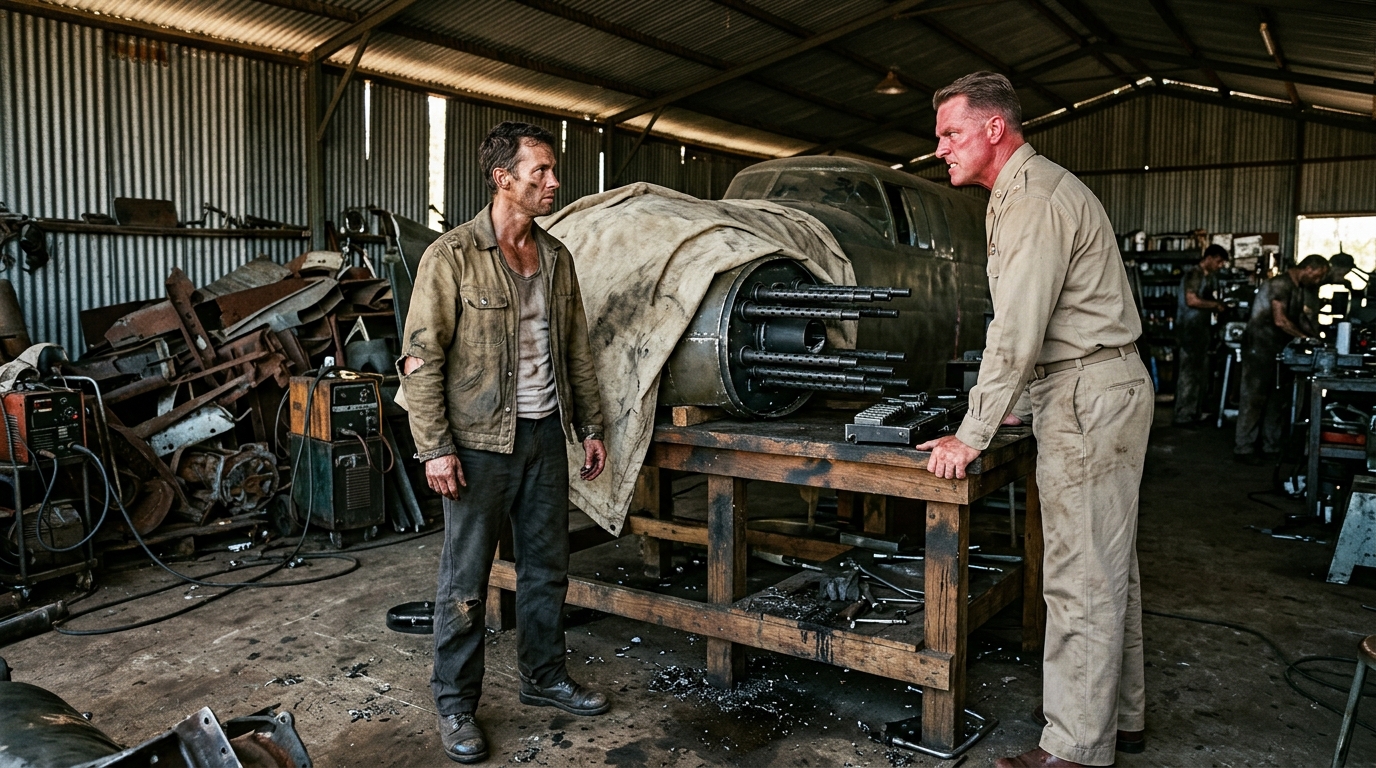
Jack threw a dirty canvas tarp over the exposed nose assembly, but the eight long barrels poked out from beneath the gray cloth like the snout of some mechanical beast refusing to be hidden.
The latch gave a sharp metallic snap, and the door swung wide to let in a harsh wedge of Queensland sunlight.
Colonel Vance stepped into the dim interior of the hangar, his boots clicking sharply on the oil-stained concrete as he surveyed the clutter of discarded metal and welding torches.
“Major Gunn,” Vance said, his voice clipped and flat, carrying the absolute authority of a man who spent his entire career memorizing field manuals that never smelled gunpowder. “What in God’s name is happening to this aircraft?”
“We’re fixing a design flaw, Colonel,” I said, wiping my palms on my trousers and keeping my posture steady.
“You’re dismantling a standard B-25 Medium Bomber without a shred of authorization from theater command,” Vance snapped, stepping past the workbench and yanking the canvas tarp back with a swift, angry motion.
His eyes locked onto the crowded bank of eight machine guns jammed into the nose where a bombardier belonged.
A muscle twitched in his jaw as he stared at the crude, hand-welded reinforcement plates we had hammered into place out of salvaged fuselage panels.
“This is gross insubordination, Major,” Vance continued, his voice rising as he turned to face me directly. “The manual specifies high-altitude bombing runs with standard optical sights. You’ve turned a multi-million-dollar government asset into a flying scrap-heap.”
“The manuals are getting our boys killed over New Guinea every single week because the enemy knows how to dodge high-altitude drops,” I said, stepping closer without yielding an inch of floor space.
Vance’s face flushed a deep, angry crimson, his hand coming down hard to slap the edge of the workbench with a sharp crack.
“I don’t care about your tactical theories, Gunn—consider this hangar officially locked down under direct orders from headquarters.”
CHAPTER 4: THE MIDNIGHT TEST RUN
The tropical rain hammered down on the corrugated iron roof like a rolling drumline, drowning out the sound of our boots on the wet concrete.
Jack slid a heavy iron wedge beneath the side access panel, lifting the warped metal just enough to slip a greased shoulder through the gap.
“If Vance left a runner outside, we’re finished,” Jack whispered, wiping rainwater out of his eyes as he dropped onto the inner floor.
“Vance is dry and warm in his quarters three miles away,” I muttered, flicking on a shielded flashlight and aiming its dim yellow beam straight at the nose of the modified bomber.
The canvas tarp lay crumpled in the corner where the colonel had thrown it, exposing the heavy cluster of eight machine guns bolted awkwardly into the frame.
The hairline fracture we spotted earlier on the eighth mount caught the faint glare of the flashlight, looking like a jagged scar across the dark steel.
Without official blueprints or supply line support, we had to rely on raw friction and guesswork to see if the welds would hold under actual ignition pressure.
I climbed up the aluminum ladder into the cramped cockpit, my boots sliding slightly on the wet metal rungs.
“Run the primer pump, Jack,” I called out, my voice tight against the roar of the storm outside.
The starboard engine coughed once, sputtered a cloud of unburned exhaust into the humid air, and then caught with a deep, rhythmic roar that shook the entire hangar frame.
I gripped the control yoke, my knuckles white as I felt the raw vibration of the engines humming through the floorboards.
If this frame failed during a live firing run over the open water, the whole nose would shear right off at three hundred miles per hour.
Jack stood below in the beam of the flashlight, holding up a spare roll of zinc wire with a grim look on his face.
“The weld’s going to snap the second you pull that trigger, Major,” Jack shouted over the rising whine of the turbines.
CHAPTER 5: THE BISMARCK APPROACH
The runway lights blurred into pale streaks through the streaming rain on the cockpit glass as I pushed the throttles all the way forward.
The modified B-25 shuddered violently from nose to tail, the extra weight of the eight heavy machine guns straining against the wing spars as we lifted off the mud.
Jack sat in the jump seat beside me, his hands braced tightly against the instrument panel as the altimeter ticked past fifty feet.
“Keep her low,” Jack shouted over the roar of the twin radial engines. “If we pop up on radar now, Vance’s desk-jockeys will have the interceptors on our tail before we clear the headland.”
I gripped the heavy control yoke, dipping the nose back down until the propeller tips were almost skimming the whitecaps rolling across the Bismarck Sea.
The sea spray hit the glass in thick sheets, reducing visibility to a gray blur where the horizon vanished entirely.
We had no official flight plan, no high-altitude escort, and no permission from headquarters to fly this low-level profile directly into an enemy formation.
Every rule in the tactical manual told us to stay high and drop bombs from a safe distance where the anti-aircraft umbrellas could be easily dodged.
Instead, we were skimming the wave-tops with eight forward-facing guns loaded and cocked, heading straight into the path of an enemy transport fleet carrying six thousand soldiers.
“Ten miles to the contact zone,” Jack called out, tapping the navigator’s chart with a grease-stained finger.
I checked the fuel gauges and felt the cold bite of the control wheel against my palms.
There was no turning back now, and no friendly supply chain to bail us out if the makeshift mounts sheared apart under the first recoil burst.
CHAPTER 6: THE FIFTEENMINUTE COLLAPSE
The corrugated bridge plating of the lead enemy destroyer filled our windshield in a sudden, blinding flash of gray steel.
I squeezed the butterfly trigger down all the way, feeling the fierce, simultaneous kick of eight heavy machine guns shaking the entire nose frame right down to my boot soles.
Tracer rounds converged in a solid, blinding beam right across the enemy bridge windows, shattering the glass inward before the sound of the firing even reached our ears.
Jack braced his shoulder against the instrument housing, feeding the link belts through the jammed tray as the air inside the cockpit filled with the sharp stench of cordite and hot brass.
“Keep her steady on the axis!” Jack yelled, his face slick with sweat.
The enemy gun crews scrambled frantically toward their deck cannons, but the heavy armor-piercing streams tore through their shields like wet paper before they could elevate a single barrel.
We held our low-level approach right down to the wave-tops, dropping our skip bombs just short of the waterline where the hull plates were thinnest.
The heavy explosive charges bounced once across the whitecaps and slammed straight into the engine rooms below the water line.
Secondary explosions ripped through the enemy vessel, tearing its formation apart and halting the entire resupply line in less fifteen minutes of brutal, unyielding friction.
There were no official blueprints or supply officers here to tell us we couldn’t do it, only the raw weight of common-sense engineering against an obsolete dogma.
The burning hulls sank slowly beneath the gray swells, leaving an empty horizon where an empire’s fleet had tried to pass.