The Weight of Silence: A Journey Through the Echo of a Repaired Heart and Forgiven Legacy
CHAPTER 1: The Threshold of Dust
The air inside the garage tasted of cold concrete and the lingering, metallic ghost of eight years of dormancy. Harlan sat in his leather chair, the kind of seat that commanded a room, but today, the space felt too large. He wasn’t watching his collection; he was watching the man standing before the workbench.
Hank. That was the name, passed down like a whispered secret through intermediaries who didn’t know the gravity of what they were carrying. He was wearing boots that had walked through more grime than Harlan’s entire fleet of restored muscle cars would ever touch. A Hells Angels patch rested on his back, not as a billboard, but as a quiet, heavy assertion of belonging to a code that couldn’t be bought with a wire transfer.
“Twelve men,” Harlan said, his voice hitting the high ceilings and falling flat. He was trying to summon his usual dominance, the laugh already coiled in his chest, ready to dismiss the intruder. “Engineers. Specialists. Men who trade in precision.”
Hank didn’t look at him. He was crouching, his fingers tracing the edge of the 1968 big block. It was a hunk of dead iron, frozen in time, its pistons seized by neglect. He ran a thumb over a jagged bit of casting, a movement so slow it felt like a caress.
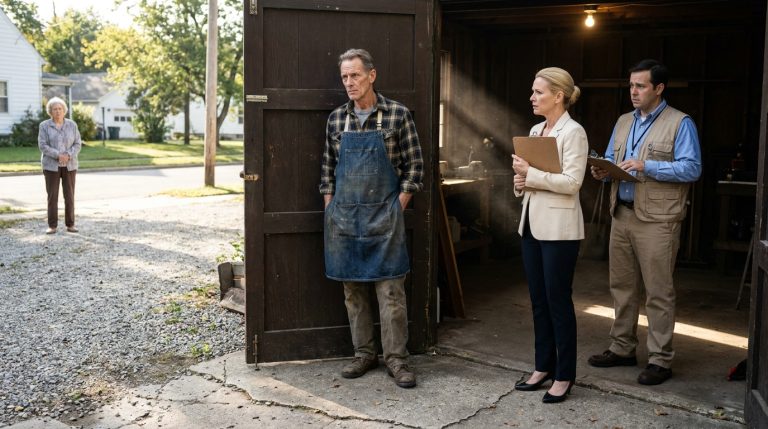
[V-1] Tucked into the corner of the workbench, beneath a heavy tarp, a flash of white caught Harlan’s eye—a corner of an old photograph, exposed by Hank’s deliberate, unhurried movements. It looked frayed, the edges curled by years of heat and cold. It wasn’t one of his. He hadn’t put it there.
“Are you even listening?” Harlan stood up, his polished oxfords clicking against the concrete. “I said, this engine has been a tomb for eight years. You’re the thirteenth attempt. The cost of failure is quite high when you consider the time you’re wasting.”
Hank finally stood. He was shorter than Harlan, but he occupied the space with a physical density that made the room feel as though the oxygen had been vacuumed out. He didn’t smile. He didn’t flinch. He just looked at Harlan with eyes that saw through the suits and the ego, seeing instead the flickering doubt Harlan tried to hide behind a high-net-worth smile.
“I’m not here for the time,” Hank said. His voice was a low hum, stripped of pretense. “I’m here for the block.”
Harlan’s laugh started, but it didn’t travel far. It died in the quiet of the garage, suffocated by the way Hank reached into his bag, pulling out a tool that looked like it had been tempered in a fire long ago. There was no arrogance in it, no performance—only the heavy, inevitable weight of a man who had already decided exactly how this story would end.
CHAPTER 2: The Geometry of Silence
The air in the garage had grown heavy, the kind of stillness that settles in a room when the power dynamics shift without a single word being shouted. Harlan stood near the workbench, his fingers drumming a nervous, erratic rhythm against the edge of his tailored trousers. It was a tell—a small, involuntary betrayer of the composure he had spent nineteen years refining. He looked at the engine, then at Hank, and for the first time in two decades, he looked like a man trying to read a map in a language he had never learned to speak.
Hank didn’t move. He stood over the block, his shoulders relaxed, his hands tucked into his pockets. The silence stretched, long and thin, like a wire pulled to its breaking point. To Harlan, this wasn’t just a mechanic refusing to be intimidated; it was a fundamental disruption of his reality. He was used to transactions. He was used to people who had a price, or at least a fear, that could be negotiated.
Hank shifted his weight, his boots scraping softly against the polished concrete. The sound was amplified, echoing off the rows of pristine, silent cars that lined the walls. He wasn’t looking at Harlan anymore. He was staring at the engine, but his eyes were unfocused, glazed by a sudden, sharp memory. [V-2] He saw it clearly—a gear assembly from a different time, a different place, ground into dust by a machine much larger and colder than this one. The ghost of that memory sat in the center of the garage, a phantom weight that he felt in his own chest, an intrusive reminder of why he was standing in this climate-controlled tomb in the first place.
“You think this is a game,” Hank finally said. His voice was steady, devoid of the jagged edges of irritation. It was simply a statement of fact.
Harlan blinked, his posture stiffening. “I think you’re a man who doesn’t understand what he’s walking away from. You talk about codes and loyalty, but you’re standing in a room full of results.” He gestured vaguely at the gleaming classics, the paint jobs that shimmered under the high-intensity lights. “This isn’t just metal, Hank. This is proof. Proof that if you’re smart enough and disciplined enough, you can control the outcome of anything.”
Hank turned his head slowly, looking at the billionaire. The sunlight filtering through the high, reinforced windows caught the dust motes dancing between them, turning the air into a shimmering, faded tapestry. “Control is an illusion you buy to keep the quiet out,” Hank murmured. “But you can’t buy the patience it takes to fix what’s broken. You can only earn it.”
He turned back to the workbench and, with a precision that bordered on surgical, reached for a set of rusted tools he had pulled from his bag. They looked like artifacts—oily, stained, and worn by years of honest labor. He laid them out in a pattern that made no sense to Harlan, a specific geometry of iron and grease.
Harlan watched, his breath hitching. He wanted to say something, to offer more money, to demand an explanation, but the sheer, deliberate indifference of the man’s movements anchored him to the spot. It was as if Hank were operating on a frequency that Harlan couldn’t reach, and the frustration of that distance was a physical ache in his throat.
“Douglas,” Harlan called out, his voice sharper than he intended.
Douglas, who had been lingering in the shadows near the back wall, stepped forward. He had been watching the exchange with the quiet intensity of a man who knew a storm was forming on the horizon. “Yes, sir?”
“Give him whatever he needs. Don’t ask questions. Just… let him work.”
Harlan turned and walked toward the side door, his footsteps sounding brittle and hollow against the concrete. He didn’t look back. As the heavy steel door swung shut, sealing him away from the garage, the silence returned—but this time, it was different. It was the silence of something starting to move.
Hank picked up a wrench, the metal cool and familiar in his grip. He leaned over the 1968 big block, his movements fluid, unhurried, and deeply intentional. He was no longer just a mechanic in a billionaire’s garage; he was an architect, and he had just begun to dismantle the foundation of Harlan’s world, one bolt at a time. He felt the cold iron, the texture of the past resisting his touch, and he knew that beneath the rust and the failure, the heart of the machine was waiting for the right hand to wake it up.
CHAPTER 3: The Ghost in the Files
Harlan’s stride was uncharacteristically jagged as he crossed the twelve acres between the garage and the main house. The morning sun, usually a source of comfort, now felt clinical, exposing the weathered textures of the estate’s outer walls. Every step away from the garage felt like a retreat, yet the alternative—staying there under the calm, unblinking gaze of a man who didn’t seem to exist by Harlan’s rules—was unbearable. He reached his private study, a room where the air was always filtered, cool, and perpetually smelled of expensive leather and old obligations.
He didn’t turn on the lights. He didn’t need them. He knew the location of every mahogany cabinet and every ledger. Harlan walked to his desk, sinking into the chair that had been the seat of his power for nineteen years. He sat there for a long time, listening to the muffled, rhythmic hum of the house, his heart still echoing the silence of the garage.
He had intended to call his broker, to run through the morning’s numbers and drown the memory of Hank’s indifference in the safety of growth and dividend reports. Instead, his hand drifted to the bottom drawer of his desk. He hadn’t opened it in years. He pulled it wide, the drawer sliding on perfectly oiled tracks, and there it was—a thin, black file folder that felt lighter than it should have, given the weight of the history it contained.
[V-1] Tucked into the front of the file was a photograph he had forgotten he possessed. It was a polaroid, the colors faded to a sickly, sepia-toned yellow. It showed a man standing in front of a small, nondescript workshop—the same man whose gaze he had encountered in Hank, or perhaps the man whose ghost now haunted his own garage. Harlan’s breath hitched. He had spent decades ensuring that this particular chapter of his early business career remained buried in the noise of his success, yet here it was, staring back at him from the dark.
He flipped through the documents. They were bank statements, property seizures, and legal notices, all signed in his own younger, more aggressive hand. He had been so proud of these maneuvers back then, viewing them as the brilliant tactical plays of a rising empire. Now, they read like the autopsy report of a life he had dismantled without a second thought.
Harlan felt a cold trickle of sweat slide down his neck. The logic of his success, the belief that he was building something permanent, suddenly felt like a house of cards. He looked at the file, then back toward the window that faced the direction of the garage. Somewhere out there, three miles away, a man who didn’t care for money was breathing life back into a machine that was supposed to have stayed dead.
The coincidence was too precise. The timing was too sharp. He stood up and paced the study, his footsteps muffled by the heavy rug. If this wasn’t an accident, if Hank had been sent here—or had come here by design—then the price of fixing the engine wasn’t just a garage. It was an accounting.
Harlan reached for the phone, his finger hovering over the speed dial for Douglas. He stopped. If he called Douglas, he was acknowledging that he was afraid. He was acknowledging that he couldn’t control the narrative. For the first time, he realized that he had been so focused on the threat of the mechanic that he hadn’t noticed the threat of the past.
He sat back down, the black file splayed across the mahogany surface. He began to read. He read until the light in the room shifted from morning brightness to the long, orange shadows of late afternoon. He read until the name of the man he had ruined decades ago finally took root in his mind again, forcing him to see that his entire empire, his forty cars, and his climate-controlled garage were built on the broken foundation of someone else’s life.
He realized then that the engine wasn’t a test. It was a mirror. And if the engine started to run, if the past finally found its voice, Harlan didn’t know if the walls he had built around himself would be strong enough to keep the truth from burning it all down. He stared at the faded polaroid, the image of the man standing in front of the workshop blurred, yet strangely accusing. He reached out and touched the photograph, his hand shaking just enough to notice. The silence in the house, once his constant companion, was now crowded with the phantom sounds of a life he thought he had successfully outrun.
CHAPTER 4: The Sound of the Cage Cracking
The hum that had defined the garage for nearly two decades—the low, constant vibration of climate control and industrial lighting—simply stopped. It didn’t stutter or fade; it vanished, replaced by a silence so sudden it felt like a physical blow. The high-intensity lights flickered, casting erratic, frantic shadows across the muscle cars, and then gave up entirely.
Hank was under the engine block when the darkness hit. He didn’t scramble. He didn’t gasp. He remained perfectly still, his hand resting on a cold piece of iron, letting his eyes adjust to the absence of light. Outside, in the main house, Harlan surged to his feet, the folder of his own sins spilling from his lap onto the rug. He stood in his study, heart hammering against his ribs, watching through the floor-to-ceiling windows as his empire retreated into shadow. The estate, usually a beacon of perfectly curated order, looked like a graveyard of steel in the moonlight.
Hank reached for his flashlight, the click of the switch sounding like a gunshot in the deadened air. He didn’t move toward the door. He moved toward the circuit breaker on the far wall, his boots steady on the concrete. [V-3] As he pulled the panel cover, the smell of ozone hit him—a sharp, stinging reminder that even the most meticulously maintained systems have a breaking point. A line had surged, a fail-safe triggered, but it wasn’t a random event. The wiring looked brittle, compromised by a surge that shouldn’t have been possible.
He knew who was coming. He could feel it in the way the air shifted, in the heavy, rhythmic tread of footsteps on the gravel outside.
Harlan arrived at the garage door, his breath coming in short, uneven bursts. He held a high-powered beam of his own, the light cutting through the dark like a blade. He didn’t have a weapon, only the sheer, desperate need to see. When the light hit the back of the garage, it illuminated Hank standing by the open breaker box, the dim, yellow glow of his flashlight washing over his face. He looked calm—so calm it was almost predatory.
“Why?” Harlan’s voice cracked, losing its rehearsed, billionaire-smooth veneer. “You could have walked away. You could have taken the money, the garage, the life I offered. Why are you digging this up?”
Hank stepped away from the panel, his shadow stretching long and distorted against the pristine rows of cars. He didn’t shout. He didn’t offer a dramatic rebuttal. He simply walked toward the workbench and picked up the photograph that had been left there—the one Harlan had been staring at in his study, though he hadn’t realized he’d dropped it near the engine while working. Hank held it up in the beam of Harlan’s light.
“You don’t remember the name, do you?” Hank asked. His voice was soft, an echo of a ghost. “You only remember the profit margins. You only remember the ‘brilliant’ maneuvers.”
Harlan’s light wavered. The beam danced across the floor, reflecting off the chrome bumpers of the cars he had spent a lifetime collecting. “I built this,” he whispered, though the certainty was leaking out of him. “I earned every bit of this.”
“You built a cage,” Hank corrected. He didn’t move toward him. He stayed in the center of the dark, a man who had already surrendered everything and therefore had nothing left to lose. “And you spent forty years wondering why you were never satisfied. It’s because the person you stepped on to get here didn’t just lose his business, Harlan. He lost his reason for being. And you did it for a ledger entry.”
The intensity in the garage was suffocating. Harlan felt the edges of his world fraying, the very concrete beneath his feet feeling unsteady. He looked at the cars—his trophies—and for the first time, he saw them not as masterpieces of design, but as expensive distractions. The realization didn’t come as a lightning strike; it came as a slow, agonizing erosion of his identity.
Hank reached out, his hand steady as he placed the photograph back on the workbench. “The engine isn’t broken, Harlan. You are. And the only way to fix it is to stop pretending the past didn’t happen.”
Harlan wanted to retort, to tell him that business was business, that the weak always lose to the strong—but the words felt like ash in his mouth. He looked at the mechanic, the man with the patch and the grease-stained hands, and realized with a sickening clarity that Hank wasn’t here to win. He was here to witness. And that, more than anything, was the most terrifying thing a man like Harlan could ever encounter.
CHAPTER 5: The Resurrected Debt
The engine roared to life. It wasn’t the tentative cough of a machine that had been coaxed into obedience; it was a thunderous, rolling declaration of presence that vibrated through the steel workbench and into the concrete floor. Hank stood back, his hands wiped clean on a rag, watching the heavy, cast-iron block shudder with a life that had been denied for eight long years.
Harlan remained by the garage door, his flashlight beam trembling as it tracked the frantic movement of the fan belt. The sound was deafening, filling the sterile, climate-controlled space with the raw, unfiltered noise of the past. To Harlan, it was the sound of his own ruin. Every piston strike felt like a hammer blow against the glass house he had spent two decades constructing.
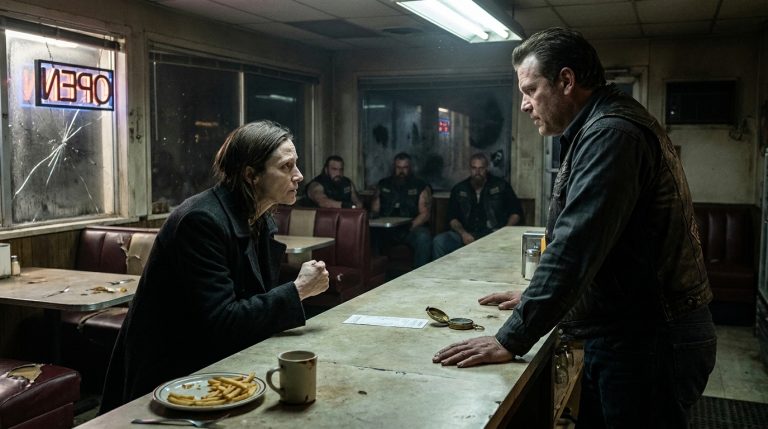
[V-4] He watched Hank move around the engine, adjusting a valve with a precision that bordered on the ritualistic, and for a fleeting, terrifying second, Harlan wondered if the man even was a mechanic. The way he moved, the way he occupied the space, the sheer lack of fatigue—it felt more like an erasure. He was wiping the slate clean. Harlan’s mind, usually his sharpest tool, began to spiral. Was this a setup? A long-game extortion? The paranoia was a cold, slick surface he couldn’t get his footing on.
“It runs,” Hank said, his voice barely audible over the thrumming, yet it cut through the din with total clarity. He shut off the ignition. The engine died instantly, leaving a silence that was even more profound than the one before.
Harlan stepped forward, his boots clicking on the floor. He wanted to scream, to demand that the engine be dismantled, to reclaim his ignorance. But the folder of papers he had read in his study was still burned into his vision. The bank statements, the seized property—the name of the man he had dismantled, a man whose workshop had been the origin of his first real fortune—it all connected now.
“I remember him,” Harlan whispered, the confession feeling like a physical weight leaving his lungs. “The name. The shop. I didn’t connect it to you until… until I saw you standing in the dark.”
Hank didn’t look at him. He began packing his tools, the heavy steel of the wrenches clinking against the canvas bag. “He was a good man, Harlan. He didn’t know how to play the game you were inventing. He just knew how to build.”
“And you?” Harlan asked, his voice raw. “What are you? You didn’t come here to kill me. You didn’t even take the money.”
Hank stopped, his hand resting on the bag. He turned, and in the dim, fading light of the garage, his expression was entirely unreadable. “I came to show you that you never actually owned any of this. You were just renting it from the people you ruined. The garage, the cars, the silence—it was all borrowed against a debt you thought you’d already paid off.”
Harlan leaned against the workbench, the cold metal biting into his palms. He felt a strange, terrifying sense of liberation. The fight was over. He had tried to outmaneuver the past, and the past had simply walked through the front door and finished the job.
“The shelters,” Harlan said, his voice barely a murmur. “The meal programs. That wasn’t just a request.”
“It was an installment,” Hank replied, swinging the bag over his shoulder.
He walked toward the exit, his boots hitting the concrete with a finality that echoed in the vast, empty space. He didn’t look back at the cars. He didn’t look back at the engine. He reached the door and paused, his hand on the frame.
“The engine is fixed, Harlan. But the garage belongs to the history you tried to bury. I’m done here.”
Harlan stood alone in the center of the garage, the smell of burnt oil and ozone clinging to his clothes. He looked around at the rows of pristine, silent muscle cars, and for the first time in nineteen years, he saw them for what they were: steel, glass, and rubber. They were empty. Everything was empty. He pulled out his phone, his thumb hovering over Douglas’s number, but he didn’t press call. There was nothing left to coordinate. The ledger was balanced, and all that remained was the quiet, unbearable truth of his own making.
CHAPTER 6: The Unfolding Horizon
Harlan did not sleep. When the sun began to bleed across the horizon, casting long, bruised light over the twelve acres of his estate, he was still standing in the garage, his hand resting on the cooling metal of the workbench. The cars were no longer trophies; they were remnants of a man he didn’t recognize. He looked at the 1968 engine, its block now warm from its brief, defiant resurrection. It sat there, a testament to the fact that something broken could, with the right hands, be restored—but it also served as a sharp reminder that the process of fixing it required more than just labor. It required an admission of what had been shattered in the first place.
He walked out of the garage, the gravel crunching beneath his feet with a sound that felt entirely too loud in the morning stillness. He didn’t call for his driver. He didn’t check his emails. For the first time in nineteen years, he simply moved through the world as a man, not an institution. He drove his own car—a nondescript sedan that had sat at the back of the collection for years—out of the gate and onto the road that led toward the edge of the city.
He found the rented shop exactly where Douglas had told him it would be. It was a modest, gray-sided structure wedged between a warehouse and an abandoned print shop. The signage was minimal, nothing like the polished, climate-controlled theater of his own estate. Harlan parked and sat for a moment, watching the morning light catch the dust motes dancing in the shop’s single, high window.
Hank was there, already working on the frame of a vintage motorcycle. He wore the same jeans, the same boots, and the same quiet intensity that Harlan had first encountered in his own garage. Harlan stepped out of the car, the air cool and biting against his face. He walked to the threshold, his footsteps hesitant, lacking the practiced, authoritative rhythm he had always carried.
Hank looked up. He didn’t look surprised to see him. He looked like a man who had been expecting a conversation that was a long time coming. He wiped his hands on a rag and set his wrench aside. The silence that stretched between them wasn’t the heavy, suffocating silence of the garage; it was the quiet of an open door.
“You came,” Hank said.
“I had to,” Harlan replied. His voice was steady, though he felt a profound, aching vulnerability in the simple act of admitting it. He looked around the shop, noticing the tools—they were the same ones Hank had used on the big block, marked by years of use, honest and worn. “I read the files. I know who you are. I know about the shop on 4th Street. The man you call father.”
Hank didn’t flinch. The acknowledgment of his history didn’t change the set of his jaw, but the tension in his shoulders seemed to dissipate, replaced by a weary, human grace. “He never hated you, Harlan. He just missed the work. He missed the life he’d built before it was taken.”
“I took it,” Harlan said, the words heavy and final. “I thought I was winning. I didn’t understand that by winning, I was just narrowing my own world until there was nothing left to stand on.”
He reached into his jacket pocket and pulled out a check—not the large, anonymous donations he had been writing, but a personal one, written for the shop, for the future, for the act of restoration that he finally understood. He placed it on the workbench, right next to the motorcycle frame. It wasn’t a bribe; it was an acknowledgment of a debt he could never fully settle, but could at least begin to honor.
Hank looked at the check, then back at Harlan. There was no triumph in his eyes, only a quiet, settling peace. He picked up the wrench he had been using, his fingers tracing the handle. “The engine is just metal, Harlan. It’s what you do with the time it gives you that counts.”
Harlan looked down at the floor, at the oil stains and the scattered bits of hardware. He felt the weight of his empire—the boardrooms, the acquisitions, the relentless, hollow climb—falling away from his shoulders. It left him feeling exposed, but for the first time in his life, he felt light. He looked back at Hank, and in that moment, the barrier between them—the antagonist and the stranger—faded, leaving only two men in the quiet, dusty light of a working day.
Harlan walked to the shop’s small, cluttered desk, where a rusted, damaged component from an old transmission sat as a paperweight. He picked it up, feeling its weight, its jagged, broken edges. He turned it over in his hand, realizing that he had spent his entire life running from the broken things, only to realize that the repair was where the life actually happened. He placed it back down with deliberate care, aligning it with the edge of the desk.
“I’m done with the garage,” Harlan said. “I’m going to sell the property. Give the cars to museums, to people who will drive them. I don’t need them anymore.”
Hank nodded, a slow, understanding movement. He went back to the motorcycle, his hands finding their rhythm again. He didn’t offer a platitude; he offered the only thing he had—the work.
Harlan walked out into the morning, the air fresh and vibrant with the sounds of the city waking up. He stood by his car, looking back at the modest gray shop one last time. He felt the phantom weight of his old life dissolving, replaced by the uncertain, yet beautiful horizon of a day that was entirely his own. He realized that the engine hadn’t just been a test; it had been an invitation to stop and finally breathe. He turned the key in the ignition, the engine purring to life, and drove away, not toward an appointment or a board meeting, but simply into the quiet, unfolding potential of the rest of his life.